
Managed Mobile Phishing Protection Services Market Size and Share
Market Overview
| Study Period | 2027 - 2032 |
|---|---|
| Market Size (2027) | USD 0.9 Billion |
| Market Size (2032) | USD 2.45 Billion |
| Growth Rate (2027 - 2032) | 22.25 % |
| Fastest Growing Market | Asia-Pacific |
| Largest Market | North America |
| Market Concentration | Medium |
Major Players *Disclaimer: Major Players sorted in no particular order Image © Mordor Intelligence. Reuse requires attribution under CC BY 4.0. | |
Managed Mobile Phishing Protection Services Market Analysis by Mordor Intelligence
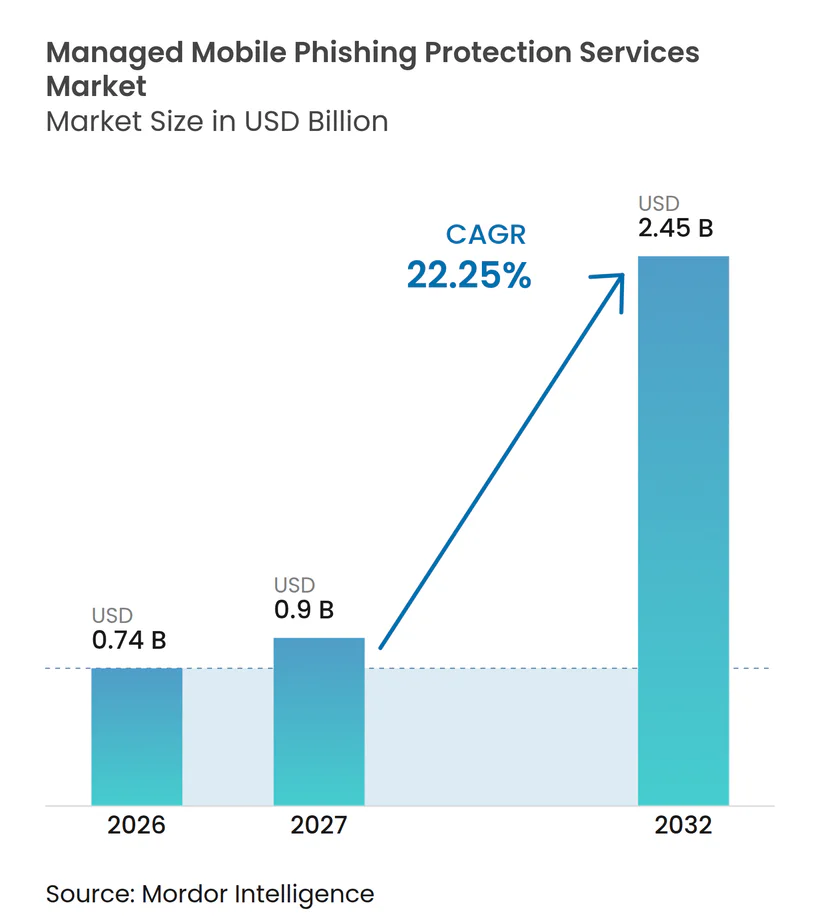
The managed mobile phishing protection services market size is projected to expand from USD 0.74 billion in 2026 to USD 2.45 billion by 2032, registering a CAGR of 22.25% between 2027 and 2032. Growth reflects the wider use of mobile devices as an entry point into corporate systems and the limits of tools that only manage devices. Organizations are moving toward managed contracts when they need continuous visibility, detection, and response across mobile fleets. The managed mobile phishing protection services market is also shaped by stricter requirements in government and other regulated settings, where active mobile threat defense is becoming part of device security expectations. Mobile phishing encounters on iOS devices are changing how enterprises protect executive and high-value users, who had often been covered through passive enrollment alone. Competition centers on specialist mobile defense capabilities, platform integration, managed delivery, and the ability to work within privacy and budget constraints.
Key Report Takeaways
- By delivery model, cloud-based solutions held 61.29% of the managed mobile phishing protection services market share in 2026, while hybrid delivery is projected to expand at a 23.61% CAGR through 2032.
- By operating system, Android held 45.66% revenue share in 2026, while iOS is projected to expand at a 23.36% CAGR through 2032.
- By organization size, large enterprises held 70.88% revenue share in 2026, while SMEs are projected to expand at a 23.88% CAGR through 2032.
- By end-user industry, BFSI held 27.44% revenue share in 2026, while government and public administration is projected to expand at a 22.76% CAGR through 2032.
Note: Market numbers in this report are based on Mordor Intelligence's proprietary estimation framework, which combines nine months of actuals with Q4 projections for base year 2026.
Market Trends and Insights
Drivers Impact Analysis of Managed Mobile Phishing Protection Services Market*
| Driver | (~) % Impact on CAGR Forecast | Geographic Relevance | Impact Timeline |
|---|---|---|---|
| Rising Mobile-First Attack Surface Across Enterprise Devices | +5.0% | Global | Short term (≤ 2 years) |
| BYOD and COPE Adoption Expanding Unmanaged Endpoints | +4.2% | Global, concentrated in North America and Europe | Medium term (2-4 years) |
| AI-Enhanced Smishing and QR Phishing Increasing Mobile Intrusion Risk | +3.5% | Global, peak exposure in Asia-Pacific and North America | Short term (≤ 2 years) |
| Zero-Trust Rollouts Pulling Mobile Devices Into Unified Policy Control | +3.0% | North America and Europe, spillover to Asia-Pacific | Medium term (2-4 years) |
| Cross-Channel Phishing Detection Gap Across SMS, Messaging, and Mobile Browsers | +2.5% | Global | Medium term (2-4 years) |
| MSP-Led Mobile Security Delivery Expanding Access Among SMEs | +2.0% | North America, early traction in Europe and Asia-Pacific | Long term (≥ 4 years) |
| Source: Mordor Intelligence | |||
Rising Mobile-First Attack Surface Across Enterprise Devices
Mobile devices have become a preferred initial access route into corporate systems rather than a secondary attack channel. Verizon reported in 2025 that 85% of organizations saw mobile attacks increase and 75% increased mobile security spending in response.[1] The supplied research also identifies stronger email filtering as a factor that can redirect attackers toward mobile channels, where detection coverage is still developing. This makes continuous mobile monitoring more relevant for security teams that have already strengthened their email defenses. The managed mobile phishing protection services market benefits when organizations recognize that device enrollment does not stop a user from opening a malicious text or browser link. Managed services can provide monitoring and response without requiring each customer to build a dedicated mobile security operation.
BYOD and COPE Adoption Expanding Unmanaged Endpoints
BYOD and company-owned, personally enabled policies expand the number of devices that can reach corporate systems. Personal-device use also creates a boundary between the security information an employer needs and the privacy employees expect. The managed mobile phishing protection services market is therefore supported by demand for controls that can work beside existing device management programs. Lookout reported that MDM and UEM tools do not fully prevent phishing exposure on common messaging platforms. This gap can persist even when a device is enrolled and receives standard policy controls. Providers that combine work-profile protection with managed detection may be better placed to address the remaining exposure.
AI-Enhanced Smishing and QR Phishing Increasing Mobile Intrusion Risk
Generative AI lowers the effort needed to create convincing mobile phishing messages at scale. Zimperium reported that phishing events on employee mobile devices rose 380% between January 2025 and mid-2026, while 86% of attacks contained AI-generated elements.[2] QR code attacks add a related concern because they can place a destination outside the text that a conventional filter examines. Palo Alto Networks Unit 42 tracked more than 11,000 malicious QR code detections per day in February 2026. An ACM study found that quishing could evade operational detectors as effectively as traditional phishing, while LLM-assisted variants produced victim visit rates above 30% in one enterprise cohort. The managed mobile phishing protection services market is supported by tools that can assess behavioral signals and identify threats that do not rely on a plainly visible malicious URL.
Zero-Trust Rollouts Pulling Mobile Devices Into Unified Policy Control
Zero-trust deployments make device condition a more direct part of access decisions. A device can meet enrollment requirements and still be compromised after a user opens a smishing link, so mobile risk signals matter to the access policy. DISA included active mobile threat defense applications in the Android 16 Security Technical Implementation Guide requirement described by Zimperium. This approach establishes a compliance precedent for government device environments and may influence contractors and other regulated organizations. Zscaler's April 2025 work with T-Mobile showed a move from traditional VPN access toward application-level access tied to device health.[3] These developments support a role for mobile phishing protection within broader identity, network access, and device-trust programs.
Restraints Impact Analysis of Managed Mobile Phishing Protection Services Market*
| Restraint | (~) % Impact on CAGR Forecast | Geographic Relevance | Impact Timeline |
|---|---|---|---|
| Privacy Pushback in BYOD-Heavy Deployments | -2.8% | Global, most acute in Europe and North America | Short term (≤ 2 years) |
| Overlap With MDM, UEM, and EDR Budgets Slowing Standalone Purchases | -2.0% | Global | Medium term (2-4 years) |
| Limited Security Telemetry on Consumer-Owned Devices | -1.2% | Global | Medium term (2-4 years) |
| Integration Friction With Legacy Identity and Mobile Fleet Tooling | -0.8% | Global | Long term (≥ 4 years) |
| Source: Mordor Intelligence | |||
Privacy Pushback in BYOD-Heavy Deployments
Employee concerns about behavioral telemetry can delay deployment on personal devices. Full device-management profiles may give IT teams visibility into personal applications, location history, or browsing patterns, which can make workers reluctant to enroll. GDPR and workplace-monitoring rules in Europe also require providers to limit the personal data they collect. The managed mobile phishing protection services market must address this constraint through designs that focus on work-context signals. Verizon found that 80% of organizations conducted employee smishing tests in 2025, while 39% of those organizations reported that up to half of employees clicked a malicious link in simulations. Containerized protection can reduce the privacy burden, but adoption remains uneven across enterprise groups.
Overlap With MDM, UEM, and EDR Budgets Slowing Standalone Purchases
Mobile phishing protection can compete for budget with existing MDM, UEM, and endpoint detection and response tools. Procurement teams may delay a separate contract when they believe an incumbent platform provides adequate coverage. This issue becomes more difficult when security teams operate several overlapping management platforms and must assess integrations before approving another service. The supplied research identifies standalone purchasing delays in accounts with multiple UEM tools, even when the underlying mobile risk is clear. The managed mobile phishing protection services market must therefore demonstrate how specialized detection complements, rather than duplicates, existing device-management and endpoint investments. Providers that connect into established identity, fleet-management, SIEM, SOAR, and XDR environments can reduce some of this purchasing friction.
*Our forecasts treat driver/restraint impacts as directional, not additive. The impact forecasts reflect baseline growth, mix effects, and variable interactions.
Managed Mobile Phishing Protection Services Market Segment Analysis
By Delivery Model:
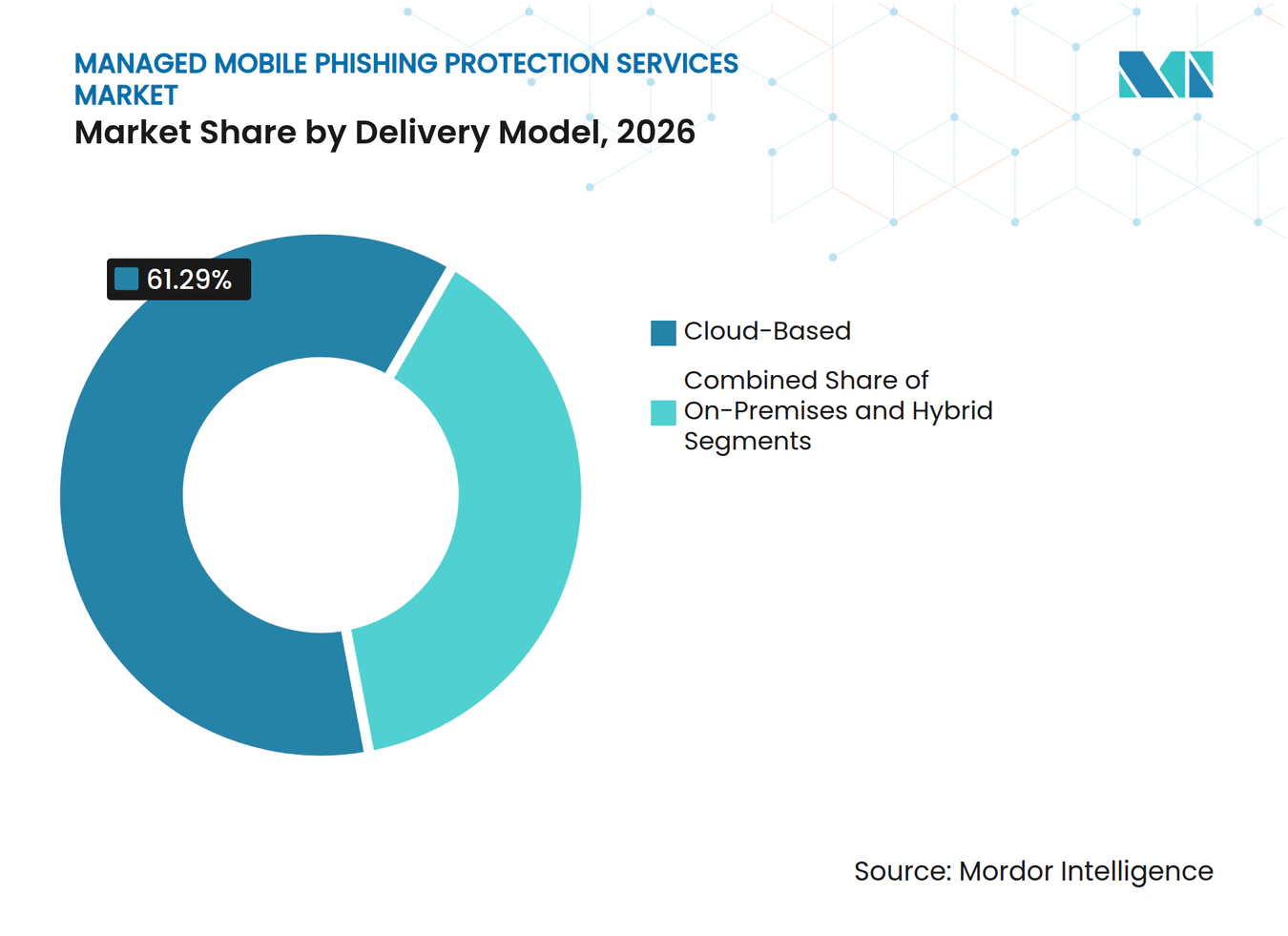
Cloud Delivery Leads While Hybrid Architecture Gains Ground In Regulated SettingsCloud-based delivery held 61.29% of the managed mobile phishing protection services market share in 2026. Enterprises favor subscription-based architectures that can scale across dispersed mobile fleets without maintaining local security infrastructure. The managed mobile phishing protection services market uses cloud delivery to support continuous threat-intelligence updates, which are important when phishing methods change quickly. MSPs can use multi-tenant cloud platforms to support several smaller customers with a common service structure. On-premises deployment retains relevance in defense and critical infrastructure, where data sovereignty can limit security telemetry sent to the cloud.
Hybrid delivery is projected to grow at a 23.61% CAGR through 2032, the fastest rate within the delivery model segmentation. This model combines local processing or control with cloud-sourced threat intelligence. It is suited to regulated organizations that must retain certain data in-country or within their own environment. Financial services and government users can apply this structure when data-residency requirements limit full cloud use. The managed mobile phishing protection services market can benefit from hybrid offers that preserve these controls without losing access to current threat information.



By Operating System:
Android Leads By Installed Base While iOS Gains From Targeted RiskAndroid accounted for 45.66% revenue share in 2026. The managed mobile phishing protection services market benefits from Android's large installed base in frontline deployments across manufacturing, logistics, and retail. The diversity of Android devices and patch levels can create uneven protection across a fleet. Zimperium reported in 2025 that more than 25% of mobile devices could not upgrade to the latest operating system versions. Managed monitoring can help security teams observe threats across these different device conditions.
The iOS segment is projected to expand at a 23.36% CAGR through 2032. Lookout found in its Q3 2025 research that iOS devices had higher phishing encounter rates than Android devices. The supplied draft links that pattern to the use of iOS devices by executives and other high-value enterprise users. Organizations are responding by shifting from passive iOS enrollment toward active threat monitoring. The managed mobile phishing protection services market can expand as security teams apply more active coverage to device groups they previously viewed as lower risk.
By Organization Size:
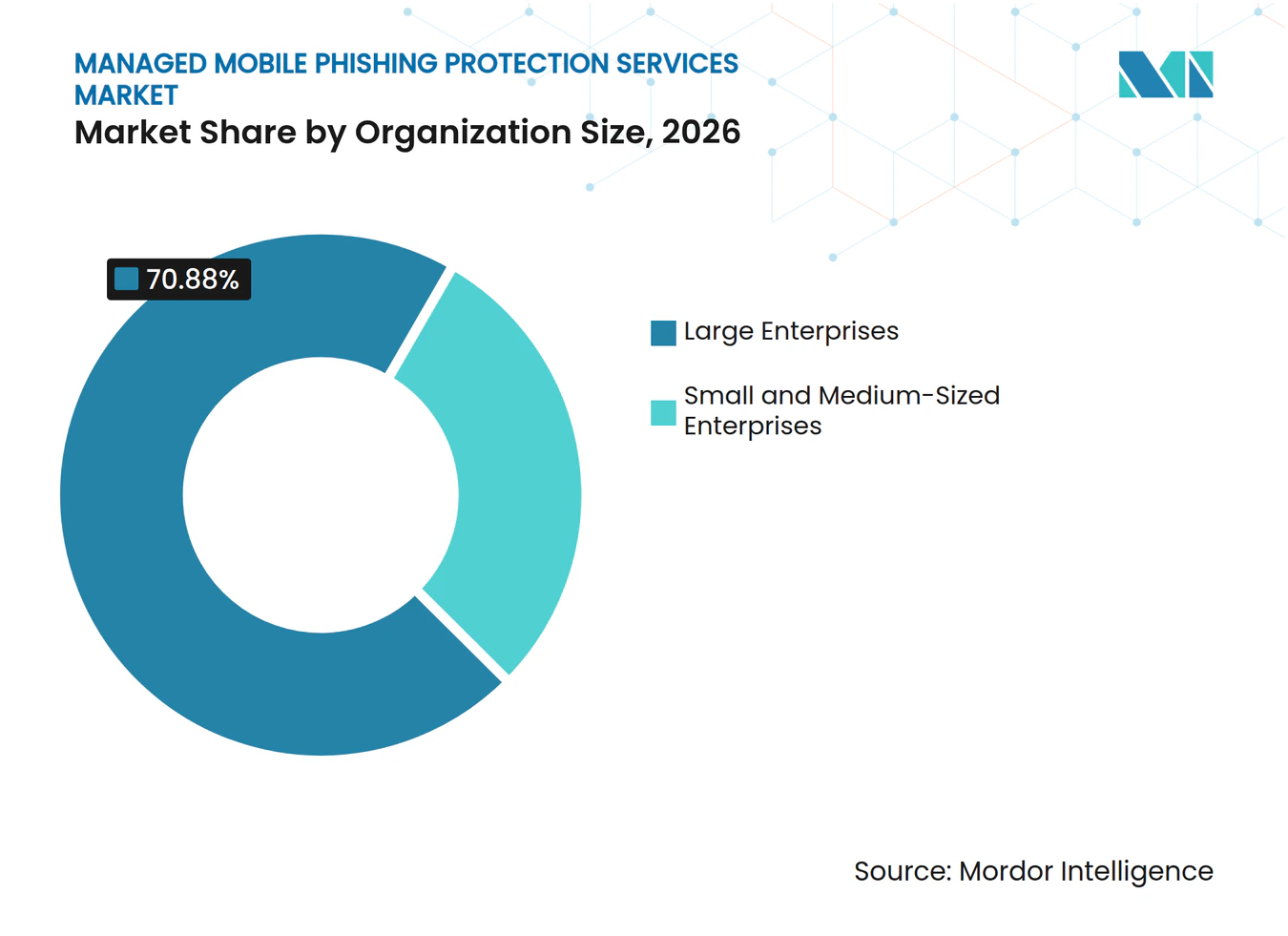
Large Enterprises Anchor Revenue While SMEs Expand Through Managed DeliveryLarge enterprises held 70.88% revenue share in 2026. The managed mobile phishing protection services market is anchored by large managed fleets, compliance obligations, and multiyear vendor agreements. Security teams in BFSI and healthcare often need mobile protection as part of wider controls for financial data and protected health information. These organizations also have the resources to integrate mobile signals with established security operations. Their purchasing decisions commonly emphasize compliance reporting, deployment scale, and connectivity with other control layers.
SMEs are projected to grow at a 23.88% CAGR through 2032, the highest rate by organization size. The supplied research attributes this growth to MSP-delivered subscriptions that reduce the need for internal specialist capacity. The managed mobile phishing protection services market can reach smaller organizations through monthly packages that combine phishing simulation, real-time monitoring, and incident response. Verizon reported that 57% of SMBs felt at a resource disadvantage in responding to cybersecurity incidents, and 54% said they had proportionally more to lose from a breach. SoSafe announced an MSP platform in June 2025 that was developed with more than 70 channel partners, illustrating investment in this route to smaller customers.

By End-User Industry:
BFSI Leads Revenue While Government Converts Policy Into DemandBFSI accounted for 27.44% revenue share in 2026. The managed mobile phishing protection services market addresses a financial-sector exposure to credential theft, fraud, and reputational harm from a successful mobile phishing attack. The segment also operates under detailed security and reporting obligations, which can favor ongoing managed protection. The supplied draft describes social engineering and mobile phishing as a prominent awareness focus for Italian banks. ABI reported that Italian banks planned cybersecurity spending of EUR 500 million, equivalent to USD 560 million, in 2026 and that 97% identified social engineering and mobile phishing as their primary awareness topic.
Government and public administration is projected to grow at a 22.76% CAGR through 2032. The DISA Android 16 mobile threat defense requirement converts an active-defense policy into a potential procurement requirement for government devices. The managed mobile phishing protection services industry also serves healthcare, IT and telecommunication, industrial manufacturing, retail and e-commerce, and energy and utilities. These industries face different compliance frameworks and workforce patterns, but each has a growing mobile exposure. This creates demand for services that can fit different operating models without removing sector-specific controls.
Geography Analysis
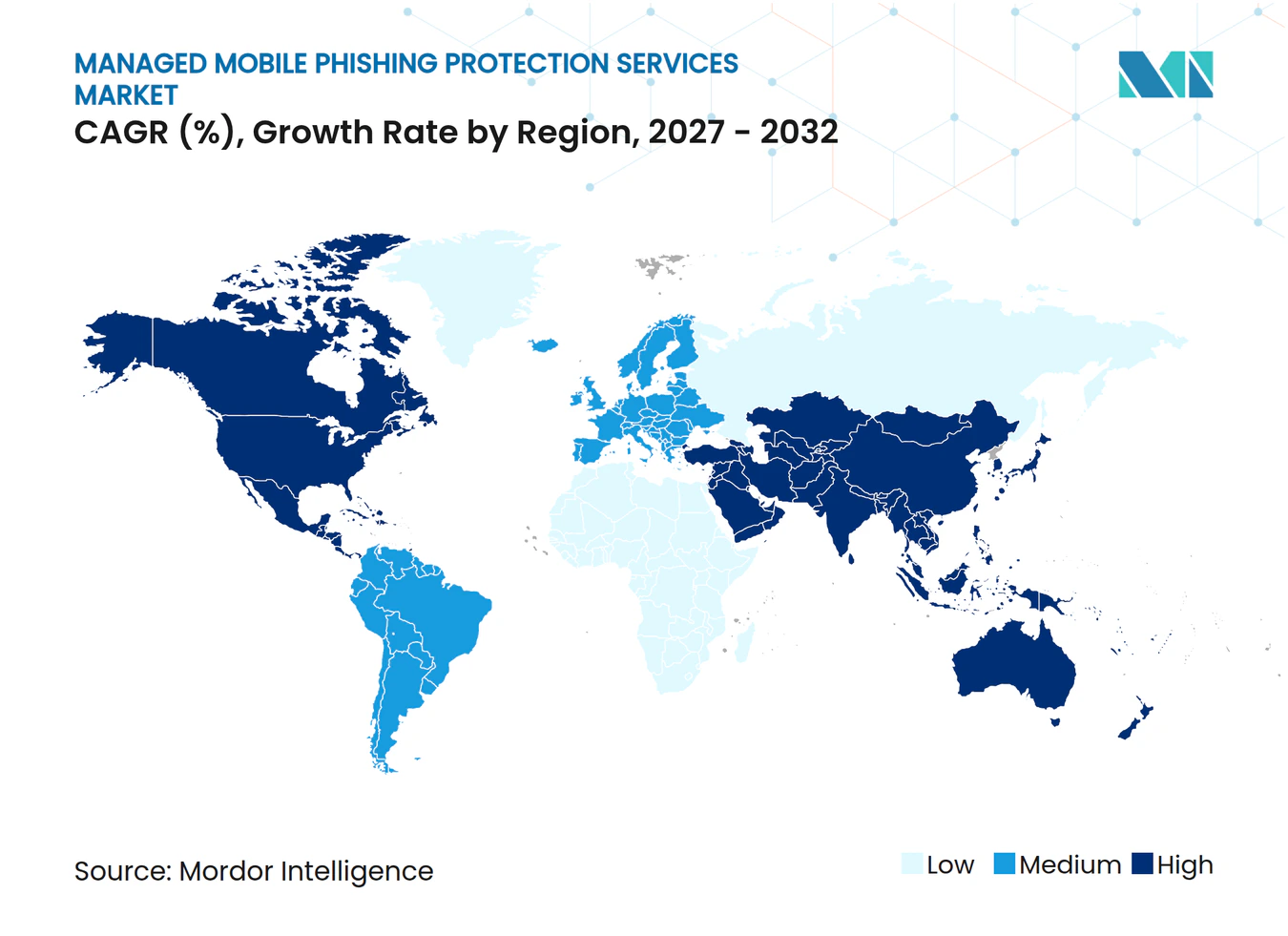
North America Managed Mobile Phishing Protection Services Market
North America held 38.21% revenue share in 2026. The managed mobile phishing protection services market is supported by the United States' developed MSP ecosystem, mobile-security guidance, and device-security requirements for government settings. Verizon reported that 80% of organizations conducted employee smishing tests in 2025. This practice can increase awareness of mobile threat exposure and the case for managed services. Canada and Mexico add demand through cross-border enterprise mobility programs and MSP packages.
Europe Managed Mobile Phishing Protection Services Market
Europe has a compliance-led demand pattern influenced by GDPR and the Digital Operational Resilience Act for financial entities. Germany, the United Kingdom, and France have a significant concentration of financial firms and government contractors with documented mobile security requirements. ABI reported that Italy's banking sector allocated 8% of total IT spending to cybersecurity in 2026. Employers need protection architectures that restrict telemetry to work-profile signals where privacy and labor rules limit device monitoring.
APAC, MEA and South America Managed Mobile Phishing Protection Services Market
Asia-Pacific is projected to record the fastest growth at a 23.05% CAGR through 2032. Enterprise digitization across India, South Korea, Japan, and China is increasing the importance of mobile security in daily operations. India's Department of Telecommunications reported that its Financial Fraud Risk Indicator had helped 34 banks and payment platforms flag high-risk mobile numbers, with cumulative fraud savings reaching INR 5,043 crore, equivalent to USD 600 million, by August 2026. The Middle East and Africa is expanding through digital-transformation spending in Saudi Arabia and the United Arab Emirates, while South Africa and Nigeria represent earlier mobile-first banking demand. South America remains at an earlier adoption stage, although Brazil's exposure to smishing is encouraging financial-sector interest in managed protection.
Competitive Landscape
Market Concentration
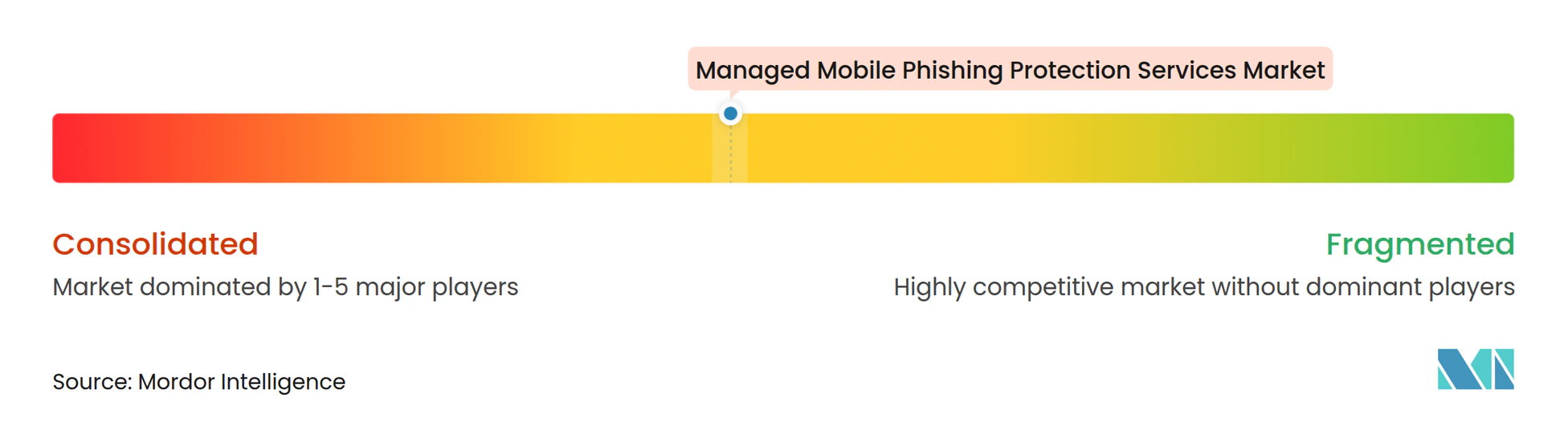
The managed mobile phishing protection services market is moderately fragmented, with specialist vendors and broader security platforms pursuing different positions. Lookout, Zimperium, and Pradeo compete through mobile threat-defense expertise, on-device telemetry, and the breadth of their integrations with other security tools. Broader endpoint providers, including Sophos, ESET, Bitdefender, F-Secure, WithSecure, Malwarebytes, and Kaspersky Lab, add mobile phishing capabilities to portfolios that customers may already buy for other endpoint needs. Their bundled pricing and established partner networks can appeal to buyers, while specialists differentiate through deeper mobile detection, mobile-specific response, and visibility beyond standard device-management controls.
Product strategy increasingly focuses on AI-based detection and faster investigation because phishing messages, call-based scams, and malicious applications can use different paths to the mobile device. Zimperium introduced its AI-Empowered Mobile Security Vision and Mobile SOC Agent in May 2026, with the stated aim of helping enterprise security operations teams investigate mobile threats. Lookout launched Smishing AI in September 2025 to evaluate SMS message intent and context rather than rely only on URLs or sender analysis. Lookout also introduced Mobile Intelligence APIs in January 2025 to support bidirectional integration of mobile security telemetry into SIEM, SOAR, and XDR platforms. These moves show how vendors are seeking a place in the wider security operations workflow, where mobile signals can be reviewed with events from other environments.
Channel partnerships are another route to market because customers often acquire mobile devices, management tools, and security services through connected suppliers. Samsung SDS Europe renewed its partnership with Pradeo in December 2025 to combine enterprise mobility management with mobile threat defense across Samsung Knox-based device fleets. Lookout's sale of its cloud security business to Fortra in 2025 also indicated a strategic focus on mobile security. The managed mobile phishing protection services market rewards vendors that can provide compliance-aligned reporting for ISO/IEC 27001 and DISA STIG-related requirements, while keeping reports useful for ordinary operational teams. Integration with device, identity, and network tools remains important because customers want to avoid creating another isolated control and want risk signals to inform the tools they already use.
Managed Mobile Phishing Protection Services Industry Leaders
-
Lookout, Inc.
-
Zimperium, Inc.
-
Pradeo Security Systems SAS
-
Guardsquare NV
-
Sophos Limited
- *Disclaimer: Major Players sorted in no particular order
Managed Mobile Phishing Protection Services Market Companies Covered in this Report
- Lookout, Inc.
- Zimperium, Inc.
- Pradeo Security Systems SAS
- Guardsquare NV
- F-Secure Oyj
- Sophos Limited
- ESET, spol. s r.o.
- Bitdefender SRL
- WithSecure Corporation
- Kaspersky Lab JSC
- Malwarebytes Corporation
- IRONSCALES Ltd.
- Cofense, Inc.
- Abnormal Security Corporation
- Mimecast Limited
- Proofpoint, Inc.
- Barracuda Networks, Inc.
- CellTrust Corporation
- ZecOps, Inc.
- Corrata Limited
Recent Industry Developments in Managed Mobile Phishing Protection Services Market
- May 2026: Zimperium unveiled its AI-Empowered Mobile Security Vision alongside two agentic AI products, Mobile SOC Agent for enterprise SOC teams investigating threats on employee devices, and Mobile App Response Agent for SOC and fraud teams assessing mobile app threats. The announcement positioned the approach as an AI-on-AI defense framework against generative-AI-powered mobile attacks.
- December 2025: Samsung SDS Europe renewed its strategic partnership with Pradeo for next-generation mobile security, combining Samsung SDS's Enterprise Mobility Management with Pradeo's Mobile Threat Defense to deliver integrated protection across Samsung Knox-based enterprise device fleets.
- September 2025: Lookout launched Smishing AI, the first AI-powered solution using large language models to evaluate SMS message intent and context, enabling detection of social engineering attacks that evade conventional mobile security tools reliant on URL or sender analysis.
- August 2025: India's Department of Telecommunications reported that 34 banks, financial institutions, and UPI service providers had integrated the Financial Fraud Risk Indicator, freezing over 10 lakh accounts linked to mobile-enabled financial fraud. The FRI was developed under DoT's Digital Intelligence Unit project with an INR 228 crore, approximately USD 27 million, budget.
Global Managed Mobile Phishing Protection Services Market Report Scope
The Managed Mobile Phishing Protection Services Market comprises outsourced security services that detect, prevent, monitor, and respond to phishing attacks targeting mobile devices and mobile communication channels. These services protect enterprise and user mobile environments from SMS phishing (smishing), messaging-based phishing, malicious links, mobile browser attacks, QR-code phishing, and other mobile-centric social engineering threats through continuous monitoring, threat detection, policy enforcement, threat intelligence, and incident response capabilities.
The Managed Mobile Phishing Protection Services Market Report is Segmented by Delivery Model (Cloud-Based, On-Premises, and Hybrid), Operating System (Android, iPhone Operating System (iOS), ChromeOS, and Other Operating Systems), Organization Size (Large Enterprises, and Small and Medium-Sized Enterprises), End-User Industry (Banking, Financial Services, and Insurance (BFSI), Government and Public Administration, Healthcare and Life Sciences, IT and Telecommunication, Industrial Manufacturing, Retail and E-commerce, Energy and Utilities, and Other End-User Industries), and Geography (North America, South America, Europe, Asia-Pacific, Middle East, and Africa). The Market Forecasts are Provided in Terms of Value (USD).
Segmentation Overview
| Cloud-Based |
| On-Premises |
| Hybrid |
| Android |
| iPhone Operating System (iOS) |
| ChromeOS |
| Other Operating Systems |
| Large Enterprises |
| Small and Medium-Sized Enterprises |
| Banking, Financial Services, and Insurance (BFSI) |
| Government and Public Administration |
| Healthcare and Life Sciences |
| IT and Telecommunication |
| Industrial Manufacturing |
| Retail and E-commerce |
| Energy and Utilities |
| Other End-User Industries |
| North America | United States |
| Canada | |
| Mexico | |
| South America | Brazil |
| Argentina | |
| Rest of South America | |
| Europe | Germany |
| United Kingdom | |
| France | |
| Italy | |
| Russia | |
| Rest of Europe | |
| Asia-Pacific | China |
| Japan | |
| India | |
| South Korea | |
| Rest of Asia-Pacific | |
| Middle East | Saudi Arabia |
| United Arab Emirates | |
| Rest of Middle East | |
| Africa | South Africa |
| Nigeria | |
| Rest of Africa |
| By Delivery Model | Cloud-Based | |
| On-Premises | ||
| Hybrid | ||
| By Operating System | Android | |
| iPhone Operating System (iOS) | ||
| ChromeOS | ||
| Other Operating Systems | ||
| By Organization Size | Large Enterprises | |
| Small and Medium-Sized Enterprises | ||
| By End-User Industry | Banking, Financial Services, and Insurance (BFSI) | |
| Government and Public Administration | ||
| Healthcare and Life Sciences | ||
| IT and Telecommunication | ||
| Industrial Manufacturing | ||
| Retail and E-commerce | ||
| Energy and Utilities | ||
| Other End-User Industries | ||
| By Geography | North America | United States |
| Canada | ||
| Mexico | ||
| South America | Brazil | |
| Argentina | ||
| Rest of South America | ||
| Europe | Germany | |
| United Kingdom | ||
| France | ||
| Italy | ||
| Russia | ||
| Rest of Europe | ||
| Asia-Pacific | China | |
| Japan | ||
| India | ||
| South Korea | ||
| Rest of Asia-Pacific | ||
| Middle East | Saudi Arabia | |
| United Arab Emirates | ||
| Rest of Middle East | ||
| Africa | South Africa | |
| Nigeria | ||
| Rest of Africa | ||
Key Questions Answered in the Report
What is the managed mobile phishing protection services market size?
The managed mobile phishing protection services market size is projected to increase from USD 0.74 billion in 2026 to USD 2.45 billion by 2032, at a 22.25% CAGR between 2027 and 2032. The estimate reflects rising demand for continuous monitoring, detection, and response across enterprise mobile devices.
What is driving demand for managed mobile phishing protection services?
Growing mobile attack exposure, BYOD use, AI-enhanced smishing, QR phishing, and zero-trust programs are increasing demand for continuous protection and response. The managed mobile phishing protection services market is also supported by organizations that need controls to work alongside device management without creating a separate manual review process.
Which delivery model leads managed mobile phishing protection services?
Cloud-based delivery leads with 61.29% share in 2026, while hybrid delivery is projected to grow at a 23.61% CAGR through 2032. Hybrid models appeal to regulated users that need local control while using cloud-based threat intelligence, while preserving data-handling practices required by their operating environment.
Which operating system is growing fastest in mobile phishing protection?
IOS is projected to grow at a 23.36% CAGR through 2032 as organizations increase protection for executive and high-value users. The managed mobile phishing protection services market is gaining from more active coverage of this device group, which organizations had often treated as lower risk.
Which end-user group has the largest share of spending?
BFSI held 27.44% share in 2026, supported by fraud exposure, regulatory obligations, and the impact of credential theft. Financial institutions also require reporting, managed response, and controls that support sensitive customer and transaction data.
Which region is projected to grow fastest through 2032?
Asia-Pacific is projected to grow at a 23.05% CAGR through 2032 as enterprise digitization raises the importance of mobile security across major economies. India, South Korea, Japan, and China are important contributors to this demand, with large enterprise mobile populations, expanding digital-service adoption, and more formal responses to financial fraud risks. This demand also reflects the scale of mobile banking and enterprise workforces across the region.