
Mobile Threat Defense (MTD) Software Market Size and Share
Market Overview
| Study Period | 2020 - 2031 |
|---|---|
| Market Size (2026) | USD 3.44 Billion |
| Market Size (2031) | USD 9.06 Billion |
| Growth Rate (2026 - 2031) | 21.37 % |
| Fastest Growing Market | Asia-Pacific |
| Largest Market | North America |
| Market Concentration | Low |
Major Players *Disclaimer: Major Players sorted in no particular order Image © Mordor Intelligence. Reuse requires attribution under CC BY 4.0. | |
Mobile Threat Defense (MTD) Software Market Analysis by Mordor Intelligence
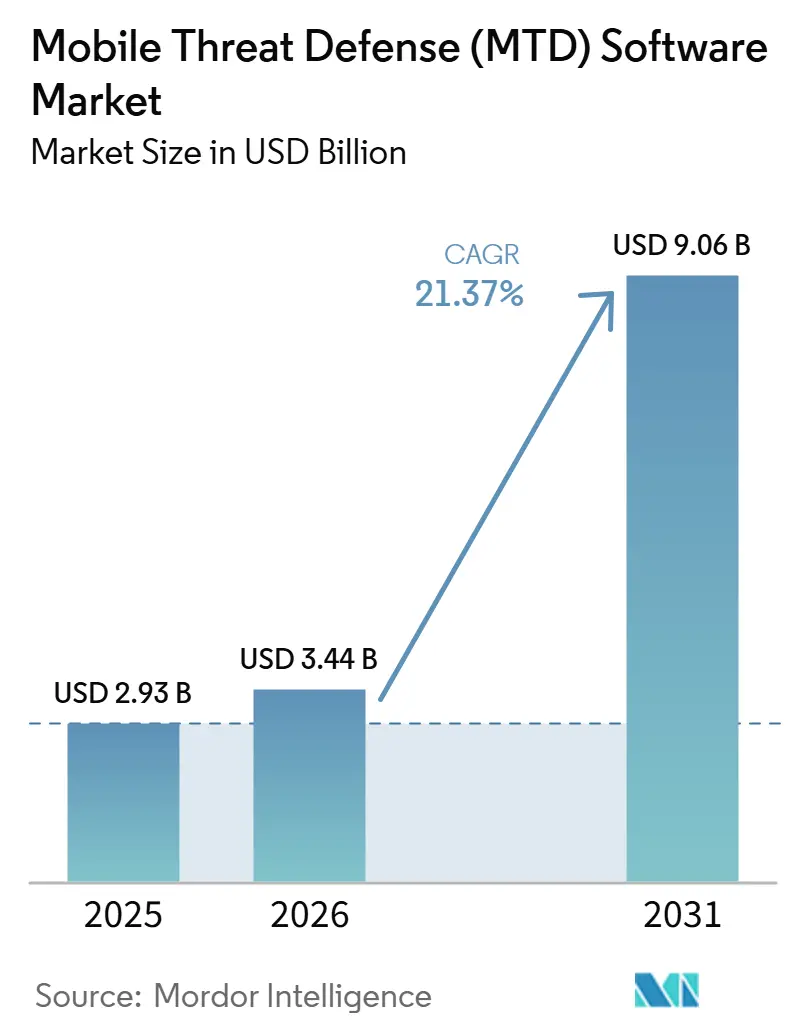
The Mobile Threat Defense (MTD) Software Market size stood at USD 2.93 billion in 2025 and is projected to reach USD 9.06 billion by 2031, expanding at a CAGR of 21.37% during 2026-2031. Mobile risk has become persistent rather than occasional, and this shift is pushing security leaders to treat smartphones and tablets as core enterprise endpoints rather than secondary devices. Remote work, broader bring-your-own-device use, and the spread of AI-enabled phishing and fraud tools are combining to shorten buying cycles, especially in regulated sectors where mobile access now touches sensitive data every day. Buyers are also placing more weight on products that connect cleanly with unified endpoint management, endpoint detection, security information and event management, and identity tools, because integration now matters as much as detection capability during product evaluations. This is creating a clearer divide between mobile-native specialists, broader cybersecurity platforms, and regional vendors that position around local compliance needs. The strongest near-term openings remain in regulated industries, hybrid deployments, managed service delivery, and Asia-Pacific, where enterprise mobility is expanding alongside mobile-led attack activity.
Key Report Takeaways
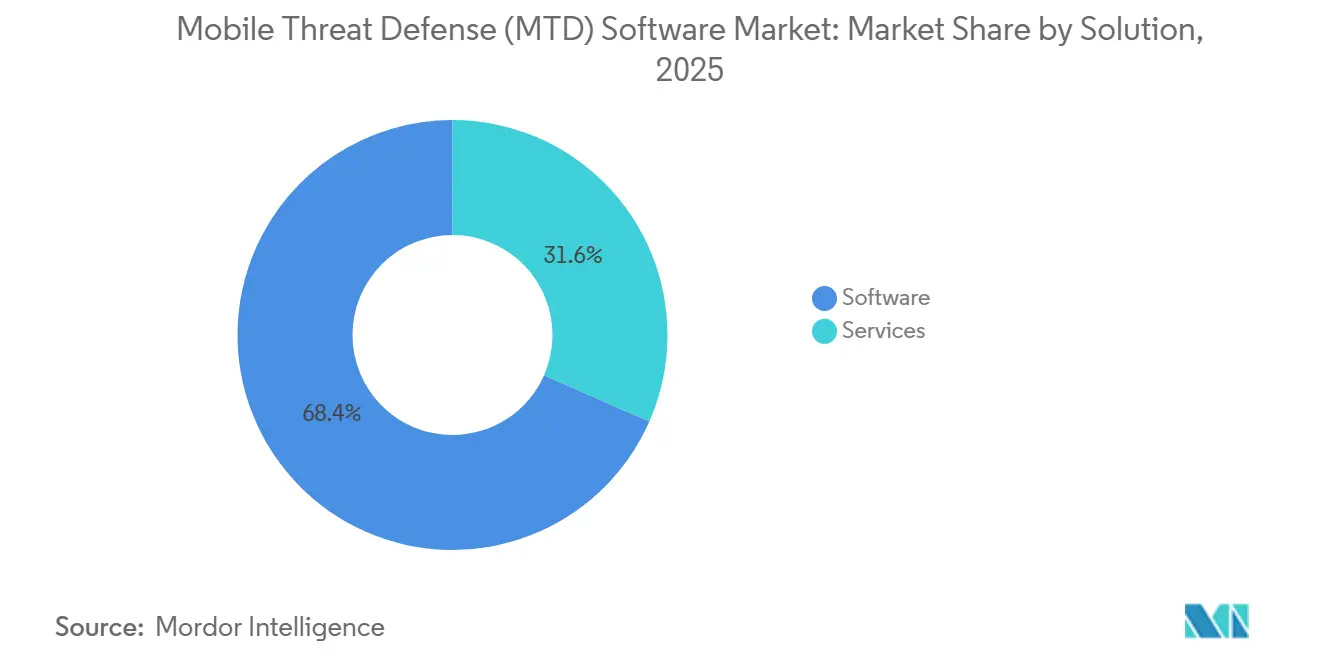
- By solution, software held 68.41% of the Mobile Threat Defense (MTD) Software Market in 2025, while services are projected to expand at a 24.83% CAGR through 2031.
- By deployment, cloud-based deployment led with a 74.18% share Mobile Threat Defense (MTD) Software Market in 2025, while hybrid deployment is expected to record the fastest growth at a 23.69% CAGR during 2026-2031.
- By operating system, Android accounted for 42.31% of revenue in 2025, while iOS is projected to advance at a 25.14% CAGR through 2031.
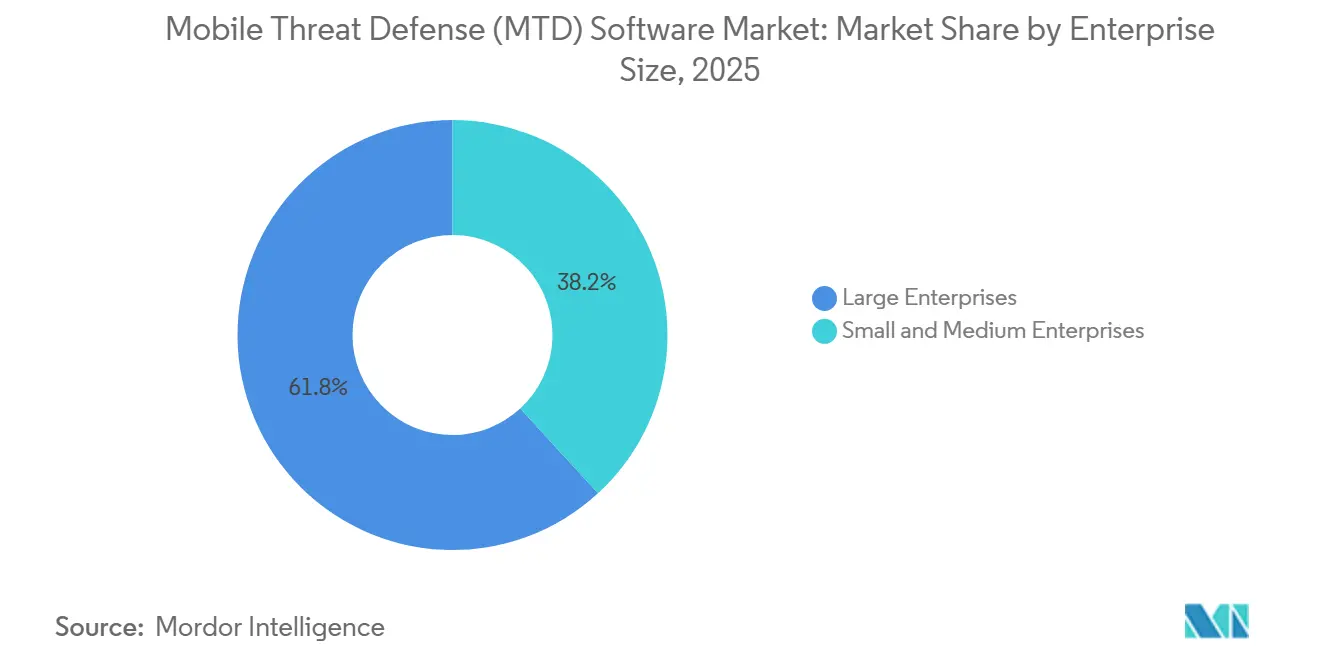
- By enterprise size, large enterprises captured 61.83% of revenue in 2025, while small and medium enterprises are expected to grow at a 24.27% CAGR during 2026-2031.
- By end user, IT and telecommunications accounted for 23.47% of revenue in Mobile Threat Defense (MTD) Software Market in 2025, while healthcare and life sciences are projected to expand at a 25.62% CAGR through 2031.
- By geography, North America held 36.42% of revenue in 2025, while Asia-Pacific is projected to grow at a 26.81% CAGR during 2026-2031.
Note: Market size and forecast figures in this report are generated using Mordor Intelligence’s proprietary estimation framework, updated with the latest available data and insights as of January 2026.
Market Trends and Insights
Drivers Impact Analysis of Mobile Threat Defense (MTD) Software Market*
| Driver | (~) % Impact on CAGR Forecast | Geographic Relevance | Impact Timeline |
|---|---|---|---|
| Rising Mobile-First Attack Surface Across Enterprise Devices | +6.5% | Global, with concentrated impact in North America and Europe | Short term (≤ 2 years) |
| BYOD and COPE Adoption Expanding Unmanaged Endpoints | +4.8% | Global, most pronounced in North America, Asia-Pacific, and Europe | Short term (≤ 2 years) |
| AI-Enhanced Smishing and QR Phishing Increasing Mobile Intrusion Risk | +3.7% | Global, with spill-over to Middle East and Africa and South America | Medium term (2-4 years) |
| Zero-Trust Rollouts Pulling Mobile Devices Into Unified Policy Control | +3.2% | North America and Europe core, Asia-Pacific emerging | Medium term (2-4 years) |
| 5G and SASE Convergence Increasing Demand for Mobile-Specific Telemetry | +2.1% | Asia-Pacific core, spill-over to North America and Middle East and Africa | Medium term (2-4 years) |
| Compliance-Driven Need for Mobile Data Loss Prevention in Regulated Verticals | +1.9% | North America, Europe, Asia-Pacific, varies by sector regulation | Long term (≥ 4 years) |
| Source: Mordor Intelligence | |||
Rising Mobile-First Attack Surface Across Enterprise Devices
Enterprise mobile devices now sit at a point where they are one of the most likely starting points in an attack chain, and that shift is strengthening demand across the Mobile Threat Defense (MTD) Software Market.[1]Digital.ai, “2025 Application Threat Report,” Digital.ai, digital.ai Digital.ai recorded attacks on 90.4% of monitored Android apps and 88.1% of monitored iOS apps in January 2025, which marked a sharp rise from the cross-platform level reported in February 2024. Many organizations had previously aligned mobile spending with device management rather than with threat detection, leaving a clear gap between control and exposure. That gap has made earlier mobility investments look incomplete because management tools do not remove phishing, malicious content, or device-level attack risk on their own. Lookout reported more than 1.2 million enterprise phishing sites in Q3 2025 and described mobile as a reliable entry point for attackers, which helps explain why buying decisions are now moving faster and reaching senior leadership review much earlier.
BYOD and COPE Adoption Expanding Unmanaged Endpoints
Bring-your-own-device use has moved from an exception to a regular workplace practice, widening the accessible base for the Mobile Threat Defense (MTD) Software Market.[2]Verizon Business, “2025 Mobile Security Index,” Verizon Business, verizon.com Verizon found that 3 in 4 IT workers saw BYOD as a regular occurrence, yet only 52% of organizations explicitly permitted it, and only 22% of employees fully complied where it was prohibited. That mismatch means corporate credentials and business applications are often present on personal devices without a dedicated mobile threat layer. NIST guidance on BYOD makes clear that controls designed for corporate devices do not fully address the distinct risks associated with employee-owned endpoints. As a result, buyers are paying more attention to deployment models that can work outside full mobile device management enrollment, because enrollment coverage alone no longer serves as a dependable proxy for mobile protection.
AI-Enhanced Smishing and QR Phishing Increasing Mobile Intrusion Risk
AI-driven mobile social engineering is no longer theoretical, and that is adding urgency to the Mobile Threat Defense (MTD) Software Market. Zimperium tracked a July 2026 campaign in which attackers used Google's Gemini AI to generate personalized smishing messages impersonating toll operators, delivery services, and government agencies. Palo Alto Networks Unit 42 also documented more than 11,000 malicious QR code detections per day in 2024, showing that mobile redirection tactics are already operating at scale. These attack paths matter because they push users into personal mobile browsers and app links that sit outside traditional email gateway coverage.[3]Palo Alto Networks Unit 42, “Phishing on the Edge of the Web and Mobile Using QR Codes,” Palo Alto Networks Unit 42, paloaltonetworks.com Vendors that combine on-device behavior analysis with live URL reputation checks are therefore in a stronger position, because the control has to act where the mobile action occurs rather than where the message first arrives.
Zero-Trust Rollouts Pulling Mobile Devices into Unified Policy Control
Zero-trust programs are making mobile posture a required input rather than an optional add-on, directly supporting the Mobile Threat Defense (MTD) Software Market. Zero-trust architecture relies on continuous authentication and validation, meaning mobile devices must provide a current risk signal before access decisions can be made.[4]National Institute of Standards and Technology, “SP 1800-22, Mobile Device Security, Bring Your Own Device,” NIST, csrc.nist.gov NIST included mobile systems within the scope of zero-trust implementation, effectively moving mobile posture into broader access-control planning. This shift is especially important for organizations working toward mandated zero-trust milestones, because mobile devices with credentials can no longer be excluded from conditional access logic. Vendors with ready-made links to Microsoft Entra ID, Okta, and identity-aligned security tools are benefiting from this demand pattern, as buyers want posture signals to flow into existing policy engines without custom work.
Restraints Impact Analysis of Mobile Threat Defense (MTD) Software Market*
| Restraint | (~) % Impact on CAGR Forecast | Geographic Relevance | Impact Timeline |
|---|---|---|---|
| Privacy Pushback in BYOD-Heavy Deployments | -2.8% | Global, most acute in Europe, Australia, and Canada | Medium term (2-4 years) |
| Overlap With MDM, UEM, and EDR Budgets Slowing Standalone Purchases | -2.1% | Global, most pronounced in North America where UEM consolidation is advanced | Short term (≤ 2 years) |
| Limited Security Telemetry on Consumer-Owned Devices | -1.3% | Global, particularly South America, emerging Asia-Pacific, and Middle East and Africa | Long term (≥ 4 years) |
| Integration Friction With Legacy Identity And Mobile Fleet Tooling | -0.9% | Europe and Middle East and Africa, where legacy SIEM and MDM adoption remains fragmented | Medium term (2-4 years) |
| Source: Mordor Intelligence | |||
Privacy Pushback in BYOD-Heavy Deployments
Employee privacy concerns remain a real obstacle in BYOD settings, especially when data protection rules limit the visibility employers can demand into personal devices. Verizon found that 29% of security professionals viewed BYOD itself as a heightened risk, yet employee workarounds on personal devices persisted, creating a difficult balance between risk control and user acceptance. The core issue is that mobile threat agents may collect behavior data, app activity, network information, or location-linked signals that employees can interpret as surveillance. In parts of Europe, employer councils and local privacy expectations have already pushed some deployments toward corporate containers rather than full-device monitoring, reducing visibility even when companies want stronger protection. This tension can slow rollout scope, prolong internal approvals, and keep coverage below what security teams would prefer in personal-device environments.
Overlap With MDM, UEM, and EDR Budgets Slowing Standalone Purchases
Budget overlap is another brake on the Mobile Threat Defense (MTD) Software Market, because buyers often compare specialized products with capabilities already bundled into broader endpoint or productivity subscriptions. Microsoft Defender for Endpoint includes mobile threat defense for Android and iOS within Microsoft 365 E5, giving existing customers a built-in alternative at no additional license entry point. This has become more important as security leaders continue to reduce vendor counts and prefer larger platforms where they can. Mobile-native vendors respond by emphasizing more advanced detection models and stronger threat specialization, but those distinctions can be harder for smaller teams to evaluate during procurement. In mid-market deals, simpler procurement and broader licensing coverage often outweigh fine differences in mobile detection depth, and that can displace standalone products even where specialists offer a stronger mobile focus.
*Our forecasts treat driver/restraint impacts as directional, not additive. The impact forecasts reflect baseline growth, mix effects, and variable interactions.
Mobile Threat Defense (MTD) Software Market Segment Analysis
By Solution:
Services Close The Execution Gap For Mid-Market BuyersSoftware commanded 68.41% of the Mobile Threat Defense (MTD) Software market share in 2025, which showed that many buyers still preferred directly managed tools over outsourced overlays. In the Mobile Threat Defense (MTD) Software Market, that preference reflected the needs of organizations that already had security operations capacity and wanted control over policies, connectors, and telemetry handling. These buyers often favored software because it allowed more direct tuning of detection rules and tighter alignment with established endpoint and identity workflows. The pattern was strongest in larger enterprises, where mobile security had already moved into formal security operations rather than remaining a simple mobility function.
Services are projected to expand at a 24.83% CAGR during 2026-2031, making it the fastest-growing solution segment in the Mobile Threat Defense (MTD) Software Market. That growth stemmed from a clear skills gap: many mid-market teams still lacked analysts who could connect mobile alerts to identity events, application risk, and user behavior. Zimperium reported that mobile-targeted phishing accounted for roughly one-third of identified threats, reinforcing the burden on smaller security teams without dedicated mobile expertise. Managed delivery models answered that gap with round-the-clock monitoring, built response playbooks, and simpler integration into wider security operations. This made services especially relevant for organizations below 1,000 seats that wanted credible mobile coverage without building a specialized internal practice from the ground up


By Deployment:
Cloud Leads While Hybrid Gains In Regulated EnvironmentsCloud-based deployment accounted for 74.18% of the Mobile Threat Defense (MTD) Software market in 2025, confirming that centralized delivery remained the default model for most buyers. In the Mobile Threat Defense (MTD) Software Market, cloud delivery remained attractive because it scaled easily, reduced infrastructure burden, and enabled vendors to continuously update signatures and models. It also supported pooled threat intelligence, which helped suppliers identify emerging attack patterns across customer environments faster than a single enterprise usually could on its own. These strengths kept cloud deployment well aligned with organizations that wanted speed, lighter deployment effort, and broad cross-customer visibility.
Hybrid deployment is expected to grow at a 23.69% CAGR during 2026-2031, reflecting rising data residency concerns in the Mobile Threat Defense (MTD) Software Market. Healthcare, financial services, and government buyers increasingly wanted cloud-speed analytics while still retaining tighter control over where sensitive telemetry was stored. NIST guidance tied mobile security architecture choices to the sensitivity of the data accessed on those devices, which supported a more selective deployment approach in regulated settings. On-premises deployment, therefore, remained relevant for air-gapped or classified environments, but it served a narrower group of users with stronger isolation needs. Hybrid models sit in the middle by combining centralized detection logic with more local control over telemetry and policy handling.
By Operating System:
Android Leads On Installed Base While iOS Grows On Targeted ExposureAndroid accounted for 42.31% of revenue in 2025, maintaining its lead in the Mobile Threat Defense (MTD) Software Market. That position matched Android’s broad enterprise device footprint, especially in Asia-Pacific and South America, where enterprise fleets often rely on Samsung Knox-enabled deployments. Android also has a wider exposure profile because of sideloading flexibility and uneven update distribution, which can leave more devices open to persistence and exploitation. This kept Android highly relevant for vendors that focused on device hardening, malicious app detection, and risk scoring tied to fragmented operating conditions.
iOS is projected to expand at a 25.14% CAGR during 2026-2031, underscoring how quickly enterprise assumptions about relative safety were changing in the Mobile Threat Defense (MTD) Software Market. Digital.ai showed that monitored attack rates had narrowed sharply between iOS and Android, with iOS at 88.1% and Android at 90.4% in January 2025. That narrowing gap reflected increased pressure from network-level attacks, phishing, and jailbreaking techniques targeting corporate iPhones. As a result, buyers were no longer treating iOS protection as a low-priority extension of general endpoint policy. Windows and other operating systems still retained niche relevance, particularly in operational environments where unified endpoint policies covered tablets and mobile devices.
By Enterprise Size:
Large Enterprises Anchor Spend While SMEs Add VolumeLarge enterprises held 61.83% of revenue in 2025, giving them the leading position in the Mobile Threat Defense (MTD) Software Market. Their spending base was tied to compliance-heavy sectors such as banking, healthcare, and defense, where mobile data access had already become part of formal risk management. These organizations usually deployed mobile protection within layered security stacks that also included unified endpoint management, identity governance, and central event monitoring. That structure gave large enterprises the operational capacity to turn mobile alerts into actionable policy responses across large device fleets.
Small and medium enterprises are projected to expand at a 24.27% CAGR during 2026-2031, which showed where new volume was building across the Mobile Threat Defense (MTD) Software Market. Verizon found that 52% of enterprises experienced a mobile cyberattack resulting in downtime, compared with 37% among smaller businesses, which highlighted why mobile risk had become more visible across company sizes. At the same time, cyber insurance expectations and lower-touch deployment models were reducing barriers for smaller buyers. Managed services and simpler activation inside established management tools gave SMEs a way to add mobile defense without standing up dedicated internal operations. This made the segment important not because it matched enterprise spending today, but because it widened the addressable customer base over the forecast period.
By End User:
IT And Telecom Lead Current Spending While Healthcare Drives Faster ExpansionIT and telecommunications accounted for 23.47% of end-user revenue in 2025, making it the largest vertical in the Mobile Threat Defense (MTD) Software Market. This lead reflected large managed device fleets, stronger internal security teams, and broad use of mobile-enabled support, service, and communication workflows. The sector also had the practical advantage of understanding endpoint integration needs early, which helped it absorb mobile posture into broader security architecture faster than many other verticals. Financial services followed as another major buyer group, supported by stricter monitoring and resilience requirements for mobile access to banking, trading, and payment systems.
Healthcare and life sciences are projected to record the fastest growth at a 25.62% CAGR during 2026-2031, underscoring the strong influence of patient data exposure on the Mobile Threat Defense (MTD) Software Market. Verizon reported that 89% of healthcare organizations were concerned or very concerned that a breach could seriously compromise patient care, which directly supported mobile security spending priorities. ISO 27799:2025 extended health information security guidance to mobile settings, such as ambulances and remote diagnostic units, further formalizing the compliance case. Government, retail, manufacturing, education, media, and energy also added demand, with government adoption strengthened by federal requirements on government-issued devices. The Mobile Threat Defense (MTD) Software industry also saw emerging demand in sectors where mobile endpoints had spread faster than dedicated security investments, leaving visible coverage gaps.
Geography Analysis
North America Mobile Threat Defense (MTD) Software Market
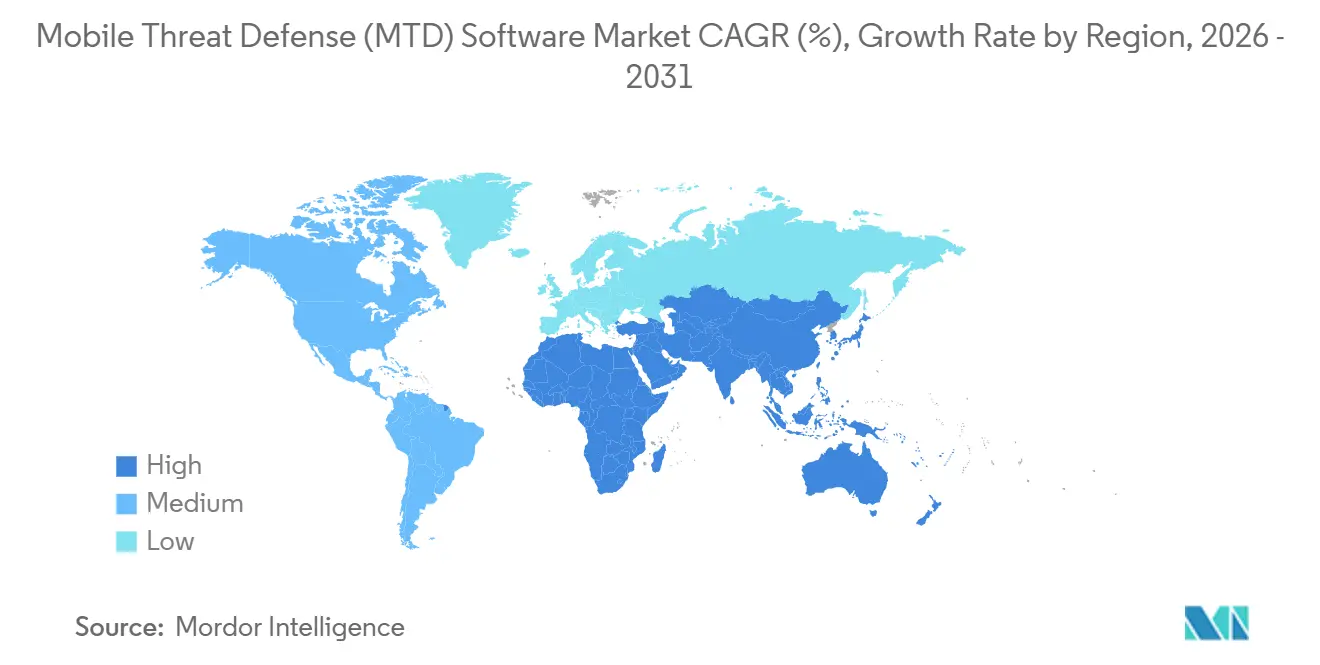
North America held 36.42% of the Mobile Threat Defense (MTD) Software market in 2025, maintaining its lead. That position reflected dense enterprise mobile usage, mature security spending, and the presence of many major vendors serving the Mobile Threat Defense (MTD) Software Market. Government direction also mattered, as formal expectations around mobile threat defense and app vetting on public-sector devices helped drive enterprise buying decisions across adjacent regulated sectors. Canada and Mexico added to regional demand, with Canadian financial institutions moving more quickly after updated supervisory attention to mobile security controls.
APAC Mobile Threat Defense (MTD) Software Market
Asia-Pacific is projected to expand at a 26.81% CAGR during 2026-2031, making it the fastest-growing region in the Mobile Threat Defense (MTD) Software Market. The region’s enterprise computing model is more mobile-first in many countries, so smartphones often carry a larger share of business data and user activity than in more PC-centric environments. Zimperium reported a 67% year-over-year increase in banking trojan activity targeting mobile financial applications in the region during 2025, which supported faster adoption in banking and digital payments. The company also stated that it signed 12 banking institutions in Asia-Pacific in one fiscal year, which gave a practical signal of regional buying momentum. China remained more distinct because local compliance structures and domestic supplier positioning created a parallel competitive path that did not fully mirror the international vendor field.
EMEA and South America Mobile Threat Defense (MTD) Software Market
Europe held the second-largest regional position in 2025, with Germany, the United Kingdom, and France serving as the main anchor markets in the Mobile Threat Defense (MTD) Software Market. NIS2 sharply widened the number of covered organizations, thereby expanding the practical relevance of mobile endpoint controls for entities now operating under stricter cyber obligations. Germany’s security framework emphasized protection beyond operating system hardening, while France granted Pradeo’s suite CSPN certification, creating a meaningful local compliance advantage for regulated buyers. South America, the Middle East, and Africa remained earlier-stage parts of the Mobile Threat Defense (MTD) Software Market, but Brazil’s financial sector and Gulf government programs were becoming clearer demand centers as mobile banking fraud and digital government use both increased.

Competitive Landscape
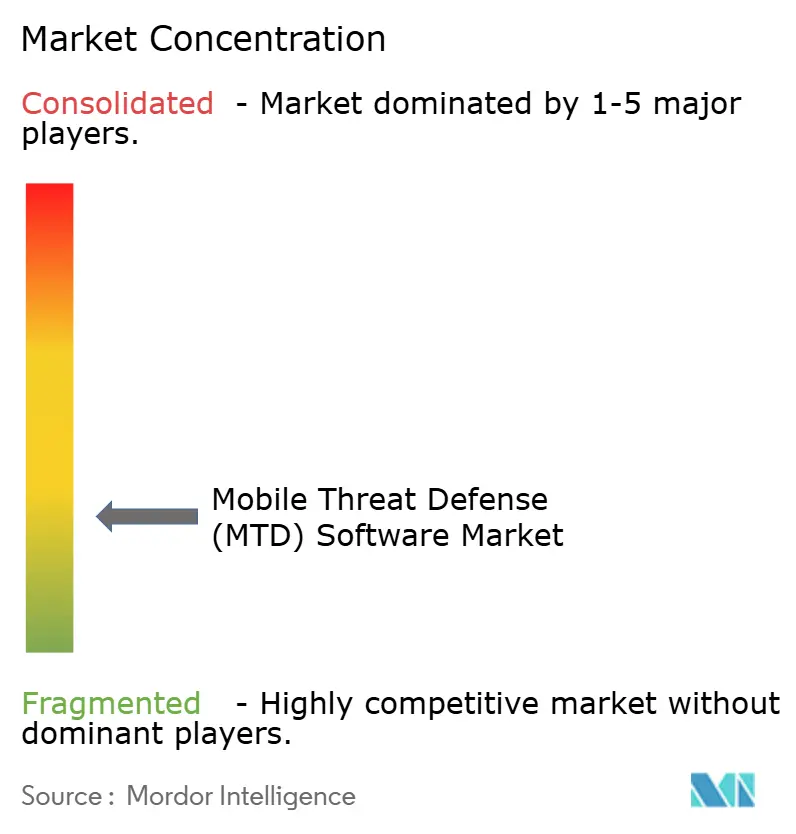
The Mobile Threat Defense (MTD) Software Market showed a moderately concentrated premium tier and a broader, fragmented field underneath it. Mobile-native vendors such as Lookout and Zimperium remained important because they built their platforms around mobile telemetry rather than extending from desktop endpoint roots. Broader cybersecurity vendors such as Microsoft, Palo Alto Networks, and Check Point also strengthened their positions by embedding mobile controls into broader security suites, thereby widening their reach during enterprise evaluations. This left buyers choosing between specialist depth, platform convenience, and regional compliance fit rather than judging mobile detection alone.
Competition had shifted toward deeper integration, as buyers increasingly expected low-friction links to Microsoft Intune, CrowdStrike Falcon, ServiceNow, and adjacent policy systems. Vendors that appeared natively in connector catalogs or offered pre-certified links often entered evaluations with an advantage before detection tests even began. Guardsquare’s February 2026 acquisition of Verimatrix’s Extended Threat Defense technology showed how providers were moving to close the space between app protection and device-level monitoring. Zimperium’s May 2026 launch of the Mobile SOC Agent was another strategic move, aiming to turn mobile alerting into faster operational decision support for security teams. Lookout’s April 2026 launch of AI Visibility and Governance showed a similar effort to extend mobile security value into shadow AI oversight on user devices.
Regional specialists still had room to compete where sovereignty, certification, or local regulatory expectations mattered more than global platform scale. Pradeo’s certified position in France illustrated how national approval can create a practical edge in public and regulated procurement. The competitive picture also became clearer after non-core names were screened out, because Broadcom had already acquired VMware, while Esper.io and Matrix42 did not align with dedicated mobile threat defense requirements as active threat detection vendors. More relevant comparators in those cases were CrowdStrike, SentinelOne, and Appdome, which better matched the active protection and connector expectations shaping the Mobile Threat Defense (MTD) Software Market.
Mobile Threat Defense (MTD) Software Industry Leaders
Lookout, Inc.
Zimperium, Inc.
Check Point Software Technologies Ltd.
Cisco Systems, Inc.
Ivanti, Inc.
- *Disclaimer: Major Players sorted in no particular order
Mobile Threat Defense (MTD) Software Market Companies Covered in this Report
- Lookout, Inc.
- Zimperium, Inc.
- Check Point Software Technologies Ltd.
- Cisco Systems, Inc.
- Broadcom Inc.
- IBM Corporation
- Palo Alto Networks, Inc.
- Jamf Holding Corp.
- Ivanti, Inc.
- Trend Micro Incorporated
- Sophos Limited
- BlackBerry Limited
- Microsoft Corporation
- VMware, Inc.
- OPSWAT, Inc.
- Pradeo Security Systems SAS
- Guardsquare NV
- Matrix42 AG
- Esper.io Inc.
- F-Secure Oyj

Recent Industry Developments in Mobile Threat Defense (MTD) Software Market
- July 2026: Zimperium documented a large-scale smishing campaign abusing Google Gemini AI to generate personalized fraudulent texts impersonating toll authorities, delivery services, and government agencies, demonstrating how generative AI is being weaponized to scale mobile social engineering at enterprise targets. The campaign highlights the growing gap between static security awareness training and AI-adaptive attack methodologies.
- June 2026: Palo Alto Networks launched Secure Agentless Access, extending zero-trust access controls to unmanaged devices, including personal mobile endpoints, without requiring an agent installation, addressing a significant coverage gap in BYOD deployments.
- May 2026: Zimperium launched its Mobile SOC Agent, an agentic AI solution integrated directly into its Mobile Threat Defense platform. The solution correlates mobile threat alerts across devices, applications, networks, and web activity, generating confidence-scored attack narratives aligned with MITRE ATT and CK and reducing investigation time from hours or days to minutes. The product is available immediately to existing and new MTD customers.
- May 2026: Ivanti disclosed critical zero-day vulnerabilities CVE-2026-6973 in Ivanti Endpoint Manager Mobile, following earlier critical zero-days CVE-2026-1281 and CVE-2026-1340 disclosed in January 2026. CISA added CVE-2026-1281 to its Known Exploited Vulnerabilities catalog with a 3-day remediation deadline for federal agencies. These disclosures reinforced the vulnerability of on-premises mobile management infrastructure to unauthenticated remote code execution.


Global Mobile Threat Defense (MTD) Software Market Report Scope
The mobile application management (MAM) software market refers to the ecosystem of software solutions and associated services designed to secure, manage, and control mobile applications deployed across enterprise environments without necessarily requiring the management of the underlying mobile device hardware. This includes capabilities such as enterprise app cataloging, application provisioning, software updates, license management, and app-level security policies (such as app wrapping, containerization, and data encryption) tailored for various operating systems, including Android, iOS, and Windows. Deployed via cloud-based, hybrid, or on-premises models, these solutions cater to organizations of all sizes across industries such as BFSI, healthcare, IT, and government. By isolating and securing corporate data at the application level across diverse mobile platforms, MAM software enables organizations to safeguard sensitive information, ensure regulatory compliance, and maintain employee productivity by allowing secure access to business-critical applications on both corporate-owned and personally owned (BYOD) smartphones and tablets.
The Mobile Application Management (MAM) Software Market Report is Segmented by Solution (Software and Services), Deployment (Cloud-Based, Hybrid, and On-Premises), Operating System (Android, iOS, Windows, and Others), Enterprise Size (Large Enterprises and Small and Medium Enterprises), End User (IT and Telecommunication, BFSI, Healthcare and Life Sciences, Retail and E-Commerce, Industrial Manufacturing, Education and Research Institutions, Media and Entertainment, Government and Administration, Energy and Utilities, and Other End-User Industries), and Geography (North America, South America, Europe, Asia-Pacific, and Middle East and Africa). The Market Forecasts are Provided in Terms of Value (USD).
| Software |
| Services |
| Cloud-Based |
| Hybrid |
| On-Premises |
| Android |
| iOS |
| Windows |
| Others |
| Large Enterprises |
| Small and Medium Enterprises |
| IT and Telecommunication |
| BFSI |
| Healthcare and Life Sciences |
| Retail and E-Commerce |
| Industrial Manufacturing |
| Education and Research Institutions |
| Media and Entertainment |
| Government and administration |
| Energy and Utilities |
| Other End-User Industries |
| North America | United States | |
| Canada | ||
| Mexico | ||
| South America | Brazil | |
| Argentina | ||
| Rest of South America | ||
| Europe | Germany | |
| United Kingdom | ||
| France | ||
| Russia | ||
| Spain | ||
| Rest of Europe | ||
| Asia-Pacific | China | |
| Japan | ||
| India | ||
| South Korea | ||
| Southeast Asia | ||
| Rest of Asia-Pacific | ||
| Middle East and Africa | Middle East | Saudi Arabia |
| United Arab Emirates | ||
| Turkey | ||
| Rest of Middle East | ||
| Africa | South Africa | |
| Nigeria | ||
| Egypt | ||
| Rest of Africa | ||
| By Solution | Software | ||
| Services | |||
| By Deployment | Cloud-Based | ||
| Hybrid | |||
| On-Premises | |||
| By Operating System | Android | ||
| iOS | |||
| Windows | |||
| Others | |||
| By Enterprise Size | Large Enterprises | ||
| Small and Medium Enterprises | |||
| By End-User Industry | IT and Telecommunication | ||
| BFSI | |||
| Healthcare and Life Sciences | |||
| Retail and E-Commerce | |||
| Industrial Manufacturing | |||
| Education and Research Institutions | |||
| Media and Entertainment | |||
| Government and administration | |||
| Energy and Utilities | |||
| Other End-User Industries | |||
| By Geography | North America | United States | |
| Canada | |||
| Mexico | |||
| South America | Brazil | ||
| Argentina | |||
| Rest of South America | |||
| Europe | Germany | ||
| United Kingdom | |||
| France | |||
| Russia | |||
| Spain | |||
| Rest of Europe | |||
| Asia-Pacific | China | ||
| Japan | |||
| India | |||
| South Korea | |||
| Southeast Asia | |||
| Rest of Asia-Pacific | |||
| Middle East and Africa | Middle East | Saudi Arabia | |
| United Arab Emirates | |||
| Turkey | |||
| Rest of Middle East | |||
| Africa | South Africa | ||
| Nigeria | |||
| Egypt | |||
| Rest of Africa | |||


Key Questions Answered in the Report
What is the current and forecast value of the Mobile Threat Defense (MTD) Software Market?
The Mobile Threat Defense (MTD) Software Market stood at USD 2.93 billion in 2025 and is projected to reach USD 9.06 billion by 2031 at a 21.37% CAGR.
Which region is expanding the fastest in mobile threat defense software?
Asia-Pacific is the fastest-growing region, with a projected CAGR of 26.81% during 2026-2031, supported by mobile-first enterprise usage and stronger banking trojan activity.
Which deployment model leads current spending in mobile threat defense software?
Cloud-based deployment led with a 74.18% share in 2025 because buyers favored centralized analytics, easier scaling, and lower infrastructure burden.
Why are BYOD policies increasing demand for mobile threat defense tools?
BYOD expands enterprise access onto personal devices that often sit outside full management enrollment, which increases the need for dedicated mobile threat visibility and response.
Which end-user group is creating the strongest growth opportunity?
Healthcare and life sciences is the fastest-growing end-user segment, with a projected CAGR of 25.62% through 2031, driven by patient data protection and mobile-specific compliance needs.
What are buyers looking for from vendors beyond threat detection quality?
Buyers increasingly want tight integration with tools such as Microsoft Intune, CrowdStrike Falcon, identity systems, and security operations platforms, because deployment simplicity now influences vendor selection heavily.
Page last updated on:


 Your data is secure and never sold or shared.


