
Managed IT Hardware Asset Management Services Market Size and Share
Market Overview
| Study Period | 2021 - 2032 |
|---|---|
| Market Size (2027) | USD 36.93 Billion |
| Market Size (2032) | USD 50.74 Billion |
| Growth Rate (2027 - 2032) | 8.18 % |
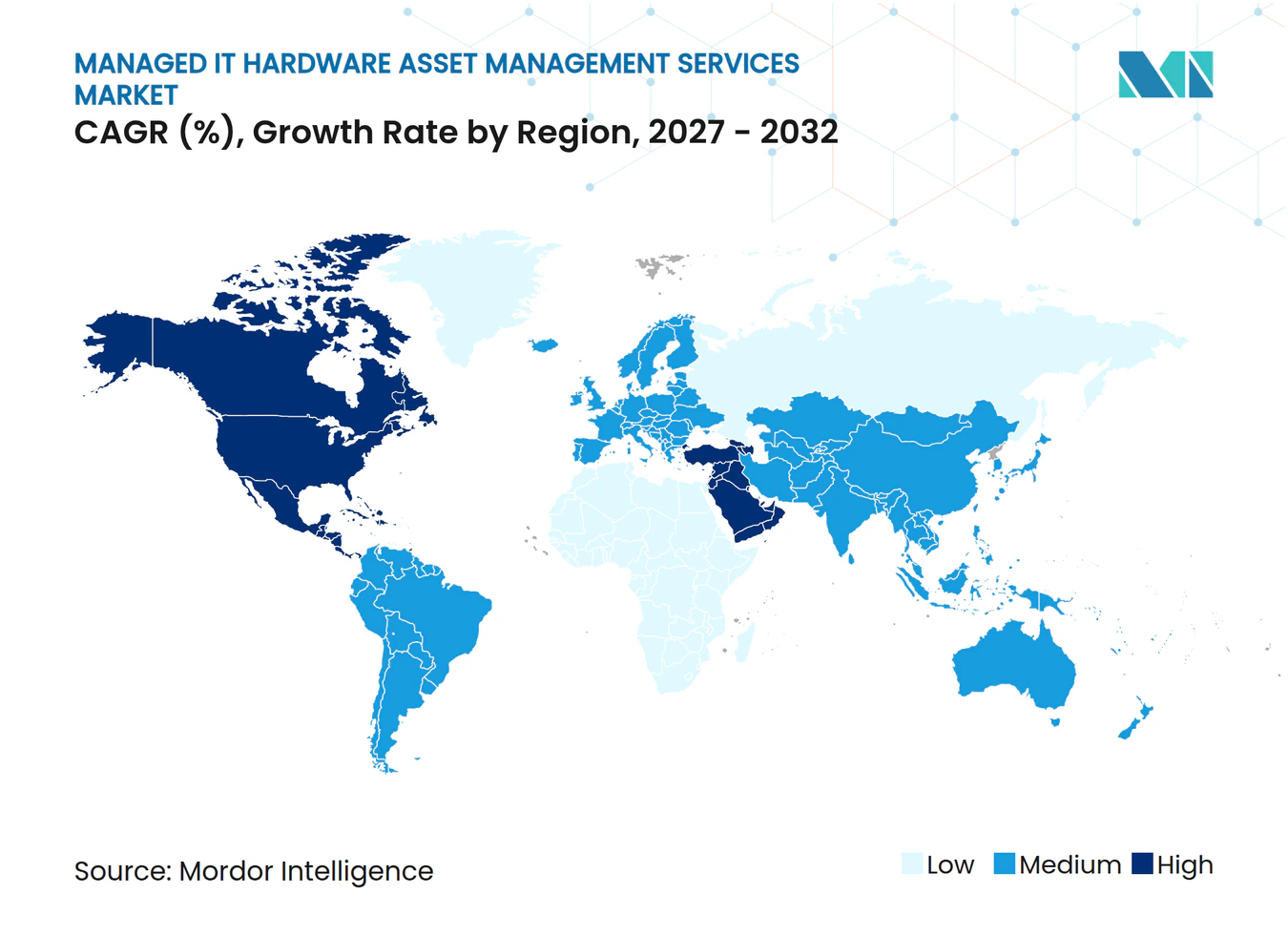
| Fastest Growing Market | Middle East |
| Largest Market | North America |
| Market Concentration | Medium |
Major Players *Disclaimer: Major Players sorted in no particular order Image © Mordor Intelligence. Reuse requires attribution under CC BY 4.0. | |
Managed IT Hardware Asset Management Services Market Analysis by Mordor Intelligence
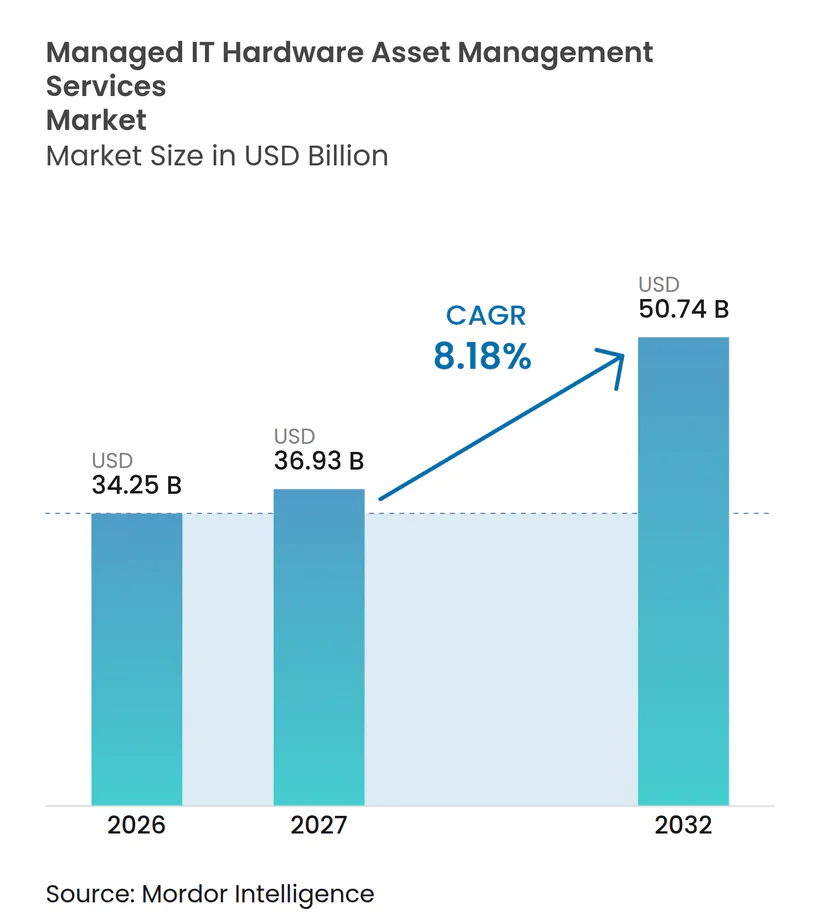
The Managed IT hardware asset management services market size is projected to expand from USD 34.25 billion in 2026 to USD 50.74 billion by 2032, registering a CAGR of 8.18% between 2027 and 2032. Organizations are moving from reactive hardware support toward lifecycle programs that cover procurement, deployment, maintenance, and secure retirement. The Windows 10 end-of-life transition in 2025 concentrated endpoint retirement activity across regulated sectors and increased the need for certified erasure and documented disposal. AI infrastructure refreshes, Device-as-a-Service arrangements, and hybrid infrastructure are adding more assets to enterprise estates. These conditions favor providers that can manage equipment across its full operating life and across multiple vendors. The Managed IT hardware asset management services market also faces delayed technology spending, longer OEM warranties, and local data rules that can slow outsourced contract decisions.
Key Report Takeaways
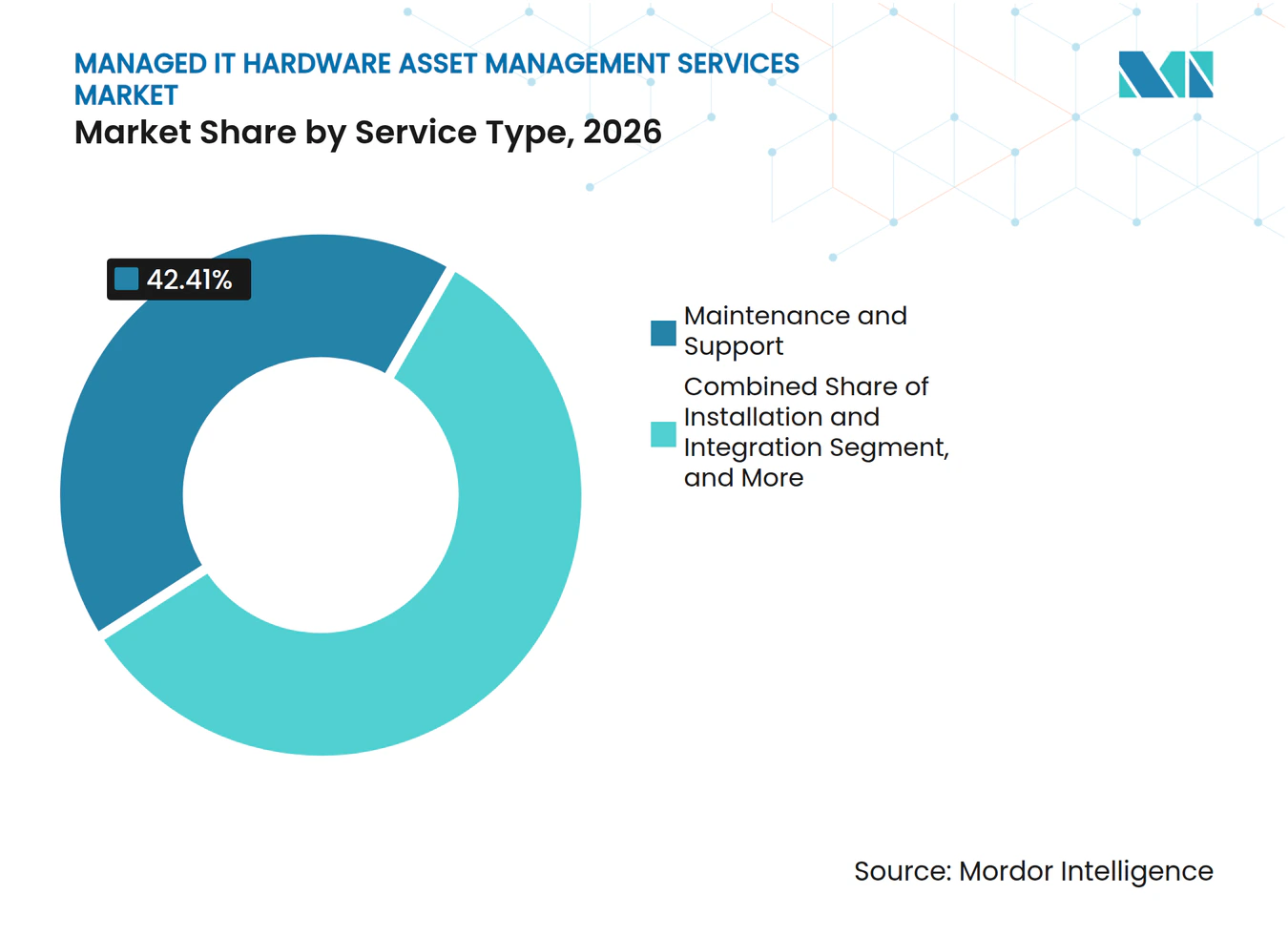
- By service type, Maintenance and Support held 42.41% of the Managed IT hardware asset management services market share in 2026, while Asset Management is projected to expand at a 9.35% CAGR through 2032.
- By hardware type, Servers held 36.35% of the managed IT hardware asset management services market share in 2026 and are projected to expand at a 9.61% CAGR through 2032.
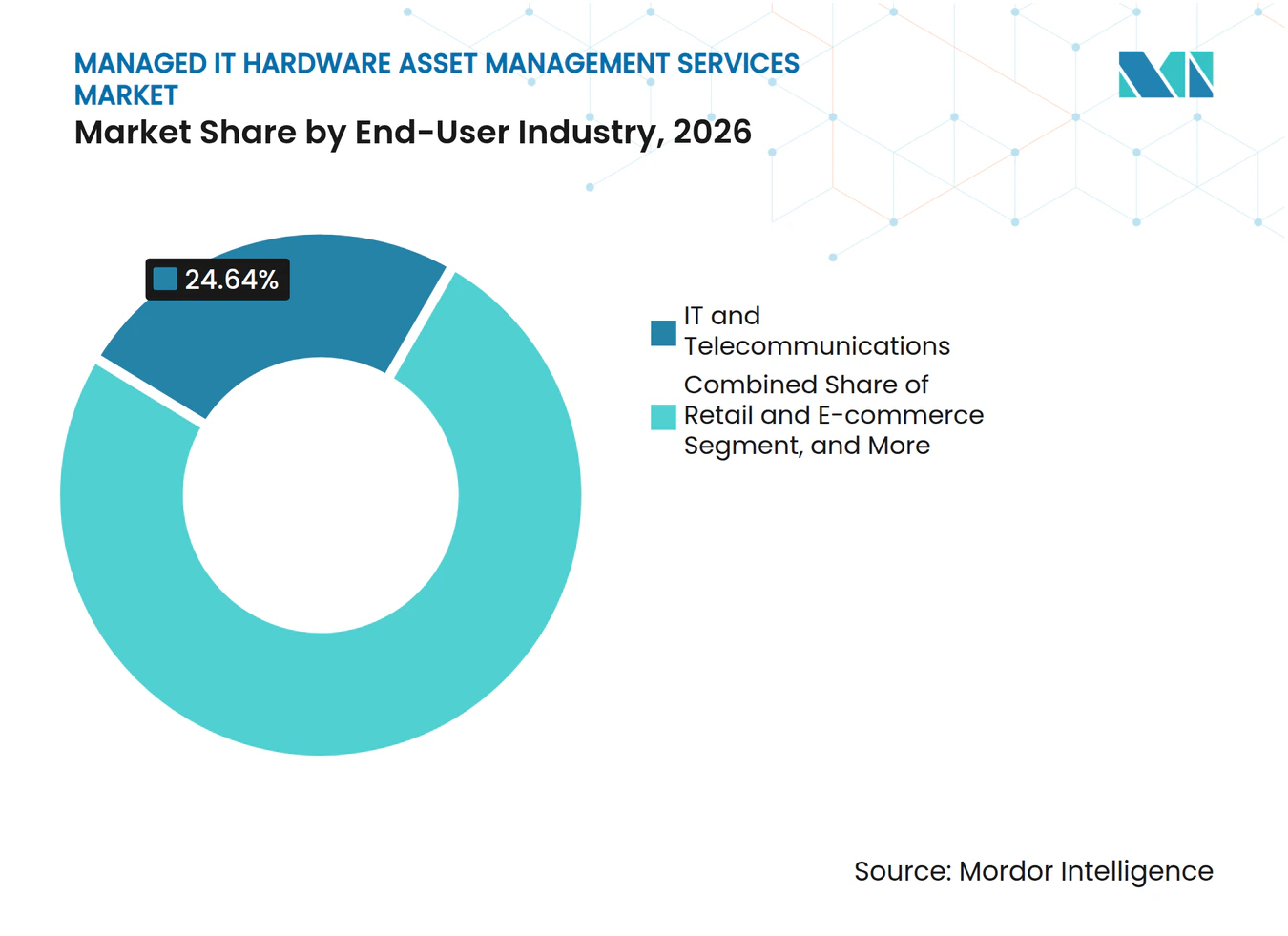
- By end-user industry, IT and Telecommunications held 24.64% of revenue in 2026 and is projected to expand at a 9.49% CAGR through 2032.
- By geography, North America accounted for 37.63% of revenue in 2026, while the Middle East is projected to expand at a 9.56% CAGR through 2032.
Note: Market numbers in this report are based on Mordor Intelligence's proprietary estimation framework, which combines nine months of actuals with Q4 projections for base year 2026.
Market Trends and Insights
Drivers Impact Analysis of Managed IT Hardware Asset Management Services Market*
| Driver | (~) % Impact on CAGR Forecast | Geographic Relevance | Impact Timeline |
|---|---|---|---|
| Accelerated Hardware Refresh Cycles | +2.5% | Global | Short term (≤ 2 years) |
| Growth of Device-as-a-Service Subscription Models | +1.8% | North America and Europe | Medium term (2-4 years) |
| Rising Complexity of Hybrid Multi-Cloud Architectures | +1.3% | Global | Medium term (2-4 years) |
| Heightened Cybersecurity Compliance Requirements | +1.0% | North America and Europe | Short term (≤ 2 years) |
| Edge Computing Deployment Across Distributed Sites | +0.7% | Global | Medium term (2-4 years) |
| Sustainability Targets and Circular IT Programs | +0.5% | Europe and Asia-Pacific | Long term (≥ 4 years) |
| Source: Mordor Intelligence | |||
Accelerated Hardware Refresh Cycles
AI workloads are shortening replacement cycles for GPU servers and high-performance storage. A Dell Technologies paper using IDC survey findings reported that 44% of organizations refreshed rack servers every 3 years or less in 2025. Faster replacement creates more equipment that must be removed, transported, erased, remarketed, or recycled. This work often occurs across several sites within a narrow time window. Iron Mountain reported that formal asset disposition programs can recover 10-30% of initial hardware costs.[1] The Managed IT hardware asset management services market benefits when providers can complete these activities with verifiable records and secure handling.
Growth of Device-as-a-Service Subscription Models
Device-as-a-Service puts procurement, deployment, maintenance, and retirement into one contracted service. A provider that installs a fleet is well placed to manage its refresh and retirement later. Dell Technologies cites its 2025 Device-as-a-Service assessment to describe faster refresh cycles and provider-managed lifecycle governance.[2] This arrangement gives finance teams clearer spending patterns and reduces asset tracking work for internal technology teams. It also reduces the number of handoffs between separate suppliers. The Managed IT hardware asset management services market is therefore supported by demand for providers that can deliver the full lifecycle rather than isolated tasks.
Rising Complexity of Hybrid Multi-Cloud Architectures
Hybrid environments combine on-premises servers, colocated equipment, edge hardware, and cloud-linked systems. This mix makes asset records harder to maintain because equipment can move between sites and operating models. Capgemini described complete visibility across on-premises assets, cloud workloads, IoT systems, and third-party interfaces as difficult to achieve. Managed programs can bring discovery, lifecycle records, and maintenance schedules into a common view. Workload repatriation for cost or latency reasons can change the location and role of physical assets. The Managed IT hardware asset management services market gains relevance when enterprises need current records rather than periodic inventories.
Heightened Cybersecurity Compliance Requirements
Cybersecurity rules increasingly treat asset records as a basic control. The New York Department of Financial Services requires covered entities to maintain IT asset policies that address hardware locations, end-of-service dates, and recovery objectives. ISO/IEC TS 19770-10:2025 provides guidance for implementing IT asset management systems across security, lifecycle, and performance activities.[3] These requirements make auditable inventories and defined retirement processes more important for regulated organizations. They also raise the value of certified erasure and documented chain of custody. The Managed IT hardware asset management services market can serve buyers that need outside support to maintain evidence for control reviews.
Restraints Impact Analysis of Managed IT Hardware Asset Management Services Market*
| Restraint | (~) % Impact on CAGR Forecast | Geographic Relevance | Impact Timeline |
|---|---|---|---|
| Macroeconomic Slowdowns and Deferred IT Spending | -0.8% | Global | Short term (≤ 2 years) |
| OEM Warranty Extensions Limiting Third-Party Service Adoption | -0.5% | North America and Europe | Medium term (2-4 years) |
| Shortage of Advanced Hardware Support Engineers | -0.4% | Global | Long term (≥ 4 years) |
| Data-Residency Restrictions on Remote Asset Management | -0.3% | Asia-Pacific and Middle East | Long term (≥ 4 years) |
| Source: Mordor Intelligence | |||
Macroeconomic Slowdowns and Deferred IT Spending
Uncertain economic conditions can lead organizations to keep equipment in service beyond planned replacement dates. Technology teams may reduce contract scope and return some lifecycle work to internal staff. This can postpone purchases of managed maintenance and disposition services. When spending resumes, delayed replacements can arrive together and place pressure on deployment and retirement capacity. ISG reported a year-over-year decline in traditional managed-services contract value in the Americas during Q3 2026. Providers with several service lines and regional coverage can better absorb uneven customer spending.
OEM Warranty Extensions Limiting Third-Party Service Adoption
Equipment manufacturers continue to offer longer warranties and support plans after the original warranty period. These programs use access to diagnostic tools, original parts, and firmware updates to retain service work. The effect is most visible in Maintenance and Support, which held 42.41% of the Managed IT hardware asset management services market size in 2026. Independent providers must show value through multi-vendor coverage, rapid response commitments, and asset intelligence. Providers supporting a single equipment brand are more exposed to displacement. Those that manage mixed estates have a broader basis for competing with OEM programs.
*Our forecasts treat driver/restraint impacts as directional, not additive. The impact forecasts reflect baseline growth, mix effects, and variable interactions.
Managed IT Hardware Asset Management Services Market Segment Analysis
By Service Type:
Maintenance Supports Current Revenue While Asset Management Leads ExpansionMaintenance and Support held 42.41% of the managed IT hardware asset management services market share in 2026. Enterprises use these arrangements to link uptime commitments with preventive maintenance, especially where outages have service-level consequences. Procurement and Deployment is often the first service engagement in a longer customer relationship. That position allows providers to support later maintenance and retirement work for the same fleet. Installation and Integration remains project-based and depends on multi-vendor configuration skills. End-of-Life Disposition is receiving more attention as AI-related refreshes add retiring assets and buyers require a documented chain of custody.
Asset Management is projected to expand at a 9.35% CAGR through 2032. ISO/IEC TS 19770-10:2025 covers implementation guidance for asset management processes, including lifecycle and security practices. Formal controls can encourage government bodies and large companies to adopt managed programs. Software platforms and managed contracts are also becoming more closely linked. Providers can use asset data to offer accountability for the wider equipment estate, rather than only a repair visit. This changes the service discussion from individual tasks to ongoing asset governance.



By Hardware Type:
Servers Combine Revenue Leadership With Fastest ExpansionServers held 36.35% of the managed IT hardware asset management services market share in 2026. They are also projected to expand at a 9.61% CAGR through 2032, which makes them the fastest hardware segment. GPU-rich systems used for model training and inference need frequent technology updates. Dell Technologies reported survey findings that showed many organizations refreshed rack servers within 3 years. Higher-value AI nodes make formal controls for deployment, maintenance, and retirement more economically relevant. The managed IT hardware asset management services market can benefit from the related volume of acquisition and disposition work.
Storage Systems are shifting from HDD equipment toward all-flash and NVMe configurations where lower latency is required. Older systems can move more quickly into refurbishment, resale, or disposal channels. End-User Devices have the largest unit volumes, and the 2025 Windows 10 transition prompted large endpoint retirement programs. Networking equipment is also being refreshed as data centers move from 100G to 400G interconnects for AI clusters. Other hardware includes rugged edge devices and IoT gateways at distributed sites. These devices add different handling requirements and increase the need for asset records outside traditional data centers.
By End-User Industry:
IT and Telecommunications Combines Scale and Demand MomentumIT and Telecommunications held 24.64% of the managed IT hardware asset management services market share in 2026. The sector is projected to expand at a 9.49% CAGR through 2032, the fastest rate among end-user industries. Network densification, 5G core upgrades, and colocated AI infrastructure require steady hardware replacement. Operators and hyperscale companies manage equipment across many locations and vendors. This scale makes outsourced lifecycle services more practical than a fully internal model. BFSI remains an important adjacent buyer because asset visibility and certified data erasure support audit requirements.
Healthcare and Life Sciences needs maintenance support and documented retirement practices for expanding hospital and device environments. Retail and E-commerce manages varied equipment, including point-of-sale terminals, scanners, signage, and local servers. Manufacturing uses lifecycle support for shop-floor servers, industrial gateways, and SCADA-related equipment. Government and Public Sector can offer longer contract terms where procurement rules require certified disposition and environmental documentation. Education, transportation, energy, and media also add demand as their digital equipment estates become larger. These varied requirements favor providers that can adapt processes to site conditions and equipment types.

Geography Analysis
North America held 37.63% of the managed IT hardware asset management services market share in 2026. Financial services, healthcare, and public bodies in the United States have incorporated hardware governance into cybersecurity work. The New York Department of Financial Services set defined asset policy obligations under its Cybersecurity Regulation. Canada contributes through digital government modernization, while Mexico supports configuration, deployment, and recovery activity within regional programs. CDW was selected as the Official IT Equipment Services and Solutions Provider for the 2028 Olympic and Paralympic Games in Los Angeles. The appointment covers a customized Device-as-a-Service program across venues. This example illustrates demand for providers that coordinate hardware, software provisioning, accessories, and onsite delivery.
The Middle East is projected to expand at a 9.56% CAGR through 2032. Saudi Arabia's Vision 2030 and UAE data center investment are adding new equipment estates that need lifecycle controls from the start. Regional spending on sovereign AI infrastructure, zero-trust security, and hybrid systems is increasing the number of assets under management. GSMA Intelligence reported that GCC enterprises expected to allocate 10% of revenue to digital transformation between 2025 and 2030. This investment supports the underlying infrastructure that managed programs serve. Data-residency and local-content requirements can limit centralized remote management. Providers with local operations may be better placed to meet these compliance factors.
Europe is shaped by circularity requirements and documented device reuse and disposal. The UK government's IT Reuse for Good Charter set a reuse-first approach for enterprise device lifecycle management in February 2025. Germany, the United Kingdom, and France support regional demand for structured disposition. Asia-Pacific combines mature maintenance demand in Japan and South Korea with server lifecycle opportunities in India and China. South America is at an earlier stage, with Brazil supported by financial services and retail device programs. Argentina and other countries can delay structured investment during economic pressure. Africa is developing through South African financial-sector digitization and telecommunications expansion in Nigeria. The managed IT hardware asset management services market needs region-specific delivery models because equipment density, regulation, and outsourcing maturity vary widely.
Competitive Landscape
Market Concentration
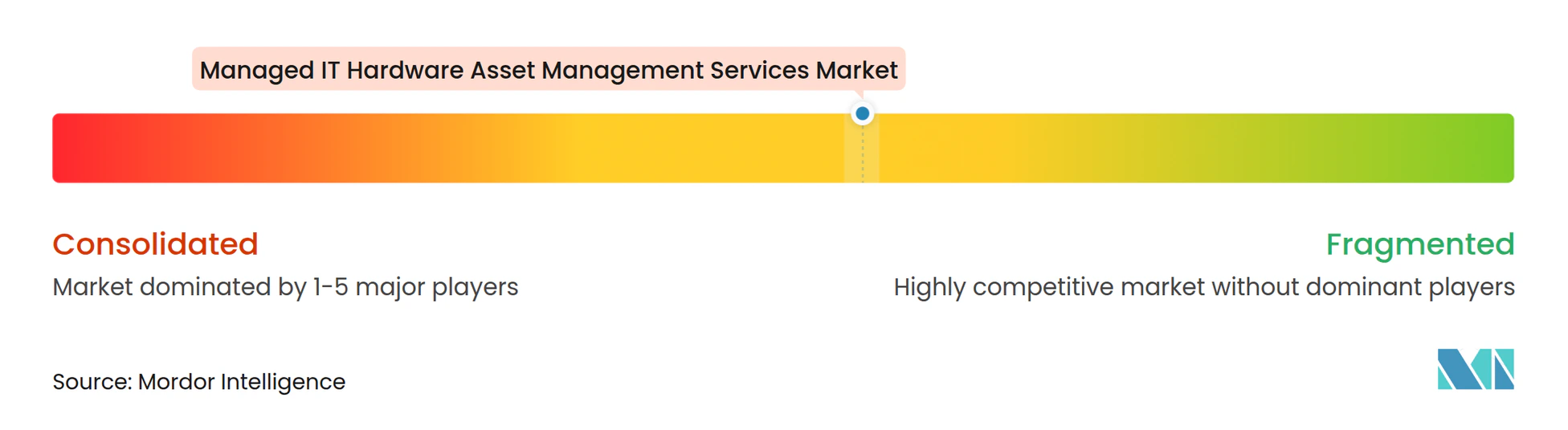
The Managed IT hardware asset management services market has a concentrated premium tier and a broad base of specialist providers. Hewlett Packard Enterprise, Dell Technologies, and IBM compete for large contracts using OEM relationships and global engineering networks. Lifecycle managers, independent maintenance firms, and ITAD specialists serve many other accounts. The mid-market includes organizations with 500 to 5,000 devices that have meaningful management needs without the scale for premium OEM programs. CHG-MERIDIAN reported EUR 3.12 billion in 2025 lease originations, equal to USD 3.40 billion, and said the figure rose 10% year over year. Its financing model shows demand for lifecycle arrangements that combine equipment access with refresh commitments.
Competitive offerings increasingly include data erasure certification and environmental documentation. Blancco announced an Agentic Platform for IT asset lifecycle management and data erasure in October 2026. The company also announced an integration with Cambrionix for compliant Apple Mac erasure and reimaging in April 2026. These actions show how data-security providers are expanding beyond individual erasure jobs. Park Place Technologies introduced ParkView Asset Intelligence, which uses maintenance records, telemetry, and parts data to generate device health scores. ISO/IEC 19770 and ISO/IEC 27001 credentials can matter in regulated procurement because they demonstrate structured asset and security practices.
Ingram Micro has positioned Xvantage as an intelligence-led platform that includes more than 400 AI and machine-learning models. This direction reflects the shift from transaction-focused distribution toward recurring lifecycle services. Iron Mountain reported that its growth businesses, including asset lifecycle management, increased more than 50% year over year in Q2 2026. Providers differentiate through global logistics, certified data handling, multi-vendor support, and asset intelligence. The Managed IT hardware asset management services market is still fragmented below the largest suppliers because regional firms can specialize in local compliance and recovery activity. A market concentration score cannot be assigned from the available data because no combined market share for leading companies is provided.
Managed IT Hardware Asset Management Services Industry Leaders
-
Hewlett Packard Enterprise Company
-
Dell Technologies Inc.
-
International Business Machines Corporation
-
Cisco Systems, Inc.
-
Lenovo Group Limited
- *Disclaimer: Major Players sorted in no particular order
Managed IT Hardware Asset Management Services Market Companies Covered in this Report
- Hewlett Packard Enterprise Company
- Dell Technologies Inc.
- International Business Machines Corporation
- Cisco Systems, Inc.
- Lenovo Group Limited
- Iron Mountain Incorporated
- Park Place Technologies, LLC
- SHI International Corp.
- Zones, LLC
- CDW Corporation
- Ingram Micro Inc.
- Sims Limited
- TES-AMM International Pte. Ltd.
- Apto Solutions, Inc.
- Cascade Asset Management, LLC
- CSI Leasing, Inc.
- 3stepIT Group Oy
- CHG-MERIDIAN AG
- Blancco Technology Group plc
- Renewtech ApS
Recent Industry Developments in Managed IT Hardware Asset Management Services Market
- October 2026: Iron Mountain published research on October 12, 2026, finding that 17% of organizations already use reclaimed IT spending as an AI funding source, with industry benchmarks indicating 10-30% of initial hardware costs can be recovered through formal asset lifecycle management programs. The research directly links managed ITAD program investment to AI infrastructure financing as a capital-recovery strategy.
- October 2026: Blancco Technology Group announced the industry's first Agentic Platform for IT asset lifecycle management and data erasure on October 14, 2026, integrating autonomous workflow orchestration into certified erasure processes. The platform enables high-volume enterprise and ITAD device processing without proportionate staffing increases, a move toward scaled, lower-cost per-unit processing economics.
- August 2026: Iron Mountain reported Q2 2026 results on August 5, 2026. Growth businesses, including data center, digital, and asset lifecycle management, collectively increased more than 50% year over year. Total quarterly revenue reached USD 2.0 billion, up 18.5% on a reported basis. The company raised full-year 2026 financial guidance simultaneously.
- May 2026: Iron Mountain disclosed a multi-year ALM agreement naming it sole provider across more than 30 countries for a global advertising company. The agreement covered enterprise IT asset decommissioning, remarketing, and a project to recycle and reuse 75,000 hardware items across the United States, Europe, and Asia-Pacific.
Global Managed IT Hardware Asset Management Services Market Report Scope
The Managed IT Hardware Asset Management Services Market comprises outsourced services that enable organizations to efficiently plan, procure, deploy, monitor, maintain, track, optimize, refresh, and retire IT hardware assets throughout their lifecycle.
The Managed IT Hardware Asset Management Services Report is Segmented by Service Type (Procurement and Deployment, Installation and Integration, Maintenance and Support, Asset Management, and End-of-Life Disposition), Hardware Type (Servers, Storage Systems, End-User Devices, Networking Equipment, and Other Hardware Types), End-User Industry (Banking, Financial Services and Insurance, Healthcare and Lifesciences, IT and Telecommunications, Retail and E-commerce, Manufacturing, Government and Public Sector, and Other End-User Industries), and Geography (North America [United States, Canada, Mexico, and Rest of North America], South America [Brazil, Argentina, and Rest of South America], Europe [Germany, United Kingdom, France, Italy, Russia, and Rest of Europe], Asia-Pacific [China, India, Japan, South Korea, and Rest of Asia-Pacific], Middle East [Saudi Arabia, United Arab Emirates, Turkey, and Rest of Middle East], and Africa [South Africa, Nigeria, and Rest of Africa]). The Market Forecasts are Provided in Terms of Value (USD).
Segmentation Overview
| Procurement and Deployment |
| Installation and Integration |
| Maintenance and Support |
| Asset Management |
| End-of-Life Disposition |
| Servers |
| Storage Systems |
| End-User Devices |
| Networking Equipment |
| Other Hardware Types |
| Banking, Financial Services and Insurance |
| Healthcare and Lifesciences |
| IT and Telecommunications |
| Retail and E-commerce |
| Manufacturing |
| Government and Public Sector |
| Other End-User Industries |
| North America | United States |
| Canada | |
| Mexico | |
| Rest of North America | |
| South America | Brazil |
| Argentina | |
| Rest of South America | |
| Europe | Germany |
| United Kingdom | |
| France | |
| Italy | |
| Russia | |
| Rest of Europe | |
| Asia-Pacific | China |
| India | |
| Japan | |
| South Korea | |
| Rest of Asia-Pacific | |
| Middle East | Saudi Arabia |
| United Arab Emirates | |
| Turkey | |
| Rest of Middle East | |
| Africa | South Africa |
| Nigeria | |
| Rest of Africa |
| By Service Type | Procurement and Deployment | |
| Installation and Integration | ||
| Maintenance and Support | ||
| Asset Management | ||
| End-of-Life Disposition | ||
| By Hardware Type | Servers | |
| Storage Systems | ||
| End-User Devices | ||
| Networking Equipment | ||
| Other Hardware Types | ||
| By End-User Industry | Banking, Financial Services and Insurance | |
| Healthcare and Lifesciences | ||
| IT and Telecommunications | ||
| Retail and E-commerce | ||
| Manufacturing | ||
| Government and Public Sector | ||
| Other End-User Industries | ||
| By Geography | North America | United States |
| Canada | ||
| Mexico | ||
| Rest of North America | ||
| South America | Brazil | |
| Argentina | ||
| Rest of South America | ||
| Europe | Germany | |
| United Kingdom | ||
| France | ||
| Italy | ||
| Russia | ||
| Rest of Europe | ||
| Asia-Pacific | China | |
| India | ||
| Japan | ||
| South Korea | ||
| Rest of Asia-Pacific | ||
| Middle East | Saudi Arabia | |
| United Arab Emirates | ||
| Turkey | ||
| Rest of Middle East | ||
| Africa | South Africa | |
| Nigeria | ||
| Rest of Africa | ||
Key Questions Answered in the Report
What is the size of the managed IT hardware asset management services market?
The managed IT hardware asset management services market is valued at USD 34.25 billion in 2026 and is projected to reach USD 50.74 billion by 2032 at an 8.18% CAGR.
Which service type holds the largest share?
Maintenance and Support holds 42.41% of revenue in 2026, supported by demand for uptime commitments and preventive maintenance.
Which hardware category is expected to expand fastest?
Servers are projected to expand at a 9.61% CAGR through 2032 as AI-related computing refreshes increase lifecycle work.
Which end-user sector has the strongest outlook?
IT and Telecommunications holds 24.64% of revenue in 2026 and is projected to expand at a 9.49% CAGR through 2032.
Which region is expected to expand fastest?
The Middle East is projected to expand at a 9.56% CAGR through 2032, supported by sovereign AI and data center programs.
Why are certified data erasure and disposition services important?
They help organizations maintain records of secure asset retirement and meet cybersecurity and environmental compliance requirements.