
Managed IT Asset Lifecycle Services Market Size and Share
Market Overview
| Study Period | 2021 - 2032 |
|---|---|
| Market Size (2027) | USD 24.43 Billion |
| Market Size (2032) | USD 36.71 Billion |
| Growth Rate (2027 - 2032) | 8.48 % |
| Fastest Growing Market | Asia-Pacific |
| Largest Market | North America |
| Market Concentration | Medium |
Major Players *Disclaimer: Major Players sorted in no particular order Image © Mordor Intelligence. Reuse requires attribution under CC BY 4.0. | |
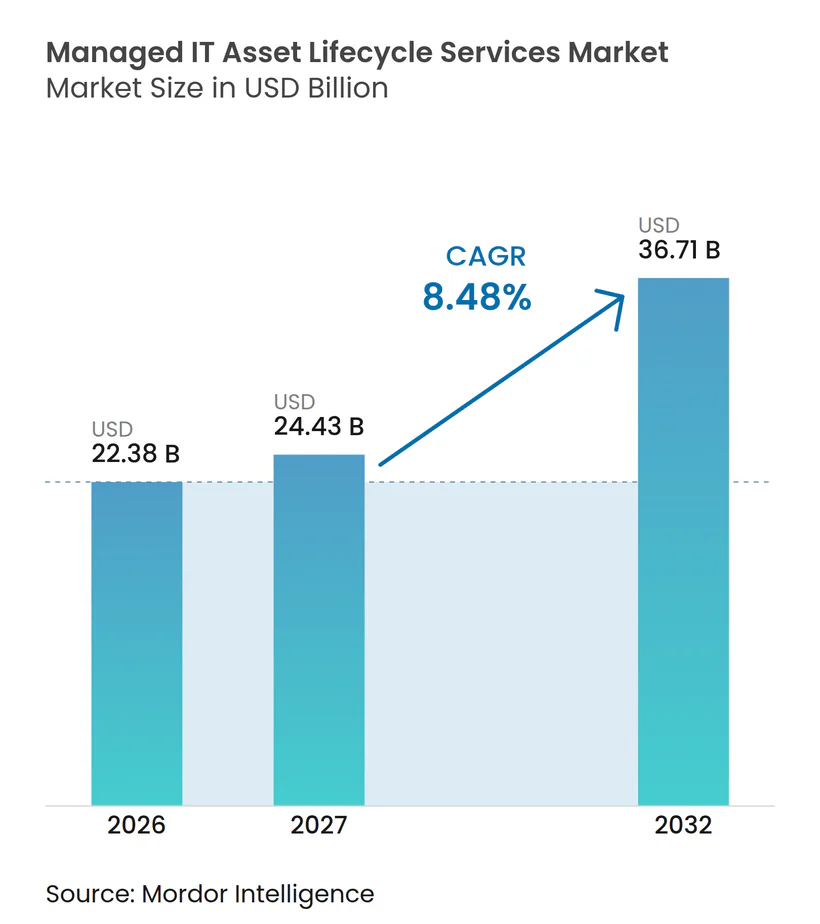
Managed IT Asset Lifecycle Services Market Analysis by Mordor Intelligence
The Managed IT Asset Lifecycle Services Market size was valued at USD 22.38 billion in 2026 and is estimated to reach USD 36.71 billion by 2032, at a CAGR of 8.48% during the forecast period 2027-2032. The Managed IT Asset Lifecycle Services Market is supported by shorter refresh cycles for AI-ready servers, which increase the volume of high-value equipment entering managed programs. Data security standards and sustainability reporting requirements are also making documented asset retirement a core enterprise requirement. Providers with certified data destruction, traceable logistics, and integrated reporting are better positioned for larger enterprise contracts. Device-as-a-Service contracts can make return volumes more predictable because reverse logistics is built into procurement arrangements. The Managed IT Asset Lifecycle Services Market remains fragmented, although global providers are gaining advantage through certified processing capacity, technology platforms, and cross-border operating coverage.
Key Report Takeaways
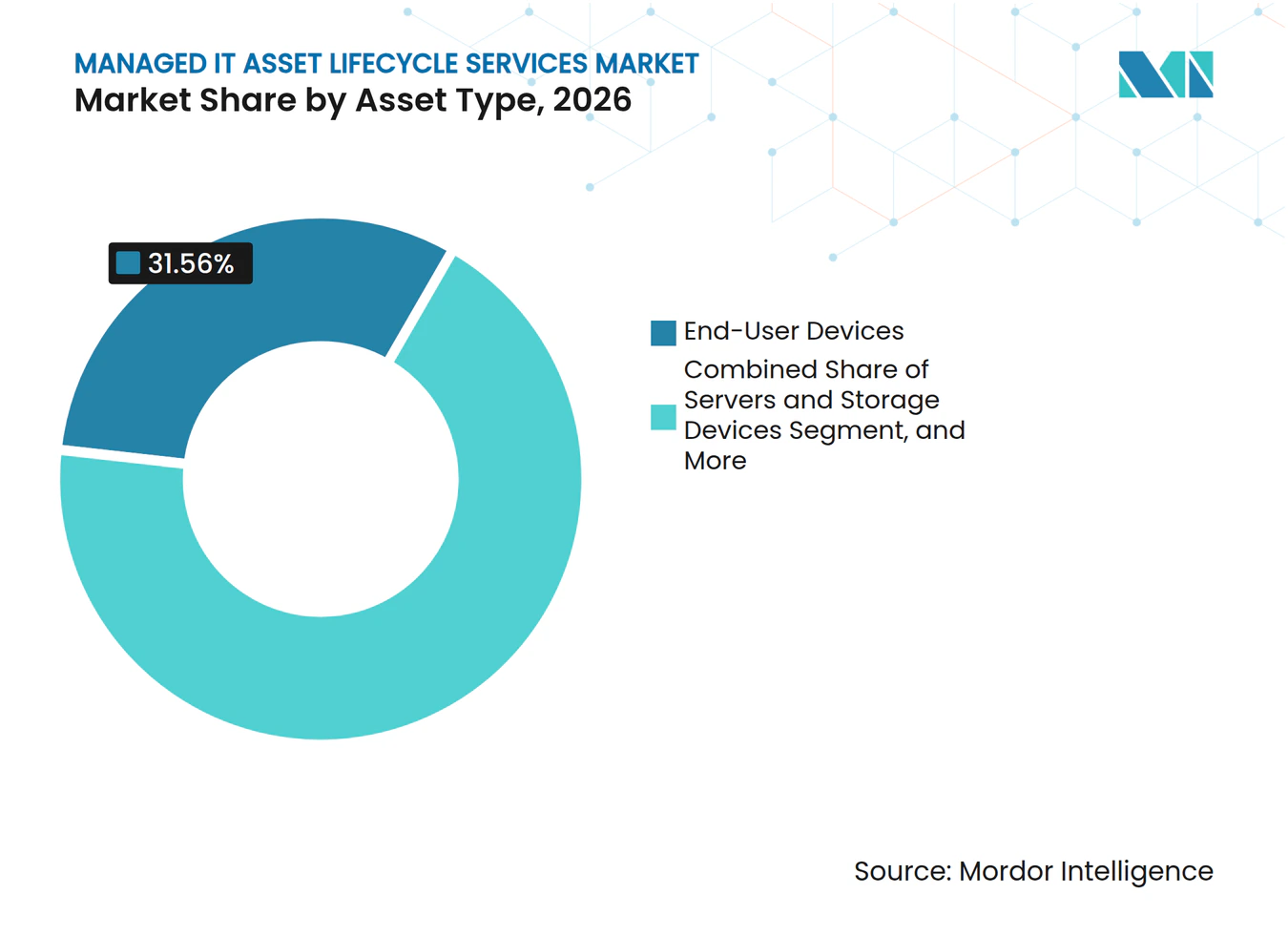
- By asset type, end-user devices held a 31.56% revenue share in 2026, while servers and storage devices are projected to expand at a 9.72% CAGR through 2032.
- By lifecycle service type, maintenance, repair, and upgrade management accounted for 21.82% of revenue in 2026, while asset discovery, tracking, and governance is projected to expand at a 9.81% CAGR through 2032.
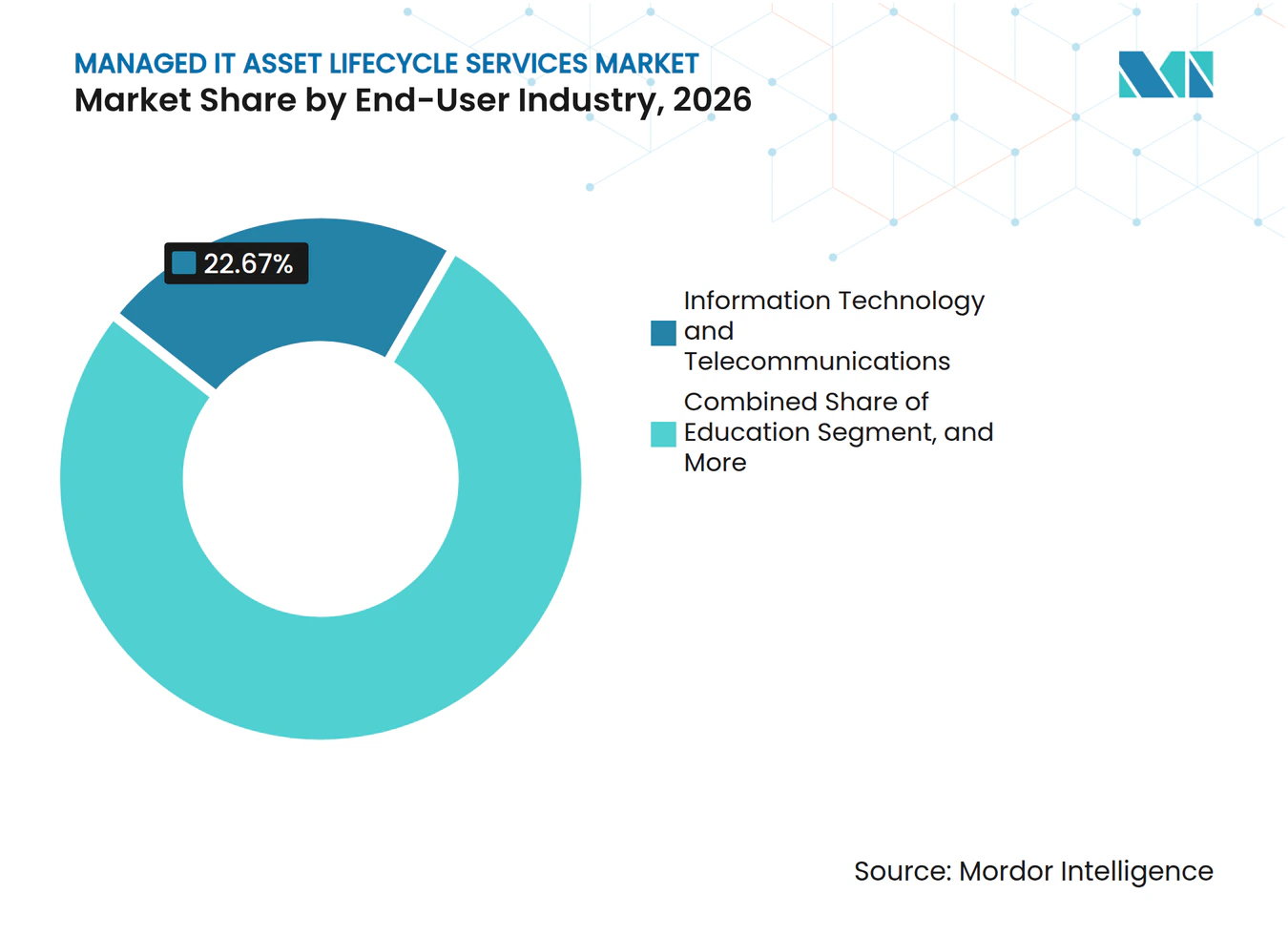
- By end-user industry, information technology and telecommunications held 22.67% of revenue in 2026 and is projected to expand at a 9.93% CAGR through 2032.
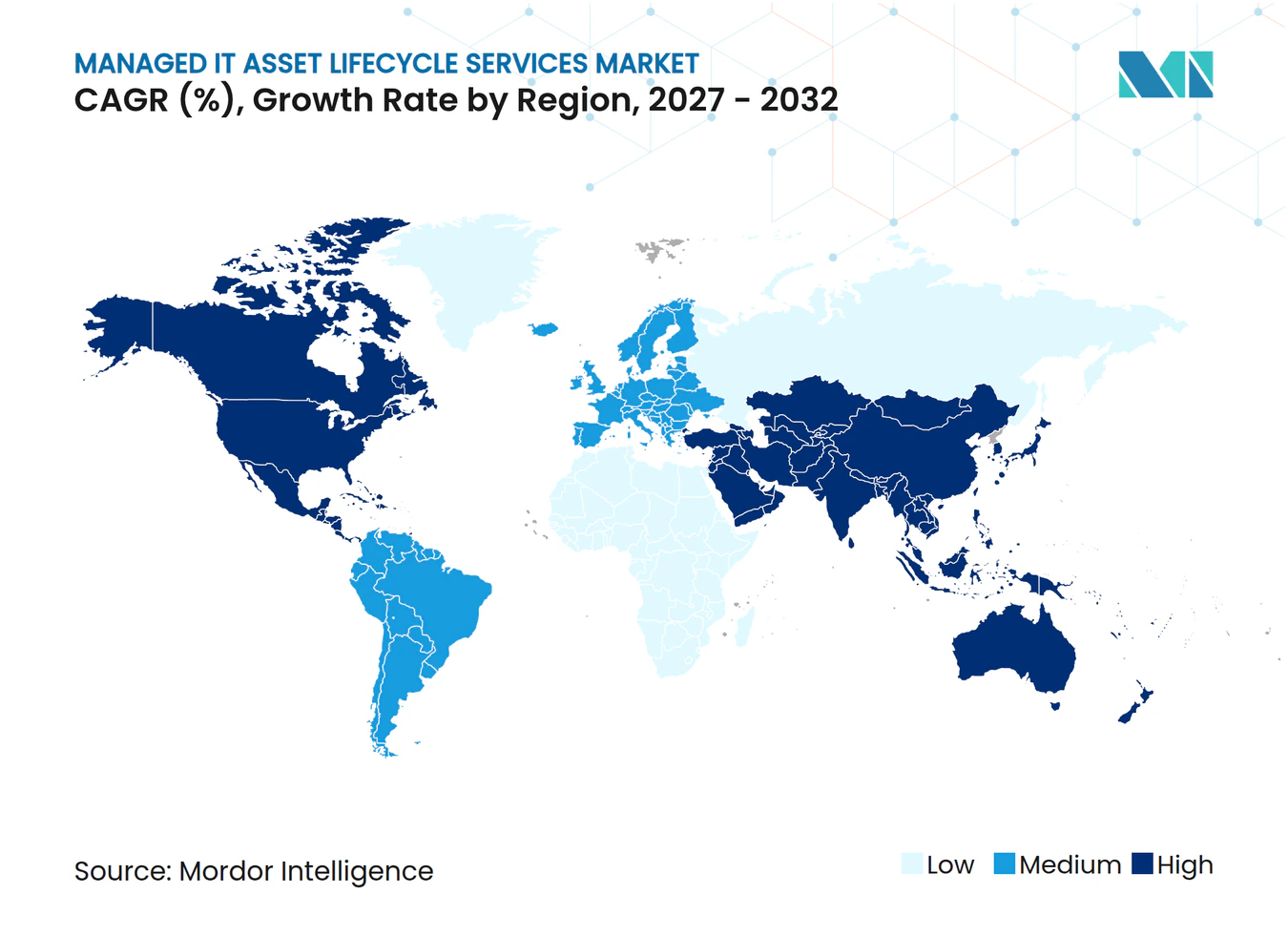
- By geography, North America held 41.64% of revenue in 2026, while Asia-Pacific is projected to expand at a 9.86% CAGR through 2032.
Note: Market numbers in this report are based on Mordor Intelligence's proprietary estimation framework, which combines nine months of actuals with Q4 projections for base year 2026.
Market Trends and Insights
Drivers Impact Analysis of Managed IT Asset Lifecycle Services Market*
| Driver | (~) % Impact on CAGR Forecast | Geographic Relevance | Impact Timeline |
|---|---|---|---|
| Accelerated AI Infrastructure and Data Center Refresh Cycles | +1.8% | Global, highest concentration in North America and Asia-Pacific | Short term (≤ 2 years) |
| Shortening Enterprise Device Refresh Intervals | +1.4% | Global | Medium term (2-4 years) |
| Rising Cybersecurity and Data-Residency Compliance Requirements | +1.2% | Global, heightened in North America, Europe, and Asia-Pacific | Medium term (2-4 years) |
| Expansion of Device-as-a-Service and Outcome-Based Contracts | +1.0% | North America and Europe, with spillover to Asia-Pacific | Medium term (2-4 years) |
| Circular Economy and Scope 3 Reporting Requirements | +0.8% | Europe core, with spillover to North America and Asia-Pacific | Long term (≥ 4 years) |
| Distributed and Hybrid Workplace Asset Complexity | +0.6% | Global | Short term (≤ 2 years) |
| Source: Mordor Intelligence | |||
Accelerated AI Infrastructure and Data Center Refresh Cycles
Large-scale AI workloads are changing the mix of assets moving through managed retirement programs. GPU-optimized server racks have refresh cycles of 18-24 months, compared with conventional enterprise server cycles of up to 5 years. These systems are dense, often use liquid cooling, and contain valuable GPU memory and network components. They require component-level assessment and specialized handling instead of high-volume commodity recycling. The first material wave of GPU-dense server decommissioning is expected to enter disposition channels between 2026 and 2029. The Managed IT Asset Lifecycle Services Market therefore favors providers that can mobilize quickly, sanitize equipment at the site or rack, and place recovered components through qualified downstream channels.
Shortening Enterprise Device Refresh Intervals
General enterprise devices are also being replaced sooner, increasing the regularity of return volumes. Cascade Asset Management reported an average retirement age of 4.1 years for enterprise laptops and 4.6 years for desktops across more than 1.6 million assets processed from 2020 through 2024. More predictable return timing helps providers plan transport, staffing, refurbishment, and resale activities. The same report stated that refurbished laptop resale values rose 37.3% year over year in 2024, while server resale values increased 5.1%.[1] Stronger resale outcomes improve the economics of refurbishment and remarketing compared with direct recycling. This supports full-lifecycle contracts that link refresh schedules with residual-value recovery in the Managed IT Asset Lifecycle Services Market.
Rising Cybersecurity and Data-Residency Compliance Requirements
Data destruction requirements are becoming more formal across enterprise asset retirement programs. NIST released Special Publication 800-88 Revision 2 in September 2025, updating guidance for media sanitization programs and aligning it with ISO/IEC 27040 and IEEE 2883.[2] The revised guidance raises expectations for serialized chain-of-custody records, audit reports, and consistent controls for externally managed key environments. GDPR, HIPAA, India’s Digital Personal Data Protection Act, and Japan’s Act on the Protection of Personal Information impose different standards for evidence of data deletion. The ITU issued supplementary guidance for media sanitization at service provider facilities in July 2025. These compliance factors are increasing demand for credentialed providers in the Managed IT Asset Lifecycle Services Market.
Expansion of Device-as-a-Service and Outcome-Based Contracts
Device-as-a-Service changes the way enterprises procure, use, and return endpoint devices. These contracts can include deployment, support, replacement, reverse logistics, and recovery responsibilities in one arrangement. This model transfers more refresh-timing decisions from internal IT teams to service operators. Operators have a financial reason to reduce holding time and recover residual value from returned assets. The structure makes managed lifecycle providers more relevant as procurement partners rather than only end-of-life vendors. It also supports recurring revenue structures instead of isolated hardware purchase and resale transactions in the Managed IT Asset Lifecycle Services Market.
Restraints Impact Analysis of Managed IT Asset Lifecycle Services Market*
| Restraint | (~) % Impact on CAGR Forecast | Geographic Relevance | Impact Timeline |
|---|---|---|---|
| Fragmented Cross-Border Chain-of-Custody Requirements | -1.5% | Global, sharpest friction across flows between Europe, Asia, and the Americas | Medium term (2-4 years) |
| Integration Complexity Across Legacy and Siloed Systems | -1.0% | Global | Medium term (2-4 years) |
| Shortage of Certified Data-Destruction and Hardware-Engineering Talent | -0.8% | Global | Short term (≤ 2 years) |
| OEM Warranty Extensions and In-House Repair Deferring Third-Party Lifecycle Spend | -0.6% | North America and Europe | Long term (≥ 4 years) |
| Source: Mordor Intelligence | |||
Fragmented Cross-Border Chain-of-Custody Requirements
Cross-border asset disposition can expose enterprises to overlapping regulatory obligations. The Basel Convention requires prior informed consent for certain transboundary movements of hazardous waste, which can create additional documentation and timing requirements. GDPR requires accountable handling of personal data after an asset changes hands, while Indian and Japanese privacy rules apply their own verification expectations. A single global process may not satisfy every jurisdiction. Providers often need to build country-specific programs for sanitization, recordkeeping, transport, and downstream processing. The resulting compliance cost can reduce margins on international engagements and slow contract execution in the Managed IT Asset Lifecycle Services Market.
Integration Complexity Across Legacy and Siloed Systems
Many enterprises retain separate procurement systems, IT service management platforms, configuration management databases, and asset discovery tools. Asset records may not match across these systems when equipment reaches end of life. This creates delays in identifying the device, its history, its location, and its approved disposition route. Enterprises increasingly expect lifecycle providers to connect with existing IT service management, procurement, asset management, and reporting systems. Smaller providers may find the required integrations difficult to fund and maintain. The resulting technology gap can limit their ability to compete for large managed contracts in the Managed IT Asset Lifecycle Services Market.
*Our forecasts treat driver/restraint impacts as directional, not additive. The impact forecasts reflect baseline growth, mix effects, and variable interactions.
Managed IT Asset Lifecycle Services Market Segment Analysis
By Asset Type:
End-User Devices Lead While AI Servers Accelerate Retirement VolumesEnd-user devices accounted for a 31.56% revenue share in 2026. Enterprise laptop and desktop fleets create substantial volumes because they are deployed widely across offices, branches, and remote workforces. Device-as-a-Service contracts add structure to this activity by embedding reverse logistics within procurement agreements. This gives service providers clearer visibility of expected returns than ad hoc retirement projects. Peripherals and print equipment add handling and governance requirements, although they have lower residual-value potential. Mobile devices and wearables are also becoming more important as corporate smartphone programs and purpose-built devices expand in manufacturing, logistics, and healthcare within the Managed IT Asset Lifecycle Services Market.
Servers and storage devices are projected to expand at a 9.72% CAGR through 2032. AI infrastructure deployed from 2022 onward is approaching a shorter 18-24-month refresh cycle. This creates a growing volume of GPU-dense servers requiring secure handling and detailed component assessment. These systems contain concentrated value in GPU memory and specialized network interconnects. Providers that can evaluate and resell these components can capture higher value per asset than conventional server retirement programs. Networking and edge equipment is also increasing as enterprises deploy distributed infrastructure for AI inference and remote processing.



By Lifecycle Service Type:
Tracking and Governance Become a Key Growth AreaMaintenance, repair, and upgrade management held 21.82% of revenue in 2026. The service benefits from recurring work across a device’s useful life, including battery replacement, storage upgrades, operating system refreshes, and break-fix support. These touchpoints help large providers maintain ongoing relationships with enterprise clients in the Managed IT Asset Lifecycle Services Market. Procurement, sourcing, deployment, configuration, and provisioning are the starting points for many managed engagements. Their role is especially important in Device-as-a-Service arrangements where a provider supports equipment from order through commissioning. Decommissioning, secure data destruction, recycling, and material recovery remain necessary later in the lifecycle as compliance and sustainability expectations rise.
Asset discovery, tracking, and governance is projected to expand at a 9.81% CAGR through 2032. Enterprises are moving from periodic inventory checks toward continuous visibility across on-premises, cloud, and edge environments. This reflects audit requirements, sustainability disclosures, and the need for serialized data from procurement through retirement. Japan’s Cloud Service Promotion Organization reported in 2025 that 89.7% of Japanese enterprises were adopting or considering cloud-based IT asset management tools. Refurbishment, redeployment, and remarketing also benefit from stronger secondary equipment pricing. The Managed IT Asset Lifecycle Services Market size for this service group is supported by enterprise demand for measurable control over asset status and disposition evidence.
By End-User Industry:
Technology and Telecommunications Combine Scale With the Fastest ExpansionInformation technology and telecommunications held 22.67% of the Managed IT Asset Lifecycle Services Market share in 2026. The sector is also projected to expand at a 9.93% CAGR through 2032, making it both the largest and fastest-growing end-user segment. Technology companies are generating more retiring equipment through data center expansion and AI infrastructure investment. They also use advanced lifecycle programs to control data risk, recover asset value, and meet sustainability reporting needs. Software and services firms with multi-region data center footprints create demand for hyperscale decommissioning. Telecommunications operators add ongoing volumes from handset programs and recurring network equipment upgrades.
Banking, financial services, and insurance remains the second-largest source of demand because of strict data-residency and destruction requirements. Healthcare and life sciences requires secure handling of patient data from medical-grade and general-purpose IT hardware. Government and public institutions operate on longer procurement cycles, yet their fleet refresh projects can produce large batches of assets. Federal and defense agencies also have strong alignment with NIST media-sanitization guidance. Manufacturing is adding new asset classes as edge computing and industrial IoT equipment become more common. Education is creating demand as devices purchased during the pandemic reach their natural end of life in the Managed IT Asset Lifecycle Services Market.

Geography Analysis
North America held 41.64% of the Managed IT Asset Lifecycle Services Market share in 2026. Dense enterprise IT infrastructure, established third-party processing networks, and active AI data center construction support this position. NIST SP 800-88 Revision 2 provides a major compliance reference for federal agencies and government contractors that need documented media sanitization.[3] Financial services and healthcare organizations create sustained demand because they combine large device fleets with strict data controls. Iron Mountain reported that its data center decommissioning revenue more than doubled year over year in the first quarter of 2026, reflecting activity across enterprise and hyperscale mandates. Canada’s privacy framework adds compliance requirements for cross-border engagements, while Mexico’s electronics manufacturing base is building an early source of industrial asset returns.
Asia-Pacific is projected to expand at a 9.86% CAGR through 2032. India’s E-Waste Management Rules established recycling targets of 20% from fiscal year 2025-2026 and strengthened the role of authorized collection and refurbishment channels. The ASEAN Guide for Sustainable Data Center Development identified a regional data center pipeline exceeding 10 GW by the end of the decade, including more than 5 GW of projects in Johor. New data center capacity will create future volumes of servers, storage systems, networking equipment, and enterprise devices for managed retirement programs. Japan is an important regional market as organizations place greater attention on IT asset governance, cybersecurity, and supply chain management. ISO/IEC 19770-1:2017 is gaining relevance as a framework for disciplined asset management in these enterprise programs.
Europe holds the second-largest regional position in the Managed IT Asset Lifecycle Services Market. The European Commission narrowed the scope of CSRD reporting in February 2026, yet the revised thresholds continue to cover large companies that hold substantial IT asset fleets. Germany’s Federal Environment Agency has issued procurement guidance that encourages public bodies to consider refurbished ICT equipment, supporting more circular practices. South America is centered on Brazil and Argentina, where enterprise digitization is increasing equipment retirement volumes, although informal channels remain a constraint. Saudi Arabia and the UAE are adding enterprise-grade data center capacity under national digital programs, increasing the need for data-sovereignty controls and structured decommissioning. South Africa and Nigeria represent early-stage formal demand centers as enterprise infrastructure and e-waste frameworks develop in the Managed IT Asset Lifecycle Services Market.
Competitive Landscape
Market Concentration
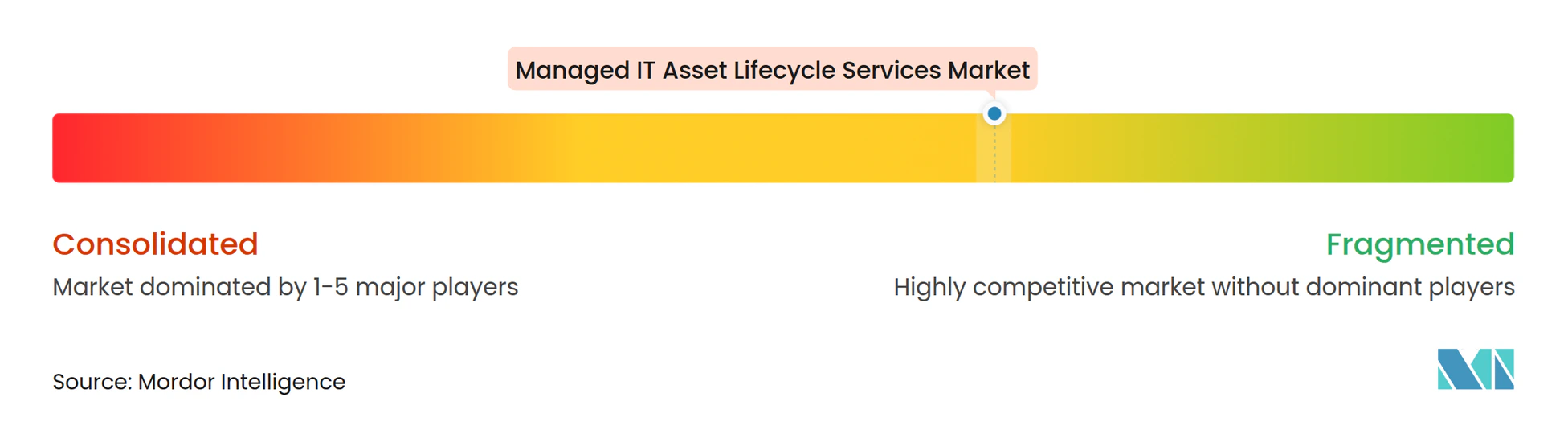
The Managed IT Asset Lifecycle Services Market remains fragmented, with globally integrated providers competing against many regional specialists. Consolidation is changing the competitive structure, particularly where companies need certified processing sites and broader geographic coverage. Sage Sustainable Electronics acquired Cascade Asset Management in January 2025, creating a combined business with 8 facilities and annual handling capacity of 1.3 million electronic assets. The combined company offers services from deployment and repair through end-of-life management. Larger providers are also using acquisitions to add regional coverage, specialized asset handling, and processing capacity. This activity increases the importance of scale in customer tenders that need consistent service across multiple sites in the Managed IT Asset Lifecycle Services Market.
Technology platforms are becoming a key competitive factor. Enterprise customers expect auditable data sanitization, chain-of-custody documentation, ESG reporting, and system integrations. Iron Mountain described a multiyear agreement to provide lifecycle services across more than 30 countries for a global advertising company, alongside a data center mandate involving 60,000 drives for a technology company. Dynamic Lifecycle Innovations launched Dynamic ITAD Sync for the ServiceNow Store in July 2026, allowing users to schedule pickups, track disposition status, access certificates of destruction, and create compliance reports from their existing workflow. These examples show why integration and traceability are becoming important in enterprise selection decisions. R2v3, NAID AAA, ISO 14001, e-Stewards, and ISO 27001 are increasingly baseline requirements in regulated tenders.
AI server decommissioning adds another separation between providers. The work requires specialized engineering, rapid site mobilization, on-device data sanitization, and established secondary markets for components. Reconext completed a 2025 decommissioning project involving 2,500 NVIDIA GPU-powered AI servers and more than 17,000 loose hard drives across 4 facilities. Its use of Rackwipe and Proteus systems supported a reported 97% reuse yield. Smaller operators may remain relevant in local collection and routine refurbishment, but they can face challenges in large, high-security data center assignments in the Managed IT Asset Lifecycle Services Market. Market concentration score: 3 out of 10, because no combined share data for leading providers is available and the presence of hundreds of regional and niche operators indicates a fragmented competitive structure.
Managed IT Asset Lifecycle Services Industry Leaders
-
Iron Mountain Incorporated
-
Sims Limited
-
SK Tes Co., Ltd.
-
Reconext Holdings, LLC
-
EPC, Inc.
- *Disclaimer: Major Players sorted in no particular order
Managed IT Asset Lifecycle Services Market Companies Covered in this Report
- Iron Mountain Incorporated
- Sims Limited
- SK Tes Co., Ltd.
- Reconext Holdings, LLC
- Cascade Asset Management, Inc.
- Apto Solutions, Inc.
- Wisetek Solutions Limited
- Sage Sustainable Electronics, LLC
- ERI, LLC
- DMD Systems Recovery, Inc.
- Securis, Inc.
- HOBI International, Inc.
- Dynamic Lifecycle Innovations, Inc.
- UCS Logistics, Inc.
- OSI Global, Inc.
- Techbuyer Limited
- Foxway AB
- Restore Technology Limited
- Cxtec, Inc.
- EPC, Inc.
- Global Resale, Inc.
- PlanITROI, Inc.
Recent Industry Developments in Managed IT Asset Lifecycle Services Market
- October 2026: SK Tes Japan and XTREME-D announced a strategic partnership to develop sustainable, cloud-based AI services using refurbished servers, linking enterprise hardware recovery directly to hyperscale AI service delivery and establishing a new commercial model for second-life data center assets. The collaboration is consistent with SK Tes’s broader strategy of addressing AI infrastructure decommissioning amid accelerating hardware refresh cycles.
- August 2026: Iron Mountain reported Q2 2026 asset lifecycle management revenue of USD 288 million, up 88% year over year including 82% organic growth. During the quarter, Iron Mountain signed a multiyear agreement with a global advertising company, becoming its sole ALM provider across more than 30 countries, and also completed a mandate to decommission and remarket 75,000 IT hardware items across the United States, Europe, and Asia-Pacific for an existing data center customer.
- July 2026: Dynamic Lifecycle Innovations launched “Dynamic ITAD Sync,” a native application on the ServiceNow Store enabling enterprise IT teams to schedule asset pickups, track disposition status in real time, access Certificates of Destruction, and generate compliance reporting without leaving their existing ServiceNow workflows, directly addressing the top enterprise demand for ITAD-to-ITSM connectivity.
- May 2026: Iron Mountain raised its full-year 2026 ALM revenue guidance to USD 950 million following Q1 2026 ALM revenue of USD 232 million, up 92% year over year, which exceeded projections by USD 40 million. The company added 2 dozen Fortune 1000 ALM customers in the quarter and signed a contract to securely decommission, sanitize, and remarket 60,000 drives for a global technology firm.
Global Managed IT Asset Lifecycle Services Market Report Scope
The Managed IT Asset Lifecycle Services Market encompasses outsourced services that enable organizations to plan, procure, deploy, monitor, maintain, secure, refresh, redeploy, and dispose of IT assets throughout their entire lifecycle.
The Managed IT Asset Lifecycle Services Market Report is Segmented by Asset Type (End-User Devices, Servers and Storage Devices, Networking and Edge Equipment, Mobile Devices and Wearables, Peripherals and Print Equipment, and Other IT Assets), Lifecycle Service Type (Procurement and Sourcing Management, Deployment, Configuration, and Provisioning, Maintenance, Repair, and Upgrade Management, Asset Discovery, Tracking, and Governance, Decommissioning and Secure Data Destruction, Refurbishment, Redeployment, and Remarketing, and Recycling and Material Recovery), End-User Industry (Banking, Financial Services, and Insurance, Information Technology and Telecommunications, Healthcare and Life Sciences, Government and Public Institutions, Manufacturing and Industrial, Education, and Other End-User Industries), and Geography (North America [United States, Canada, and Mexico], South America [Argentina, Brazil, and Rest of South America], Europe [Germany, United Kingdom, France, Russia, and Rest of Europe], Asia-Pacific [China, Japan, India, South Korea, and Rest of Asia-Pacific], Middle East [Turkey, Saudi Arabia, United Arab Emirates, and Rest of Middle East], and Africa [Nigeria, South Africa, and Rest of Africa]). The Market Forecasts are Provided in Terms of Value (USD).
Segmentation Overview
| End-User Devices |
| Servers and Storage Devices |
| Networking and Edge Equipment |
| Mobile Devices and Wearables |
| Peripherals and Print Equipment |
| Other IT Assets |
| Procurement and Sourcing Management |
| Deployment, Configuration, and Provisioning |
| Maintenance, Repair, and Upgrade Management |
| Asset Discovery, Tracking, and Governance |
| Decommissioning and Secure Data Destruction |
| Refurbishment, Redeployment, and Remarketing |
| Recycling and Material Recovery |
| Banking, Financial Services, and Insurance |
| Information Technology and Telecommunications |
| Healthcare and Life Sciences |
| Government and Public Institutions |
| Manufacturing and Industrial |
| Education |
| Other End-User Industries |
| North America | United States |
| Canada | |
| Mexico | |
| South America | Argentina |
| Brazil | |
| Rest of South America | |
| Europe | Germany |
| United Kingdom | |
| France | |
| Russia | |
| Rest of Europe | |
| Asia-Pacific | China |
| Japan | |
| India | |
| South Korea | |
| Rest of Asia-Pacific | |
| Middle East | Turkey |
| Saudi Arabia | |
| United Arab Emirates | |
| Rest of Middle East | |
| Africa | Nigeria |
| South Africa | |
| Rest of Africa |
| By Asset Type | End-User Devices | |
| Servers and Storage Devices | ||
| Networking and Edge Equipment | ||
| Mobile Devices and Wearables | ||
| Peripherals and Print Equipment | ||
| Other IT Assets | ||
| By Lifecycle Service Type | Procurement and Sourcing Management | |
| Deployment, Configuration, and Provisioning | ||
| Maintenance, Repair, and Upgrade Management | ||
| Asset Discovery, Tracking, and Governance | ||
| Decommissioning and Secure Data Destruction | ||
| Refurbishment, Redeployment, and Remarketing | ||
| Recycling and Material Recovery | ||
| By End-User Industry | Banking, Financial Services, and Insurance | |
| Information Technology and Telecommunications | ||
| Healthcare and Life Sciences | ||
| Government and Public Institutions | ||
| Manufacturing and Industrial | ||
| Education | ||
| Other End-User Industries | ||
| By Geography | North America | United States |
| Canada | ||
| Mexico | ||
| South America | Argentina | |
| Brazil | ||
| Rest of South America | ||
| Europe | Germany | |
| United Kingdom | ||
| France | ||
| Russia | ||
| Rest of Europe | ||
| Asia-Pacific | China | |
| Japan | ||
| India | ||
| South Korea | ||
| Rest of Asia-Pacific | ||
| Middle East | Turkey | |
| Saudi Arabia | ||
| United Arab Emirates | ||
| Rest of Middle East | ||
| Africa | Nigeria | |
| South Africa | ||
| Rest of Africa | ||
Key Questions Answered in the Report
What is the Managed IT Asset Lifecycle Services Market size?
The Managed IT Asset Lifecycle Services Market was valued at USD 22.38 billion in 2026 and is projected to reach USD 36.71 billion by 2032 at an 8.48% CAGR.
What is driving demand for managed IT asset lifecycle services?
Shorter AI server refresh cycles, cybersecurity requirements, data sanitization rules, and sustainability reporting needs are increasing demand.
Which asset category is expected to expand fastest?
Servers and storage devices are projected to expand at a 9.72% CAGR through 2032, supported by AI infrastructure refresh cycles.
Which end-user sector leads demand?
Information technology and telecommunications held 22.67% of revenue in 2026 and is projected to expand at a 9.93% CAGR through 2032.
Which region has the largest share?
North America held 41.64% of revenue in 2026, supported by mature IT infrastructure and established compliance requirements.
Why are data destruction services important?
NIST SP 800-88 Revision 2 and varied privacy requirements make documented data sanitization and traceable chain of custody important for retired devices.