
Managed IoT Security Operations Services Market Size and Share
Market Overview
| Study Period | 2021 - 2032 |
|---|---|
| Market Size (2027) | USD 7.81 Billion |
| Market Size (2032) | USD 16.42 Billion |
| Growth Rate (2027 - 2032) | 19.91 % |
| Fastest Growing Market | Asia-Pacific |
| Largest Market | North America |
| Market Concentration | Medium |
Major Players *Disclaimer: Major Players sorted in no particular order Image © Mordor Intelligence. Reuse requires attribution under CC BY 4.0. | |
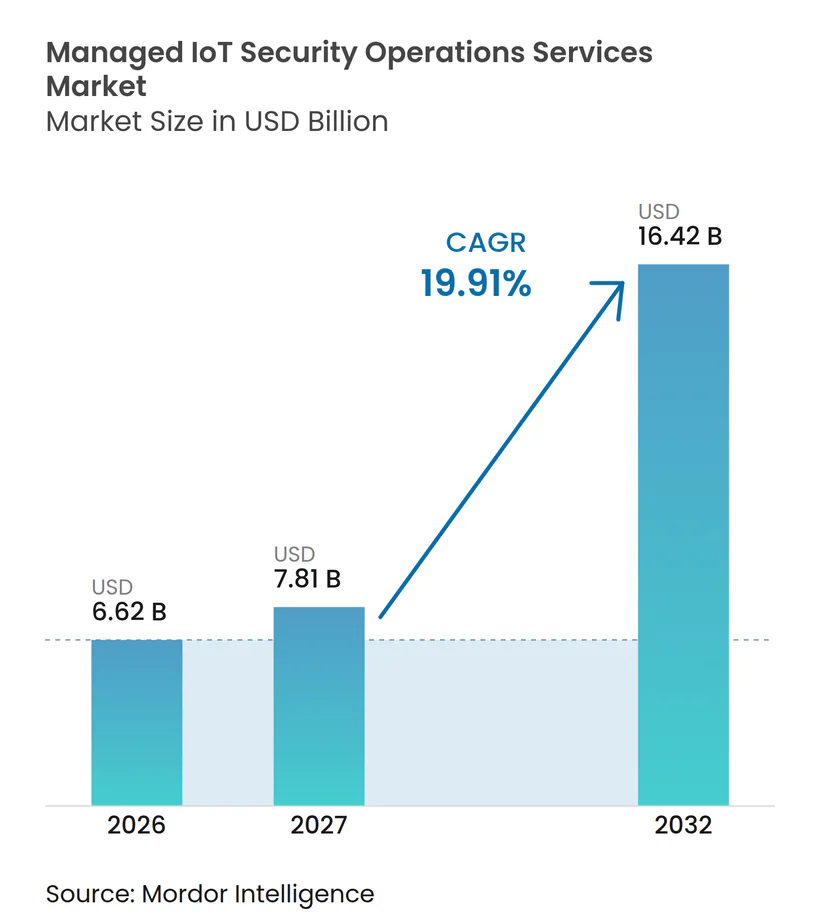
Managed IoT Security Operations Services Market Analysis by Mordor Intelligence
The managed IoT security operations services market size is valued at USD 6.62 billion in 2026 and is projected to reach USD 16.42 billion by 2032, advancing at a CAGR of 19.91% during 2027-2032. Demand reflects the rapid adoption of connected assets in industrial, healthcare, and municipal settings, where security teams must protect devices not designed for conventional enterprise controls. Many organizations also lack the OT and IoT specialists needed to maintain around-the-clock monitoring. Regulatory requirements for continuous vulnerability management and prompt incident reporting make outsourced operations more relevant to procurement decisions. The managed IoT security operations services market therefore benefits when operators need to preserve production continuity while improving visibility across sensors, industrial controls, medical devices, and older programmable logic controllers. Providers that unite protocol-aware monitoring, response services, and compliance reporting are better placed to retain accounts as security programs mature.
Key Report Takeaways
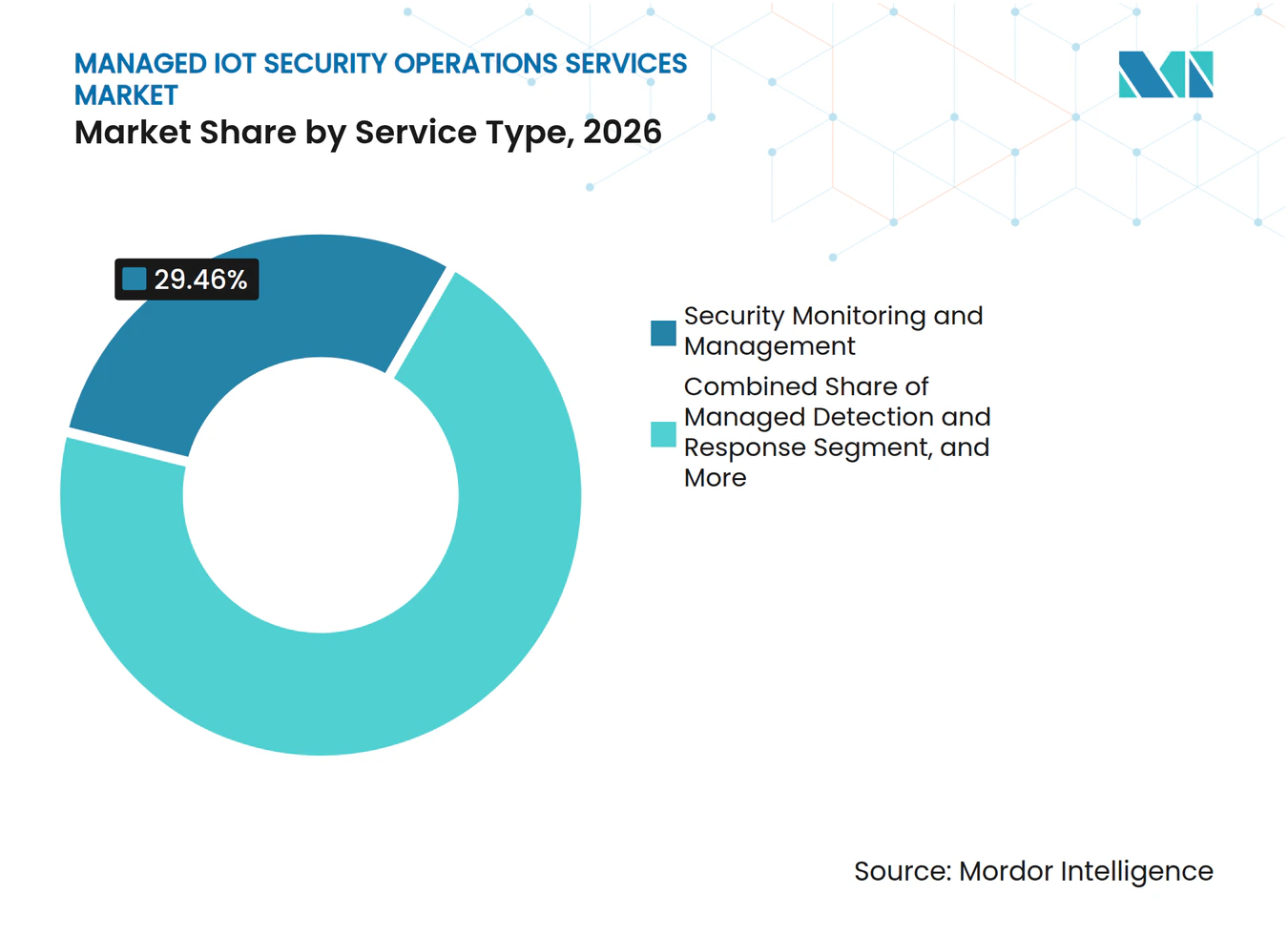
- By service type, Security Monitoring and Management held 29.46% of the managed IoT security operations services market share in 2026, while Managed Detection and Response is projected to expand at a 20.41% CAGR through 2032.
- By security function, Network and Protocol Security held 31.62% of revenue in 2026, while Identity, Access, and Privileged-Access Security is projected to expand at a 20.12% CAGR through 2032.
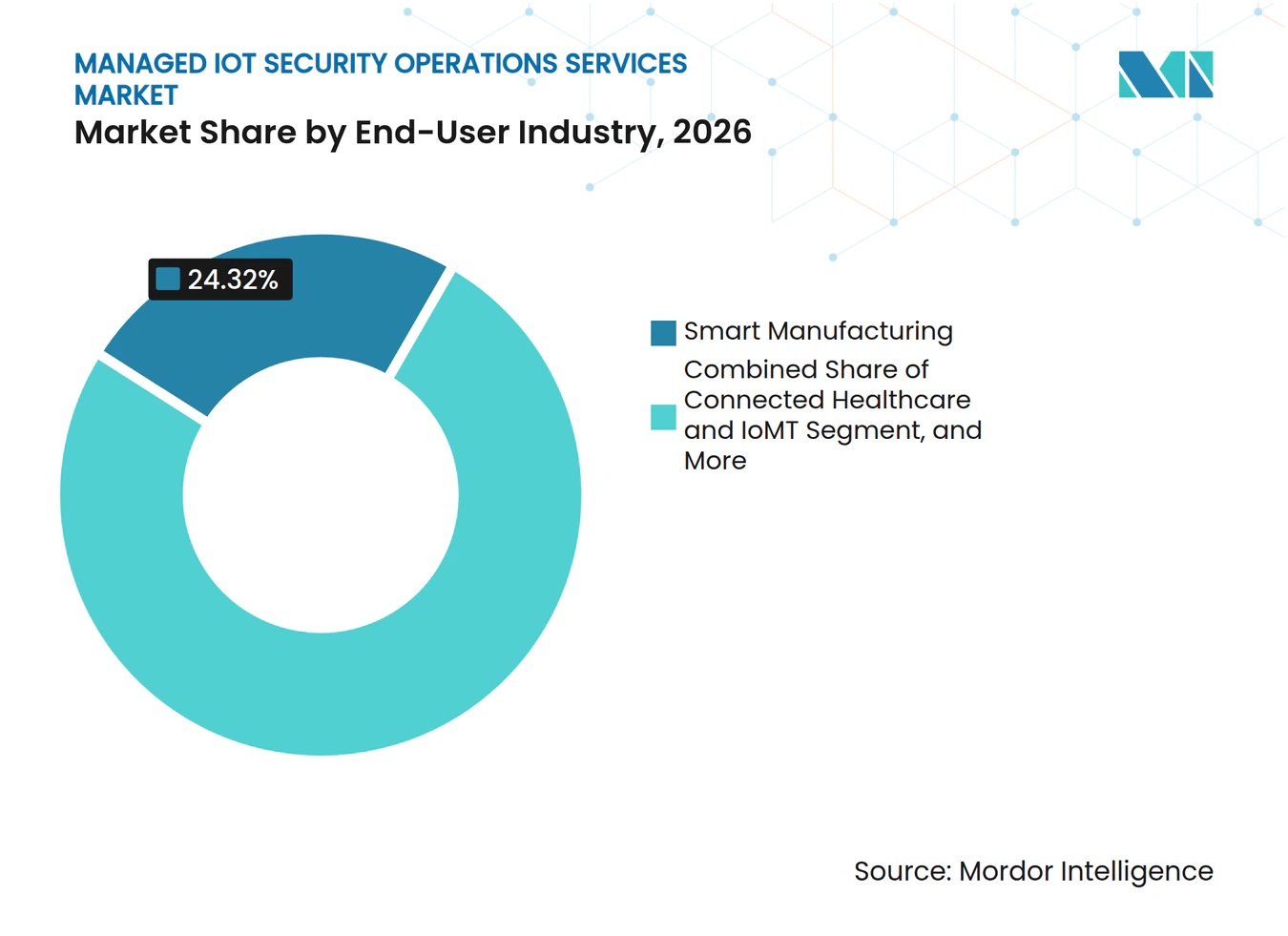
- By end-user industry, Smart Manufacturing accounted for 24.32% of revenue in 2026, while Connected Healthcare and IoMT is projected to expand at a 20.68% CAGR through 2032.
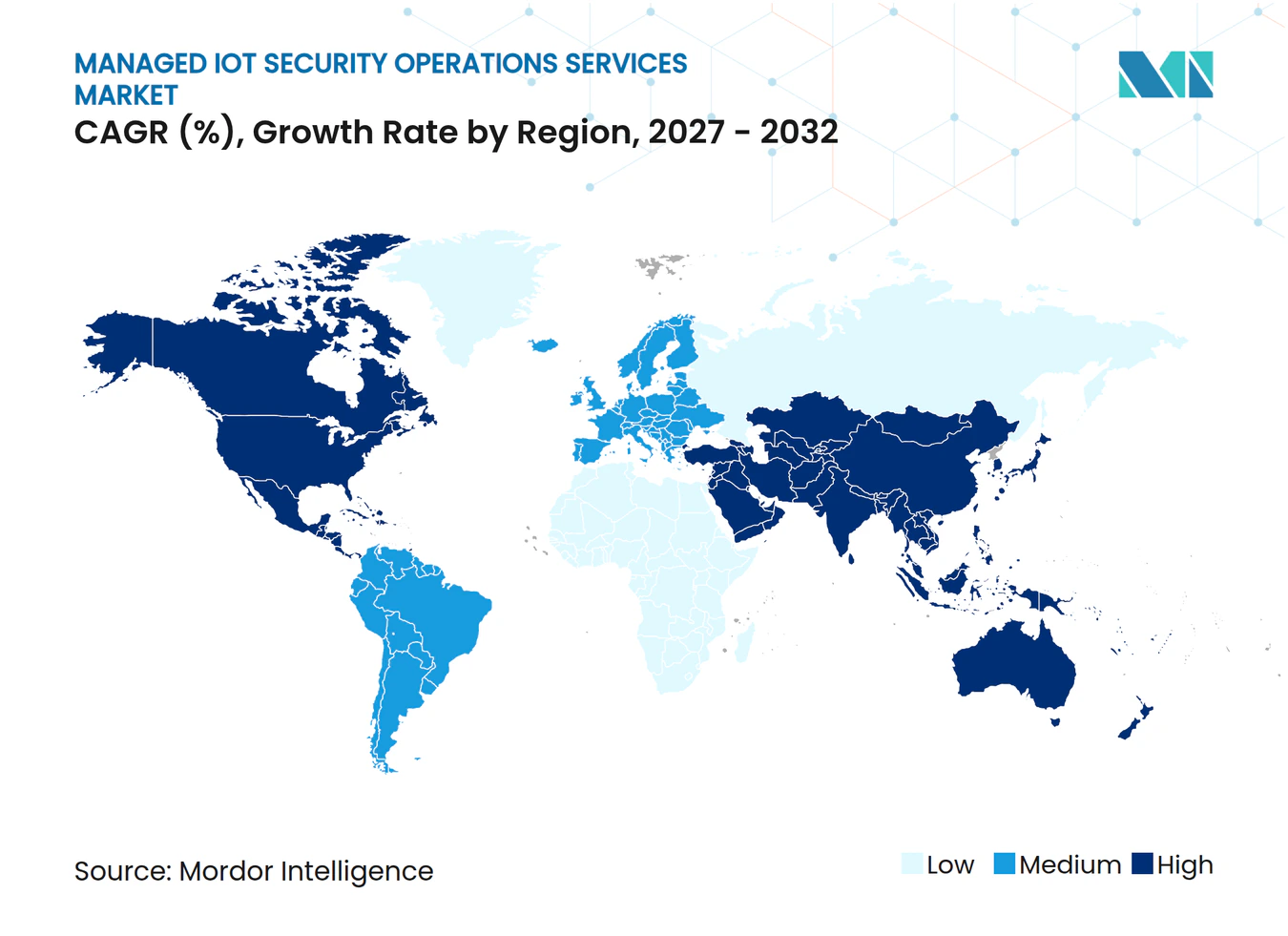
- By geography, North America accounted for 40.23% of revenue in 2026, while Asia-Pacific is projected to expand at a 20.76% CAGR through 2032.
Note: Market numbers in this report are based on Mordor Intelligence's proprietary estimation framework, which combines nine months of actuals with Q4 projections for base year 2026.
Market Trends and Insights
Drivers Impact Analysis of Managed IoT Security Operations Services Market*
| Driver | (~) % Impact on CAGR Forecast | Geographic Relevance | Impact Timeline |
|---|---|---|---|
| Growing IoT, OT, and IoMT Attack Surfaces | +5.2% | Global | Short term (≤ 2 years) |
| Cybersecurity Talent Shortages Driving 24/7 Monitoring Outsourcing | +4.1% | Global | Short term (≤ 2 years) |
| Regulatory Requirements for Continuous Vulnerability and Incident Reporting | +3.8% | North America and Europe | Medium term (2-4 years) |
| IT, OT, and IoT Convergence Requiring Unified Security Operations | +3.2% | Global | Medium term (2-4 years) |
| AI-Assisted Threat Detection and Automated Device Isolation | +2.5% | North America and Asia-Pacific | Long term (≥ 4 years) |
| Rising Security Requirements for Remote and Unattended Assets | +1.8% | Global | Medium term (2-4 years) |
| Source: Mordor Intelligence | |||
Growing IoT, OT, and IoMT Attack Surfaces
Expanding connectivity is widening device exposure faster than many security architectures can monitor it. IBM reported that 49% of 670 OT-related vulnerabilities disclosed during the first half of 2025 carried critical or high CVSS ratings, while 1 in 5 critical vulnerabilities had public exploit code.[1] Forescout found that IoT device exploits represented 19% of observed exploits in 2025, up from 16% in 2024, and identified IP cameras and network video recorders as leading targets. Zscaler reported 2025 attack increases of 387% in energy, 382% in transportation, and 224% in healthcare. These conditions increase the need for the managed IoT security operations services market to provide continuous, protocol-aware coverage across IT, OT, and IoMT estates. The breadth of connected devices makes internal coverage difficult for operators outside the largest industrial groups.
Cybersecurity Talent Shortages Driving 24/7 Monitoring Outsourcing
OT and IoT security staffing gaps are pushing organizations toward managed coverage because specialist roles can remain open for 4 to 9 months. EPRI found that only 9% of surveyed professionals devoted all their time to ICS or OT security, while decision-making budgets were often divided among IT, OT, and executive stakeholders.[2] Schneider Electric reported that 40% of critical infrastructure operators had 24/7 OT monitoring in place, even though 91% reported at least 1 OT breach or failure in the preceding 18 months. SANS found that 49% of organizations detected ICS security incidents within 24 hours, but nearly 1 in 5 took more than a month to fully remediate. This gap supports demand in the managed IoT security operations services market for services that combine alert triage, investigation, and recovery support. Providers can address a practical operating problem rather than simply add another security product.
Regulatory Requirements for Continuous Vulnerability and Incident Reporting
Compliance requirements are shifting from periodic attestations to ongoing security operations. NIS2 broadened incident-reporting and risk-management obligations across transport, water, healthcare, and digital infrastructure when it became applicable in October 2024.[3] The ISA/IEC 62443 series remains a recognized industrial cybersecurity framework for automation and control systems. The European Union Cyber Resilience Act will apply fully from December 2027 and sets cybersecurity requirements for products with digital elements across their life cycles. CISA issued Binding Operational Directive 26-02 in 2026 to require federal civilian agencies to mitigate risks from end-of-support edge devices. In the managed IoT security operations services market, providers that build reporting automation into active monitoring can fit compliance-led procurement processes more closely.
IT, OT, and IoT Convergence Requiring Unified Security Operations
Connected industrial programs are reducing the separation between business networks and operating environments. Fortinet found that 50% of organizations experienced at least 1 OT cybersecurity incident during its 2025 survey period. ISACA described how links among enterprise resource planning systems, industrial robots, and IoT sensors create lateral movement risk that requires unified telemetry. SANS reported that 58% of ICS and OT incidents originated from IT compromises that extended into OT networks. The managed IoT security operations services market is responding with services that correlate device, network, cloud, and identity signals in one operating workflow. Vendors with broad protocol coverage can replace separate point solutions where customers want clearer security accountability. This preference also supports larger platform acquisitions and partnerships.
Restraints Impact Analysis of Managed IoT Security Operations Services Market*
| Restraint | (~) % Impact on CAGR Forecast | Geographic Relevance | Impact Timeline |
|---|---|---|---|
| Fragmented Firmware, Protocol, and Patch-Management Ecosystems | -2.4% | Global | Long term (≥ 4 years) |
| Legacy Brownfield Infrastructure and Production Downtime Concerns | -2.1% | Europe and Asia-Pacific | Long term (≥ 4 years) |
| High Cost of Passive Sensors, Integration, and Specialized OT Expertise | -1.6% | South America, Middle East and Africa | Medium term (2-4 years) |
| Limited Telemetry Quality From Low-Power and Intermittently Connected Devices | -1.0% | Global, with acute impact in Middle East and Africa | Long term (≥ 4 years) |
| Source: Mordor Intelligence | |||
Fragmented Firmware, Protocol, and Patch-Management Ecosystems
Large device estates often include many firmware releases, proprietary protocols, and vendor-specific patch cycles. Phosphorus reported that 176,200 unique firmware versions had at least 1 known CVE through 2025, and that 549,098 end-of-life devices remained active in customer environments. Providers must often create device-specific connectors and integration workflows before they can establish dependable monitoring. Multi-vendor OT installations further require specialized support for protocols such as PROFINET and DNP3. This extends onboarding and can lower the quality of the telemetry available to analysts. The managed IoT security operations services market therefore faces slower time to full coverage than conventional IT security services.
Legacy Brownfield Infrastructure and Production Downtime Concerns
Industrial operators are cautious about deploying active agents or scanning tools where an unplanned interruption may affect safety or production. Palo Alto Networks found that more than 60% of exploit attempts against the 50,000 OT firewalls it analyzed targeted vulnerabilities that were 6 to 10 years old. Schneider Electric reported that cyber incidents caused service interruptions for 51% of affected manufacturing organizations and revenue loss for 49%. These risks lead customers to favor passive, sensor-based monitoring, which can limit the service scope that they authorize. Energy, chemicals, and continuous-process manufacturing require careful validation before any remediation activity. The managed IoT security operations services market must therefore combine cyber expertise with OT engineering knowledge when supporting brownfield environments.
*Our forecasts treat driver/restraint impacts as directional, not additive. The impact forecasts reflect baseline growth, mix effects, and variable interactions.
Managed IoT Security Operations Services Market Segment Analysis
By Service Type:
Monitoring Anchors Revenue as Detection and Response AcceleratesSecurity Monitoring and Management accounted for 29.46% of managed IoT security operations services market share in 2026. It provides continuous asset visibility and alert triage for dispersed connected devices and industrial protocols that standard IT tools may not interpret. Multi-year agreements can support retention after providers install sensors and tailor alert workflows to a production setting. Managed Detection and Response is projected to expand at a 20.41% CAGR during 2027-2032. Buyers are moving from basic observation toward detection, containment, investigation, and automated device isolation.
Threat Detection and Incident Response and Vulnerability and Exposure Management gain priority as clients seek measurable remediation. SANS found that ICS-specific incident response capability is associated with faster containment than IT-adapted playbooks. Compliance Monitoring and Reporting, Threat Intelligence and Threat Hunting, and Incident Readiness and Digital Forensics support more specialized needs. Dragos added active device discovery, firmware update automation, password rotation, and certificate management when it acquired Phosphorus Cybersecurity in June 2026. The managed IoT security operations services market favors providers that connect monitoring findings to practical device actions.



By Security Function:
Identity and Privileged Access Emerge as the Fastest-Growing Control DomainNetwork and Protocol Security held 31.62% of managed IoT security operations services market share in 2026. Modbus, DNP3, PROFINET, and EtherNet/IP require specialized analysis to separate normal industrial activity from anomalous behavior. Deep packet inspection and established protocol libraries are therefore core capabilities in industrial managed security contracts. Identity, Access, and Privileged-Access Security is projected to expand at a 20.12% CAGR from 2027 to 2032. IBM identified credential-based access abuse as a primary initial access method in OT incidents during 2025.
Remote access, third-party support, and original equipment manufacturer activity make time-limited access controls more important. Forescout and Xage Security combined device discovery with distributed, least-privilege access enforcement for OT and critical infrastructure in an August 2025 partnership. Endpoint and Device Security and Cloud and Virtual Security are also expanding as gateways and edge systems connect to cloud services. Application and API Security for IoT is emerging where industrial platforms use cloud back ends to process sensor data. The managed IoT security operations services market must combine these functions without interrupting devices that support physical processes.
By End-User Industry:
Smart Manufacturing Leads While Healthcare AcceleratesSmart Manufacturing held 24.32% of the managed IoT security operations services market share in 2026. Production sites combine programmable logic controllers, human-machine interfaces, supervisory control and data acquisition systems, industrial robots, and sensor networks. SANS found that 33% of ICS incidents were attributed to internet-accessible devices, showing the exposure created as remote monitoring expands. Energy and Utilities is the second-largest user group as grid modernization connects substations, smart meters, and distributed energy assets. Government and Smart Cities and Transportation and Logistics also give the managed IoT security operations services market large distributed device estates with limited internal capacity.
Connected Healthcare and IoMT is projected to expand at a 20.68% CAGR through 2032. Asimily reported that 43% of surveyed North American hospital CISOs identified complete device visibility as their leading cybersecurity challenge in December 2025. Forescout reported average quarterly annual recurring revenue expansion of 23% for 6 consecutive quarters in its healthcare business through 2025. Automotive and Mobility also need specialized support as vehicle controls connect with telematics systems. Retail and Commercial Buildings remain earlier-stage users, but the managed IoT security operations services market is relevant as building-management systems and retail networks become more connected.

Geography Analysis
North America Managed IoT Security Operations Services Market
North America accounted for 40.23% of the managed IoT security operations services market share in 2026. High security spending, critical infrastructure concentration, and enforceable requirements make continuous monitoring a procurement priority. NERC CIP requirements, CISA directives, and Transportation Security Administration cybersecurity directions support attention to energy, pipeline, and aviation assets. Canada and Mexico add manufacturing and energy demand, although the United States represents most regional spending. SANS found that the United States and Europe allocated 26% to 50% of cybersecurity budgets to ICS and OT in its 2025 survey.
Europe Managed IoT Security Operations Services Market
Europe is the second-largest regional market, led by Germany, the United Kingdom, and France. NIS2 has broadened the entities expected to improve security management and report significant cyber incidents across utilities, transport, healthcare, and digital infrastructure. The Cyber Resilience Act will add life-cycle cybersecurity obligations for manufacturers from December 2027. Italy offers demand from manufacturers and food processors with legacy equipment, while France's energy and transportation operators and United Kingdom critical infrastructure are increasing managed service procurement.
APAC, MEA and South America Managed IoT Security Operations Services Market
Asia-Pacific is projected to expand at a 20.76% CAGR from 2027 to 2032. Industrial digitization, a broad manufacturing base, and government-supported IoT programs are connecting assets faster than specialist teams can be hired. Japan's Ministry of Economy, Trade and Industry issued OT security guidelines for semiconductor device factories in 2025. NTT Communications expanded WideAngle OsecT in July 2025 with 24/7 operations support and monthly security assessments. China, India, and Indonesia are significant deployment markets, while South America, Middle East, and Africa remain earlier-stage opportunities for the managed IoT security operations services market because of cost and integration complexity.
Competitive Landscape
Market Concentration
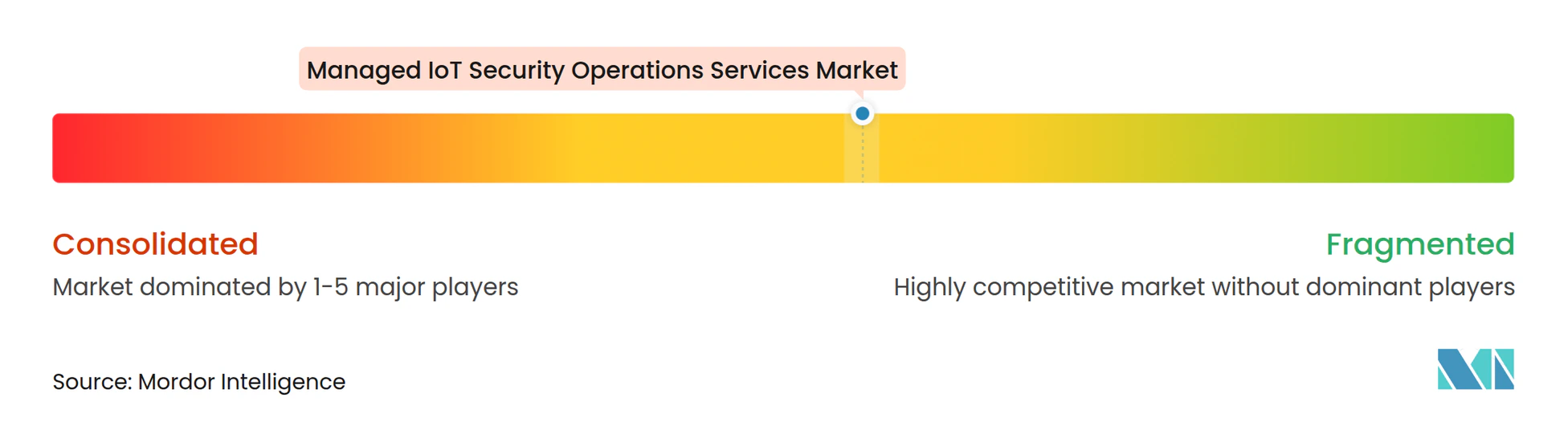
The managed IoT security operations services market is moderately consolidated among broad platform providers but fragmented among specialists. Accenture's majority investment in Dragos and related runZero and NetRise transactions added exposure assessment, attack-surface intelligence, and firmware-level visibility to a larger platform strategy. ServiceNow's acquisition of Armis added agentless asset discovery and cyber risk management across IT, OT, IoT, medical devices, physical AI, and cloud. Mitsubishi Electric acquired Nozomi Networks in September 2025, bringing OT and IoT visibility into its industrial equipment portfolio. These acquisitions support bundled security monitoring for customers with established industrial equipment relationships.
Claroty, TXOne Networks, Asimily, and Forescout compete through vertical specialization and partnerships. Claroty raised USD 150 million in a Series F round in January 2026 to support global expansion and platform development. Forescout and Xage joined device intelligence with least-privilege access controls in their 2025 partnership. Ontinue launched ION for IoT Security in February 2025 to provide managed detection and response using Microsoft Defender for IoT. Such partnerships let firms extend managed IoT security operations services market coverage without first developing proprietary sensor networks.
The managed IoT security operations services market increasingly competes on device telemetry, threat intelligence, and remediation capability. Dragos added device discovery, firmware updates, credential rotation, and certificate management through its Phosphorus acquisition. Mid-market manufacturing, building automation, and smart city settings remain open areas where security operations coverage is less developed. Providers that simplify deployment in mixed legacy estates can compete with larger platforms.
Managed IoT Security Operations Services Industry Leaders
-
Dragos, Inc.
-
Nozomi Networks Inc.
-
Claroty, Inc.
-
Armis, Inc.
-
Forescout Technologies, Inc.
- *Disclaimer: Major Players sorted in no particular order
Managed IoT Security Operations Services Market Companies Covered in this Report
- Armis, Inc.
- Claroty, Inc.
- Dragos, Inc.
- Nozomi Networks Inc.
- Forescout Technologies, Inc.
- Upstream Security, Inc.
- Phosphorus Cybersecurity Inc.
- Asimily, Inc.
- Finite State, Inc.
- Sternum Ltd.
- Ordr, Inc.
- Mocana Corporation
- TXOne Networks Inc.
- Xage Security, Inc.
- Mission Secure, Inc.
- SecurityGate.io, Inc.
- CyberSaint, Inc.
- Wizard Cyber Limited
- Vijilan Security, LLC
- Ontinue, Inc.
- HexaShield Limited
Recent Industry Developments in Managed IoT Security Operations Services Market
- September 2026: Dragos formally completed the acquisitions of runZero and NetRise, concurrent with the close of Accenture's majority investment. RunZero contributes exposure assessment and attack surface intelligence across IT, OT, IoT, and cloud environments. NetRise adds firmware-level software supply chain visibility, giving the combined Dragos Platform end-to-end xOT protection from asset discovery through device-level component risk.
- June 2026: Accenture announced a combined USD 4.175 billion transaction to acquire a majority stake in Dragos and 100% of runZero and NetRise, creating a scaled end-to-end OT and extended IoT security platform backed by Accenture's global professional services delivery network. The transaction closed in stages through September 2026 and is the largest single capital deployment in the OT and IoT security market to date.
- June 2026: Dragos acquired Phosphorus Cybersecurity, an extended IoT device management and security specialist, extending the Dragos Platform to active connected device discovery, automated firmware update management, password rotation, and certificate lifecycle management across critical infrastructure OT and IoT environments.
- April 2026: ServiceNow completed its USD 7.75 billion acquisition of Armis, its largest-ever transaction. Armis adds real-time agentless discovery and cyber risk management across IT, OT, IoT, medical devices, physical AI, and cloud to ServiceNow's platform, and is expected to more than triple ServiceNow's addressable market for security and risk solutions.
Global Managed IoT Security Operations Services Market Report Scope
The managed IoT Security Operations Services Market refers to the industry focused on the outsourced delivery, monitoring, management, and continual optimization of cybersecurity operations for Internet of Things (IoT) environments across enterprises, industrial facilities, critical infrastructure, smart cities, healthcare systems, transportation networks, and connected consumer ecosystems.
The managed IoT Security Operations Services Report is Segmented by Service Type (Security Monitoring and Management, Managed Detection and Response, Threat Detection and Incident Response, Vulnerability and Exposure Management, Compliance Monitoring and Reporting, Threat Intelligence and Threat Hunting, and Incident Readiness and Digital Forensics), Security Function (Network and Protocol Security, Endpoint and Device Security, Application and API Security, Cloud and Virtual Security, Data Security and Encryption, and Identity, Access, and Privileged-Access Security), End-User Industry (Smart Manufacturing, Energy and Utilities, Connected Healthcare and IoMT, Automotive and Mobility, Government and Smart Cities, Transportation and Logistics, Retail and Commercial Buildings, and Other End-User Industries), and Geography (North America [United States, Canada, and Mexico], South America [Brazil, Argentina, and Rest of South America], Europe [Germany, United Kingdom, France, Italy, and Rest of Europe], Asia-Pacific [China, Japan, India, South Korea, Australia, Singapore, and Rest of Asia-Pacific], Middle East [United Arab Emirates, Saudi Arabia, Israel, Turkey, and Rest of Middle East], and Africa [South Africa, Nigeria, Egypt, and Rest of Africa]). The Market Forecasts are Provided in Terms of Value (USD).
Segmentation Overview
| Security Monitoring and Management |
| Managed Detection and Response |
| Threat Detection and Incident Response |
| Vulnerability and Exposure Management |
| Compliance Monitoring and Reporting |
| Threat Intelligence and Threat Hunting |
| Incident Readiness and Digital Forensics |
| Network and Protocol Security |
| Endpoint and Device Security |
| Application and API Security |
| Cloud and Virtual Security |
| Data Security and Encryption |
| Identity, Access, and Privileged-Access Security |
| Smart Manufacturing |
| Energy and Utilities |
| Connected Healthcare and IoMT |
| Automotive and Mobility |
| Government and Smart Cities |
| Transportation and Logistics |
| Retail and Commercial Buildings |
| Other End-User Industries |
| North America | United States |
| Canada | |
| Mexico | |
| South America | Brazil |
| Argentina | |
| Rest of South America | |
| Europe | Germany |
| United Kingdom | |
| France | |
| Italy | |
| Rest of Europe | |
| Asia-Pacific | China |
| Japan | |
| India | |
| South Korea | |
| Australia | |
| Singapore | |
| Rest of Asia-Pacific | |
| Middle East | United Arab Emirates |
| Saudi Arabia | |
| Israel | |
| Turkey | |
| Rest of Middle East | |
| Africa | South Africa |
| Nigeria | |
| Egypt | |
| Rest of Africa |
| By Service Type | Security Monitoring and Management | |
| Managed Detection and Response | ||
| Threat Detection and Incident Response | ||
| Vulnerability and Exposure Management | ||
| Compliance Monitoring and Reporting | ||
| Threat Intelligence and Threat Hunting | ||
| Incident Readiness and Digital Forensics | ||
| By Security Function | Network and Protocol Security | |
| Endpoint and Device Security | ||
| Application and API Security | ||
| Cloud and Virtual Security | ||
| Data Security and Encryption | ||
| Identity, Access, and Privileged-Access Security | ||
| By End-User Industry | Smart Manufacturing | |
| Energy and Utilities | ||
| Connected Healthcare and IoMT | ||
| Automotive and Mobility | ||
| Government and Smart Cities | ||
| Transportation and Logistics | ||
| Retail and Commercial Buildings | ||
| Other End-User Industries | ||
| By Geography | North America | United States |
| Canada | ||
| Mexico | ||
| South America | Brazil | |
| Argentina | ||
| Rest of South America | ||
| Europe | Germany | |
| United Kingdom | ||
| France | ||
| Italy | ||
| Rest of Europe | ||
| Asia-Pacific | China | |
| Japan | ||
| India | ||
| South Korea | ||
| Australia | ||
| Singapore | ||
| Rest of Asia-Pacific | ||
| Middle East | United Arab Emirates | |
| Saudi Arabia | ||
| Israel | ||
| Turkey | ||
| Rest of Middle East | ||
| Africa | South Africa | |
| Nigeria | ||
| Egypt | ||
| Rest of Africa | ||
Key Questions Answered in the Report
What is the size of the managed IoT security operations services market?
The managed IoT security operations services market is valued at USD 6.62 billion in 2026 and is projected to reach USD 16.42 billion by 2032, registering a CAGR of 19.91% during 2027-2032.
Which service type has the largest share?
Security Monitoring and Management leads with 29.46% of market revenue in 2026, driven by the need for continuous device visibility, threat monitoring, and alert triage across connected environments.
Which security function is expanding the fastest?
Identity, Access, and Privileged-Access Security is projected to grow at a 20.12% CAGR through 2032, supported by increasing requirements for secure remote access, third-party connectivity, and privileged account protection.
Why is Smart Manufacturing a major customer group?
Smart Manufacturing accounted for 24.32% of market revenue in 2026 because industrial facilities rely on large networks of connected machines, sensors, robotics, and control systems that require uninterrupted security monitoring.
Which region is expected to expand the fastest?
Asia-Pacific is projected to record the fastest growth, with a 20.76% CAGR through 2032, driven by rapid industrial digitization, expanding IoT deployments, and growing demand for outsourced cybersecurity expertise.
What is driving managed security adoption in connected healthcare?
Connected Healthcare and IoMT is expected to grow at a 20.68% CAGR through 2032 as healthcare organizations increasingly require continuous monitoring, medical-device visibility, compliance support, and protection against ransomware attacks.