
Managed IAM Services Market Size and Share
Market Overview
| Study Period | 2021 - 2032 |
|---|---|
| Market Size (2027) | USD 22.19 Billion |
| Market Size (2032) | USD 42.56 Billion |
| Growth Rate (2027 - 2032) | 13.91 % |
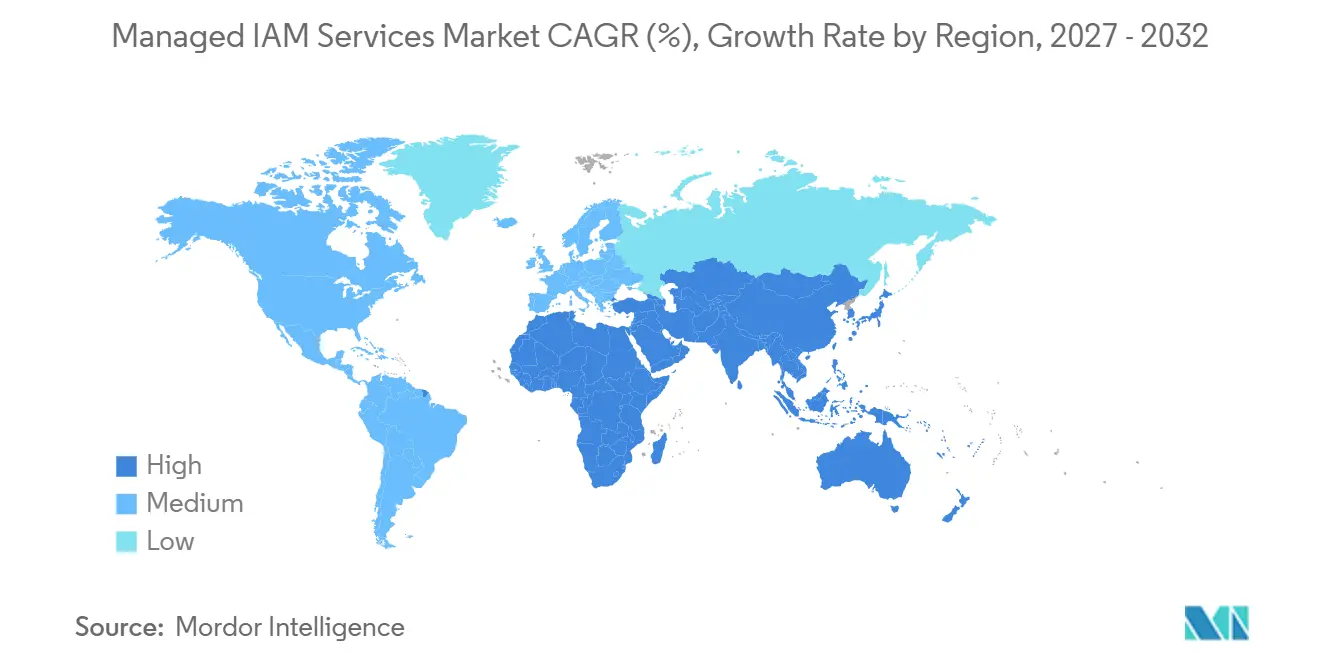
| Fastest Growing Market | Asia-Pacific |
| Largest Market | North America |
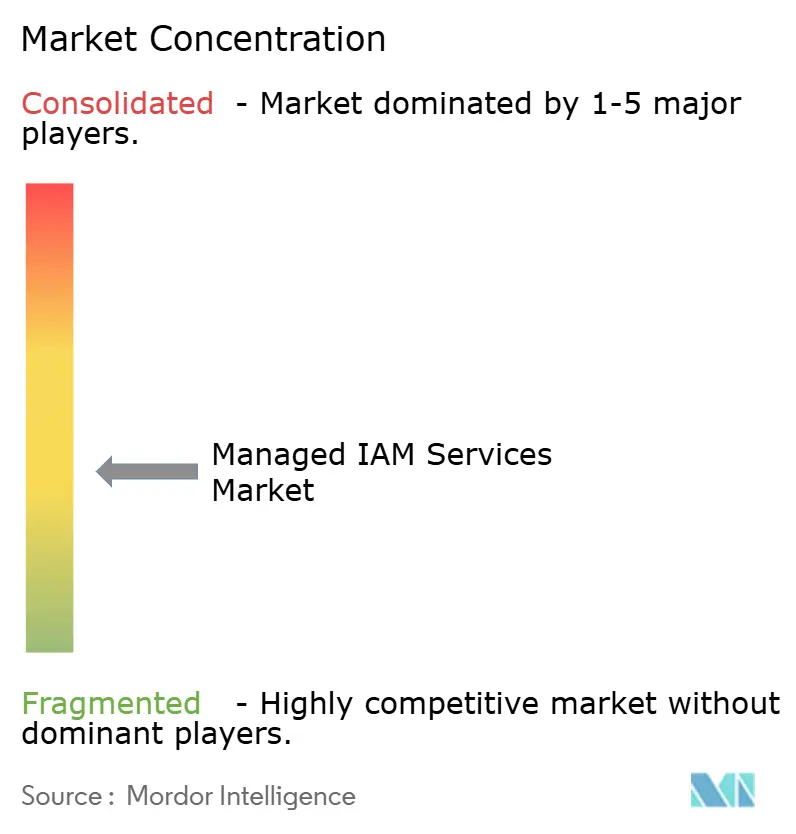
| Market Concentration | Medium |
Major Players *Disclaimer: Major Players sorted in no particular order Image © Mordor Intelligence. Reuse requires attribution under CC BY 4.0. | |
Managed IAM Services Market Analysis by Mordor Intelligence
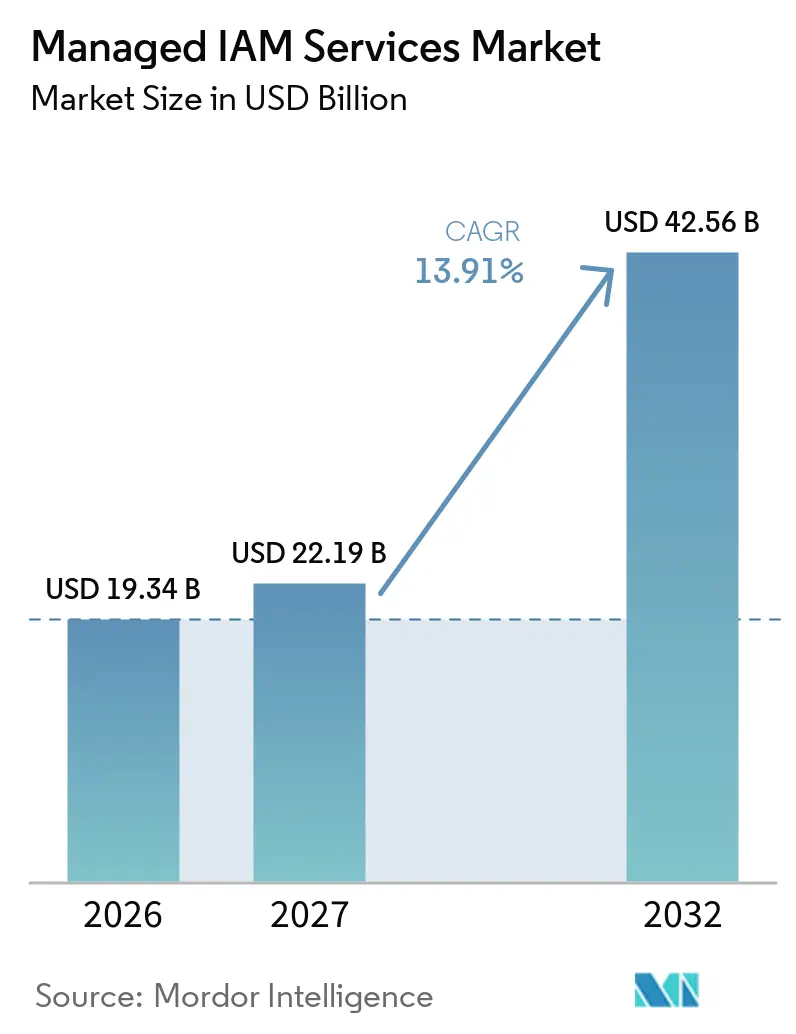
The managed IAM services market size is expected to grow from USD 19.34 billion in 2026 to USD 22.19 billion in 2027, and is forecast to reach USD 42.56 billion by 2032, at a 13.91% CAGR over 2027-2032. Identity-related incidents, shortages of experienced identity professionals, and the wider use of machine and AI-agent credentials are increasing the need for outsourced operations. Buyers are shifting budget from standalone tools toward subscriptions that combine continuous monitoring, policy enforcement, and compliance evidence. This change makes service quality, operational coverage, and the ability to work across cloud and legacy environments central competitive factors in the Managed IAM services market. Transition costs and complex entitlement records can delay adoption, especially when organizations operate several older directories and custom applications. Pricing for machine identities also remains difficult to forecast because usage can vary across API calls, secret rotations, and short-lived credentials.
Key Report Takeaways
- By service type, Managed IAM Operations held 27.31% of the managed IAM services market share in 2026, while Managed Identity Threat Detection and Response is projected to expand at a 16.88% CAGR through 2032.
- By deployment model, Cloud-Based delivery accounted for 67.58% of revenue in 2026 and is projected to expand at a 16.92% CAGR through 2032.
- By organization size, Large Enterprises accounted for 68.54% of revenue in managed IAM services in 2026, while SMEs are projected to expand at a 17.56% CAGR through 2032.
- By identity type, Workforce Identities accounted for 31.76% of revenue in 2026, while AI-Agent Identities are projected to expand at a 15.83% CAGR through 2032.
- By end-user vertical, BFSI held 26.69% of revenue in 2026, while Healthcare and Life Sciences are projected to expand at a 14.77% CAGR through 2032.
- By geography, North America accounted for 38.92% of revenue in managed IAM services in 2026, while Asia-Pacific is projected to expand at a 16.62% CAGR through 2032.
Note: Market numbers in this report are based on Mordor Intelligence's proprietary estimation framework, which combines nine months of actuals with Q4 projections for base year 2026.
Market Trends and Insights
Drivers Impact Analysis of Managed IAM Services Market*
| DRIVER | (~) % IMPACT ON CAGR FORECAST | GEOGRAPHIC RELEVANCE | IMPACT TIMELINE |
|---|---|---|---|
| Escalating Identity-Centric Breach Exposure | +3.2% | Global | Short term (≤ 2 years) |
| Regulatory Demand for Continuous Access Evidence | +2.5% | North America and Europe | Medium term (2-4 years) |
| 24/7 Zero Trust Enforcement Requirements | +2.0% | Global | Medium term (2-4 years) |
| Cloud and Hybrid Identity Sprawl | +1.9% | Global | Medium term (2-4 years) |
| Shortage of Specialized IAM Operations Talent | +1.6% | North America, Europe, and Asia-Pacific | Short term (≤ 2 years) |
| Expansion of Non-Human and AI-Agent Identities | +1.4% | Global | Long term (≥ 4 years) |
| Source: Mordor Intelligence | |||
Escalating Identity-Centric Breach Exposure
Identity weaknesses are becoming a central entry point for cyberattacks, which raises the value of continuous identity operations. Sophos reported that 71% of organizations experienced at least 1 identity-related breach in the prior year, with a mean recovery cost of USD 1.64 million per incident.[1] Its Active Adversary Report also found that identity-related attacks were involved in 67% of the incidents investigated by its response and managed detection teams. Stolen credentials, weak multi-factor authentication, and poorly governed accounts make discrete software deployments insufficient for many organizations. The Managed IAM services market benefits when buyers seek continuous assurance rather than periodic configuration work. Sophos also found that weak management of non-human identities added USD 150,000 to the recovery cost of an identity incident, strengthening the case for managed oversight
Regulatory Demand for Continuous Access Evidence
Compliance work increasingly requires evidence that access controls operate continuously instead of only during an audit. The EU Digital Operational Resilience Act became applicable on January 17, 2025, requiring covered financial entities to manage information and communication technology risk, including access controls and third-party dependencies. The U.S. Department of Health and Human Services proposed updates to the HIPAA Security Rule in January 2025 that include stronger authentication and access-control requirements for electronic protected health information. These obligations favor providers that can document access reviews, certifications, and policy enforcement in a consistent format. The Managed IAM services market, therefore, gains from recurring compliance work rather than one-time implementation projects. Providers that align their reporting to financial services and healthcare obligations can also make their contracts harder to replace.
24/7 Zero Trust Enforcement Requirements
Zero Trust programs require access decisions to reflect changing risk, user context, and least-privilege rules. Many organizations cannot maintain that operating model around the clock across remote users, cloud workloads, and legacy systems. The 2026 SANS survey found that 85% of respondents had deployed identity threat detection and response tools, yet 55% still reported an identity compromise during the preceding 12 months.[2] This difference between tool ownership and sustained response capacity supports demand for managed services. Managed offerings can combine authentication monitoring, behavior analysis, access reviews, and response coordination into an identity operations function. The Managed IAM services market is driven by the need to complement, rather than replace, internal security teams.
Cloud and Hybrid Identity Sprawl
Cloud migration has expanded the number of systems that organizations must connect to their identity controls. A typical estate can include on-premises Active Directory, cloud identity providers, SaaS applications, APIs, service accounts, and AI agents. This structure creates more lifecycle events and access paths than small internal teams can consistently govern. Netwrix found that respondents whose use of AI had significantly increased identity volumes reported breach rates nearly 4 times those of organizations where AI had not changed access patterns. Providers that cover cloud tenants, local directories, and non-human credentials through one operating model have a clear opening. The Managed IAM services market can capture this work when clients need a single accountable team across a fragmented identity environment.
Restraints Impact Analysis of Managed IAM Services Market*
| RESTRAINT | (~) % IMPACT ON CAGR FORECAST | GEOGRAPHIC RELEVANCE | IMPACT TIMELINE |
|---|---|---|---|
| High Transition and Integration Costs | -2.1% | Global | Short term (≤ 2 years) |
| Legacy Directory and Entitlement Complexity | -1.7% | North America and Europe | Medium term (2-4 years) |
| Ambiguous Consumption Pricing for Machine Identities | -0.9% | Global | Long term (≥ 4 years) |
| Data Residency and Privileged-Access Trust Concerns | -0.8% | Europe, Asia-Pacific core, with spillover to the Middle East and Africa | Medium term (2-4 years) |
| Source: Mordor Intelligence | |||
High Transition and Integration Costs
A transition to managed delivery requires connector development, data migration, policy alignment, and service-level negotiation. Organizations with several directories, older enterprise resource planning systems, and custom workflows can face integration timelines of 12-18 months before operations become more efficient. The first-year cost can be high because project expenses overlap with subscription fees. Manufacturing and public-sector users can face the largest burden when critical systems cannot readily provide identity events to a managed platform. Pre-built connectors and onboarding accelerators reduce some of this work, but they do not remove the need to reconcile local policies. This restraint can lengthen purchasing cycles in the Managed IAM services market even when buyers recognize a security need.
Legacy Directory and Entitlement Complexity
Long-running IT environments often contain role definitions, group memberships, and entitlements spread across several directories and application-level lists. Some permissions are undocumented, duplicated, or inconsistent with current job roles. The European Union Agency for Cybersecurity reported that 34% of surveyed organizations had gaps in identity and access management capability. A provider that inherits undefined entitlements must first establish a reliable governance baseline before it can automate decisions. Access reviews can also reveal remediation work that was not included in the original scope. These issues create uncertainty in project timing and service pricing, which can make large buyers slower to commit.
*Our forecasts treat driver/restraint impacts as directional, not additive. The impact forecasts reflect baseline growth, mix effects, and variable interactions.
Managed IAM Services Market Segment Analysis
By Service Type:
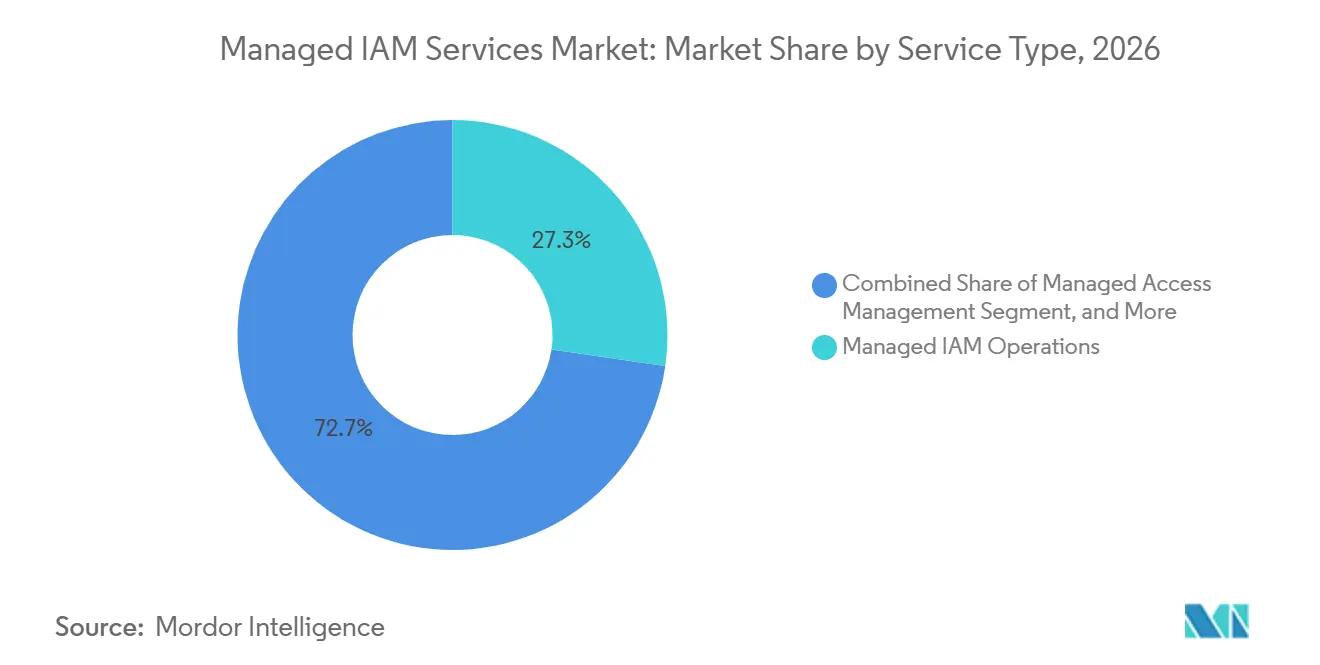
Operations Lead Revenue While ITDR Changes the Growth MixManaged IAM Operations held 27.31% of revenue in 2026, making it the largest service category in the Managed IAM services market. Its work includes provisioning, de-provisioning, directory monitoring, access review support, and the daily handling of identity lifecycle requests. Clients often begin with this steady operational scope because it addresses a visible workload without requiring an immediate redesign of every identity policy. Managed Identity Governance and Administration, Managed Access Management, and Managed Privileged Access Management can follow as providers identify gaps during routine operations. This sequence makes early service relationships a path toward broader contracts in the Managed IAM services industry.
Managed Directory and Federation Services remain important for organizations moving from local directories to cloud identity providers. Demand remains stable during migration, though it may ease once the main integration work is complete. Managed ITDR is projected to expand at a 16.88% CAGR through 2032, the fastest rate among service types. The SANS findings show why continuous detection and response matter after a tool is implemented. SailPoint launched Agent Identity Security in September 2025 to help enterprises aggregate, certify, and govern AI-agent identities alongside human identities.[3] The product direction suggests that operations, governance, and identity threat response are becoming more connected in the Managed IAM services market.

By Deployment Model:
Cloud-Based Delivery Leads While On-Premises Remains RelevantCloud-Based delivery held 67.58% of revenue in 2026 and is projected to expand at a 16.92% CAGR through 2032. This segment benefits from lower infrastructure maintenance requirements and from the ability to scale identity services when application and credential volumes change. Cloud delivery also lets providers operate common policy and monitoring services across multiple client locations. These advantages make it a preferred model for organizations that use several SaaS services and cloud platforms. The Managed IAM services market size for Cloud-Based delivery is supported by the need to manage unpredictable increases in AI-agent and machine credentials.
Hybrid delivery serves organizations that must link cloud policy engines with local systems, air-gapped environments, or regulated databases. It provides a practical bridge when a full migration cannot occur at once. On-Premises delivery remains relevant in defense, critical infrastructure, and sovereign-cloud settings where credential storage rules limit cloud use. SailPoint released IdentityIQ 9.0 in October 2026 with granular time-based access controls and a rebuilt technical foundation for on-premises deployments. Continued product investment shows that managed providers must retain skills across each deployment approach. The Managed IAM services market is therefore not limited to a single technical architecture.
By Organization Size:
Large Enterprises Lead While SMEs Accelerate AdoptionLarge Enterprises held 68.54% of revenue in 2026 because they have broad identity estates, higher regulatory exposure, and the budgets for multiyear contracts. Their environments can include employees, contractors, partners, administrators, and application accounts across many systems. In-house teams often remain responsible for identity strategy while providers run repeatable operational processes. This structure supports large service volumes and creates opportunities for governance and privileged-access add-ons. Large clients also require detailed service levels, regional support, and compliance evidence, which raises the importance of provider scale.
SMEs are projected to expand at a 17.56% CAGR through 2032, the fastest rate within the organization-size split. SaaS delivery, simpler configuration, and subscription pricing are making managed identity governance available to organizations with lean IT teams. WALLIX introduced WALLIX One PAM Core in September 2025 as a SaaS-deployable privileged access management offering for SMEs and mid-sized companies that are subject to NIS2 requirements.[4] The offering reflects demand for deployments measured in weeks rather than large transformation programs. The Managed IAM services market size for SMEs can expand as accessible platforms meet obligations that apply to smaller organizations as well as larger ones. Providers that simplify onboarding can reach buyers who previously relied on manual administration.
By Identity Type:
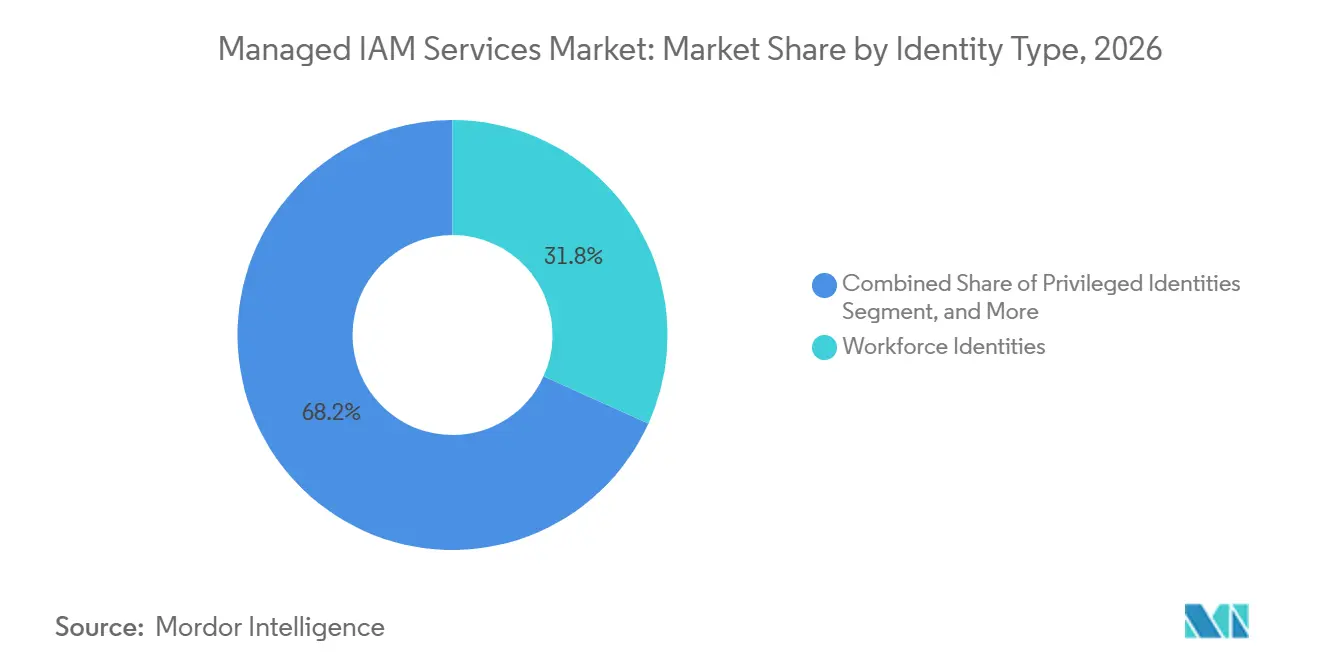
Workforce Identities Lead While AI-Agent Governance EmergesWorkforce Identities represented 31.76% of revenue in 2026, reflecting the established need to manage employee access, roles, certifications, and privileged accounts. This category is familiar to both customers and providers because lifecycle processes are linked to hiring, transfers, and departures. Consumer Identities, Business-to-Business Identities, and Privileged Identities also require distinct policy approaches and service workflows. Mature governance practices give providers a defined starting point for access certification and role management. Workforce identity operations will continue to be the base of many managed service engagements in the Managed IAM services market.
Non-Human Identities include service accounts, API keys, robotic process automation agents, and device credentials. Sophos found that 41% of identity incidents involved weak non-human identity management as a contributing factor. AI-Agent Identities are projected to expand at a 15.83% CAGR through 2032 as enterprises introduce more automated software actors. NIST published a February 2026 concept paper that applies Zero Trust Architecture and digital identity guidance to software and AI-agent identity and authorization. That work signals a move toward more formal governance expectations for this class of identity. The Managed IAM services market must therefore support human and non-human credentials within connected control processes.
By End-User Vertical:
BFSI Leads Spending While Healthcare Advances FasterBFSI held 26.69% of revenue in 2026 because financial institutions treat identity controls as essential supervisory infrastructure. These organizations must manage employees, customers, third parties, privileged users, and system accounts while producing auditable evidence. A 2025 Thales survey found that 93% of financial-sector respondents had prioritized workforce identity modernization. Government and Public Administration also need reliable management of large credentialed populations and complex access rights. Telecommunications and Media users face similar pressure from contractor access and API-intensive partner environments.
The healthcare and life sciences industry is projected to expand at a 14.77% CAGR through 2032, the fastest end-user rate. The proposed changes to the HIPAA Security Rule highlight the need for stronger authentication and access controls for electronic protected health information. Cloud migration of electronic health records increases the need to connect local and cloud access policies. Retail and E-Commerce demand is shaped by customer identity, fraud prevention, and transaction security requirements. Travel and hospitality face high consumer identity volumes and fraud exposure during peak booking periods. These conditions extend the Managed IAM services market across sectors with very different identity populations and operating risks.
Geography Analysis
The Americas Managed IAM Services Market
North America held 38.92% of revenue in 2026, the largest regional position in the Managed IAM services market. The region benefits from a mature IT services base and an established history of managed identity adoption. Financial services requirements continue to create demand for stronger multi-factor authentication and evidence of access control. The United States Department of Health and Human Services proposed stronger healthcare security requirements in 2025, which added another compliance driver for identity operations. South America is at an earlier stage of adoption, with Brazil and Argentina as important demand centers. Digital banking and the move toward continuous access monitoring support regional activity.
Europe Managed IAM Services Market
Europe is the second-largest geography, with demand reinforced by DORA and the national implementation of NIS2. DORA has been applicable since January 2025 and has increased attention on operational resilience and third-party risk in financial services. Germany, the United Kingdom, and France are the principal demand centers. The region also faces a shortage of qualified identity professionals, which supports outsourcing where internal recruitment is difficult. Buyers often require regional operating support and close treatment of data residency obligations. These needs make trusted access to privileged systems a core buying consideration in the Managed IAM services market.
APAC and MEA Managed IAM Services Market
Asia-Pacific is projected to expand at a 16.62% CAGR through 2032, making it the fastest-growing geography. China, Japan, India, and South Korea are the largest national markets, although their managed IAM maturity differs. India’s national digitization activity and wider cloud use are increasing the need for governance across workforce and application access. Southeast Asian financial services and telecommunications firms must address different national data protection rules as they expand digital services. The Middle East is concentrated in the United Arab Emirates and Saudi Arabia, where cloud transformation programs support managed identity adoption. Africa remains an earlier-stage region, with South Africa and Egypt leading demand.
Competitive Landscape
The Managed IAM services market is moderately fragmented, including global IT service firms, specialist identity providers, and large cloud platform companies. Large providers compete through existing client relationships, broad cybersecurity portfolios, and the ability to bundle IAM operations with cloud and security work. Specialist providers compete through identity-focused operations centers, detailed service levels, and expertise in governance or privileged access. Microsoft, Amazon Web Services, and Google influence the market as platform providers and as enablers of managed delivery. This structure can place price pressure on pure-play providers and can limit technical differentiation. Buyers, therefore, assess integration depth, operational quality, and sector knowledge across the Managed IAM services market.
Palo Alto Networks completed its acquisition of CyberArk Software for USD 24.6 billion in February 2026 and subsequently positioned the Idira platform around human, machine, and AI identities. The transaction combines privileged access management with broader identity and security functions, which can influence the services that partners build around the platform. SailPoint expanded its managed service partner offering in March 2025, giving partners a path to offer Identity Security Cloud to smaller enterprises. It later introduced Navigators, a flexible pricing model intended to help partners offer consumption-based identity services. These actions show that vendor partner programs and packaging remain important routes to customers. They also reflect the need to make advanced identity services usable for organizations that cannot fund a large initial deployment.
Cisco completed its acquisition of Oort in April 2026 and renamed the business Cisco Identity Intelligence, adding identity threat detection capabilities to its portfolio. SailPoint also introduced adaptive identity innovations in March 2026, including changes to access certification and separation-of-duties functions. Providers that can link identity governance, access management, privileged access, and threat response can present a more complete operating model to customers. However, migration complexity still protects incumbent relationships where policies and entitlements are deeply embedded. Machine and AI-agent identity pricing remains an open issue because volumes may depend on automated activity rather than employee counts. Competition in the Managed IAM services market will remain centered on service consistency, platform partnerships, and the ability to reduce onboarding risk.
Managed IAM Services Industry Leaders
-
Accenture plc
-
Amazon Web Services, Inc.
-
BeyondTrust Corporation
-
Broadcom Inc.
-
CyberArk Software Ltd.
- *Disclaimer: Major Players sorted in no particular order
Managed IAM Services Market Companies Covered in this Report
- Accenture plc
- Amazon Web Services, Inc.
- BeyondTrust Corporation
- Broadcom Inc.
- CyberArk Software Ltd.
- Deloitte Touche Tohmatsu Limited
- Dell Technologies Inc.
- Ernst & Young Global Limited
- Google LLC
- HCLTech
- IBM Corporation
- International Data Group, Inc.
- Microsoft Corporation
- NTT DATA Corporation
- Okta, Inc.
- Oracle Corporation
- Palo Alto Networks, Inc.
- Ping Identity Corporation
- SailPoint, Inc.
- Saviynt, Inc.
- Simeio Solutions
- Tata Consultancy Services Limited
- Thales S.A.
- Wipro Limited
Recent Industry Developments in Managed IAM Services Market
- October 2026: SailPoint released IdentityIQ 9.0 at Navigate 2026, delivering granular time-based access controls and a rebuilt technical foundation for on-premises deployments, extending its managed services addressable market to regulated organizations unable to migrate fully to the cloud.
- April 2026: Wiz acquired Permiso, folding non-human identity governance into its cloud-native application protection platform and connecting cloud security posture management with identity entitlement data for workloads, service accounts, and AI agents.
- April 2026: Cisco completed the acquisition of Oort, rebranding it Cisco Identity Intelligence, with a Q4 2026 general availability target for its identity threat detection and response module. The acquisition extends Cisco’s managed identity portfolio with behavioral analytics and continuous identity risk scoring.
- March 2026: SailPoint unveiled adaptive identity innovations including a next-generation Access Certification engine and a Separation of Duties revamp, advancing its positioning as a platform managing AI-agent identities alongside human and machine principals in a single managed control plane.
Global Managed IAM Services Market Report Scope
The managed IAM services market covers ongoing managed services for operating, monitoring, governing, and securing identity and access environments. It includes managed IAM operations, identity governance, access management, privileged access, directory and federation, identity threat detection and response, and identity support services.
The Managed IAM Services Market Report is Segmented by Service Type (Managed IAM Operations, Managed Identity Governance and Administration, Managed Access Management, Managed Privileged Access Management, Managed Directory and Federation Services, Managed Identity Threat Detection and Response, and Other Service Types), Deployment Model (Cloud-Based, On-Premises, and Hybrid), Organization Size (Large Enterprises, and Small and Medium Enterprises), Identity Type (Workforce Identities, Consumer Identities, Business-to-Business Identities, Privileged Identities, Non-Human Identities, AI-Agent Identities, and Other Identity Types), End-User Industry (Banking, Financial Services, and Insurance (BFSI), Government and Public Administration, Healthcare and Life Sciences, Retail and E-Commerce, Telecommunications and Media, Travel and Hospitality, and End-User Industries), and Geography (North America, South America, Europe, Asia-Pacific, Middle East, and Africa). The Market Forecasts are Provided in Terms of Value (USD).
Segmentation Overview
| Managed IAM Operations |
| Managed Identity Governance and Administration |
| Managed Access Management |
| Managed Privileged Access Management |
| Managed Directory and Federation Services |
| Managed Identity Threat Detection and Response |
| Other Service Types |
| Cloud-Based |
| Hybrid |
| On-Premise |
| Large Enterprises |
| Small and Medium-Sized Enterprises |
| Workforce Identities |
| Consumer Identities |
| Business-to-Business Identities |
| Privileged Identities |
| Non-Human Identities |
| AI-Agent Identities |
| Other Identity Types |
| Banking, Financial Services, and Insurance (BFSI) |
| Government and Public Administration |
| Healthcare and Life Sciences |
| Retail and E-Commerce |
| Telecommunications and Media |
| Travel and Hospitality |
| Other End-User Industries |
| North America | United States |
| Canada | |
| Mexico | |
| South America | Brazil |
| Argentina | |
| Rest of South America | |
| Europe | United Kingdom |
| Germany | |
| France | |
| Italy | |
| Rest of Europe | |
| Asia-Pacific | China |
| Japan | |
| India | |
| South Korea | |
| Rest of Asia-Pacific | |
| Middle East | United Arab Emirates |
| Saudi Arabia | |
| Rest of Middle East | |
| Africa | South Africa |
| Egypt | |
| Rest of Africa |
| By Service Type | Managed IAM Operations | |
| Managed Identity Governance and Administration | ||
| Managed Access Management | ||
| Managed Privileged Access Management | ||
| Managed Directory and Federation Services | ||
| Managed Identity Threat Detection and Response | ||
| Other Service Types | ||
| By Deployment Model | Cloud-Based | |
| Hybrid | ||
| On-Premise | ||
| By Organization Size | Large Enterprises | |
| Small and Medium-Sized Enterprises | ||
| By Identity Type | Workforce Identities | |
| Consumer Identities | ||
| Business-to-Business Identities | ||
| Privileged Identities | ||
| Non-Human Identities | ||
| AI-Agent Identities | ||
| Other Identity Types | ||
| By End-User Industry | Banking, Financial Services, and Insurance (BFSI) | |
| Government and Public Administration | ||
| Healthcare and Life Sciences | ||
| Retail and E-Commerce | ||
| Telecommunications and Media | ||
| Travel and Hospitality | ||
| Other End-User Industries | ||
| By Geography | North America | United States |
| Canada | ||
| Mexico | ||
| South America | Brazil | |
| Argentina | ||
| Rest of South America | ||
| Europe | United Kingdom | |
| Germany | ||
| France | ||
| Italy | ||
| Rest of Europe | ||
| Asia-Pacific | China | |
| Japan | ||
| India | ||
| South Korea | ||
| Rest of Asia-Pacific | ||
| Middle East | United Arab Emirates | |
| Saudi Arabia | ||
| Rest of Middle East | ||
| Africa | South Africa | |
| Egypt | ||
| Rest of Africa | ||
Key Questions Answered in the Report
What is the size of the Managed IAM services market?
The managed IAM services market size is expected to grow from USD 19.34 billion in 2026 to USD 22.19 billion in 2027, and is forecast to reach USD 42.56 billion by 2032, at a 13.91% CAGR over 2027-2032.
What is driving demand for managed IAM services?
Identity-related breaches, continuous compliance needs, cloud identity sprawl, and a shortage of specialized professionals are increasing demand for outsourced identity operations.
Which managed IAM service type is expanding fastest?
Managed Identity Threat Detection and Response is projected to expand at a 16.88% CAGR through 2032, the highest rate among the listed service types.
Why do companies use managed IAM providers?
Providers can operate identity lifecycle processes, access reviews, monitoring, and compliance evidence continuously when internal teams lack the capacity or specialized skills.
Which deployment model leads managed IAM adoption?
Cloud-Based delivery held 67.58% of revenue in 2026 and is projected to expand at a 16.92% CAGR through 2032.
Which region is projected to expand fastest for managed IAM services?
Asia-Pacific is projected to expand at a 16.62% CAGR through 2032, supported by cloud adoption, national digitization programs, and regional data protection requirements.