
Managed Hyperconverged Infrastructure (HCI) Services Market Size and Share
Market Overview
| Study Period | 2021 - 2032 |
|---|---|
| Market Size (2027) | USD 24.68 Billion |
| Market Size (2032) | USD 43.48 Billion |
| Growth Rate (2027 - 2032) | 11.99 % |
| Fastest Growing Market | Asia-Pacific |
| Largest Market | North America |
| Market Concentration | Medium |
Major Players *Disclaimer: Major Players sorted in no particular order Image © Mordor Intelligence. Reuse requires attribution under CC BY 4.0. | |
Managed Hyperconverged Infrastructure (HCI) Services Market Analysis by Mordor Intelligence
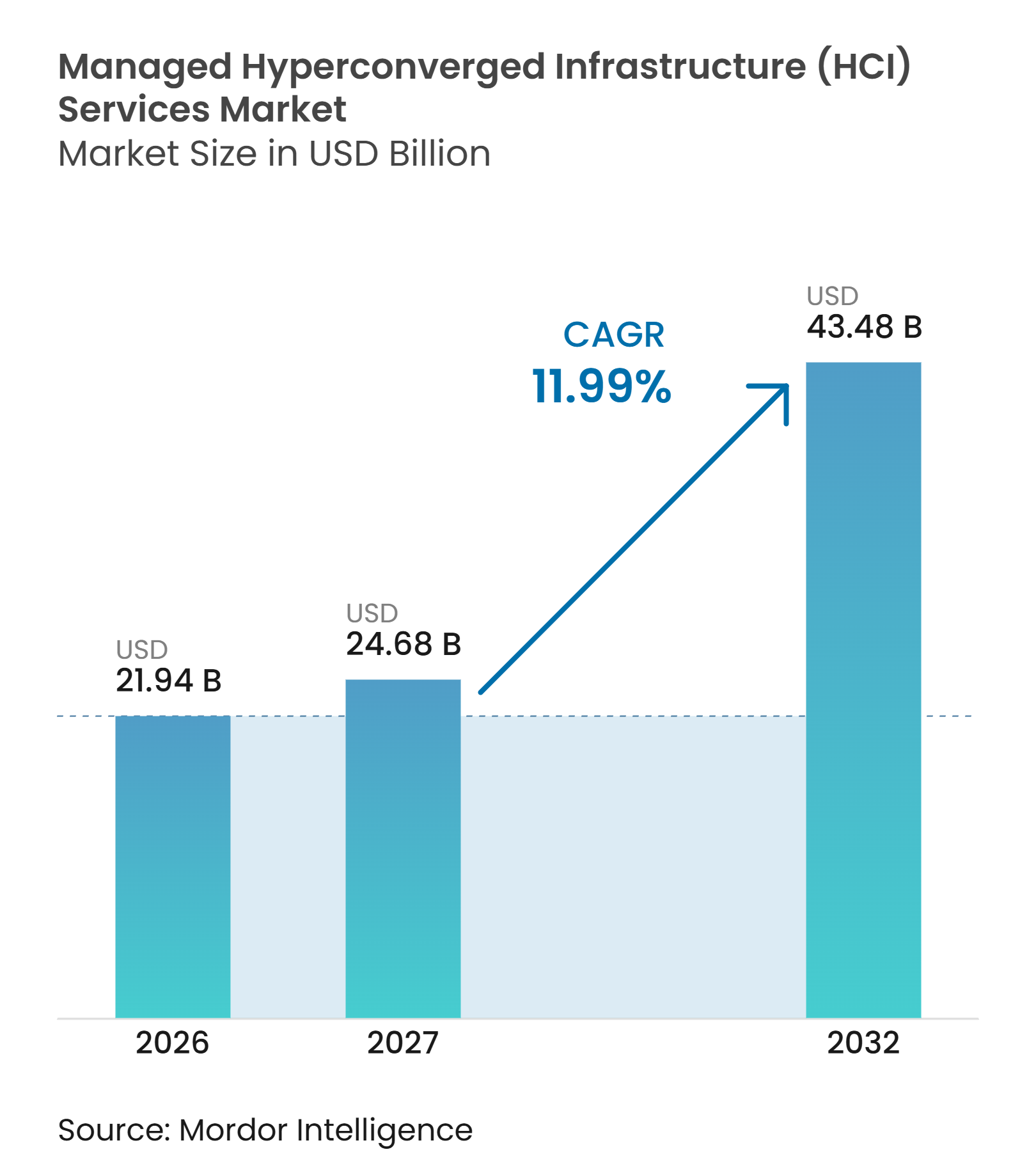
The managed hyperconverged infrastructure services (HCI) market size is valued at USD 21.94 billion in 2026 and is projected to reach USD 43.48 billion by 2032, registering a CAGR of 11.99% between 2027 and 2032. Changes to VMware licensing have increased the urgency of virtualization decisions and shifted more organizations toward externally managed infrastructure arrangements. Many enterprises are assessing hypervisor alternatives while trying to avoid rebuilding specialized operations teams during a migration. This has expanded the role of providers that can manage private, hybrid, and distributed infrastructure under multi-year service agreements. AI workloads, data protection needs, and sovereignty requirements are also increasing the value placed on local operations, recovery capabilities, and infrastructure that can be upgraded without a full replacement. The managed hyperconverged infrastructure services market therefore favors providers that combine platform choice, operational accountability, and support for regulated workloads.
Key Report Takeaways
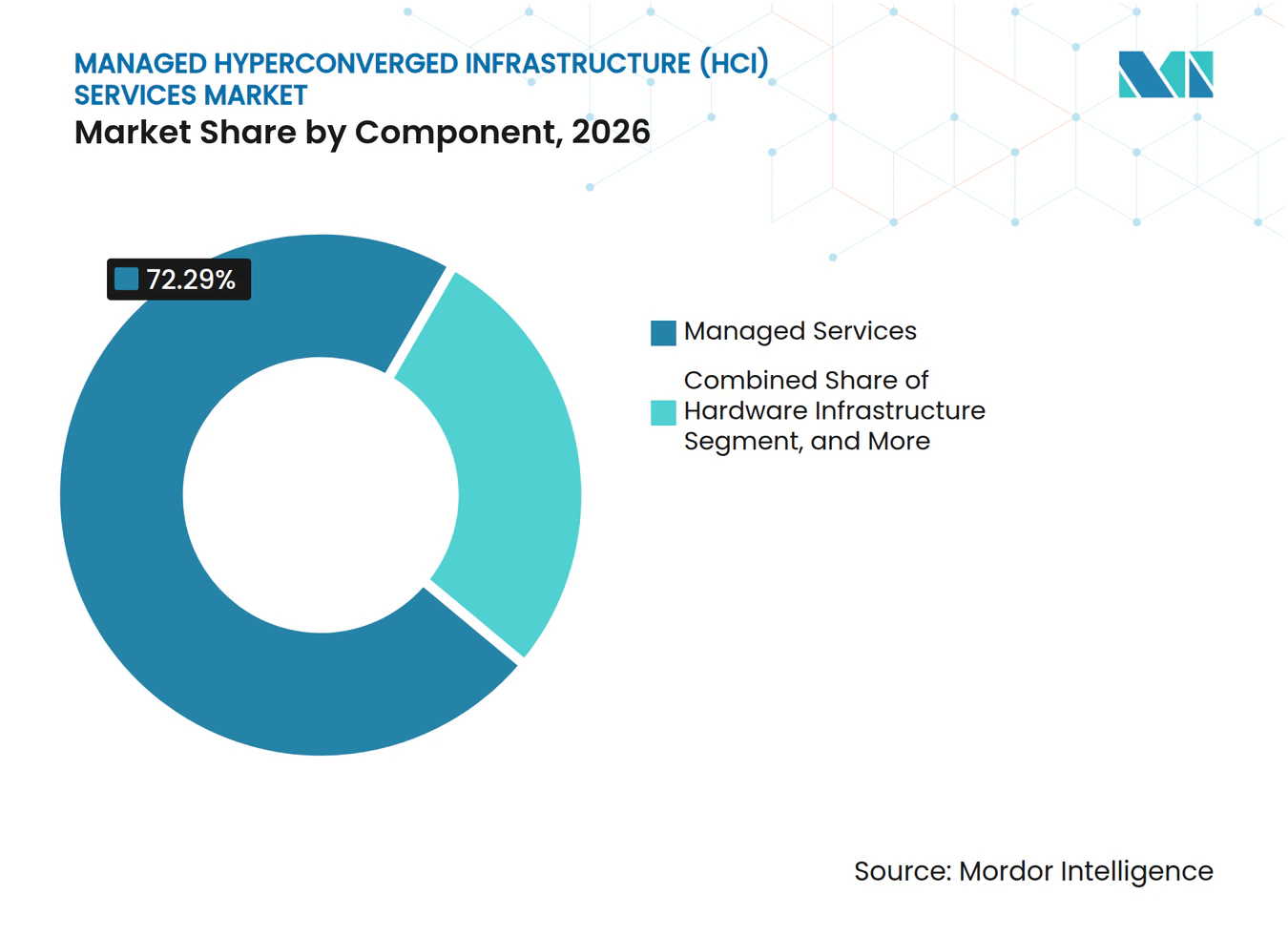
- By component, Managed Services held 72.29% of the managed hyperconverged infrastructure services market share in 2026 and is projected to expand at a 12.46% CAGR through 2032.
- By service type, Infrastructure Management Services accounted for 24.75% of revenue in 2026, while Monitoring and Observability Services is projected to expand at a 12.86% CAGR through 2032.
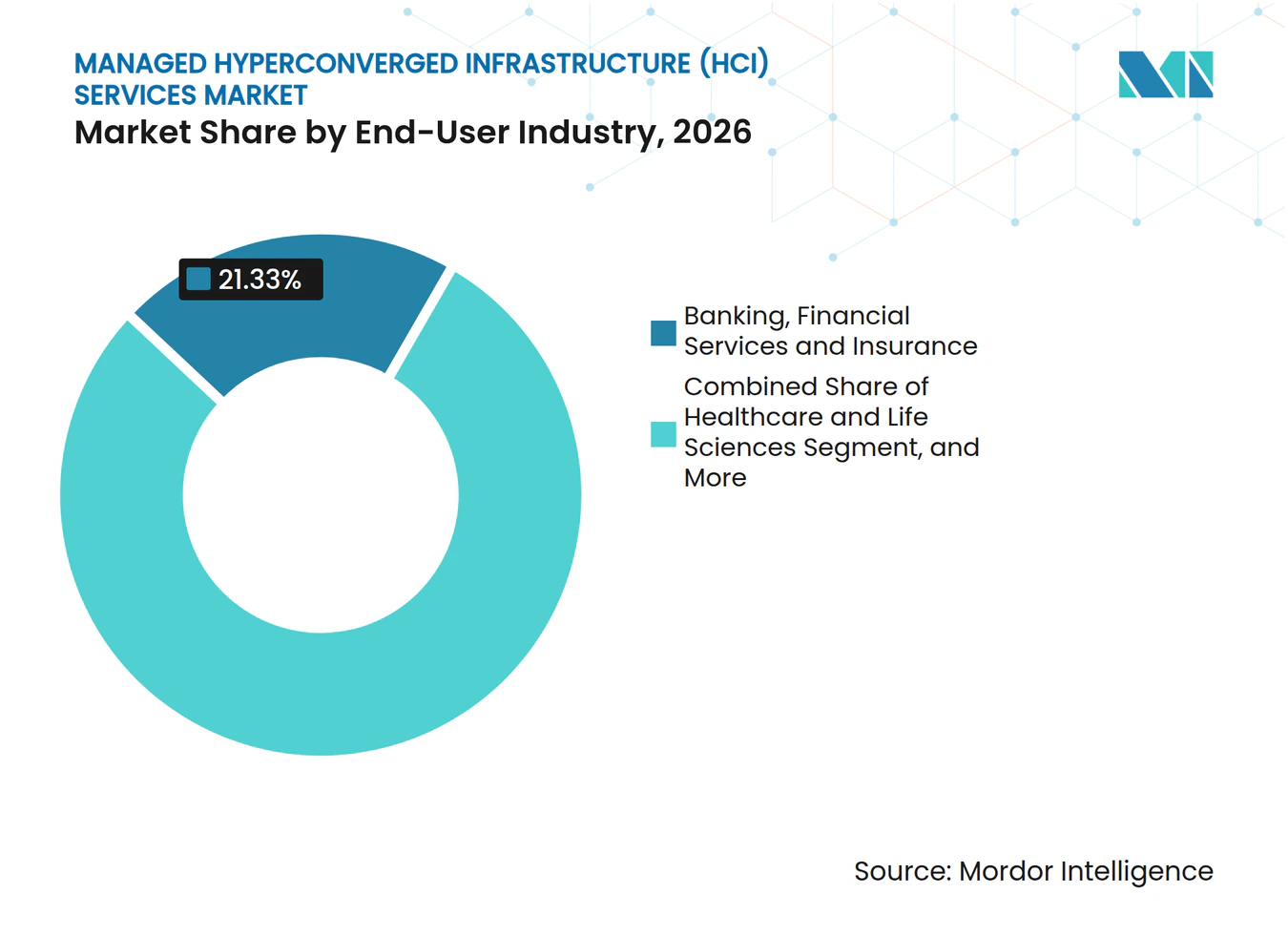
- By end-user industry, Banking, Financial Services and Insurance held 21.33% of revenue in 2026, while Healthcare and Life Sciences is projected to expand at a 12.78% CAGR through 2032.
- By geography, North America held 41.57% of revenue in 2026, while Asia-Pacific is projected to expand at a 12.42% CAGR through 2032.
Note: Market numbers in this report are based on Mordor Intelligence's proprietary estimation framework, which combines nine months of actuals with Q4 projections for base year 2026.
Market Trends and Insights
Drivers Impact Analysis of Managed Hyperconverged Infrastructure (HCI) Services Market*
| Driver | (~) % Impact on CAGR Forecast | Geographic Relevance | Impact Timeline |
|---|---|---|---|
| Rising Demand for Managed Hybrid and Private Cloud Operations | +3.5% | Global, strongest in North America and Europe | Short term (≤ 2 years) |
| AI-Ready Infrastructure and Containerized Workload Adoption | +2.2% | Global, concentrated in North America and Asia-Pacific | Medium term (2-4 years) |
| Increasing Data Protection and Disaster Recovery Requirements | +2.0% | Global, compliance-intensive in North America, Europe, and Asia-Pacific | Short term (≤ 2 years) |
| Expansion of Edge and Remote-Branch Workloads | +1.5% | Asia-Pacific core, with spillover to the Middle East and Africa and South America | Medium term (2-4 years) |
| Shift From Capital Expenditure to Consumption-Based Infrastructure | +1.2% | North America and Europe, expanding to Asia-Pacific | Short term (≤ 2 years) |
| Shortage of Specialized Infrastructure Operations Talent | +0.8% | Global, most acute in South America, the Middle East and Africa, and smaller Asia-Pacific markets | Long term (≥ 4 years) |
| Source: Mordor Intelligence | |||
Rising Demand for Managed Hybrid and Private Cloud Operations
Broadcom's changes to VMware licensing created a wider need for managed hyperconverged infrastructure services (HCI) market providers. Enterprises must address higher renewal costs and the practical work of evaluating alternative hypervisors. Outsourcing the management layer can reduce the need to recreate deep operational expertise inside the organization. Dell made its Private Cloud available in late 2025 with blueprints for VMware, Nutanix AHV, and Red Hat OpenShift, while its automation platform covers Day 0 through Day 2 lifecycle activities.[1] Finanz Informatik signed a long-term Nutanix managed services agreement in August 2025 for virtual-machine migration across its data centers. The engagement shows why organizations with large and regulated estates are using managed partners for migration work rather than attempting it solely with internal staff.
AI-Ready Infrastructure and Containerized Workload Adoption
AI inference and containerized workloads are changing the scope of managed HCI contracts. Enterprises increasingly need GPU-enabled nodes, Kubernetes layers, and more detailed telemetry than earlier agreements required. Cisco found that only 13% of enterprises reported readiness to support AI at scale, with infrastructure limitations identified as a central obstacle. Cisco introduced Unified Edge in November 2025 with CPU and GPU configurations, NVMe storage, and SD-WAN networking for distributed AI inference.[2] The platform was designed to work with managed service providers as an enterprise delivery layer. Existing customers can therefore extend a managed agreement to cover AI infrastructure instead of coordinating another specialist provider.
Increasing Data Protection and Disaster Recovery Requirements
Data protection and recovery requirements are moving from optional additions to core terms in managed service agreements. The European Union's NIS2 Directive expanded cybersecurity obligations for more than 160,000 entities and raised the importance of continuity and recovery service levels for critical operators. In the United States, the Cybersecurity Maturity Model Certification framework requires defense supply-chain organizations to maintain verifiable recovery capabilities. These obligations make backup, disaster recovery, and compliance management more relevant in the managed hyperconverged infrastructure services market. The budget case is increasingly tied to meeting a regulatory requirement rather than reducing routine information technology costs. This can make demand more resilient than discretionary infrastructure spending when business conditions weaken.
Expansion of Edge and Remote-Branch Workloads
Edge computing is extending managed HCI into locations previously served by basic branch appliances. Cisco cited an IDC 2025 EdgeView survey in which 53% of organizations planned to upgrade edge computing for AI. The same source stated that enterprise edge data volumes could reach 1.6 petabytes per organization by 2027. Retail, manufacturing, and logistics sites may require centralized management across hundreds of distributed nodes. Power, cooling, and physical-security limits make those sites difficult to operate with local teams. These constraints create demand for providers that can monitor, secure, and maintain the fleet remotely.
Restraints Impact Analysis of Managed Hyperconverged Infrastructure (HCI) Services Market*
| Restraint | (~) % Impact on CAGR Forecast | Geographic Relevance | Impact Timeline |
|---|---|---|---|
| Vendor Lock-In and Hypervisor Migration Friction | -2.1% | Global, most acute in large North American and European enterprises | Short term (≤ 2 years) |
| Unpredictable Economics for Imbalanced Compute and Storage Growth | -1.3% | Global, with cost sensitivity highest in Asia-Pacific and South America | Medium term (2-4 years) |
| Distributed Edge Power, Cooling, and Physical-Security Constraints | -0.9% | Asia-Pacific core, the Middle East and Africa, and South America | Long term (≥ 4 years) |
| Customer Concerns About Provider Dependency and Exit Costs | -0.7% | Global, particularly in risk-averse regulated sectors | Medium term (2-4 years) |
| Source: Mordor Intelligence | |||
Vendor Lock-In and Hypervisor Migration Friction
The disruption encouraging managed HCI adoption can also delay decisions when an enterprise has deep investments in a specific hypervisor ecosystem. Organizations using vSAN-integrated appliances may need to commit capital to exit their installed architecture. That cost can partly offset the operating benefits of moving to a managed model. Dell stated that 52% of information technology leaders surveyed were evaluating multiple hypervisor options to avoid lock-in. Its multi-hypervisor Private Cloud approach recognizes the need for choice, but a transition still requires professional services and careful implementation. Longer project timelines can increase perceived risk and postpone contract awards in the managed hyperconverged infrastructure services market.
Unpredictable Economics for Imbalanced Compute and Storage Growth
HCI can become expensive when compute and storage needs change at very different rates. A data-intensive analytics or AI inference workload may need a major storage increase without comparable demand for additional compute. Node-based scaling can require both resources to expand together and can leave capacity unused. This concern is especially relevant for customers that evaluate managed HCI against software-led or storage-disaggregated alternatives. It can also create a margin issue for a provider when a client's workload profile shifts after a contract begins. Contract revisions under those conditions may create friction and reduce the likelihood of a straightforward renewal.
*Our forecasts treat driver/restraint impacts as directional, not additive. The impact forecasts reflect baseline growth, mix effects, and variable interactions.
Managed Hyperconverged Infrastructure (HCI) Services Market Segment Analysis
By Component:
Managed Services Lead the Revenue ModelManaged Services held 72.29% of revenue in 2026 and is projected to expand at a 12.46% CAGR through 2032. The position reflects a customer preference for transferring full operational responsibility instead of adding limited support to an internal team. Providers manage monitoring, lifecycle work, capacity planning, security activities, and recovery processes under a single service relationship. This structure shifts the commercial emphasis from one-time infrastructure delivery to recurring operating commitments. HPE reported an annualized revenue run rate of USD 3.2 billion for GreenLake at the end of fiscal 2025, up 62% year over year, while software and services exceeded 70% of annual recurring revenue.[3] The result illustrates why platform vendors are placing greater importance on recurring services revenue.
HCI Software and Control Plane demand follows different needs across regions. Sovereign cloud environments place value on software that does not depend on external telemetry, while cost-sensitive buyers in Asia-Pacific often seek software licenses for standard server hardware. Hardware Infrastructure is also broadening as ARM-based nodes appear on validated HCI compatibility lists. Professional Services remains necessary because migration design across multiple sites and virtual-machine estates is difficult to standardize. These related components support the Managed Services offering rather than replacing it. The managed hyperconverged infrastructure services industry is therefore increasingly defined by the ability to operate a complete environment over time. The managed hyperconverged infrastructure services market also rewards providers that can combine migration expertise with continuing operational responsibility.



By Service Type:
Observability Changes Contract PrioritiesInfrastructure Management Services held 24.75% of revenue in 2026. The category includes routine virtual-machine lifecycle work, patching, and capacity provisioning that remain essential across installed HCI environments. Monitoring and Observability Services is projected to expand at a 12.86% CAGR through 2032. Buyers are moving beyond reactive incident handling toward platforms that identify resource contention earlier and support AI-assisted operations. DartPoints joined the Nutanix Elevate Service Provider Program in October 2025 and positioned its managed private-cloud service around HIPAA, SOC 1, SOC 2, SOC 3, PCI-DSS, and HITECH compliance. The example shows how audit readiness is becoming a service differentiator alongside technical performance.
Security and Compliance Management Services are becoming more important as NIS2 and U.S. cybersecurity requirements raise expectations for recovery and audit evidence. Migration and Modernization Services also benefit from ongoing VMware replacement projects. Nutanix reported that it added more than 2,700 net new customers in fiscal 2025 and recorded USD 2.22 billion in annual recurring revenue, up 17% year over year. Capacity and Performance Optimization Services are gaining relevance in AI-heavy deployments that need specialist tuning of GPU allocation, memory tiers, and NVMe throughput. Backup and Disaster Recovery services remain a basic requirement for regulated customers. Together, these services increase the scope and value of a managed agreement. The managed hyperconverged infrastructure services market is shifting toward service bundles that address performance, compliance, and recovery needs together.
By End-User Industry:
BFSI Provides Scale, Healthcare Adds MomentumBanking, Financial Services and Insurance accounted for 21.33% of the managed hyperconverged infrastructure services market size in 2026. The sector requires high availability, documented controls, and private infrastructure for core workloads. It also has complex legacy environments that are difficult to migrate while maintaining service continuity. Finanz Informatik serves the Sparkassen Finance Group and signed a long-term Nutanix agreement in August 2025 for virtual-machine migration. Its role serving 50 million customers shows the operational scale involved in financial-services infrastructure decisions. Managed transition support is attractive when an internal technology team must reduce migration risk while sustaining strict uptime commitments.
Healthcare and Life Sciences is projected to expand at a 12.78% CAGR through 2032. AI diagnostics, picture archiving and communication system imaging, and distributed research data require strong input and output performance, low latency, and dependable recovery procedures. These needs can be difficult for internal teams to maintain consistently across clinical sites. IT and Telecommunications is the second-largest end-user segment because telecommunications providers use HCI for network-function virtualization and enterprise teams use it in multi-tenant settings. Government and Defense demand is also supported by sovereign hosting requirements, while manufacturing and retail use edge HCI for automation and real-time inventory applications. The managed hyperconverged infrastructure services market can address these varied needs when the provider pairs centralized operations with site-level support. This breadth of demand reduces the importance of any single end-user application to the managed hyperconverged infrastructure services market.

Geography Analysis
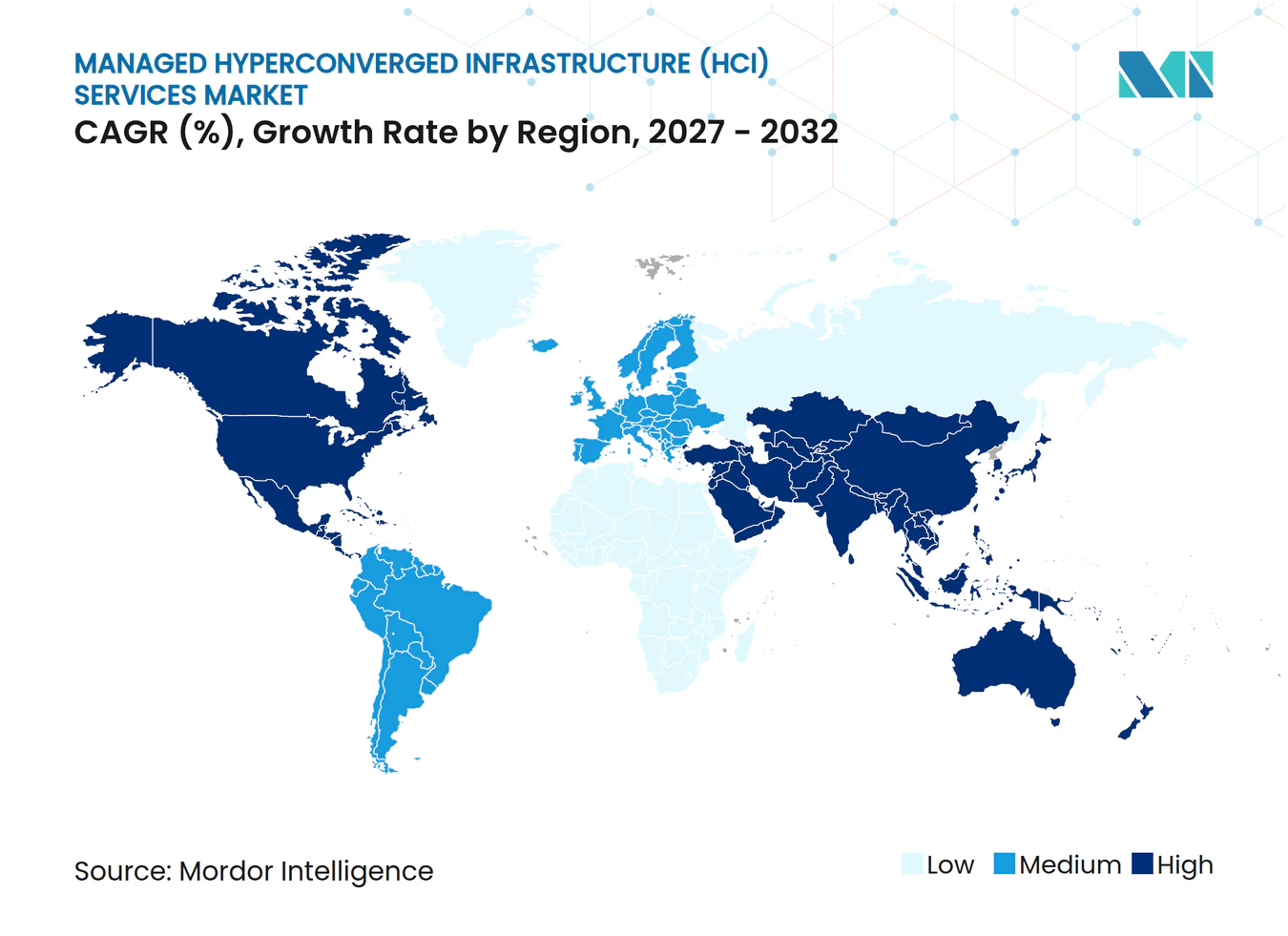
North America held 41.57% of the managed hyperconverged infrastructure services market share in 2026. The region has a large base of VMware estates, mature managed service provider networks, and sizeable technology budgets in financial services, healthcare, and the public sector. These conditions support broader use of managed private and hybrid environments. Consumption-based offers are also well established, with providers using per-node monthly pricing to replace uncertain capital refresh cycles with defined operating expenses. The region's migration activity gives vendors an opportunity to package assessment, re-platforming, lifecycle management, and recovery support into one contract. This favors partners that can support more than one hypervisor and work across a customer's existing hardware estate. The managed hyperconverged infrastructure services market benefits from a regional customer base that is accustomed to outsourcing defined operational responsibilities.
Asia-Pacific is projected to expand at a 12.42% CAGR through 2032, giving it the highest regional rate in the managed hyperconverged infrastructure services market. China, India, and Japan each represent a different demand pattern. China's information technology sovereignty programs require compatibility with domestic processors and operating systems, making certified local partnerships important for providers. India has significant demand from BFSI organizations and AI infrastructure initiatives. Japan is seeing VMware replacement activity, including Toshiba I.S. Corporation's migration of 2,200 virtual machines to Nutanix. The region gives providers room to offer software-led, locally compliant, and managed operating models rather than using a single standard approach. The managed hyperconverged infrastructure services market must therefore accommodate different compliance, platform, and operating conditions across the region.
Europe's demand is tied to data sovereignty, GDPR-related infrastructure requirements, and VMware migration activity in public-sector and mid-market organizations. Germany is a central spending area, and the State of Hessen awarded a EUR 92 million procurement for Nutanix HCI systems and managed services under German Federal Office for Information Security conformance requirements. In the United Kingdom, Nine23 partnered with Nutanix in July 2025 to provide a sovereign managed cloud service for government, national-security, and defense clients South America is earlier in its adoption cycle, with Brazil supporting demand through BFSI digitalization and public-infrastructure modernization. The Middle East is adding sovereign data-center capacity through programs in Saudi Arabia and the United Arab Emirates. Africa offers a longer-term opportunity, although grid reliability and limited specialist capacity remain practical constraints. These mixed regional conditions make local compliance credentials and dependable operations more important than a uniform global delivery model. They also make the managed hyperconverged infrastructure services market more dependent on local partners with recognized compliance credentials.
Competitive Landscape
Market Concentration
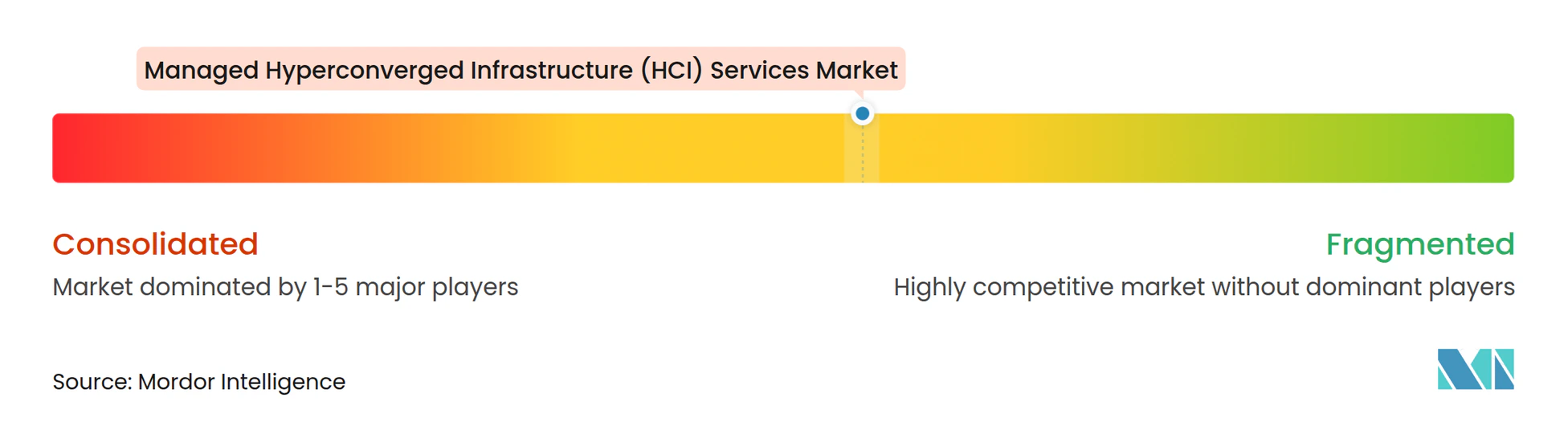
The managed hyperconverged infrastructure services (HCI) market is moderately concentrated in enterprise accounts. Nutanix, Dell Technologies, and Hewlett Packard Enterprise influence platform direction and commercial expectations, while mid-market and edge work remains spread across regional service providers and specialist vendors. The enterprise vendors are building partner ecosystems rather than competing only on hardware. Dell added native Nutanix AHV support to Dell Private Cloud in February 2026, alongside VMware and Red Hat OpenShift options. This helps customers select a hypervisor by workload while keeping lifecycle activities within one management framework. Standards such as SOC 2 Type II, ISO 27001-aligned delivery, and support for the CMMC framework are becoming material qualifications for regulated accounts.
Nutanix is using partnerships to extend its hardware and service reach. In May 2025, Nutanix and Pure Storage announced an integrated offering that combines Nutanix Cloud Infrastructure with Pure Storage FlashArray over NVMe/TCP for mission-critical and AI workloads. The arrangement was validated for hardware from Cisco, Dell, HPE, Lenovo, and Supermicro, with Expedient named as the first managed service provider design partner. Nutanix and Telekom Deutschland also introduced a sovereign hybrid-cloud offering in November 2025 that combines Nutanix software, Dell hardware, and Telekom Deutschland managed operations. These moves show how vendors can turn hardware relationships and local operating capacity into channels for managed services.
Opportunities remain in mid-market organizations operating mixed VMware and Nutanix environments that lack strong observability. Sovereign and regulated environments also create demand where data residency restricts the use of large public-cloud options. GPU-ready edge HCI with remote management is becoming a distinct category for customers that cannot staff every site locally. Scale Computing, StarWind Software, StorMagic, and DataCore Software compete in smaller and edge-focused deployments where simplicity and cost per node matter more than platform breadth. SmartX has built a position in China, while Arcfra has demonstrated HCI replacement activity across manufacturing sites in China, Taiwan, Vietnam, and North America. The managed hyperconverged infrastructure services (HCI) market remains open to specialists, but large vendors retain an advantage where customers require a broad platform, compliance evidence, and multi-site support. In the managed hyperconverged infrastructure services market, specialist providers can still compete when they target deployment sizes and operating needs that enterprise platforms do not prioritize. The managed hyperconverged infrastructure services (HCI) market also places value on a provider's ability to support customers through both migration and the ongoing service period.
Managed Hyperconverged Infrastructure (HCI) Services Industry Leaders
-
Nutanix, Inc.
-
Dell Technologies Inc.
-
Broadcom Inc.
-
Hewlett Packard Enterprise Development LP
-
Cisco Systems, Inc.
- *Disclaimer: Major Players sorted in no particular order
Managed Hyperconverged Infrastructure (HCI) Services Market Companies Covered in this Report
- Nutanix, Inc.
- Dell Technologies Inc.
- Broadcom Inc.
- Hewlett Packard Enterprise Development LP
- Cisco Systems, Inc.
- Microsoft Corporation
- Huawei Technologies Co., Ltd.
- Lenovo Group Limited
- NetApp, Inc.
- International Business Machines Corporation
- Fujitsu Limited
- NEC Corporation
- Hitachi Vantara LLC
- Super Micro Computer, Inc.
- Scale Computing, Inc.
- StarWind Software, Inc.
- StorMagic Ltd.
- DataCore Software Corporation
- Sangfor Technologies Inc.
- Quantum Corporation
- Diamanti, Inc.
Recent Industry Developments in Managed Hyperconverged Infrastructure (HCI) Services Market
- August 2026: Nutanix reported fourth-quarter fiscal 2026 revenue of USD 757.1 million, annual recurring revenue of USD 2.55 billion, and adjusted operating margins of 26.2%. It guided fiscal 2027 revenue of USD 3.18 billion to USD 3.23 billion as VMware migration activity and external storage adoption sustained demand.
- July 2026: Dell Technologies achieved general availability of PowerStore integration for the Nutanix Cloud Platform. The option gave customers a second Dell storage choice alongside PowerFlex for Nutanix AHV environments, with Nutanix Prism providing unified management and Dell Private Cloud managing AHV deployment and lifecycle automation.
- May 2026: Nutanix and Pure Storage celebrated one year from its partnership combining Nutanix Cloud Infrastructure with Pure Storage FlashArray over NVMe/TCP. The offer supported mission-critical and AI workloads across validated hardware from Cisco, Dell, HPE, Lenovo, and Supermicro.
- February 2026: Dell launched Dell Private Cloud with native Nutanix AHV support alongside VMware and Red Hat OpenShift blueprint options. The Dell Automation Platform automated Day 0 through Day 2 infrastructure management and enabled workload-level hypervisor selection from a self-service portal.
Global Managed Hyperconverged Infrastructure (HCI) Services Market Report Scope
The Managed Hyperconverged Infrastructure (HCI) Services Market encompasses the professional and managed service offerings through which third-party providers, including IT service companies, managed service providers (MSPs), system integrators, hyperscaler-aligned partners, and the HCI vendors themselves, design, deploy, operate, monitor, optimize, and support HCI environments on behalf of enterprises.
The Managed HCI Services Market is Segmented by Component (Hardware Infrastructure, HCI Software and Control Plane, Managed Services, and Professional Services), Service Type (Infrastructure Management Services, Monitoring and Observability Services, Security and Compliance Management Services, Backup and Disaster Recovery Services, Capacity and Performance Optimization Services, and Migration and Modernization Services), End-User (Banking, Financial Services and Insurance, Information Technology and Telecommunications, Healthcare and Life Sciences, Government and Defense, Manufacturing, Retail and Consumer Goods, and Other End-User Industries), and Geography (North America, South America, Europe, Asia-Pacific, Middle East, and Africa). The Market Forecasts are Provided in Terms of Value (USD).
Segmentation Overview
| Hardware Infrastructure |
| HCI Software and Control Plane |
| Managed Services |
| Professional Services |
| Infrastructure Management Services |
| Monitoring and Observability Services |
| Security and Compliance Management Services |
| Backup and Disaster Recovery Services |
| Capacity and Performance Optimization Services |
| Migration and Modernization Services |
| Banking, Financial Services and Insurance |
| Information Technology and Telecommunications |
| Healthcare and Life Sciences |
| Government and Defense |
| Manufacturing |
| Retail and Consumer Goods |
| Other End-User Industries |
| North America | United States |
| Canada | |
| Mexico | |
| South America | Brazil |
| Argentina | |
| Rest of South America | |
| Europe | Germany |
| United Kingdom | |
| France | |
| Italy | |
| Spain | |
| Rest of Europe | |
| Asia-Pacific | China |
| India | |
| Japan | |
| South Korea | |
| Rest of Asia-Pacific | |
| Middle East | Turkey |
| Israel | |
| Saudi Arabia | |
| United Arab Emirates | |
| Rest of Middle East | |
| Africa | South Africa |
| Nigeria | |
| Egypt | |
| Rest of Africa |
| By Component | Hardware Infrastructure | |
| HCI Software and Control Plane | ||
| Managed Services | ||
| Professional Services | ||
| By Service Type | Infrastructure Management Services | |
| Monitoring and Observability Services | ||
| Security and Compliance Management Services | ||
| Backup and Disaster Recovery Services | ||
| Capacity and Performance Optimization Services | ||
| Migration and Modernization Services | ||
| By End-User Industry | Banking, Financial Services and Insurance | |
| Information Technology and Telecommunications | ||
| Healthcare and Life Sciences | ||
| Government and Defense | ||
| Manufacturing | ||
| Retail and Consumer Goods | ||
| Other End-User Industries | ||
| By Geography | North America | United States |
| Canada | ||
| Mexico | ||
| South America | Brazil | |
| Argentina | ||
| Rest of South America | ||
| Europe | Germany | |
| United Kingdom | ||
| France | ||
| Italy | ||
| Spain | ||
| Rest of Europe | ||
| Asia-Pacific | China | |
| India | ||
| Japan | ||
| South Korea | ||
| Rest of Asia-Pacific | ||
| Middle East | Turkey | |
| Israel | ||
| Saudi Arabia | ||
| United Arab Emirates | ||
| Rest of Middle East | ||
| Africa | South Africa | |
| Nigeria | ||
| Egypt | ||
| Rest of Africa | ||
Key Questions Answered in the Report
What is the managed hyperconverged infrastructure services market size?
The managed hyperconverged infrastructure services market was valued at USD 21.94 billion in 2026 and is projected to reach USD 43.48 billion by 2032.
What is driving adoption of managed HCI services?
VMware migration activity, demand for hybrid and private-cloud operations, AI-ready infrastructure needs, and stronger recovery requirements are key factors.
Which component leads managed HCI services?
Managed Services held 72.29% of revenue in 2026 and is projected to expand at a 12.46% CAGR through 2032.
Which service type is projected to expand fastest?
Monitoring and Observability Services is projected to expand at a 12.86% CAGR through 2032 as organizations prioritize proactive operations.
Which end-user sector has the largest managed HCI services demand?
Banking, Financial Services and Insurance held 21.33% of revenue in 2026 because of uptime, control, and private-infrastructure requirements.
Which region is projected to expand fastest for managed HCI services?
Asia-Pacific is projected to expand at a 12.42% CAGR through 2032, supported by sovereignty programs, AI infrastructure demand, and migration projects.