
Fraud Orchestration Platform Market Size and Share
Market Overview
| Study Period | 2020 - 2031 |
|---|---|
| Market Size (2026) | USD 2.62 Billion |
| Market Size (2031) | USD 5.84 Billion |
| Growth Rate (2026 - 2031) | 17.39 % |
| Fastest Growing Market | Asia-Pacific |
| Largest Market | North America |
| Market Concentration | Medium |
Major Players *Disclaimer: Major Players sorted in no particular order Image © Mordor Intelligence. Reuse requires attribution under CC BY 4.0. | |
Fraud Orchestration Platform Market Analysis by Mordor Intelligence
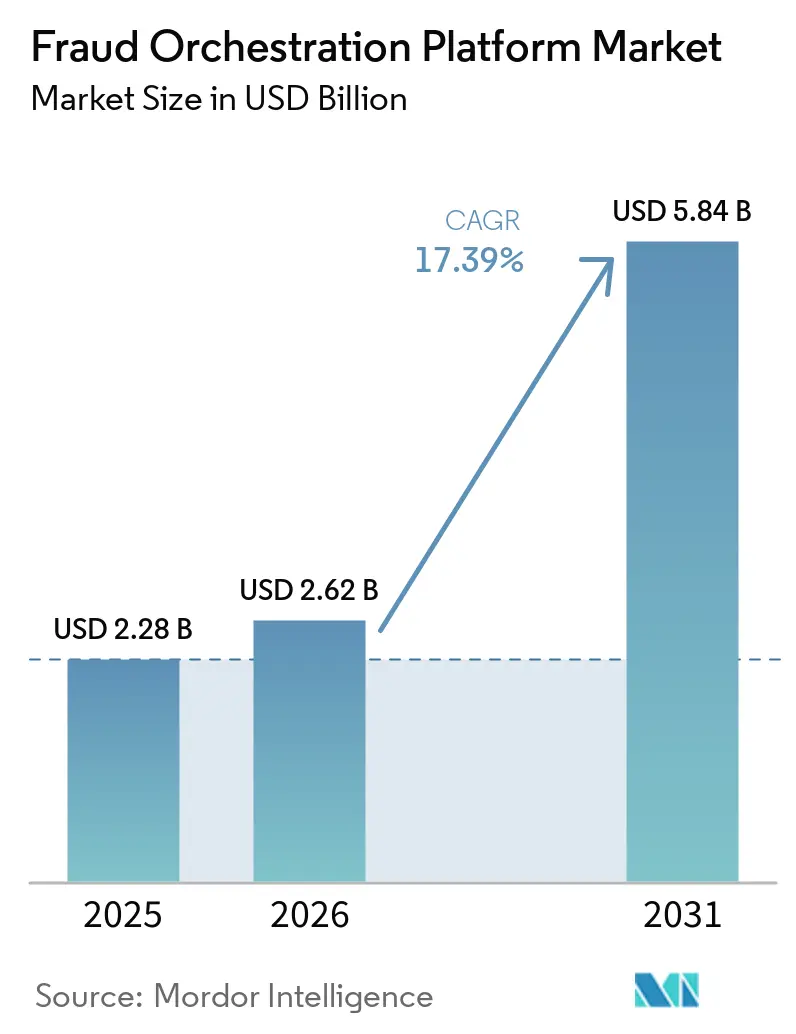
The fraud orchestration platform market size was USD 2.28 billion in 2025 and is estimated to grow from USD 2.62 billion in 2026 to reach USD 5.84 billion by 2031, at a CAGR of 17.39% during the forecast period (2026-2031). Rising payment fraud is driving demand for systems that integrate data, models, and review workflows into a single operating environment. The fraud orchestration platform market is moving away from disconnected tools because payment, identity, and compliance teams need a single record of each decision. Real-time payments make that change more urgent because a delayed decision can leave little time to recover funds. Providers are responding through cloud delivery, managed services, and integrations that let customers connect existing fraud tools. Competition is also intensifying as payment networks, established risk vendors, and newer AI-focused providers compete for the same enterprise budgets.
Key Report Takeaways
- By component, software accounted for 68.49% of revenue in the fraud orchestration platform market in 2025, while services are projected to expand at a 20.58% CAGR through 2031.
- By deployment mode, cloud-based deployment held 69.53% share in 2025 and is expected to expand at a 19.74% CAGR through 2031.
- By organization size, large enterprises held 66.71% share in the fraud orchestration platform market in 2025, while SMEs are projected to expand at a 22.47% CAGR through 2031.
- By platform type, integrated enterprise fraud management platforms held 43.11% share in 2025, while independent fraud orchestration platforms are projected to expand at a 21.13% CAGR through 2031.
- By industry vertical, BFSI held 28.63% share in 2025, while the retail and e-commerce industry is projected to expand at a 19.86% CAGR through 2031.
- By geography, North America held 39.72% share in the fraud orchestration platform market in 2025, while Asia-Pacific is projected to expand at a 22.61% CAGR through 2031.
Note: Market size and forecast figures in this report are generated using Mordor Intelligence’s proprietary estimation framework, updated with the latest available data and insights as of January 2026.
Global Fraud Orchestration Platform Market Trends and Insights
Drivers Impact Analysis*
| DRIVER | (~) % IMPACT ON CAGR FORECAST | GEOGRAPHIC RELEVANCE | IMPACT TIMELINE |
|---|---|---|---|
| Generative AI Deepfakes and Synthetic Identity Fraud | +4.2% | Global, with concentrated losses in North America and Western Europe | Short term (≤ 2 years) |
| Growth of Real-Time and Account-to-Account Payments | +3.8% | Asia-Pacific, Europe, North America | Short term (≤ 2 years) |
| Enterprise Consolidation of Siloed Fraud Controls | +3.1% | Global, led by North America and Europe | Medium term (2-4 years) |
| Regulatory Demand for Traceable Automated Decisioning | +2.7% | Europe and North America | Medium term (2-4 years) |
| Cloud-Native Low-Code Fraud Operations | +2.3% | Global, accelerating in Asia-Pacific and South America | Medium term (2-4 years) |
| Agentic Investigation and Disposition Automation | +1.9% | North America and Asia-Pacific, with spillover to Middle East and Africa | Long term (≥ 4 years) |
| Source: Mordor Intelligence | |||
Generative AI Deepfakes and Synthetic Identity Fraud Push Platforms Toward Multi-Signal Defense
Generative AI is making it easier for fraud rings to create synthetic identities and convincing deepfake material. FinCEN warned in November 2024 that criminals were using deepfake media to fabricate identity documents, photographs, and personal information for synthetic-identity schemes.[1] The FBI recorded 22,364 AI-related cybercrime complaints in 2025, with adjusted losses totaling USD 893 million. Federal Reserve Governor Michael Barr stated in 2025 that deepfakes could intensify identity fraud and could challenge existing bank voice-detection practices. The fraud orchestration platform market, therefore, favors systems that evaluate behavioral biometrics, device signals, and network intelligence together instead of relying on static rules. In the fraud orchestration platform market, this approach gives investigators more context when a single identity or transaction signal appears legitimate.
Growth of Real-Time and Account-to-Account Payments Compresses Decision Windows
Real-time payments have shifted fraud prevention from a review activity to a decision that must be made before funds move. The Federal Reserve Financial Services 2026 survey found that faster payments had the largest increase in attempted fraud and reported losses among the channels surveyed.[2] It also reported a 6% increase in attempted faster-payment fraud and a 15% rise in the number of institutions reporting persistent or increasing exposure to bank impostor scams. The Reserve Bank of India is developing the Digital Payments Intelligence Platform to identify mule accounts and suspicious payments across the national ecosystem. The fraud orchestration platform market gains a clear use case with each immediate-payment rail, which adds transactions that require low-latency scoring, clear routing, and documented action. The fraud orchestration platform market benefits because banks and payment firms need a layer that can coordinate those actions across several fraud tools.
Enterprise Consolidation of Siloed Fraud Controls Accelerates Platform Convergence
Organizations often operate separate tools for card fraud, transaction monitoring, identity checks, and case management. Experian found in 2025 that 76% of businesses used multiple fraud solutions, while only 42% had connected those solutions. Across the fraud orchestration platform market, separate queues can leave risk teams with conflicting scores and incomplete context for a customer or payment. They can also make it harder to establish which rule, model, or data source produced the final decision. The fraud orchestration platform market is benefiting from consolidation programs, as a common decision layer can record the sequence of checks and route cases to the appropriate team. Providers that can integrate legacy systems without forcing a full replacement are better suited to these programs.
Regulatory Demand for Traceable Automated Decisioning Elevates Audit-Ready Architectures
Regulators increasingly expect automated fraud controls to be traceable and subject to effective oversight. NACHA fraud-monitoring rules took effect in the United States on March 20, 2026, requiring participants to use risk-based fraud controls for ACH activity. The European Commission states that authorities and the AI Office are responsible for supervising and enforcing the EU AI Act from August 2026. For the fraud orchestration platform market, these requirements increase the value of rule versioning, review records, and human-override workflows. The fraud orchestration platform market is supported when compliance teams treat audit logging as part of their operating controls rather than a report produced after an incident. Established suppliers can use their regulatory relationships, while newer providers must show that their flexible models remain explainable.
Restraints Impact Analysis*
| RESTRAINT | (~) % IMPACT ON CAGR FORECAST | GEOGRAPHIC RELEVANCE | IMPACT TIMELINE |
|---|---|---|---|
| Privacy Data Localization and Cross-Border Signal Constraints | -1.8% | Global, acute in the European Union, China, India, and Southeast Asia | Long term (≥ 4 years) |
| False Positives Alert Fatigue and Customer Friction | -1.4% | Global, most costly in North America and Europe | Medium term (2-4 years) |
| Legacy-Core Integration and Model-Governance Complexity | -1.1% | North America and Europe, especially large Tier-1 institutions | Long term (≥ 4 years) |
| Adversarial Adaptation and Zero-Day Evasion | -0.9% | Global | Short term (≤ 2 years) |
| Source: Mordor Intelligence | |||
Privacy Data Localization and Cross-Border Signal Constraints Fragment Consortium Intelligence
Network-level fraud signals can reveal patterns that are not visible to one institution acting alone. The European Payments Council identified data protection constraints on the sharing of fraud information as a barrier to cross-border scam prevention in its 2025 report. China’s Personal Information Protection Law and India’s Digital Personal Data Protection Act can also limit the movement of personal data used in cross-border model development. Within the fraud orchestration platform market, those restrictions require providers to localize data processing, adjust model design, or build privacy-preserving approaches. The fraud orchestration platform market faces a practical limit when a provider cannot combine useful signals across jurisdictions. Vendors with localized networks, appropriate agreements, and compliant data practices can strengthen their position in regulated markets.
False Positives Alert Fatigue and Customer Friction Create an Efficiency Ceiling
False positives impose costs on investigators and create friction for legitimate customers. NICE Actimize reported in 2026 that European banking executives viewed loss of customer trust as the most significant effect of fraud events.[3] For buyers in the fraud orchestration platform market, large alert volumes can delay case handling and make it harder to prioritize genuine threats. Incorrectly declined payments can also affect customer loyalty when switching costs are low. The fraud orchestration platform market must show that more data and more automated checks improve precision rather than simply creating more alerts. Behavioral context and adjustable thresholds can help institutions balance prevention, review capacity, and the experience of legitimate customers.
*Our forecasts treat driver/restraint impacts as directional, not additive. The impact forecasts reflect baseline growth, mix effects, and variable interactions.
Segment Analysis
By Component: Services Extend the Value of Managed Decisioning
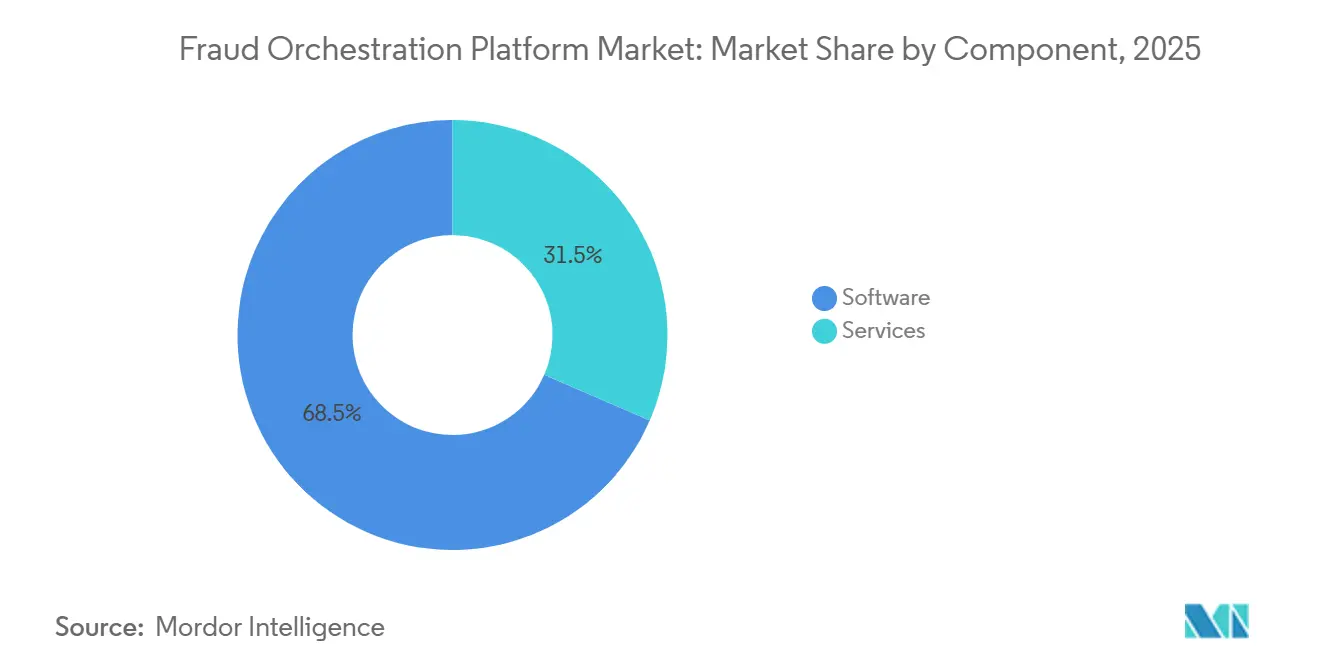
Software accounted for 68.49% of revenue from fraud orchestration platforms in 2025. Decisioning engines, rule libraries, model management tools, and case management interfaces remain central to enterprise deployments. Within the fraud orchestration platform market, the leading position reflects the practical need to configure rules, record decisions, and manage reviews in a single platform. Multi-year software contracts can remain durable once a platform is linked to payment flows, customer data, and internal review processes. The fraud orchestration platform market continues to favor suppliers that offer open interfaces, as customers rarely replace all their fraud tools at the same time.
Services are projected to expand at a 20.58% CAGR through 2031, the fastest rate among component types. Managed decisioning services allow institutions to receive model updates, threat intelligence, and operating support without building large internal teams for model tuning. Integration work remains important when firms replace isolated products with a common orchestration layer across payment rails, core banking systems, and identity providers. Consulting, implementation, training, and support become more important when organizations must document controls and train analysts on new review workflows. The Bank for International Settlements described cross-border fraud prevention as requiring coordinated tools and information sharing, which supports work that connects technology with daily operating processes.[4]
By Deployment Mode: Cloud Delivery Combines Scale With Control Options
Cloud-based deployment held 69.53% of revenue in 2025. In the fraud orchestration platform market, this model enables providers to scale processing capacity during transaction peaks and distribute approved model updates more quickly. It supports centralized administration for institutions that operate across cards, transfers, wallets, and other payment channels. Cloud delivery can also reduce the effort required to maintain hardware and core platform software within each customer location. These features make it a practical option for customers who need rapid implementation and frequent adjustments to fraud controls.
Cloud-based deployment is expected to grow at a 19.74% CAGR through 2031. Data residency rules mean customers may require regional processing locations and clear controls over where transaction data is retained. On-premises installations remain relevant for central banks, public institutions, and regulated entities operating under strict sovereignty requirements. Hybrid designs allow an organization to retain selected data or model assets locally while using cloud computing for high-volume decisioning workloads. The Association of Certified Fraud Examiners reported that adoption of cloud-native fraud technology remained limited among surveyed organizations in 2026, suggesting deployment choices will remain mixed.[5]
By Organization Size: SMEs Become a Larger Source of New Demand
Large enterprises held 66.71% of revenue in 2025. Their position in the fraud orchestration platform market reflects higher transaction volumes, direct financial exposure, established compliance teams, and more extensive procurement capacity. Many large banks, insurers, and e-commerce operators have used fraud technology for years, so current spending commonly includes upgrades, extra modules, and managed-service expansion. These customers also need integrations across legacy systems, payment channels, and internal case-management processes, which can make contracts larger and implementation longer. The fraud orchestration platform industry continues to rely on this group for complex deployments requiring detailed controls and formal governance.
SMEs are projected to grow at a 22.47% CAGR through 2031. Cloud-based, low-code products reduce the time, cost, and specialized resources required to establish decisioning workflows. Smaller fintech firms and mid-market merchants often need prebuilt connections to processors, card networks, and identity providers rather than custom integration work. They also tend to prefer pricing linked to subscriptions, preventing chargebacks, or operational outcomes over large upfront commitments. The Reserve Bank of India’s Digital Payments Intelligence Platform shows how stronger fraud-monitoring expectations can extend beyond the largest institutions.
By Platform Type: Independent Platforms Challenge Integrated Suites
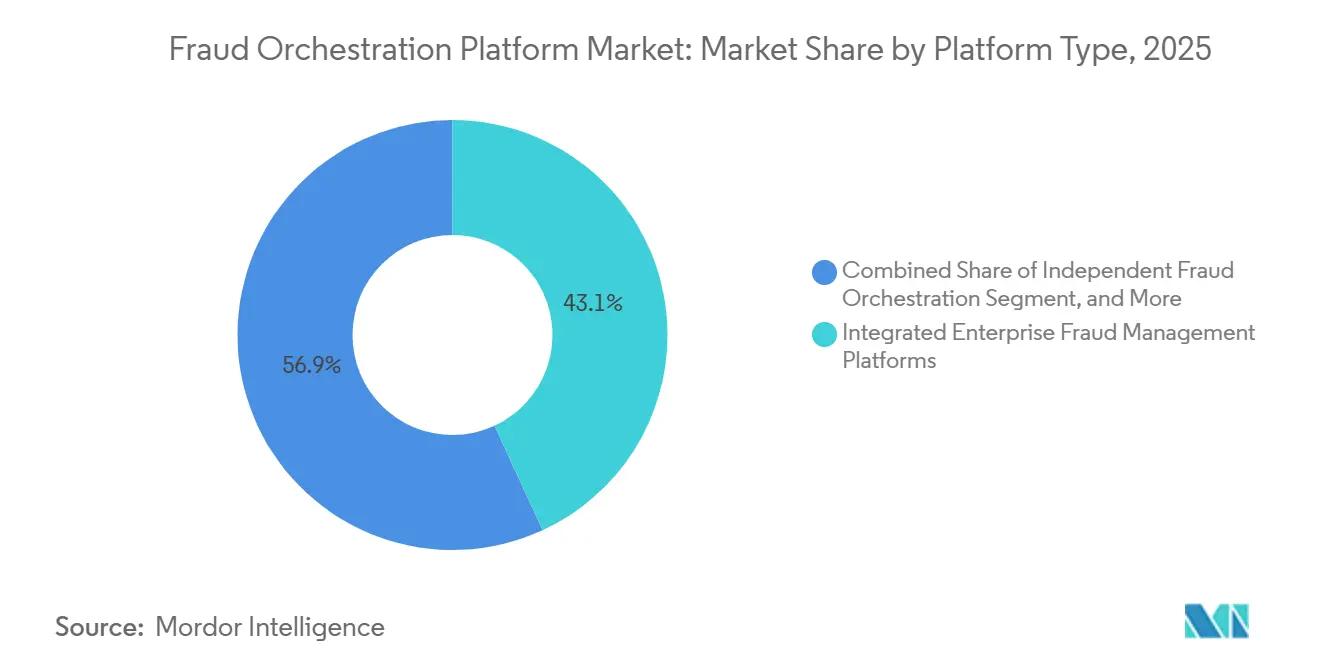
Integrated enterprise fraud management platforms accounted for 43.11% of revenue in 2025. These suites combine anti-money laundering controls, fraud detection, case management, and reporting within a single provider relationship. Large banks often value that structure because it can reduce integration work and create a common record for audit and review. It also provides compliance and fraud teams with a shared framework for routing alerts, escalating cases, and assigning investigative responsibilities. The established base of broad-suite suppliers remains an important barrier for independent providers that must demonstrate compatibility with existing controls.
Independent fraud orchestration platforms are projected to grow at a 21.13% CAGR through 2031. Buyers in this category want a vendor-neutral decision layer that can route work across internal models, external data, and specialized detection products. Fraud decisioning-led platforms compete through the speed and flexibility of their rules engines, while identity-risk systems combine document, device, and behavioral signals. Visa announced in August 2026 that it had agreed to acquire BioCatch for USD 2.4 billion, adding behavioral-intelligence capabilities to its fraud infrastructure. The transaction illustrates why network-scale behavioral data is becoming more important across the fraud orchestration platform market.
By Industry Vertical: BFSI Leads Spending While Retail Changes Accuracy Incentives
BFSI held 28.63% of revenue in 2025. High transaction volumes, regulatory duties, and direct exposure to financial losses make this vertical the largest source of demand. The European Central Bank and European Banking Authority reported EUR 4.2 billion (USD 4.82 billion) in payment fraud across the EEA in 2024, with credit-transfer losses reaching EUR 2.2 billion (USD 2.52 billion). These losses strengthen the case for controls that assess behavioral context and payment intent before a transfer is released. Insurers face a related requirement to integrate signals used in claims fraud review, customer verification, and case handling.
The retail and e-commerce industry is projected to expand at a 19.86% CAGR through 2031. Chargeback-guarantee models give providers a direct reason to improve approval precision because an incorrect decline can reduce merchant sales. Signifyd reported in 2026 that fraud pressure rose 33% year over year, and account takeover rose 78%. Payments and fintech firms also need real-time controls as open banking expands third-party-initiated transactions and increases the number of connected parties. Online marketplaces, gaming, telecommunications, healthcare, and public agencies provide additional use cases in which a decision depends on signals from more than one system.
Geography Analysis
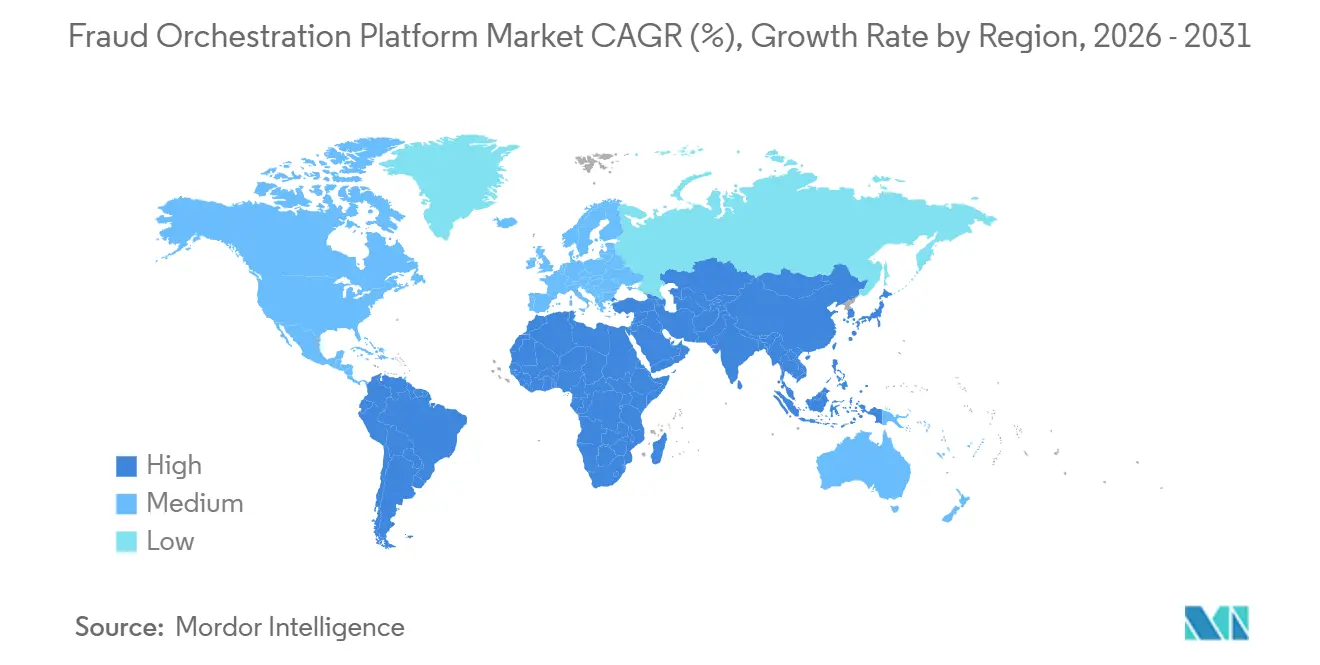
North America held 39.72% of revenue in 2025. The region has a large concentration of major financial institutions, mature payment infrastructure, and established technology budgets. The Federal Reserve Financial Services survey found that 75% of institutions experienced debit-card fraud attempts in 2026. NACHA’s fraud-monitoring rules are prompting ACH participants to document risk-based controls. Independent providers compete intensely in the United States by offering modular deployments and flexible commercial terms.
Asia-Pacific is projected to expand at a 22.61% CAGR through 2031. India’s payment ecosystem needs fast decisions because UPI processed 18.3 billion transfers worth INR 24.77 lakh crore (USD 298 billion) in March 2025. The Reserve Bank of India is building a risk-scoring layer through the Digital Payments Intelligence Platform. China is another important source of demand because mobile payments are widely used, and social-engineering scams require more than transaction-pattern checks. Japan, South Korea, and Australia have mature buyer groups shaped by compliance obligations and exposure to cross-border fraud.
Europe remains a major regional market because regulatory requirements and anti-scam measures are driving technology purchases. The Banque de France reported that payment fraud in France grew by 3.8% in 2025, while manipulation fraud rose by 34% to EUR 516 million (USD 558 million). The United Kingdom reported APP fraud of GBP 576.4 million (USD 736 million) in 2025.[6] South America is developing through Brazil’s PIX payment system, while the Middle East and Africa remain earlier in adoption despite investment by the United Arab Emirates and Saudi Arabia.
Competitive Landscape
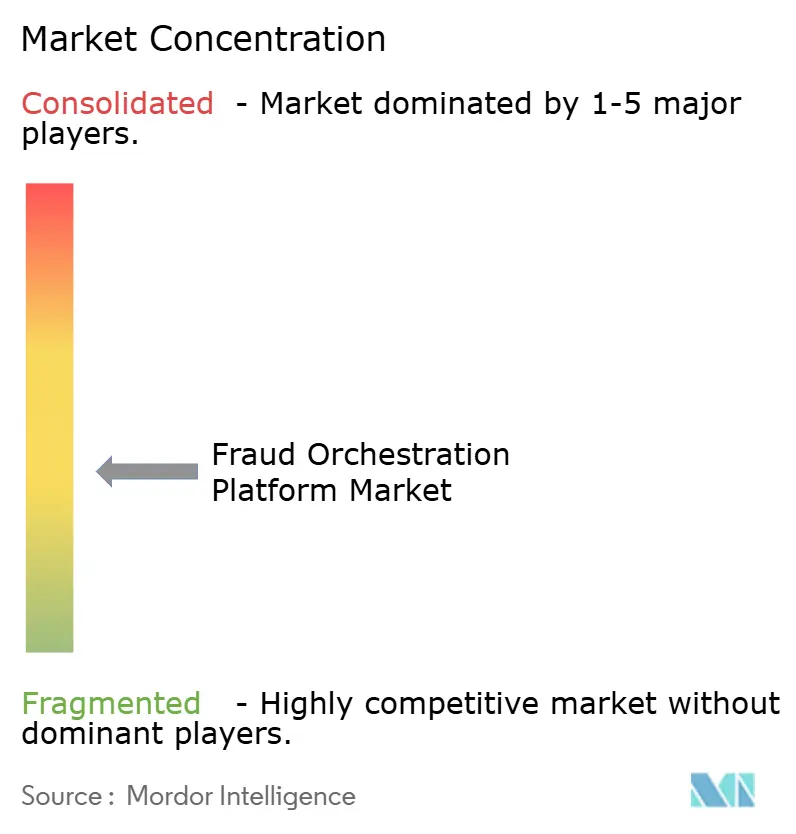
The fraud orchestration platform market is moderately fragmented, with 8 to 10 providers accounting for much of the addressable enterprise revenue alongside specialized vendors. ACI Worldwide, NICE Actimize, LexisNexis Risk Solutions, FICO, and SAS Institute offer broad coverage across fraud, anti-money laundering, case management, and reporting. Feedzai, DataVisor, SardineAI, and Alloy compete with more modular, AI-focused products. Competition often turns on model update speed, integration depth, and the quality of available data rather than on a single feature. FICO has an established position in card transaction scoring, while larger enterprise technology providers offer their own decision-management capabilities.
Visa’s agreement to acquire BioCatch for USD 2.4 billion in August 2026 is a notable step toward broader ownership of fraud infrastructure. BioCatch analyzes more than 3,000 behavioral, device, and network signals per session and protects more than 760 million users. NICE Actimize launched its Insights Network in January 2026 to provide institutions with counterparty risk visibility through shared fraud and financial crime intelligence. ACI Worldwide integrated Kinexys by J.P. Morgan’s Confirm application into its fraud and financial-crime products in April 2026, adding pre-transaction payee verification for ACH, wire, and instant payments. These actions show that suppliers are extending their role before a payment is authorized, not only after suspicious behavior is identified.
Opportunity remains in SME-focused products, identity-risk coordination, and unified fraud and anti-money laundering workflows. Mid-market customers often rely on capabilities bundled with payment processors rather than on a dedicated decision layer. Identity-risk orchestration requires behavioral biometrics, document verification, device intelligence, and session behavior to work together within a single flow. Convergence between compliance and fraud teams can change purchasing decisions because their separate budgets increasingly support the same operational platform.
Fraud Orchestration Platform Industry Leaders
-
ACI Worldwide, Inc.
-
NICE Actimize Limited
-
LexisNexis Risk Solutions Inc.
-
Fair Isaac Corporation
-
Feedzai, Inc.
- *Disclaimer: Major Players sorted in no particular order
Recent Industry Developments
- September 2026: ACI Worldwide signed a definitive agreement to acquire Cranium Ventures, a developer of cloud-native card payment switching technology. The acquisition will add microservices-based card switching capability to ACI Connetic for Cards, the platform ACI launched in March 2026, accelerating its roadmap to unify card payments, account-to-account payments, and AI-powered fraud prevention on a single cloud-native architecture.
- August 2026: Visa announced a definitive agreement to acquire BioCatch, a behavioral-first fraud intelligence provider, from funds advised by Permira and other shareholders for USD 2.4 billion in cash. BioCatch analyzes more than 3,000 behavioral, device, and network signals per session, protects over 760 million users across 1.8 billion devices, and serves more than 350 financial institutions globally. The transaction is expected to close by the end of Visa’s fiscal Q2 2027.
- April 2026: ACI Worldwide and Kinexys by J.P. Morgan announced the integration of the Kinexys Liink Confirm application into ACI Worldwide’s Fraud and Financial Crime solution and ACI Connetic, embedding pre-transaction payee verification across ACH, wire, and instant payment workflows to help stop misdirected payments and APP scams before funds leave accounts.
- January 2026: NICE Actimize launched the Actimize Insights Network, an intelligence-sharing network providing financial institutions with real-time counterparty-risk visibility by leveraging its global network of fraud and financial crime data from over 1,000 organizations in more than 70 countries.
Global Fraud Orchestration Platform Market Report Scope
The fraud orchestration platform market comprises solutions that centrally coordinate fraud detection tools, data sources, and decisioning engines in real time. These platforms address operational silos created by the use of multiple point solutions for fraud, identity, anti-money laundering (AML), and authentication. Through API-based frameworks, they route transactions among vendors, aggregate risk signals, and apply consistent decision policies across channels. Platforms such as LexisNexis Dynamic Decision Platform, ACI Worldwide, and independent orchestration layers enable fraud teams to modify routing rules, test detection models, and maintain unified audit trails without replacing existing infrastructure. They support payment fraud, account opening, transaction monitoring, and claims fraud use cases across the BFSI, e-commerce, and digital services sectors.
The Fraud Orchestration Platform Market Report is Segmented by Component (Software, and Services [Consulting and Fraud-Strategy Services, Implementation and Integration Services, Model, Rule, and Workflow Optimization Services, Managed Fraud Decisioning and Orchestration Services, and Training, Support, and Maintenance Services]), Deployment Mode (Cloud, On-Premises, and Hybrid), Organization Size (Large Enterprises, and Small and Medium-Sized Enterprises), Platform Type (Independent Fraud Orchestration Platforms, Fraud Decisioning-Led Orchestration Platforms, Identity Risk and Authentication Orchestration Platforms, and Integrated Enterprise Fraud Management Platforms), Industry Vertical (Banking and Financial Services, Payments and Fintech, Insurance, Retail and E-Commerce, Online Marketplaces and Digital Platforms, Gaming and Gambling, Telecommunications, Travel, Transportation, and Hospitality, Media and Entertainment, Healthcare and Life Sciences, Government and Public Administration, and Other Industry Verticals), and Geography (North America, South America, Europe, Asia-Pacific, and Middle East and Africa). The Market Forecasts are Provided in Terms of Value (USD).
| Software | |
| Services | Consulting and Fraud-Strategy Services |
| Implementation and Integration Services | |
| Model, Rule, and Workflow Optimization Services | |
| Managed Fraud Decisioning and Orchestration Services | |
| Training, Support, and Maintenance Services |
| Cloud |
| On-Premises |
| Hybrid |
| Large Enterprises |
| Small and Medium Enterprises |
| Independent Fraud Orchestration Platforms |
| Fraud Decisioning-Led Orchestration Platforms |
| Identity Risk and Authentication Orchestration Platforms |
| Integrated Enterprise Fraud Management Platforms |
| Banking, Financial Services, and Insurance (BFSI) |
| Retail and E-Commerce |
| Telecommunications |
| Travel, Transportation, and Hospitality |
| Media and Entertainment |
| Healthcare and Life Sciences |
| Government and Public Administration |
| Gaming and Gambling |
| Other Industry Verticals |
| North America | United States | |
| Canada | ||
| South America | Brazil | |
| Mexico | ||
| Rest of South America | ||
| Europe | Germany | |
| United Kingdom | ||
| France | ||
| Italy | ||
| Rest of Europe | ||
| Asia-Pacific | China | |
| Japan | ||
| India | ||
| Rest of Asia-Pacific | ||
| Middle East and Africa | Middle East | United Arab Emirates |
| Saudi Arabia | ||
| Rest of Middle East | ||
| Africa | South Africa | |
| Rest of Africa | ||
| By Component | Software | ||
| Services | Consulting and Fraud-Strategy Services | ||
| Implementation and Integration Services | |||
| Model, Rule, and Workflow Optimization Services | |||
| Managed Fraud Decisioning and Orchestration Services | |||
| Training, Support, and Maintenance Services | |||
| By Deployment Mode | Cloud | ||
| On-Premises | |||
| Hybrid | |||
| By Organization Size | Large Enterprises | ||
| Small and Medium Enterprises | |||
| By Platform Type | Independent Fraud Orchestration Platforms | ||
| Fraud Decisioning-Led Orchestration Platforms | |||
| Identity Risk and Authentication Orchestration Platforms | |||
| Integrated Enterprise Fraud Management Platforms | |||
| By Industry Vertical | Banking, Financial Services, and Insurance (BFSI) | ||
| Retail and E-Commerce | |||
| Telecommunications | |||
| Travel, Transportation, and Hospitality | |||
| Media and Entertainment | |||
| Healthcare and Life Sciences | |||
| Government and Public Administration | |||
| Gaming and Gambling | |||
| Other Industry Verticals | |||
| By Geography | North America | United States | |
| Canada | |||
| South America | Brazil | ||
| Mexico | |||
| Rest of South America | |||
| Europe | Germany | ||
| United Kingdom | |||
| France | |||
| Italy | |||
| Rest of Europe | |||
| Asia-Pacific | China | ||
| Japan | |||
| India | |||
| Rest of Asia-Pacific | |||
| Middle East and Africa | Middle East | United Arab Emirates | |
| Saudi Arabia | |||
| Rest of Middle East | |||
| Africa | South Africa | ||
| Rest of Africa | |||
Key Questions Answered in the Report
What is the fraud orchestration platform market size?
The fraud orchestration platform market size was USD 2.28 billion in 2025 and is estimated to grow from USD 2.62 billion in 2026 to reach USD 5.84 billion by 2031, at a CAGR of 17.39% during the forecast period (2026-2031).
What is driving demand for fraud orchestration platforms?
Deepfake identity fraud, real-time payments, fragmented fraud tools, and requirements for traceable decisions are increasing adoption. Buyers also need to connect existing systems without losing review records, decision history, or the ability to adjust controls quickly.
Which component leads revenue?
Software led with 68.49% revenue share in 2025, while services is expected to record the fastest component growth at a 20.58% CAGR through 2031. Services include integration, model support, training, and operating assistance for institutions with limited internal resources.
Which deployment model is most widely used?
Cloud-based deployment held 69.53% share in 2025 and is projected to grow at a 19.74% CAGR through 2031. It supports scalable processing and quicker update delivery, while on-premises and hybrid options remain relevant where data sovereignty rules are strict.
Which end-user vertical is expanding fastest?
Retail and e-commerce is projected to expand at a 19.86% CAGR through 2031, supported by chargeback guarantees and rising account-takeover risk. This sector needs approval decisions that prevent fraudulent orders without creating unnecessary friction for legitimate shoppers.
Which region is growing fastest?
Asia-Pacific is projected to expand at a 22.61% CAGR through 2031. High real-time payment volumes, including UPI activity in India, and expanding fraud-monitoring requirements support demand for systems that assess transactions within very short decision windows.