
Managed End-User Device Support Services Market Size and Share
Market Overview
| Study Period | 2021 - 2032 |
|---|---|
| Market Size (2027) | USD 22.93 Billion |
| Market Size (2032) | USD 31.46 Billion |
| Growth Rate (2027 - 2032) | 6.53 % |
| Fastest Growing Market | Asia-Pacific |
| Largest Market | North America |
| Market Concentration | Medium |
Major Players *Disclaimer: Major Players sorted in no particular order Image © Mordor Intelligence. Reuse requires attribution under CC BY 4.0. | |
Managed End-User Device Support Services Market Analysis by Mordor Intelligence
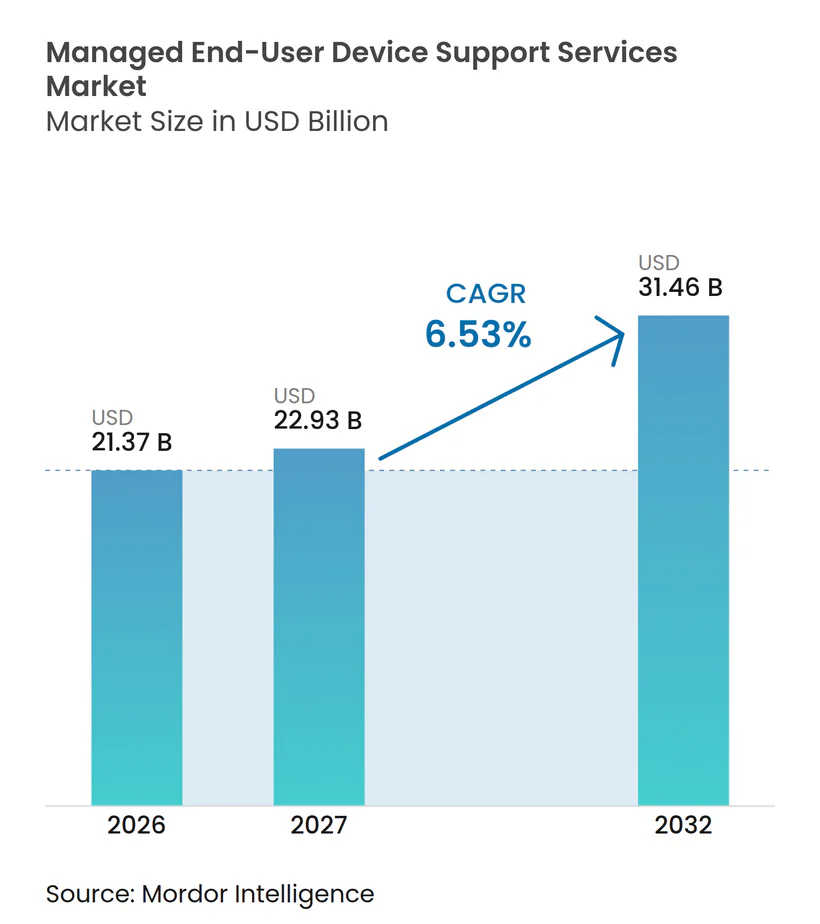
The managed end-user device support services market size is projected to expand from USD 21.37 billion in 2026 to USD 22.77 billion in 2027, and to USD 31.46 billion by 2032, registering a CAGR of 6.53% from 2027 to 2032. Enterprise digital programs are expanding the number and variety of endpoints that require provisioning, policy control, maintenance, and secure retirement. Cloud workloads, connected platforms, AI PCs, operational technology devices, and mobile work patterns are making it harder for internal teams to manage endpoint support on their own. This is moving demand in the managed end-user device support services market toward broader contracts that combine service desk delivery, lifecycle services, security management, and remote support. Providers that use predictive remediation and digital employee experience measures can compete on service quality rather than labor capacity alone. Third-party access risks, fragmented device estates, data residency requirements, and legacy infrastructure continue to lengthen deployment timelines and complicate procurement decisions.
Key Report Takeaways
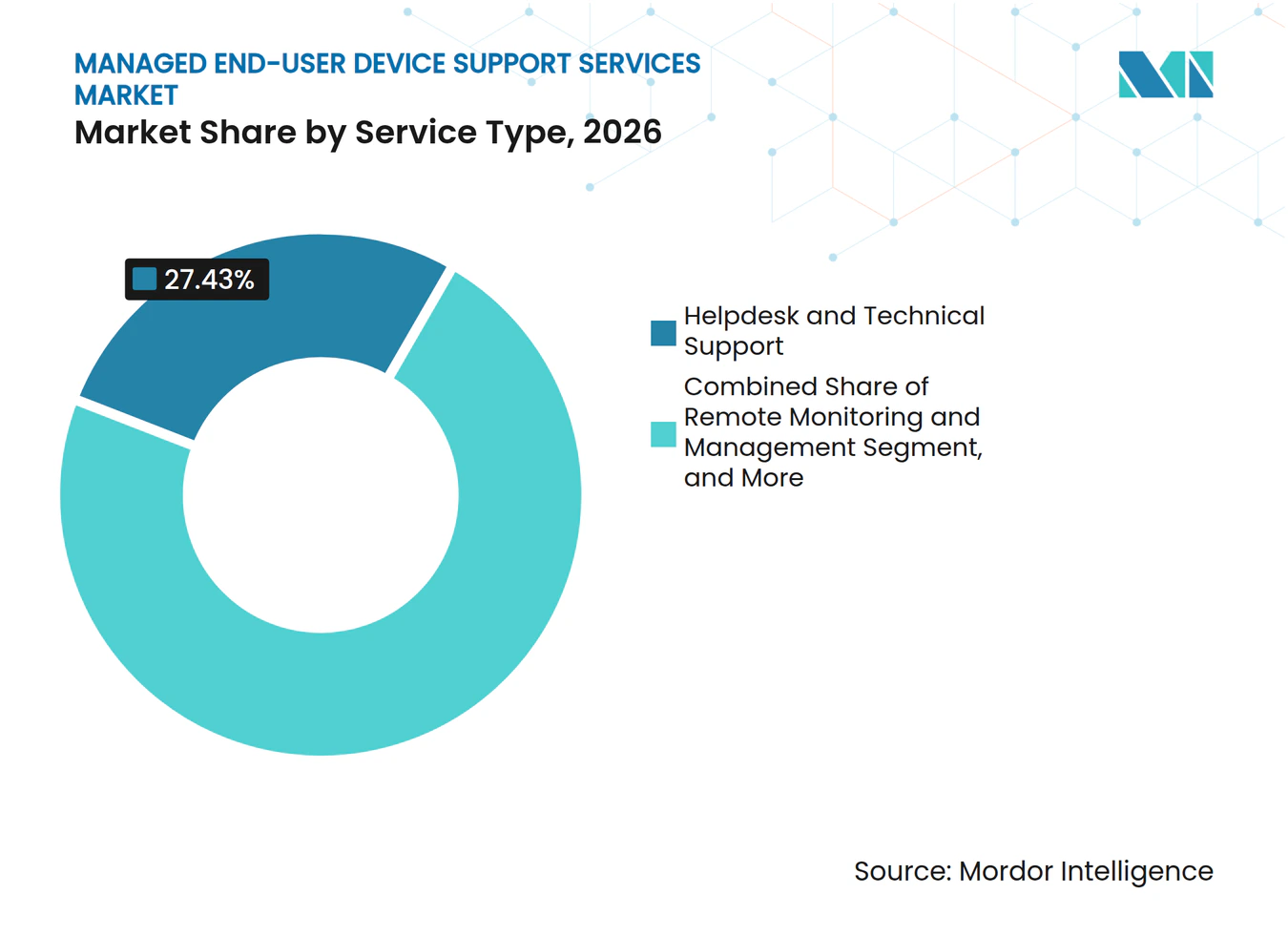
- By service type, Helpdesk and Technical Support held 27.43% of the managed end-user device support services market in 2026, while Endpoint Security Management is projected to expand at a 6.97% CAGR through 2032.
- By enterprise size, Large Enterprises accounted for 72.37% of revenue in 2026, while Small and Medium Enterprises are expected to grow at a 7.43% CAGR through 2032.
- By device type, Laptops and Notebooks held 46.83% of revenue in 2026, while IoT and Operational-Technology Endpoints are projected to expand at a 7.51% CAGR through 2032.
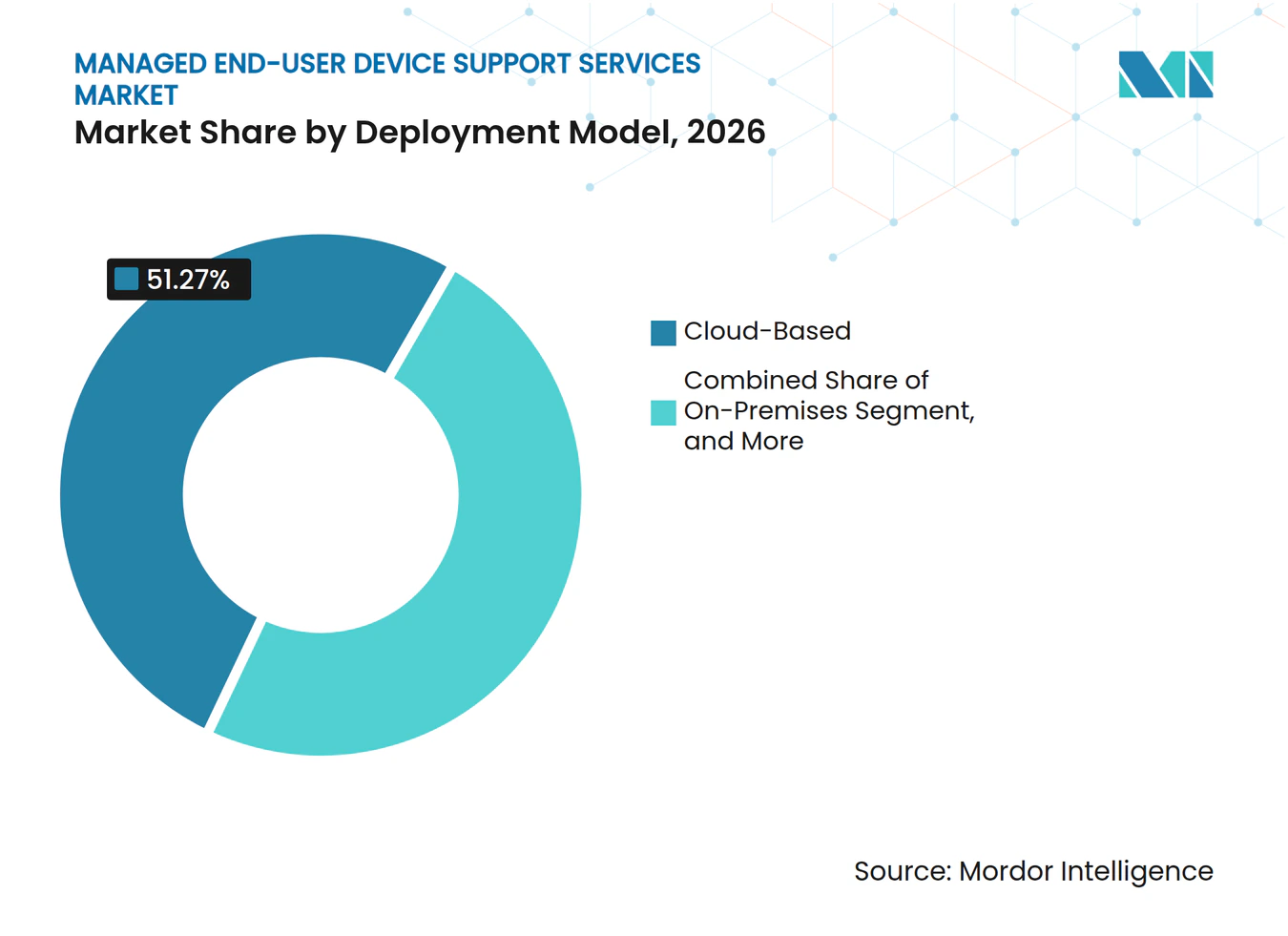
- By deployment model, Cloud-Based deployment accounted for 51.27% of revenue in 2026, while Hybrid deployment is expected to grow at a 7.18% CAGR through 2032.
- By end-user industry, Information Technology and Telecommunications accounted for 22.63% of revenue in 2026, while Healthcare is projected to grow at a 7.83% CAGR through 2032.
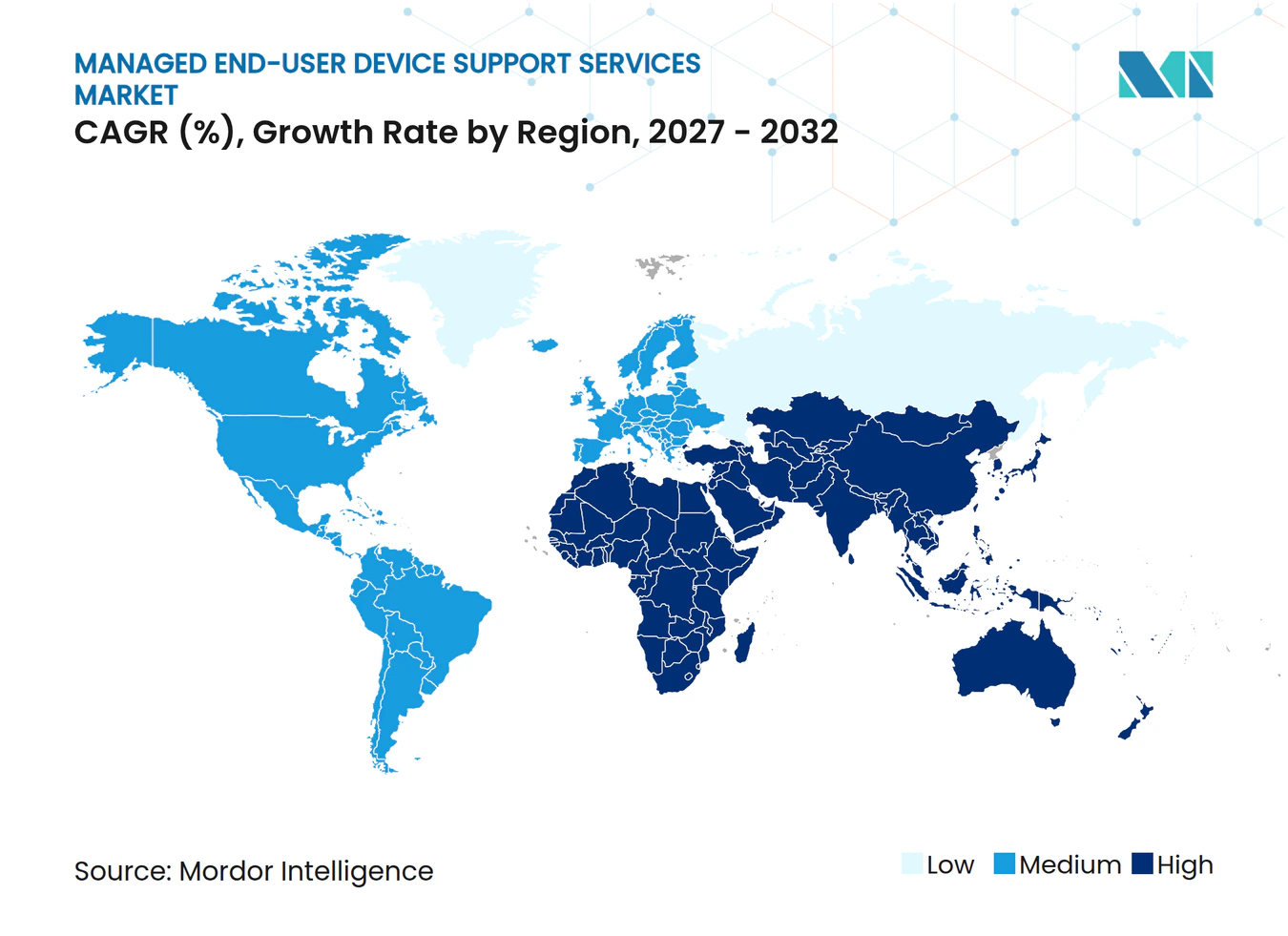
- By geography, North America held 36.87% of revenue in 2026, while Asia-Pacific is expected to expand at a 7.63% CAGR through 2032.
Note: Market numbers in this report are based on Mordor Intelligence's proprietary estimation framework, which combines nine months of actuals with Q4 projections for base year 2026.
Market Trends and Insights
Drivers Impact Analysis of Managed End-User Device Support Services Market*
| Driver | (~) % Impact on CAGR Forecast | Geographic Relevance | Impact Timeline |
|---|---|---|---|
| Enterprise Digital Transformation and Endpoint Proliferation | +2.1% | Global | Long term (≥ 4 years) |
| Hybrid Workforce Expansion and Distributed-User Complexity | +1.4% | Global, strongest in North America and Europe | Medium term (2-4 years) |
| Rising Endpoint Security, Compliance, and Patch-Management Requirements | +1.3% | Global, strongest in North America, Europe, and Asia-Pacific core | Medium term (2-4 years) |
| AI-Enabled Remote Support and Predictive Remediation | +0.9% | North America, Europe, spillover to Asia-Pacific | Medium term (2-4 years) |
| Zero-Touch Provisioning and Device Lifecycle Outsourcing | +0.6% | North America, Asia-Pacific core | Short term (≤ 2 years) |
| Endpoint Telemetry Demand for Digital Employee Experience | +0.5% | Global, North America leading | Short term (≤ 2 years) |
| Source: Mordor Intelligence | |||
Enterprise Digital Transformation and Endpoint Proliferation
Enterprise digitalization is increasing the number of devices that require continuous support. Cloud-based enterprise resource planning systems, AI-enabled collaboration tools, and edge nodes add to endpoint estates. These estates often include Windows, macOS, iOS, Linux, and operational technology-adjacent platforms. Device management now spans acquisition, onboarding, policy enforcement, telemetry, optimization, and secure retirement. Microsoft describes this lifecycle as an integrated enterprise process rather than a narrow helpdesk task. Maintaining separate internal teams for every platform can raise costs and slow service delivery. The managed end-user device support services market benefits when device growth outpaces internal hiring and specialist capability.
Hybrid Workforce Expansion and Distributed-User Complexity
Hybrid work has moved support needs beyond corporate offices and traditional network boundaries. Employees now use devices from home offices, shared locations, customer sites, and travel locations. This makes location-independent support and verified response times more important in managed service contracts. Consistent patching and configuration controls also depend on remote access and cloud-based management capabilities. Providers can use those capabilities to support a uniform experience across distributed device fleets. The managed end-user device support services market, therefore, gains from operational problems that a deskside-only support model cannot resolve efficiently.
Rising Endpoint Security, Compliance, and Patch-Management Requirements
Security and compliance obligations are moving endpoint patching from an operational activity to a formal purchasing requirement. GDPR, HIPAA, NIS2, SOC 2, PCI-DSS, ISO/IEC 27001, and NIST 800-53 require evidence of controls that affect managed endpoints. NIS2 addresses supply chain risk and access governance among the issues in its security requirements. Buyers are therefore combining patch management, vulnerability assessment, configuration controls, and compliance reporting into a single contract. This increases the value of providers capable of documenting device status and privileged activity. The managed end-user device support services market has a broader scope, particularly for regulated organizations that require support capacity and auditable control processes.
AI-Enabled Remote Support and Predictive Remediation
AI-based remediation is moving support delivery from ticket response toward preventive action. TeamViewer introduced AI-driven scripting for its Tia agent in April 2026.[1] The feature converts patterns from resolved incidents into scripts for future incidents. This approach can reduce recurring manual effort and make service quality easier to measure. Predictive tools can also use endpoint telemetry to identify common device problems before users raise a ticket. The managed end-user device support services market is likely to favor providers that link automated resolution to clear service commitments and lower support costs.
Restraints Impact Analysis of Managed End-User Device Support Services Market*
| Restraint | (~) % Impact on CAGR Forecast | Geographic Relevance | Impact Timeline |
|---|---|---|---|
| Cybersecurity Exposure and Third-Party Risk | -1.1% | Global | Medium term (2-4 years) |
| Fragmented Endpoint Estates and Integration Complexity | -0.8% | Global, strongest in large enterprise segments | Medium term (2-4 years) |
| Shortage of Specialized EUC and UEM Talent | -0.5% | Global | Medium term (2-4 years) |
| Data Residency and Cross-Border Support Constraints | -0.4% | Europe, Asia-Pacific, Middle East | Long term (≥ 4 years) |
| Source: Mordor Intelligence | |||
Cybersecurity Exposure and Third-Party Risk
A managed provider needs privileged access to customer device estates, posing a significant third-party risk. Procurement teams increasingly assess identity controls, encryption, incident response, and regulatory alignment before signing contracts. NIS2 recognizes supply chain risk as part of the security challenge facing affected organizations. Security reviews can extend purchasing cycles in financial services, healthcare, government, and other regulated settings. Providers with SOC 2 Type II certification, zero-standing-access designs, and real-time session records can reduce buyer concerns. The managed end-user device support services market faces slower contract decisions when providers cannot show comparable assurance.
Fragmented Endpoint Estates and Integration Complexity
Most managed support engagements begin with several device brands, operating systems, and legacy management tools. Bringing those environments under a single contract often requires reimagining, re-enrollment, and policy changes. These activities add upfront cost and increase the risk of interruption during the migration. Incomplete policy migration can leave compliance gaps after a contract starts. Running cloud and on-premises controls in parallel can also increase work during the transition period. The managed end-user device support services market is constrained, where integration remains highly manual across complex estates.
*Our forecasts treat driver/restraint impacts as directional, not additive. The impact forecasts reflect baseline growth, mix effects, and variable interactions.
Managed End-User Device Support Services Market Segment Analysis
By Service Type:
Helpdesk Revenue Base and Security-Led GrowthHelpdesk and Technical Support held 27.43% of the managed end-user device support services market share in 2026. It remains the recurring service base for many outsourced device support contracts. The service manages high ticket volumes across employee devices and common workplace applications. Remote Monitoring and Management also remains important for fleets that need regular status checks. Software Installation and Patch Management is increasingly included in standard contracts for distributed workforces. Asset Lifecycle Management, Device Provisioning and Deployment, and security services broaden the typical service portfolio. Organizations use these combined services to reduce internal coordination across device teams. The managed end-user device support services market continues to rely on helpdesk delivery as a familiar entry point for outsourcing. This service type also gives providers a direct view of recurring user issues and device performance.
Endpoint Security Management is projected to grow at a 6.97% CAGR through 2032. Regulatory requirements are increasing the demand for accurate patch status and configuration records across enrolled devices. Buyers who previously outsourced tier-1 support are also seeking security patching and compliance reporting. This expands service scope without requiring separate contracts for basic user support and endpoint controls. Zero-touch provisioning is being integrated with lifecycle services to reduce onboarding work per device. AI-supported self-healing can reduce repetitive tier-1 tickets and shift attention to more complex problems. That change may lead providers to price services around outcomes, automation, and resolution quality. Providers with strong automation can compete on lower manual effort while preserving support coverage. The managed end-user device support services industry is therefore moving toward preventive services without eliminating the need for accessible human support.



By Enterprise Size:
Large Enterprise Scale and SME AdoptionLarge Enterprises accounted for 72.37% of the managed end-user device support services market share in 2026. Their large device fleets make centralized support contracts commercially practical. These organizations also have a longer history of outsourcing complex information technology operations. Financial services, government, and other regulated buyers often require formal reporting and audit trails. Those requirements raise the threshold for providers seeking major accounts. Larger contracts may combine procurement, deployment, monitoring, repair coordination, and end-of-life recovery. This makes integration depth and process discipline as important as unit price. The managed end-user device support services market is supported by this demand for extensive, multi-country device operations. Large accounts can also give providers the scale to invest in service automation and governance tools.
Small and Medium Enterprises are projected to expand at a 7.43% CAGR through 2032. Cloud-managed endpoint platforms have lowered the minimum contract size needed for external support. Per-device service designs let channel partners offer managed services at more accessible price points. Smaller healthcare and financial services organizations face many of the same compliance obligations as larger peers. Their internal teams may have fewer specialists available for device governance and evidence collection. This creates demand for packaged support that combines standard tools with managed operations. Flexible deployments can also help smaller firms add services as their workforces and device counts expand. The managed end-user device support services market can reach a wider customer base when service providers standardize delivery without removing essential controls. Competition in this segment is likely to depend on simple pricing, practical onboarding, and credible security support.
By Device Type:
Laptop Leadership and OT ExpansionLaptops and Notebooks held 46.83% of revenue in 2026. They remain the main productivity device for enterprise knowledge workers and hybrid employees. The Windows 11 migration, after Windows 10 reached end of life in October 2025, increased provisioning and refresh workload. Desktops remain relevant in back-office, industrial, and fixed-location settings. Smartphones and Tablets support field employees, frontline workers, and mobile operations. These device categories require different approaches to enrollment, application, and security. Providers need to support multiple platforms while maintaining consistent policy management. The managed end-user device support services market is shaped by this need for unified visibility across conventional workplace devices. Hardware refresh cycles also create recurring demand for configuration, delivery, and secure recovery services.
IoT and Operational-Technology Endpoints are projected to grow at a 7.51% CAGR through 2032. Manufacturing, utility, and logistics organizations are aligning information technology and operational technology management practices. Industrial sensors, building systems, and connected factory equipment often use firmware that cannot be treated like standard PC software. Siemens and Viakoo agreed in March 2026 to provide automated firmware and certificate management, as well as continuous compliance tracking, for OT and IoT fleets.[2] This illustrates the need for specialized processes in industrial endpoint environments. Standard unified endpoint management tools may not provide the full capability required by these assets. Providers that invest in OT-specific methods can address a gap in industrial accounts. The managed end-user device support services market can gain from unified governance where customers need consistent oversight across workplace and operational devices. This opportunity requires providers to understand both security controls and operational continuity.
By Deployment Model:
Cloud Adoption and Hybrid RequirementsCloud-based deployment accounted for 51.27% of revenue in 2026. This majority position reflects wider acceptance of cloud-managed endpoint governance in new contracts. Cloud delivery can synchronize policies across distributed fleets without depending on constant virtual private network access. It also supports remote enrollment, automated updates, and centralized reporting. These capabilities became especially important as hybrid work expanded. Cloud models can provide providers with a consistent delivery platform across multiple customer locations. Microsoft Intune and Windows Autopilot are commonly used for cloud-based policy management and zero-touch provisioning. The managed end-user device support services market size for Cloud-Based deployment benefits from customers seeking location-independent management. On-Premises deployment remains important where network isolation or strict control requirements limit cloud adoption.
Hybrid deployment is projected to expand at a 7.18% CAGR through 2032. It serves organizations that cannot move legacy workloads and modern endpoints on the same schedule. Data sovereignty, audit requirements, and regulated operating environments can make a full cloud move impractical. HCLSoftware describes BigFix deployment options across on-premises, cloud-native SaaS, and hybrid environments. Hybrid contracts require providers to design and maintain controls across both environments. That can increase delivery complexity but also provide a clear role for managed expertise. Organizations use this model to protect operational continuity during phased modernization. The managed end-user device support services market needs flexible deployment designs because a common platform does not fit every security or infrastructure requirement. Providers that can operate across environments can address a broader range of regulated and legacy-heavy accounts.

By End-User Industry:
Technology Demand and Healthcare GrowthInformation Technology and Telecommunications held 22.63% of revenue in 2026. Technology companies operate large device fleets and have experience buying managed services. Their environments require reliable support for employees, developers, remote workers, and customer-facing operations. BFSI, Manufacturing, and Retail and E-Commerce form the next level of demand. Each of these sectors has distinct security, uptime, and device management needs. Government and Defense also remain important because contracts are long and security standards are demanding. Canada awarded Kyndryl a professional services contract for Enterprise Service Desk and End-User Service Desk in 2025.
Healthcare is projected to advance at a 7.83% CAGR through 2032. Clinical organizations are adding connected medical devices, telehealth endpoints, and AI-supported diagnostic tools. These assets expand support needs beyond a conventional office device estate. HIPAA security obligations require access controls, audit records, and patch governance for endpoints processing protected health information. Hospitals also need dependable support that does not interrupt clinical workflows. Managed service contracts can combine multichannel support, software controls, and device governance across multiple sites. This makes healthcare a demanding but attractive vertical for specialist providers.
Geography Analysis
North America held 36.87% of revenue in 2026. High enterprise information technology maturity supports spending across the financial services, healthcare, and defense sectors. The United States represents most regional revenue and has substantial demand from federal and regulated commercial organizations. NIST 800-53 requirements contribute to the need for structured security and support controls. Kyndryl’s work for Shared Services Canada also shows continuing public-sector demand for enterprise service desk and end-user support services. The region provides a large customer base for testing AI-enabled remediation at a commercial scale. North American buyers are also well-placed to evaluate services using detailed measures of support and experience.
Europe is the second-largest regional revenue pool, with Germany, the United Kingdom, and France serving as core demand centers. GDPR and NIS2 are increasing attention to data protection, access control, and documented operational practices. European buyers also place importance on regionally delivered services when considering data sovereignty. France’s cloud sovereignty approach and the United Kingdom's regulatory positioning influence procurement choices. DXC Technology received an agreement from the European Central Bank in March 2026 for end-user computing and IT infrastructure managed services.[3] The work is delivered from European Economic Area delivery centers. Spain and Italy are growing demand centers as managed service procurement becomes more established among regional enterprises.
Asia-Pacific is projected to expand at a 7.63% CAGR through 2032. Cloud adoption, mobile-first working models, and growing device estates are supporting demand across China, India, Japan, South Korea, and Australia. Small and medium enterprise adoption is an important opportunity as standardized cloud platforms become more available. The region also has increasing requirements for local delivery and data handling. South America remains a smaller but growing demand base, with Brazil supported by LGPD-related data protection requirements. The Middle East and Africa are at earlier stages of adoption, while Saudi Arabia, the United Arab Emirates, South Africa, Nigeria, and Egypt are expanding digital infrastructure investment. The managed end-user device support services market has varied regional prospects because regulatory maturity, cloud adoption, and local delivery needs differ widely.
Competitive Landscape
Market Concentration
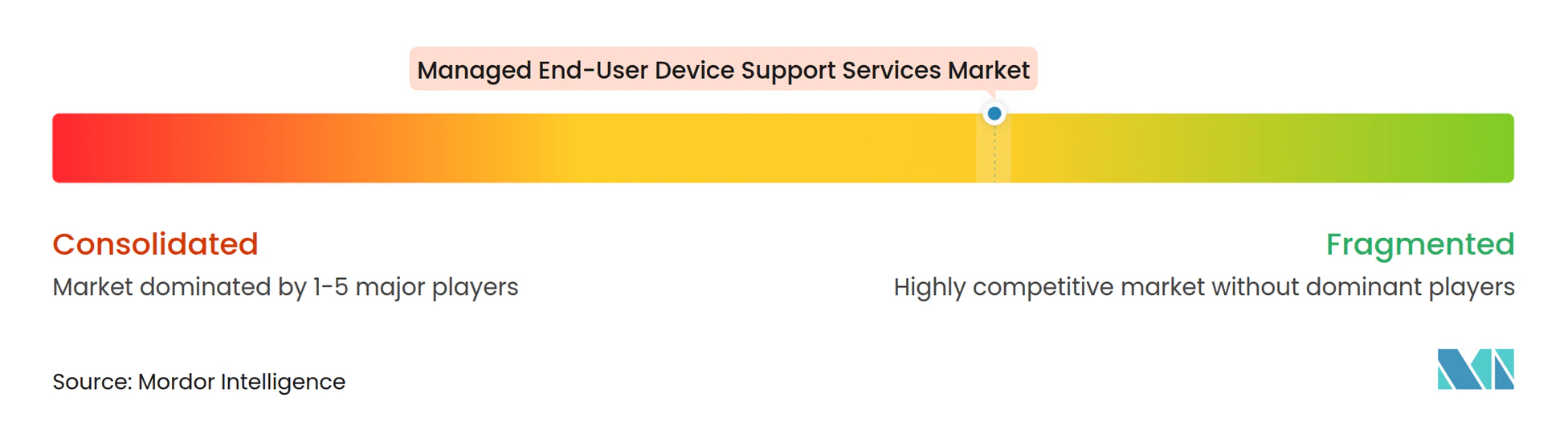
The managed end-user device support services market is moderately fragmented. Global information technology services providers compete with specialist managed workplace firms, Indian information technology companies, and OEM-adjacent service organizations. Competition is shifting away from labor-intensive helpdesk delivery toward platforms that automate routine tasks. Providers seek to demonstrate faster resolution, stronger device visibility, and better employee experience measures. Accenture and Computacenter have used Tanium integrations to combine asset discovery, endpoint management, and detection-and-response capabilities. This brings security and endpoint support closer together within the same service proposition. HCLTech is also using FlexSpace for managed device lifecycle delivery and NeoX for AI-enabled service management.[4] These moves show that providers are building proprietary capabilities to avoid competing only on agent capacity.
There is a clear opportunity for workplace devices and operational technology endpoints to be supported within a single commercial framework. Many providers can support traditional employee devices, but fewer can manage industrial IoT assets with specialized firmware and operational requirements. This creates room for providers that develop focused tools, processes, and partner relationships. Sustainability is another consideration in larger enterprise and public-sector procurement. Computacenter reported that its circular information technology model avoided 208,000 tons of carbon in 2024 through device redeployment, remarketing, and secure recycling. Device recovery and reuse can therefore complement security and lifecycle commitments when customers assess support proposals. The managed end-user device support services market may reward providers that can provide credible reporting on these outcomes. These features can strengthen differentiation without replacing the importance of service reliability and security.
Innovation is concentrated in AI remediation, zero-touch provisioning, device telemetry, and management across mixed endpoint estates. AI tools can turn resolved incidents into reusable automation and reduce the workload associated with repetitive support tasks. Zero-touch processes can standardize setup for new devices and reduce delays for distributed employees. Endpoint telemetry can help providers identify experience problems and policy issues before they become larger support incidents. Sovereign AI policies in Europe and Southeast Asia can create demand for regional delivery models. This may challenge providers that rely heavily on offshore service delivery.
Managed End-User Device Support Services Industry Leaders
-
Accenture plc
-
Atos SE
-
Capgemini SE
-
Cognizant Technology Solutions Corporation
-
CompuCom Systems, Inc.
- *Disclaimer: Major Players sorted in no particular order
Managed End-User Device Support Services Market Companies Covered in this Report
- Accenture plc
- Atos SE
- Capgemini SE
- Cognizant Technology Solutions Corporation
- CompuCom Systems, Inc.
- Computacenter plc
- DXC Technology Company
- Fujitsu Limited
- Genpact Limited
- HCLTech
- HP Inc.
- Infosys Limited
- Insight Enterprises, Inc.
- Kyndryl Holdings, Inc.
- NTT DATA Group Corporation
- Stefanini Group
- Tata Consultancy Services Limited
- Tech Mahindra Limited
- Unisys Corporation
- Wipro Limited
Recent Industry Developments in Managed End-User Device Support Services Market
- April 2026: Lighthouse Investment Partners and SS&C Technologies partnered to modernize the global technology infrastructure of Lighthouse, adopting SS&C's Managed IT Services to align the management of infrastructure, end-user computing, and core IT services under a single integrated operating model.
- March 2026: The European Central Bank and DXC established an agreement for DXC to support the bank's IT infrastructure managed services and end-user computing.
- February 2026: Unisys and Dell Technologies enhanced the Unisys Device Subscription Service to extend managed device lifecycle coverage to edge and IoT endpoints, integrating AI-driven support automation, proactive endpoint security, and real-time analytics under a utility-based pricing model for multi-subsidiary organizations.
- February 2026: Accenture completed its acquisition of CyberCX, a cybersecurity services provider with approximately 1,400 professionals across Australia, New Zealand, and internationally, the company's largest cybersecurity acquisition to date, significantly expanding managed security capabilities in the Asia-Pacific region.
Global Managed End-User Device Support Services Market Report Scope
The Managed End-User Device Support Services Market refers to the market for outsourced services that help organizations manage, maintain, secure, and support end-user devices. The scope of the report includes services for desktops, laptops, tablets, smartphones, and peripherals, including device provisioning, configuration, monitoring, troubleshooting, repair, software updates, security management, and end-user help desk support.
The Managed End-User Device Support Services Report is Segmented by Service Type (Device Provisioning and Deployment, Remote Monitoring and Management, Software Installation and Patch Management, Endpoint Security Management, Helpdesk and Technical Support, and Asset Lifecycle Management), Enterprise Size (Large Enterprises, and Small and Medium Enterprises), Device Type (Desktops, Laptops and Notebooks, Smartphones and Tablets, and IoT and Operational-Technology Endpoints), Deployment Model (On-Premises, Cloud-Based, and Hybrid), End-User Industry (Information Technology and Telecommunications, BFSI, Healthcare, Retail and E-Commerce, Manufacturing, Government and Defense, and Other End-User Industries), and Geography (North America, South America, Europe, Asia-Pacific, Middle East, and Africa). The Market Forecasts are Provided in Terms of Value (USD).
Segmentation Overview
| Device Provisioning and Deployment |
| Remote Monitoring and Management |
| Software Installation and Patch Management |
| Endpoint Security Management |
| Helpdesk and Technical Support |
| Asset Lifecycle Management |
| Large Enterprises |
| Small and Medium Enterprises |
| Desktops |
| Laptops and Notebooks |
| Smartphones and Tablets |
| IoT and Operational-Technology Endpoints |
| On-Premises |
| Cloud-Based |
| Hybrid |
| Information Technology and Telecommunications |
| BFSI |
| Healthcare |
| Retail and E-Commerce |
| Manufacturing |
| Government and Defense |
| Other End-User Industries |
| North America | United States |
| Canada | |
| Mexico | |
| South America | Brazil |
| Argentina | |
| Rest of South America | |
| Europe | Germany |
| United Kingdom | |
| France | |
| Italy | |
| Spain | |
| Russia | |
| Rest of Europe | |
| Asia-Pacific | China |
| India | |
| Japan | |
| South Korea | |
| Australia | |
| Rest of Asia-Pacific | |
| Middle East | Saudi Arabia |
| United Arab Emirates | |
| Turkey | |
| Rest of Middle East | |
| Africa | South Africa |
| Egypt | |
| Nigeria | |
| Rest of Africa |
| By Service Type | Device Provisioning and Deployment | |
| Remote Monitoring and Management | ||
| Software Installation and Patch Management | ||
| Endpoint Security Management | ||
| Helpdesk and Technical Support | ||
| Asset Lifecycle Management | ||
| By Enterprise Size | Large Enterprises | |
| Small and Medium Enterprises | ||
| By Device Type | Desktops | |
| Laptops and Notebooks | ||
| Smartphones and Tablets | ||
| IoT and Operational-Technology Endpoints | ||
| By Deployment Model | On-Premises | |
| Cloud-Based | ||
| Hybrid | ||
| By End-User Industry | Information Technology and Telecommunications | |
| BFSI | ||
| Healthcare | ||
| Retail and E-Commerce | ||
| Manufacturing | ||
| Government and Defense | ||
| Other End-User Industries | ||
| By Geography | North America | United States |
| Canada | ||
| Mexico | ||
| South America | Brazil | |
| Argentina | ||
| Rest of South America | ||
| Europe | Germany | |
| United Kingdom | ||
| France | ||
| Italy | ||
| Spain | ||
| Russia | ||
| Rest of Europe | ||
| Asia-Pacific | China | |
| India | ||
| Japan | ||
| South Korea | ||
| Australia | ||
| Rest of Asia-Pacific | ||
| Middle East | Saudi Arabia | |
| United Arab Emirates | ||
| Turkey | ||
| Rest of Middle East | ||
| Africa | South Africa | |
| Egypt | ||
| Nigeria | ||
| Rest of Africa | ||
Key Questions Answered in the Report
What is the size of the managed end-user device support services market?
The managed end-user device support services market is projected to increase from USD 21.37 billion in 2026 and USD 22.77 billion in 2027 to USD 31.46 billion by 2032, at a 6.53% CAGR. This reflects a broader need for external support as organizations add cloud workloads, mobile devices, AI PCs, and connected equipment.
Which service type has the largest share?
Helpdesk and Technical Support held 27.43% of revenue in 2026, making it the largest service type. It remains the usual recurring service base within outsourced workplace support contracts and provides a direct response channel for employee device issues.
Which deployment model is growing fastest?
Hybrid deployment is projected to expand at a 7.18% CAGR through 2032 as organizations manage phased cloud transitions and data residency needs. It supports customers that need to retain selected on-premises workloads while using cloud-based policy and reporting functions.
Why is endpoint security management growing?
Security and compliance requirements are increasing demand for patch management, vulnerability assessment, configuration control, and documented reporting. Buyers are increasingly combining these functions with core end-user support agreements to obtain a more complete view of device status.
Which end-user sector is growing fastest?
Healthcare is projected to advance at a 7.83% CAGR through 2032 because connected clinical devices and compliance needs are expanding support requirements. Clinical workflows also require dependable access to managed digital systems across hospitals, clinics, telehealth settings, and supporting administrative sites.
Which region is expected to grow fastest?
Asia-Pacific is projected to expand at a 7.63% CAGR through 2032, supported by cloud adoption, mobile-first work models, and growing device estates. China, India, Japan, South Korea, and Australia are key demand locations with distinct local service and data handling requirements.