
Managed Edge Kubernetes Services Market Size and Share
Market Overview
| Study Period | 2021 - 2032 |
|---|---|
| Market Size (2027) | USD 4.24 Billion |
| Market Size (2032) | USD 10.71 Billion |
| Growth Rate (2027 - 2032) | 20.36 % |
| Fastest Growing Market | Asia-Pacific |
| Largest Market | North America |
| Market Concentration | Medium |
Major Players *Disclaimer: Major Players sorted in no particular order Image © Mordor Intelligence. Reuse requires attribution under CC BY 4.0. | |
Managed Edge Kubernetes Services Market Analysis by Mordor Intelligence
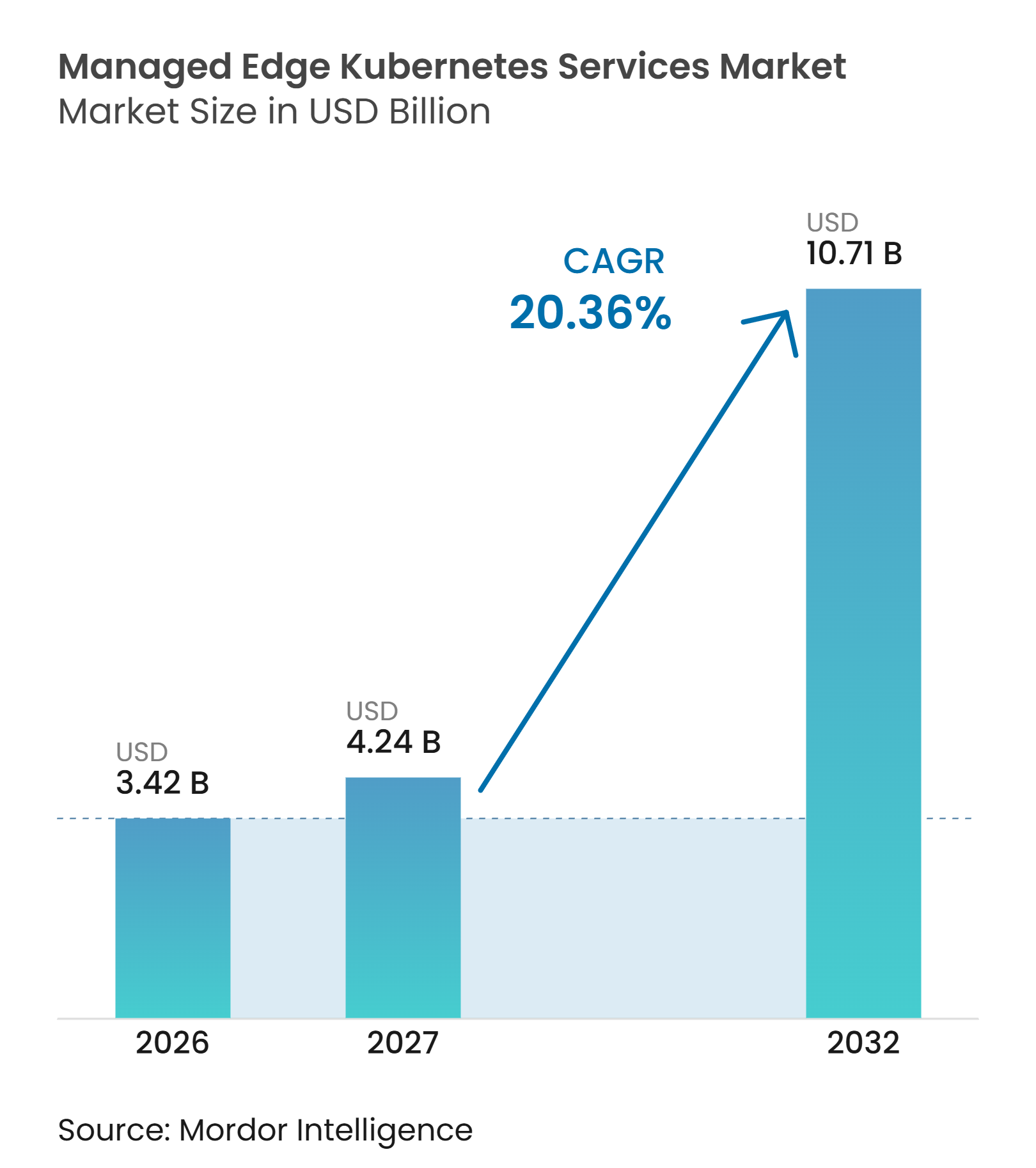
The managed edge Kubernetes services market size is projected to expand from USD 3.42 billion in 2026 and USD 4.24 billion in 2027 to USD 10.71 billion by 2032, registering a CAGR of 20.36% between 2027 to 2032. The managed edge Kubernetes services market is being shaped by the need to operate distributed compute sites without maintaining a specialist team at every location. 5G network virtualization, AI inference, and industrial IoT projects are bringing container orchestration closer to network sites, factories, and retail locations. Buyers are increasingly looking for providers that combine lifecycle automation, security controls, and support across cloud and on-premises locations. This creates an opening for hyperscalers, specialist platform providers, and systems integrators, although their roles differ by deployment and compliance need. Hardware variation, intermittent connections, skills shortages, and data rules still lengthen adoption decisions in some edge environments.
Key Report Takeaways
- By service type, managed platform services held 37.90% of the managed edge Kubernetes services market share in 2026, while managed security and compliance services are projected to expand at a 21.94% CAGR through 2032.
- By deployment model, public cloud edge held 52.00% of the market in 2026, while hybrid edge is projected to expand at a 22.98% CAGR through 2032.
- By organization size, large enterprises held 70.81% of the managed edge Kubernetes services market share in 2026, while small and medium-sized enterprises are projected to expand at a 21.67% CAGR through 2032.
- By application, network function virtualization and cloud-native 5G held 23.67% share in 2026, while artificial intelligence and machine learning inference are projected to expand at a 23.62% CAGR through 2032.
- By end-user industry, IT and telecommunications held 26.69% of the managed edge Kubernetes services market share in 2026, while manufacturing is projected to expand at a 21.61% CAGR through 2032.
- By geography, North America held 35.57% share in 2026, while Asia-Pacific is projected to expand at a 21.92% CAGR through 2032.
Note: Market numbers in this report are based on Mordor Intelligence's proprietary estimation framework, which combines nine months of actuals with Q4 projections for base year 2026.
Market Trends and Insights
Drivers Impact Analysis of Managed Edge Kubernetes Services Market*
| Driver | (~) % Impact on CAGR Forecast | Geographic Relevance | Impact Timeline |
|---|---|---|---|
| Edge Computing and 5G Site Proliferation | +5.2% | Global, Asia-Pacific and North America leading | Short term (≤ 2 years) |
| AI and Machine Learning Inference at the Edge | +4.5% | Global, concentrated in North America and Asia-Pacific | Medium term (2-4 years) |
| Cloud-Native Application Modernization | +3.8% | Global, North America and Europe primary markets | Short term (≤ 2 years) |
| Hybrid and Multi-Cloud Workload Portability | +2.7% | Global, North America dominant | Medium term (2-4 years) |
| Zero-Touch Fleet Operations for Intermittently Connected Sites | +1.8% | Industrial regions, Europe, Asia-Pacific, North America | Medium term (2-4 years) |
| Sovereign and Air-Gapped Edge Deployment Demand | +1.2% | Europe, North America, Middle East | Long term (≥ 4 years) |
| Source: Mordor Intelligence | |||
Edge Computing and 5G Site Proliferation
Open RAN replaces proprietary network equipment with cloud-native software components, which makes each radio site a potential location for a Kubernetes cluster. This expands the managed edge Kubernetes services market beyond central data centers because dispersed sites require consistent lifecycle management. Wind River was selected by Vodafone in October 2025 to provide the container-as-a-service layer for Open RAN deployments in Germany and other European locations. The deployment involves thousands of sites where local Kubernetes teams would be impractical. NTT DOCOMO has shown that centralized automation can manage distributed network infrastructure across regional and edge locations, making fleet operations a central commercial requirement. O-RAN Alliance and ETSI lifecycle standards also influence provider selection because carriers need platforms that fit their certification and interoperability requirements.
AI and Machine Learning Inference at the Edge
AI inference creates demand for local compute where cloud routing cannot consistently meet latency, cost, or data-residency needs. The managed edge Kubernetes services market benefits when providers can operate GPU resources, models, and application updates under one service commitment. ZEDEDA introduced Edge Kubernetes App Flows in November 2025 with support for bare-metal GPU compute in manufacturing and logistics settings. Research in the IEEE Internet of Things Journal reported that a Kubernetes-native industrial monitoring design supported 12 concurrent cluster replicas while maintaining multi-step prediction errors below 0.26 mean absolute error units. These operational requirements shift spending from basic cluster administration toward managed GPU scheduling, model versioning, and patch management. Providers that package these capabilities for industrial environments can address AI budgets that previously sat outside Kubernetes operations.
Cloud-Native Application Modernization
Changes to enterprise virtualization estates are prompting organizations to assess virtual machines and container workloads together. The 2024 Broadcom acquisition of VMware and subsequent licensing changes have increased the need to consider migration paths for on-premises and edge infrastructure. Platform9 extended its Private Cloud Director in 2025 with AI hardware support and migration tools intended to convert VMware vSphere clusters in place. Red Hat and Google Cloud expanded their collaboration in March 2026 to make Red Hat OpenShift available in the Google Cloud console and to make OpenShift Virtualization generally available on Red Hat OpenShift Dedicated on Google Cloud. This gives enterprises a managed platform for virtual machines and containers without requiring each application to be redesigned first. It also widens the managed edge Kubernetes services market because providers can support a larger base of workloads during infrastructure transitions.
Hybrid and Multi-Cloud Workload Portability
Organizations often run Kubernetes across cloud, on-premises, and edge environments, which raises configuration and policy management demands. A provider that only operates a single cloud environment cannot fully address these fleet requirements. Kubermatic released KKP 2.29 in October 2025 with dynamic resource allocation, Kueue support for batch processing, and improved GPU visibility across multi-cluster environments.[1] Microsoft made Azure Kubernetes Service Automatic generally available in September 2025 with preset operational defaults, scaling, and security controls. Spectro Cloud added Amazon EKS Hybrid Nodes support to Palette 4.6 in 2025, allowing a managed cloud control plane to govern on-premises and edge worker nodes. These products reduce control-plane complexity, although specialist providers remain relevant where fleets are heterogeneous, disconnected, or air-gapped.
Restraints Impact Analysis of Managed Edge Kubernetes Services Market*
| Restraint | (~) % Impact on CAGR Forecast | Geographic Relevance | Impact Timeline |
|---|---|---|---|
| Kubernetes Skills Shortage and Operational Complexity | -2.2% | Global, most acute in SME-heavy emerging markets | Short term (≤ 2 years) |
| Security, Data Sovereignty, and Compliance Risks | -1.7% | Europe, North America, Asia-Pacific | Medium term (2-4 years) |
| Heterogeneous Hardware, Power, and Connectivity Constraints | -1.1% | Rural and industrial sites in Africa, South Asia, Southeast Asia | Long term (≥ 4 years) |
| Distributed Observability and Patch Management Complexity | -0.7% | Global, especially multi-cloud and multi-region deployments | Medium term (2-4 years) |
| Source: Mordor Intelligence | |||
Kubernetes Skills Shortage and Operational Complexity
The shortage of Kubernetes operations talent limits the pace at which enterprises can run distributed edge clusters internally. The Data on Kubernetes Community reported in 2025 that 40% of organizations identified talent and skills gaps as a leading operational challenge.[2] Teams need skills across operations, storage, performance, cost management, and AI infrastructure, which is difficult to assemble for a small fleet. The managed edge Kubernetes services market, therefore, gains demand from buyers that need outside operating support rather than another self-managed platform. The difficulty is greater at the edge because the data plane, patching, and monitoring must be managed remotely. Small and medium-sized enterprises are especially affected because they often lack a dedicated platform engineering function.
Security, Data Sovereignty, and Compliance Risks
Security and compliance obligations are rising faster than many distributed Kubernetes deployments can adapt. The NIS2 Directive has been enforceable since October 2024, while the Digital Operational Resilience Act became applicable in January 2025 for relevant financial entities. Edge fleets must apply controls that prevent regulated data from moving across jurisdictions without authorization. Spectro Cloud reported FedRAMP Moderate in-process status and FIPS 140-3 validation in October 2025, reflecting the importance of federal and cryptographic requirements in provider selection. Different jurisdictions can require separate audit practices, data controls, and cryptographic standards. This makes compliance capability a product requirement, but it can delay adoption when an organization cannot verify controls across every site.
*Our forecasts treat driver/restraint impacts as directional, not additive. The impact forecasts reflect baseline growth, mix effects, and variable interactions.
Managed Edge Kubernetes Services Market Segment Analysis
By Service Type:
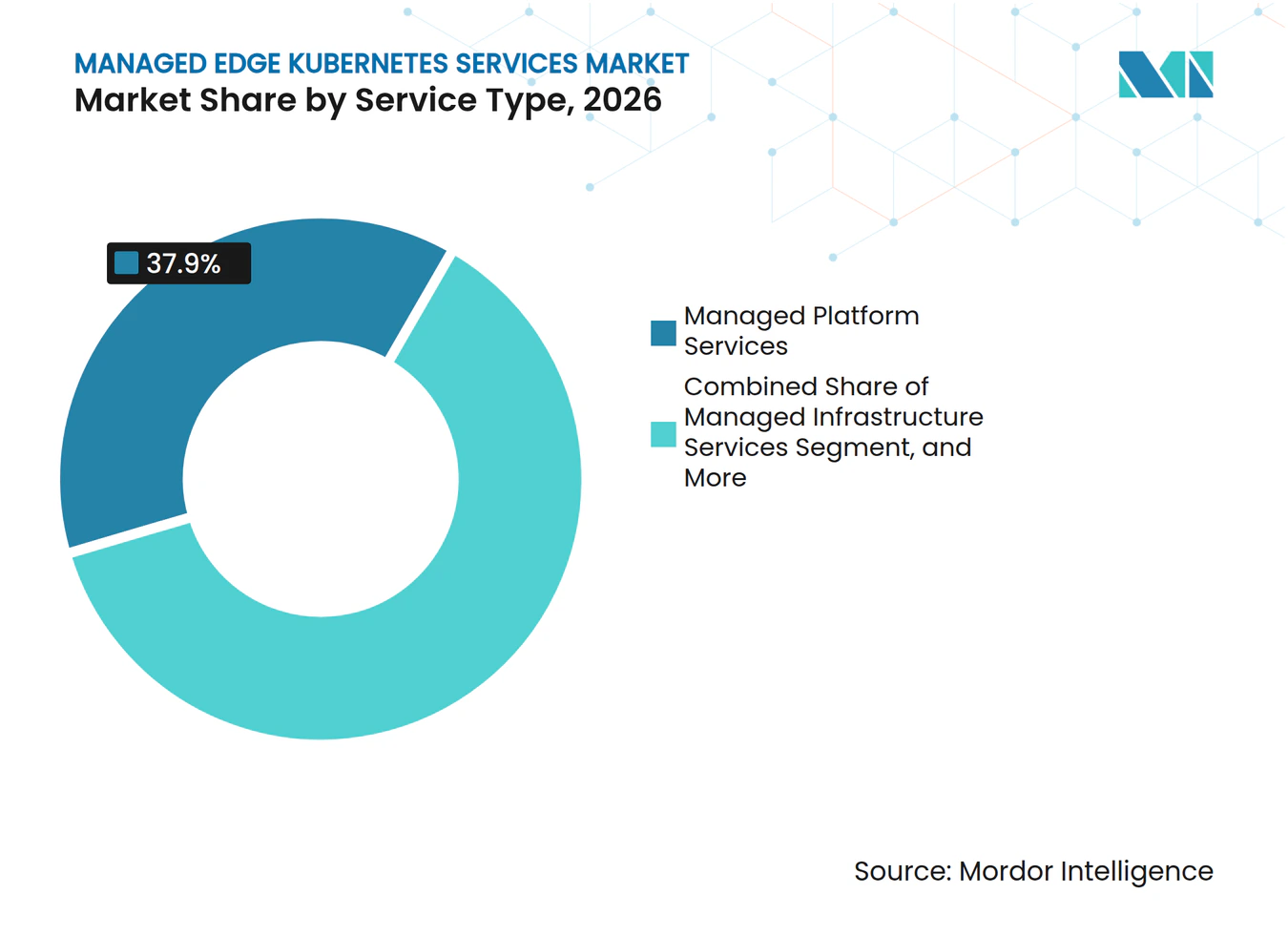
Security Services Outpace the Platform LayerManaged platform services accounted for 37.90% of the managed edge Kubernetes services market share in 2026. The segment is the first purchase because organizations need provisioning, configuration, control-plane maintenance, and upgrades before adding higher-value services. It faces standardization as hyperscaler platforms automate some routine control-plane work. Managed infrastructure services support remote clusters across varied hardware and connectivity conditions. Managed application and workload services cover application lifecycle tasks, GPU allocation, and model deployment for buyers seeking a broader operating service.
Managed security and compliance services are projected to expand at a 21.94% CAGR through 2032. The segment is supported by requirements for continuous policy enforcement and audit-ready logs in dispersed fleets. FIPS 140-3, FedRAMP, NIS2, and DORA raise the required control level for public-sector, financial, and critical-infrastructure users. Red Hat offers Advanced Cluster Security for Kubernetes, while Spectro Cloud announced Hadron as a security-focused Linux base for enterprise edge environments in January 2026. Canonical, IBM, and Rackspace Technology also bundle infrastructure and application services, shifting the managed edge Kubernetes services industry beyond basic control-plane administration.



By Deployment Model:
Hybrid Edge Surges as Cloud Share StabilizesPublic cloud edge accounted for 49.32% of the managed edge Kubernetes services market size in 2026. Hyperscalers extend cloud operating models through local zones, wavelength zones, and distributed cloud nodes near enterprise locations. AWS EKS Anywhere, Microsoft AKS Arc, and Google Distributed Cloud provide managed Kubernetes capabilities outside centralized cloud regions. This approach suits buyers who want a familiar management plane while retaining local computing capacity. Private and on-premises deployments remain important where latency, data residency, or operational requirements restrict external control planes.
Hybrid edge is projected to expand at a 22.98% CAGR through 2032 as buyers combine cloud-based operations with local sites. It supports workloads that require centralized policy management and local execution at the same time. Google Distributed Cloud and its air-gapped appliance received US Department of Defense Impact Level 6 authorization in May 2025 for classified Secret-level workloads.Nutanix Kubernetes Platform became available through the Department of Defense Platform One environment in 2025, while Rancher Government Solutions made IC Cloud Support generally available in October 2025 for classified Kubernetes operations.[3] The managed edge Kubernetes services market favors providers that can operate across more than 1 deployment model for sovereign and industrial users.
By Organization Size:
SMEs Narrow the Kubernetes Adoption GapLarge enterprises held 70.81% of demand in 2026. Even with daily operations outsourced, the customer needs internal teams for governance, integration planning, and security policy decisions. Telecommunications operators and manufacturers also have the scale to justify managed-service contracts across many sites. Their early adoption has established operating patterns for broader enterprise users. Large organizations can integrate managed Kubernetes with existing network, security, and cloud programs.
Small and medium-sized enterprises are projected to expand at a 21.67% CAGR through 2032. Packaged services reduce the internal capability required to deploy a Kubernetes environment at an edge location. Spectro Cloud and HPE have offered an edge-in-a-box approach that combines compact servers with pre-provisioned Palette software for retail, healthcare, and manufacturing users. Consumption-based and per-cluster subscriptions can reduce the upfront commitment compared with large enterprise contracts. Palette has been tested above 10,000 clusters from one management plane, showing that the managed edge Kubernetes services market can serve a long tail of smaller users.
By Application:
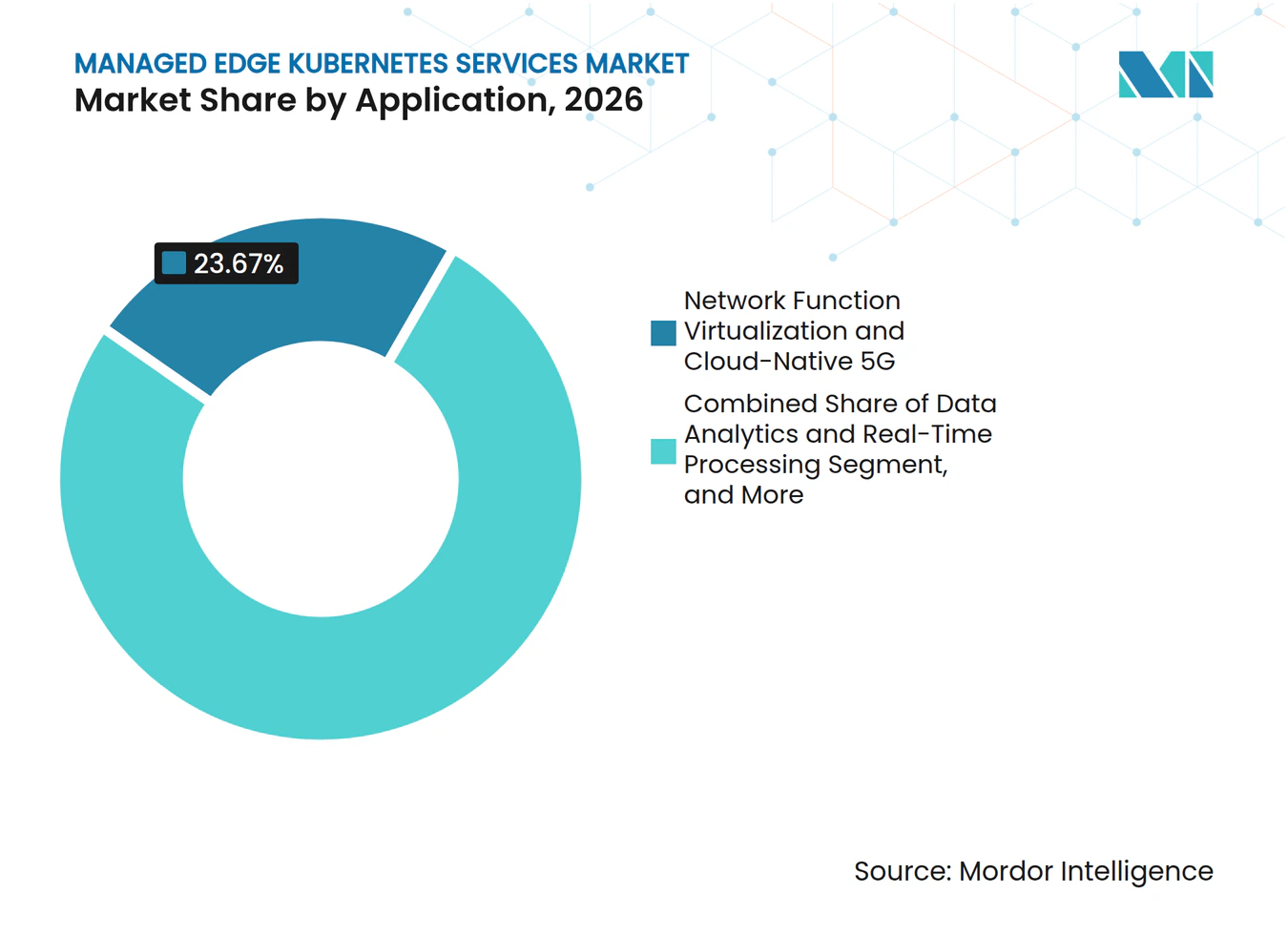
AI Inference Gains Priority at the EdgeNetwork function virtualization and cloud-native 5G accounted for 23.67% of the managed edge Kubernetes services market size in 2026. Open RAN has made Kubernetes a key orchestration layer for containerized network functions at Tier-1 operators. This workload requires reliable automation across carrier sites in North America, Europe, and Asia-Pacific. Data analytics, IoT and device management, and industrial automation also require dependable edge orchestration. These use cases create ongoing demand for remotely managed applications and infrastructure.
Artificial intelligence and machine learning inference are projected to expand at a 23.62% CAGR through 2032. Manufacturers, retailers, logistics providers, and healthcare organizations use edge inference for vision, inventory, routing, and diagnostics where response time matters. GPU-enabled nodes need resource scheduling and model lifecycle controls beyond basic cluster administration. IEEE research published in 2025 found that multi-cluster MLOps platforms can support low-latency machine learning inference on resource-constrained edge devices. ZEDEDA designed Edge Kubernetes App Flows with manufacturing, energy, transportation, and retail customers to address the operating gap between application delivery and infrastructure management.

By End-User Industry:
Telecom Anchors, Manufacturing AcceleratesIT and Telecommunications held 26.69% of end-user demand in 2026. The sector has invested for years in network function virtualization and relies on Kubernetes for cloud-native 5G core and Open RAN deployments. This experience has established service-level expectations for distributed production environments. Nokia and Ericsson can use their installed telecom positions to extend cloud-native 5G and private wireless service portfolios. Telecommunications remains the largest customer group in the managed edge Kubernetes services market.
Manufacturing is projected to expand at a 21.61% CAGR through 2032. Industry 4.0 programs require local data processing, predictive maintenance, and coordination across multiple production sites. German Edge Cloud, Red Hat, and Fraunhofer CCIT demonstrated the ONCITE Digital Production System on Red Hat OpenShift in March 2026 for edge-to-cloud industrial use. Foxconn used the Arcfra Enterprise Cloud Platform across factories in mainland China, Taiwan, Vietnam, and North America to manage virtual machines and containers from one Kubernetes-based plane. Healthcare, retail, utilities, government, and financial services also require isolation, auditability, and local processing for selected workloads.
Geography Analysis
North America Managed Edge Kubernetes Services Market
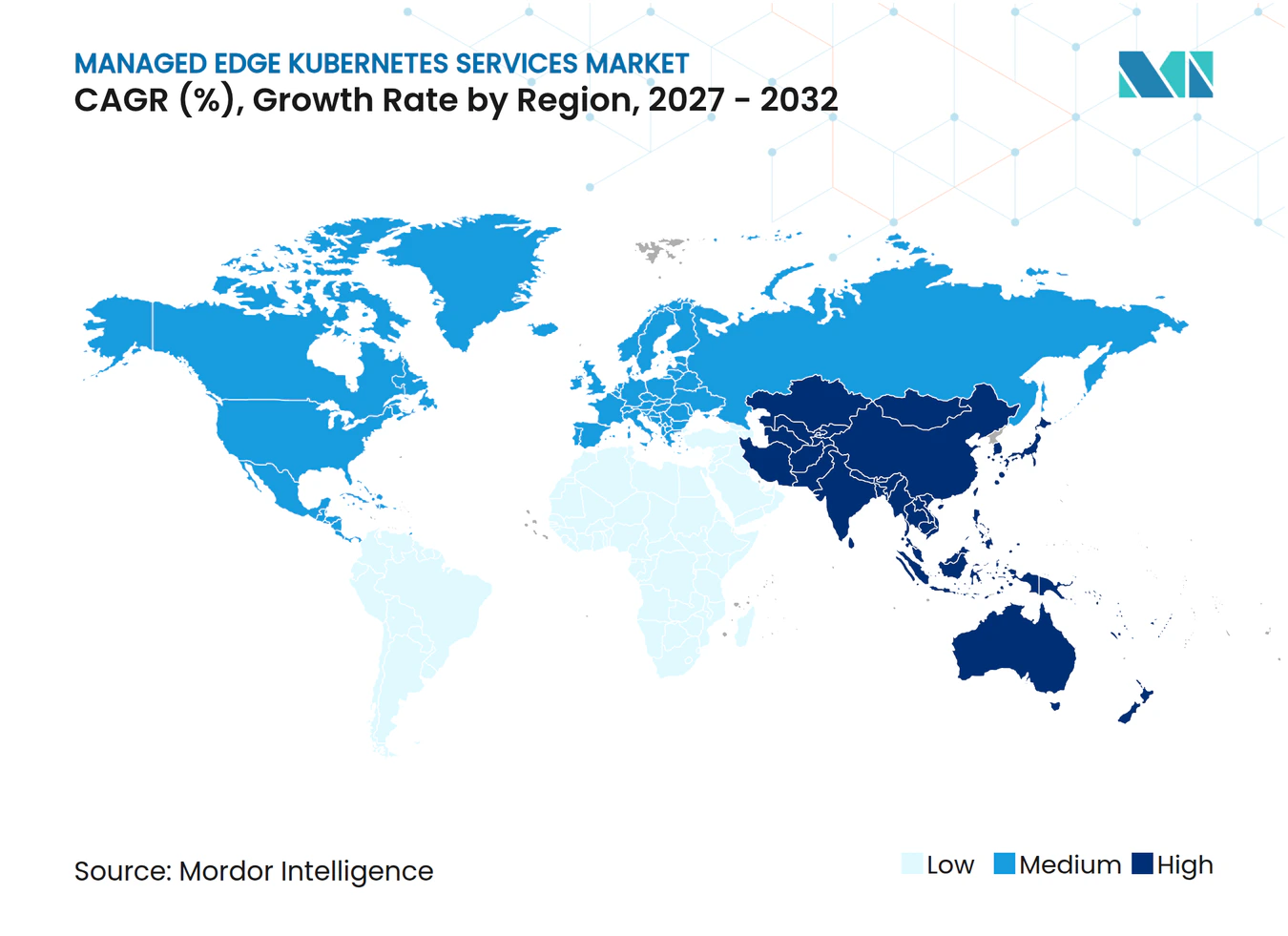
North America accounted for 35.57% of the managed edge Kubernetes services market share in 2026. The region has dense hyperscaler infrastructure and early commercial Open RAN deployments. Federal demand has progressed from evaluations to production-scale managed Kubernetes in classified and unclassified settings. The Department of Defense authorization for Google Distributed Cloud at Impact Level 6 established a high bar for sovereign deployments. Open RAN deployments, private 5G networks, and legacy virtualization reviews support demand across telecommunications, government, and industrial users.
Europe Managed Edge Kubernetes Services Market
Europe is the second-largest region, supported by demand in Germany, the United Kingdom, France, and the Nordic countries. Automotive investment supports local computing, while GDPR and the EU Data Act reinforce data-residency requirements. ScaleUp Technologies achieved Sovereign Cloud Stack-compatible KaaS certification in June 2025, providing a compliance signal for procurement teams.[4] Swisscom launched a sovereign Kubernetes service in August 2025 with 390 clusters, 2,100 worker nodes, and 160 TB of persistent storage in production.
APAC Managed Edge Kubernetes Services Market
Asia-Pacific is projected to expand at a 21.92% CAGR through 2032. China, Japan, South Korea, and India combine large 5G programs with manufacturing demand for edge AI. National telecom and cloud programs give providers a broad base for distributed operations across the region. Alibaba Cloud required migration of older cluster versions to its managed cluster pro tier from January 2026, while Wind River and Tech Data partnered in October 2025 to support cloud-native edge adoption in India. The managed edge Kubernetes services market is also supported by Japan's private 5G programs and South Korea's robotics-intensive manufacturing base.
Competitive Landscape
Market Concentration
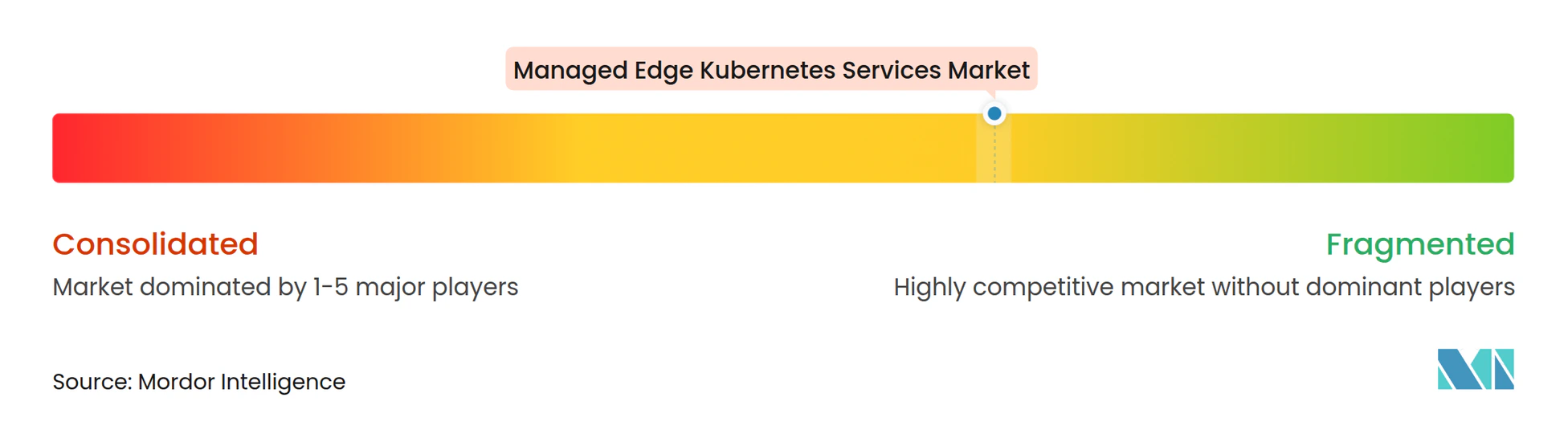
The managed edge Kubernetes services market is moderately fragmented at the solution layer but more concentrated at the hyperscaler infrastructure layer. AWS, Microsoft, and Google provide managed control planes that underpin a significant share of enterprise edge deployments. Wind River, Spectro Cloud, Rafay Systems, Kubermatic, and Platform9 focus on multi-cluster management, air-gapped deployments, and vertical compliance needs. Accenture and Kyndryl compete through implementation and managed operations in regulated sectors. The managed edge Kubernetes services market can support all 3 provider groups because buyers may need infrastructure, specialized software, and deployment expertise at the same time.
Providers use security certification, AI infrastructure capabilities, and validated appliances to differentiate their offers. Spectro Cloud combined federal authorization work with FIPS validation for connected and air-gapped environments. Supermicro introduced validated Kubernetes Edge AI appliances with Red Hat and Everpure in July 2026 to simplify distributed AI deployment. Kubermatic announced its AI platform in September 2026, extending its Kubernetes management role into enterprise AI operations.
Nokia and Ericsson can extend their telecommunications relationships through cloud-native 5G and private wireless services, creating an installed-base advantage over smaller providers. Managed security operations for edge clusters remains less developed than core orchestration and infrastructure services. The gap is important because NIS2 and DORA apply greater scrutiny to security controls, incident response, and auditability. Specialist providers that build edge observability and runtime security capabilities can compete in this space.
Managed Edge Kubernetes Services Industry Leaders
-
Amazon Web Services, Inc.
-
Microsoft Corporation
-
Red Hat, Inc.
-
Cisco Systems, Inc.
-
VMware LLC
- *Disclaimer: Major Players sorted in no particular order
Managed Edge Kubernetes Services Market Companies Covered in this Report
- Amazon Web Services, Inc.
- Microsoft Corporation
- Google LLC
- Red Hat, Inc.
- SUSE S.A.
- International Business Machines Corporation
- Cisco Systems, Inc.
- VMware LLC
- Nutanix, Inc.
- Mirantis, Inc.
- Canonical Group Limited
- Hewlett Packard Enterprise Company
- Dell Technologies Inc.
- Huawei Technologies Co., Ltd.
- Nokia Corporation
- Ericsson AB
- Wind River Systems, Inc.
- Spectro Cloud, Inc.
- Rafay Systems, Inc.
- Kubermatic GmbH
- Platform9 Systems, Inc.
- ZEDEDA, Inc.
- Rackspace Technology, Inc.
- Accenture plc
- Kyndryl Holdings, Inc.
Recent Industry Developments in Managed Edge Kubernetes Services Market
- October 2026: Kubermatic released KDP 1.2 featuring built-in Model Context Protocol, smarter blueprint management with kro Collections, and new platform packages for enterprise AI workloads, extending the Kubermatic AI platform to a broader set of managed Kubernetes deployments. The release advances Kubermatic's position in Kubernetes-native AI infrastructure management following its September 2026 Kubermatic AI platform announcement.
- July 2026: Supermicro, in collaboration with Red Hat and Everpure, launched validated Kubernetes Edge AI appliances combining Red Hat OpenShift with Supermicro edge computing hardware and the Portworx data management platform for AI workloads. The turnkey appliance, shipped preloaded with software and hardware, simplifies deployment, scaling, and security of AI applications at distributed edge sites for manufacturing, healthcare, and retail customers.
- March 2026: Red Hat and Google Cloud expanded their collaboration at KubeCon and CloudNativeCon, making Red Hat OpenShift available directly in the Google Cloud console and announcing general availability of Red Hat OpenShift Virtualization on Red Hat OpenShift Dedicated on Google Cloud. The integration enables enterprises to migrate virtual machines and container workloads to a single managed Kubernetes platform on Google Cloud without rearchitecting existing applications.
- March 2026: German Edge Cloud, Red Hat, and Fraunhofer CCIT demonstrated the ONCITE Digital Production System running on Red Hat OpenShift across the edge-cloud continuum at Hannover Messe 2026. The reference architecture enables real-time shopfloor data processing and industrial AI deployment across distributed factory sites with the ONCITE DPS now fully operable on Red Hat Device Edge for resource-constrained environments with intermittent connectivity.
Global Managed Edge Kubernetes Services Market Report Scope
Managed Edge Kubernetes Services refer to outsourced, cloud-managed infrastructure platforms where a third-party provider takes operational responsibility for provisioning, orchestrating, updating, and securing containerized environments across geographically distributed edge locations and resource-constrained local nodes.
The Managed Edge Kubernetes Services Market Report is Segmented by Service Type (Managed Platform Services, Managed Infrastructure Services, Managed Application and Workload Services, Managed Security and Compliance Services, and Other Service Types), Deployment Model (Public Cloud Edge, Private and On-Premises Edge, and Hybrid Edge), Organization Size (Large Enterprises and Small and Medium-Sized Enterprises ), Application (Internet of Things and Device Management, Artificial Intelligence and Machine Learning Inference, Data Analytics and Real-Time Processing, Network Function Virtualization and Cloud-Native 5G, Industrial Automation and Smart Manufacturing, and Other Applications), End-User Industry (IT and Telecommunications, BFSI, Healthcare and Life Sciences, Manufacturing, Retail and E-Commerce, Government and Public Sector, and Other End-User Industries), and Geography (North America, South America, Europe, Asia-Pacific, Middle East, and Africa). The Market Forecasts are Provided in Terms of Value (USD).
Segmentation Overview
| Managed Platform Services |
| Managed Infrastructure Services |
| Managed Application and Workload Services |
| Managed Security and Compliance Services |
| Other Service Types |
| Public Cloud Edge |
| Private and On-Premises Edge |
| Hybrid Edge |
| Large Enterprises |
| Small and Medium-Sized Enterprises |
| Internet of Things and Device Management |
| Artificial Intelligence and Machine Learning Inference |
| Data Analytics and Real-Time Processing |
| Network Function Virtualization and Cloud-Native 5G |
| Industrial Automation and Smart Manufacturing |
| Other Applications |
| IT and Telecommunications |
| BFSI |
| Healthcare and Life Sciences |
| Manufacturing |
| Retail and E-commerce |
| Government and Public Sector |
| Other End-User Industries |
| North America | United States |
| Canada | |
| Mexico | |
| South America | Brazil |
| Argentina | |
| Rest of South America | |
| Europe | Germany |
| United Kingdom | |
| France | |
| Italy | |
| Rest of Europe | |
| Asia-Pacific | China |
| Japan | |
| India | |
| South Korea | |
| Rest of Asia-Pacific | |
| Middle East | United Arab Emirates |
| Saudi Arabia | |
| Rest of Middle East | |
| Africa | South Africa |
| Nigeria | |
| Rest of Africa |
| By Service Type | Managed Platform Services | |
| Managed Infrastructure Services | ||
| Managed Application and Workload Services | ||
| Managed Security and Compliance Services | ||
| Other Service Types | ||
| By Deployment Model | Public Cloud Edge | |
| Private and On-Premises Edge | ||
| Hybrid Edge | ||
| By Organization Size | Large Enterprises | |
| Small and Medium-Sized Enterprises | ||
| By Application | Internet of Things and Device Management | |
| Artificial Intelligence and Machine Learning Inference | ||
| Data Analytics and Real-Time Processing | ||
| Network Function Virtualization and Cloud-Native 5G | ||
| Industrial Automation and Smart Manufacturing | ||
| Other Applications | ||
| By End-User Industry | IT and Telecommunications | |
| BFSI | ||
| Healthcare and Life Sciences | ||
| Manufacturing | ||
| Retail and E-commerce | ||
| Government and Public Sector | ||
| Other End-User Industries | ||
| By Geography | North America | United States |
| Canada | ||
| Mexico | ||
| South America | Brazil | |
| Argentina | ||
| Rest of South America | ||
| Europe | Germany | |
| United Kingdom | ||
| France | ||
| Italy | ||
| Rest of Europe | ||
| Asia-Pacific | China | |
| Japan | ||
| India | ||
| South Korea | ||
| Rest of Asia-Pacific | ||
| Middle East | United Arab Emirates | |
| Saudi Arabia | ||
| Rest of Middle East | ||
| Africa | South Africa | |
| Nigeria | ||
| Rest of Africa | ||
Key Questions Answered in the Report
What is the 2027 value of the managed edge Kubernetes services market?
The managed edge Kubernetes services market is estimated at USD 4.24 billion in 2027 and is projected to reach USD 10.71 billion by 2032 at a 20.36% CAGR. The forecast reflects sustained requirements for distributed computing, automation, and operational support across locations that cannot be staffed with dedicated local teams.
What is driving demand for managed edge Kubernetes services?
5G virtualization, AI inference, industrial IoT, and the need to operate dispersed sites without local Kubernetes teams are supporting demand. The managed edge Kubernetes services market also benefits from buyers seeking one operating model across cloud-adjacent, on-premises, and intermittently connected sites.
Which deployment model is expanding fastest?
For the managed edge Kubernetes services market, hybrid edge is projected to expand at a 22.98% CAGR through 2032 because it combines centralized policy management with local execution. It is particularly relevant when organizations must balance latency, resilience, and data-residency requirements across industrial, telecom, and sovereign environments.
Which service type is expanding fastest?
In the managed edge Kubernetes services market, managed security and compliance services is projected to expand at a 21.94% CAGR through 2032. The service requires continuous policy enforcement and auditable operations when workloads are distributed across multiple locations and jurisdictions.
Which end-user sector leads demand?
IT and Telecommunications held 26.69% of demand in 2026, supported by cloud-native 5G and Open RAN deployments. The sector's experience with remote, carrier-grade lifecycle management makes it an important reference customer group for the managed edge Kubernetes services market.
Which region is expanding fastest?
Asia-Pacific is projected to expand at a 21.92% CAGR through 2032, supported by 5G commercialization and manufacturing demand for edge AI. Across the managed edge Kubernetes services market, growth is reinforced by telecom investment, industrial automation, and the need for managed compute capacity close to operating sites. This regional environment supports service providers that can address manufacturing, telecom, and cloud operations in one distributed architecture. The managed edge Kubernetes services market also needs operating models that work across varied site conditions.