
Managed IoT Edge Infrastructure Services Market Size and Share
Market Overview
| Study Period | 2021 - 2032 |
|---|---|
| Market Size (2027) | USD 21.76 Billion |
| Market Size (2032) | USD 49.91 Billion |
| Growth Rate (2027 - 2032) | 18.06 % |
| Fastest Growing Market | Asia-Pacific |
| Largest Market | North America |
| Market Concentration | Medium |
Major Players *Disclaimer: Major Players sorted in no particular order Image © Mordor Intelligence. Reuse requires attribution under CC BY 4.0. | |
Managed IoT Edge Infrastructure Services Market Analysis by Mordor Intelligence
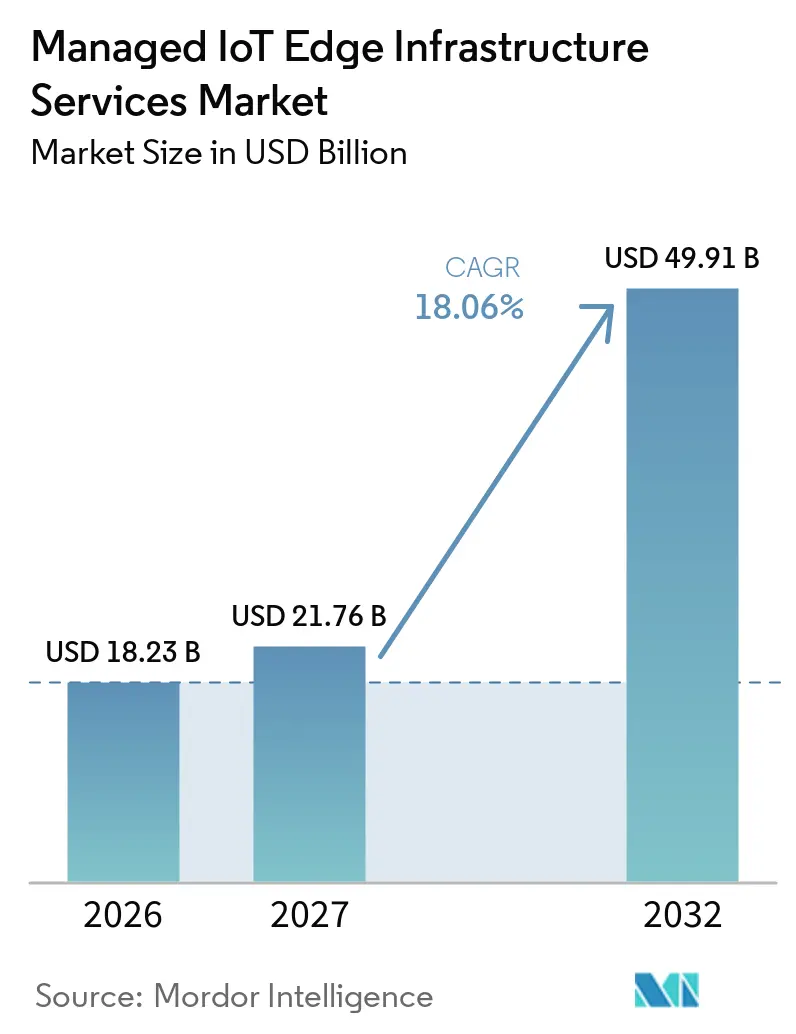
The Managed IoT edge infrastructure services market size is projected to expand from USD 18.23 billion in 2026 and USD 21.76 billion in 2027 to USD 49.91 billion by 2032, registering a CAGR of 18.06% between 2027 and 2032. The Managed IoT edge infrastructure services market is benefiting from enterprises that need to process operational data close to equipment rather than send all data to centralized cloud systems. AI workloads also require dependable low-latency processing for industrial decisions, which raises the value of managed local infrastructure. Customers are increasingly using outcome-based contracts that place hardware, firmware, security, and service-level responsibility with specialized providers. This approach can make multi-site edge operations more manageable for asset-heavy organizations with limited internal technical capacity, particularly when equipment must remain available across facilities that differ in workforce expertise, network quality, operating schedules, environmental conditions, and the maturity of their existing technology systems. Data-residency rules in Europe and Asia-Pacific are also making regional infrastructure coverage and country-specific compliance important competitive considerations for providers serving regulated industrial customers.
Key Report Takeaways
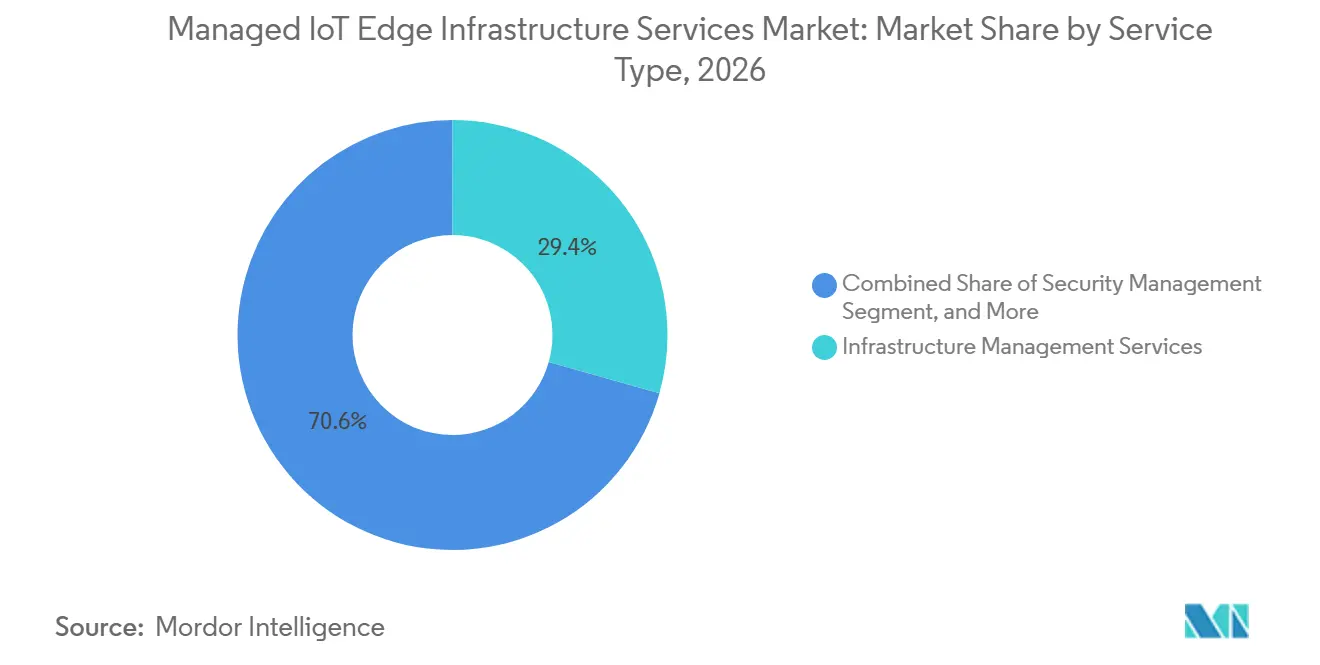
- By service type, Infrastructure Management Services held 29.37% of the Managed IoT edge infrastructure services market in 2026, while Security Management Services is projected to expand at a CAGR of 21.42% through 2032.
- By deployment model, Cloud-Managed Edge held 42.63% of 2026 revenue, while Hybrid Edge is projected to expand at a CAGR of 19.97% through 2032.
- By organization size, Large Enterprises held 73.41% of the Managed IoT edge infrastructure services market 2026 revenue, while Small and Medium Enterprises are projected to expand at a CAGR of 20.37% through 2032.
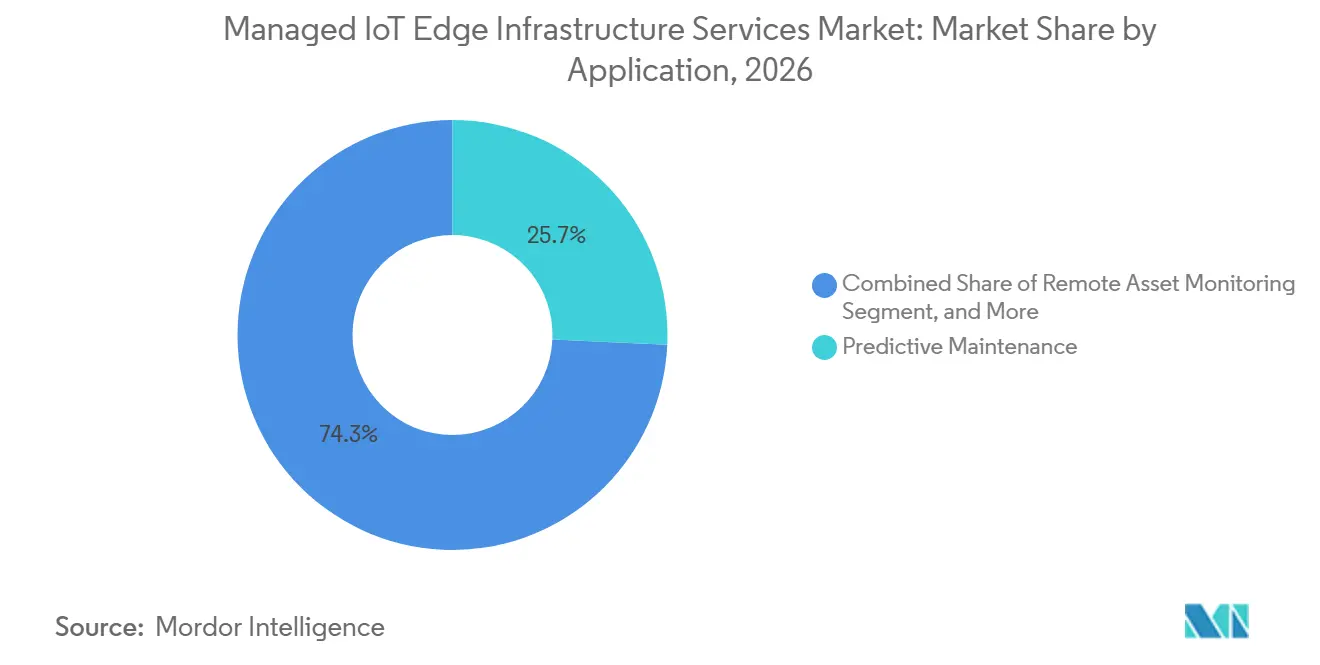
- By application, Predictive Maintenance held 25.73% of 2026 revenue, while Quality Inspection and Machine Vision are projected to expand at a CAGR of 21.13% through 2032.
- By end-user industry, Manufacturing held 30.89% of 2026 revenue, while Transportation and Logistics is projected to expand at a CAGR of 21.57% through 2032.
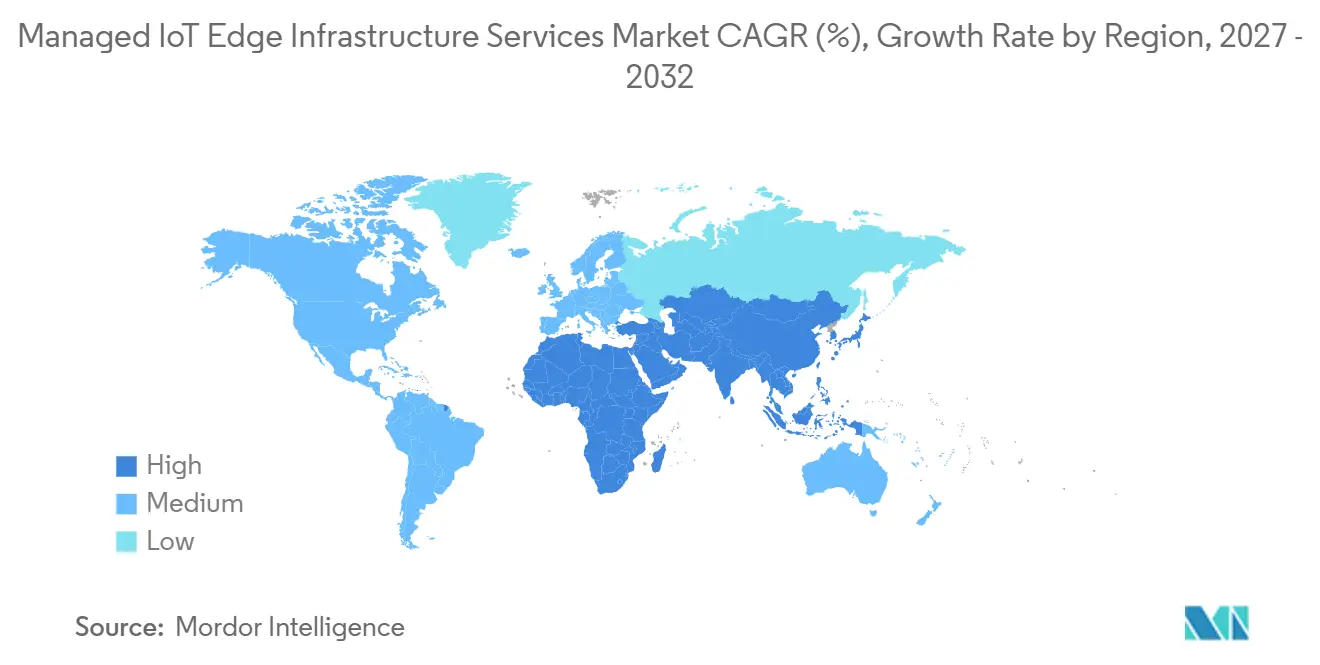
- By geography, North America held 32.57% of the Managed IoT edge infrastructure services market 2026 revenue, while Asia-Pacific is projected to expand at a CAGR of 21.63% through 2032.
Note: Market numbers in this report are based on Mordor Intelligence's proprietary estimation framework, which combines nine months of actuals with Q4 projections for base year 2026.
Global Managed IoT Edge Infrastructure Services Market Trends and Insights
Drivers Impact Analysis*
| Driver | (~) % Impact on CAGR Forecast | Geographic Relevance | Impact Timeline |
|---|---|---|---|
| Expansion of Multi-Site IoT Deployments | +3.5% | Global, with concentration in North America and Asia-Pacific | Medium term (2-4 years) |
| Demand for Low-Latency Edge Analytics | +3.2% | North America, Europe, and Asia-Pacific industrial hubs | Medium term (2-4 years) |
| Growth of AI-Enabled Predictive Maintenance | +2.8% | Global, led by manufacturing-intensive Asia-Pacific and Europe | Medium term (2-4 years) |
| Increasing IT-OT Cybersecurity and Compliance Requirements | +2.5% | North America and the EU, with spillover to the Middle East and Africa | Short term (≤ 2 years) |
| Brownfield Edge Modernization Without Rip-and-Replace | +2.0% | North America and Europe, where the brownfield installed base is largest | Long term (≥ 4 years) |
| Edge Operations Consolidation Through Outcome-Based Contracts | +1.5% | Global, with early adoption in North America and Nordic markets | Long term (≥ 4 years) |
| Source: Mordor Intelligence | |||
Expansion of Multi-Site IoT Deployments
The Managed IoT edge infrastructure services market gains momentum when organizations extend edge systems from a single facility to many sites, because each added location introduces its own equipment mix, connectivity conditions, local procedures, and support needs that must be coordinated without interrupting ongoing operations. For the Managed IoT edge infrastructure services market, managing multi-site installations requires consistent policies across different device types, network conditions, protocols, and firmware versions, while local teams still need the flexibility to respond to equipment-specific conditions that cannot be handled by a single generic configuration. Each additional site can introduce local operating constraints that internal teams must support alongside existing responsibilities. Managed providers address this need through zero-touch provisioning, centralized control platforms, and defined uptime commitments. Those capabilities reduce the need for clients to add technical staff as their device estates expand. The result is a stronger case for recurring services where operational consistency matters as much as initial deployment.
Demand for Low-Latency Edge Analytics
The Managed IoT edge infrastructure services market is also supported by applications that cannot tolerate delays created by cloud-only processing, especially when a production, inspection, or control decision depends on local data that loses operational value if it is routed away before evaluation. Cisco introduced its Unified Edge Platform in November 2025 for distributed agentic AI workloads with zero-touch deployment, fleet management, and observability capabilities.[1] A 2026 scientific study of an AWS IoT Greengrass architecture reported that hybrid edge processing reduced decision latency from 23.1 milliseconds to 0.09 milliseconds and reduced cloud-bound bandwidth by 86.8%. Quality inspection lines and process-control systems need this level of responsiveness because delayed decisions can interrupt operations or allow defects to pass. Providers must monitor local infrastructure continuously to meet low-latency service commitments. This requirement makes managed delivery more relevant, where decision speed is tied directly to uptime and product quality.
Growth of AI-Enabled Predictive Maintenance
AI-enabled predictive maintenance is increasing demand for reliable edge data collection, local inference, and continuous infrastructure support. A 2025 study reported maintenance-cost reductions of 25% to 30%, equipment-breakdown reductions of 70% to 75%, and downtime reductions of 35% to 45% in an edge-cloud predictive maintenance deployment. A separate 2025 IEEE study reported a 28% reduction in unplanned downtime and a 32% improvement in fault-detection accuracy for a hybrid SCADA-to-edge architecture. These deployments depend on clean operating data and stable connectivity over time. Managed providers can operate the edge estate that supports model monitoring, device availability, and controlled updates. Larger providers may also strengthen their offerings by applying anonymized patterns from multiple managed fleets to improve predictive models.
Increasing IT-OT Cybersecurity and Compliance Requirements
IT and operational technology integration increases the number of systems that require coordinated security oversight. The Managed IoT edge infrastructure services market responds to this issue through managed security, patching, segmentation, and audit support, allowing industrial operators to apply consistent safeguards across remote nodes even when their sites use different generations of equipment and networks. The European Commission's Digital Skills and Jobs Platform cited an ISC2 estimate of 30,000 to 45,000 unfilled OT cybersecurity roles in Europe during 2025. Industrial operators must manage security across control systems, enterprise networks, cloud services, and distributed edge nodes. Standards such as ISA/IEC 62443, ISO 27001, and the EU NIS2 Directive make certified security practices more important in vendor selection. Providers that can demonstrate an established compliance process are better positioned for regulated industrial accounts.
Restraints Impact Analysis*
| Restraint | (~) % Impact on CAGR Forecast | Geographic Relevance | Impact Timeline |
|---|---|---|---|
| High Upfront Costs for Ruggedized Edge Infrastructure | -2.5% | Global, most acute in the Middle East and Africa and South America | Short term (≤ 2 years) |
| Shortage of OT-IT-Cloud Engineering Talent | -2.0% | Global, particularly pronounced in Europe and North America | Medium term (2-4 years) |
| Fragmented Middleware and Interoperability Standards | -1.5% | Global, more pronounced in multi-vendor Asia-Pacific deployments | Long term (≥ 4 years) |
| Distributed Patch Management and Data-Custody Complexity | -1.2% | Global, acute for regulated industries in North America and the EU | Medium term (2-4 years) |
| Source: Mordor Intelligence | |||
High Upfront Costs for Ruggedized Edge Infrastructure
Ruggedized edge hardware is designed for temperature extremes, vibration, and electromagnetic interference in demanding industrial locations. This equipment can cost 3 to 5 times more than comparable data-center hardware, since the design must withstand conditions that ordinary indoor systems are not built to handle over long operating periods. The cost burden is especially significant for mid-sized industrial organizations and for emerging markets with less developed equipment-financing options. A multi-site modernization program can require a substantial commitment before operating savings become visible. Subscription and outcome-based contracts can distribute some of this cost over time. The underlying equipment cost nevertheless limits adoption in sectors where technology budgets remain constrained.
Shortage of OT-IT-Cloud Engineering Talent
The Managed IoT edge infrastructure services market needs professionals who understand industrial controls, enterprise security, and cloud orchestration, because dependable service delivery requires decisions that account for physical operations, cyber risk, application performance, and the practical limits of local site teams. These skills are rarely developed together through one standard educational or professional route. The European Commission platform identified the skills deficit across manufacturing, energy, transportation, and utilities.[2] Shortages can delay deployments and limit the capacity of providers to support complex client environments, particularly when a project needs knowledge of both site-level equipment and the centralized systems that collect, protect, and manage operational information. They also increase the value of providers that have established industrial engineering teams. This constraint is likely to remain important while organizations adopt more connected assets and more advanced edge applications.
*Our forecasts treat driver/restraint impacts as directional, not additive. The impact forecasts reflect baseline growth, mix effects, and variable interactions.
Segment Analysis
By Service Type: Infrastructure Management Services Lead While Security Services Accelerate
Infrastructure Management Services held 29.37% of the Managed IoT edge infrastructure services market share in 2026, reflecting the foundational need to maintain hardware lifecycles, connectivity, and edge-node provisioning before higher-value data, analytics, or security services can operate reliably. Enterprises often start managed engagements by transferring routine infrastructure responsibilities from internal teams that must otherwise support different sites, equipment ages, protocols, and operating schedules. These initial engagements can become long-duration relationships because the provider gains responsibility for a physical and operational base that supports later service additions. The segment has broad relevance across manufacturing, utilities, transportation, and other asset-intensive fields where dispersed equipment demands consistent support. Its leading position also reflects the continuing effort required to keep geographically distributed hardware available, current, and connected under defined operating commitments.
Security Management Services is projected to expand at a CAGR of 21.42% between 2027 and 2032 as distributed nodes create more potential access points that need controlled identities, monitoring, patching, segmentation, and timely remediation. Network Management Services and Data Management Services are gaining relevance as customers move from isolated pilots toward multi-site deployments that need a unified view of connectivity and governed data flows. The Managed IoT edge infrastructure services industry is moving toward bundled arrangements that combine infrastructure, security, network, data, and device support through a common control platform and a single operational relationship, reducing the burden on customers that would otherwise have to coordinate several providers and resolve responsibility gaps themselves. Cisco's 2025 Unified Edge Platform combined zero-touch deployment with Cisco Intersight fleet management, reflecting the practical move toward coordinated rather than standalone edge operations. Providers with integrated stacks can support a broader share of the client environment, while providers limited to individual service lines face more direct competition on price and narrower scope.

By Deployment Model: Cloud-Managed Edge Retains Scale as Hybrid Edge Gains Adoption
Cloud-Managed Edge held 42.63% of the Managed IoT edge infrastructure services market in 2026, supported by established cloud infrastructure and by IT teams that already manage applications, reporting, and software services through cloud-native toolsets, which can make service adoption easier when organizations want edge operations to fit established technology governance and purchasing processes. Its scale reflects a preference for central administration across many locations, particularly where organizations want consistent software coordination, model training, governance, and operational reporting without separate local management systems. This model aligns with procurement practices that favor familiar hyperscale platforms and existing enterprise cloud investments, existing governance procedures, established vendor relationships, and known technical operating models. It also provides a practical route for coordinating dispersed sites when local equipment does not require full isolation from central services. On-Premises Edge remains necessary for air-gapped environments, critical infrastructure, defense applications, and facilities with strict data-residency rules, ensuring that deployment choices remain linked to operating conditions.
Hybrid Edge is projected to expand at a CAGR of 19.97% between 2027 and 2032 because it retains local processing for time-sensitive decisions while using cloud resources for aggregation, model training, oversight, and broader reporting. Within the Managed IoT edge infrastructure services market, this approach lets industrial operators keep control loops close to equipment without losing the benefits of centralized information management across plants, warehouses, ports, and field assets, which is valuable when operations require both immediate local action and enterprise-wide visibility. Providers can use hybrid designs to set separate performance expectations for local response and cloud synchronization, making service commitments more specific to actual operating needs. Siemens extended its work with Microsoft during March 2025 to connect Siemens Industrial Edge with Azure IoT Operations for OT-to-cloud data flows and local inference.[3] The arrangement illustrates how industrial platform vendors are connecting local edge functions with cloud services rather than treating these architectures as competing alternatives.
By Organization Size: Large Enterprises Anchor Demand While Smaller Organizations Expand Access
Large Enterprises held 73.41% of 2026 revenue in the Managed IoT edge infrastructure services market, as their multi-site estates and multi-year contracts can justify dedicated delivery resources and the customized integration work required by complex environments, while their long planning cycles also allow providers to establish shared procedures across several operating locations. These organizations often operate legacy operational systems alongside newer enterprise applications, strict security requirements, and varied local constraints that make standardized internal support difficult. Their scale increases the value of a provider that can pair infrastructure management with industrial domain knowledge, coordinated governance, and established procedures for repeatable deployment. Contracts across plants, warehouses, ports, or energy assets can provide a provider with stable recurring revenue and a clear basis for extending the relationship into adjacent managed services. Large enterprise demand, therefore, continues to shape provider capacity, account strategy, and the service capabilities that vendors prioritize.
Small and Medium Enterprises are projected to expand at a CAGR of 20.37% through 2032 as subscription pricing and outcome-linked contracts reduce the need for a large initial investment in specialized computing, connectivity, and management tools. For the Managed IoT edge infrastructure services market, this model can improve access for manufacturers that previously lacked the scale, staffing, or capital to build and operate a dedicated edge environment themselves, allowing adoption to depend more on operating needs than on the ability to finance and staff a full internal platform. Mitsuiwa launched a factory-specific Cisco Meraki managed network service in Japan during March 2025, demonstrating a managed approach directed at smaller industrial deployments. Adoption among Germany's Mittelstand and Japan's manufacturing base can broaden the potential customer base for providers that offer clear packaging and practical remote support. This opportunity increases the importance of standardized deployment, understandable pricing, device lifecycle management, and operational support that does not depend on a large internal engineering team.
By Application: Predictive Maintenance Leads While Machine Vision Accelerates
Predictive Maintenance held 25.73% of the Managed IoT edge infrastructure services market size in 2026, making it a central application because equipment data can directly inform maintenance planning and identify developing operational issues before failure, giving operational teams a direct connection between edge data collection, local analysis, and measurable asset-management decisions. Manufacturing, oil and gas, and mining operators use these data streams to understand asset condition, where equipment availability has direct implications for production continuity and operating cost. Edge processing is valuable when information must be evaluated close to the asset, particularly when sending all raw operational data to remote systems would add delay or create bandwidth demands. Managed providers support this use case by maintaining devices, connectivity, local compute, data flows, and the ongoing operational conditions required for sustained model performance. Predictive maintenance consequently serves as a common first application from which organizations can extend managed edge services to other asset and process requirements.
Quality Inspection and Machine Vision is projected to expand at a CAGR of 21.13% through 2032 because high-resolution visual inference requires reliable local computing capacity, dependable device oversight, and data handling that can support immediate production-floor decisions. In the Managed IoT edge infrastructure services market, the application is relevant where quality standards leave little room for delayed review or inconsistent inference performance during active manufacturing operations, since production teams need dependable local processing that can support immediate decisions without waiting for remote system availability. Real-Time Process Optimization, Remote Asset Monitoring, and Safety and Compliance Analytics remain important adjacent uses with their own operational and procurement requirements. Energy Optimization and Carbon Monitoring are also gaining attention as organizations seek real-time telemetry from dispersed assets to support decarbonization commitments that cloud-only architectures may not serve efficiently. A 2025 scientific paper demonstrated transformer-based fault diagnosis on edge hardware using KubeEdge and Kubernetes, supporting the technical basis for more advanced industrial edge applications.
By End-User Industry: Manufacturing Leads While Transportation and Logistics Accelerate
Manufacturing accounted for 30.89% of the market's 2026 revenue, reflecting its extensive installed base of automation equipment that can be connected, monitored, and optimized without requiring a complete replacement of established production assets. Delivering these services often requires familiarity with programmable logic controllers, SCADA systems, and older industrial protocols that remain integral to production settings. This requirement favors providers with operational technology experience and implementation capabilities suited to specific manufacturing environments rather than generic information technology services alone. Brownfield modernization remains important because it can connect long-lived equipment with less disruption to production than a full greenfield replacement program. Manufacturing is therefore a major source of recurring infrastructure, security, device-management, and application-support demand for the Managed IoT edge infrastructure services market, because the sector's installed equipment base creates continuing needs for controlled modernization, reliable monitoring, and coordinated operational support.
Transportation and Logistics is projected to expand at a CAGR of 21.57% between 2027 and 2032 as port operators and freight networks deploy edge intelligence for real-time asset tracking, operational visibility, and predictive fleet maintenance across distributed environments. For the Managed IoT edge infrastructure services market, these systems must work across mobile assets, remote facilities, and varying network conditions, which makes resilient device and connectivity management especially important and increases the value of providers that can maintain consistent service across changing physical locations. Oil and Gas, Mining and Metals, and Utilities and Energy also form a high-value group because their assets are critical, dispersed, and often subject to demanding continuity standards. Healthcare is emerging through medical-device management, point-of-care monitoring, and local diagnostic data processing, where service delivery must also address data-governance expectations. Across these sectors, providers must pair technical infrastructure with operating practices that reflect the importance, location, and regulatory context of the assets being supported.
Geography Analysis
North America held 32.57% of the Managed IoT edge infrastructure services market in 2026, supported by a dense base of cloud infrastructure, industrial assets, regulated organizations, and established outcome-based managed service relationships. Manufacturers, energy operators, and regulated enterprises in the region are investing in closer integration between information technology systems and operational environments. The United States has a broad low-latency infrastructure that providers can use for deployments across geographically dispersed customer operations. This ecosystem allows managed providers to support local processing without building proprietary national points of presence for every deployment. Regional customers also place considerable emphasis on uptime, security, scale, and repeatable fleet operations.
Europe remains important because Germany has a large industrial automation base, while the United Kingdom, France, and Italy have established demand across energy, financial services, and manufacturing. Data-residency obligations and the EU NIS2 Directive are changing how enterprises evaluate providers and the location of the infrastructure they use. Customers increasingly require solutions that combine operational capability with European hosting and compliance credentials. Hilscher and Schwarz Digits launched a sovereign Edge-to-Cloud platform for industrial customers in April 2026, illustrating the commercial importance of compliant regional infrastructure.[4] Within the Managed IoT edge infrastructure services market, providers with certified local coverage can therefore differentiate their services beyond technical performance alone, because regional compliance credentials can influence procurement decisions before customers assess the full range of infrastructure, security, and application capabilities.
Asia-Pacific is projected to expand at a CAGR of 21.63% through 2032, supported by China's extensive edge-enabled 5G base and structured industrial investment across major economies. Japan's Cloud-Edge-IoT Continuum program positions edge computing as part of industrial competitiveness and supports demand for scalable orchestration. India's production-linked incentive programs and South Korea's private 5G ecosystem support manufacturing and logistics adoption, while South America remains earlier in adoption with Brazil and Argentina as near-term markets. The Middle East and Africa also offer opportunities linked to Saudi Arabia's Vision 2030, smart-city initiatives in the United Arab Emirates, and mining, utilities, and telecommunications activity in South Africa, Nigeria, and Egypt.
Competitive Landscape
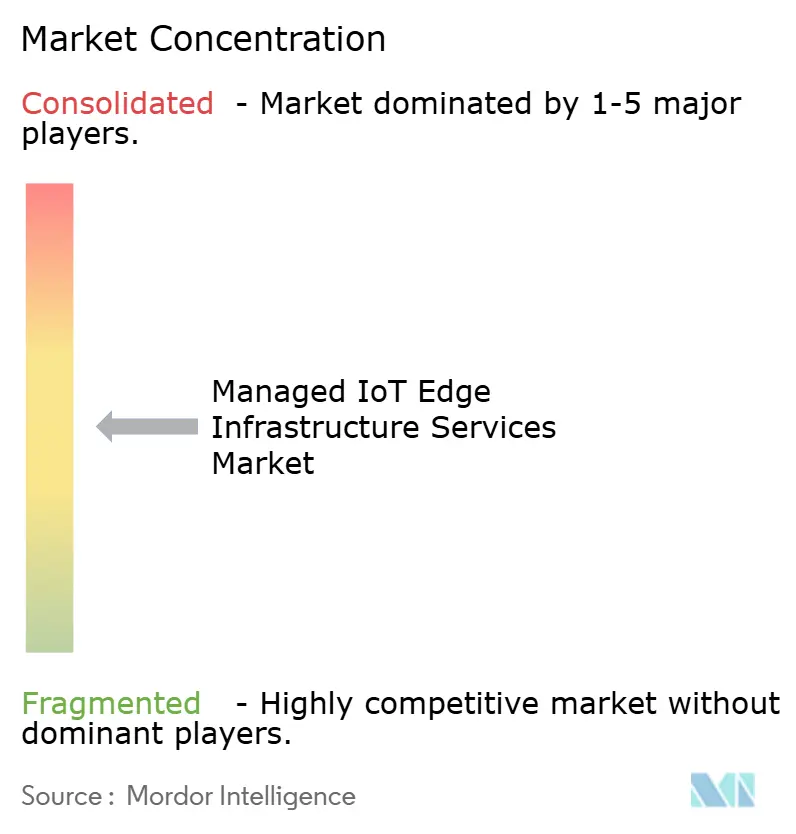
The Managed IoT edge infrastructure services market is moderately fragmented among hyperscalers, industrial operational technology specialists, networking platform providers, and systems integrators that serve different client needs rather than competing directly across every requirement. Hyperscalers compete through cloud integration, established enterprise relationships, and global infrastructure reach that can connect edge environments with existing cloud systems. Industrial specialists compete through brownfield protocol coverage, operational knowledge, and credentials related to mission-critical uptime. Systems integrators compete through delivery scale, multi-vendor coordination, and their ability to implement solutions across complex customer estates. This structure leaves space for providers that combine infrastructure management, security, and outcome-based analytics for mid-market customers.
Rockwell Automation launched the SecureOT Solution Suite in November 2025, combining an OT security platform with professional services, managed services, and 24/7 security and network operations coverage. Such vertically focused security offers can strengthen retention among industrial clients that must align distributed technology with demanding operating and compliance requirements. Siemens made its Industrial Edge Cloud Device available through AWS and Azure marketplaces during September 2025, simplifying procurement through cloud marketplace distribution. The move can lower switching costs for customers while raising the importance of interoperable offerings that fit existing cloud purchasing processes. Siemens and OnLogic partnered in April 2026 to extend Industrial Edge into rugged locations, combining edge software with fanless hardware for minerals, energy, and distributed infrastructure.
In the Managed IoT edge infrastructure services market, smaller edge-native providers target customers that larger suppliers may not serve economically through customized engagements, using pre-integrated and subscription-priced managed stacks for a broader set of smaller deployments, including organizations that need predictable support but cannot justify a dedicated bespoke delivery model. AI-native capabilities form another competitive area because data from a managed fleet can support continuing improvement of predictive maintenance and quality-inspection models, provided that providers can manage the data responsibly and translate learning from comparable operating conditions into usable application performance. Providers that serve similar industrial environments can develop repeatable delivery practices, while generic horizontal services face stronger pricing pressure than vertical-optimized offerings. The Managed IoT edge infrastructure services market will favor providers that combine scalable operations, credible sector knowledge, deep protocol support, and application libraries suited to customer operations.
Managed IoT Edge Infrastructure Services Industry Leaders
-
Microsoft Corporation
-
IBM Corporation
-
Schneider Electric SE
-
Cisco Systems, Inc.
-
Huawei Technologies Co., Ltd.
- *Disclaimer: Major Players sorted in no particular order
Recent Industry Developments
- October 2026: Honeywell Technologies introduced Forge Cognition, a self-contained agentic AI and simulation platform for industrial and facility operations, co-developed with NVIDIA and Dell Technologies. A pilot at NVIDIA's Voyager campus achieved up to 90% reduction in unnecessary alerts and up to 10% potential energy savings, with the platform targeting an installed base exceeding 300,000 Honeywell-managed sites globally.
- April 2026: Siemens and OnLogic announced a strategic partnership to extend the Siemens Industrial Edge ecosystem into extreme-edge environments in minerals, energy, and distributed infrastructure, combining Siemens Industrial Edge software with OnLogic's ruggedized, fanless hardware for assets previously unreachable by standard edge compute.
- April 2026: AWS and Siemens Energy expanded their strategic collaboration, establishing AWS as the primary cloud provider for Siemens Energy's digital transformation, encompassing smart manufacturing and autonomous plant operations through the IoT Connected Factory platform, with Amazon Bedrock and SageMaker enabling generative AI capabilities across industrial workflows.
- February 2026: Unisys expanded its Device Subscription Service in collaboration with Dell Technologies to extend managed edge and IoT device lifecycle management to restaurant hardware, smart parking sensors, and campus IoT devices, targeting multi-subsidiary organizations managing complex distributed device estates.
Global Managed IoT Edge Infrastructure Services Market Report Scope
The Managed IoT Edge Infrastructure Services refers to a cloud-controlled solutions that deploy, monitor, and manage computing, storage, and analytics workloads directly on local hardware close to data sources rather than sending everything to a centralized remote cloud.
The Managed IoT Edge Infrastructure Services Market Report is Segmented by Service Type (Infrastructure Management Services, Security Management Services, Network Management Services, Data Management Services, and Device Management Services), Deployment Model (Cloud-Managed Edge, On-Premises Edge, and Hybrid Edge), Organization Size (Large Enterprises and Small and Medium Enterprises), Application (Predictive Maintenance, Quality Inspection and Machine Vision, Real-Time Process Optimization, Remote Asset Monitoring, Safety and Compliance Analytics, and Energy Optimization and Carbon Monitoring), End-User Industry (Manufacturing, Oil and Gas, Mining and Metals, Utilities and Energy, Transportation and Logistics, Healthcare, and Other End-User Industries), and Geography (North America, South America, Europe, Asia-Pacific, Middle East, and Africa). The Market Forecasts are Provided in Terms of Value (USD).
| Infrastructure Management Services |
| Security Management Services |
| Network Management Services |
| Data Management Services |
| Device Management Services |
| Cloud-Managed Edge |
| On-Premises Edge |
| Hybrid Edge |
| Large Enterprises |
| Small and Medium Enterprises |
| Predictive Maintenance |
| Quality Inspection and Machine Vision |
| Real-Time Process Optimization |
| Remote Asset Monitoring |
| Safety and Compliance Analytics |
| Energy Optimization and Carbon Monitoring |
| Manufacturing |
| Oil and Gas |
| Mining and Metals |
| Utilities and Energy |
| Transportation and Logistics |
| Healthcare |
| Other End-User Industries |
| North America | United States |
| Canada | |
| Mexico | |
| South America | Brazil |
| Argentina | |
| Rest of South America | |
| Europe | Germany |
| United Kingdom | |
| France | |
| Italy | |
| Spain | |
| Rest of Europe | |
| Asia-Pacific | China |
| Japan | |
| India | |
| South Korea | |
| Australia | |
| Rest of Asia-Pacific | |
| Middle East | Saudi Arabia |
| United Arab Emirates | |
| Turkey | |
| Rest of Middle East | |
| Africa | South Africa |
| Nigeria | |
| Egypt | |
| Rest of Africa |
| By Service Type | Infrastructure Management Services | |
| Security Management Services | ||
| Network Management Services | ||
| Data Management Services | ||
| Device Management Services | ||
| By Deployment Model | Cloud-Managed Edge | |
| On-Premises Edge | ||
| Hybrid Edge | ||
| By Organization Size | Large Enterprises | |
| Small and Medium Enterprises | ||
| By Application | Predictive Maintenance | |
| Quality Inspection and Machine Vision | ||
| Real-Time Process Optimization | ||
| Remote Asset Monitoring | ||
| Safety and Compliance Analytics | ||
| Energy Optimization and Carbon Monitoring | ||
| By End-User Industry | Manufacturing | |
| Oil and Gas | ||
| Mining and Metals | ||
| Utilities and Energy | ||
| Transportation and Logistics | ||
| Healthcare | ||
| Other End-User Industries | ||
| By Geography | North America | United States |
| Canada | ||
| Mexico | ||
| South America | Brazil | |
| Argentina | ||
| Rest of South America | ||
| Europe | Germany | |
| United Kingdom | ||
| France | ||
| Italy | ||
| Spain | ||
| Rest of Europe | ||
| Asia-Pacific | China | |
| Japan | ||
| India | ||
| South Korea | ||
| Australia | ||
| Rest of Asia-Pacific | ||
| Middle East | Saudi Arabia | |
| United Arab Emirates | ||
| Turkey | ||
| Rest of Middle East | ||
| Africa | South Africa | |
| Nigeria | ||
| Egypt | ||
| Rest of Africa | ||
Key Questions Answered in the Report
What is the size of the Managed IoT edge infrastructure services market?
The market is projected at USD 18.23 billion in 2026 and USD 21.76 billion in 2027, with a forecast value of USD 49.91 billion by 2032.
What is driving demand for managed IoT edge infrastructure services?
Multi-site deployments, low-latency analytics, predictive maintenance, and security requirements are increasing demand for managed operating models.
Which service type leads managed IoT edge infrastructure services?
Infrastructure Management Services held 29.37% of 2026 revenue, reflecting the need for hardware lifecycle, connectivity, and edge-node support.
Which deployment model is expanding fastest?
Hybrid Edge is projected to expand at a CAGR of 19.97% through 2032 because it supports local decisions with cloud-based management and reporting.
Which end-user sector has the largest share?
Manufacturing held 30.89% of 2026 revenue because of its large automation installed base and need for brownfield modernization.
Which region is forecast to expand fastest?
Asia-Pacific is projected to expand at a CAGR of 21.63% through 2032, supported by industrial connectivity, private 5G, and manufacturing investment.