
Asia-Pacific Employee Experience Platform Market Size and Share
Market Overview
| Study Period | 2020 - 2031 |
|---|---|
| Forecast Data Period | 2026 - 2031 |
| Base Year Market Size (2025) | USD 1.06 Billion |
| Market Size (2026) | USD 1.22 Billion |
| Market Size (2031) | USD 2.36 Billion |
| Growth Rate (2026 - 2031) | 14.12 % |
| Market Concentration | Medium |
Major Players *Disclaimer: Major Players sorted in no particular order Image © Mordor Intelligence. Reuse requires attribution under CC BY 4.0. | |
Asia-Pacific Employee Experience Platform Market Analysis by Mordor Intelligence
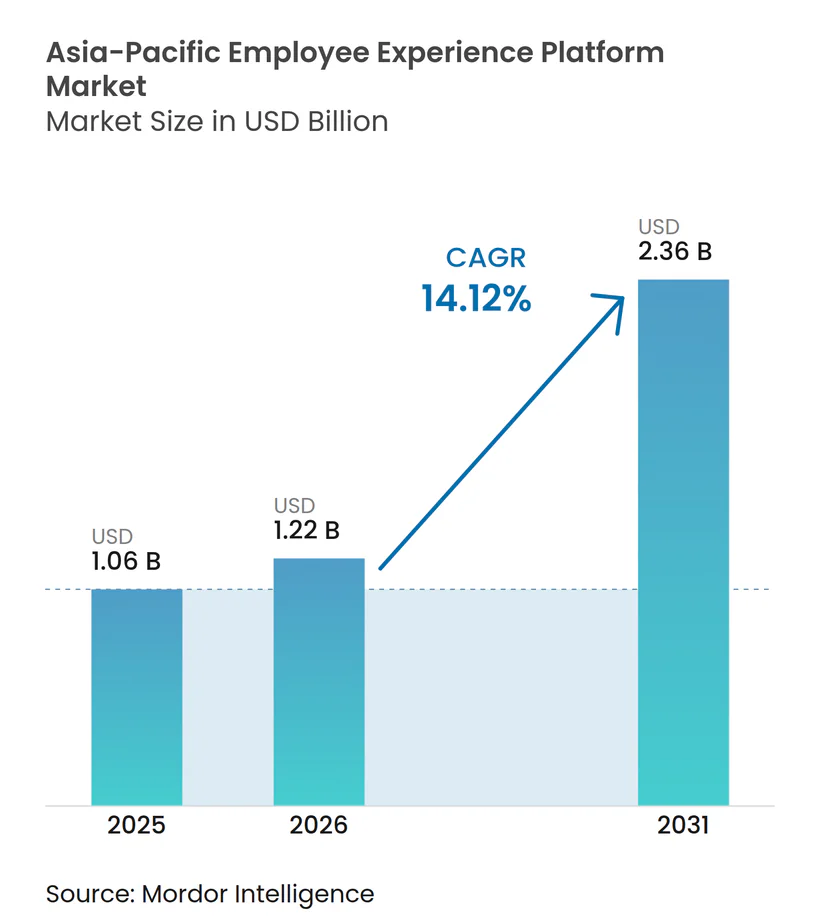
The Asia-Pacific employee experience platform market size is expected to grow from USD 1.06 billion in 2025 to USD 1.22 billion in 2026 and is forecast to reach USD 2.36 billion by 2031 at 14.12% CAGR over 2026-2031. Growth is tied to workforce digitization, wider AI use in HR workflows, and stronger competition for skilled employees across the region. Enterprises are treating employee experience spending as an operating priority because retention pressure now affects productivity, hiring costs, and management continuity. Return-to-office policies are also changing buying decisions because employers are under pressure to improve the quality of in-office work, not just attendance levels. Vendors that combine structured listening, recognition, communication, and auditable workflow tools are gaining ground because buyers want fewer disconnected systems across multiple countries. The Asia-Pacific employee experience platform market is also creating room for providers that can localize products for national labor rules while still delivering one regional operating model.
Key Report Takeaways
- By deployment model, cloud held a 71.42% share of the Asia-Pacific employee experience platform market in 2025, and is projected to expand at a 14.88% CAGR through 2031.
- By organization size, large enterprises held 74.18% share of the market in 2025, while SMEs are projected to grow at 15.24% CAGR through 2031.
- By application, employee communication and collaboration accounted for 31.84% of the market size in 2025, while employee well-being and support are projected to advance at 15.76% CAGR through 2031.
- By end-user industry, BFSI accounted for 22.16% of the market size in 2025, while healthcare and life sciences are projected to expand at 14.96% CAGR through 2031.
- By geography, China held 29.48% of the APAC employee experience platform market share in 2025, while India is projected to grow at 16.84% CAGR through 2031.
Note: Market size and forecast figures in this report are generated using Mordor Intelligence’s proprietary estimation framework, updated with the latest available data and insights as of January 2026.
Market Trends and Insights
Drivers Impact Analysis of Asia-Pacific Employee Experience Platform Market*
| Driver | (~) % Impact on CAGR Forecast | Geographic Relevance | Impact Timeline |
|---|---|---|---|
| Accelerating AI-Enabled HR and Workflow Personalization | +3.2% | Asia-Pacific-wide, with early concentration in India, Singapore, and China | Short term (≤ 2 years) |
| Heightened Talent Retention and Employee Engagement Priorities | +2.8% | Asia-Pacific-wide | Medium term (2-4 years) |
| Cloud-First HR Stack Modernization | +2.5% | China, India, and Southeast Asia | Medium term (2-4 years) |
| Expansion of Hybrid and Distributed Work Models | +2.1% | Asia-Pacific-wide, with notable gains in Singapore, Australia, and India | Medium term (2-4 years) |
| Frontline and Deskless Workforce Communication Gaps | +1.8% | Indonesia, Malaysia, Thailand, and South Asia | Medium term (2-4 years) |
| Multi-Jurisdiction Labor and AI Governance Pressures | +1.0% | Singapore, South Korea, China, Australia, and New Zealand | Long term (≥ 4 years) |
| Source: Mordor Intelligence | |||
Accelerating AI-Enabled HR and Workflow Personalization
AI personalization has become a core buying criterion in the Asia-Pacific employee experience platform market, as employers seek faster insight delivery and more consistent workforce support across large workforces. Workday and Achievers launched Workday Recognition in April 2026, placing AI-driven recognition and rewards within the HCM workflow rather than treating them as a separate process.[1] The companies stated that weekly recognition can lift productivity by 2.6 times and make employees 6 times more likely to stay, which gives employers a direct business case for AI-assisted nudges inside people workflows. Lattice moved in the same direction when it acquired Mandala Technology on March 31, 2026, and added deeper workforce analytics to its people intelligence platform. Mercer data from India showed that 66% of HR leaders were planning an organizational redesign to embed AI into talent processes, suggesting that buyers want AI tied to daily management decisions rather than limited pilots. That shift favors vendors with prebuilt analytics, recognition, and listening functions within a single system, as enterprises seek faster deployment and clearer action paths across countries in the market.
Heightened Talent Retention and Employee Engagement Priorities
Retention is one of the clearest revenue drivers for the Asia-Pacific employee experience platform market, as employers are under pressure to convert employee feedback into tangible action. Culture Amp reported in January 2026 that 71% of Asia-Pacific employees felt engaged, yet 10% still planned to leave within 2 years, which exposed a gap between current sentiment and future commitment. Workhuman found in 2026 that 80% of respondents believed recognition makes valuable work visible, and 77% were more likely to go above and beyond when formally recognized, but 1 in 3 still lacked a structured recognition program.[2] This helps explain why buyers are moving from one-time survey tools to broader listening, recognition, and workflow products that support continuous management action in the Asia-Pacific employee experience platform market. The spending case is especially strong in high-skill workforces because each preventable exit incurs replacement costs, knowledge loss, and team disruption, making it easier to justify the infrastructure for structured engagement.
Cloud-First HR Stack Modernization Across Asia-Pacific Enterprises
Cloud modernization is building the foundation layer on which the market depends for real-time data flow, cross-system visibility, and regional scale. UOB's July 2025 deployment of Workday HCM for 13,000 employees across its Asia-Pacific operations demonstrated how large employers are replacing fragmented country systems with a single, common HR layer. Coforge made a similar move in March 2026, deploying the ServiceNow AI-led HR service delivery platform globally, including India, demonstrating that even IT services firms now see HR modernization as a strategic capability rather than a back-office upgrade.
Expansion of Hybrid and Distributed Work Models
Hybrid work is expanding the use case for the APAC employee experience platform market, as distance creates gaps in communication, visibility, and day-to-day culture management. A 2025 Reeracoen and Rakuten Insight Asia-Pacific study found that 72% of workers preferred a hybrid model, while only 46% currently had access to one, leaving a significant gap between workforce preference and employer practice. Vendors that can connect office experience, employee feedback, and communication flows within a single environment are therefore better positioned in the market. CARSOME's February 2026 deployment of Darwinbox for 3,000 employees across Southeast Asia also showed how regional employers are using unified mobile-first platforms to manage distributed operations more consistently.
Restraints Impact Analysis of Asia-Pacific Employee Experience Platform Market*
| Restraint | (~) % Impact on CAGR Forecast | Geographic Relevance | Impact Timeline |
|---|---|---|---|
| Data Privacy, Residency, and Cybersecurity Constraints | -1.5% | China, India, Australia, and South Korea | Medium term (2-4 years) |
| Integration Complexity With Legacy HR and Collaboration Systems | -1.2% | Japan, South Korea, and large Chinese enterprises | Medium term (2-4 years) |
| Shadow Collaboration and Shadow AI Tool Sprawl | -0.8% | Technology-intensive Asia-Pacific markets | Medium term (2-4 years) |
| Middle-Manager Readiness and AI Governance Gaps | -0.6% | Asia-Pacific-wide, with a stronger impact in Japan and South Korea | Medium term (2-4 years) |
| Source: Mordor Intelligence | |||
Data Privacy, Residency, and Cybersecurity Constraints
Privacy and residency rules remain among the hardest constraints on the Asia-Pacific employee experience platform market, as they raise compliance costs and complicate cross-border data flows. China's amended Cybersecurity Law took effect on January 1, 2026, and introduced Article 20 provisions on AI security in networked systems, which directly affect any platform handling employee behavioral or sentiment data in that market. Australia was also moving toward broader employee-data obligations through the second tranche of Privacy Act 1988 amendments, anticipated in 2025, including possible coverage of employee records and right-to-erasure provisions. The Future of Privacy Forum found in May 2025 that 42% of regional organizations reported data-governance gaps and 50% faced AI literacy shortages among the teams responsible for managing employee data systems. These issues slow vendor expansion because every country-level rollout can require different hosting, consent, access-control, and audit decisions. The result is a stronger advantage for providers that can show explainability, security, and localized compliance readiness across multiple jurisdictions in the Asia-Pacific employee experience platform market.
Integration Complexity with Legacy HR and Collaboration Systems
Integration complexity remains a major brake on the Asia-Pacific employee experience platform market, as many employers still run older HR and collaboration systems that do not integrate easily with newer tools. This issue is especially pronounced in Japan, South Korea, and large Chinese enterprises, where on-premises HR estates often predate current cloud infrastructure by many years. Salesforce reported in 2025 that 95% of IT leaders saw integration as a challenge to seamless AI deployment, and siloed applications ranked as the second-largest barrier to digital transformation. Rippling found that 85% of HR, IT, and finance teams already use 3 or more software tools, and most need 2 or more full-time staff just to manage integrations.
*Our forecasts treat driver/restraint impacts as directional, not additive. The impact forecasts reflect baseline growth, mix effects, and variable interactions.
Asia-Pacific Employee Experience Platform Market Segment Analysis
By Deployment Model:
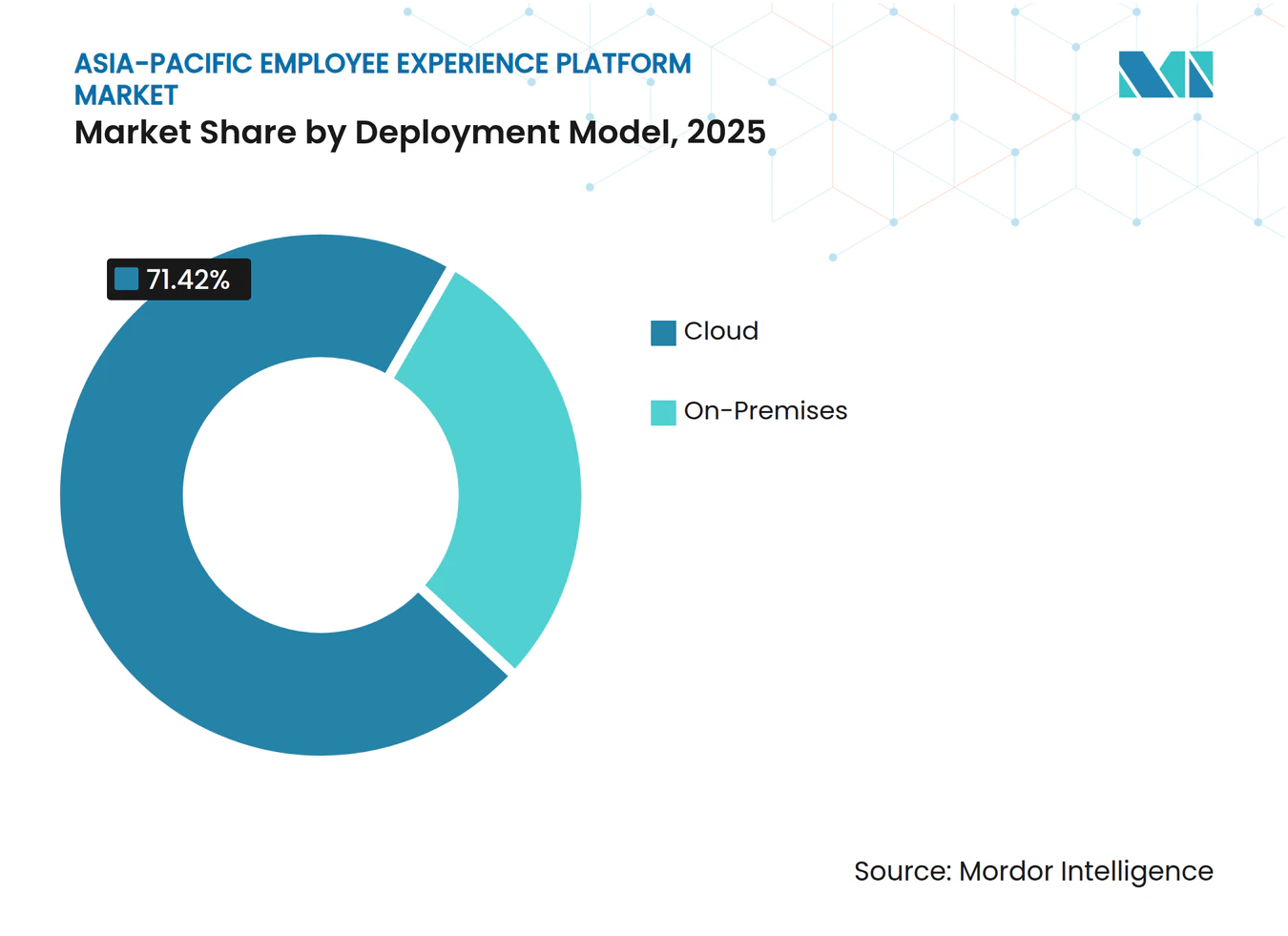
Cloud Consolidates as the Deployment DefaultCloud held 71.42% of the Asia-Pacific employee experience platform market share in 2025, which made it the default architecture for enterprise investment across the region. That migration path supports a stronger demand for cloud-native experience platforms because these systems are built around continuous data movement, mobile access, and broader integration. UOB's July 2025 deployment of Workday HCM for 13,000 employees across its Asia-Pacific operations showed how a single cloud layer can replace fragmented national systems and support a more consistent employee experience model.
Cloud is also the fastest-growing deployment model, with a 14.88% CAGR over 2026-2031, because enterprises want real-time listening, AI-assisted nudges, and cross-geography analytics without running local infrastructure in every market. On-premises still matters in countries with stricter residency or network security requirements, especially China, and it remains relevant among government-linked entities in Japan and South Korea. Even so, major vendors increasingly treat on-premises as a compliance-driven delivery mode rather than a primary growth engine. Its position is likely to narrow over time as clearer cloud guidance emerges and older infrastructure reaches end-of-life replacement cycles across large employers.


By Organization Size:
SMEs Accelerate as Large Enterprises Deepen InvestmentLarge enterprises accounted for 74.18% of the APAC employee experience platform market in 2025, supported by formal procurement processes, larger HR technology budgets, and the challenge of managing workforces across several national jurisdictions. Their scale creates practical advantages, enabling them to absorb multi-year implementation work, maintain dedicated integration teams, and layer new tools on top of existing HCM environments. This helps explain why enterprise-grade recognition and listening products continue to deepen penetration inside established large-employer customer bases. Workhuman reported in March 2026 that its platform had reached 8 million users globally, which reflected sustained traction among enterprise recognition customers across multiple regions, including Asia-Pacific.
SMEs are the fastest-growing segment, with a 15.24% CAGR over 2026-2031, as vendors lower adoption barriers through modular subscriptions and mobile-first design. HashMicro's launch of Enrich in Indonesia showed how regional vendors are building workforce intelligence systems that connect fragmented HR data for smaller and mid-sized employers. The spread of low-code and mobile-led tools across Southeast Asia is also narrowing the adoption gap between smaller firms and their enterprise peers. Malaysia's Gig Worker Bill 2025, effective March 31, 2026, further expands the addressable base by formalizing employment relationships for workers previously outside many structured HR systems.
By Application:
Wellbeing Emerges as the High-Growth Application LayerEmployee well-being and support is the fastest-growing application in the Asia-Pacific employee experience platform market, with a 15.76% CAGR over 2026-2031, as employers respond to visible mental health and support gaps across the workforce. AIA's May 2026 workplace wellbeing survey in Hong Kong reported an average employee happiness score of 65 out of 100, which fell further among junior employees. That pattern matters because junior-level experience gaps can feed attrition, disengagement, and slower, long-term capability development. Workhuman's April 2026 Frontline Recognition Experience also addressed a long-standing support gap for deskless and frontline employees who were often excluded from office-centered recognition systems.
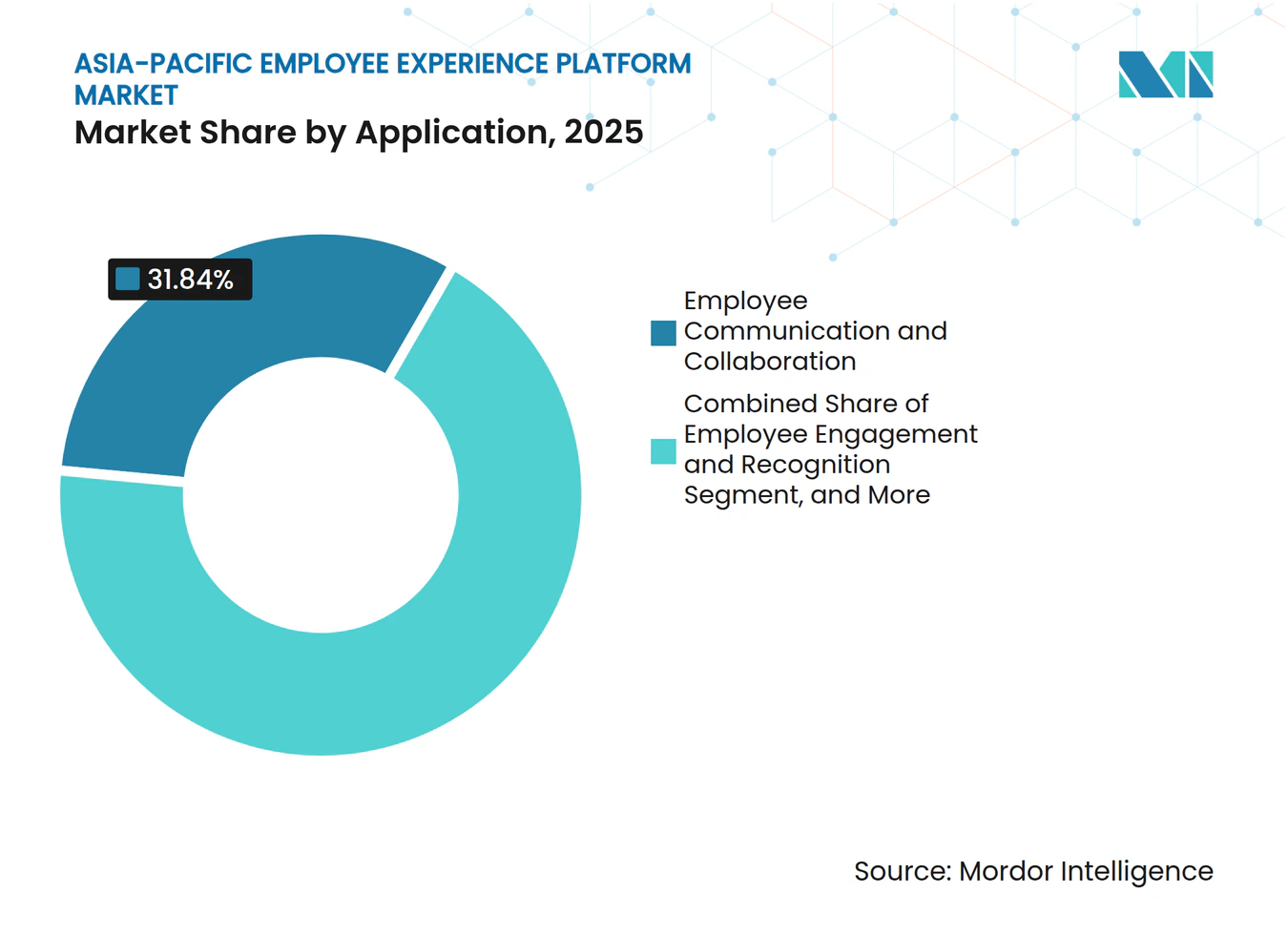
Employee communication and collaboration accounted for 31.84% of the Asia-Pacific employee experience platform market size in 2025, making it the largest application because it serves as the delivery layer for many other experience functions. Its leading position also reflects the earlier wave of communication platform adoption during the COVID-19 period, with current investment now shifting toward AI-led personalization and multi-channel orchestration. Staffbase's September 2025 launch of Employee AI showed how communication platforms are moving toward automated content delivery and conversational support.


By End-User Industry:
BFSI Anchors Demand, Healthcare and Life Sciences AccelerateThe healthcare and life sciences segment is the fastest-growing end-user verticals, with a 14.96% CAGR over 2026-2031, driven by workforce shortages and pressure on service quality, which have increased the need for structured feedback and engagement tools. Qualtrics completed its USD 6.75 billion acquisition of Press Ganey Forsta on May 18, 2026, adding healthcare and employee analytics capabilities that strengthen cross-vertical experience management.[3] BFSI remained the largest end-user vertical, accounting for 22.16% in 2025, as banks and financial institutions are highly sensitive to attrition in specialist roles and operate under multiple national regulatory frameworks. That pressure is especially visible in Singapore, Hong Kong, and India, where competition for digital banking and fintech talent continues to make retention systems more valuable.
IT and telecom, retail and e-commerce, and manufacturing remain important demand pools, though they are comparatively more mature in the Asia-Pacific employee experience platform market, as digital readiness has already enabled earlier adoption. Government and public-sector demand is also building in Australia, Singapore, and South Korea as agencies use listening and communication tools to support hybrid workforce cohesion and broader workforce transformation efforts. Energy and utilities are still a smaller vertical, but it is gaining relevance as employers address generational workforce shifts and skills-transfer needs through structured onboarding and engagement tools. Other end-user industries, including logistics, education, and professional services, are adding incremental demand as platform pricing becomes easier to adopt across a broader range of employer types.
Geography Analysis
Northeast Asia Employee Experience Platform Market
China accounted for 29.48% of the Asia-Pacific employee experience platform market share in 2025, making it the largest country market due to its enterprise scale and the maturity of its domestic HCM ecosystems, which can support integration with experience tools. That scale gives both domestic and international vendors a large demand base, but it also raises the importance of deployment architecture and local hosting choices. Japan and South Korea remain mature economies, yet they are still relatively underpenetrated by international standards in their markets. South Korea's AI Basic Act and labor-related governance work in 2026, together with China's amended Cybersecurity Law, are making auditable workflows and localized deployment options more important for vendors operating across Northeast Asia.
APAC Employee Experience Platform Market
India is the fastest-growing individual geography, with a 16.84% CAGR over 2026-2031, supported by a growing corporate workforce, a large pool of technology employers, and the presence of domestic vendors such as Darwinbox and Vantage Circle. Mercer data from India showed that 66% of HR leaders were planning an organizational redesign to embed AI into talent workflows, signaling strong management commitment to investing in the Asia-Pacific employee experience platform market. Australia and New Zealand face a different trigger, as possible Privacy Act changes have increased interest in compliant, auditable employee data solutions. Singapore continues to act as a regional testing ground because policy changes, such as the CPF retirement age adjustment to 64 from July 1, 2026, and expanded shared parental leave from April 2,0, introduce new lifecycle touchpoints that platforms need to support.
ASEAN and East Asia Employee Experience Platform Market
Southeast Asia, especially Indonesia, Malaysia, Thailand, and Vietnam, is emerging as a strong growth bloc in the APAC employee experience platform market, driven by an expanding SME base across manufacturing and services. Vietnam's electronic labor contract requirement under Decree 337/2025 and Malaysia's Gig Worker Bill 2025 both formalize employment relationships for large worker groups and widen the addressable base for mobile-first platforms. CARSOME's February 2026 Darwinbox deployment for 3,000 employees across Southeast Asia, along with HashMicro's Enrich launch in Indonesia, showed that the region is attracting both regional platform rollouts and local vendor competition. The rest of Asia-Pacific, including the Philippines, Taiwan, and Hong Kong, adds incremental demand, with the Philippines benefiting from the structural communication and engagement needs of its large business process outsourcing workforce.
Competitive Landscape
Market Concentration
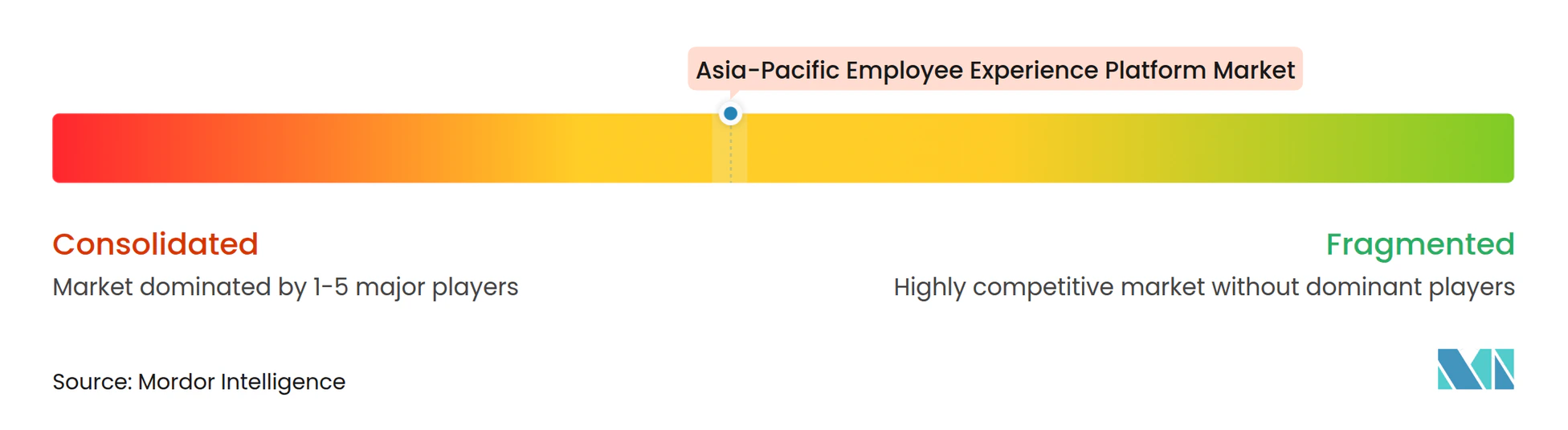
The Asia-Pacific employee experience platform market is seeing moderate consolidation at the top, led by Qualtrics, Workhuman, Simpplr, and Staffbase, while regional specialists such as Darwinbox, Vantage Circle, and SurveySparrow continue to shape local competition. Competitive positioning is increasingly tied to AI capability, localization depth, regional pricing, and the ability to integrate with local HCM environments. Qualtrics strengthened its position in May 2026 by completing the USD 6.75 billion acquisition of Press Ganey Forsta, which expanded its cross-vertical employee and experience analytics capabilities. Lattice also moved aggressively in March 2026 by acquiring Mandala Technology and deepening its AI-native people analytics position. Staffbase's AI-led platform push and Simpplr's Forrester Wave recognition showed that product depth and external validation remain meaningful signals in enterprise buying decisions.
One important open space is the frontline and deskless workforce segment, where many earlier platforms were built for office-based users rather than distributed operational teams. Workhuman's Frontline Recognition Experience, launched in April 2026, directly targeted that gap and widened the practical use case for structured recognition across manufacturing and service environments. Another open space lies in SME-focused modular products across Southeast Asia, where smaller employers are looking for lower-cost, mobile-led systems that still connect to core HR data. Regional vendors are using partnerships to close the credibility gap with global players, and Vantage Circle's work with Wipro and Microsoft 365 Copilot is a clear example of that approach.[4]
Compliance readiness is becoming a stronger product differentiator because vendors now need to support explainability, audit trails, and local deployment options across multiple national systems simultaneously. This matters even more in markets where AI governance and employee-data obligations are evolving quickly, since procurement teams increasingly want fewer legal and operational surprises after implementation. The Asia-Pacific employee experience platform market, therefore, remains competitive rather than winner-take-all, because global scale helps, but regional localization and regulatory fit still influence contract outcomes. That balance keeps room open for both established multinationals and focused regional challengers in the Asia-Pacific employee experience platform market.
Asia-Pacific Employee Experience Platform Industry Leaders
-
Qualtrics International Inc.
-
Culture Amp Pty Ltd
-
Achievers Solutions Inc.
-
WorkTango, Inc.
-
Vantage Circle Private Limited
- *Disclaimer: Major Players sorted in no particular order
Asia-Pacific Employee Experience Platform Market Companies Covered in this Report
- Qualtrics International Inc.
- Culture Amp Pty Ltd
- Achievers Solutions Inc.
- 15Five, Inc.
- Lattice, Inc.
- Leapsome GmbH
- Motivosity, Inc.
- Quantum Workplace, Inc.
- Vantage Circle Private Limited
- SurveySparrow Inc.
- Kudos, Inc.
- WorkTango, Inc.
- Workleap Inc.
- Simpplr Inc.
- Staffbase GmbH
- LumApps SAS
- Firstup, Inc.
- Haiilo GmbH
- Beekeeper AG
- Unily Group Limited
- Workhuman, Inc.
- Terryberry Company
Recent Industry Developments in Asia-Pacific Employee Experience Platform Market
- May 2026: Qualtrics completed its USD 6.75 billion acquisition of Press Ganey Forsta on May 18, 2026. The transaction combines Qualtrics' enterprise experience management capabilities with Press Ganey's healthcare and employee analytics expertise, positioning the combined entity as a cross-vertical experience intelligence provider with expanded Asia-Pacific go-to-market capabilities.
- May 2026: WorkTango released a Microsoft Teams integration for recognition workflows, enabling employees to send and receive recognition without leaving the Teams environment and reducing adoption friction associated with standalone recognition platforms.
- April 2026: Workday and Achievers jointly launched Workday Recognition, an AI-powered recognition and rewards solution integrated within the Workday HCM platform. The solution uses machine learning to surface contextually relevant recognition signals, with underlying data indicating weekly recognition increases employee productivity by 2.6 times and retention likelihood by 6 times.
- April 2026: WorkTango announced a partnership with Axomo, integrating branded merchandise and rewards fulfillment into its recognition platform to expand tangible incentive options available to enterprise customers.
Asia-Pacific Employee Experience Platform Market Report Scope
The Asia-Pacific employee experience platform market comprises software platforms and associated services designed to enhance employee engagement, communication, collaboration, well-being, productivity, and workplace experience across organizations in the Asia-Pacific region. These platforms provide a unified digital workplace experience by integrating employee communication tools, engagement platforms, feedback systems, wellness applications, HR self-service capabilities, collaboration tools, and AI-driven employee support capabilities across distributed and hybrid work environments.
The Asia-Pacific Employee Experience Platform Market Report is Segmented by Deployment Model (Cloud, and On-Premises), Organization Size (Large Enterprises, and SMEs), Application (Employee Communication and Collaboration, Employee Engagement and Recognition, Employee Listening and Survey Analytics, Employee Wellbeing and Support, and Other Applications), End-User Industry (BFSI, Healthcare and Life Sciences, Information Technology and Telecom, Retail and E-Commerce, Manufacturing, Government and Public Sector, Energy and Utilities, and Other End-User Industries), and Geography (China, India, Japan, South Korea, Australia and New Zealand, Singapore, Indonesia, Malaysia, Thailand, and Rest of Asia-Pacific). The Market Forecasts are Provided in Terms of Value (USD).
Segmentation Overview
| Cloud |
| On-premises |
| Large enterprises |
| SMEs |
| Employee Communication and Collaboration |
| Employee Engagement and Recognition |
| Employee Listening and Survey Analytics |
| Employee Wellbeing and Support |
| Other Applications |
| BFSI |
| Healthcare and Life Sciences |
| Information Technology and Telecom |
| Retail and E-Commerce |
| Manufacturing |
| Government and Public Sector |
| Energy and Utilities |
| Other End-user Industries |
| China |
| India |
| Japan |
| South Korea |
| Australia and New Zealand |
| Singapore |
| Indonesia |
| Malaysia |
| Thailand |
| Rest of Asia-Pacific |
| By Deployment Model | Cloud |
| On-premises | |
| By Organization Size | Large enterprises |
| SMEs | |
| By Application | Employee Communication and Collaboration |
| Employee Engagement and Recognition | |
| Employee Listening and Survey Analytics | |
| Employee Wellbeing and Support | |
| Other Applications | |
| By End-User Industry | BFSI |
| Healthcare and Life Sciences | |
| Information Technology and Telecom | |
| Retail and E-Commerce | |
| Manufacturing | |
| Government and Public Sector | |
| Energy and Utilities | |
| Other End-user Industries | |
| By Geography | China |
| India | |
| Japan | |
| South Korea | |
| Australia and New Zealand | |
| Singapore | |
| Indonesia | |
| Malaysia | |
| Thailand | |
| Rest of Asia-Pacific |
Key Questions Answered in the Report
What is the 2026 size of the Asia-Pacific employee experience platform space?
It stands at USD 1.22 billion in 2026 and is forecast to reach USD 2.36 billion by 2031 at a CAGR of 14.12% over 2026-2031.
Which deployment model leads adoption across the region?
Cloud leads adoption with 71.42% share in 2025 and is also the fastest-growing deployment model at 14.88% CAGR through 2031.
Why are employers increasing spending on employee experience platforms in Asia-Pacific?
Demand is being supported by retention pressure, HR workflow digitization, wider AI use, and the need to manage hybrid and distributed workforces more consistently across countries.
Which application area is growing the fastest?
Employee wellbeing and support is the fastest-growing application, with a 15.76% CAGR through 2031, while employee communication and collaboration remains the largest application by 2025 share.
Which country is growing the fastest in the region?
India is the fastest-growing country market, with a projected CAGR of 16.84% over 2026-2031, supported by AI-focused HR redesign and strong domestic vendor activity.
Which end-user group contributes the most demand today?
BFSI is the largest end-user vertical with 22.16% share in 2025, while healthcare and life sciences is the fastest-growing vertical at 14.96% CAGR through 2031.