
Managed Device Lifecycle Services Market Size and Share
Market Overview
| Study Period | 2021 - 2032 |
|---|---|
| Market Size (2027) | USD 13.97 Billion |
| Market Size (2032) | USD 27.58 Billion |
| Growth Rate (2027 - 2032) | 14.56 % |
| Fastest Growing Market | Asia-Pacific |
| Largest Market | North America |
| Market Concentration | Low |
Major Players *Disclaimer: Major Players sorted in no particular order Image © Mordor Intelligence. Reuse requires attribution under CC BY 4.0. | |
Managed Device Lifecycle Services Market Analysis by Mordor Intelligence
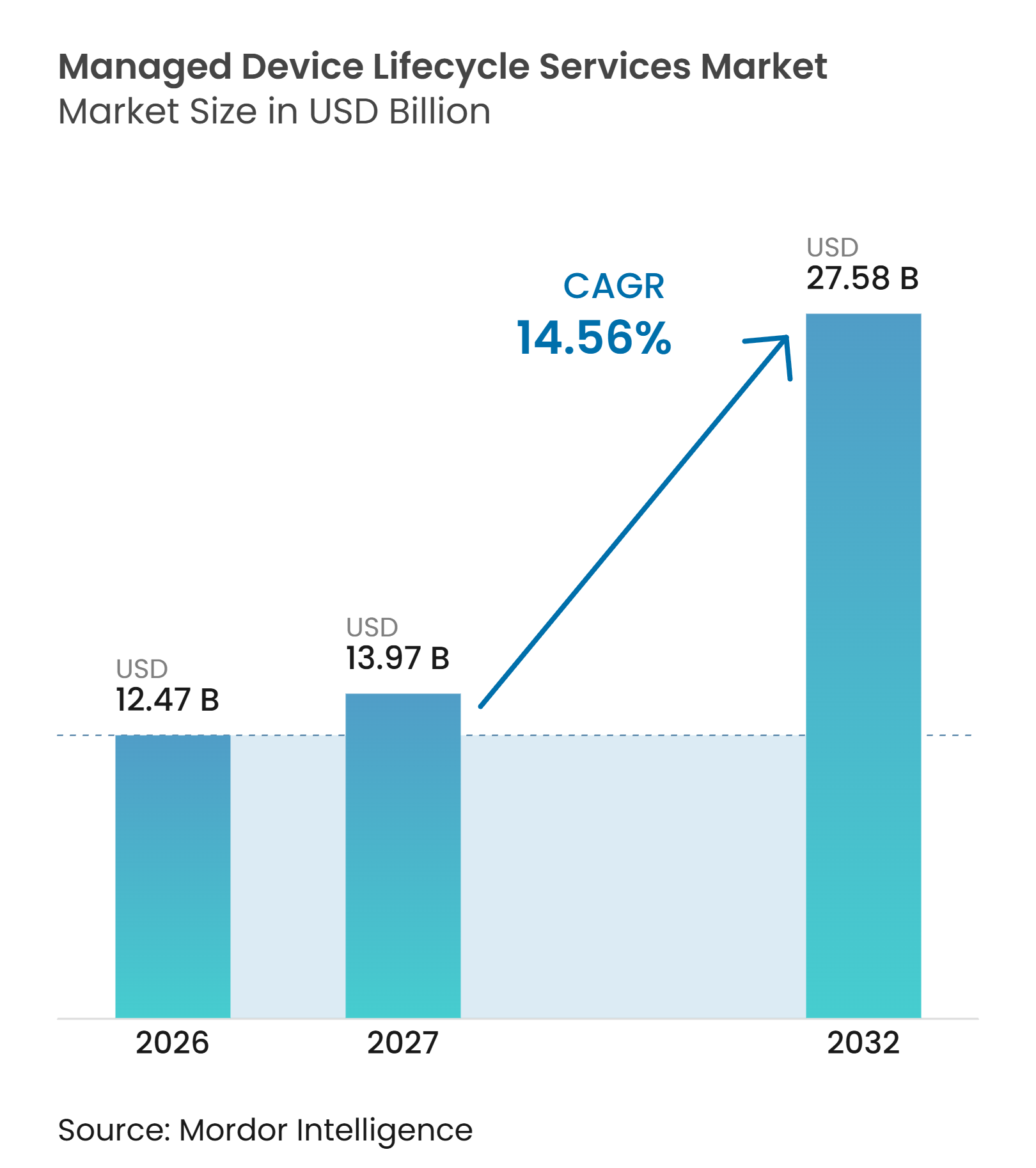
The Managed Device Lifecycle Services Market size is projected to expand from USD 12.47 billion in 2026 to USD 27.58 billion by 2032, registering a CAGR of 14.56% between 2027 and 2032. Hybrid work has made device management a broader operating requirement rather than a back-office IT activity. Organizations now manage distributed fleets that include PCs, rugged terminals, wearables, and IoT endpoints. Security requirements, device recovery goals, and demand for predictable operating costs support longer outsourced service contracts. Providers are competing on their ability to connect provisioning, support, recovery, and compliance activities across client systems. Data sovereignty rules and difficult integrations can slow deployment and reduce the efficiency of standardized global delivery models.
Key Report Takeaways
- By service type, Managed Endpoint Operations and Support held 38.42% of the Managed Device Lifecycle Services Market share in 2026, while Managed Device Recovery and Disposition is projected to expand at a 19.22% CAGR through 2032.
- By device type, Laptops and Desktop PCs accounted for 54.63% of the Managed Device Lifecycle Services Market share in 2026, while Rugged Devices and Mobile Computers are projected to expand at a 19.61% CAGR through 2032.
- By organization size, Large Enterprises held 67.18% of revenue in 2026, while Small and Medium-Sized Enterprises are projected to expand at a 17.24% CAGR through 2032.
- By end-user industry, Banking, Financial Services, and Insurance accounted for 22.64% of revenue in 2026, while Healthcare and Life Sciences are projected to expand at an 18.38% CAGR through 2032.
- By geography, North America held 38.32% of revenue in 2026, while Asia-Pacific is projected to expand at an 18.46% CAGR through 2032.
Note: Market numbers in this report are based on Mordor Intelligence's proprietary estimation framework, which combines nine months of actuals with Q4 projections for base year 2026.
Market Trends and Insights
Drivers Impact Analysis of Managed Device Lifecycle Services Market*
| Driver | (~) % Impact on CAGR Forecast | Geographic Relevance | Impact Timeline |
|---|---|---|---|
| Hybrid and Distributed Workforces | +3.5% | Global | Short term (≤ 2 years) |
| Rising Endpoint Security and Compliance Requirements | +2.9% | Global, with higher concentration in North America and Europe | Medium term (2-4 years) |
| IT Skills and Capacity Constraints | +2.4% | Global | Short term (≤ 2 years) |
| Demand for Predictable Device Costs and OpEx Models | +2.0% | North America, Europe, Asia-Pacific core | Medium term (2-4 years) |
| AI-Enabled Proactive Endpoint Operations | +1.7% | North America, Europe, Asia-Pacific core, spillover to Middle East and Africa | Long term (≥ 4 years) |
| Circular IT and Device-Value Recovery Programs | +1.2% | Europe, North America, spillover to Asia-Pacific | Long term (≥ 4 years) |
| Source: Mordor Intelligence | |||
Hybrid and Distributed Workforces
Hybrid and distributed work has moved the device perimeter beyond offices and central IT locations. In an April 2025 survey, 93% of organizations reported that a typical employee used 2 or more endpoint devices each day. The same survey found that 36% of organizations identified support for remote and hybrid workers as a main source of endpoint management complexity.[1] A remote device lifecycle can involve shipment, retrieval, data sanitization, reimaging, and carrier coordination. The Managed Device Lifecycle Services Market supports organizations that need these steps delivered under defined service levels. Demand is especially relevant for professional services, technology, and financial services employers that rely on distributed knowledge workers.
Rising Endpoint Security and Compliance Requirements
Endpoint security has become part of enterprise risk reporting and audit readiness. The April 2025 endpoint survey found that 29% of relevant professionals cited regulatory compliance complexity as a primary cause of endpoint management difficulty. The FFIEC states that financial institutions should manage hardware, software, and mobile assets through documented inventory practices.[2]This requirement raises the value of reliable asset records and documented device changes. Providers can support this need through configuration controls, audit trails, and endpoint reporting. The Managed Device Lifecycle Services Market is therefore relevant to regulated buyers that need lifecycle processes aligned with their control environment.
IT Skills and Capacity Constraints
Organizations face shortages in the skills needed to operate diverse endpoint fleets. The Linux Foundation found that 44% of respondents viewed a lack of skilled workers as one of the top 3 challenges in 2025. The report identified skills gaps in cybersecurity and compliance for 65% of respondents and cloud computing for 59%.[3] Device operations require knowledge of hardware logistics, operating systems, endpoint platforms, and security controls. Lean IT teams can defer patch verification, retirement workflows, and planned maintenance when these skills are unavailable. The Managed Device Lifecycle Services Market gives organizations a way to place these recurring tasks within an external service model.
Demand for Predictable Device Costs and OpEx Models
Organizations are increasingly seeking more predictable costs for hardware and related services. Subscription and device-as-a-service models can combine hardware, licenses, support, and end-of-life logistics into recurring charges. This approach can simplify budget planning for organizations that previously used several vendor relationships for fleet operations. It can also align refresh decisions with operational needs rather than depreciation schedules. The Managed Device Lifecycle Services Market benefits when procurement teams value a single commercial framework for device operations. The model is particularly relevant as AI-capable hardware and operating-system transitions put additional pressure on refresh planning.
Restraints Impact Analysis of Managed Device Lifecycle Services Market*
| Restraint | (~) % Impact on CAGR Forecast | Geographic Relevance | Impact Timeline |
|---|---|---|---|
| Data Sovereignty and Cross-Border Processing Complexity | -2.1% | Global, with heightened sensitivity in Europe, Asia-Pacific, and Middle East and Africa | Long term (≥ 4 years) |
| Integration Friction Across UEM, ITSM, HRIS, and Finance Systems | -1.8% | Global | Medium term (2-4 years) |
| Customer Reluctance to Surrender Fleet Control | -1.3% | Global, pronounced in Government and BFSI sectors | Medium term (2-4 years) |
| Reverse-Logistics and Secure-Disposition Capacity Constraints | -0.9% | Emerging markets in Asia-Pacific, Middle East and Africa, and South America | Short term (≤ 2 years) |
| Source: Mordor Intelligence | |||
Data Sovereignty and Cross-Border Processing Complexity
The European Union Data Act became applicable on September 12, 2025. Its rules on access to and portability of connected-product data affect device telemetry that providers process for enterprise clients. Service providers may need separate processing and storage practices for endpoints in different jurisdictions. This can increase delivery costs for global contracts and reduce the benefits of a common operating model. The Monetary Authority of Singapore also proposed more comprehensive lifecycle asset-tracking and reporting requirements for financial institutions in 2026. The Managed Device Lifecycle Services Market must therefore address data location, access controls, and reporting needs as part of service design.
Integration Friction Across UEM, ITSM, HRIS, and Finance Systems
Managed services work best when device, HR, service, and finance systems exchange reliable information. A new employee record should trigger device provisioning, enrollment, and software configuration without manual intervention. Many enterprises still operate partly manual processes because their legacy systems were not designed for real-time lifecycle coordination. Firstbase has described using SCIM integrations to automate global deployment and retrieval workflows across more than 150 countries. These connections require client-side change management and can extend implementation periods. Integration problems are more difficult after acquisitions, when business units use different endpoints, ticketing, and HR platforms. Such friction can delay the Managed Device Lifecycle Services Market from realizing the full operational benefit of outsourced delivery.
*Our forecasts treat driver/restraint impacts as directional, not additive. The impact forecasts reflect baseline growth, mix effects, and variable interactions.
Managed Device Lifecycle Services Market Segment Analysis
By Service Type:
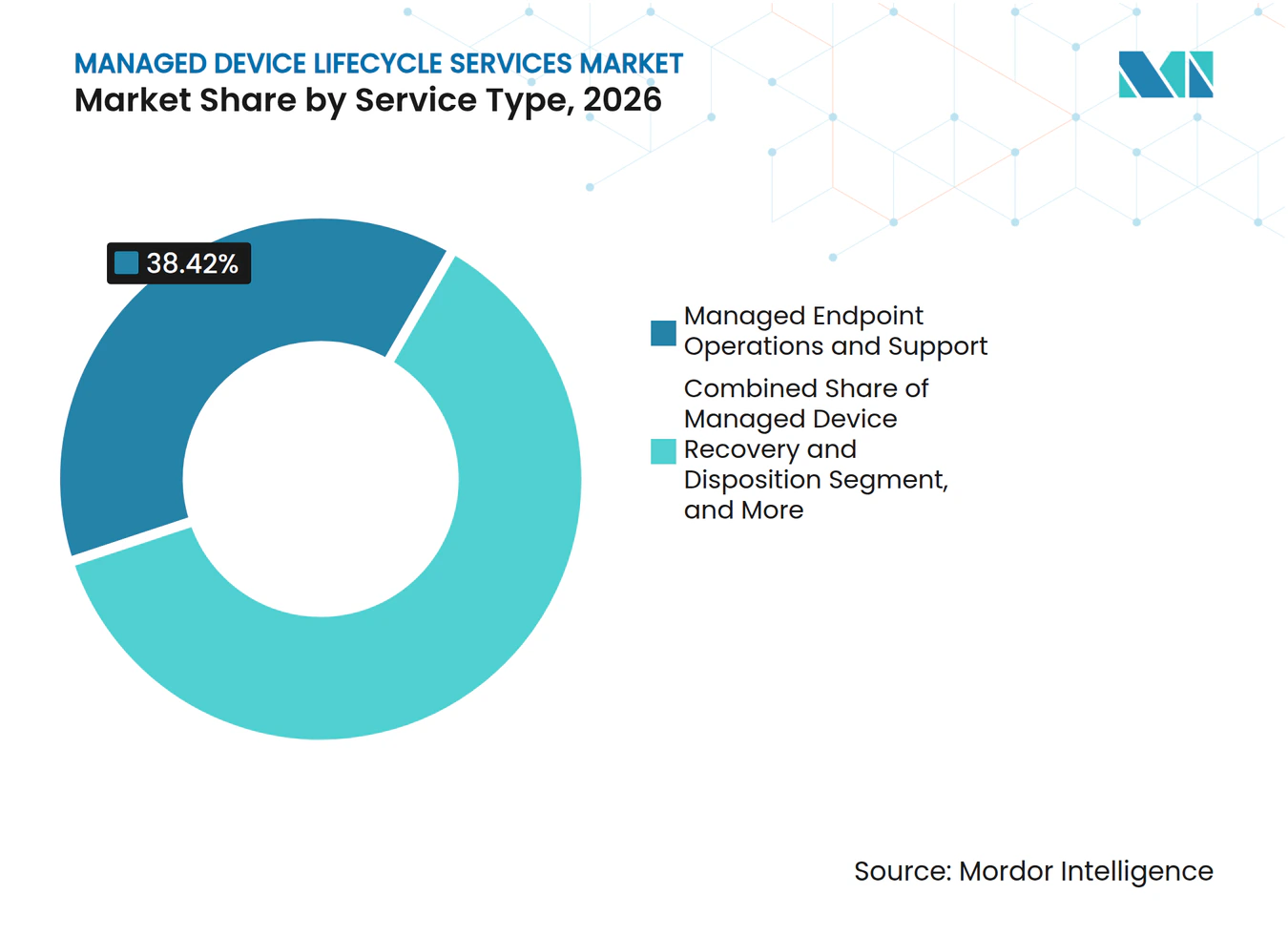
Outsourced Operations Lead as Recovery Services Extend Lifecycle ValueManaged Endpoint Operations and Support captured 38.42% of revenue in 2026. This service provides the recurring foundation for contracts that also include deployment, recovery, and administration. Organizations use the service for device-health monitoring, patch coordination, and tiered help desk support. Clear uptime and resolution outcomes can help providers demonstrate operational value to clients. The Managed Device Lifecycle Services Market relies on this segment because day-to-day support is required across most device fleets.
Managed Device Recovery and Disposition is projected to expand at a 19.22% CAGR through 2032. This part of the Managed Device Lifecycle Services Market is supported by sustainability programs and the rising value of reusable equipment. Cascade Asset Management reported that retrieving devices from remote associates for disposition remained an operational challenge for organizations in its 2025 benchmarking work. Providers address issues in retrieval workflows, chain-of-custody processes, and data sanitization practices. BNP Paribas 3 Step IT opened a 3,500 m² refurbishment and remarketing center in Buchelay, France, in March 2025, with annual capacity for up to 400,000 devices.[4] The facility shows the physical infrastructure that supports circular recovery services.



By Device Type:
PCs Anchor Spending as Rugged Mobility AcceleratesLaptops and Desktop PCs accounted for 54.63% of revenue in 2026. Knowledge-worker fleets create large provisioning, support, and replacement workloads for enterprise customers. The Windows 11 migration and adoption of AI-capable PCs have shortened the focus on refresh planning. The Managed Device Lifecycle Services Market continues to depend on PCs as its core fleet category. Smartphones and tablets remain an important secondary category as organizations seek unified management for mobile apps, policies, and lost-device response.
Rugged Devices and Mobile Computers are projected to expand at a 19.61% CAGR through 2032. These devices support frontline activities in healthcare, logistics, manufacturing, public safety, and field services. Service providers can differentiate through device staging, spare-pool programs, and rapid field replacement. Unisys expanded its Device Subscription Service with Dell Technologies in February 2026 to cover IoT and edge devices such as restaurant hardware and campus sensors.
By Organization Size:
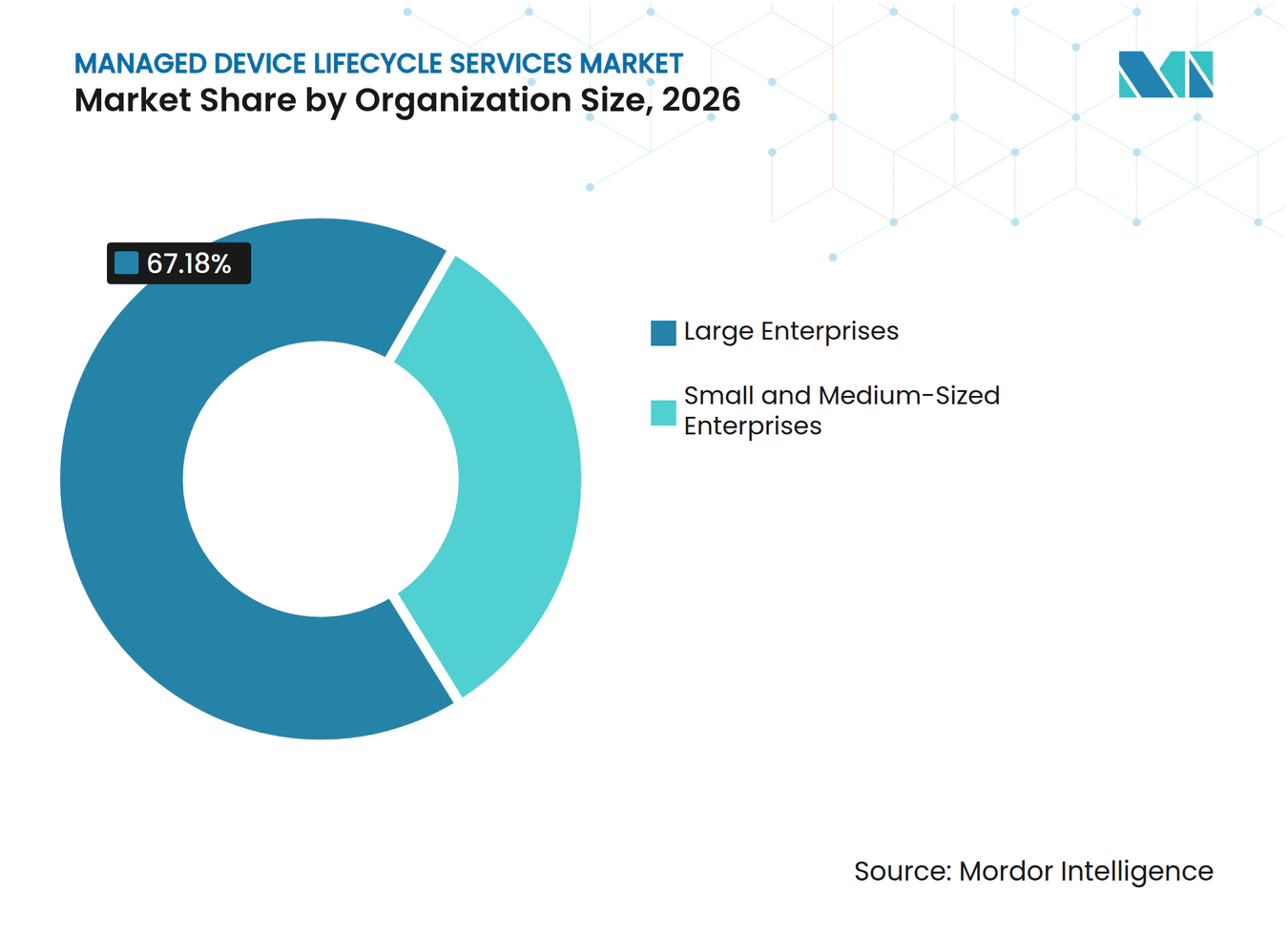
Large Enterprises Lead Revenue as SMEs Gain AccessLarge Enterprises held 67.18% of revenue in 2026. Their multi-thousand-device fleets and multi-country operations require consistent delivery across several device categories. These buyers commonly seek volume pricing, ITSM integration, HR connections, and dedicated service management. Established providers such as Computacenter, CDW, Insight Enterprises, and SHI International are positioned to serve these needs at scale. Computacenter reported a GBP 7.1 billion committed product order book in its 2025 annual report, equivalent to USD 9.0 billion at the 2025 average exchange rate.
Small and Medium-Sized Enterprises are projected to expand at a 17.24% CAGR through 2032. Cloud-delivered platforms and standardized logistics reduce the account size needed to use a managed service. Firstbase stated that organizations can lose 3 to 5 onboarding days per remote hire due to equipment coordination. The company also stated that up to 40% of devices can remain unreturned after offboarding without a structured retrieval process. HP reduced minimum seat requirements for its channel-delivered Managed Device Services program in the United States and the United Kingdom in June 2025. HP This makes outsourced device services more accessible to smaller organizations with lean IT teams.

By End-User Industry:
BFSI Leads Revenue as Healthcare Needs AccelerateBanking, Financial Services, and Insurance accounted for 22.64% of revenue in 2026. The sector manages trading workstations, branch terminals, mobile banking tools, and ATM-adjacent equipment. The FFIEC calls for comprehensive IT asset management practices covering hardware, software, and mobile assets. New York's revised Part 500 rules strengthened the focus on complete asset inventories, effective as of November 2025. These requirements support demand for documented custody, erasure, and disposal procedures. Government, manufacturing, and retail also create opportunities because each has distinct device estates and operating conditions.
Healthcare and Life Sciences are projected to expand at an 18.38% CAGR through 2032. Hospitals and research organizations need reliable clinical devices when digitizing patient care workflows. Tablets, barcode scanners, workstations, kiosks, and telehealth devices each require tailored staging and replacement practices. A device failure in a care setting can affect service delivery rather than only office productivity. Providers serving this segment need clinical-environment experience, careful chain-of-custody practices, and spare equipment on hand. Education is also relevant for Chromebook and tablet programs, where high device volumes can offset lower per-device contract values.
Geography Analysis
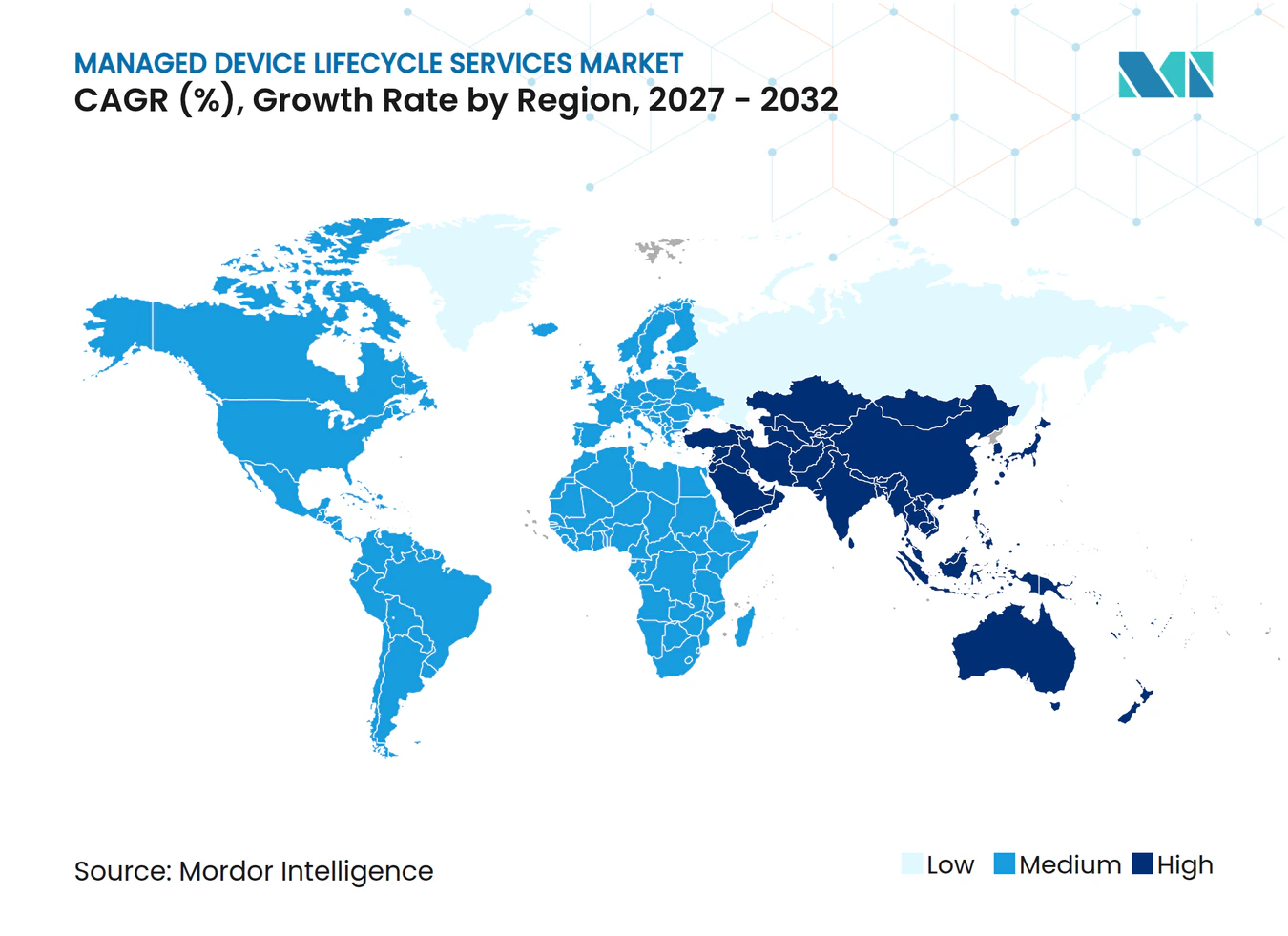
North America held 38.32% of revenue in 2026. The Managed Device Lifecycle Services Market benefits from technology-intensive enterprises, established resellers and service channels, and a strong device refresh cycle in the region. The Windows 10 end-of-support transition and the adoption of AI-capable PCs have increased attention to provisioning workloads. The United States also has demanding expectations for device-level asset records and endpoint governance. Canada and Mexico exhibit similar demand patterns, although managed service adoption is at an earlier stage in some customer groups.
Europe is the second-largest region in the Managed Device Lifecycle Services Market. Germany, the United Kingdom, and France support enterprise adoption through established technology channels and large business fleets. Computacenter's reported GBP 7.1 billion order book, equivalent to USD 9.0 billion, reflects contracted lifecycle engagements in Northern and Western Europe. Updated WEEE requirements, effective from January 2025, encourage certified circular outcomes for retired equipment. The Managed Device Lifecycle Services Market benefits from regional investment in recovery and deployment infrastructure, including BNP Paribas 3 Step IT's French refurbishment center and Hemmersbach's configuration capabilities.
Asia-Pacific is projected to expand at an 18.46% CAGR through 2032. The Managed Device Lifecycle Services Market in India is supported by the formalization of enterprise IT practices across financial services, retail, and technology services. South Korea's smart manufacturing and semiconductor activities support dense deployments of rugged and mobile devices. Southeast Asian mid-market businesses are moving from informal device practices toward structured outsourcing arrangements. China presents a substantial opportunity, although domestic provider preferences and data-localization rules shape competition. Japan's older enterprise device base creates deferred maintenance needs, while Australia and New Zealand have mature reseller channels and established subscription adoption. South America, the Middle East, and Africa remain smaller but important areas where enterprise formalization, infrastructure investment, and multinational expansion support demand. Brazil, the United Arab Emirates, Saudi Arabia, South Africa, and Nigeria are relevant markets for providers capable of combining local service coverage with secure recovery capacity.
Competitive Landscape
Market Concentration
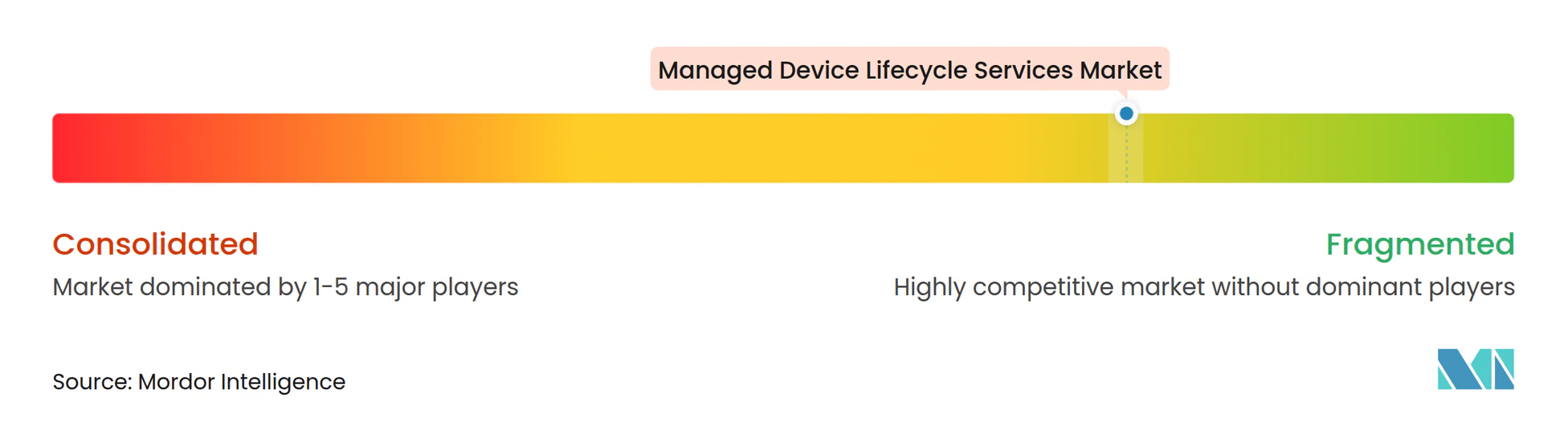
The Managed Device Lifecycle Services Market is moderately fragmented. Competition includes OEM-integrated service platforms, specialist managed service providers and resellers, and cloud-native providers. HP, Lenovo, and Dell can attach lifecycle services to their hardware installed bases. CDW, Computacenter, SHI International, Insight Enterprises, Atea, DMI, and MCPC offer OEM-agnostic delivery across broader device fleets. Firstbase and Stratix focus on the needs of organizations with distributed workforces. Service scope and integration depth are major competitive factors.
Leading providers in the Managed Device Lifecycle Services Market seek to connect provisioning, monitoring, and recovery workflows with client HR, IT service, and finance systems. Tanium launched Ask Agent in October 2025 to support device investigation, troubleshooting, software management, and autonomous remediation from a natural-language console. Computacenter has described its Triple A Approach, which combines anticipation, automation, and augmentation with circular economy practices. Lenovo expanded its Asset Recovery Services in April 2025 to enable recovery at any lifecycle stage for devices from any brand across 43 markets. These moves show how providers are extending coverage across the lifecycle and improving service automation.
The Managed Device Lifecycle Services Market also has opportunities in small and medium-sized customers, rugged-device programs, and cross-border compliant IT asset disposition. Small organizations need lower-overhead services that can manage remote equipment without enterprise-scale contracts. Rugged-device contracts require specialized staging, spare pools, and field exchange capability. Global customers need data sanitization, custody records, and reverse-logistics coverage across jurisdictions. Sustainability credentials, such as NIST 800-88-aligned sanitization and R2v3 certification, can support supplier selection where environmental requirements are part of procurement. Providers that cannot manage complex integrations or local compliance needs may find it harder to expand contracts across a customer's regions and business units.
Managed Device Lifecycle Services Industry Leaders
-
Dell Technologies
-
Lenovo Group
-
HP Inc.
-
CDW Corporation
-
Computacenter
- *Disclaimer: Major Players sorted in no particular order
Managed Device Lifecycle Services Market Companies Covered in this Report
- Insight Enterprises, Inc.
- Softcat plc
- DMI (Digital Management, LLC)
- MCPC, Inc.
- Hemmersbach GmbH & Co. KG
- Techstep ASA
- ISEC7 Group GmbH
- Tialis
- Computacenter plc
- SHI International Corp.
- CDW Corporation
- Jigsaw24 Limited
- Atea ASA
- Stratix Corporation
- Firstbase, Inc.
- HP Inc.
- Lenovo Group Limited
- Dell Technologies Inc.
- Vodafone Group Plc
- BT Group plc
Recent Industry Developments in Managed Device Lifecycle Services Market
- February 2026: Unisys Corporation enhanced its Device Subscription Service in collaboration with Dell Technologies, expanding managed lifecycle coverage beyond PCs to IoT and edge devices, including restaurant-specific hardware, smart parking systems, and university-campus sensors, supported by AI-driven support automation, proactive endpoint security, flexible infrastructure procurement, and globally consistent provisioning. Unisys and Dell developed a joint responsibility matrix to standardize end-to-end edge deployment frameworks, positioning the service for multi-subsidiary organizations of any size through utility-based pricing.
- February 2026: Techstep ASA completed the carve-out and divestment of its BCM unit, sharpening the company's organizational focus on managed mobile and circular technology services. Following the restructuring, Techstep reported managing over 3 million devices across more than 2,000 enterprise and public-sector customers across Europe and the Nordics, with a new AI and automation-powered ERP backbone and commerce platform implemented to improve speed and scalability.
- January 2026: Techstep ASA's comprehensive managed clinical device contract with Sykehuspartner became operational, covering the management of clinical devices across all hospitals within Helse Sør-Øst RHF, the largest healthcare authority in Norway. The contract, signed in November 2025, represents a significant expansion of Techstep's managed healthcare device services in the Nordic public sector.
- November 2025: NCS Technologies launched its Managed Device Lifecycle Services offering in the United States, featuring AI-ready HP devices and positioning the launch as a next-generation device management approach, following Gartner's formal recognition of MDLS as a distinct market category in its June 2025 Market Guide.
Global Managed Device Lifecycle Services Market Report Scope
The Managed Device Lifecycle Services Market covers third-party managed services that support the end-to-end administration, deployment, operation, maintenance, recovery, and disposition of enterprise-owned and employee-assigned devices throughout their operational lifecycle. The market includes Managed Device Deployment and Provisioning, Managed Endpoint Operations and Support, Managed Device Recovery and Disposition, Managed Device Configuration and Integration, and Managed Device Expense and Contract Administration. These services encompass device procurement coordination, asset tagging and inventory management, device staging and configuration, zero-touch provisioning, endpoint management, technical support, patch management, device replacement, repair coordination, secure data erasure, certified disposal, IT asset disposition (ITAD), expense tracking, and vendor contract administration. Market revenue includes recurring managed service fees, per-device management charges, and directly associated lifecycle service fees, while excluding standalone hardware sales, device financing and leasing principal, software license subscriptions, telecommunications connectivity charges, and standalone product resale revenue. Hardware and software costs bundled into managed service contracts are excluded to avoid overstating service-specific revenue.
The Managed Device Lifecycle Services Market Report is segmented by Service Type (Managed Device Deployment and Provisioning, Managed Endpoint Operations and Support, Managed Device Recovery and Disposition, Managed Device Configuration and Integration, and Managed Device Expense and Contract Administration), Device Type (Laptops and Desktop PCs; Smartphones and Tablets; Rugged Devices and Mobile Computers; Chromebooks and Thin Clients; and Wearables, Printers, and IoT Endpoints), Organization Size (Small and Medium-Sized Enterprises and Large Enterprises), End-User Industry (Banking, Financial Services, and Insurance; Healthcare and Life Sciences; Government and Public Administration; Industrial Manufacturing; Retail, Hospitality, and Restaurants; Education; and Other End-User Industries), and Geography (North America, South America, Europe, Asia-Pacific, Middle East, and Africa), with country-level coverage across major markets within each region. Market sizes and forecasts are presented in value terms (USD).
Segmentation Overview
| Managed Device Deployment and Provisioning |
| Managed Endpoint Operations and Support |
| Managed Device Recovery and Disposition |
| Managed Device Configuration and Integration |
| Managed Device Expense and Contract Administration |
| Laptops and Desktop PCs |
| Smartphones and Tablets |
| Rugged Devices and Mobile Computers |
| Chromebooks and Thin Clients |
| Wearables, Printers, and IoT Endpoints |
| Small and Medium-Sized Enterprises |
| Large Enterprises |
| Banking, Financial Services, and Insurance |
| Healthcare and Life Sciences |
| Government and Public Administration |
| Industrial Manufacturing |
| Retail, Hospitality, and Restaurants |
| Education |
| Other End-User Industries |
| North America | United States |
| Canada | |
| Mexico | |
| South America | Brazil |
| Argentina | |
| Rest of South America | |
| Europe | Germany |
| United Kingdom | |
| France | |
| Italy | |
| Rest of Europe | |
| Asia-Pacific | China |
| Japan | |
| India | |
| South Korea | |
| Australia and New Zealand | |
| Rest of Asia-Pacific | |
| Middle East | Saudi Arabia |
| United Arab Emirates | |
| Rest of Middle East | |
| Africa | South Africa |
| Nigeria | |
| Rest of Africa |
| By Service Type | Managed Device Deployment and Provisioning | |
| Managed Endpoint Operations and Support | ||
| Managed Device Recovery and Disposition | ||
| Managed Device Configuration and Integration | ||
| Managed Device Expense and Contract Administration | ||
| By Device Type | Laptops and Desktop PCs | |
| Smartphones and Tablets | ||
| Rugged Devices and Mobile Computers | ||
| Chromebooks and Thin Clients | ||
| Wearables, Printers, and IoT Endpoints | ||
| By Organization Size | Small and Medium-Sized Enterprises | |
| Large Enterprises | ||
| By End-User Industry | Banking, Financial Services, and Insurance | |
| Healthcare and Life Sciences | ||
| Government and Public Administration | ||
| Industrial Manufacturing | ||
| Retail, Hospitality, and Restaurants | ||
| Education | ||
| Other End-User Industries | ||
| By Geography | North America | United States |
| Canada | ||
| Mexico | ||
| South America | Brazil | |
| Argentina | ||
| Rest of South America | ||
| Europe | Germany | |
| United Kingdom | ||
| France | ||
| Italy | ||
| Rest of Europe | ||
| Asia-Pacific | China | |
| Japan | ||
| India | ||
| South Korea | ||
| Australia and New Zealand | ||
| Rest of Asia-Pacific | ||
| Middle East | Saudi Arabia | |
| United Arab Emirates | ||
| Rest of Middle East | ||
| Africa | South Africa | |
| Nigeria | ||
| Rest of Africa | ||
Key Questions Answered in the Report
What is the Managed Device Lifecycle Services Market size?
The market is projected to expand from USD 12.47 billion in 2026 to USD 27.58 billion by 2032, at a 14.56% CAGR between 2027 and 2032.
Which service type has the largest revenue share?
Managed Endpoint Operations and Support led the Managed Device Lifecycle Services Market with 38.42% of revenue in 2026 because it provides recurring monitoring, patching, and support.
Which device category is expected to expand fastest?
Rugged Devices and Mobile Computers are projected to expand at a 19.61% CAGR through 2032 as frontline digitization increases.
Why are healthcare organizations using lifecycle services?
Healthcare and Life Sciences is projected to expand at an 18.38% CAGR because clinical devices require dependable deployment, replacement, and handling.
Which region has the highest projected expansion?
Asia-Pacific is projected to expand at an 18.46% CAGR through 2032, supported by enterprise IT formalization and industrial digitization in the Managed Device Lifecycle Services Market.
What factors can slow adoption of outsourced device services?
Cross-border data rules and difficult connections among endpoint, service, HR, and finance platforms can delay implementations and increase delivery costs.