
Managed Data Center and Cloud Sustainability Services Market Size and Share
Market Overview
| Study Period | 2021 - 2032 |
|---|---|
| Market Size (2027) | USD 19.04 Billion |
| Market Size (2032) | USD 35.53 Billion |
| Growth Rate (2027 - 2032) | 13.29 % |
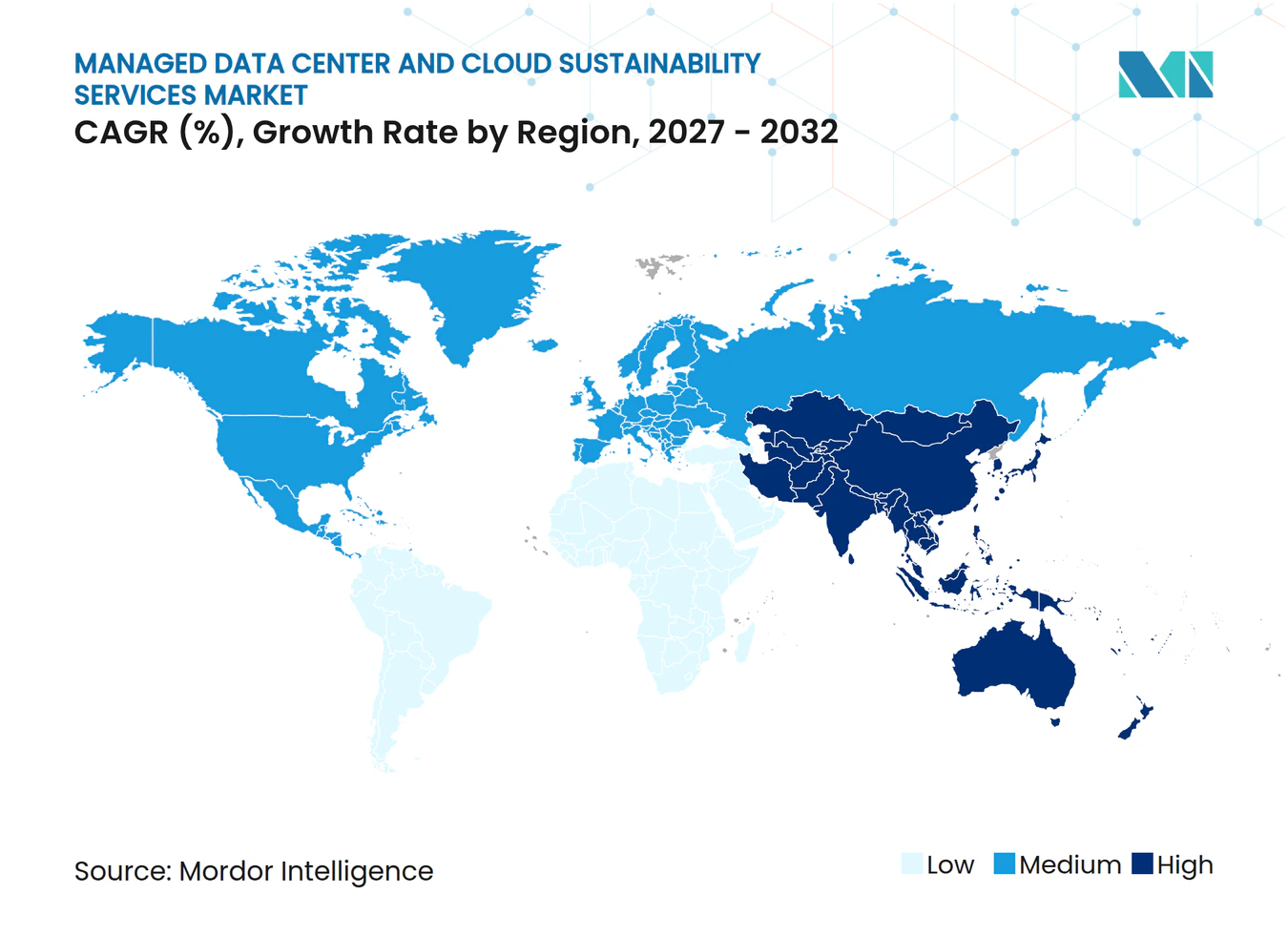
| Fastest Growing Market | Asia-Pacific |
| Largest Market | North America |
| Market Concentration | Low |
Major Players *Disclaimer: Major Players sorted in no particular order Image © Mordor Intelligence. Reuse requires attribution under CC BY 4.0. | |
Managed Data Center and Cloud Sustainability Services Market Analysis by Mordor Intelligence
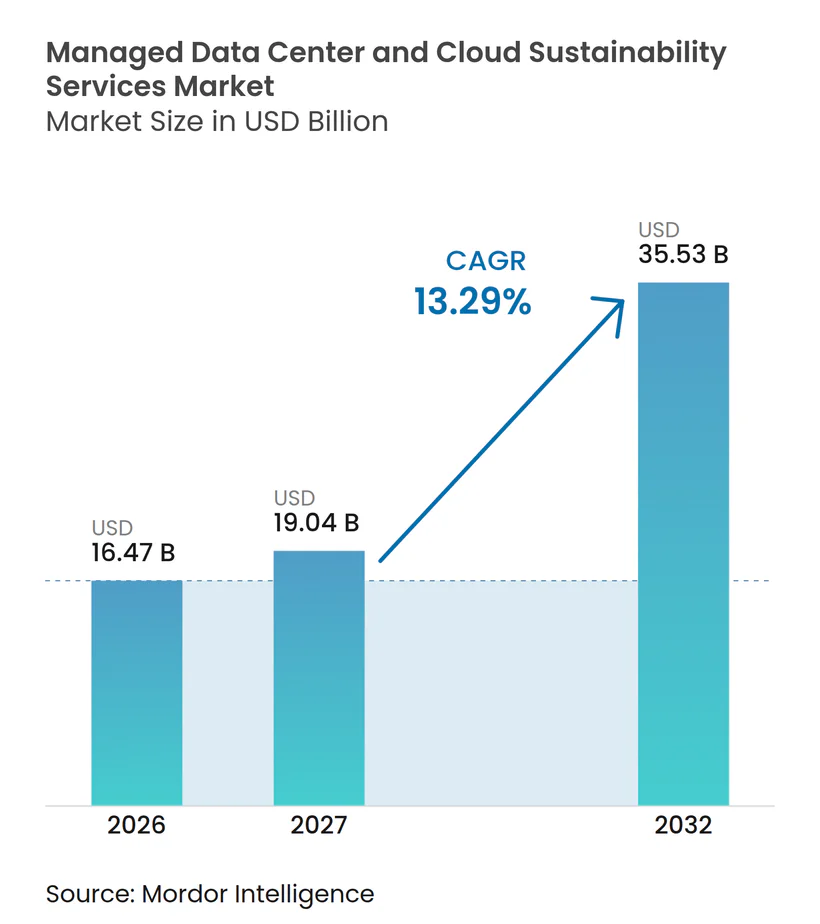
The managed data center and cloud sustainability services market size is projected to expand from USD 16.47 billion in 2026 and USD 19.04 billion in 2027 to USD 35.53 billion by 2032, registering a CAGR of 13.29% between 2027 to 2032. The managed data center and cloud sustainability services market is being shaped by higher AI-related power demand, reporting requirements that require auditable operating data, and electricity costs that make efficiency a financial priority. Data center electricity demand increased 17% in 2025, compared with 3% growth in total electricity demand, while large technology companies increased investment in data center infrastructure. Operators are also managing community concerns, grid connection delays, and water constraints, which place greater value on measurable energy and water performance. The managed data center and cloud sustainability services market, therefore, favors providers that can combine operating support, reporting, cooling expertise, and resource optimization across large and aging facilities.
Key Report Takeaways
- By service offering, managed operations services held 32.81% of the managed data center and cloud sustainability services market in 2026, while implementation and transformation services are projected to expand at a 16.33% CAGR through 2032.
- By sustainability focus, energy management held 36.52% of revenue in 2026, while cooling management is projected to expand at a 17.10% CAGR through 2032.
- By service model, fully managed services held 64.30% of the managed data center and cloud sustainability services market in 2026, while co-managed services are projected to expand at a 16.78% CAGR through 2032.
- By data center type, hyperscale and cloud data centers held 42.18% of the managed data center and cloud sustainability services market in 2026 and are projected to expand at a 17.22% CAGR through 2032.
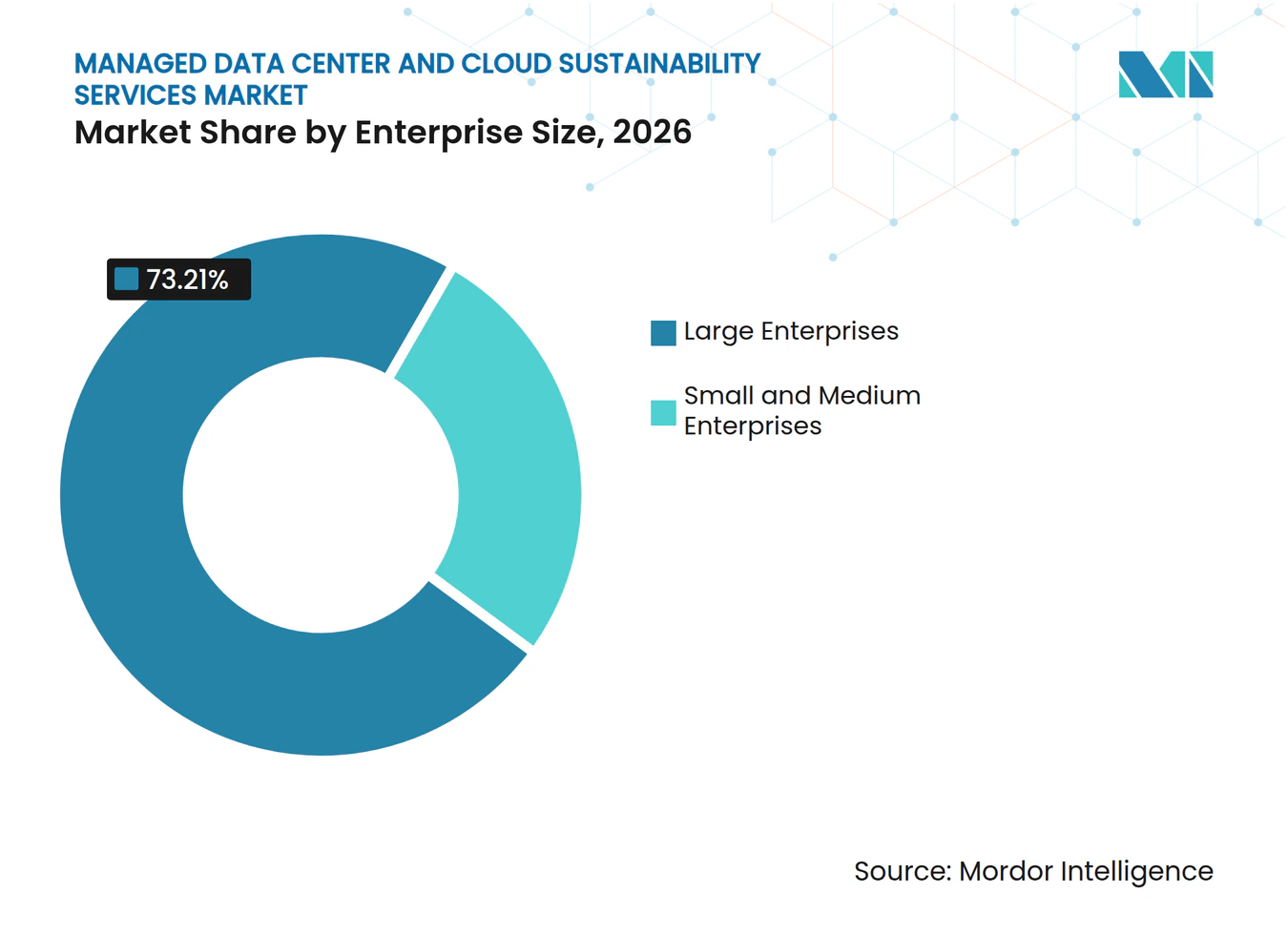
- By enterprise size, large enterprises held 73.21% of revenue in 2026, while small and medium enterprises are projected to expand at a 17.49% CAGR through 2032.
- By end user, IT and telecommunications held 33.61% of the managed data center and cloud sustainability services market in 2026, while BFSI is projected to expand at a 17.84% CAGR through 2032.
- By geography, North America held 36.13% of the managed data center and cloud sustainability services market in 2026, while Asia-Pacific is projected to expand at an 18.09% CAGR through 2032.
Note: Market numbers in this report are based on Mordor Intelligence's proprietary estimation framework, which combines nine months of actuals with Q4 projections for base year 2026.
Market Trends and Insights
Drivers Impact Analysis of Managed Data Center and Cloud Sustainability Services Market*
| Driver | (~) % Impact on CAGR Forecast | Geographic Relevance | Impact Timeline |
|---|---|---|---|
| AI and High-Performance Computing Increasing Sustainability Optimization Demand | +3.5% | Global, strongest in North America and Asia-Pacific | Short term (≤ 2 years) |
| Mandatory Energy and Sustainability Reporting Requirements | +2.8% | Europe, China, and North America | Medium term (2-4 years) |
| Rising Data Center Electricity Costs and Grid Constraints | +2.2% | North America and Asia-Pacific core, with spillover to Europe | Short term (≤ 2 years) |
| Cloud Migration and Hyperscale Economies Improving Resource Efficiency | +1.8% | Global | Medium term (2-4 years) |
| Workload-Level Carbon Visibility Enabling FinOps and GreenOps Procurement | +1.4% | North America and Europe | Medium term (2-4 years) |
| AI-Aware Cooling and Dynamic Workload Placement Creating New Managed-Service Revenue | +1.2% | North America, Europe, and Asia-Pacific core | Long term (≥ 4 years) |
| Source: Mordor Intelligence | |||
AI and High-Performance Computing Increasing Sustainability Optimization Demand
AI workloads increase electricity use, water requirements, and embodied carbon concerns across the infrastructure supply chain. Global data center electricity demand increased 17% in 2025, substantially above the 3% increase in overall electricity demand. Conventional power and thermal management practices were designed for 8-10 kW server racks, so they do not address the sustained power density, cooling requirements, and real-time operating changes associated with dense AI clusters. These facilities require liquid cooling and real-time thermal management as rack density rises, and customers need practical ways to measure whether these systems are delivering the expected performance. The managed data center and cloud sustainability services market benefits because many operators do not have sufficient internal staff for continuous optimization across electrical, cooling, water, and reporting functions. The IEA also states that AI applications could reduce energy costs in energy-intensive sectors by 3-10 percentage points, supporting the use of AI-aware services where savings can offset service fees and where operating improvements have a direct financial rationale.
Mandatory Energy and Sustainability Reporting Requirements
Reporting rules are moving from voluntary commitments toward enforceable operating requirements. The European Union Energy Efficiency Directive requires qualifying data center operators to report annual indicators, including PUE, WUE, renewable energy use, and waste heat reuse. The European reporting process requires data that many facilities do not collect in a consistent manner, especially where facility systems and IT systems were installed separately and use different methods. China has also placed data centers within priority energy-consuming sectors and requires PUE monitoring and carbon-related accounting. The September 2026 green computing program added carbon effectiveness, water use, and computing resource metrics to the evaluation framework.[1] The managed data center and cloud sustainability services market is supported by the gap between required disclosures and the data that operators can produce from existing systems, because providers can bring measurement, reporting, and ongoing operating support into one service.
Rising Data Center Electricity Costs and Grid Constraints
Grid availability is limiting new data center capacity in several locations. The IEA expects global data center electricity consumption to double by 2030. A peer-reviewed study found that U.S. data center demand could increase 2030 power-sector carbon dioxide emissions by up to 28% and raise demand-weighted electricity prices by up to 29% in constrained areas. In 2025, the Ypsilanti Community Utilities Authority imposed a 12-month moratorium on new data center water connections. These pressures make lower PUE, lower water intensity, and grid-responsive operations more important to project approvals, particularly where operators must address public concerns alongside technical requirements. The managed data center and cloud sustainability services market has a clear role where operators need to demonstrate that new and existing sites can reduce resource strain, respond to grid conditions, and maintain a documented record of operating performance.
Cloud Migration and Hyperscale Economies Improving Resource Efficiency
Cloud migration concentrates workloads in larger facilities where operating improvements can be applied across more capacity. Google reported an average PUE of 1.09 for its data center fleet in 2025. Microsoft reported that low-power server states reduced energy use by up to 35% across nearly 2 million servers.[2] These operating benchmarks establish practical targets for providers serving enterprise workloads in shared infrastructure, while showing why customers expect service providers to identify and sustain measurable performance gains. Tenants gain from hyperscale efficiency but still need to account for Scope 2 and Scope 3 emissions across cloud services. The managed data center and cloud sustainability services market can address this need through tenant-level reporting and optimization support that links shared infrastructure performance with the information individual customers need for their own disclosures.
Restraints Impact Analysis of Managed Data Center and Cloud Sustainability Services Market*
| Restraint | (~) % Impact on CAGR Forecast | Geographic Relevance | Impact Timeline |
|---|---|---|---|
| High Upfront Cost and Long Payback Periods for Retrofit Projects | -2.4% | Global, most acute in North America and Europe with aging infrastructure | Medium term (2-4 years) |
| Data Quality and Interoperability Gaps Across Legacy Facilities | -1.8% | Global, most acute in enterprise and colocation data centers | Long term (≥ 4 years) |
| Regulatory Fragmentation and Data-Localization Constraints | -1.2% | Europe, Asia-Pacific, and Middle East | Medium term (2-4 years) |
| Water, Grid, and Community Tradeoffs Limiting Low-Carbon Expansion | -0.9% | North America, Asia-Pacific, and South America | Short term (≤ 2 years) |
| Source: Mordor Intelligence | |||
High Upfront Cost and Long Payback Periods for Retrofit Projects
The upfront cost of a sustainability retrofit can delay decisions at aging facilities. Schneider Electric reported that 36% of U.S. data centers are more than 10 years old and lack facility-wide proactive asset management strategies.[3] Thermal efficiency retrofits may have payback periods of 8-12 years, which can create difficult investment choices for operators that must fund facility upgrades while continuing to meet availability commitments. Large hyperscale and colocation operators can spread service costs across greater capacity, while mid-market enterprises face higher per-site costs relative to expected savings and may have fewer options for spreading the investment. This difference limits adoption among operators that have fewer facilities, less available capital, and less ability to absorb a long return period. The managed data center and cloud sustainability services market remains less accessible to these operators when consumption-based pricing does not close the gap between the initial service cost and the savings that smaller sites can realize.
Data Quality and Interoperability Gaps Across Legacy Facilities
Managed services depend on granular operating data from facility and IT systems. Legacy sites often use separate building management systems, power distribution equipment, and IT monitoring tools that do not exchange data easily or provide a single view of resource use. The European Commission found methodology inconsistencies in first-year operator submissions to the Energy Efficiency Directive reporting database. These inconsistencies make it harder to produce comparable sustainability reports, establish a reliable baseline, and identify the operating priorities that need attention first. Hybrid environments add complexity because cloud providers may use different emission-factor vintages and scope boundaries, while customers still need a consolidated view. The resulting implementation effort can extend deployment schedules by 6-18 months and can slow the managed data center and cloud sustainability services market, where providers must resolve data gaps before they can deliver continuous optimization.
*Our forecasts treat driver/restraint impacts as directional, not additive. The impact forecasts reflect baseline growth, mix effects, and variable interactions.
Managed Data Center and Cloud Sustainability Services Market Segment Analysis
By Service Offering:
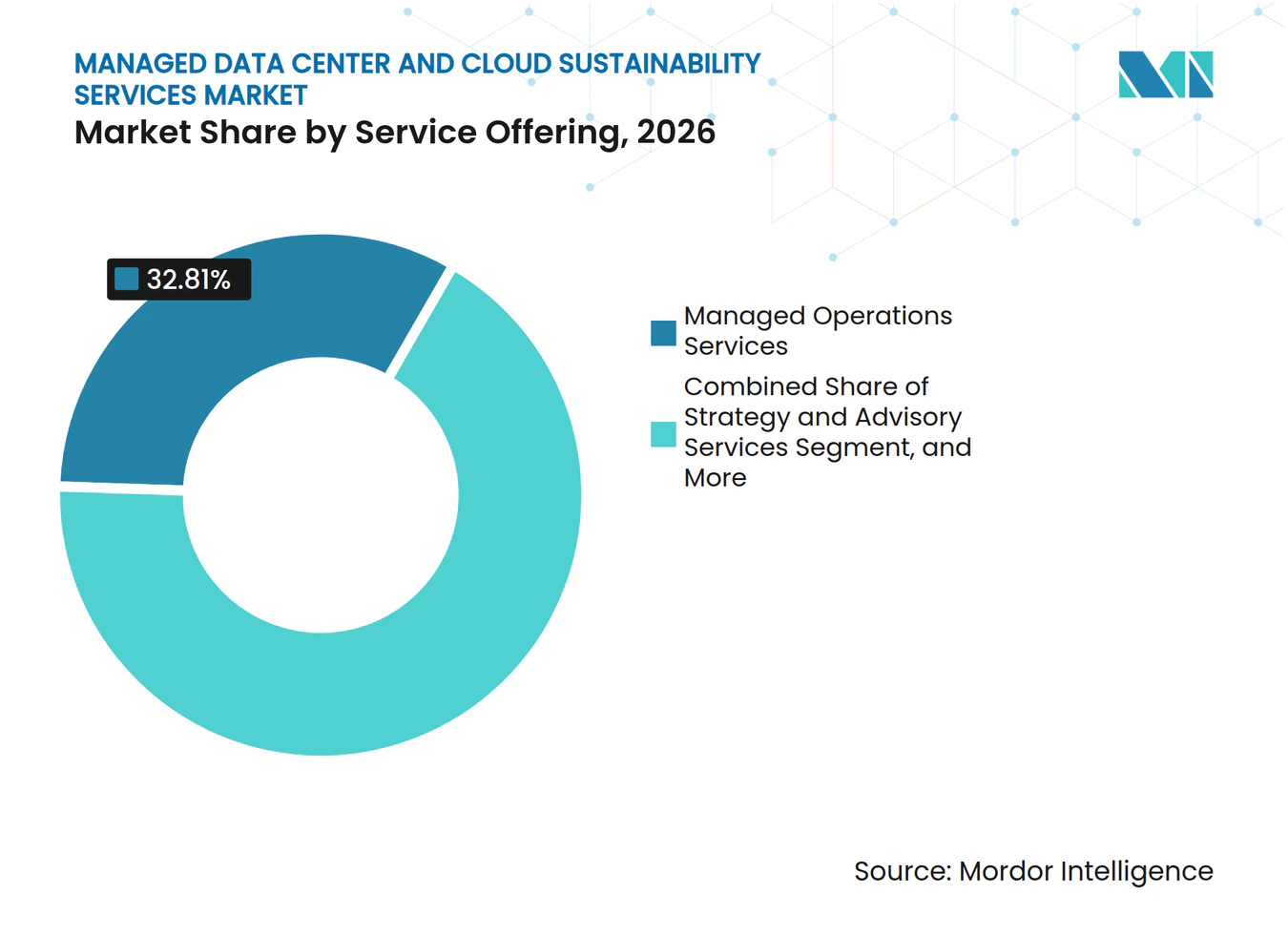
Managed Operations Support Near-Term RevenueManaged operations services held 32.81% of the managed data center and cloud sustainability services market size in 2026. The segment covers continuous energy monitoring, dynamic load optimization, and round-the-clock reporting on sustainability performance across facility systems. Long-duration facility management contracts support this position because operators can extend established agreements to include sustainability metrics, instead of starting separate procurement exercises for each requirement. This structure keeps the same operating partner involved in monitoring, escalation, performance reporting, and the routine adjustments needed to sustain efficiency. It also gives customers a clearer route to connect facility operations with sustainability obligations that require regular and reliable data.
Strategy and advisory services help operators interpret reporting rules, identify gaps in current practices, and decide how they should respond. Analytics and insights services are becoming decision-support tools that connect carbon accounting with FinOps workflows, allowing operating and financial data to be reviewed together. Assurance and verification services become more relevant when customers need third-party support for sustainability claims or compliance submissions. Implementation and transformation services is projected to expand at a 16.33% CAGR through 2032, driven by AI data center construction and legacy retrofit programs whose roadmaps moved into execution after 2025. The managed data center and cloud sustainability services industry depends on providers that can turn those plans into measured operating improvements, not simply produce reports. This mix gives customers support from initial planning through the operating stage, while keeping responsibility for results tied to the same service relationship.



By Sustainability Focus:
Energy Management Leads While Cooling Management AdvancesEnergy management held 36.52% of demand in 2026. The segment draws on established practices for PUE improvement, power monitoring, and renewable energy procurement. It benefits from a vendor base that has supported facility energy management for many years and from performance measures that customers already recognize. Standardized measures make energy-related services easier to define, compare, and assess than newer parts of sustainability support. The managed data center and cloud sustainability services market continues to treat energy management as the central operating focus because electricity use is directly tied to facility cost and reporting needs.
Cooling management is projected to expand at a 17.10% CAGR through 2032 as liquid-cooled AI systems become more common. Vertiv introduced a global liquid cooling services portfolio in 2025, and Ecolab strengthened its Cooling-as-a-Service program in November 2025. These moves reflect the need to manage coolant networks, thermal conditions, and direct-to-chip systems as AI workloads alter facility design. Carbon and emissions management is gaining attention as Scope 3 requirements reach IT supply chains. Water stewardship has greater relevance in water-constrained locations, including the United Arab Emirates, Malaysia, and arid areas of North America. Circularity and waste management is supported by European Ecodesign requirements for enterprise servers, while supply-chain services address embodied carbon in construction. Together, these services broaden the managed data center and cloud sustainability services market beyond its longstanding focus on electricity use alone.
By Service Model:
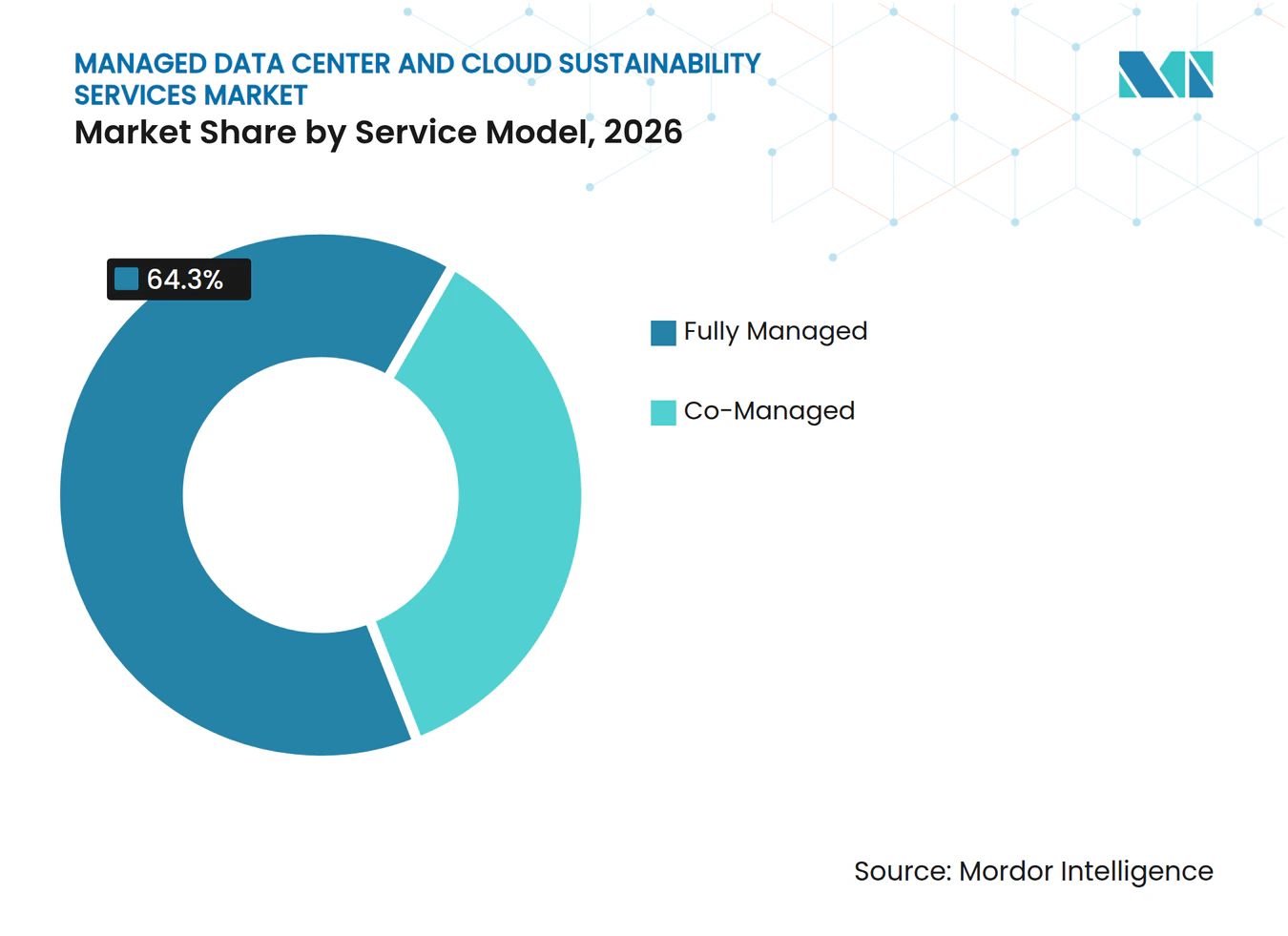
Fully Managed Services Lead While Co-Managed Services Gain GroundFully managed services held 64.30% of demand in 2026. Under this model, the provider takes responsibility for energy procurement, carbon reporting, compliance submissions, and the operating coordination required to support them. The arrangement fits publicly listed operators that want one provider to be accountable for key sustainability tasks and for the information used in disclosures. It also gives customers an integrated service structure as reporting requirements become more demanding across energy, water, and emissions data. This accountability transfer is a central reason fully managed arrangements remain the leading service model in the managed data center and cloud sustainability services market.
Co-managed services is projected to expand at a 16.78% CAGR through 2032. It allows organizations to retain strategic oversight, internal control, and access to operating data while contracting outside teams for execution. This model is especially relevant for BFSI organizations whose internal audit functions require direct visibility into the data behind performance claims. FinOps and GreenOps use related underlying information, which allows organizations with established cloud cost practices to extend the same framework to carbon tracking.[4] Providers can supply analytics, measurement methods, and operational support while internal teams retain authority over decisions. This division of responsibility offers a practical option for customers that need external capabilities but are not prepared to transfer all accountability to a provider.

By Data Center Type:
Hyperscale and Cloud Facilities Lead DemandHyperscale and cloud data centers held 42.18% of the managed data center and cloud sustainability services market share in 2026. They are also projected to expand at a 17.22% CAGR through 2032. Their scale concentrates a large volume of compute, cooling, power, and reporting activity in shared infrastructure, which makes continuous management more valuable. This concentration creates a strong case for managed sustainability services because a single operating improvement can affect a significant amount of capacity. It also places large facilities at the center of demand for resource efficiency, auditable performance data, and services that can operate across complex estates.
A 1% PUE improvement across a 500 MW campus can create hundreds of millions of USD in annual energy savings. This makes service costs small compared with the potential value of sustained efficiency gains and supports longer-term operating agreements. Colocation facilities also remain important because enterprise customers need visibility across leased infrastructure for Scope 2 and Scope 3 reporting. Enterprise data centers face increasing pressure to demonstrate performance that compares with cloud alternatives. Edge and micro data centers add remote monitoring and variable grid-quality challenges, creating a role for centrally delivered anomaly detection and managed operations. The managed data center and cloud sustainability services market therefore needs delivery models that can serve centralized campuses and distributed sites without losing data consistency.
By Enterprise Size:
Large Enterprises Anchor Demand While SMEs AccelerateLarge enterprises held 73.21% of demand in 2026. Their energy use and direct exposure to sustainability disclosure obligations support greater spending on managed services. These customers use services for both compliance and cost management, particularly where facility operations are spread across several sites or involve large energy loads. They also tend to operate more complex systems that require continuous measurement, reporting, and coordination among facility, IT, finance, and risk teams. Large enterprises therefore remain the principal source of current demand in the managed data center and cloud sustainability services market.
Small and medium enterprises are projected to expand at a 17.49% CAGR through 2032. Many smaller organizations do not meet reporting thresholds themselves, so their purchasing decisions are often shaped by customer and supplier requirements. Large enterprises and hyperscalers increasingly include sustainability criteria in vendor selection, creating a demand path that differs from direct regulatory compliance. This pattern can bring smaller operators into managed service programs even when they have limited internal sustainability staff. Providers that offer modular and outcome-based packages can serve this group without imposing the cost structure used for large facilities. The opportunity depends on whether providers can package monitoring, reporting, and improvement services in forms that smaller organizations can adopt.
By End User:
IT and Telecommunications Lead While BFSI AcceleratesIT and telecommunications held 33.61% of demand in 2026. These operators own or manage a large share of the data center infrastructure that faces power costs, carbon reporting, and operational optimization needs. Their facilities require support across energy, cooling, emissions, and performance management because they must maintain service reliability while responding to resource constraints. Their role as core infrastructure owners gives this group a leading position in demand and creates a need for long-duration operating relationships. The managed data center and cloud sustainability services market continues to rely on this group for recurring contracts that connect technical operations with sustainability performance.
BFSI is projected to expand at a 17.84% CAGR through 2032. Climate risk is becoming more relevant to capital adequacy frameworks, and banks need ESG data in core IT systems such as credit approvals and risk models. Healthcare and life sciences operators need to address data sovereignty alongside sustainability requirements, which creates a dual compliance need. Government and defense organizations continue to need on-premises services because of data-localization requirements and their operating environments. Manufacturing, retail and e-commerce, and energy and utilities operators are increasing adoption as Scope 3 reporting reaches downstream IT infrastructure emissions. The variety of end-user needs means providers must adapt their operating support to sector-specific governance requirements without changing the core focus on resource efficiency and reliable data.
Geography Analysis
North America Managed Data Center and Cloud Sustainability Services Market
North America held 36.13% of the managed data center and cloud sustainability services market share in 2026. The region benefits from dense hyperscale campuses, corporate governance practices that place sustainability accountability at the board level, and a large installed base that needs better energy and water performance data. The United States is the main national market, where renewable energy commitments and portfolio standards reward energy performance, while Canada benefits from hydroelectric resources and cooler climatic conditions that can reduce cooling demand. The IEA has identified financial and technical barriers for onsite generation at AI data centers, and connection delays increase the value of demand-side optimization that can reduce the burden on constrained systems.
APAC Managed Data Center and Cloud Sustainability Services Market
Asia-Pacific is projected to expand at an 18.09% CAGR through 2032. China had more than 13.73 million standard racks at the end of 2025, and data center electricity use reached 170 billion kWh, or 1.6% of national electricity use. The September 2026 program requires carbon effectiveness, water use, computing efficiency, and PUE performance metrics, creating a formal need for reliable operating information and recurring performance management. Tencent reported that green electricity use in its owned data centers reached 82.9% in 2025, showing the scale of the shift toward renewable procurement.[5] India is attracting major hyperscale investment, while Malaysia’s water approval constraints support demand for closed-loop cooling management and services that document resource performance for local stakeholders.
EMEA Managed Data Center and Cloud Sustainability Services Market
Europe has the most prescriptive regulatory environment, with Germany, the United Kingdom, France, and Italy as the largest national markets. The planned Cloud and AI Development Act is expected to link public support for new capacity with demonstrated energy efficiency and circularity performance, which reinforces the managed data center and cloud sustainability services market need for documented operating results. The Middle East is increasing capacity, with regional capacity expected to increase from 1 GW in 2025 to 3.3 GW over 5 years. DataVolt and Jacobs advanced a renewable AI campus in NEOM’s Oxagon, supported by an initial USD 5 billion investment, and the project brings energy, environmental, and technical considerations into the same facility plan. Africa remains at an earlier stage, led by South Africa and Nigeria, as digital investment builds the infrastructure base for future managed services demand.
Competitive Landscape
Market Concentration
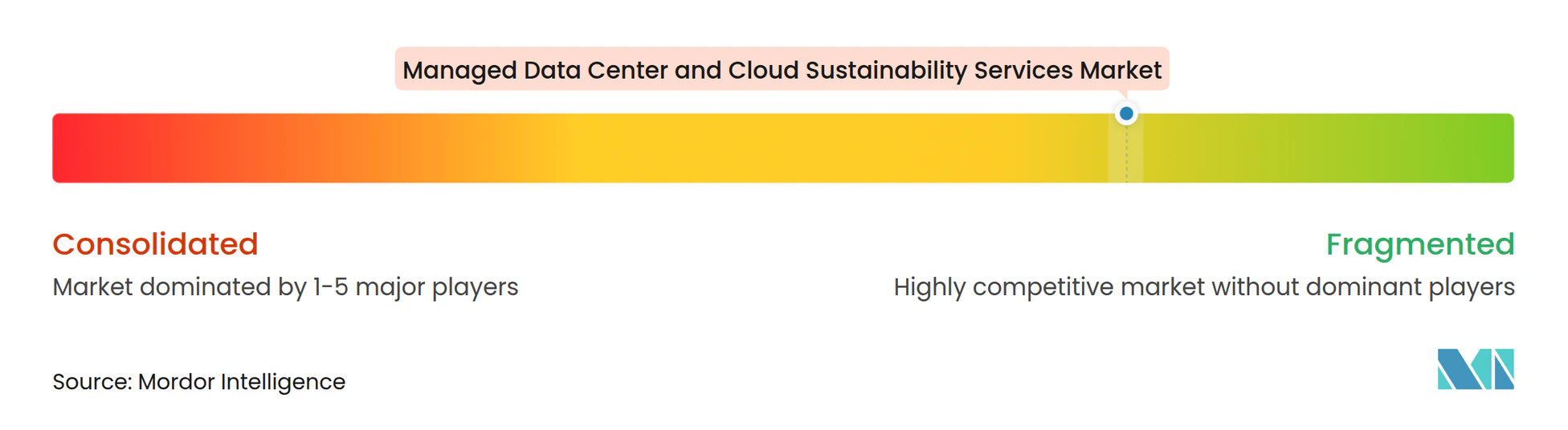
The managed data center and cloud sustainability services market is fragmented. Hyperscale cloud providers have an embedded advantage because customers already use their platforms, while specialized providers and industrial technology companies compete for individual service assignments and longer operating contracts. Hardware portfolios give infrastructure companies a route into managed services because installed equipment can lead to recurring support arrangements, maintenance needs, and sustained access to operating data. This structure means providers compete through technical capability, data access, service integration, and the ability to support customers from equipment deployment through ongoing performance management.
Schneider Electric signed a USD 1.9 billion supply capacity agreement with Switch in November 2025 and launched EcoConsult for Data Centers in April 2025. Ecolab strengthened its Cooling-as-a-Service program in November 2025 to link coolant monitoring with liquid cooling management. These moves show how companies are combining equipment and operating support, and they indicate that cooling expertise is becoming more important as AI systems increase thermal complexity. The managed data center and cloud sustainability services market gives companies an opportunity to use these capabilities in recurring service arrangements rather than one-time equipment transactions.
FinOps and GreenOps are converging as providers seek multi-year operating relationships built around common cost and carbon data. ISO 14064 carbon accounting and ISO 50001 energy management compliance are increasingly relevant in enterprise and BFSI procurement because customers need consistent information that can withstand review. Fluid-management companies such as Ecolab and Dow are entering the value chain as liquid cooling creates new demands for coolant monitoring, treatment, and operating oversight. AI-native platforms offer workload-level carbon data through application programming interfaces and compete for analytics revenue, sometimes without the infrastructure-embedded model used by traditional providers. The mid-market remains a gap because smaller operators often cannot access hyperscaler-native tools or support models designed for large sites.
Managed Data Center and Cloud Sustainability Services Industry Leaders
-
Schneider Electric SE
-
Amazon Web Services, Inc.
-
Microsoft Corporation
-
Vertiv Holdings Co
-
Siemens AG
- *Disclaimer: Major Players sorted in no particular order
Managed Data Center and Cloud Sustainability Services Market Companies Covered in this Report
- Schneider Electric SE
- Amazon Web Services, Inc.
- Microsoft Corporation
- Google LLC
- Vertiv Holdings Co
- Eaton Corporation plc
- International Business Machines Corporation
- Siemens AG
- ABB Ltd.
- Huawei Technologies Co., Ltd.
- Equinix, Inc.
- Digital Realty Trust, Inc.
- NTT DATA Corporation
- Capgemini SE
- Accenture plc
- Dell Technologies Inc.
- Cisco Systems, Inc.
- Johnson Controls International plc
- STULZ GmbH
- Rittal GmbH and Co. KG
- Munters Group AB
- Legrand SA
Recent Industry Developments in Managed Data Center and Cloud Sustainability Services Market
- September 2026: China’s MIIT and NDRC launched the 2026 National Green Computing Facilities Recommendation Program, upgrading evaluation criteria to include carbon effectiveness, water resource utilization, and computing resource efficiency alongside mandatory PUE requirements of 1.30 or below, covering an installed base of over 13.73 million standard racks.
- September 2026: China’s Central Cyberspace Affairs Commission issued the Implementation Plan for Promoting Digital-Green Coordination and Transformation (2026-2030), mandating that computing facilities’ renewable electricity consumption align with provincial responsibility weightings by 2030 and designating computing infrastructure as a core national low-carbon priority.
- July 2026: NTT DATA and ENGIE formed a strategic partnership to advance decarbonization, energy resilience, and sustainability across NTT DATA’s global data center estate. As pressure grows on data center operators to cut carbon, the deal combines ENGIE’s experience in renewable energy and low-carbon solutions with NTT DATA’s infrastructure and technology capabilities.
- June 2026: Sweep, an AWS ISV-Accelerate partner, has introduced a comprehensive cloud emissions measurement solution integrated with the AWS Sustainability service, a standalone emissions reporting service launched by Amazon Web Services (AWS). This solution enables enterprise clients to seamlessly aggregate their cloud emissions metrics within Sweep’s sustainability intelligence platform, consolidating them with Scope 1, 2, and 3 operational data to provide a unified corporate environmental overview.
Global Managed Data Center and Cloud Sustainability Services Market Report Scope
Managed Data Center and Cloud Sustainability Services refer to outsourced IT governance and operational solutions where a third-party specialist takes comprehensive responsibility for auditing, monitoring, optimizing, and transforming an enterprise's data center and cloud infrastructure to minimize its environmental footprint.
The Managed Data Center and Cloud Sustainability Services Market Report is Segmented by Service Offering (Strategy and Advisory Services, Implementation and Transformation Services, Managed Operations Services, Analytics and Insights Services, and Assurance and Verification Support), Sustainability Focus (Energy Management, Cooling Management, Carbon and Emissions Management, Water Stewardship, Circularity and Waste Management, and Supply Chain and Scope 3 Management), Service Model (Fully Managed and Co-Managed), Data Center Type (Hyperscale and Cloud Data Centers, Colocation Data Centers, Enterprise Data Centers, and Edge and Micro Data Centers), Enterprise Size (Large Enterprises and Small and Medium Enterprises), End User (IT and Telecommunications, BFSI, Healthcare and Life Sciences, Government and Defense, Energy and Utilities, Manufacturing, Retail and E-commerce, Other End Users), and Geography (North America, South America, Europe, Asia-Pacific, Middle East, and Africa). The Market Forecasts are Provided in Terms of Value (USD).
Segmentation Overview
| Strategy and Advisory Services |
| Implementation and Transformation Services |
| Managed Operations Services |
| Analytics and Insights Services |
| Assurance and Verification Support |
| Energy Management |
| Cooling Management |
| Carbon and Emissions Management |
| Water Stewardship |
| Circularity and Waste Management |
| Supply Chain and Scope 3 Management |
| Fully Managed |
| Co-Managed |
| Hyperscale and Cloud Data Centers |
| Colocation Data Centers |
| Enterprise Data Centers |
| Edge and Micro Data Centers |
| Large Enterprises |
| Small and Medium Enterprises |
| IT and Telecommunications |
| BFSI |
| Healthcare and Life Sciences |
| Government and Defense |
| Energy and Utilities |
| Manufacturing |
| Retail and E-commerce |
| Other End Users |
| North America | United States |
| Canada | |
| Mexico | |
| South America | Brazil |
| Argentina | |
| Rest of South America | |
| Europe | Germany |
| United Kingdom | |
| France | |
| Italy | |
| Rest of Europe | |
| Asia-Pacific | China |
| India | |
| Japan | |
| South Korea | |
| Rest of Asia-Pacific | |
| Middle East | Saudi Arabia |
| United Arab Emirates | |
| Rest of Middle East | |
| Africa | South Africa |
| Nigeria | |
| Rest of Africa |
| By Service Offering | Strategy and Advisory Services | |
| Implementation and Transformation Services | ||
| Managed Operations Services | ||
| Analytics and Insights Services | ||
| Assurance and Verification Support | ||
| By Sustainability Focus | Energy Management | |
| Cooling Management | ||
| Carbon and Emissions Management | ||
| Water Stewardship | ||
| Circularity and Waste Management | ||
| Supply Chain and Scope 3 Management | ||
| By Service Model | Fully Managed | |
| Co-Managed | ||
| By Data Center Type | Hyperscale and Cloud Data Centers | |
| Colocation Data Centers | ||
| Enterprise Data Centers | ||
| Edge and Micro Data Centers | ||
| By Enterprise Size | Large Enterprises | |
| Small and Medium Enterprises | ||
| By End User | IT and Telecommunications | |
| BFSI | ||
| Healthcare and Life Sciences | ||
| Government and Defense | ||
| Energy and Utilities | ||
| Manufacturing | ||
| Retail and E-commerce | ||
| Other End Users | ||
| By Geography | North America | United States |
| Canada | ||
| Mexico | ||
| South America | Brazil | |
| Argentina | ||
| Rest of South America | ||
| Europe | Germany | |
| United Kingdom | ||
| France | ||
| Italy | ||
| Rest of Europe | ||
| Asia-Pacific | China | |
| India | ||
| Japan | ||
| South Korea | ||
| Rest of Asia-Pacific | ||
| Middle East | Saudi Arabia | |
| United Arab Emirates | ||
| Rest of Middle East | ||
| Africa | South Africa | |
| Nigeria | ||
| Rest of Africa | ||
Key Questions Answered in the Report
What is the size of the managed data center and cloud sustainability services market?
The managed data center and cloud sustainability services market size is USD 16.47 billion in 2026 and is projected to reach USD 35.53 billion by 2032, at a 13.29% CAGR from 2027 to 2032.
What is driving demand for managed sustainability services in data centers?
Higher AI power density, auditable sustainability reporting requirements, and grid constraints are increasing demand for energy, cooling, and reporting support. These factors make continuous measurement and practical operating improvements more important for facility operators. They also increase the value of providers that can combine facility data, operating support, and compliance reporting in one continuing service relationship. This need is particularly clear where facilities are operating under tighter power and water conditions.
Which service offering leads demand?
Managed operations services led demand with a 32.81% share in 2026 because customers need continuous monitoring, optimization, and sustainability performance reporting. The service model also allows operators to extend existing facility relationships rather than procure individual tools. It brings routine operating activities and sustainability metrics into the same contractual arrangement.
Which data center type has the highest demand?
Hyperscale and cloud data centers held 42.18% of demand in 2026 and are projected to expand at a 17.22% CAGR through 2032. Their concentration of power, cooling, and reporting activity supports continuous managed services. Large shared facilities can also apply a consistent operating method across a substantial amount of capacity.
Which region is expanding fastest?
Asia-Pacific is projected to expand at an 18.09% CAGR through 2032, supported by computing infrastructure investment and tighter operating metrics. China’s green computing requirements and water constraints in Malaysia increase the need for documented operational performance. These conditions support services that connect measurement, reporting, facility-level action, and resource management across expanding capacity.
Why is cooling management becoming more important?
AI deployments use denser systems that require liquid cooling and real-time thermal management, supporting a 17.10% projected CAGR for cooling management through 2032. The managed data center and cloud sustainability services market addresses this requirement through specialized coolant, monitoring, and thermal management support. This support is relevant where the performance of cooling systems affects both energy use and reliable operation.