
Managed Cyber Recovery Services Market Size and Share
Market Overview
| Study Period | 2021 - 2032 |
|---|---|
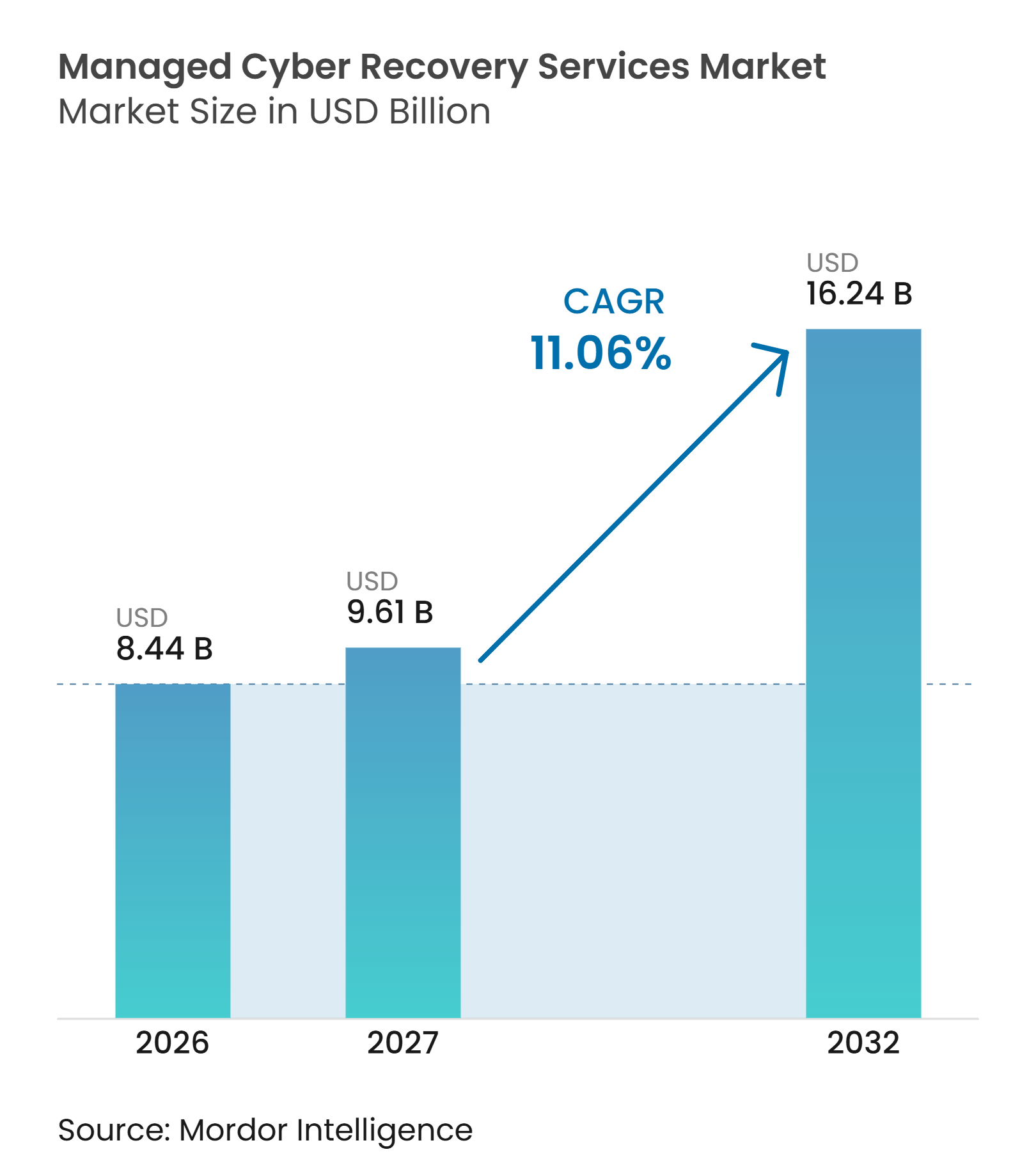
| Market Size (2027) | USD 9.61 Billion |
| Market Size (2032) | USD 16.24 Billion |
| Growth Rate (2027 - 2032) | 11.06 % |
| Fastest Growing Market | Asia-Pacific |
| Largest Market | North America |
| Market Concentration | Medium |
Major Players *Disclaimer: Major Players sorted in no particular order Image © Mordor Intelligence. Reuse requires attribution under CC BY 4.0. | |
Managed Cyber Recovery Services Market Analysis by Mordor Intelligence
The Managed Cyber Recovery Services Market size was projected to expand from USD 8.44 billion in 2026 and is expected to grow from USD 9.61 billion in 2027 to USD 16.24 billion by 2032, registering a CAGR of 11.06% during the forecast period (2027-2032). The market is supported by a widening gap between confidence in recovery and the ability to restore operations after a ransomware event. Backups are now a frequent target, which increases the value of managed services that can validate clean recovery points and coordinate restoration. Regulatory expectations also make tested recovery plans and segregated restoration environments an operational requirement for many buyers. Providers are responding by combining vaulting, identity recovery, clean rooms, and orchestration capabilities within managed offerings. The Managed Cyber Recovery Services Market is also shaped by the need to restore identity services before applications and data, because authentication is necessary for an orderly return to operations.
Key Report Takeaways
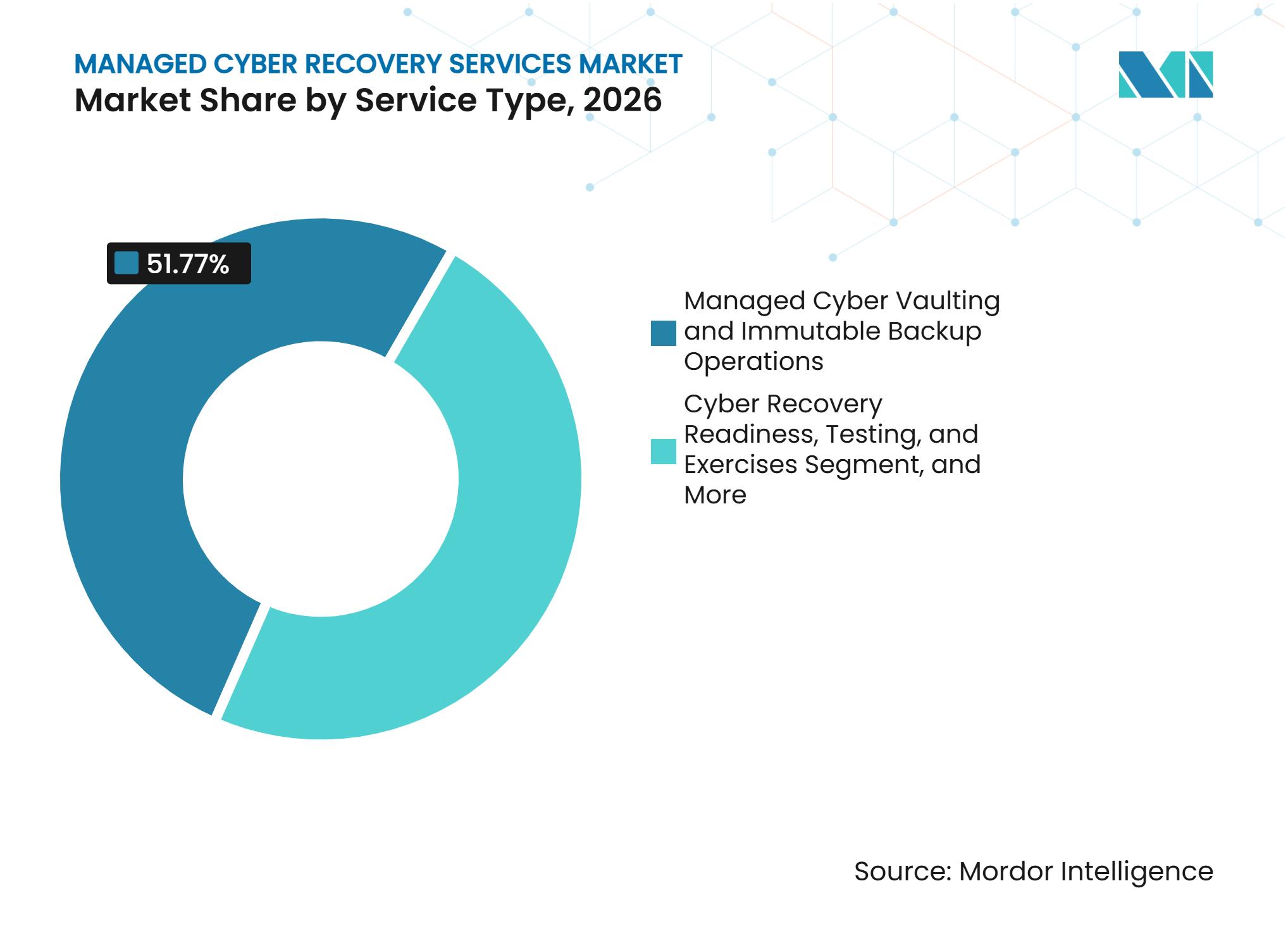
- By service type, managed cyber vaulting and immutable backup operations held 51.77% of the Managed Cyber Recovery Services Market share in 2026, while identity, directory, and access recovery is projected to expand at an 11.22% CAGR through 2032.
- By deployment model, hybrid and multicloud environments accounted for 39.88% of the market in 2026 and are projected to expand at an 11.26% CAGR through 2032.
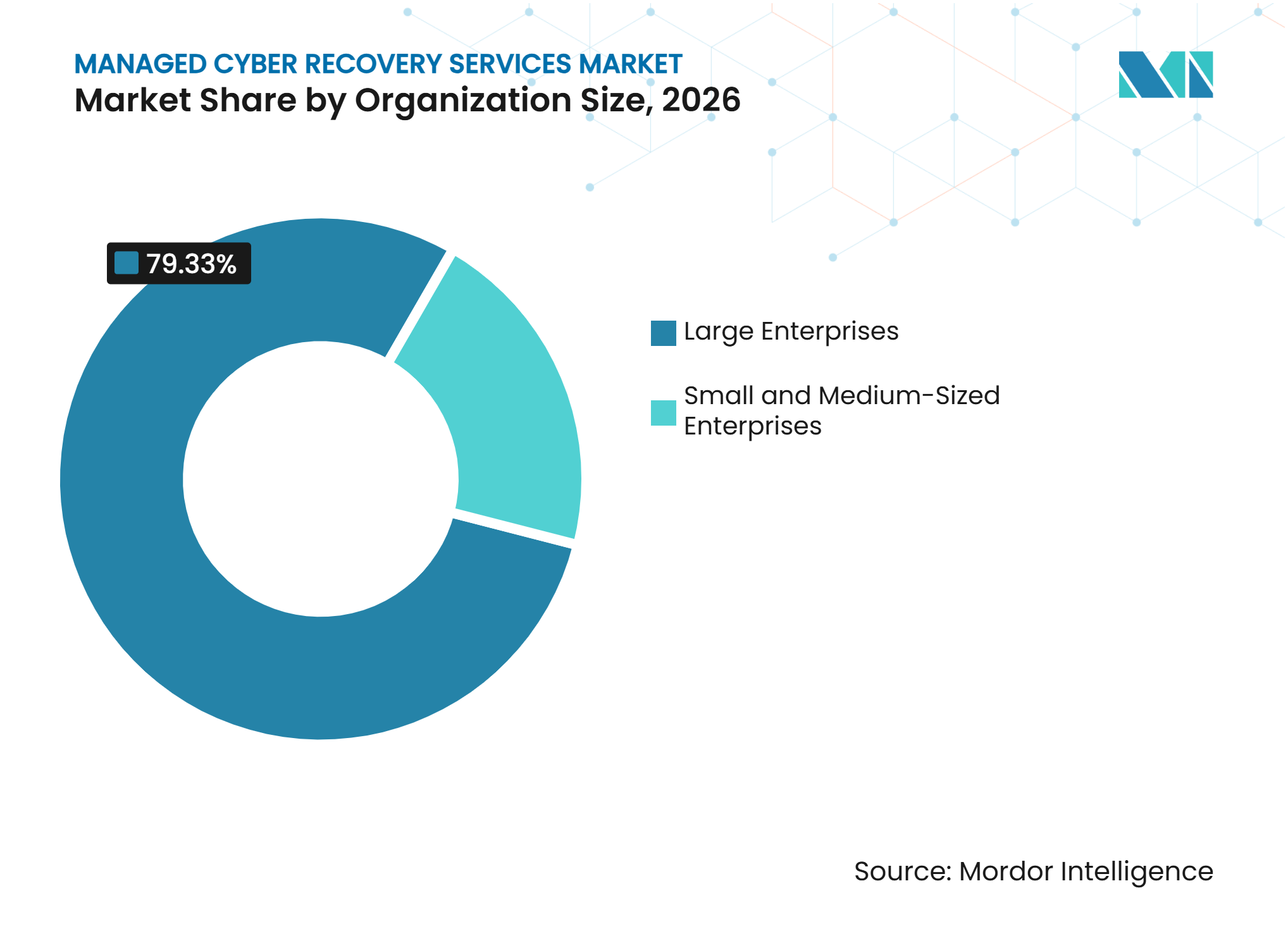
- By organization size, large enterprises held 79.33% of demand in 2026, while SMEs are projected to expand at an 11.37% CAGR through 2032.
- By industry vertical, BFSI accounted for 23.67% of demand in 2026, while healthcare and life sciences are projected to expand at an 11.38% CAGR through 2032.
- By geography, North America held 43.88% of the market in 2026, while Asia-Pacific is projected to expand at an 11.52% CAGR through 2032.
Note: Market numbers in this report are based on Mordor Intelligence's proprietary estimation framework, which combines nine months of actuals with Q4 projections for base year 2026.
Market Trends and Insights
Drivers Impact Analysis of Managed Cyber Recovery Services Market*
| Driver | (~) % Impact on CAGR Forecast | Geographic Relevance | Impact Timeline |
|---|---|---|---|
| Ransomware and Destructive Cyberattack Escalation | +3.2% | Global, with highest intensity in North America, Europe, and Asia-Pacific | Short term (≤ 2 years) |
| Mandatory Evidence of Recoverability From Regulators and Insurers | +2.5% | EU, North America, and Asia-Pacific | Medium term (2-4 years) |
| Hybrid and Multicloud Workload Expansion | +1.8% | Global, with fastest expansion in Asia-Pacific and Europe | Medium term (2-4 years) |
| Shortage of Recovery Engineering and Forensic Specialists | +1.3% | Global, especially SME-heavy markets in Asia-Pacific and South America | Long term (≥ 4 years) |
| Consumption-Based Resilience Replacing Idle Secondary Infrastructure | +0.9% | North America, Europe, and core Asia-Pacific markets | Medium term (2-4 years) |
| Recovery as Code and AI-Guided Orchestration | +0.8% | Global, led by early adopters in North America | Long term (≥ 4 years) |
| Source: Mordor Intelligence | |||
Ransomware and Destructive Cyberattack Escalation Fuels Managed Recovery Spend
Ransomware increasingly affects identity systems and infrastructure as well as files, which changes the design requirements for recovery programs. Attack volumes increased 25% year over year from July 2024 to June 2025, and 41 new threat groups entered the field as the number of active groups exceeded 60 globally. Sophisticated groups can remain in an environment for months and may place malware in backup copies before encryption begins. This leaves organizations unable to identify a clean restoration point without forensic review, a task that basic backup and restore processes do not consistently address. The Managed Cyber Recovery Services Market benefits when buyers need independent recovery testing, clean-room procedures, and documented readiness rather than storage alone. Cyber-insurance requirements further strengthen this demand because verified recovery testing can influence policy binding and premium discussions.
Mandatory Evidence of Recoverability Rewires Procurement Logic
Regulators increasingly require evidence that recovery controls work rather than a statement that a plan exists. DORA came into application on January 17, 2025, and requires tested ICT continuity arrangements and restoration of backup data from physically and logically segregated systems for covered financial entities.[1] On January 20, 2026, the European Commission proposed NIS2 changes intended to simplify compliance for 28,700 companies, including more than 6,200 small enterprises. Managed recovery providers can supply testing records and evidence that is ready for auditors and insurers. This shifts recovery procurement from a technical purchase to a compliance and governance decision. The Managed Cyber Recovery Services Market therefore gains from requests for proposal that specify recoverability evidence, segregated recovery, and recurring exercises.
Hybrid and Multicloud Workload Expansion Creates Recovery Complexity
Recovery planning becomes more difficult when an organization runs workloads across on-premises systems, cloud platforms, and software-as-a-service applications. More than 60% of organizations reported a public cloud-related security incident, while maintaining recovery coverage across several environments remained a key concern. Separate architectures can also create different recovery sequences and different identity dependencies. Research from KTH Royal Institute of Technology found that autonomous multi-agent coordination performs particularly well in cross-region and cross-cloud recovery scenarios. These conditions favor managed providers that can operate a common recovery process across several environments. The Managed Cyber Recovery Services Market gains because buyers need consistent protection and validated restoration across systems that are no longer managed as a single estate.
Shortage of Recovery Engineering and Forensic Specialists Drives Outsourcing
The shortage of recovery and forensic specialists limits the ability of organizations to manage complex incidents internally. A lack of expertise was cited in 40.2% of ransomware incidents in 2025, ahead of undetected security gaps at 40.1% and insufficient staffing capacity at 39.4%. Effective recovery requires skills in clean-room forensics, Active Directory reconstruction, identity restoration, and the sequencing of dependent workloads. Most organizations do not maintain all of these skills continuously. SMEs face the greatest constraint because they have limited ability to recruit specialists while still facing similar expectations for preparedness. This supports the Managed Cyber Recovery Services Market because a consumption-based service can provide access to specialized capabilities without building a full internal team.
Restraints Impact Analysis of Managed Cyber Recovery Services Market*
| Restraint | (~) % Impact on CAGR Forecast | Geographic Relevance | Impact Timeline |
|---|---|---|---|
| Data Sovereignty and Cross-Border Recovery Constraints | -1.5% | EU and EEA, India, China, and the Middle East | Long term (≥ 4 years) |
| High Cost and Uncertain Scope of Major Recovery Engagements | -1.0% | Global, with greater sensitivity in SME markets in Asia-Pacific and South America | Short term (≤ 2 years) |
| Fragmented Identity and Application Dependencies | -0.6% | Global | Medium term (2-4 years) |
| Trusted Clean Recovery Point Scarcity After Long-Dwell Attacks | -0.5% | Global | Short term (≤ 2 years) |
| Source: Mordor Intelligence | |||
Data Sovereignty and Cross-Border Recovery Constraints Limit Service Portability
Data localization rules can limit the use of a centralized recovery environment across several countries. GDPR Chapter V requires personal data transferred outside the European Economic Area to receive equivalent protection, and exporters must assess transfer risks. A recovery site in a different jurisdiction may therefore be unavailable for certain workloads even when it is technically suitable. Financial services buyers can also require customer data to remain within designated regions, adding another condition to service design.[2] Providers must invest in in-region clean rooms, local operations, and controls that demonstrate compliance. These requirements can compress margins and slow the portability of the Managed Cyber Recovery Services Market across borders.
High Cost and Uncertain Scope of Major Recovery Engagements Delay Commitments
Large recovery engagements can be hard to price because the full extent of identity and workload damage is often unclear at the start of an incident. The average recovery cost after a ransomware incident was USD 1.53 million in 2025, excluding ransom payments. Long-dwell attacks can require a review of months of backup data and forensic validation of many recovery points. A retainer can cover readiness and testing, but an extensive activation can still exceed the value implied by the base contract. This uncertainty may slow approvals, especially among buyers with limited budgets. Consumption-based clean-room services reduce upfront infrastructure spending, but they do not remove the need to define the scope of a major recovery engagement.
*Our forecasts treat driver/restraint impacts as directional, not additive. The impact forecasts reflect baseline growth, mix effects, and variable interactions.
Managed Cyber Recovery Services Market Segment Analysis
By Service Type:
Vaulting Anchors Revenue While Identity Recovery Sets the PaceManaged cyber vaulting and immutable backup operations held 51.77% of service-type revenue in 2026, the largest share within the Managed Cyber Recovery Services Market. This service aligns with DORA requirements for backup restoration from physically and logically segregated systems. It provides the isolation needed to preserve copies outside the affected production environment. The managed cyber recovery services industry uses vaulting as a foundation because other recovery work depends on trustworthy data and system images. Readiness testing and recovery exercises are also important because organizations must demonstrate that plans can be executed under realistic conditions. Infrastructure, system, application, and cloud restoration remain broad service areas because hybrid estates contain many workload types. Digital forensics and root-cause analysis add value by identifying the attack path and helping teams avoid reintroducing malware. Emergency assessment, triage, and containment can attract higher retainer pricing where financial services and healthcare buyers must meet strict reporting deadlines.
Identity, directory, and access recovery is projected to expand at an 11.22% CAGR through 2032, making it the fastest-growing service type. A clean identity layer is necessary before users and systems can authenticate, so workload restoration alone cannot return operations to normal. Commvault introduced Active Directory Pre Recover in September 2026, using an air-gapped standby copy that is scanned for malware to shorten Active Directory recovery from hours to minutes. Rubrik expanded its identity recovery coverage across Active Directory, Entra ID, and Okta in September 2025. These releases show why identity is becoming a distinct managed service category. Providers that validate identity services before restoring applications can reduce the risk of restoring compromised credentials. The Managed Cyber Recovery Services Market increasingly favors services that coordinate this dependency rather than treating identity as a separate backup task.



By Deployment Model:
Hybrid and Multicloud Drives Both Scale and SpeedHybrid and multicloud environments accounted for 39.88% of demand in 2026 and held the leading position by deployment. They are also projected to expand at an 11.26% CAGR through 2032, showing that complex environments are becoming more common. The Managed Cyber Recovery Services Market size for hybrid and multicloud deployment benefits from the need to coordinate protection across different infrastructure stacks. Public cloud environments support scalable clean rooms and allow providers to offer per-terabyte services. This shifts recovery capacity from a fixed infrastructure commitment to an operating expense. On-premises and colocation environments remain relevant when regulated workloads cannot leave controlled facilities. Private cloud deployment also remains important for organizations with sovereign infrastructure requirements.
Isolation architecture is a key competitive factor in accounts that use several deployment models. Providers need to offer a clean recovery environment regardless of where the source workload runs. Gartner research cited by Rubrik stated that consumption-based services can scale protection without requiring buyers to manage physical capacity, favoring cloud-native managed platforms over traditional on-premises approaches. Druva introduced Microsoft Azure support in March 2025, its first additional embedded cloud beyond AWS. The move illustrates the platform investment required to support credible multicloud recovery. Hybrid clients also need recovery procedures that account for cross-platform identity, network, compute, and data dependencies. Providers that can validate these relationships before an incident can differentiate their managed offering. The Managed Cyber Recovery Services Market will continue to reward deployment flexibility because infrastructure choices remain diverse.
By Organization Size:
Large Enterprises Lead but SMEs Are Gaining GroundLarge enterprises held 79.33% of demand in 2026, reflecting their scale, formal procurement processes, and regulatory exposure. These organizations operate more workloads and often face direct scrutiny from financial services and healthcare authorities. They can also require broad coverage across data centers, clouds, business units, and regions. The Managed Cyber Recovery Services Market is supported by their demand for contracts that combine readiness testing, recovery execution, and governance evidence. Large organizations typically require detailed service-level commitments and recurring recovery exercises. Their buying decisions often involve security, infrastructure, risk, legal, and business continuity functions. This creates long sales cycles, but it also supports extensive contracts once a provider is selected. Demand is strongest where operational downtime and regulatory failure both create material management attention.
SMEs are projected to expand at an 11.37% CAGR through 2032. They face many of the same readiness expectations as larger organizations but have fewer internal specialists and smaller capital budgets. The European Commission's proposed NIS2 changes in January 2026 included measures intended to ease compliance for more than 6,200 micro and small enterprises. Rubrik's MSP PayGo program offers partners a route to start with zero minimums and scale as customer demand expands. Rubrik and Cognizant also announced Business Resilience-as-a-Service in October 2025, combining a security platform with consulting support. These arrangements lower adoption barriers for organizations that cannot build recovery engineering teams. Managed service providers are becoming an important route to the SME tier. This distribution model changes vendor acquisition economics because providers can reach smaller accounts through channel partners.

By Industry Vertical:
BFSI Anchors Demand While Healthcare Sets UrgencyBFSI held 23.67% of demand in 2026, making it the leading vertical in the managed cyber recovery services industry. DORA requires financial entities to test recovery arrangements and restore from segregated systems, which raises the need for dedicated recovery processes. Financial institutions must show that recovery plans work under realistic threat conditions. This requirement is difficult to meet through untested internal processes alone. Government and public administration, IT and telecommunications, industrial manufacturing, energy and utilities, and retail and e-commerce also require managed recovery services. Energy providers have additional needs because operational technology systems require specialized recovery capabilities. The Managed Cyber Recovery Services Market therefore has demand across sectors with different operational priorities but similar needs for validated restoration.
Healthcare and life sciences is projected to expand at an 11.38% CAGR through 2032. In the 12 months through mid-2026, 97% of U.S. healthcare organizations experienced at least 1 cyberattack, while the average cost of the most significant attack increased from USD 3.9 million in 2025 to USD 4.2 million in 2026. Cohesity reported that 85% of healthcare organizations that experienced a material cyberattack in 2026 exceeded their recovery time objective. Healthcare buyers must consider clinical system availability as well as financial loss and compliance. This raises the value of recovery agreements that include tested service levels, clinical system prioritization, and reporting support. IBM reported an average healthcare data breach cost of USD 6.64 million in 2026, the highest among industries for the 13th consecutive year.[3] Providers can therefore support a premium procurement tier where recovery assurance is closely tied to continuity of care. The Managed Cyber Recovery Services Market gains when healthcare organizations move from backup ownership to managed validation and recovery execution.
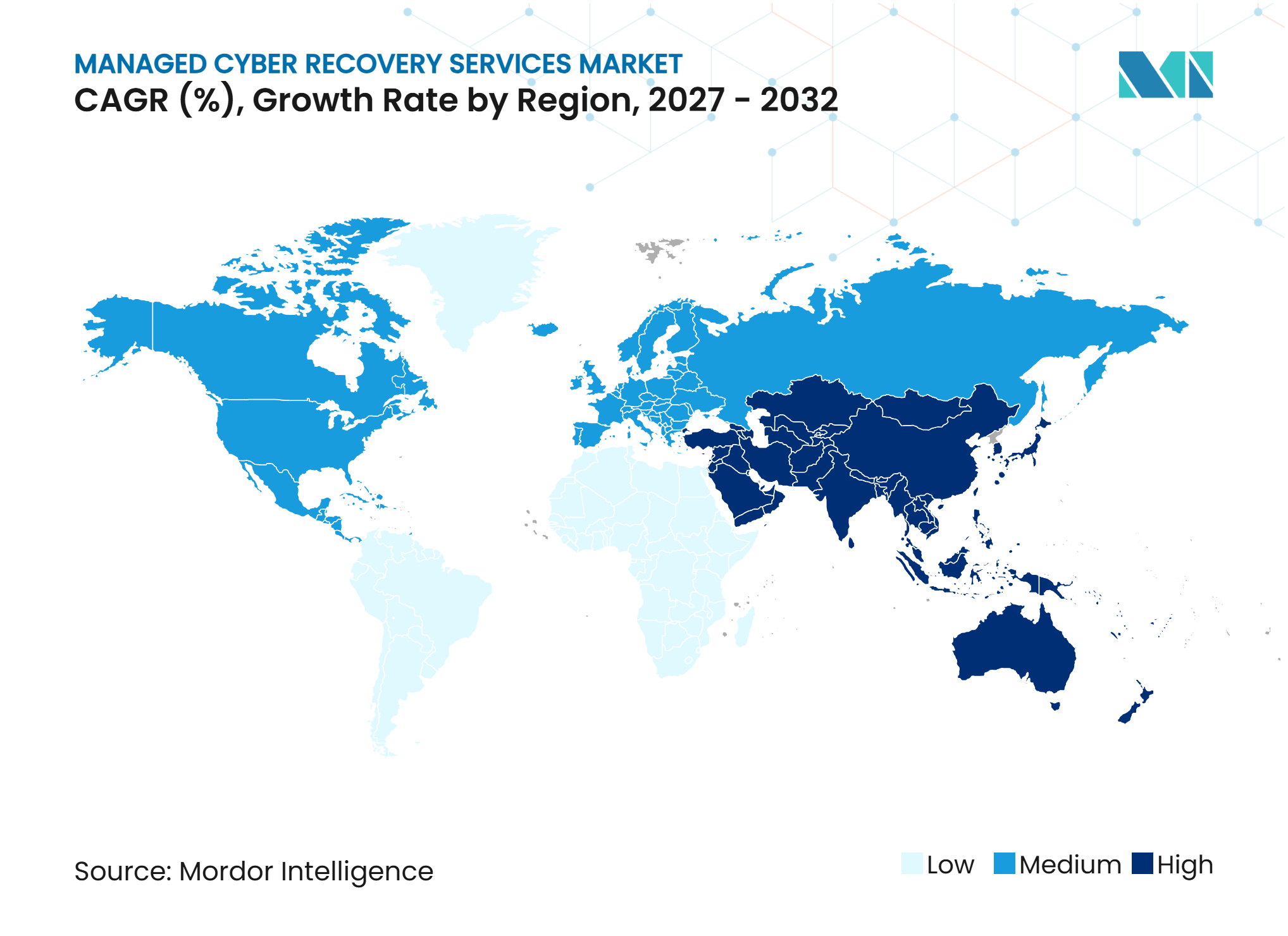
Geography Analysis
North America held 43.88% of the Managed Cyber Recovery Services Market share in 2026. The region benefits from board-level attention to cyber risk, broad cyber-insurance use, and a large enterprise base across BFSI, healthcare, and government. Recovery investment is supported when executives view downtime as a business continuity problem rather than an infrastructure issue. The region also has a mature ecosystem of hyperscalers, specialists, security providers, and managed service providers. These participants can combine security operations with recovery capabilities. CrowdStrike integrations announced at Fal.Con 2026 allowed Commvault and Rubrik recovery actions to operate as steps in Charlotte Agentic SOAR workflows. This illustrates the regional move toward embedding recovery within security operations.
Europe is the second-largest regional market, supported by the compliance architecture created by DORA and NIS2. DORA applies to covered financial entities and places tested digital operational resilience at the center of governance requirements. Commission Delegated Regulation (EU) 2025/532 sets criteria for ICT third-party service providers serving EU financial sector clients, which acts as a market-access requirement.[4]Germany, the United Kingdom, France, Italy, and Russia are the largest national markets identified in the supplied material. Proposed NIS2 changes can extend compliance attention to additional mid-sized operators. Data sovereignty rules also require providers to design local recovery capacity and controls. These conditions support demand, but they also make regional delivery more complex.
Asia-Pacific is projected to expand at an 11.52% CAGR through 2032, the highest regional rate. Japan's domestic backup and recovery market reached JPY 58.478 billion in FY2025, equivalent to USD 390.1 million at the 2025 average exchange rate of JPY 149.9 per USD, and increased 9.7% year over year. ITR Corporation projects a 12.0% CAGR for Japan's backup and recovery market through FY2030. Japan recorded a 40% rise in ransomware attacks in the first half of 2025 compared with 2024, while cyber-insurance claims rose 57% from 2022 to 2024. India, South Korea, China, Australia, and Southeast Asia contribute through cloud adoption, compliance expectations, and cyber recovery-as-a-service development. South America is led by Brazil and Argentina, while Saudi Arabia, the UAE, and South Africa support demand in the Middle East and Africa.
Competitive Landscape
Market Concentration
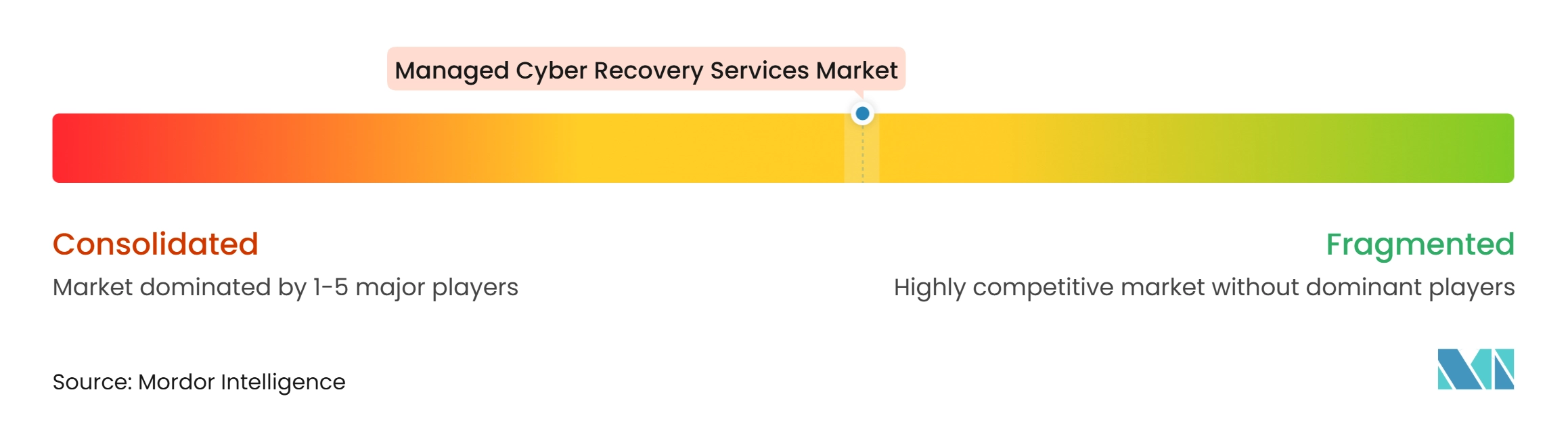
The Managed Cyber Recovery Services Market includes both large platform providers and specialist recovery providers. IBM, Dell Technologies, Microsoft, Amazon Web Services, Kyndryl, DXC Technology, and NTT DATA compete through broad platforms and established enterprise relationships. Cohesity, Rubrik, Commvault, Veeam, Druva, and Acronis compete through recovery orchestration, clean-room design, and identity resilience capabilities. This structure gives buyers several provider types to consider. Large providers can bundle recovery with infrastructure, cloud, and consulting services. Specialists can differentiate by the depth and order of recovery actions. Competition is therefore based on more than data backup capacity. It also depends on the ability to establish a trustworthy recovery point and return business services in the right sequence.
Rubrik launched Autonomous Business Recovery for Cloud Applications in private preview in June 2026. The offering maps application dependencies and coordinates network, compute, and data recovery from pre-validated clean points. The sequence addresses the need to rebuild an environment rather than restore isolated data sets. Cohesity reported in September 2026 that 78% of organizations focus recovery on system restoration rather than business operations continuity, while 22% have both documented and tested a Minimum Viable Company plan.[5] This leaves room for providers that link technical restoration to business process continuity. The Managed Cyber Recovery Services Market also favors providers that can produce proof of recoverability for management, insurers, and regulators. IBM and Predatar announced a March 2026 integration that combines IBM Storage Defender DRS with cyber recovery orchestration to validate recovery points in an isolated clean room and produce evidence for senior leaders.
Security orchestration is becoming part of the competitive model because recovery actions need to be initiated and coordinated quickly during an incident. At Fal.Con 2026, Commvault and Rubrik announced integrations that make their recovery actions native steps within CrowdStrike Charlotte Agentic SOAR workflows. This reduces manual handoffs between security and recovery teams. DORA-related third-party requirements create an additional competitive filter for providers that serve EU financial institutions. Providers must demonstrate suitable controls as well as technical recovery capability. Kyndryl launched the Kyndryl Intelligent Recovery Service in February 2026 to automate workflows and provide visibility across hybrid and multicloud environments. The field remains moderately competitive because platform breadth, orchestration depth, regulatory readiness, and delivery capability each matter to buyers.
Managed Cyber Recovery Services Industry Leaders
-
International Business Machines Corporation
-
Dell Technologies Inc.
-
Cohesity, Inc.
-
Kyndryl, Inc.
-
Commvault Systems, Inc.
- *Disclaimer: Major Players sorted in no particular order
Managed Cyber Recovery Services Market Companies Covered in this Report
- International Business Machines Corporation
- Dell Technologies Inc.
- Cohesity, Inc.
- Commvault Systems, Inc.
- Rubrik, Inc.
- Veeam Software Group GmbH
- Acronis International GmbH
- Druva Inc.
- Hewlett Packard Enterprise
- Amazon Web Services, Inc.
- Microsoft Corporation
- Kyndryl, Inc.
- Rackspace Technology, Inc.
- 11:11 Systems, Inc.
- Sungard Availability Services, LLC
- Recovery Point Systems, Inc.
- TierPoint, LLC
- NTT DATA Corporation
- DXC Technology Company
- OnX Managed Services, Inc.
Recent Industry Developments in Managed Cyber Recovery Services Market
- October 2026: Commvault announced Discover-to-Recover resilience capabilities for Microsoft 365, introducing threat hunting across Exchange, OneDrive, SharePoint, and Teams backup data using Commvault Threat Scan and Data Posture 360. The solution identifies compromised content, isolates it, and recovers only verified clean data, targeting early 2027 for general availability.
- September 2026: Commvault introduced Active Directory Pre Recover, reducing AD recovery from hours to minutes via an air-gapped cleanroom standby copy continuously scanned by Threat Scan, delivered at no additional charge to enterprise AD customers within the Identity Resilience portfolio.
- June 2026: Rubrik launched Autonomous Business Recovery for Cloud Applications in private preview, automatically mapping application stack dependencies and orchestrating sequenced network-first, then compute, then data recovery from pre-validated clean points, powered by Rubrik's Preemptive Recovery Engine.
- February 2026: Kyndryl launched the Kyndryl Intelligent Recovery Service, a cloud-based solution integrated with Kyndryl Bridge that automates recovery workflows and delivers real-time visibility across hybrid and multicloud environments. Kyndryl Intelligent Recovery Service supports cloud platforms, containerized workloads, and databases, with unified dashboards for recovery progress and compliance metrics.
- August 2025: Rubrik and Sophos announced a partnership delivering Sophos M365 Backup and Recovery Powered by Rubrik, the first MDR-optimized Microsoft 365 backup and recovery solution integrated into Sophos Central, targeting mid-market customers.
Global Managed Cyber Recovery Services Market Report Scope
The managed cyber recovery services market is externally delivered services in which a provider prepares for, executes, and validates the restoration of an organization’s data, systems, identities, and applications after a ransomware, destructive, or other cyberattack, with commercial value measured by demonstrable recoverability and speed of secure return to operations rather than by backup volumes or routine disaster recovery uptime alone. Providers operate isolated vaults and immutable backups, test recovery readiness, run forensic and containment activities, and rebuild infrastructure, directory, and application environments from verified clean recovery points.
The Managed Cyber Recovery Services Market Report is Segmented by Service Type (Cyber Recovery Readiness, Testing, and Exercises; Managed Cyber Vaulting and Immutable Backup Operations; Recovery Validation and Secure Return to Operations; Infrastructure, System, Application, and Cloud Restoration; Identity, Directory, and Access Recovery; Digital Forensics, Evidence Preservation, and Root-Cause Analysis; and Emergency Assessment, Triage, Containment, and Eradication), Deployment Model (Public Cloud, Private Cloud, Hybrid and Multicloud, and On-Premises and Colocation), Organization Size (Large Enterprises, and Small and Medium-Sized Enterprises), Industry Vertical (Banking, Financial Services, and Insurance (BFSI), Government and Public Administration, Healthcare and Life Sciences, IT and Telecommunications, Industrial Manufacturing, Energy and Utilities, Retail and E-Commerce, and Other Industry Verticals), and Geography (North America, South America, Europe, Asia-Pacific, and Middle East and Africa). The Market Forecasts are Provided in Terms of Value (USD).
Segmentation Overview
| Cyber Recovery Readiness, Testing, and Exercises |
| Managed Cyber Vaulting and Immutable Backup Operations |
| Recovery Validation and Secure Return to Operations |
| Infrastructure, System, Application, and Cloud Restoration |
| Identity, Directory, and Access Recovery |
| Digital Forensics, Evidence Preservation, and Root-Cause Analysis |
| Emergency Assessment, Triage, Containment, and Eradication |
| Public Cloud |
| Private Cloud |
| Hybrid and Multicloud |
| On-Premises and Colocation |
| Large Enterprises |
| Small and Medium-Sized Enterprises |
| Banking, Financial Services, and Insurance |
| Government and Public Administration |
| Healthcare and Life Sciences |
| IT and Telecommunications |
| Industrial Manufacturing |
| Energy and Utilities |
| Retail and E-Commerce |
| Other Industry Verticals |
| North America | United States |
| Canada | |
| Mexico | |
| South America | Brazil |
| Argentina | |
| Rest of South America | |
| Europe | Germany |
| United Kingdom | |
| France | |
| Italy | |
| Russia | |
| Rest of Europe | |
| Asia-Pacific | China |
| Japan | |
| India | |
| South Korea | |
| Australia | |
| Southeast Asia | |
| Rest of Asia-Pacific | |
| Middle East and Africa | Saudi Arabia |
| United Arab Emirates | |
| South Africa | |
| Egypt | |
| Rest of Middle East and Africa |
| By Service Type | Cyber Recovery Readiness, Testing, and Exercises | |
| Managed Cyber Vaulting and Immutable Backup Operations | ||
| Recovery Validation and Secure Return to Operations | ||
| Infrastructure, System, Application, and Cloud Restoration | ||
| Identity, Directory, and Access Recovery | ||
| Digital Forensics, Evidence Preservation, and Root-Cause Analysis | ||
| Emergency Assessment, Triage, Containment, and Eradication | ||
| By Deployment Model | Public Cloud | |
| Private Cloud | ||
| Hybrid and Multicloud | ||
| On-Premises and Colocation | ||
| By Organization Size | Large Enterprises | |
| Small and Medium-Sized Enterprises | ||
| By Industry Vertical | Banking, Financial Services, and Insurance | |
| Government and Public Administration | ||
| Healthcare and Life Sciences | ||
| IT and Telecommunications | ||
| Industrial Manufacturing | ||
| Energy and Utilities | ||
| Retail and E-Commerce | ||
| Other Industry Verticals | ||
| By Geography | North America | United States |
| Canada | ||
| Mexico | ||
| South America | Brazil | |
| Argentina | ||
| Rest of South America | ||
| Europe | Germany | |
| United Kingdom | ||
| France | ||
| Italy | ||
| Russia | ||
| Rest of Europe | ||
| Asia-Pacific | China | |
| Japan | ||
| India | ||
| South Korea | ||
| Australia | ||
| Southeast Asia | ||
| Rest of Asia-Pacific | ||
| Middle East and Africa | Saudi Arabia | |
| United Arab Emirates | ||
| South Africa | ||
| Egypt | ||
| Rest of Middle East and Africa | ||
Key Questions Answered in the Report
What is the size of the managed cyber recovery services market?
The Managed Cyber Recovery Services Market size was projected to expand from USD 8.44 billion in 2026 and is expected to grow from USD 9.61 billion in 2027 to USD 16.24 billion by 2032, registering a CAGR of 11.06% during the forecast period (2027-2032).
Which service type leads managed cyber recovery demand?
Managed cyber vaulting and immutable backup operations lead with 51.77% of service-type revenue in 2026.
Why is identity recovery becoming more important?
Identity, directory, and access recovery is projected to expand at an 11.22% CAGR because systems and users cannot authenticate until a clean identity layer is restored.
Which deployment approach has the strongest outlook?
Hybrid and multicloud environments account for 39.88% of demand in 2026 and are projected to expand at an 11.26% CAGR through 2032.
Which customer group is expanding fastest?
SMEs are projected to expand at an 11.37% CAGR through 2032 because many need specialized recovery capabilities without maintaining a full internal team.
Which region has the fastest projected expansion?
Asia-Pacific is projected to expand at an 11.52% CAGR through 2032, supported by ransomware exposure, cloud adoption, and expanding digital infrastructure.