
Managed Campus Network Services Market Size and Share
Market Overview
| Study Period | 2021 - 2032 |
|---|---|
| Market Size (2027) | USD 32.98 Billion |
| Market Size (2032) | USD 46.09 Billion |
| Growth Rate (2027 - 2032) | 6.92 % |
| Fastest Growing Market | Asia-Pacific |
| Largest Market | North America |
| Market Concentration | Medium |
Major Players *Disclaimer: Major Players sorted in no particular order Image © Mordor Intelligence. Reuse requires attribution under CC BY 4.0. | |
Managed Campus Network Services Market Analysis by Mordor Intelligence
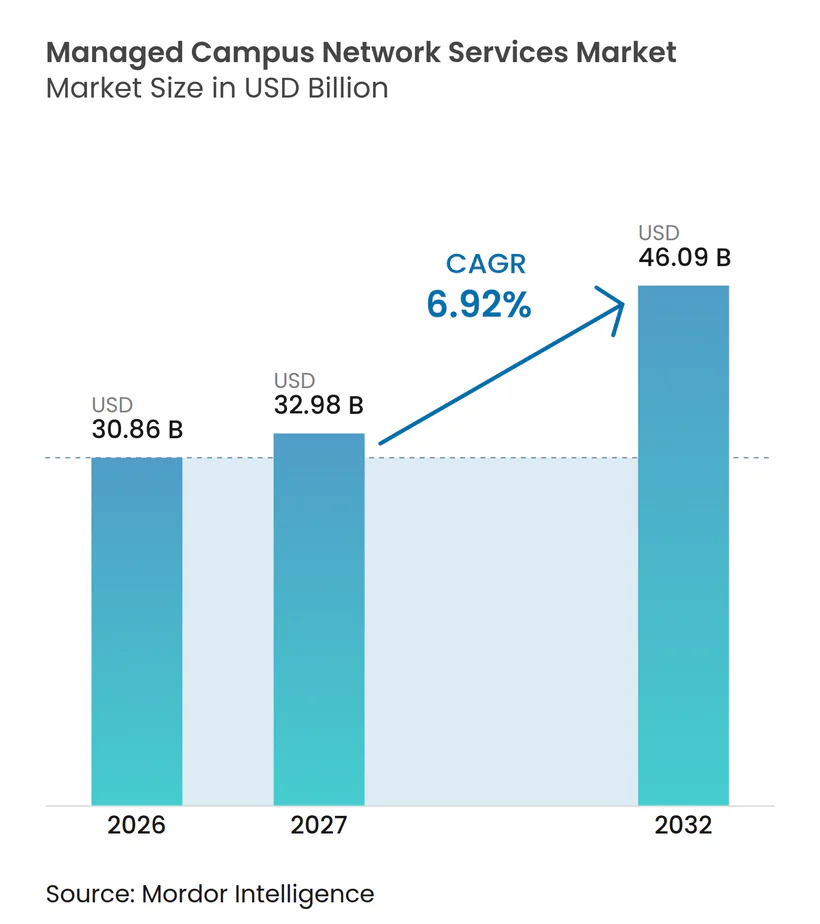
The managed campus network services market size was valued at USD 30.86 billion in 2026 and is projected to grow from USD 32.98 billion in 2027 to USD 46.09 billion by 2032, registering a CAGR of 6.92% during the forecast period (2027-2032). Demand is shifting from operating individual LAN, WLAN, and edge environments internally to using providers that manage these environments as a continuing service. Network modernization has become closely tied to AI, IoT, and cloud deployment, which raises the value of dependable connectivity and centralized operations. Cisco reported in June 2025 that 97% of surveyed senior IT and business leaders viewed a modernized network as critical to AI, IoT, and cloud rollouts, while 91% planned to increase the networking share of their IT budgets. Providers are responding with managed security, AIOps, and subscription options that reduce the need for customers to assemble separate technology and operations teams. The managed campus network services market, therefore, benefits from a procurement shift toward ongoing performance, visibility, and compliance support.
Key Report Takeaways
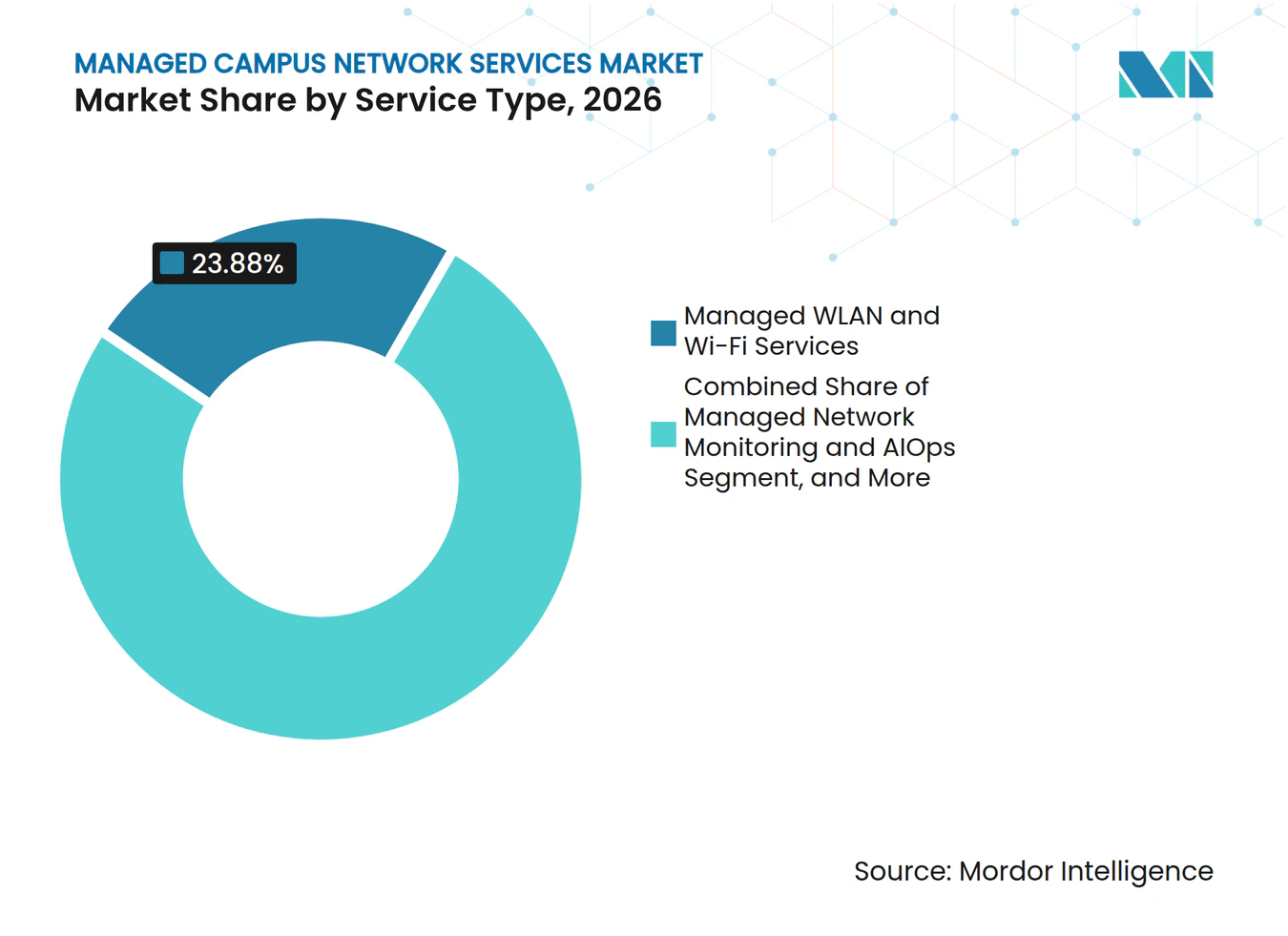
- By service type, Managed WLAN and Wi-Fi Services held 23.88% of the managed campus network services market share in 2026, while Managed Private 5G Campus Services is projected to expand at a 7.26% CAGR through 2032.
- By commercial model, Fully Managed Services held 44.66% of revenue in 2026, while Network as a Service is projected to expand at a 7.21% CAGR through 2032.
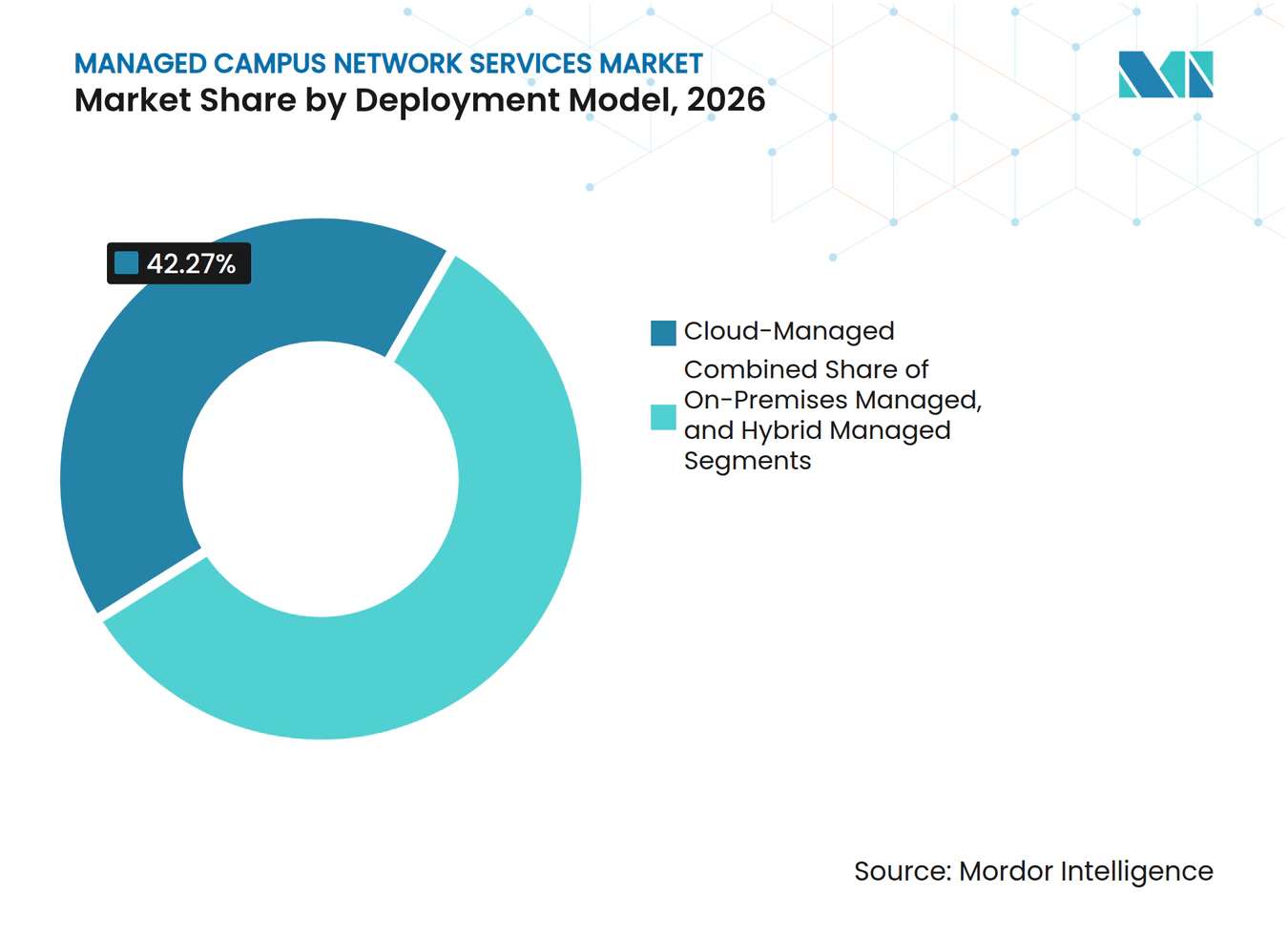
- By deployment model, Cloud-Managed deployments held 42.27% of the managed campus network services market share in 2026, and are projected to expand at a 7.57% CAGR through 2032.
- By organization size, Large Enterprises held 74.33% of revenue in 2026, while Small and Medium-Sized Enterprises are projected to expand at a 7.18% CAGR through 2032.
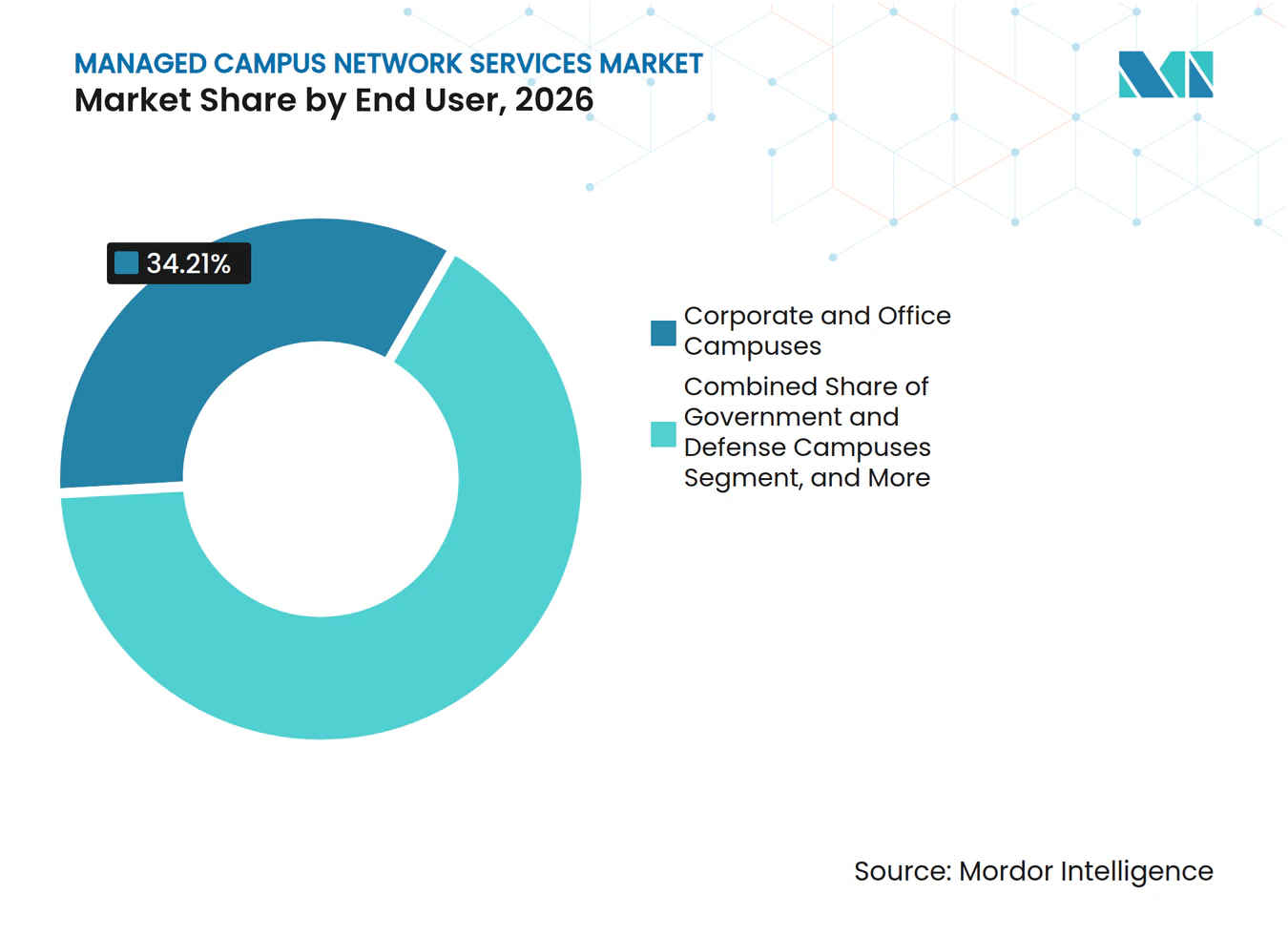
- By end user, Corporate and Office Campuses held 34.21% of revenue in 2026, while Manufacturing and Industrial Campuses are projected to expand at a 7.39% CAGR through 2032.
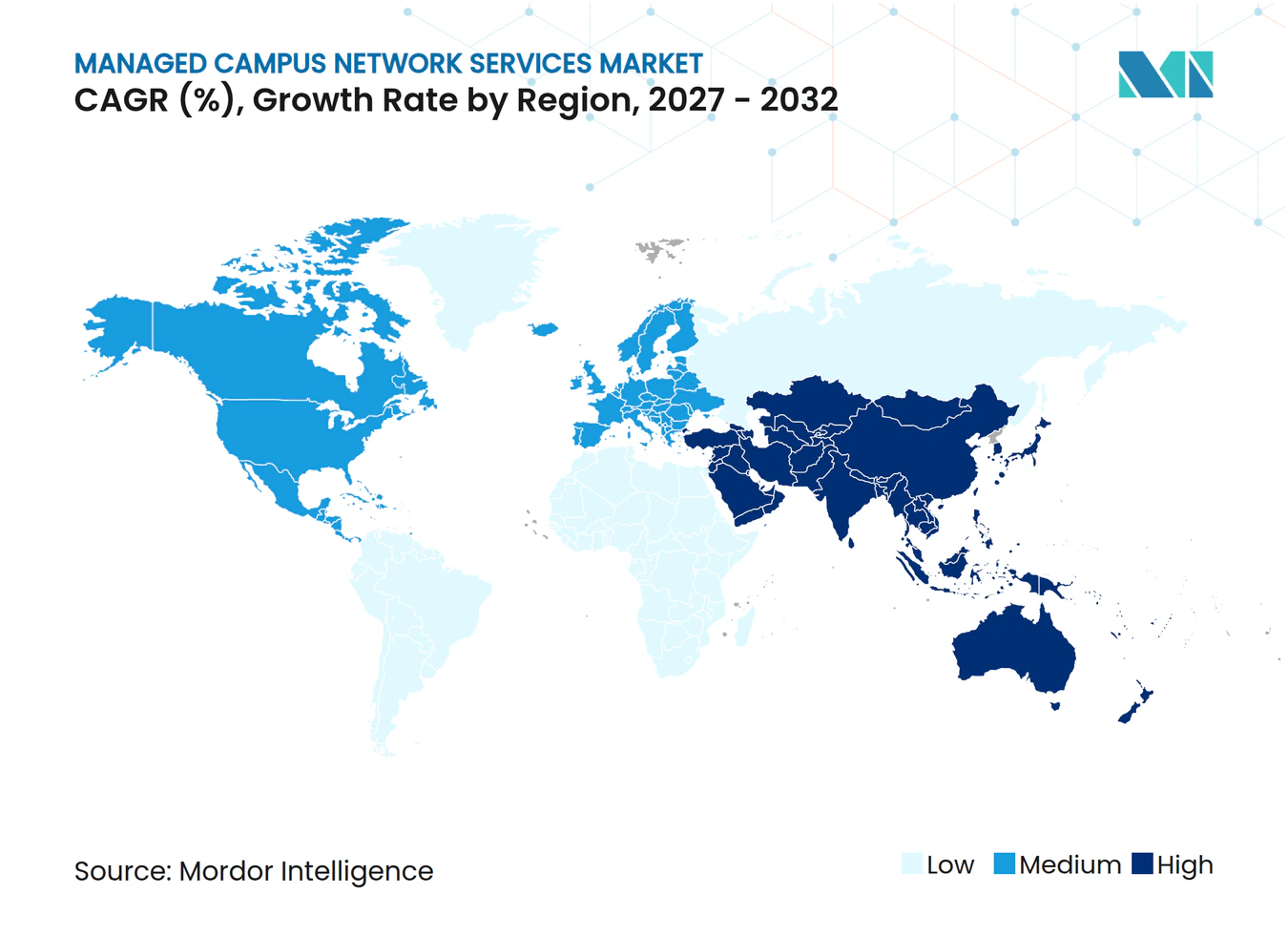
- By geography, North America held 37.77% of revenue in 2026, while Asia-Pacific is projected to expand at a 7.46% CAGR through 2032.
Note: Market numbers in this report are based on Mordor Intelligence's proprietary estimation framework, which combines nine months of actuals with Q4 projections for base year 2026.
Global Managed Campus Network Services Market Trends and Insights
Drivers Impact Analysis*
| Driver | (~) % Impact on CAGR Forecast | Geographic Relevance | Impact Timeline |
|---|---|---|---|
| Hybrid Work and Distributed User Experience Requirements | +2.1% | Global, with strongest adoption in North America and Western Europe | Short term (≤ 2 years) |
| Cloud and SaaS Traffic Growth Across Campus Networks | +1.8% | Global, concentrated in North America and Asia-Pacific | Short term (≤ 2 years) |
| Cybersecurity, Zero-Trust, and Compliance Requirements | +1.4% | Global, with regulatory pressure highest in North America and Europe | Medium term (2-4 years) |
| Shortage of Specialized Network Operations Talent | +0.9% | Global, with the most acute pressure in North America and Western Europe | Short term (≤ 2 years) |
| AI-Driven Network Automation and Predictive Operations | +0.8% | Global, with Asia-Pacific and North America leading adoption | Medium term (2-4 years) |
| Subscription-Based Campus Network as a Service Adoption | +0.7% | North America and Europe, expanding into Asia-Pacific | Medium term (2-4 years) |
| Source: Mordor Intelligence | |||
Hybrid Work and Distributed User Experience Requirements
Hybrid work is changing what the managed campus network services market must provide and who must operate it. When employees move between offices, homes, and customer locations, network performance must be assessed at the application layer rather than only at access switches or wireless controllers. This favors providers that can monitor user experience across sites and maintain operations at all hours. The managed campus network services market is supported by the need to connect campus networking with WAN performance and application visibility. Cisco found that network modernization is central to organizations pursuing cloud, AI, and IoT programs, which makes the user experience a broader operational concern.[1] Organizations with many locations can use managed services to apply a more consistent experience standard without building large internal monitoring teams.
Cloud and SaaS Traffic Growth Across Campus Networks
Cloud applications and SaaS platforms are creating traffic patterns that are reshaping the managed campus network services market. Cisco and Foundry reported in June 2025 that AI-driven traffic on campus and branch networks had increased 34% during the preceding 12 months, and respondents expected a further 96% increase during the following year. Traffic for collaboration, business software, and cloud platforms often travels beyond the campus backbone, so local monitoring alone may not show the user experience. Managed providers can combine SD-WAN, cloud telemetry, and AIOps to identify problems across these paths. Wi-Fi 7 upgrades and switch refreshes also increase the need for lifecycle planning, configuration, and ongoing support. This traffic change gives the managed campus network services market a continuing demand base rather than a one-time equipment replacement opportunity.
Cybersecurity, Zero-Trust, and Compliance Requirements
Campus networks are an important attack surface in the managed campus network services market, making security services part of the broader outsourcing decision. Cisco reported that 73% of surveyed organizations already faced, or expected within 24 months, campus and branch capacity limits partly related to security inspection and policy enforcement. Zero-trust segmentation requires device authentication, policy separation, and frequent updates as device inventories change. Kyndryl launched end-to-end SASE services with Palo Alto Networks in February 2025, combining zero-trust access, SD-WAN, and 24/7 managed security capabilities. NIS2 requirements in Europe and FIPS 140-2 requirements for some U.S. government deployments add procurement value for providers that can document compliant operations. Security and compliance needs, therefore, widen managed contracts beyond basic network availability.
Shortage of Specialized Network Operations Talent
The shortage of network operations talent increases the appeal of external operating models in the managed campus network services market. Expereo reported in September 2025 that 39% of global organizations struggled to find or retain networking talent, while 45% planned to rely more on external vendors to address that gap.[2] The skills required now extend beyond routing and switching to cloud-native design, AIOps tools, and OT and IT integration. Internal teams can find it difficult to maintain these capabilities across every campus location and every technology generation. Providers using AI-assisted network operations centers can automate routine incident triage and predictive maintenance, while specialists address more complex issues. This labor constraint supports the managed campus network services market in organizations that need access to scarce skills without expanding permanent technical teams.
Restraints Impact Analysis*
| Restraint | (~) % Impact on CAGR Forecast | Geographic Relevance | Impact Timeline |
|---|---|---|---|
| Legacy Infrastructure and Brownfield Integration Complexity | -0.5% | Global, more acute in mature economies including North America and Europe | Medium term (2-4 years) |
| Data Sovereignty and Third-Party Operational Dependency | -0.4% | Europe and Asia-Pacific, with increasing relevance in North America | Medium term (2-4 years) |
| Interoperability Gaps Across Multivendor Environments | -0.3% | Global | Long term (≥ 4 years) |
| Unclear Service Boundaries and Unexpected Fee Escalation | -0.2% | Global, with the greatest effect on small and medium-sized enterprises | Medium term (2-4 years) |
| Source: Mordor Intelligence | |||
Legacy Infrastructure and Brownfield Integration Complexity
Brownfield campus environments can slow managed service onboarding in the managed campus network services market because they contain several generations of switching, WLAN, and security equipment. Legacy OT systems, proprietary VLAN settings, and missing documentation can require extended discovery before a provider can assume operational responsibility. Ciena noted in 2025 that operators may not be able to locate all equipment delivering circuits in a legacy environment, and that maintaining service continuity adds technical and financial risk. These conditions can expand scope, increase SLA exposure, and delay revenue recognition for contracts that initially appear standardized. Phased migrations using cloud monitoring and AI-driven discovery can reduce the need for a complete replacement before service operations begin. Co-managed models remain relevant where manufacturing and government campuses need a gradual transition from internal operations.
Data Sovereignty and Third-Party Operational Dependency
Data sovereignty rules can limit uniform global network management platforms in the managed campus network services market, particularly in Europe and parts of the Asia-Pacific. Telemetry processed in another jurisdiction can create regulatory and contractual concerns for financial services, healthcare, defense, and government customers. HPE introduced dedicated customer virtual private cloud and disconnected on-premises deployment choices for HPE Aruba Networking Central in April 2025, including FIPS 140-2-certified hardware for government requirements.[3]These options show that providers must adapt their operations, data residency, and security controls to local requirements. Customers also remain cautious when third parties receive operational access to sensitive environments. This friction does not end demand for external management, but it raises contract complexity and supports hybrid and sovereign deployment models.
*Our forecasts treat driver/restraint impacts as directional, not additive. The impact forecasts reflect baseline growth, mix effects, and variable interactions.
Segment Analysis
By Service Type: Private 5G Drives Growth While Wi-Fi Anchors Volume
Managed WLAN and Wi-Fi Services held 23.88% of the managed campus network services market size in 2026, supported by the broad installed base of wireless access points in corporate, education, and healthcare campuses. The segment remains important because each new Wi-Fi standard adds planning, spectrum coordination, device management, and security requirements. Wi-Fi 7 makes multi-link operation, 6 GHz coordination, and denser access point deployment more relevant to enterprise network teams. Cisco's January 2026 agreement with Georgetown University covered a large Wi-Fi 7 deployment across classrooms, dormitories, stadiums, and multiple campuses. Such deployments require ongoing configuration and performance monitoring, supporting recurring management needs as customers move to newer wireless standards.
Managed Private 5G Campus Services is projected to expand at a 7.26% CAGR through 2032, making it the fastest-growing service type. Demand is strongest in manufacturing, logistics, and government locations that need low latency, SIM-based authentication, and dedicated wireless coverage. A 2025 paper from FIR at RWTH Aachen University identified predictive maintenance and autonomous systems as key private 5G use cases in production environments.[4] GlobalLogic and Ericsson deployed a private 5G network at Hitachi Rail's 307,000 square foot Hagerstown digital factory in September 2025 to support automation, worker safety, and industrial. Managed LAN Services, Managed Network Security Services, Managed SD-Branch and SD-WAN Services, Managed Network Monitoring and AIOps, and Managed Network Lifecycle and Professional Services make up the remaining demand, while security and AIOps gain importance where customers want one operating model for connectivity, policy control, and incident response.



By Commercial Model: Fully Managed Dominates as NaaS Gains Structural Momentum
Fully Managed Services accounted for 44.66% of the managed campus network services market share in 2026. This model places most day-to-day responsibility with the provider and suits organizations with complex sites, limited internal staff, or strict service expectations. Large organizations can use it to consolidate operations across many campuses under a common set of service levels. The approach can also coordinate network, security, and lifecycle tasks that would otherwise involve separate teams. NTT DATA and Cisco formed a partnership in August 2025 to provide advisory, software-defined infrastructure, adoption, and end-to-end managed network services for organizations modernizing legacy architecture for AI workloads.
Network as a Service is projected to expand at a 7.21% CAGR through 2032. The model shifts customers from large upfront network purchases toward recurring operating expenditure, which can make upgrades easier to plan. Subscription arrangements may bundle hardware, software, operations, and lifecycle support under one commercial agreement. This structure is relevant to customers who want to add sites or refresh equipment without negotiating a separate project each time. Co-Managed Services and Monitoring and Notification Only models remain relevant for customers that retain control but need outside expertise or observability, particularly in brownfield settings where full outsourcing is not yet practical.
By Deployment Model: Cloud-Managed Leads in Both Share and Growth
Cloud-Managed deployments accounted for 42.27% of revenue in 2026 and are projected to expand at a 7.57% CAGR through 2032, making this the largest and fastest-growing deployment segment. Cloud platforms allow providers in the managed campus network services market to deliver centralized visibility, software updates, zero-touch provisioning, and automated remediation across distributed sites. Cisco introduced cloud-managed fabrics and Unified Branch capabilities in November 2025 to support automated and secure deployment across distributed enterprise environments. HPE also expanded its AI-native networking portfolio in June 2026 across edge, campus, data center, and AI factory environments. These developments support cloud-managed operations where customers need continuous security and performance oversight.
On-Premises Managed and Hybrid Managed deployments remain relevant for air-gapped environments and regulated organizations. Some government, financial services, and healthcare users need network telemetry and control planes to remain within defined technical and legal boundaries. HPE's April 2025 additions included cloud SaaS, customer virtual private cloud, on-premises, and Network as a Service deployment choices. Hybrid models combine cloud-based monitoring and AIOps with local controls, supporting a gradual migration while an organization addresses compliance requirements or replaces older infrastructure. These alternatives preserve a role for providers that tailor operations rather than require a single public-cloud approach.

By Organization Size: Large Enterprises Set the Baseline, SMEs Drive the Margin
Large Enterprises held 74.33% of revenue in 2026, reflecting their multi-site footprint, longer contract terms, and higher service complexity. A contract covering many campuses provides a provider with greater revenue per customer than a collection of single-site engagements. Large organizations also need consistent policy, security, and user experience management across regions. Their scale can make internal network management expensive when every site requires current expertise and continuous monitoring. The managed campus network services market serves these organizations with standardized operations while allowing local conditions to be addressed, and AI, cloud, and security programs reinforce this demand.
Small and Medium-Sized Enterprises are projected to expand at a 7.18% CAGR through 2032. Subscription-based Network as a Service can reduce the capital barrier that has limited access to advanced network capabilities for smaller organizations. Providers can appeal to this group with modular tiers, transparent pricing, and lower minimum commitments. These customers may retain basic internal oversight while using an outside provider for monitoring, security, or wireless operations. Clear service boundaries and simplified commercial onboarding can help providers serve this faster-expanding customer group without applying a large-enterprise delivery model unchanged.
By End User: Corporate Campuses Anchor Volume, Manufacturing Drives New Demand
Corporate and Office Campuses accounted for 34.21% of revenue in 2026, making them the largest end-user segment. Headquarters and regional offices remain central locations for enterprise IT investment, even when employees use hybrid working arrangements. Hybrid work adds experience management requirements to basic connectivity rather than reducing the need for campus services. Offices need reliable wireless access, security policy enforcement, application visibility, and integration with WAN and cloud services. Managed providers can provide these capabilities through recurring operations and lifecycle support, making corporate sites a stable demand base across the managed campus network services market.
Manufacturing and Industrial Campuses are projected to expand at a 7.39% CAGR through 2032. Industrial facilities have distinct requirements for autonomous mobile robots, OT equipment, real-time process control, and secure device connectivity. Private 5G can provide dedicated coverage and SIM-based authentication where Wi-Fi alone does not meet operational needs. Siemens expanded its private 5G infrastructure to the United States and 7 additional countries in April 2026, bringing its offering to 15 countries across Europe and the Americas.[5]Higher Education and Research, Healthcare, Government and Defense, Retail and Distribution Campuses also need tailored models based on security, compliance, and operations, while retail sites use managed WLAN for inventory automation, mobile payments, and loss-prevention analytics.
Geography Analysis
North America held 37.77% of the managed campus network services market size in 2026. The region benefits from large enterprise headquarters, established managed service providers, and early adoption of cloud-managed networking and zero-trust frameworks. AT&T, Verizon, Cisco, and Kyndryl have active roles across carrier-led and technology-led delivery. Cisco reported in June 2025 that 71% of surveyed U.S. enterprise IT leaders said their data centers could not yet meet current AI demands. This gap supports campus upgrades that connect users, applications, and AI-capable core environments, while Canada and Mexico add demand through multinational operations and domestic digital infrastructure investment.
Asia-Pacific is projected to expand at a 7.46% CAGR through 2032, giving the managed campus network services market its fastest regional rate. India, South Korea, and Australia are important growth centers beyond China and Japan, with investment across manufacturing, financial services, and higher education. In May 2025, Vodafone Idea signed a managed services agreement with HPE to deliver Aruba Networking WLAN, switching, and security solutions to enterprise customers in India. The services are managed through Vi's Network Operations Center and use AI and machine learning analytics. Regional operators and vendors are responding to high-growth enterprise campus requirements across the region.
Europe has meaningful demand because data governance and security requirements support managed contracts with compliance capabilities. Germany has a developed managed networking ecosystem, while industrial users are adopting private wireless for logistics and production. Deutsche Telekom and Ericsson completed a private 5G campus network at Hamburg's Container Terminal Altenwerder in July 2026, supporting automated container logistics on a dedicated network.[6] South America is led by Brazil and Argentina, while government digitalization, smart cities, aviation infrastructure, and SITA's April 2026 airport campus network service support demand in the Middle East and Africa.
Competitive Landscape
Market Concentration
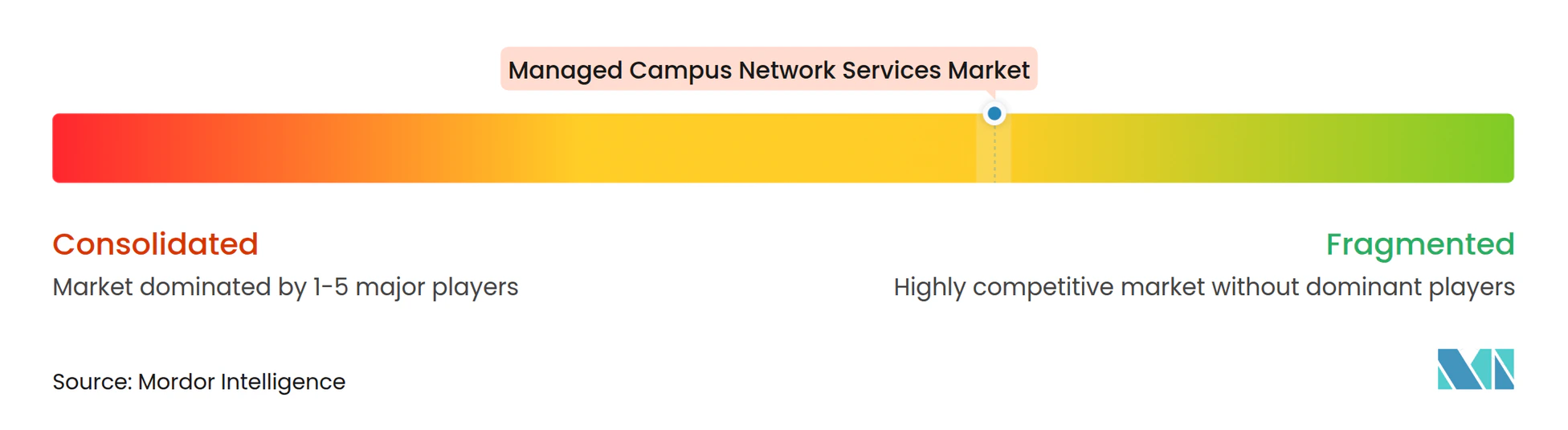
The managed campus network services market is moderately fragmented, with telecom carriers, systems integrators, and network equipment vendors competing across overlapping service portfolios. Carriers active in the managed campus network services market include AT&T, Verizon, BT, Orange, and Vodafone, while technology-led providers include Accenture, TCS, Wipro, HCL Technologies, Kyndryl, NTT DATA, IBM, and Fujitsu. Cisco, HPE, Extreme Networks, Juniper Networks, Nokia, Ericsson, and Huawei provide managed offerings linked to their network platforms. Competition is shaped by service breadth, security integration, cloud operations, and multivendor management capability.
Providers are extending coverage from WAN into campus operations and using cloud platforms to keep customers connected to their services. Cisco introduced cloud-managed fabrics and the AgenticOps approach in November 2025, aimed at automating cross-domain network and security workflows. HPE reported AI-native advances for self-driving network operations in December 2025 across enterprise and campus environments. These moves are intended to make operations more automated and strengthen platform integration.
Aviation, industrial OT and IT convergence, and sovereign services create openings where conventional managed models do not always meet customer requirements. SITA's airport-focused service addresses a specialized transport environment, while private 5G providers address industrial sites requiring dedicated wireless connectivity. Nile, Meter, and Join Digital are using campus Network as a Service models that combine recurring delivery with software-led operations. Nile launched its AI-powered Nile Nav application in January 2025 to reduce campus deployment timelines through automated lifecycle management. Compliance documentation and support for data residency requirements can influence vendor selection, and the absence of supplied combined shares supports a fragmented rather than concentrated characterization.
Managed Campus Network Services Industry Leaders
-
Cisco Systems, Inc.
-
Hewlett Packard Enterprise Company
-
NTT DATA Corporation
-
AT&T Inc.
-
Verizon Communications Inc.
- *Disclaimer: Major Players sorted in no particular order
Recent Industry Developments
- September 2026: Cisco entered a multi-year partnership with Notre Dame Athletics to modernize the University of Notre Dame's campus-wide network, deploying nearly 1,000 new Catalyst 9300x switches across the South Bend campus with Catalyst Center for zero-touch deployment and Cisco ThousandEyes for end-to-end digital experience visibility.
- July 2026: Deutsche Telekom and Ericsson completed deployment of a high-performance private 5G campus network at HHLA's Container Terminal Altenwerder in Hamburg, covering over 1 square kilometer and providing real-time connectivity for automated container logistics, running as a dedicated private 5G network independent of the public mobile network.
- July 2026: GTT Communications expanded its partnership with HPE to include managed SASE and LAN/WLAN services, combining GTT Secure Connect with HPE Aruba Central and HPE Networking Security Service Edge, extending managed services from the WAN into campus and local network environments for enterprise customers.
- June 2026: HPE announced expanded self-driving networks across edge, campus, data center, and AI factory environments, advancing its agentic enterprise strategy with autonomous networking integrating HPE Aruba Networking and HPE Juniper Networking for self-driving operations to maximize performance and scale for AI workloads.
- April 2026: SITA launched SITA Campus Network powered by HPE Aruba Networking, a fully managed wired and wireless network service targeting airports and transport hubs across more than 145 countries, using AI-driven monitoring and cloud-based management to reduce downtime and eliminate the need for on-site network expertise.
- April 2026: Siemens expanded its private 5G infrastructure to the United States and 7 additional countries, bringing the solution to a total of 15 countries across Europe and the Americas, with a U.S.-specific CBRS-band radio unit enabling manufacturers to deploy Siemens private 5G independently on their own premises.
Global Managed Campus Network Services Market Report Scope
The managed campus network services market comprises outsourced services for managing, monitoring, securing, and optimizing enterprise campus network infrastructure, including wired LAN, wireless LAN, SD-WAN, and private 5G networks. These services include network operations, performance monitoring, security management, automation, and lifecycle support, delivered through fully managed, co-managed, or subscription-based models to ensure reliable connectivity across organizational campuses.
The Managed Campus Network Services Market Report is segmented by Service Type (Managed LAN Services, Managed WLAN and Wi-Fi Services, Managed Network Security Services, Managed Network Monitoring and AIOps, Managed SD-Branch and SD-WAN Services, Managed Private 5G Campus Services, and Managed Network Lifecycle and Professional Services), Commercial Model (Fully Managed Services, Co-Managed Services, Network as a Service, and Monitoring and Notification Only), Deployment Model (Cloud-Managed, On-Premises Managed, and Hybrid Managed), Organization Size (Large Enterprises and Small and Medium-Sized Enterprises), End User (Corporate and Office Campuses, Higher Education and Research Campuses, Healthcare Campuses, Government and Defense Campuses, Manufacturing and Industrial Campuses, Retail and Distribution Campuses, and Other End Users), and Geography (North America, South America, Europe, Asia-Pacific, and Middle East and Africa). The Market Forecasts are Provided in Terms of Value (USD).
| Managed LAN Services |
| Managed WLAN and Wi-Fi Services |
| Managed Network Security Services |
| Managed Network Monitoring and AIOps |
| Managed SD-Branch and SD-WAN Services |
| Managed Private 5G Campus Services |
| Managed Network Lifecycle and Professional Services |
| Fully Managed Services |
| Co-Managed Services |
| Network as a Service |
| Monitoring and Notification Only |
| Cloud-Managed |
| On-Premises Managed |
| Hybrid Managed |
| Large Enterprises |
| Small and Medium-Sized Enterprises |
| Corporate and Office Campuses |
| Higher Education and Research Campuses |
| Healthcare Campuses |
| Government and Defense Campuses |
| Manufacturing and Industrial Campuses |
| Retail and Distribution Campuses |
| Other End Users |
| North America | United States | Canada |
| Mexico | ||
| South America | Brazil | |
| Argentina | ||
| Rest of South America | ||
| Europe | Germany | |
| United Kingdom | ||
| France | ||
| Italy | ||
| Rest of Europe | ||
| Asia-Pacific | China | |
| India | ||
| Japan | ||
| South Korea | ||
| Rest of Asia-Pacific | ||
| Middle East and Africa | Saudi Arabia | |
| United Arab Emirates | ||
| South Africa | ||
| Egypt | ||
| Rest of Middle East and Africa | ||
| By Service Type | Managed LAN Services | ||
| Managed WLAN and Wi-Fi Services | |||
| Managed Network Security Services | |||
| Managed Network Monitoring and AIOps | |||
| Managed SD-Branch and SD-WAN Services | |||
| Managed Private 5G Campus Services | |||
| Managed Network Lifecycle and Professional Services | |||
| By Commercial Model | Fully Managed Services | ||
| Co-Managed Services | |||
| Network as a Service | |||
| Monitoring and Notification Only | |||
| By Deployment Model | Cloud-Managed | ||
| On-Premises Managed | |||
| Hybrid Managed | |||
| By Organization Size | Large Enterprises | ||
| Small and Medium-Sized Enterprises | |||
| By End User | Corporate and Office Campuses | ||
| Higher Education and Research Campuses | |||
| Healthcare Campuses | |||
| Government and Defense Campuses | |||
| Manufacturing and Industrial Campuses | |||
| Retail and Distribution Campuses | |||
| Other End Users | |||
| By Geography | North America | United States | Canada |
| Mexico | |||
| South America | Brazil | ||
| Argentina | |||
| Rest of South America | |||
| Europe | Germany | ||
| United Kingdom | |||
| France | |||
| Italy | |||
| Rest of Europe | |||
| Asia-Pacific | China | ||
| India | |||
| Japan | |||
| South Korea | |||
| Rest of Asia-Pacific | |||
| Middle East and Africa | Saudi Arabia | ||
| United Arab Emirates | |||
| South Africa | |||
| Egypt | |||
| Rest of Middle East and Africa | |||
Key Questions Answered in the Report
What is the size of managed campus network services?
The managed campus network services market size was valued at USD 30.86 billion in 2026 and is projected to grow from USD 32.98 billion in 2027 to USD 46.09 billion by 2032, registering a CAGR of 6.92% during the forecast period (2027-2032). The forecast also reflects demand for centralized visibility, cloud-connected operations, and support for wireless, LAN, edge, and security environments across distributed sites. Organizations are using these services where internal teams need additional operational capacity, specialized skills, or a defined path for modernizing older infrastructure.
Which service type has the largest share in managed campus network services?
Managed WLAN and Wi-Fi Services holds the largest service-type share at 23.88% in 2026. Wireless upgrades require ongoing configuration, spectrum coordination, device management, and security support.
What is driving private 5G adoption on campuses?
Manufacturing, logistics, and government sites use private 5G for low-latency connectivity, SIM-based authentication, and dedicated wireless coverage. It also supports automation, OT equipment, and real-time process control.
Why are enterprises using fully managed campus networking services?
Fully Managed Services holds 44.66% of revenue because customers use providers to address multi-site complexity, skills shortages, and ongoing operational needs. The model also helps consolidate network, security, and lifecycle work.
Which region is expanding fastest for managed campus network services?
Asia-Pacific is projected to expand at a 7.46% CAGR through 2032, led by investment across India, South Korea, and Australia. Demand spans manufacturing, financial services, and higher education campuses.
How are cloud-managed deployments changing campus networking?
Cloud-Managed deployments hold 42.27% of revenue and are projected to expand at a 7.57% CAGR because they support centralized visibility, updates, and automated operations. Hybrid and on-premises choices remain important for regulated and air-gapped settings, where customers need local control, data residency, and specialized security arrangements.