
Managed Branch Networking Services Market Size and Share
Market Overview
| Study Period | 2021 - 2032 |
|---|---|
| Market Size (2027) | USD 54.63 Billion |
| Market Size (2032) | USD 100.29 Billion |
| Growth Rate (2027 - 2032) | 15.58 % |
| Fastest Growing Market | Asia-Pacific |
| Largest Market | North America |
| Market Concentration | Medium |
Major Players *Disclaimer: Major Players sorted in no particular order Image © Mordor Intelligence. Reuse requires attribution under CC BY 4.0. | |
Managed Branch Networking Services Market Analysis by Mordor Intelligence
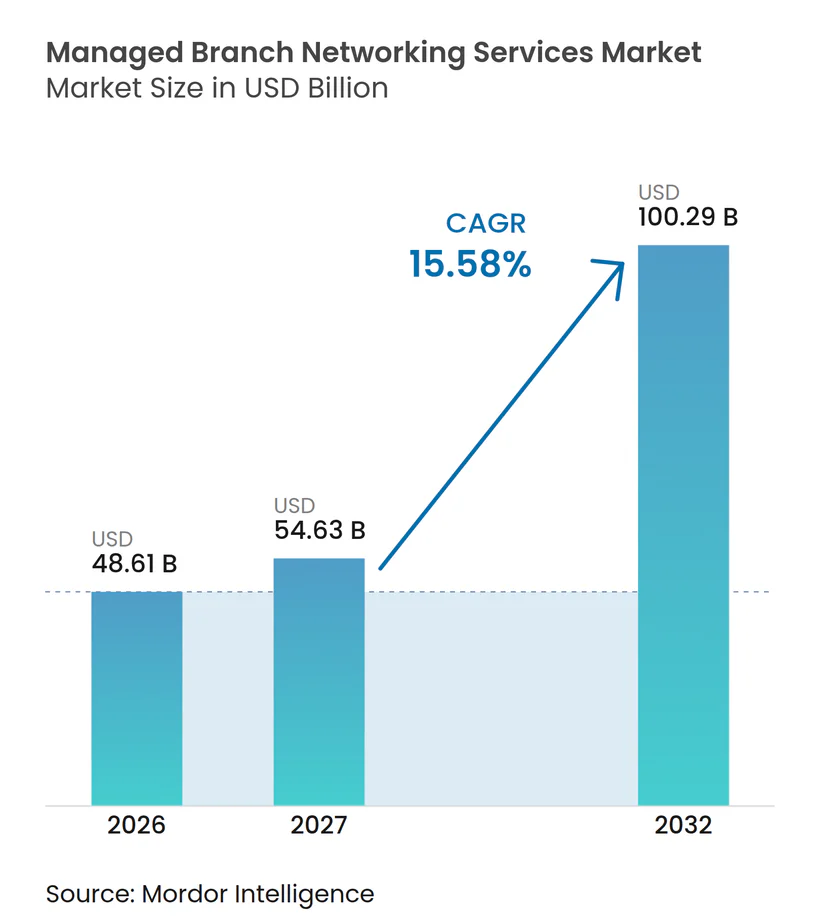
The managed branch networking services market size is projected to expand from USD 48.61 billion in 2026 and USD 54.63 billion in 2027 to USD 100.29 billion by 2032, registering a CAGR of 15.58% between 2027 and 2032. The managed branch networking services market is moving toward integrated services that combine connectivity, security, monitoring, and branch support under one provider. Enterprises are replacing separate routers, firewalls, WAN tools, and Wi-Fi systems with software-defined platforms that can be managed centrally. This change reduces the operational pressure associated with coordinating multiple vendors across large branch networks. Providers are responding by combining managed SD-WAN with secure access service edge capabilities and more flexible service models. Demand also reflects the need to support cloud applications, distributed workforces, stronger security controls, and consistent application performance across locations.
Key Report Takeaways
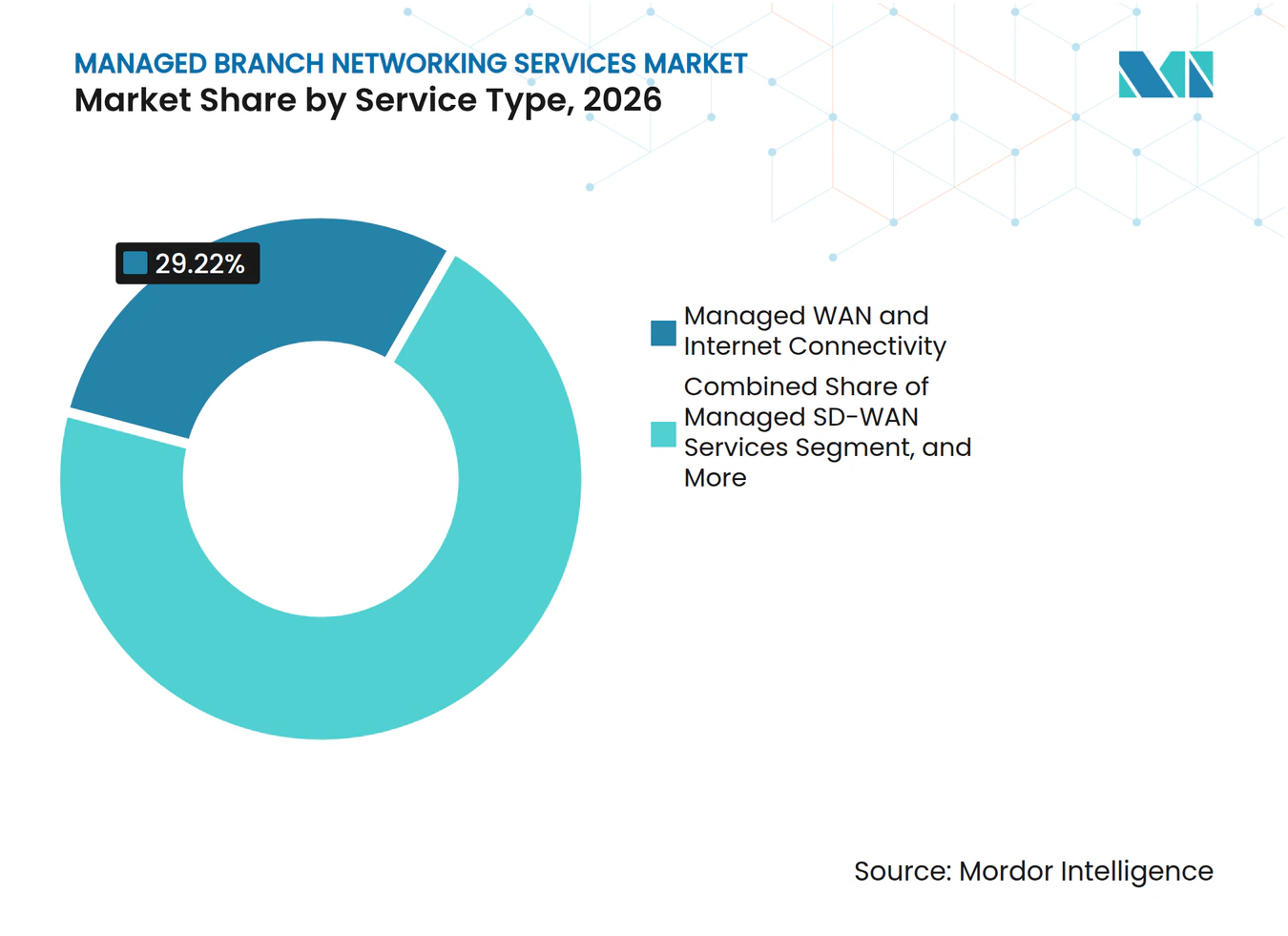
- By service type, Managed WAN and Internet Connectivity held 29.22% of the managed branch networking services market share in 2026, while Managed SD-WAN Services is projected to expand at a CAGR of 16.72% through 2032.
- By delivery model, Fully Managed Services accounted for 55.14% of revenue in 2026, while Network-as-a-Service and Consumption-Based Services is projected to expand at a CAGR of 16.63% through 2032.
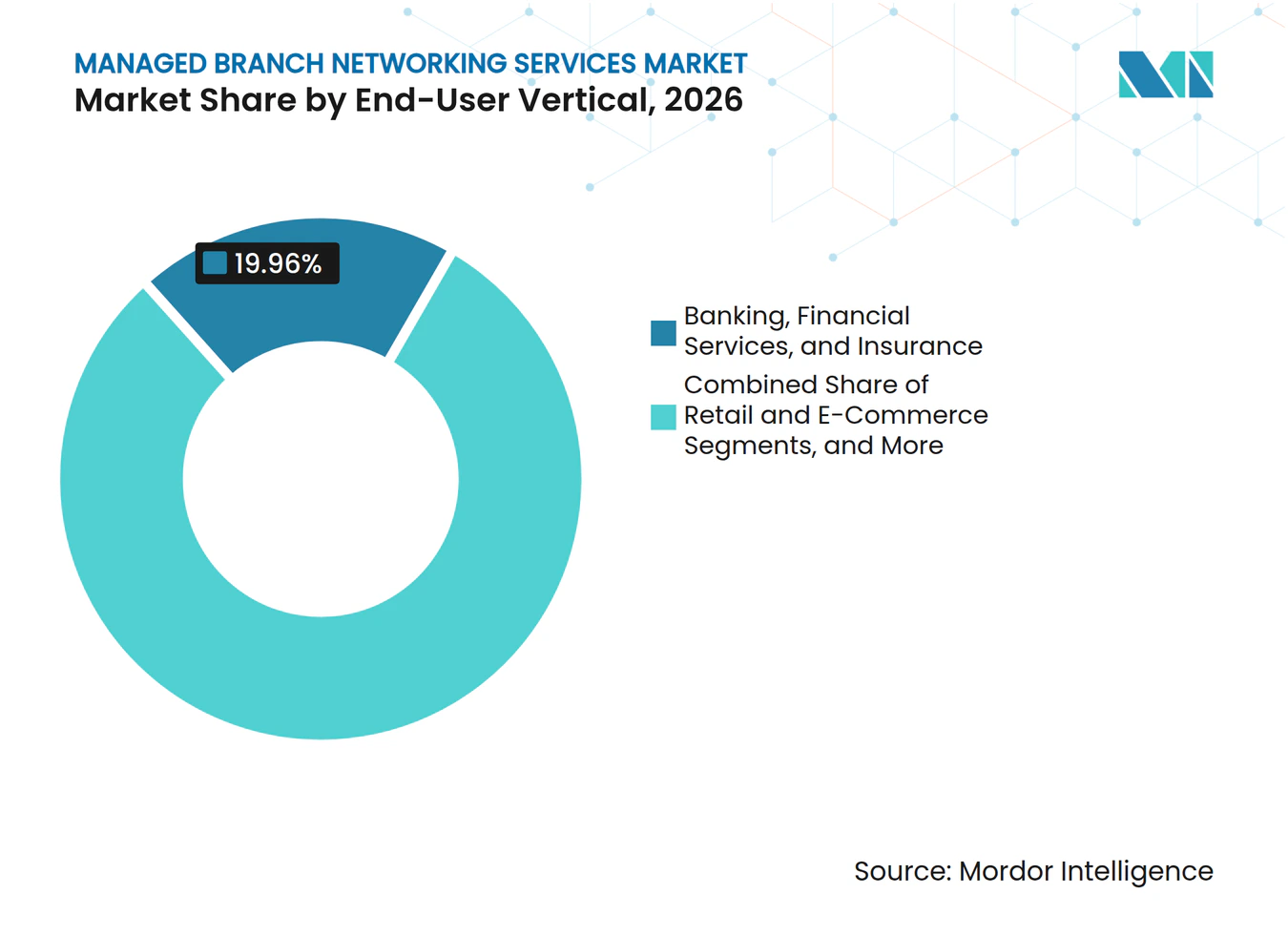
- By end-user vertical, Banking, Financial Services, and Insurance held 19.96% of revenue in 2026, while Retail and E-Commerce is projected to expand at a CAGR of 16.84% through 2032.
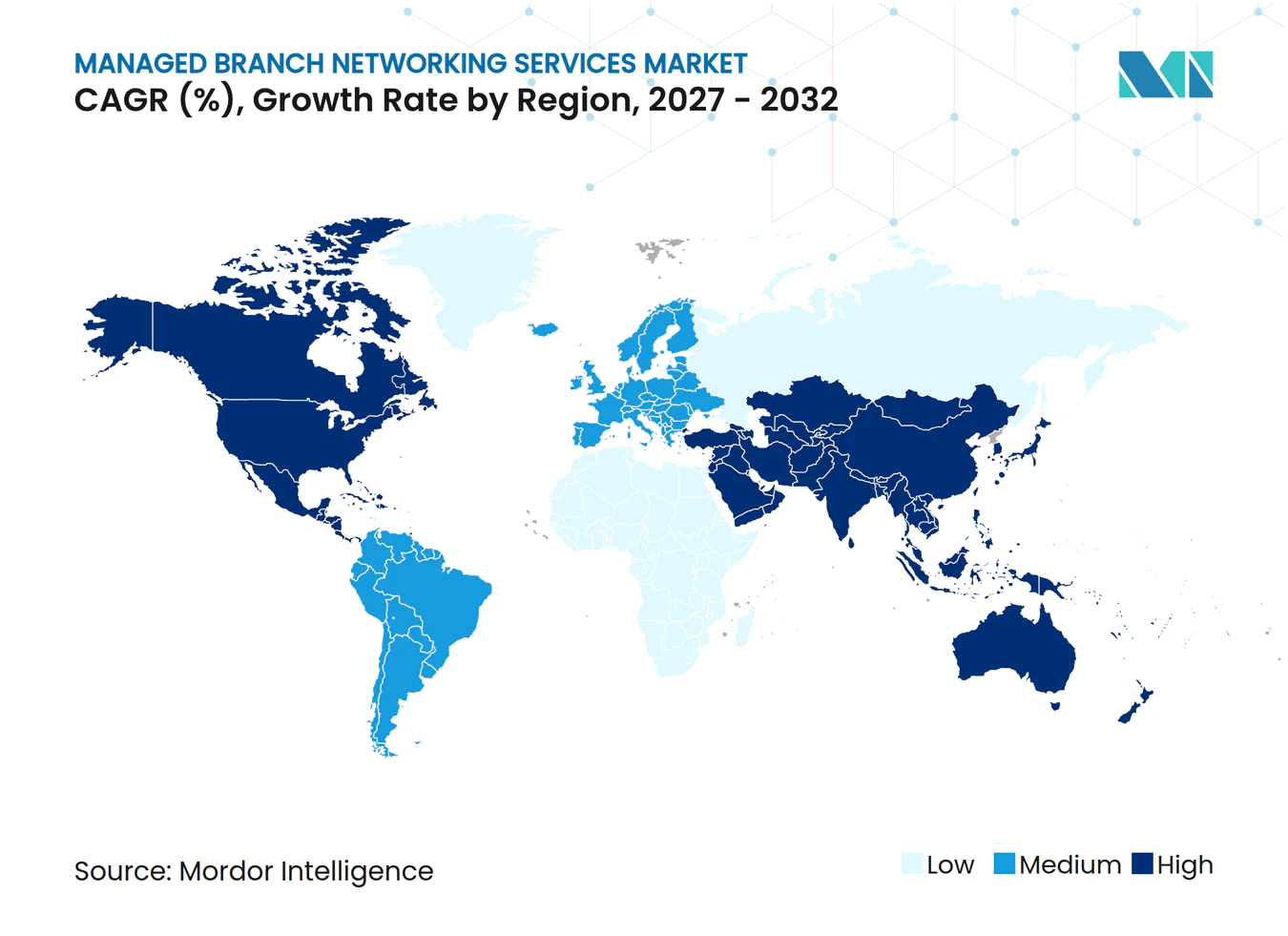
- By geography, North America held 38.48% of revenue in 2026, while Asia-Pacific is projected to expand at a CAGR of 16.84% through 2032.
Note: Market numbers in this report are based on Mordor Intelligence's proprietary estimation framework, which combines nine months of actuals with Q4 projections for base year 2026.
Market Trends and Insights
Drivers Impact Analysis of Managed Branch Networking Services Market*
| Driver | (~) % Impact on CAGR Forecast | Geographic Relevance | Impact Timeline |
|---|---|---|---|
| Cloud and SaaS Traffic Growth Across Distributed Branches | +4.0% | Global | Short term (≤ 2 years) |
| MPLS Modernization and Broadband, 5G, and DIA Cost Optimization | +3.2% | Global | Medium term (2-4 years) |
| Convergence of Networking and Security Through SASE | +2.8% | Global | Medium term (2-4 years) |
| Shortage of Network Engineering Talent and Demand for Outsourced Operations | +2.0% | North America and Europe, spill-over to Asia-Pacific | Medium term (2-4 years) |
| AI-Enabled Network Assurance and Predictive Incident Prevention | +1.5% | Global | Medium term (2-4 years) |
| Standardized Zero-Touch Branch Rollouts for Retail, Financial, and Distributed Workforces | +1.2% | Asia-Pacific and North America, spill-over to Middle East and Africa | Short term (≤ 2 years) |
| Source: Mordor Intelligence | |||
Cloud and SaaS Traffic Growth Across Distributed Branches
Cloud and SaaS traffic from branch locations has changed the role of enterprise networks. Sending this traffic back to a central data center can add latency and place unnecessary pressure on older MPLS links. Branch teams now need direct, secure access to cloud applications while retaining consistent performance and policy control. The managed branch networking services market benefits because providers can coordinate access links, cloud connectivity, software-defined controls, and security functions through one operating model. As organizations add productivity, analytics, and sector-specific cloud applications, network policies become harder to manage at every individual location. This shift makes application performance and traffic visibility important elements of managed service contracts, rather than secondary features.
MPLS Modernization and Broadband, 5G, and DIA Cost Optimization
Replacing legacy MPLS connections remains a major activity for distributed enterprises. Managed SD-WAN allows organizations to use broadband, dedicated internet access, and 5G fixed wireless links without relying on a single transport type. Versa Networks states that managed SD-WAN overlays can reduce transport costs by up to 40% while maintaining application-aware path selection across varied underlays.[1] 5G is also becoming useful as a primary link where fiber installation takes months, especially in urban and peri-urban branch settings. The managed branch networking services market therefore has an opportunity to support faster site activations and more resilient access designs. The continuing replacement of older contracts supports demand for Managed SD-WAN Services through the forecast period.
Convergence of Networking and Security Through SASE
Enterprises increasingly seek one managed service for branch connectivity and security controls. This approach combines SD-WAN with security capabilities that inspect traffic, apply access policies, and support audit needs across many locations. The managed branch networking services market is supported by buyers that want a single management interface and clear accountability for network and security outcomes. Security requirements now influence many branch refresh decisions because distributed applications need controls that work consistently across users, devices, and sites. Providers that include managed SASE in branch contracts can simplify vendor oversight and make it easier for customers to apply standard controls. This approach can also deepen provider relationships because customers rely on the same service for traffic management and security enforcement.
Shortage of Network Engineering Talent and Demand for Outsourced Operations
Many enterprises lack enough network specialists to operate complex branch environments around the clock. The shortage is most acute where teams must manage software-defined networks, cloud connectivity, security tools, and 5G access at the same time. The managed branch networking services market addresses this need through external design, monitoring, incident response, and lifecycle support. Mid-sized organizations can be particularly affected because their branch footprints require professional operations, but their scale may not justify a dedicated network operations center. Outsourced services allow these organizations to use standardized designs and specialized support without building every capability internally. Providers that tailor their services to retail, financial services, healthcare, and other branch-heavy users can address needs that differ by operating environment.
Restraints Impact Analysis of Managed Branch Networking Services Market*
| Restraint | (~) % Impact on CAGR Forecast | Geographic Relevance | Impact Timeline |
|---|---|---|---|
| Multivendor Interoperability and Carrier-Boundary Complexity | -1.8% | Global | Long term (≥ 4 years) |
| Data Sovereignty, Cybersecurity, and Regulatory Compliance Burden | -1.4% | Europe, Asia-Pacific, and Middle East and Africa | Medium term (2-4 years) |
| Customer Reluctance to Outsource Mission-Critical Network Control | -1.0% | Global | Long term (≥ 4 years) |
| Fragmented Underlay Connectivity and Inconsistent Last-Mile Service Quality | -0.8% | South America, Africa, and Rest of Middle East and Africa | Long term (≥ 4 years) |
| Source: Mordor Intelligence | |||
Multivendor Interoperability and Carrier-Boundary Complexity
Multinational enterprises often use several carriers to connect their branch locations. The physical access network and the SD-WAN overlay may be managed by different parties, which can slow fault isolation during an outage. Open Systems notes that underlay issues can create accountability gaps when the overlay provider does not manage the transport network.[2] These gaps can extend restoration times and lead to difficult escalation processes for customers. The managed branch networking services market must address this issue through clearer service responsibilities, better carrier coordination, and stronger visibility across access links and overlays. A globally uniform model can remain difficult where countries require local carrier approvals or place limits on data routing.
Data Sovereignty, Cybersecurity, and Regulatory Compliance Burden
Data residency, traffic-routing, and visibility rules can increase the cost of delivering managed services across borders. Financial institutions also face third-party technology oversight requirements when they rely on external network providers. The European Union NIS2 Directive covers essential and important entities in 18 sectors and includes administrative fines of up to EUR 10 million or 2% of worldwide annual turnover, whichever is higher.[3] This regulatory influence can require managed providers to demonstrate how traffic is contained, protected, monitored, and recovered. Graphiant identified sovereign controls as a core feature of its Saudi Arabia expansion in 2025, showing the relevance of localized service architecture for regulated users. The managed branch networking services market must balance cloud performance with requirements that keep sensitive traffic within designated jurisdictions.
*Our forecasts treat driver/restraint impacts as directional, not additive. The impact forecasts reflect baseline growth, mix effects, and variable interactions.
Managed Branch Networking Services Market Segment Analysis
By Service Type:
WAN Connectivity Retains Scale as Managed SD-WAN ExpandsManaged WAN and Internet Connectivity held 29.22% of revenue in 2026. The managed branch networking services market continues to rely on this segment because many enterprises outsource the provisioning, monitoring, and assurance of WAN links across dispersed branch estates. Long-standing carrier relationships have created recurring service arrangements for organizations that first outsourced networks during the MPLS period. The broader portfolio also includes Managed LAN and Wi-Fi, Managed Network Security, monitoring and assurance, and branch voice and unified communications. Monitoring has gained importance where unified communications and cloud-hosted enterprise applications need stable performance, detailed visibility, and quick issue detection.
Managed SD-WAN Services is projected to expand at a CAGR of 16.72% through 2032, making it the fastest-moving service category in the managed branch networking services industry. The segment benefits from MPLS replacement and from SD-WAN's role as a traffic-control layer within SASE designs. Managed providers can select paths according to application requirements, link conditions, and policy rules, improving resilience at branch locations. Centralized configuration limits the need for on-site technical work during deployments and supports more consistent operating standards. These capabilities make Managed SD-WAN Services relevant for enterprises seeking reliable connectivity across larger location networks.



By Delivery Model:
Fully Managed Services Lead While NaaS Changes Spending ModelsFully Managed Services accounted for 55.14% of managed branch networking services market revenue in 2026. Organizations in this segment outsource network design, deployment, monitoring, maintenance, incident resolution, and performance reporting to a single provider. The managed branch networking services market supports this approach for enterprises with many sites and limited capacity to staff global network operations internally. Co-Managed Services and Notify-Only and Monitoring Services serve organizations that retain some technical control but need help with selected tasks. These alternatives are relevant for technology-focused companies and larger institutions that have internal teams but do not want to manage the full lifecycle alone.
Network-as-a-Service and Consumption-Based Services is projected to expand at a CAGR of 16.63% through 2032. The model allows organizations to align networking expenses with use rather than purchasing capacity for long periods in advance. It can support customers opening sites quickly, testing new locations, or adjusting capacity as requirements change. PacketFabric introduced PacketFabric.ai in December 2025 to enable customers to design, price, and provision connectivity through natural-language commands. This type of platform can reduce the technical effort required to consume flexible networking services, particularly for mid-sized companies with limited engineering resources.
By End-User Vertical:
BFSI Holds Leadership While Retail and E-Commerce AccelerateBanking, Financial Services, and Insurance held 19.96% of revenue in 2026. The managed branch networking services market serves this sector's many branches, extensive regulatory obligations, and limited tolerance for disruption. Financial institutions require reliable connectivity, documented performance, security controls, and rapid recovery procedures that can be reviewed by internal and external stakeholders. Other major users include IT and Telecom, Manufacturing, Healthcare and Life Sciences, Government and Public Sector, and Energy and Utilities. Each of these sectors has distinct requirements for device connectivity, security, traffic visibility, and data handling.
Retail and E-Commerce is projected to expand at a CAGR of 16.84% through 2032. Store networks often need rapid activation, standardized security, and centralized oversight across large numbers of locations. Cloud-based orchestration can reduce the need to configure equipment manually at every site. Airtel Business reported a deployment of SD-Branch with zero-touch provisioning across more than 6,000 outlets for an Indian pharmaceutical retailer. The deployment combined connectivity, network security, and surveillance management without sending engineers to each outlet, an approach relevant to grocery, convenience, and quick-service restaurant networks.

Geography Analysis
North America held 38.48% of the managed branch networking services market share in 2026. Early cloud adoption, extensive broadband availability, and a developed managed-services ecosystem support demand from financial services and healthcare organizations that require secure, documented operations across dispersed sites. Canadian companies face geographic dispersion, while Mexican manufacturers near the U.S. border use managed connectivity for production environments that exchange data across supply chains. GTT expanded its managed service scope with HPE in July 2026 to cover SASE and managed LAN and WLAN capabilities from edge to cloud, showing how providers are extending beyond traditional WAN management.
Asia-Pacific is projected to expand at a CAGR of 16.84% through 2032. The managed branch networking services market benefits from MPLS modernization, 5G development, and government digitization programs, particularly where varied access quality and tight technical labor markets make externally managed operations attractive. Cisco and KDDI delivered Japan's first fully managed, single-vendor SASE solution in August 2025, combining Cisco Secure Access with SD-WAN. NTT Integration also began offering Aryaka's global SD-WAN service in Japan in February 2025 for enterprises with international branch networks. In India, manufacturing and banking users are deploying managed SD-Branch services in Tier 2 and Tier 3 cities, where inconsistent infrastructure and growing industrial connectivity needs favor localized access coordination and centralized policy management.
Europe is an important regional market for managed branch networking services, with demand concentrated in the United Kingdom, Germany, and France. MPLS replacement and NIS2-related cybersecurity obligations require providers to support auditable controls, incident handling, and third-party accountability. In the Middle East, Saudi Arabia's Vision 2030 programs and enterprise investment in the United Arab Emirates support interest in sovereign networking models, and Graphiant expanded its Saudi Arabia presence in 2025 for regulated users. Brazil leads South American adoption, although inconsistent last-mile performance in secondary cities can limit service quality and increase the need for coordinated underlay management. Africa remains an emerging opportunity, with South Africa's enterprise base, Egypt's digital infrastructure programs, and commercial-corridor broadband and 5G availability shaping future deployments.
Competitive Landscape
Market Concentration
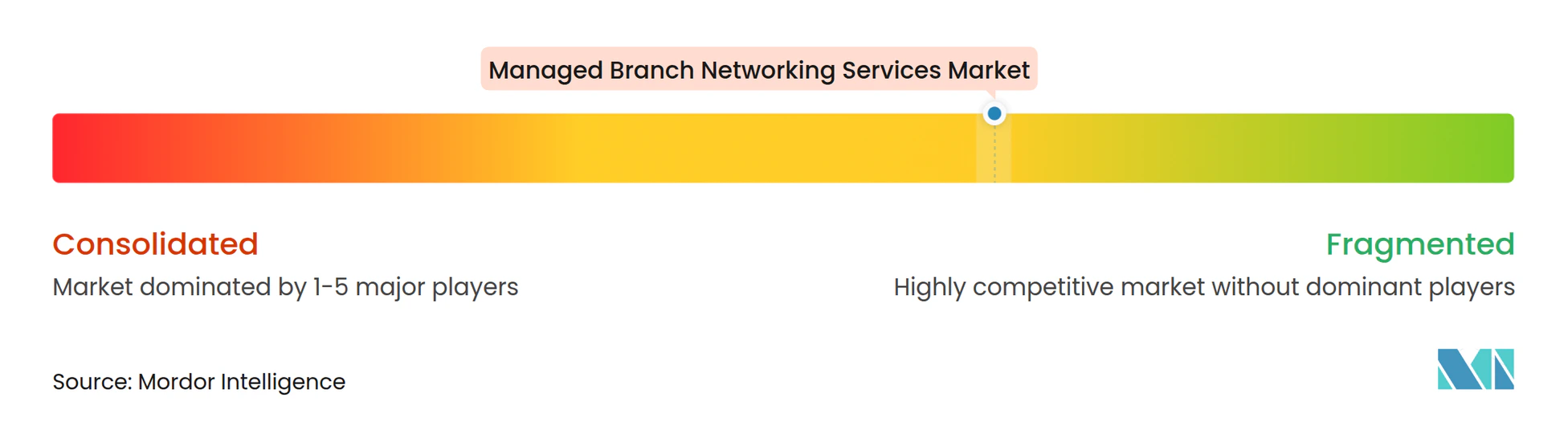
The managed branch networking services market has a fragmented global structure. Competition centers on combining SD-WAN, SASE, managed LAN, security, monitoring, and access services into one operating model. Providers are also investing in automation and geographic reach to improve incident handling, configuration work, and service coordination across countries. The managed branch networking services market rewards providers that can retain a consistent management layer while coordinating local underlay relationships.
GTT has pursued a broader managed platform approach through GTT Envision. In July 2025, the company expanded its partnership with Palo Alto Networks to add Prisma SASE to its Secure Connect managed SASE portfolio. In October 2025, GTT deployed an AI factory with NVIDIA, Dell Technologies, and Insight Enterprises to support AI-driven network and security insights, product development, and internal productivity. The company also expanded its EnvisionCORE Tier 1 IP backbone across several Asia-Pacific and South American countries in May 2025. These actions combine platform scope, AI-supported operations, and wider reach for multinational enterprise customers.
The managed branch networking services market has opportunities in sovereign managed services, AI-ready branch connectivity, and consumption-based managed LAN for site-intensive organizations. Regulated government, energy, and financial services users need specific controls over traffic location and data handling, while AI workloads need predictable paths, strong security, and centralized policy enforcement. PacketFabric and Massed Compute introduced an integrated GPU-as-a-Service and Network-as-a-Service offering in January 2026 for enterprise AI deployments. Graphiant has focused on sovereign connectivity in Saudi Arabia, while Aryaka updated its Unified SASE as a Service platform with zero-trust and AI security capabilities. These examples show how competitors are combining network delivery, security controls, automation, and flexible service models.
Managed Branch Networking Services Industry Leaders
-
Cisco Systems, Inc.
-
AT&T Inc.
-
Verizon Communications Inc.
-
NTT DATA Group Corporation
-
Deutsche Telekom AG
- *Disclaimer: Major Players sorted in no particular order
Managed Branch Networking Services Market Companies Covered in this Report
- Aryaka Networks, Inc.
- Cato Networks Ltd.
- GTT Communications, Inc.
- Hughes Network Systems, LLC
- TPx Communications, LLC
- Windstream Holdings II, LLC
- Fusion Connect, Inc.
- Open Systems AG
- Versa Networks, Inc.
- Bigleaf Networks, Inc.
- FatPipe Networks, Inc.
- Epsilon Global Communications Pte. Ltd.
- Expereo International B.V.
- Apcela, Inc.
- Turnium Technology Group Inc.
- Megaport Limited
- PacketFabric, Inc.
- Sencinet
- Masergy Communications, Inc.
- Comcast Business Communications, LLC
- Nitel, Inc.
- Telarus, LLC
- Graphiant, Inc.
- Nour Global
- Sify Technologies Limited
Recent Industry Developments in Managed Branch Networking Services Market
- July 2026: GTT Communications and HPE deepened their partnership to deliver new managed services spanning SASE and managed LAN/WLAN, enabling enterprises to simplify operations and strengthen security from edge to cloud. The partnership extended GTT Envision's platform-level accountability to campus and branch LAN environments, expanding the addressable managed service scope for existing GTT customers.
- April 2026: GTT announced its 2026 strategy, building on recognition by CAIDA as the world's third-largest global internet backbone at 700-plus terabits of capacity. The strategy introduced an AI-enabled cybersecurity framework for real-time detection and proactive threat mitigation, expanded zero-touch provisioning through the EnvisionDX platform, and added 5G fixed wireless and LEO satellite connectivity to its branch access portfolio. GTT reported that Enhanced Services revenue, including Managed SD-WAN and SIP Trunking, expanded in every quarter of 2025.
- February 2026: Expereo and Cato Networks announced a collaboration at TechEx London, combining Cato's SASE platform and 85-plus points of presence with Expereo's underlay partner network across more than 190 countries. The collaboration is designed to deliver a single-source, end-to-end networking and security solution for multinational enterprises, with the combined addressable market positioned at USD 105 billion across SASE and connectivity.
- January 2026: PacketFabric and Massed Compute announced the first-to-market integration of GPU-as-a-Service and Network-as-a-Service, creating a production-ready platform for enterprises deploying and scaling AI workloads. The offering simplifies the procurement of compute and connectivity for distributed AI inference environments, reducing the infrastructure complexity that previously required separate vendor relationships.
Global Managed Branch Networking Services Market Report Scope
The Managed Branch Networking Services Market refers to the industry focused on the outsourcing of branch network planning, deployment, monitoring, optimization, security, and lifecycle management to specialized third-party service providers that manage connectivity across distributed enterprise locations.
The Managed Branch Networking Services Market Report is Segmented by Service Type (Managed SD-WAN Services, Managed WAN and Internet Connectivity, Managed LAN and Wi-Fi, Managed Network Security, Managed Network Monitoring and Assurance, and Managed Branch Voice and Unified Communications), Delivery Model (Fully Managed Services, Co-Managed Services, Notify-Only and Monitoring Services, and Network-as-a-Service and Consumption-Based Services), End-User Vertical (Banking, Financial Services, and Insurance, Retail and E-Commerce, IT and Telecom, Manufacturing, Healthcare and Life Sciences, Government and Public Sector, Energy and Utilities, and Other End-User Verticals), and Geography (North America [United States, Canada, and Mexico], South America [Brazil, Argentina, and Rest of South America], Europe [United Kingdom, Germany, France, Italy, Spain, Russia, and Rest of Europe], Asia-Pacific [China, Japan, India, South Korea, and Rest of Asia-Pacific], Middle East [Saudi Arabia, United Arab Emirates, Israel, Turkey, and Rest of Middle East], and Africa [South Africa, Egypt, and Rest of Africa]). The Market Forecasts are Provided in Terms of Value (USD).
Segmentation Overview
| Managed SD-WAN Services |
| Managed WAN and Internet Connectivity |
| Managed LAN and Wi-Fi |
| Managed Network Security |
| Managed Network Monitoring and Assurance |
| Managed Branch Voice and Unified Communications |
| Fully Managed Services |
| Co-Managed Services |
| Notify-Only and Monitoring Services |
| Network-as-a-Service and Consumption-Based Services |
| Banking, Financial Services, and Insurance |
| Retail and E-Commerce |
| IT and Telecom |
| Manufacturing |
| Healthcare and Life Sciences |
| Government and Public Sector |
| Energy and Utilities |
| Other End-User Verticals |
| North America | United States |
| Canada | |
| Mexico | |
| South America | Brazil |
| Argentina | |
| Rest of South America | |
| Europe | United Kingdom |
| Germany | |
| France | |
| Italy | |
| Spain | |
| Russia | |
| Rest of Europe | |
| Asia-Pacific | China |
| Japan | |
| India | |
| South Korea | |
| Rest of Asia-Pacific | |
| Middle East | Saudi Arabia |
| United Arab Emirates | |
| Israel | |
| Turkey | |
| Rest of Middle East | |
| Africa | South Africa |
| Egypt | |
| Rest of Africa |
| By Service Type | Managed SD-WAN Services | |
| Managed WAN and Internet Connectivity | ||
| Managed LAN and Wi-Fi | ||
| Managed Network Security | ||
| Managed Network Monitoring and Assurance | ||
| Managed Branch Voice and Unified Communications | ||
| By Delivery Model | Fully Managed Services | |
| Co-Managed Services | ||
| Notify-Only and Monitoring Services | ||
| Network-as-a-Service and Consumption-Based Services | ||
| By End-User Vertical | Banking, Financial Services, and Insurance | |
| Retail and E-Commerce | ||
| IT and Telecom | ||
| Manufacturing | ||
| Healthcare and Life Sciences | ||
| Government and Public Sector | ||
| Energy and Utilities | ||
| Other End-User Verticals | ||
| By Geography | North America | United States |
| Canada | ||
| Mexico | ||
| South America | Brazil | |
| Argentina | ||
| Rest of South America | ||
| Europe | United Kingdom | |
| Germany | ||
| France | ||
| Italy | ||
| Spain | ||
| Russia | ||
| Rest of Europe | ||
| Asia-Pacific | China | |
| Japan | ||
| India | ||
| South Korea | ||
| Rest of Asia-Pacific | ||
| Middle East | Saudi Arabia | |
| United Arab Emirates | ||
| Israel | ||
| Turkey | ||
| Rest of Middle East | ||
| Africa | South Africa | |
| Egypt | ||
| Rest of Africa | ||
Key Questions Answered in the Report
What is the managed branch networking services market size?
The managed branch networking services market size is projected to increase from USD 48.61 billion in 2026 and USD 54.63 billion in 2027 to USD 100.29 billion by 2032, at a CAGR of 15.58%.
What is driving demand for managed branch networking services?
Cloud application use, MPLS modernization, SASE adoption, and a shortage of network specialists are increasing demand for externally managed connectivity and security services.
Which service category leads managed branch networking services?
Managed WAN and Internet Connectivity led with a 29.22% share in 2026, while Managed SD-WAN Services is projected to expand at a CAGR of 16.72% through 2032.
Why are enterprises adopting Network-as-a-Service?
Network-as-a-Service provides a consumption-based model that can align network spending with actual demand and support faster service provisioning.
Which end-user vertical has the highest share?
Banking, Financial Services, and Insurance held 19.96% of revenue in 2026 because these organizations require secure, reliable, and auditable branch connectivity.
Which region is expanding fastest for managed branch networking services?
Asia-Pacific is projected to expand at a CAGR of 16.84% through 2032, supported by network modernization, 5G development, and digitization across enterprise sectors.