
Malaysia Takaful Market Size and Share
Market Overview
| Study Period | 2021 - 2032 |
|---|---|
| Forecast Data Period | 2027 - 2032 |
| Base Year Market Size (2026) | USD 4.20 Billion |
| Market Size (2027) | USD 4.5 Billion |
| Market Size (2032) | USD 5.80 Billion |
| Growth Rate (2027 - 2032) | 5.50 % |
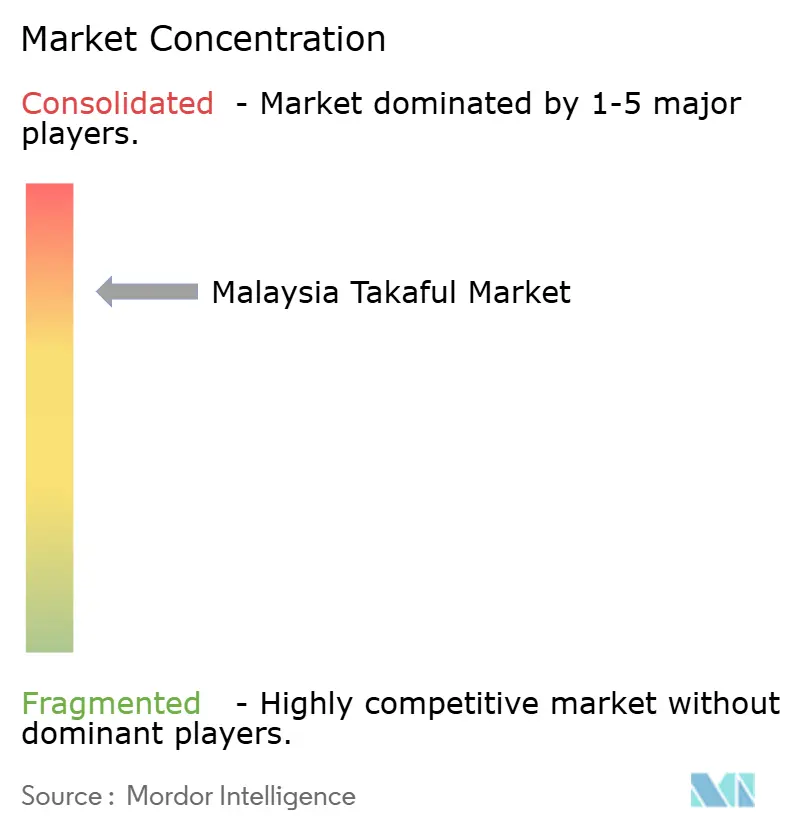
| Market Concentration | High |
Major Players *Disclaimer: Major Players sorted in no particular order Image © Mordor Intelligence. Reuse requires attribution under CC BY 4.0. | |
Malaysia Takaful Market Analysis by Mordor Intelligence
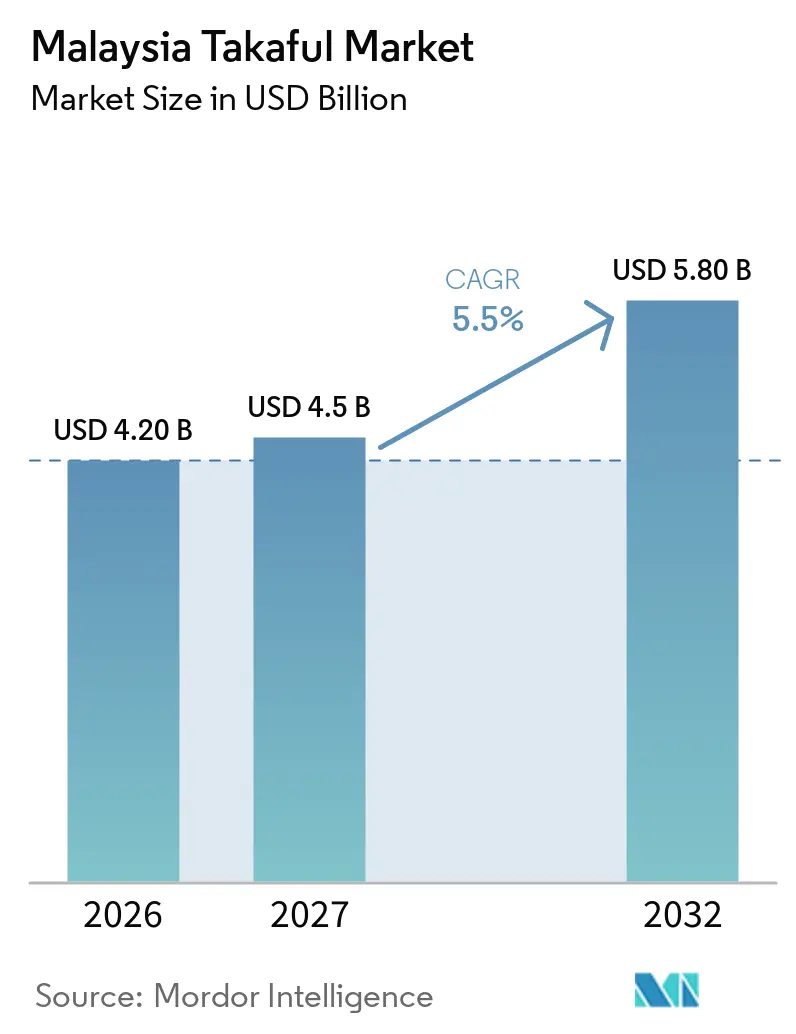
The Malaysia Takaful Market size is projected to expand from USD 4.20 billion in 2026 and USD 4.5 billion in 2027 to USD 5.80 billion by 2032, registering a CAGR of 5.5% between 2027 and 2032.
Net contributions in Malaysia’s takaful industry rose 9.8% to MYR 19.0 billion (USD 4.2 billion) in 2024, compared with MYR 17.3 billion in 2023. In 2025, gross contributions increased 4.73% to MYR 16.38 billion (USD 3.6 billion), indicating continued market expansion at a more moderate pace. Takaful industry assets reached MYR 62.54 billion (USD 13.9 billion) by mid-2025, up from MYR 41.87 billion (USD 9.3 billion) in 2020, strengthening the sector’s financial base. Meanwhile, the overall Malaysian insurance and takaful industry maintained a capital adequacy ratio of 225% in the second half of 2025, above Bank Negara Malaysia’s 130% regulatory minimum, with excess capital of MYR 43.8 billion (USD 9.7 billion). These capital figures apply to the combined insurance and takaful industry rather than takaful operators alone. Market growth is supported by bancatakaful partnerships, motor protection demand, and digital distribution, while rising medical costs and claims are putting pressure on product affordability, pricing, and underwriting margins.
Key Report Takeaways
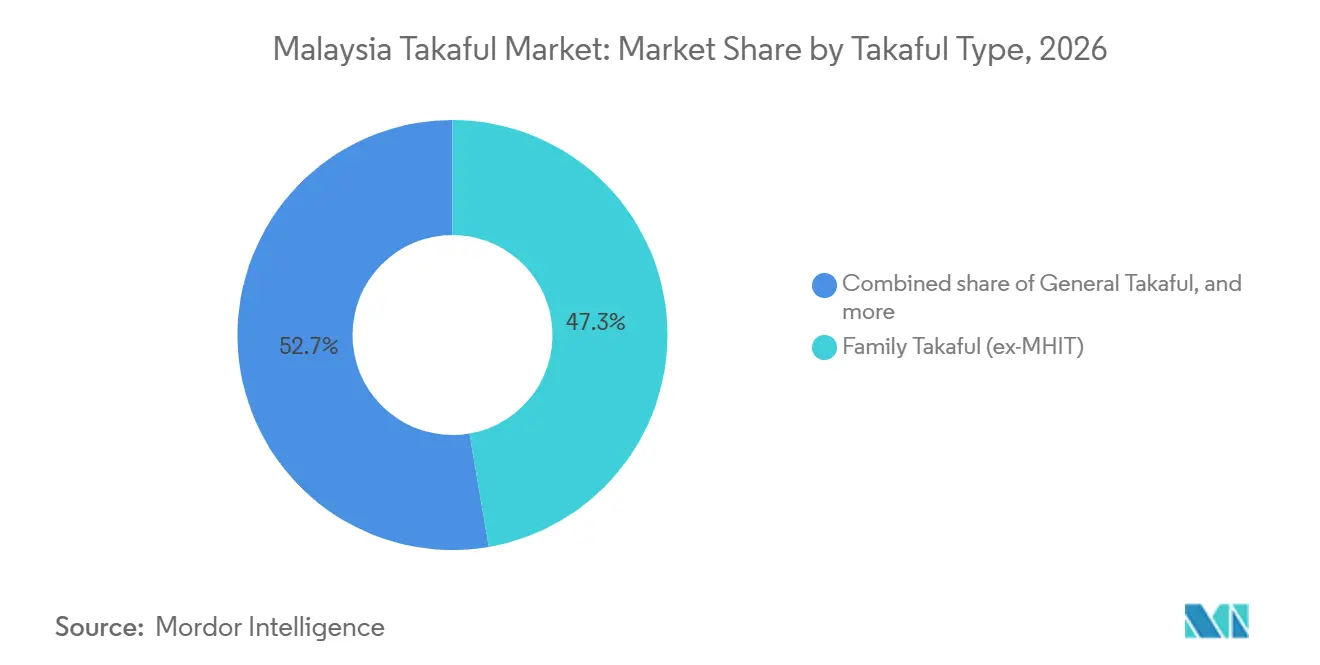
- By takaful type, family takaful excluding medical and health insurance, and takaful captured 47.3% of the Malaysia Takaful market share in 2026, while general takaful is projected to grow at a 6.6% CAGR through 2032.
- By distribution channel, bancatakaful held 53.8% of the Malaysia Takaful market share in 2026, while embedded, affinity, and other non-bank partnerships are forecast to grow at an 8.6% CAGR through 2032.
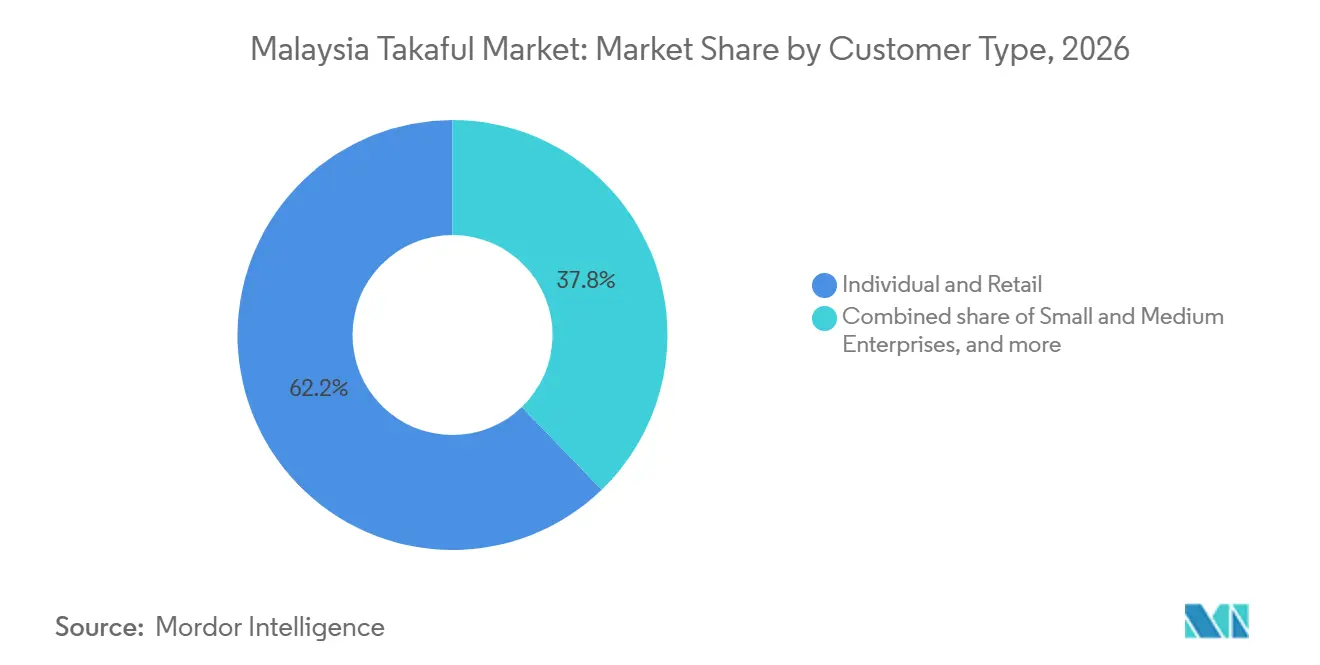
- By customer type, individual and retail participants accounted for 62.2% of the Malaysia Takaful market share in 2026, while small and medium-sized enterprises are projected to grow at a 7.1% CAGR through 2032.
- By geography, Central Malaysia accounted for 46.3% of the Malaysia Takaful market share in 2026, while East Malaysia is projected to grow at a 7.4% CAGR through 2032.
Note: Market numbers in this report are based on Mordor Intelligence's proprietary estimation framework, which combines nine months of actuals with Q4 projections for base year 2026.
Malaysia Takaful Market Trends and Insights
Drivers Impact Analysis*
| Driver | (~) % Impact on CAGR Forecast | Geographic Relevance | Impact Timeline |
|---|---|---|---|
| Bancatakaful Expansion | +0.8% | National, with the highest density in Central Malaysia and Northern Malaysia | Medium term (2-4 years) |
| Family Protection Gaps | +0.7% | National, with concentrated relevance in East Malaysia and the East Coast | Long term (≥ 4 years) |
| Microtakaful and Affordable Protection | +0.5% | National, with early traction in B40 communities across all 5 regions | Medium term (2-4 years) |
| Digital Distribution and Digital Operators | +0.9% | National, with spillover into East Malaysia through mobile-first access | Medium term (2-4 years) |
| Motor Demand and Motor-Market Reform | +0.8% | National, with the highest density in Central Malaysia and Southern Malaysia | Short term (≤ 2 years) |
| Medical and Health Protection Demand | +0.6% | National, with the greatest relevance in Central Malaysia and Northern Malaysia urban clusters | Medium term (2-4 years) |
| Source: Mordor Intelligence | |||
Expansion of Bancatakaful as a Key Takaful Distribution Channel
Bancatakaful remains an important distribution channel for family takaful products by connecting financial protection with banking relationships, including mortgage financing, personal financing, and retail banking. Syarikat Takaful Malaysia Keluarga Berhad reported 17.1% growth in new credit-related family takaful business in 2024, exceeding the industry growth rate of 8.7%, supported by partnerships with 18 banks. In August 2026, Prudential BSN Takaful and Bank Simpanan Nasional reported that their partnership provided financial protection to more than 600,000 customers, with a basic sum covered exceeding MYR 47.9 billion (USD 10.6 billion)[1]. These partnerships demonstrate the channel’s ability to distribute protection through established banking relationships. However, operators must also develop advisory-led and regular-contribution products to sustain customer engagement beyond credit-linked coverage.
Persistent Life and Family Takaful Protection Gaps Among Underserved Malaysians
Protection gaps create a long-term opportunity for the Malaysia takaful market, particularly among lower-income households and underserved communities. Bank Negara Malaysia highlighted in 2024 that only approximately two in five Malaysians had life protection, while many existing policyholders also had inadequate coverage against major life events. In 2025, BNM expanded its social-finance initiatives through iTEKAD Protection, which aims to improve access to affordable protection for microentrepreneurs and other vulnerable groups[2]. Two takaful operators began rolling out their offerings in December 2025. These initiatives provide an additional route for extending protection beyond established urban and bank-led distribution networks, although broader adoption will depend on affordability, awareness, and accessible claims services.
Growth of Microtakaful and Affordable Protection Initiatives
Government-supported microtakaful initiatives are helping address affordability barriers among lower-income households and small entrepreneurs. Under Budget 2025, the government allocated MYR 5 million (USD 1.1 million) through iTEKAD to subsidise microentrepreneurs’ annual takaful contributions[3]. It also introduced MYR 30 (USD 6.7) Perlindungan Tenang vouchers for eligible Sumbangan Tunai Rahmah recipients to purchase affordable microinsurance and microtakaful products. Earlier, Prudential BSN Takaful and the Implementation Coordination Unit of the Prime Minister’s Department relaunched Skim Insurans Kesejahteraan Rakyat 2.0 in August 2024, extending coverage to 300,000 beneficiaries with a contribution value of MYR 16.5 million (USD 3.7 million). These initiatives support market expansion by lowering the initial cost of protection and simplifying access for vulnerable households. Sustained growth, however, will depend on continued affordability, customer awareness, and the ability to maintain participation beyond subsidised enrolment.
Digitalization of Takaful Distribution and Emergence of Digital Takaful Operators
Digital distribution is creating opportunities for takaful operators to improve customer reach, simplify purchasing processes, and serve segments that are less accessible through traditional agent-led channels. Bank Negara Malaysia's licensing framework for digital insurers and takaful operators provides for an application window from 2 January 2025 to 31 December 2026, creating a regulatory pathway for new digital-first business models[4]. Established operators are also expanding digital distribution. Syarikat Takaful Malaysia Keluarga reported that its retail family regular-contribution business market share increased from 0.8% in 2022 to approximately 7% in the fourth quarter of 2025, with growth supported by its Kaotim digital platform, bancatakaful advisory, and branch distribution. This progress illustrates the potential of digital channels to support customer acquisition and broaden access to protection products. Further expansion will depend on effective digital onboarding, clear product disclosures, and accessible claims support.
Restraints Impact Analysis*
| Restraint | (~) % Impact on CAGR Forecast | Geographic Relevance | Impact Timeline |
|---|---|---|---|
| Medical-Cost Inflation and Repricing Pressure | -1.2% | National, with the highest exposure in the Central Malaysia and Northern Malaysia urban areas | Short term (≤ 2 years) |
| Product Complexity and Financial-Literacy Gaps | -0.6% | National, with greater relevance in East Malaysia, the East Coast, and rural communities | Long term (≥ 4 years) |
| Bancatakaful Persistency and Suitability Challenges | -0.5% | National, concentrated in states with high bancatakaful penetration | Medium term (2-4 years) |
| Affordability Constraints | -0.4% | East Malaysia, the East Coast, and B40 communities nationwide | Long term (≥ 4 years) |
| Source: Mordor Intelligence | |||
Medical-Cost Inflation and Health-Takaful Repricing Pressure
Rising medical costs are putting pressure on health-takaful affordability and operators’ underwriting performance. Malaysia’s medical and health insurance and takaful industry experienced cumulative medical claims cost inflation of 56% between 2021 and 2023, while medical cost inflation reached 15% in 2024. Claims growth has increased pressure on operators to adjust contributions, creating affordability concerns for policyholders. In December 2024, Bank Negara Malaysia introduced interim measures requiring contribution adjustments linked to medical claims inflation to be spread over at least three years through the end of 2026, with at least 80% of affected policyholders expected to experience annual adjustments below 10%. In July 2026, the government announced the MediAsas pilot programme, ahead of a planned nationwide rollout in January 2027, to provide more affordable medical protection and support healthcare cost reforms. These measures may ease immediate pressure, but they also pose the challenge of balancing affordability with sustainable claims coverage.
Affordability Constraints Among Underserved and Lower-Income Consumers
Affordability remains a barrier to wider takaful participation among lower-income households, microentrepreneurs, and gig workers, particularly when regular contributions compete with essential living expenses. Bank Negara Malaysia identifies expanding access to affordable protection as a priority, while the government introduced a MYR 5 million (USD 1.1 million) allocation under Budget 2025 to subsidise annual takaful contributions for microentrepreneurs through iTEKAD. In September 2025, the Perlindungan Tenang Voucher 3.0 programme also provided eligible Sumbangan Tunai Rahmah recipients with MYR 30 (USD 6.7) vouchers to help purchase affordable insurance and takaful products. The government allocated MYR 60 million (USD 13.4 million) for the voucher programme under Budget 2025, reflecting continued policy support for protection among lower-income households. In addition, iTEKAD Protection was introduced to extend affordable cover to microentrepreneurs and gig workers facing risks such as illness and income loss. These initiatives demonstrate efforts to address affordability and access barriers; however, sustained market expansion will depend on whether takaful operators can offer relevant coverage at contribution levels that customers can maintain beyond subsidised enrolment.
*Our forecasts treat driver/restraint impacts as directional, not additive. The impact forecasts reflect baseline growth, mix effects, and variable interactions.
Segment Analysis
By Takaful Type: Motor and Medical Acceleration as Family Protection Matures
Family takaful, excluding medical and health takaful, held 47.3% of the Malaysian takaful market in 2026. New business contributions remained broadly stable at MYR 9.74 billion (USD 2.2 billion) in 2025, compared with MYR 9.73 billion (USD 2.2 billion) in 2024, while in-force contributions increased to MYR 10.15 billion (USD 2.3 billion) from MYR 9.62 billion (USD 2.2 billion). The sum covered under in-force family takaful certificates rose 4.47% to MYR 1.62 trillion (USD 360 billion) in 2025. These figures reflect continuing demand for family protection, savings, and investment-linked products, although stable new business contributions indicate that operators still need to strengthen customer acquisition and certificate retention.
General takaful is projected to be the fastest-growing takaful type, with a 6.6% CAGR through 2032. In 2025, motor takaful generated MYR 4.59 billion (USD 1.02 billion) in gross written contributions, accounting for 68.89% of general takaful contributions. Property and fire takaful also recorded growth, with fire takaful contributions reaching MYR 1.11 billion (USD 0.25 billion), up 10.43%, while travel and personal accident takaful contributions reached MYR 422.67 million (USD 94 million), increasing 8.93%. Rising vehicle sales, property exposure, and demand for personal protection provide opportunities for general takaful operators to expand their portfolios.
By Distribution Channel: Bancatakaful Dominance Masking a Structural Shift
Bancatakaful accounted for 53.8% of the Malaysia takaful market in 2026, making it the largest distribution channel. Its importance is particularly evident in Family Takaful; banks provide access to customers through established financial relationships and can distribute family protection and credit-linked certificates alongside housing finance and personal financing. However, operators need to maintain customer engagement beyond the original financing transaction to encourage continuing protection and reduce dependence on credit-linked business.
Embedded, affinity, and other non-bank partnerships are projected to be the fastest-growing distribution channel, with an 8.6% CAGR through 2032. Partnerships with digital platforms, telecommunications providers, employers, and other customer-facing organisations can help takaful operators reach customers beyond bank branches and traditional agent networks. Internet-based distribution is also developing, indicating gradual digital adoption within General Takaful, while agents and brokers continue to play an important role in explaining coverage, exclusions, and claims conditions.
By Customer Type: Retail Retains the Core While Small and Medium-Sized Enterprises Define the Decade
Individual and retail participants accounted for 62.2% of the Malaysia takaful market in 2026. Demand from this customer group spans personal and family protection, savings and investment-linked certificates, medical and health protection, and general protection products such as motor and personal accident takaful. Family takaful certificates in force increased to 6.74 million at the end of 2025 from 6.69 million in 2024, although new certificates issued declined to 861,956 from 993,393. This highlights the importance of customer acquisition, certificate retention, and accessible product offerings across individual protection needs.
Small and medium enterprises are projected to be the fastest-growing customer type, with a 7.1% CAGR through 2032. Smaller businesses offer opportunities for employee protection, group family takaful, medical benefits, and general coverage for business assets and operational risks. Digitally administered group plans and simpler purchasing processes can help reduce administrative barriers for smaller employers. Government and institutional initiatives, including iTEKAD Protection, can also support access to protection among eligible microentrepreneurs. Sustained growth will depend on matching products to business size, workforce needs, and affordability, while large corporates and government and institutional participants continue to represent distinct customer groups with demand for larger-scale employee benefits and commercial protection.
Geography Analysis
Central Malaysia accounted for 46.3% of Malaysia takaful market value in 2026. Selangor, Kuala Lumpur, and Putrajaya form a major concentration of urban households, businesses, and financial-service providers, supporting demand for Family Takaful, medical and health protection, motor coverage, and corporate policies. The Klang Valley is also the location of the MediAsas pilot, scheduled to run from late July through October 2026 with six participating insurers and takaful operators and selected private hospitals. MediAsas is intended to test a more affordable base medical and health insurance and takaful plan ahead of a planned national rollout in January 2027. Central Malaysia is therefore likely to remain the largest value centre, although its future growth will depend on affordability, product take-up, and retention.
Northern and Southern Malaysia have demand potential from manufacturing, trade, logistics, and cross-border economic activity, supporting motor protection, commercial property, engineering, and group Takaful. Johor is a particularly important growth location following the establishment of the Johor-Singapore Special Economic Zone in January 2025, which targets investment across manufacturing, logistics, financial services, and other sectors. These developments could create opportunities for commercial and employee-related coverage, although the effect on Takaful contributions will depend on actual business formation and insurance take-up. In the East Coast, agriculture, fisheries, and exposure to weather-related disruption create potential demand for personal protection, motor, property, and business coverage.
East Malaysia is projected to be the fastest-growing regional segment, with a 7.4% CAGR through 2032. Sabah and Sarawak offer opportunities to expand household protection and commercial Takaful as infrastructure, business activity, and distribution access develop; Labuan also contributes an offshore financial-services dimension. Malaysia’s 13th Malaysia Plan covers 2026–2030 and provides a current policy framework for national development and investment, replacing the 12th Malaysia Plan, which covered 2021–2025. These developments may support wider access to Takaful, particularly where distribution and servicing have been more challenging.
Competitive Landscape
The Malaysia takaful market is concentrated, with established operators holding meaningful positions across Family and General Takaful, while competition remains active among several providers. Syarikat Takaful Malaysia Keluarga increased its share of Family Takaful new business to 27.9% in the financial year 2025 from 26.4% in 2024, and held a 23% share of General Takaful as of mid-2025. The company reported MYR 3.78 billion (USD 840 million) in takaful revenue and MYR 616 million (USD 136.9 million) in profit before zakat and tax in the financial year 2025, followed by MYR 158.2 million (USD 35.2 million) in profit before zakat and tax in the first quarter of 2026. Bancatakaful partnerships, LPPSA-linked coverage, and its Kaotim digital platform support its competitive position. AIA Public Takaful, Prudential BSN Takaful, Etiqa, and other established operators compete for customers through bank distribution, agency networks, and product offerings.
Technology and strategic partnerships are becoming increasingly important competitive differentiators in the Malaysia Takaful market. Great Eastern Takaful’s Great Journey healthcare network connects hospitals and clinics to support coordinated care and improve access to healthcare services. Takaful Malaysia Am partnered with Handshakes Technology to strengthen customer onboarding and monitoring through beneficial-ownership information and corporate risk intelligence. In July 2026, Zurich Malaysia and MBSB Bank announced a bancatakaful partnership covering homeowner, group personal accident, and personal protection products. These developments demonstrate that operators are competing not only through pricing and product breadth but also through healthcare access, technology-enabled compliance, and wider distribution reach.
Digital distribution, microenterprise protection, rural access in East Malaysia, and embedded partnerships beyond traditional banking remain potential growth areas. Mobile onboarding, simplified underwriting, and affordable contribution options could help operators reach underserved individuals and small businesses. All licensed operators remain subject to Malaysia’s Islamic Financial Services Act 2013 and applicable Shariah governance requirements, providing a common regulatory framework for product development and competition.
Malaysia Takaful Industry Leaders
-
Prudential BSN Takaful Berhad
-
Takaful Ikhlas Family Berhad
-
Etiqa Family Takaful Berhad
-
Syarikat Takaful Malaysia Keluarga Berhad
-
Great Eastern Takaful Berhad
- *Disclaimer: Major Players sorted in no particular order
Recent Industry Developments
- August 2026: Prudential BSN Takaful and BSN launched BSN Takaful Legasi, a family takaful solution covering over 600,000 BSN customers with a total sum covered exceeding MYR 47.9 billion (USD 10.6 billion), extending the bancatakaful partnership's reach into legacy planning and long-term protection for individual customers.
- July 2026: MBSB Bank and Zurich General Takaful Malaysia entered a bancatakaful partnership, offering homeowner, group personal accident, and personal sentinel takaful products across MBSB's network, extending Zurich's bancatakaful footprint into Islamic banking clientele.
- July 2026: The Malaysian Ministry of Finance launched the MediAsas pilot in the Klang Valley, with Prudential BSN Takaful, Etiqa Family Takaful, and Syarikat Takaful Malaysia Keluarga among 6 participating operators. Indicative monthly premiums of MYR 60 (USD 13.3) to MYR 550 (USD 122.2) target nationwide rollout in January 2027.
- January 2026: Zurich Malaysia and Kenanga Investment Bank entered a strategic partnership to distribute general insurance, takaful, life insurance, and family takaful through Kenanga's advisory-led and digital distribution platforms, with an exclusive group takaful scheme offered to Kenanga Investors' clients.
Malaysia Takaful Market Report Scope
| Family Takaful | Family Protection / Life Takaful |
| Savings and Investment-Linked Takaful | |
| Medical and Health Takaful | |
| General Takaful | Motor Takaful |
| Property and Fire Takaful | |
| Marine and Aviation Takaful | |
| Engineering and Construction Takaful | |
| Liability Takaful | |
| Travel and Personal Accident Takaful | |
| Credit and Other General Takaful |
| Agents and Brokers |
| Bancatakaful |
| Direct Distribution |
| Embedded, Affinity and Other Non-Bank Partnerships |
| Individual and Retail Participants |
| Small and Medium Enterprises |
| Large Corporates |
| Government and Institutional Participants |
| Central (Selangor, W.P. Kuala Lumpur, W.P. Putrajaya) |
| Northern (Perlis, Kedah, Pulau Pinang, Perak) |
| Southern (Negeri Sembilan, Melaka, Johor) |
| East Coast (Pahang, Terengganu, Kelantan) |
| East Malaysia (Sabah, Sarawak, W.P. Labuan) |
| By Takaful Type | Family Takaful | Family Protection / Life Takaful |
| Savings and Investment-Linked Takaful | ||
| Medical and Health Takaful | ||
| General Takaful | Motor Takaful | |
| Property and Fire Takaful | ||
| Marine and Aviation Takaful | ||
| Engineering and Construction Takaful | ||
| Liability Takaful | ||
| Travel and Personal Accident Takaful | ||
| Credit and Other General Takaful | ||
| By Distribution Channel | Agents and Brokers | |
| Bancatakaful | ||
| Direct Distribution | ||
| Embedded, Affinity and Other Non-Bank Partnerships | ||
| By Customer Type | Individual and Retail Participants | |
| Small and Medium Enterprises | ||
| Large Corporates | ||
| Government and Institutional Participants | ||
| By Region | Central (Selangor, W.P. Kuala Lumpur, W.P. Putrajaya) | |
| Northern (Perlis, Kedah, Pulau Pinang, Perak) | ||
| Southern (Negeri Sembilan, Melaka, Johor) | ||
| East Coast (Pahang, Terengganu, Kelantan) | ||
| East Malaysia (Sabah, Sarawak, W.P. Labuan) | ||
Key Questions Answered in the Report
What is the projected value of Malaysia takaful by 2032?
The Malaysia Takaful market is forecast to reach USD 5.50 billion by 2032 from USD 4.20 billion in 2026, at a 5.2% CAGR.
Which takaful type is growing fastest in Malaysia?
General Takaful is projected to grow at a 6.6% CAGR through 2032, supported by motor, fire, and personal accident coverage.
Which distribution channel leads takaful sales in Malaysia?
Bancatakaful led with 53.8% of distribution in 2026, while embedded, affinity, and other non-bank partnerships are expected to post the fastest channel growth.
Why are medical and health plans facing pressure?
Medical cost inflation reached 15% in 2024, while the combined insurance and takaful sector recorded MYR 3.6 billion (USD 0.8 billion) in net underwriting losses in the second half of 2025.
Which Malaysian region has the fastest takaful growth outlook?
East Malaysia is projected to grow at a 7.4% CAGR through 2032, supported by catch-up penetration, digital access, and infrastructure investment.
What is shaping competition among takaful operators?
Operators are competing through bancatakaful partnerships, digital platforms, healthcare networks, technology-supported compliance, and affordable protection programs.