
Malaysia Sukuk Market Size and Share
Market Overview
| Study Period | 2021 - 2032 |
|---|---|
| Forecast Data Period | 2027 - 2032 |
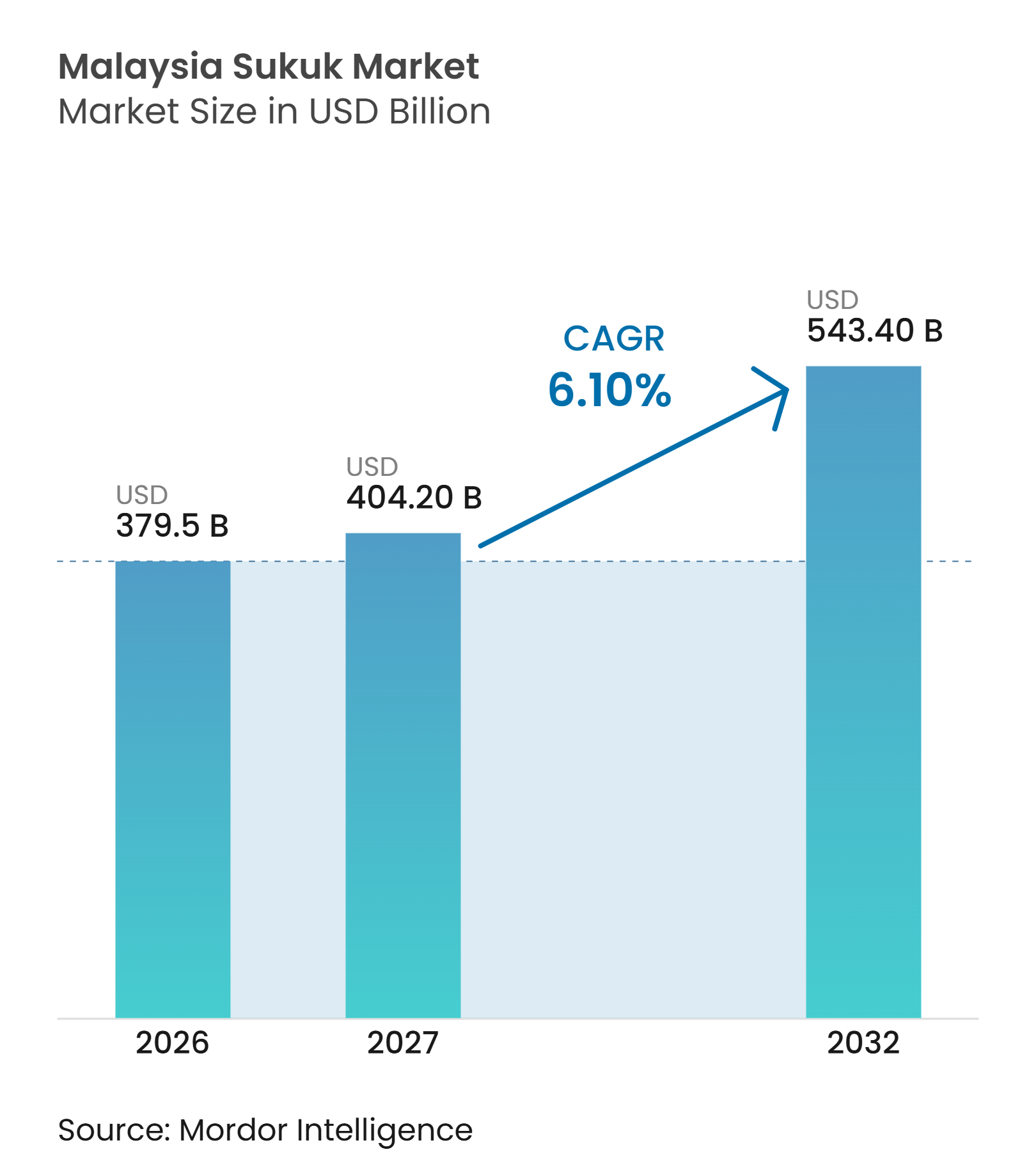
| Base Year Market Size (2026) | USD 379.5 Billion |
| Market Size (2027) | USD 404.20 Billion |
| Market Size (2032) | USD 543.40 Billion |
| Growth Rate (2027 - 2032) | 6.10 % |
| Market Concentration | High |
Major Players *Disclaimer: Major Players sorted in no particular order Image © Mordor Intelligence. Reuse requires attribution under CC BY 4.0. | |
Malaysia Sukuk Market Analysis by Mordor Intelligence
The Malaysia Sukuk Market size is projected to be USD 379.5 billion in 2026, USD 404.20 billion in 2027, and reach USD 543.40 billion by 2032, growing at a CAGR of 6.10% from 2027 to 2032.
Malaysia accounted for 37% of global sukuk outstanding and approximately 1/3 of global sukuk issuance in 2025, which supports its role as a core Islamic capital market center. The Malaysia sukuk market benefits from a deep domestic investor base, established government issuance, and a broad corporate funding ecosystem. Sustainable structures, digital issuance, and international formats are widening the range of instruments available to issuers and investors. Fiscal consolidation may limit net sovereign supply, while government refinancing needs continue to support gross issuance. Secondary-market liquidity and cross-border Shariah alignment remain important factors for the Malaysia sukuk market.
Key Report Takeaways
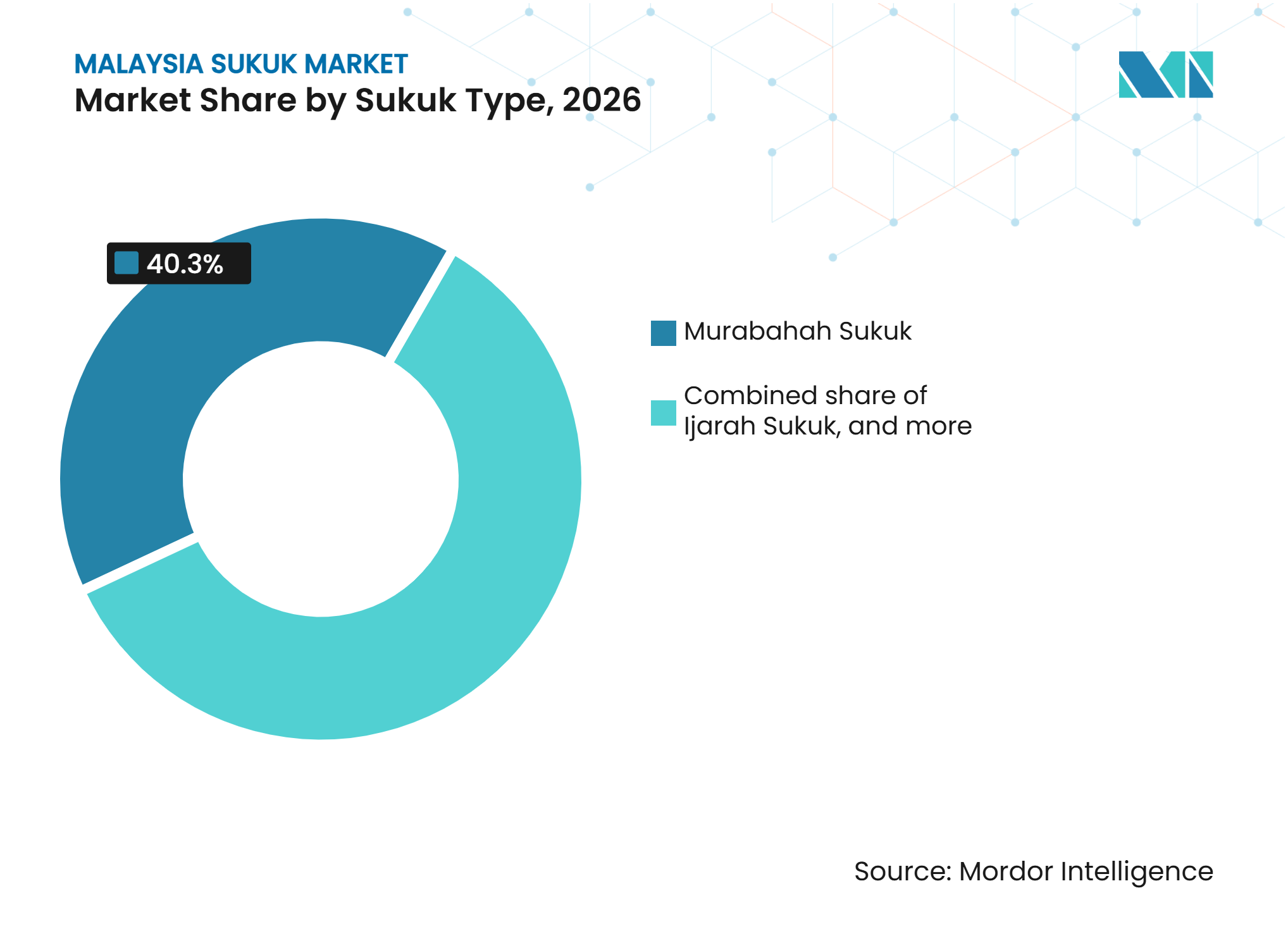
- By sukuk type, Murabahah captured 40.3% of the Malaysia sukuk market share in 2026, while Wakalah is the fastest-growing structural type through 2032.
- By issuer type, Sovereign issuers held 49.8% of the Malaysia sukuk market share in 2026, while non-financial corporates are projected to grow at an 8.2% CAGR through 2032.
- By market type, domestic sukuk accounted for 84.5% of the Malaysia sukuk market share in 2026, while international sukuk are projected to grow at an 8.1% CAGR through 2032.
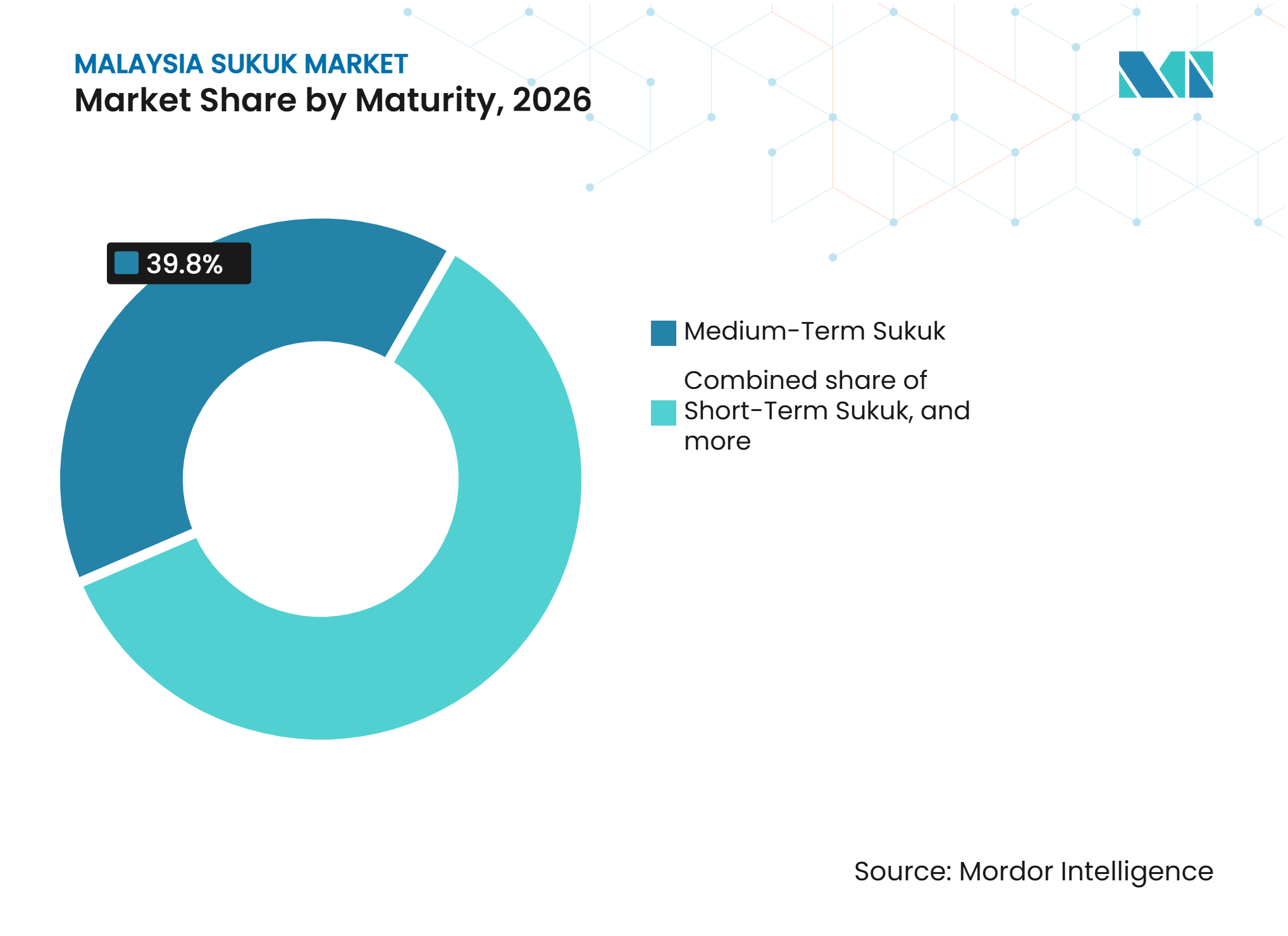
- By maturity, medium-term sukuk held 39.8% of the Malaysia sukuk market share in 2026, while perpetual sukuk are projected to grow at a 7.9% CAGR through 2032.
- By label, plain or unlabelled sukuk held 87.6% of the Malaysia sukuk market share in 2026, while green sukuk are projected to grow at an 11.6% CAGR through 2032.
Note: Market numbers in this report are based on Mordor Intelligence's proprietary estimation framework, which combines nine months of actuals with Q4 projections for base year 2026.
Market Trends and Insights
Drivers Impact Analysis of Malaysia Sukuk Market*
| Driver | (~) % Impact on CAGR Forecast | Geographic Relevance | Impact Timeline |
|---|---|---|---|
| Institutional and International Investor Demand for Shariah-Compliant Securities | +1.2% | Global, concentrated in Malaysia, Gulf Cooperation Council, and Southeast Asia | Medium term (2-4 years) |
| Government Financing and Refinancing Requirements | +0.8% | Malaysia | Short term (≤ 2 years) |
| Corporate Funding Demand Through Sukuk Issuance | +1.5% | Malaysia, with early gains in Selangor, Kuala Lumpur, and Johor | Medium term (2-4 years) |
| Established Domestic Islamic Capital Market Infrastructure | +0.7% | Malaysia, with spillover to Association of Southeast Asian Nations and Organization of Islamic Cooperation markets | Long term (≥ 4 years) |
| Growth in Sustainable and Sustainability-Linked Sukuk Issuance | +0.9% | Global, led by Malaysia and the Gulf Cooperation Council | Medium term (2-4 years) |
| Digitalization of Sukuk Issuance and Securities Administration | +0.4% | Malaysia and Association of Southeast Asian Nations markets | Long term (≥ 4 years) |
| Source: Mordor Intelligence | |||
Institutional and International Investor Demand for Shariah-Compliant Securities
Foreign investors held 21.4% of Malaysian government debt in the first quarter of 2026, according to the Asian Development Bank. Malaysia’s July 2026 USD 1.5 billion Global Sukuk received peak orders of USD 9.5 billion[1]. The offering was 4.7 times oversubscribed and priced at the tightest spreads in Malaysia’s sovereign sukuk history. The Manafae structure followed the Accounting and Auditing Organization for Islamic Financial Institutions guidelines. Bank Negara Malaysia has identified secondary-market tradability and Shariah alignment as priorities for sustaining non-resident participation. Malaysia’s global position can support continued investor attention for the Malaysia Sukuk market.
Government Financing and Refinancing Requirements
Gross Government Investment Issue issuance from January through October 2026 reached MYR 159 billion (USD 35.3 billion), while redemptions totaled MYR 85.8 billion (USD 19.1 billion)[2]. Maturing government debt supports regular issuance even when fiscal policy limits net borrowing. Government sukuk represented 48% of total government bonds as of May 2025. This issuance provides reference points for domestic pricing across sukuk maturities. It also gives corporate issuers a benchmark for setting spreads. The Malaysia Sukuk market therefore continues to rely on sovereign issuance for pricing depth and issuer confidence.
Corporate Funding Demand Through Sukuk Issuance
Corporate bond and sukuk issuance reached MYR 174.4 billion (USD 38.8 billion) in 2025, compared with MYR 124.2 billion (USD 27.6 billion) in 2024. Corporate issuance rose 27.8% quarter-over-quarter to MYR 73.2 billion (USD 16.3 billion) in the second quarter of 2026[3]. Healthcare, renewable energy, and takaful are among the sectors using sukuk financing. This broadens activity beyond financial institutions and property developers. Larger issuance programs also improve the availability of benchmark corporate paper. These conditions support a wider issuer base in the Malaysia Sukuk market.
Established Domestic Islamic Capital Market Infrastructure
Malaysia’s capital market reached MYR 4.3 trillion (USD 955.6 billion) in 2025. Sukuk represented 64% of total bonds outstanding and 85% of the corporate bond segment. This depth supports regular issuance, domestic investment, and Shariah governance. The Securities Commission Malaysia plans to expand capital market value to MYR 5.8 trillion to MYR 6.3 trillion (USD 1.3 trillion to USD 1.4 trillion) by 2030[4]. The framework supports the Malaysia Sukuk market through established issuance, disclosure, and investor arrangements. It also provides a foundation for links with the Association of Southeast Asian Nations and the Organization of Islamic Cooperation markets.
Restraints Impact Analysis of Malaysia Sukuk Market*
| Restraint | (~) % Impact on CAGR Forecast | Geographic Relevance | Impact Timeline |
|---|---|---|---|
| Fiscal Consolidation Limiting Growth in Sovereign Sukuk Supply | -0.6% | Malaysia | Medium term (2-4 years) |
| Secondary-Market Liquidity Constraints in Selected Sukuk Segments | -0.4% | Malaysia, with effects on international investor confidence | Medium term (2-4 years) |
| Shariah Structuring Complexity and Cross-Border Standardization Challenges | -0.3% | Cross-border Malaysia, Gulf Cooperation Council, and Association of Southeast Asian Nations corridors | Long term (≥ 4 years) |
| Green Project Eligibility, Verification and Reporting Requirements | -0.2% | Malaysia and Association of Southeast Asian Nations markets | Medium term (2-4 years) |
| Source: Mordor Intelligence | |||
Fiscal Consolidation Limiting Growth in Sovereign Sukuk Supply
Malaysia’s Public Finance and Fiscal Responsibility Act sets a fiscal-deficit limit of 3% of gross domestic product and a federal-debt limit of 60% of gross domestic product. Net government borrowing is projected to decline to MYR 74.6 billion (USD 16.6 billion) in 2026 from MYR 76.7 billion (USD 17 billion) in 2025. Federal debt remains near 64% of gross domestic product through 2026 to 2029. Lower net issuance can reduce the stock of government benchmarks used in corporate pricing. Smaller or less liquid corporate issues may then face wider spreads. Fiscal consolidation therefore limits the expansion for the Malaysia Sukuk market.
Secondary-Market Liquidity Constraints in Selected Sukuk Segments
Trading activity remains concentrated in benchmark Government Investment Issues and large corporate sukuk. Mid-tier and niche structures have less consistent price discovery. Bank Negara Malaysia has identified the use of Government Investment Issues as a corporate sukuk reference curve as a market development priority. The mandatory transition to the Malaysia Islamic Overnight Rate by July 1, 2027, is intended to establish a transaction-based benchmark for floating-rate instruments. Until liquidity develops, nonbenchmark instruments may be harder for foreign investors to assess. This constraint can narrow the investable universe in selected Malaysia Sukuk market segments.
*Our forecasts treat driver/restraint impacts as directional, not additive. The impact forecasts reflect baseline growth, mix effects, and variable interactions.
Malaysia Sukuk Market Segment Analysis
By Sukuk Type:
Wakalah Structures Reshape Secondary-Market TradabilityMurabahah sukuk held 40.3% of the Malaysia Sukuk market size in 2026. Their commodity-based mechanics and broad Shariah acceptance support continued use by domestic issuers. Maybank issued a MYR 750 million (USD 166.7 million) Subordinated Sukuk Murabahah in May 2025. The issuance qualified as Tier 2 regulatory capital under Bank Negara Malaysia’s Capital Adequacy Framework. Wakalah is the fastest-growing structural type because it meets secondary-market tradability criteria used by domestic and international Shariah authorities.
Bank Negara Malaysia plans to use wakalah bi al-khadamat for a sovereign issuance in 2026. The approach uses intangible service rights as underlying assets. It can broaden access for Gulf Cooperation Council investors who have avoided debt-based structures. Ijarah supports asset-leasing transactions, while musharakah supports partnership-based financing. Salam, istisna, and mudarabah remain smaller because of documentation and asset-verification requirements. The Securities Commission Malaysia’s June 2026 guidance raises disclosure expectations across structures.


By Issuer Type:
Debut Corporates Broaden the Malaysia Sukuk Industry Issuer BaseSovereign issuers held 49.8% of the Malaysia Sukuk market share in 2026. Government Investment Issues remain the primary domestic risk-free reference for sukuk pricing. Non-financial corporates are forecast to grow at an 8.2% CAGR from 2027 to 2032. New issuance has included healthcare, renewable energy, and takaful sectors. SD Guthrie issued a MYR 2.1 billion (USD 466.7 million) sustainability-linked sukuk in November 2025. The 10-year and 15-year tranches were priced at 3.80% and 3.97%, respectively.
Quasi-sovereign issuers such as Urusharta Jamaah, DanaInfra, and Cagamas provide long-duration instruments for institutional investors. Urusharta Jamaah issued MYR 11.5 billion (USD 2.6 billion) in the second quarter of 2026. Financial-institution sukuk benefit from bank demand and short book-building cycles. Maybank Investment Bank’s MYR 3 billion (USD 666.7 million) ALSREIT Capital program showed the role of credit enhancement in the Malaysia Sukuk industry. The program was the largest sukuk guaranteed by the Asian Development Bank’s Credit Guarantee and Investment Facility in Association of Southeast Asian Nations markets. A broader mix of issuers supports corporate funding options and domestic capital formation.
By Market Type:
International Sukuk Gain Momentum on Sovereign Pricing CredibilityDomestic sukuk accounted for 84.5% of the Malaysia Sukuk market size in 2026. Ringgit bond and sukuk outstanding totaled MYR 2.294 trillion (USD 509.8 billion) in February 2026. Domestic institutions provide a stable base for primary issuance. International sukuk are forecast to grow at an 8.1% CAGR from 2027 to 2032. Malaysia’s July 2026 Global Sukuk set a record-tight sovereign pricing benchmark. This benchmark can support future quasi-sovereign and corporate international offerings.
The Global Sukuk used an Accounting and Auditing Organization for Islamic Financial Institutions-aligned Manafae structure. Bank Negara Malaysia’s planned wakalah bi al-khadamat instrument further addresses international tradability needs. Khazanah issued a MYR 100 million (USD 22.2 million) tokenized sukuk in April 2026. The Securities Commission Malaysia seeks to anchor MYR 100 billion (USD 22.2 billion) to MYR 110 billion (USD 24.4 billion) in foreign-underlying assets. These measures extend the Malaysia Sukuk market beyond domestic ringgit issuance. They also link digital innovation with established cross-border funding formats.
By Maturity:
Perpetual Instruments Reflect a Hybrid Capital TrendMedium-term sukuk held 39.8% of Malaysia's sukuk market value in 2026. Tenors of 3 to 7 years suit infrastructure projects and financial-sector liability management. Perpetual sukuk are projected to grow at a 7.9% CAGR from 2027 to 2032. Issuers use these instruments to obtain hybrid capital with equity-like accounting treatment. Eco World Development established a MYR 2 billion (USD 444.4 million) perpetual sukuk wakalah program in August 2025. Its first MYR 800 million (USD 177.8 million) issuance had tranches noncallable for 7 and 10 years.
Short-term sukuk support liquidity management and working-capital needs. Long-term instruments support infrastructure and mortgage-pool financing. Issuers use senior and perpetual formats to address distinct capital needs. The Malaysia Islamic Overnight Rate transition will affect floating-rate instruments across all maturities by July 1, 2027. Mid-curve tenors may face the greatest basis risk during the transition.

By Label:
Green Sukuk’s Pricing Advantage Accelerates Corporate AdoptionPlain or unlabelled sukuk held 87.6% of the Malaysia sukuk market size in 2026. Green sukuk are forecast to grow at an 11.6% CAGR from 2027 to 2032. A study covering 128 Bursa Malaysia green sukuk tranches reported a 17.5-basis-point financing advantage over comparable conventional sukuk. The result gives issuers an economic reason to consider green labeling. Port of Tanjung Pelepas issued a MYR 500 million (USD 111.1 million) green sukuk in October 2025 to fund port capacity expansion. The transaction extended the green issuer base into transport and port infrastructure.
Cagamas issued a MYR 200 million (USD 44.4 million) ASEAN social SRI sukuk in August 2025. Its proceeds were allocated to affordable home financing assets. The social label can draw mandates that differ from green and sustainability-linked investment strategies. The Securities Commission Malaysia is developing the Sukuk Prisma SDG framework for non-ringgit sukuk by foreign sovereigns. This could support Kuala Lumpur’s role in sustainable Islamic capital products. Plain formats will remain material because they account for most outstanding issuances.
Geography Analysis
Malaysia accounted for 84.5% of the Malaysia Sukuk market in 2026. Ringgit bonds and sukuk outstanding reached MYR 2.3 trillion (USD 511.1 billion) at the end of the second quarter of 2026, increasing 2.8% quarter-over-quarter. Government and corporate bond segments increased 3.2% and 2.7%, respectively. Social security institutions held 32.6% of government debt, while financial institutions held 29.5%. This domestic absorption supports regular government and corporate issuance across the local investor base.
The Gulf Cooperation Council and the Middle East are strategically important international demand areas. Malaysia’s USD 1.5 billion Global Sukuk in July 2026 received peak orders above USD 9.5 billion. The deal was 4.7 times oversubscribed. Bank Negara Malaysia’s wakalah bi al-khadamat structure is intended to meet Gulf Cooperation Council tradability preferences. International demand helps establish reference prices for future cross-border issuance.
Southeast Asia and the Asia-Pacific region are central to sustainable and digital sukuk expansion. Corporates accounted for 84.4% of Malaysia’s sustainable bond market at the end of June 2026. Khazanah’s tokenized issuance included institutional participation from Malaysia and the region. The proposed Sukuk Prisma SDG framework could support non-ringgit issuance by Organization of Islamic Cooperation member governments.
Competitive Landscape
Market Concentration
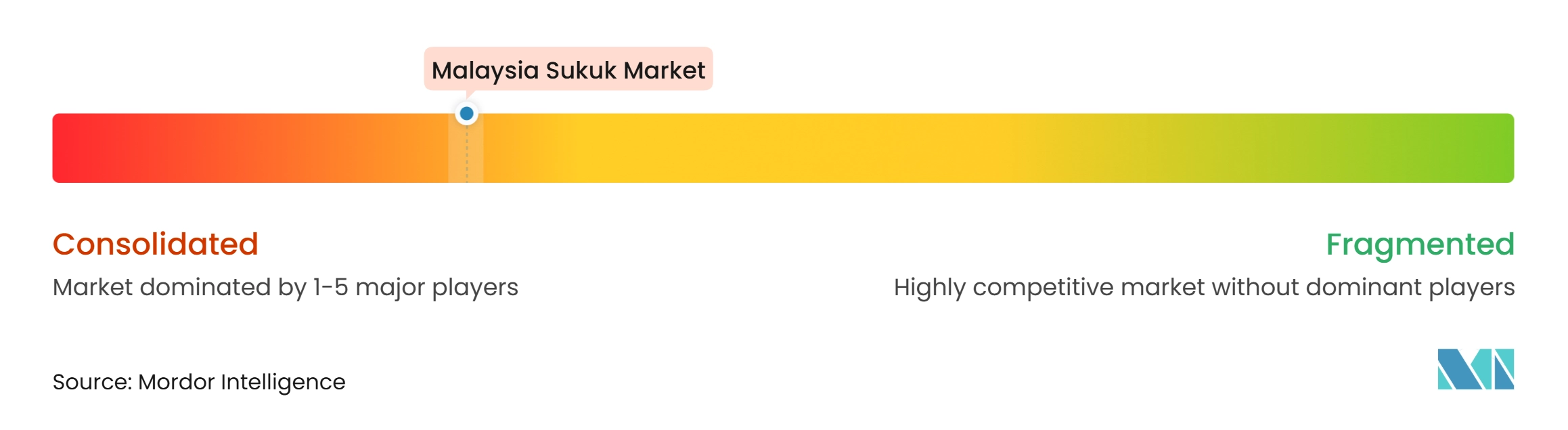
The Malaysia sukuk market is consolidated. Leading financial institutions such as CIMB Group, Maybank, RHB Investment Bank, AmInvestment Bank, HSBC Amanah Malaysia, and Bank Islam compete across primary issuance and Islamic capital-market services. Competition is driven by structuring expertise, Shariah advisory capabilities, issuer relationships, and the ability to execute domestic and cross-border transactions. Established banking groups benefit from integrated investment banking and Islamic finance operations, supporting their participation in complex sukuk mandates.
Market participants are expanding their capabilities in digital sukuk issuance and sustainable finance. In April 2026, CIMB acted as sole principal adviser for Khazanah’s MYR 100 million (USD 22.2 million) tokenised sukuk pilot, reinforcing its role in Malaysia’s digital capital-market development. CIMB has also advanced its tokenised sukuk strategy to cover structuring, execution, custody, and lifecycle servicing, while Maybank Investment Bank arranged SD Guthrie’s MYR 2.1 billion (USD 466.7 million) sustainability-linked sukuk in 2025. These transactions demonstrate the growing importance of technology-enabled issuance and sustainability-linked financing in the competitive landscape.
Competition is expected to increasingly depend on the ability to combine conventional sukuk underwriting with digital infrastructure, sustainable-finance expertise, and tailored financing solutions. Leading arrangers are positioned to leverage established issuer relationships and advisory capabilities, while other banks can strengthen their positions through mid-market corporate coverage, innovative structures, and cross-border distribution. The expansion of tokenised securities and sustainability-focused instruments is creating opportunities for market participants to diversify their mandates and differentiate their service offerings.
Malaysia Sukuk Industry Leaders
-
CIMB Investment Bank Berhad
-
RHB Investment Bank Berhad
-
Maybank Investment Bank Berhad
-
Hong Leong Islamic Bank Berhad
-
AmInvestment Bank Berhad
- *Disclaimer: Major Players sorted in no particular order
Malaysia Sukuk Market Companies Covered in this Report
- CIMB Investment Bank Berhad
- Maybank Investment Bank Berhad
- AmInvestment Bank Berhad
- RHB Investment Bank Berhad
- Hong Leong Investment Bank Berhad
- HSBC Amanah Malaysia Berhad
- Bank Islam Malaysia Berhad
- Affin Hwang Investment Bank Berhad
- United Overseas Bank (Malaysia) Berhad
- OCBC Al-Amin Bank Berhad
- Kenanga Investment Bank Berhad
- Public Investment Bank Berhad
- MIDF Amanah Investment Bank Berhad
- MBSB Investment Bank Berhad
- Bank of China (Malaysia) Berhad
- China Construction Bank (Malaysia) Berhad
- Kuwait Finance House (Malaysia) Berhad
- Alliance Islamic Bank Berhad
- Standard Chartered Saadiq Berhad
- BNP Paribas Malaysia Berhad
Recent Industry Developments in Malaysia Sukuk Market
- July 2026: The Government of Malaysia priced a USD 1.5 billion Global Sukuk, which was 4.7 times oversubscribed, with a peak order book exceeding USD 9.5 billion. The 5.75-year and 10-year tranches achieved record-tight spreads of T+15 basis points and T+25 basis points, respectively. The issuance was structured under the Manafae concept, rated A3/A-, and set a benchmark for Malaysian quasi-sovereign and corporate issuers.
- April 2026: Khazanah Nasional Berhad, in collaboration with the Securities Commission Malaysia, priced Malaysia’s first tokenized sukuk at MYR 100 million (USD 22.2 million) under the Sukuk Danum Program using distributed ledger technology. CIMB served as sole principal adviser, lead arranger, and facility agent, while Maybank was the primary subscriber and custodian.
- April 2026: The Securities Commission Malaysia launched the Capital Market Masterplan 2026-2030. The plan targeted capital market growth from MYR 4.3 trillion (USD 955.6 billion) to MYR 5.8 trillion-MYR 6.3 trillion (USD 1.3 trillion-USD 1.4 trillion) by 2030. It also targeted MYR 90 billion-MYR 100 billion (USD 20 billion-USD 22.2 billion) in cumulative sustainability financing.
- November 2025: SD Guthrie Berhad issued Malaysia’s largest sustainability-linked sukuk at MYR 2.1 billion (USD 466.7 million). The 10-year tranche was priced at 3.80%, and the 15-year tranche was priced at 3.97%. CIMB Investment Bank arranged the transaction, which was oversubscribed at twice the initial deal size.
Malaysia Sukuk Market Report Scope
Segmentation Overview
| Murabahah Sukuk |
| Ijarah Sukuk |
| Wakalah Sukuk |
| Musharakah Sukuk |
| Mudarabah Sukuk |
| Salam Sukuk |
| Istisna Sukuk |
| Hybrid / Composite Sukuk |
| Other Sukuk Types |
| Sovereign |
| Sovereign-Related / Quasi-Sovereign |
| Financial Institution |
| Non-Financial Corporate |
| Multilateral / Supranational |
| Domestic Sukuk |
| International Sukuk |
| Short-Term Sukuk |
| Medium-Term Sukuk |
| Long-Term Sukuk |
| Perpetual Sukuk |
| Plain / Unlabelled Sukuk |
| Green Sukuk |
| Sustainability / Sustainability-Linked / Social / Other labeled Sukuk |
| By Sukuk Type | Murabahah Sukuk |
| Ijarah Sukuk | |
| Wakalah Sukuk | |
| Musharakah Sukuk | |
| Mudarabah Sukuk | |
| Salam Sukuk | |
| Istisna Sukuk | |
| Hybrid / Composite Sukuk | |
| Other Sukuk Types | |
| By Issuer Type | Sovereign |
| Sovereign-Related / Quasi-Sovereign | |
| Financial Institution | |
| Non-Financial Corporate | |
| Multilateral / Supranational | |
| By Market Type | Domestic Sukuk |
| International Sukuk | |
| By Maturity | Short-Term Sukuk |
| Medium-Term Sukuk | |
| Long-Term Sukuk | |
| Perpetual Sukuk | |
| By Label | Plain / Unlabelled Sukuk |
| Green Sukuk | |
| Sustainability / Sustainability-Linked / Social / Other labeled Sukuk |
Key Questions Answered in the Report
What is the expected growth rate for Malaysia sukuk through 2032?
The Malaysia Sukuk market is projected to grow at a 6.1% CAGR from 2027 to 2032, reaching USD 543.4 billion by 2032.
Which sukuk type has the largest share in Malaysia?
Murabahah held 40.3% share in 2026, supported by commodity-based mechanics and broad Shariah acceptance.
Which issuer group is growing fastest in Malaysia sukuk?
Non-financial corporates are projected to grow at 8.2% CAGR through 2032 as issuers expand into sectors such as healthcare and renewable energy.
Why are green sukuk gaining traction in Malaysia?
Green sukuk are projected to grow at 11.6% CAGR through 2032, and a 2026 study found a 17.5-basis-point financing advantage over comparable conventional sukuk.
What is driving international demand for Malaysian sukuk?
Malaysia’s July 2026 USD 1.5 billion Global Sukuk was 4.7 times oversubscribed, showing demand from global and Gulf Cooperation Council investors.