
Malaysia Residential Construction Market Size and Share
Market Overview
| Study Period | 2021 - 2032 |
|---|---|
| Forecast Data Period | 2027 - 2032 |
| Base Year Market Size (2026) | USD 18.28 Billion |
| Market Size (2027) | USD 19.62 Billion |
| Market Size (2032) | USD 27.97 Billion |
| Growth Rate (2027 - 2032) | 7.35 % |
| Market Concentration | Medium |
Major Players *Disclaimer: Major Players sorted in no particular order Image © Mordor Intelligence. Reuse requires attribution under CC BY 4.0. | |
Malaysia Residential Construction Market Analysis by Mordor Intelligence
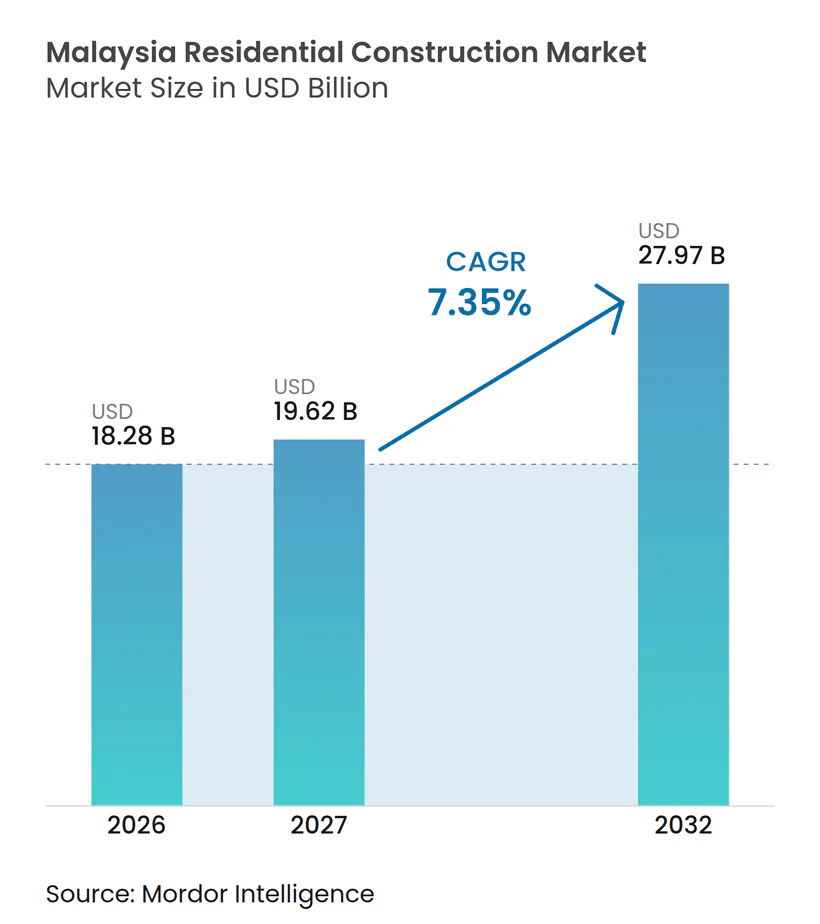
The Malaysia Residential Construction Market size is expected to increase from USD 18.28 billion in 2026 to USD 19.62 billion in 2027 and reach USD 27.97 billion by 2032, growing at a CAGR of 7.35% over 2027-2032.
Federal housing delivery under the 13th Malaysia Plan supports a large base of affordable-home construction, while public financing programs can help translate demand into purchases. Industrial investment, especially data center activity, is drawing employment and housing demand toward Johor and the Klang Valley. Transit investment and urban renewal are widening the locations available for development, although delivery depends on approvals, financing, and construction capacity. The Malaysia residential construction market therefore has opportunities in integrated townships, transit-linked projects, and affordable housing, while developers must address unsold high-rise inventory and buyer affordability.
Key Report Takeaways
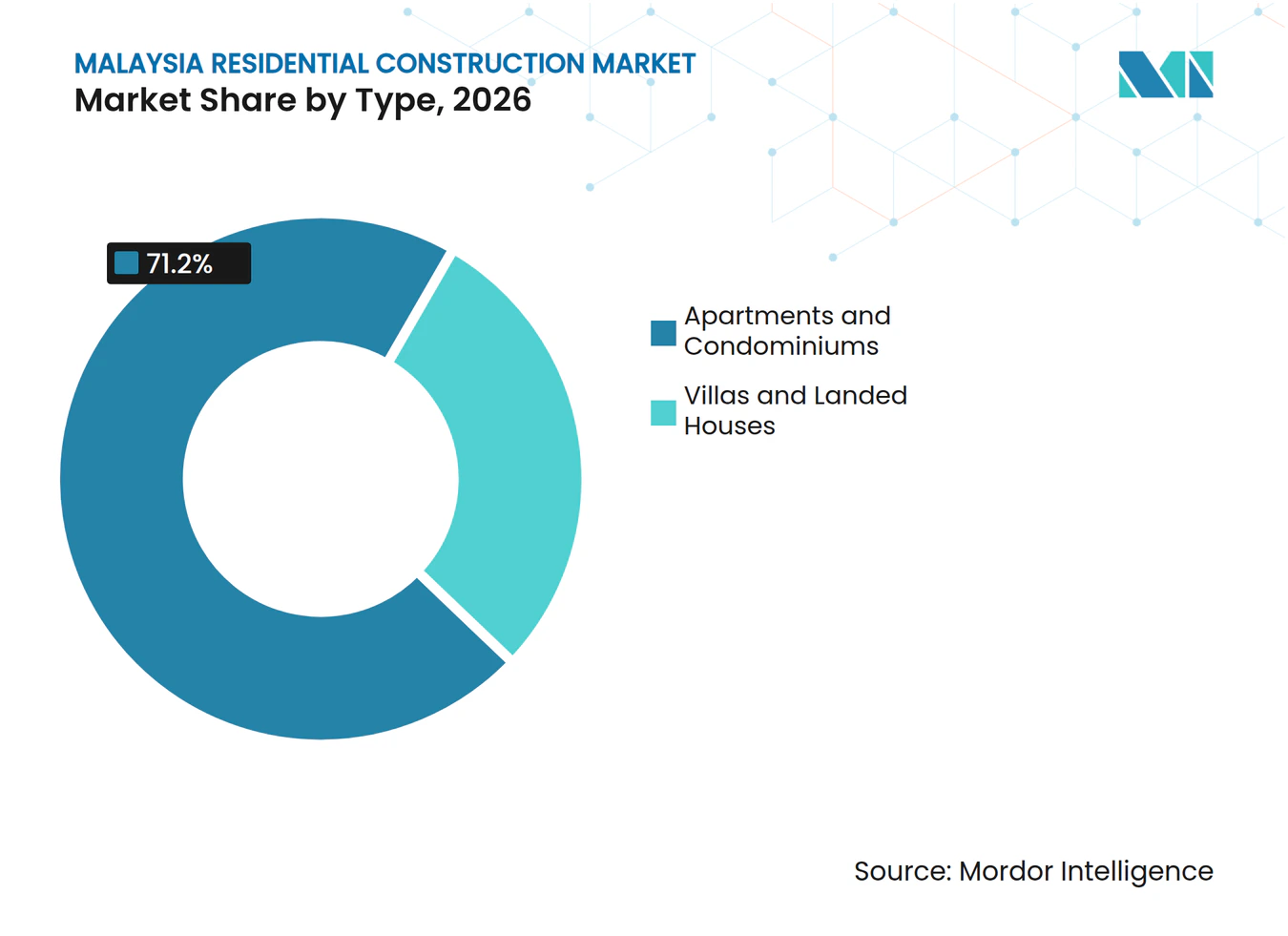
- By type, apartments and condominiums held 71.2% of the Malaysia residential construction market share in 2026, while villas and landed houses are forecast to grow at a 7.98% CAGR through 2032.
- By construction type, within the Malaysia residential construction market, new construction accounted for 76.4% of the Malaysia residential construction market size in 2026, while renovation is forecast to expand at a 7.91% CAGR through 2032.
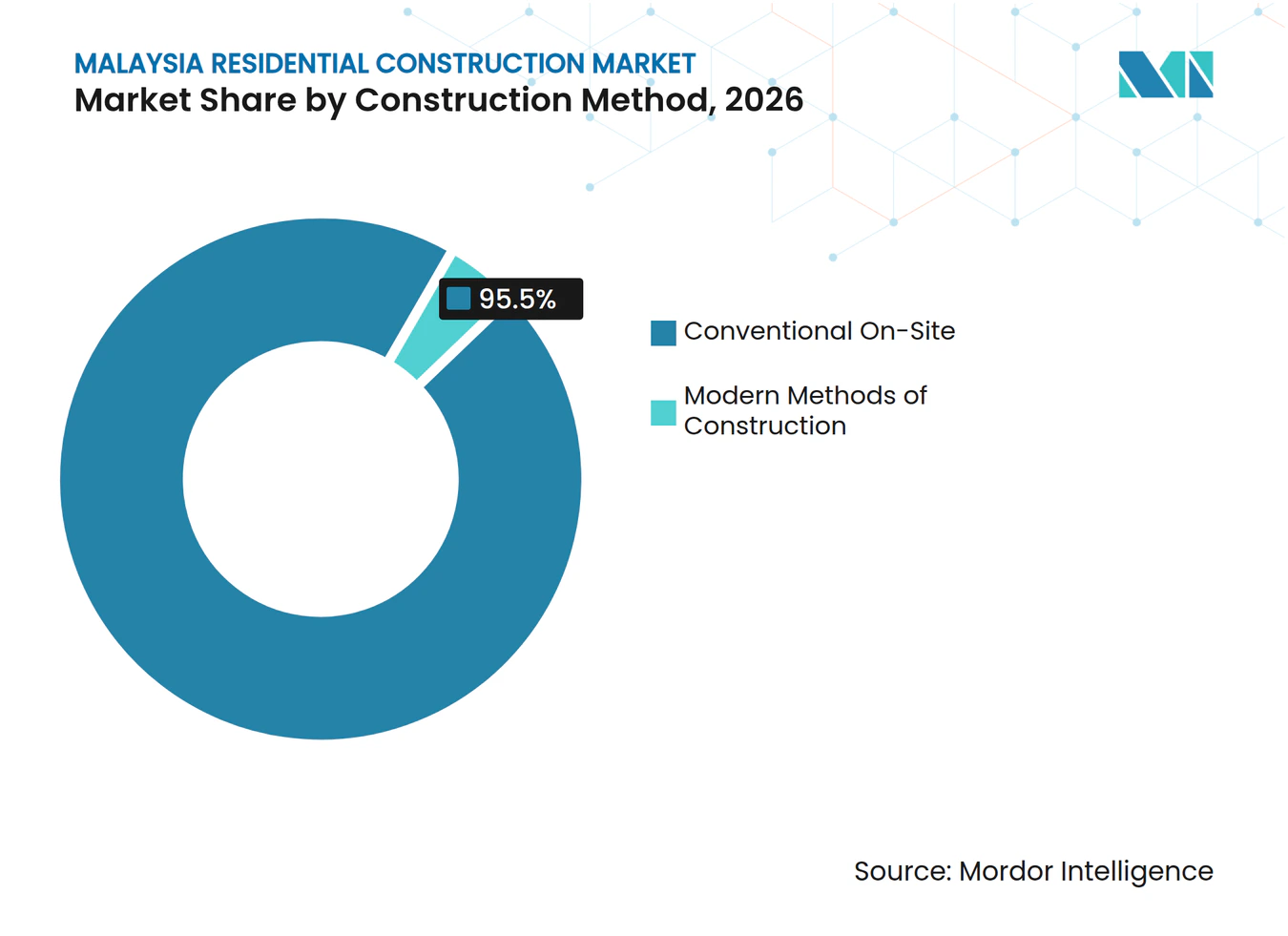
- By construction method, conventional on-site construction held 95.5% of the Malaysia residential construction market share in 2026, while within the Malaysia residential construction market, modern methods of construction are forecast to grow at an 8.22% CAGR through 2032.
- By investment source, within the Malaysia residential construction market, Private investment accounted for 61.8% of the Malaysia residential construction market size in 2026, while public investment is forecast to grow at an 8.12% CAGR through 2032.
- By key city, Kuala Lumpur held 47.4% of the residential construction share in 2026, while Johor Bahru is forecast to grow at an 8.39% CAGR through 2032.
Note: Market numbers in this report are based on Mordor Intelligence's proprietary estimation framework, which combines nine months of actuals with Q4 projections for base year 2026.
Market Trends and Insights
Drivers Impact Analysis of Malaysia Residential Construction Market*
| Drivers | (~) % Impact on CAGR Forecast | Geographic Relevance | Impact Timeline |
|---|---|---|---|
| Government-backed affordable housing initiatives | +1.8% | National, with concentrated delivery in Selangor, Kuala Lumpur, Johor, Penang, and Sarawak | Short term (≤ 2 years) |
| Industrial and technology investment clusters | +1.0% | Johor Bahru core, with spillover to Klang Valley and Penang | Medium term (2-4 years) |
| MRT, LRT, and highway network expansion | +0.9% | Klang Valley, Johor Bahru, and Penang | Medium term (2-4 years) |
| Integrated township communities | +0.7% | Greater Kuala Lumpur, Johor Bahru, and northern Selangor | Long term (≥ 4 years) |
| Urban regeneration initiatives | +0.6% | Kuala Lumpur, with national coverage across identified sites | Medium term (2-4 years) |
| Industrialised Building System adoption | +0.4% | National, with early gains in Selangor, Kuala Lumpur, and Johor | Long term (≥ 4 years) |
| Source: Mordor Intelligence | |||
Government-Backed Affordable Housing Initiatives Drive New Construction
The 13th Malaysia Plan commits to 1 million affordable homes between 2026 and 2035, giving the Malaysia residential construction market a defined public delivery pipeline[1]. The preceding 12th Malaysia Plan had 493,874 homes completed, under construction, or approved by June 2025, which represented 98.8% of its 500,000-home objective[2]. The Housing Credit Guarantee Scheme had approved financing by July 2025, and 67% of beneficiaries bought lower-priced homes. In the Malaysia residential construction market, project funding can support output in secondary urban areas, including PRR Harmoni Bestari Jaya in Selangor. The Housing Development Control and Licensing Act 1966 and the draft Urban Renewal Bill provide the compliance framework for program delivery and redevelopment eligibility.
Technology and Industrial Investment Clusters Amplify Housing Demand
Approved data center projects in Johor numbered 42 by the second quarter of 2025, concentrating investment near Johor Bahru. These projects represented 78.6% of Malaysia’s operational information technology capacity, according to the source material. Artificial intelligence investment in the first half of 2025 added to demand around technology employment locations[3]. This investment can increase Malaysia residential construction market demand for homes in Johor, Penang, and northern Selangor as workers move near employment clusters. The same projects also draw civil, mechanical, and electrical specialists, which can tighten construction labor availability for nearby residential projects.
Transit Network Expansion Unlocks New Residential Corridors
The Light Rail Transit Line 3 alignment is expected to be completed in 2026, and 12 residential projects have already been positioned in station catchments, including 10 high-rise developments. This supports more transit-oriented development in the Malaysia residential construction market, meaning housing planned around rail access and related urban services. The Rapid Transit System Link between Bukit Chagar in Johor Bahru and Woodlands North in Singapore is scheduled for completion by the end of 2026, with operations planned from January 2027. Sunway Property began construction on its Bukit Chagar project in March 2025 after an agreement with Malaysia Mass Rapid Transit Corporation for the integrated development. The project shows how transit access can bring housing, healthcare, retail, and hospitality into a single development area.
Integrated Township Preference Reshapes Master-Planned Residential Development
Integrated townships combine homes with commercial space, schools, public amenities, and green areas. Kota Madani in Putrajaya covers 102 acres and is planned to include 10,000 high-density homes for more than 30,000 residents. The project includes digital infrastructure and green mobility features. This model is also reflected in private master-planned communities that mix landed homes, apartments, and commercial uses. Such projects can help developers in the Malaysia residential construction market phase supply, provide amenities earlier, and serve both owner-occupiers and investors across several product types.
Restraints Impact Analysis of Malaysia Residential Construction Market*
| Restraints | (~) % Impact on CAGR Forecast | Geographic Relevance | Impact Timeline |
|---|---|---|---|
| Limited homebuyer affordability | -1.3% | National, most acute in Kuala Lumpur, Selangor, and Penang | Short term (≤ 2 years) |
| Rising construction material and labor costs | -1.1% | National, with concentrated pressure in Sabah and East Malaysia | Medium term (2-4 years) |
| Elevated unsold housing inventory | -0.7% | Kuala Lumpur and Johor | Short term (≤ 2 years) |
| Complex land conversion and approval procedures | -0.5% | National, most acute in peninsular urban centers | Long term (≥ 4 years) |
| Source: Mordor Intelligence | |||
Homebuyer Affordability Constraints Limit Demand Conversion
Affordability remains a constraint because the intended buyers for lower-priced homes can face the highest financing barriers. A Real Estate and Housing Developers’ Association Malaysia survey found that 71% of developers faced financing challenges in the first half of 2025. The survey cited loan rejection rates of 16% to 30% in the price band aimed at first-time M40 buyers. The property loan approval ratio for January through August 2025 was 41%. A more reliable conversion of housing demand into sales will depend on income, lending conditions, and debt-service capacity as well as the price of new supply.
Rising Input Costs Compress Developer Margins and Suppress Launches
Construction cost increases can delay projects or narrow returns on price-sensitive housing. In early 2025, reported price increases reached 15% for cement, 20% for steel, 12% for bricks, and 10% for timber. The Department of Statistics Malaysia reported annual cement price increases of 2.0% to 6.1% across peninsular regions in December 2025. Electricity tariff changes from July 2025 added cost pressure on precast factories and material producers. Labor availability also matters because data center and residential projects compete for specialist trades in the same locations. The Malaysia residential construction market may therefore see developers stage launches more carefully where buyers are highly sensitive to price.
*Our forecasts treat driver/restraint impacts as directional, not additive. The impact forecasts reflect baseline growth, mix effects, and variable interactions.
Malaysia Residential Construction Market Segment Analysis
By Type:
Apartments and Condominiums Lead While Villas and Landed Homes Grow FasterApartments and condominiums held 71.2% of the residential construction share in 2026, reflecting long-standing urban densification and high land values in Kuala Lumpur, George Town, and the Klang Valley. The segment remains important because high-rise formats make intensive use of scarce urban sites. The draft Urban Renewal Bill identifies 534 potential redevelopment sites nationwide. Kuala Lumpur accounts for 139 of these sites across 1,372 acres, which can support vertical replacement housing. Developers can use redevelopment to add modern homes where utilities, workplaces, and public transport already exist.
Villas and landed houses are forecast to expand at a 7.98% CAGR through 2032, faster than the other type segment. These homes are supported by township growth in the outer Klang Valley, Johor Bahru, and secondary corridors. Developers can offer terraced and semi-detached homes where larger sites permit lower-density planning and supporting community facilities. Freehold landed homes in integrated communities can appeal to owner-occupiers who place value on space, tenure, schools, shopping, and nearby parks. In the Malaysia residential construction market, this product mix helps developers reduce reliance on premium urban high-rise demand, which faces a more visible overhang in selected locations.



By Construction Type:
New Construction Leads While Renovation Gains PaceWithin the Malaysia residential construction market, New Construction accounted for 76.4% of the Malaysia residential construction market size in 2026. Affordable-home programs, township expansion, and projects linked to employment clusters support this large share. The 13th Malaysia Plan provides a public policy basis for continued new supply through its 1 million-home commitment. Major projects are also moving forward in Putrajaya and Johor Bahru, which shows continued developer investment in planned urban areas.
Renovation is forecast to grow at a 7.91% CAGR through 2032. The opportunity follows the aging profile of housing in established areas and interest in more efficient homes. The draft urban renewal framework distinguishes revitalization, regeneration, and full redevelopment. These routes can move older properties from repair work to environmental upgrades or replacement construction. Renovation uses skilled finishing trades intensively so that it can compete with new-build projects for the same workforce. Contractors will need to align skills, material procurement, and project timing across these two forms of work.
By Construction Method:
Conventional On-Site Delivery Leads While Modern Methods of Construction Gain GroundConventional on-site construction accounted for 95.5% of residential construction output in 2026. The installed base of local contractors, site processes, and supply chains helps explain the segment’s scale. Conventional methods remain suitable for varied site conditions and projects where designs change during delivery. They also serve much of the private housing pipeline, including smaller projects with different plot sizes and layouts. Cost pressure and labor constraints are encouraging builders to assess methods that reduce site work and improve schedule consistency.
Within the Malaysia residential construction market, modern methods of construction are forecast to expand at an 8.22% CAGR through 2032. The 13th Malaysia Plan directs public housing programs to use the Industrialised Building System and Building Information Modelling, a digital method for planning and managing building information. Public contracts also have a 70% Industrialised Building System content target. Research by Universiti Teknologi MARA found that the system can shorten construction time by 30%, reduce lifecycle costs by 40%, and cut material waste by 25%. Volumetric modules, prefabricated bathroom pods, and digital fabrication can give developers a more predictable way to manage deadlines and labor needs.

By Investment Source:
Private Investment Leads While Public Investment AcceleratesWithin the Malaysia residential construction market, private investment accounted for 61.8% of residential construction output in 2026. Listed developers are continuing to plan projects across the Klang Valley, Johor Bahru, and Penang. Mah Sing Group Berhad is planning residential launches during 2026 across these locations. Private capital is central to land acquisition, phased township construction, and the delivery of market-priced homes. It also allows developers to adjust product mix, launch dates, and construction phasing as local demand changes.
Public investment is forecast to grow at an 8.12% CAGR through 2032. In 2025, 5,450 Rumah Mesra Rakyat homes were under construction. A pre-development fund for Bandar PR1MA Teluk Intan shows the public role in preparing affordable housing schemes before construction. The ministry has encouraged private developers to allocate land to people’s housing projects under an integrated concept. These arrangements can bring public and private activity closer together in locations where affordability is the central requirement.
Geography Analysis
Kuala Lumpur held 47.4% of the residential construction share in 2026. The city remains the country’s administrative and financial center, and its redevelopment pipeline supports continued residential activity. The Kuala Lumpur Structure Plan 2040 identifies 139 urban renewal sites across 1,372 acres. This supply is mainly brownfield, so delivery requires coordination with residents, landowners, approvals, and the existing urban fabric.
Johor Bahru is forecast to grow at an 8.39% CAGR through 2032, the fastest rate among the key cities. The Johor-Singapore Special Economic Zone framework was signed in January 2025, and the Rapid Transit System Link is scheduled to operate from January 2027. Data center projects add an employment and investment base, and the Bukit Chagar development shows how companies are responding to the new cross-border transit location. Supply management remains important because Johor had a 9,018-unit serviced apartment overhang as of the third quarter of 2025.
Penang faces tight island land availability, which concentrates new supply in higher-value condominiums, while Seberang Perai has room for affordable and mid-priced township projects. The planned Penang Light Rail Transit project can shape future development locations on the island and mainland. Other Malaysian locations are also gaining rail-linked activity, including Pangsapuri Pahangku near the East Coast Rail Link station in Bentong. These transit-linked projects can widen the geographic base of the Malaysia residential construction market beyond the Klang Valley.
Competitive Landscape
Market Concentration
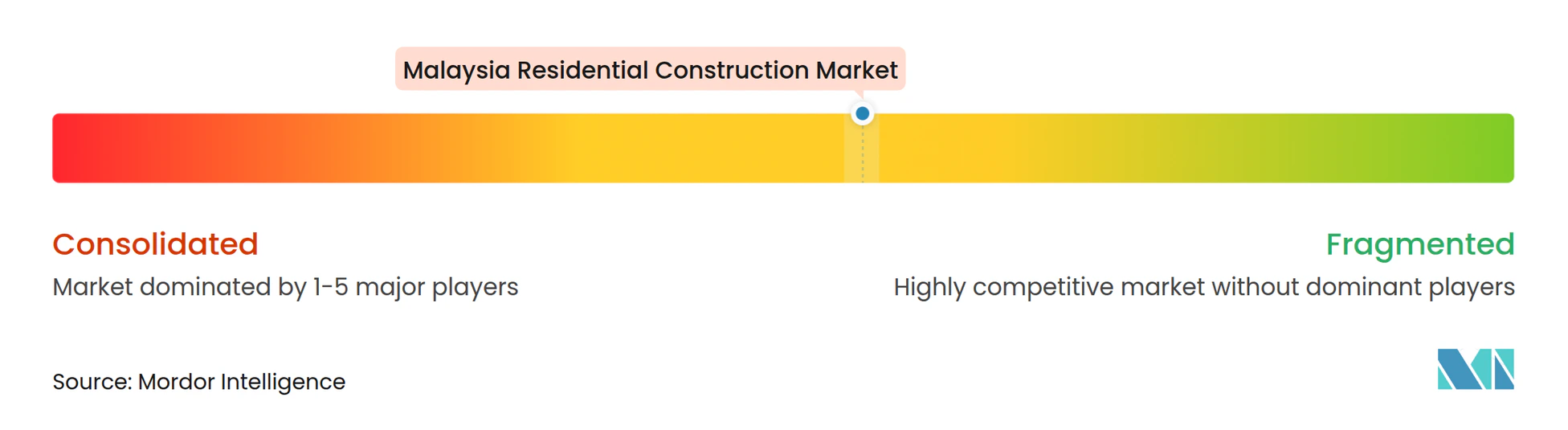
The Malaysia residential construction market is moderately concentrated around large integrated township developers and public-sector housing agencies. S P Setia Berhad, Sime Darby Property Berhad, Gamuda Land, and Sunway Property have the land banks and financial capacity needed for long-duration township projects. Matrix Concepts Holdings Berhad and Lagenda Properties Berhad have a stronger focus on affordable landed housing in secondary cities. The report’s company coverage also includes IOI Properties Group Berhad, Eco World Development Group Berhad, UEM Sunrise Berhad, Mah Sing Group Berhad, Tropicana Corporation Berhad, IJM Land Berhad, LBS Bina Group Berhad, Glomac Berhad, OSK Property, WCT Land, MRCB Land, Symphony Life Berhad, PR1MA Corporation Malaysia, Scientex Berhad, SkyWorld Development Berhad, Crest Builder Holdings Berhad, KSL Holdings Berhad, and Eastern & Oriental Berhad.
Strategic moves point to a focus on partnerships, land-bank expansion, and projects around major infrastructure. In October 2025, S P Setia’s Setia EcoHill subsidiary entered a joint venture with Mitsui Fudosan for a 113-acre landed project in Semenyih with 683 homes. In September 2025, Sunway Group completed the acquisition of MCL Land’s Malaysian and Singaporean residential business from Hongkong Land, adding land in Wangsa Maju and Seremban. Sunway Property also moved ahead with the Bukit Chagar development next to the cross-border rail station, which combines homes with healthcare, retail, and hospitality.
Competition is also shaped by construction efficiency and the ability to serve different household budgets. Industrialised Building System requirements can affect access to government-linked work and can help builders manage labour and material pressure. The 13th Malaysia Plan formalizes a Rent-to-Own approach and examines housing consortium structures, which could encourage developers to build income from rentals alongside unit sales. In the Malaysia residential construction market, developers that can combine affordable pricing, transit access, and efficient delivery may be better placed to convert demand into sales. The competitive field remains broad across large township groups, mid-sized housing developers, and government-related delivery agencies.
Malaysia Residential Construction Industry Leaders
-
S P Setia Berhad
-
Sime Darby Property Berhad
-
IOI Properties Group Berhad
-
Sunway Property
-
Eco World Development Group Berhad
- *Disclaimer: Major Players sorted in no particular order
Malaysia Residential Construction Market Companies Covered in this Report
- S P Setia Berhad
- Sime Darby Property Berhad
- IOI Properties Group Berhad
- Sunway Property
- Eco World Development Group Berhad
- UEM Sunrise Berhad
- Mah Sing Group Berhad
- Gamuda Land
- Tropicana Corporation Berhad
- IJM Land Berhad
- Matrix Concepts Holdings Berhad
- LBS Bina Group Berhad
- Glomac Berhad
- OSK Property
- WCT Land
- MRCB Land
- Symphony Life Berhad
- PR1MA Corporation Malaysia
- Scientex Berhad (Property Division)
- Lagenda Properties Berhad
- SkyWorld Development Berhad
- Crest Builder Holdings Berhad
- KSL Holdings Berhad
- Eastern & Oriental Berhad
Recent Industry Developments in Malaysia Residential Construction Market
- October 2026: GDB’s wholly owned subsidiary, Grand Dynamic Builders, secured a contract worth approximately USD 239 million from Perdana ParkCity for ParkCity Residences in Desa ParkCity, Kuala Lumpur. The development comprises two residential towers with 433 apartments, a seven-storey podium and a two-storey basement car park.
- September 2026: MGB Berhad announced Starlight Residences, a new residential development in Cameron Highlands, as part of its property development activities. The company operates across property development and construction, including industrialized building system solutions.
- July 2026: Lim Seong Hai Capital Berhad entered a conditional sale and development agreement with Railway Assets Corporation for 17.4 acres in Subang Jaya. The planned development can include up to 6 residential towers with integrated retail and commercial space. Construction is targeted to begin in the second half of 2027, with completion expected in the second half of 2032.
Malaysia Residential Construction Market Report Scope
Segmentation Overview
| Apartments and Condominiums |
| Villas and Landed Houses |
| New Construction |
| Renovation |
| Conventional On-Site |
| Modern Methods of Construction |
| Public |
| Private |
| Kuala Lumpur |
| Penang (George Town) |
| Johor Bahru |
| Petaling Jaya |
| Rest of Malaysia |
| By Type | Apartments and Condominiums |
| Villas and Landed Houses | |
| By Construction Type | New Construction |
| Renovation | |
| By Construction Method | Conventional On-Site |
| Modern Methods of Construction | |
| By Investment Source | Public |
| Private | |
| By Key Cities | Kuala Lumpur |
| Penang (George Town) | |
| Johor Bahru | |
| Petaling Jaya | |
| Rest of Malaysia |
Key Questions Answered in the Report
What is the forecast for Malaysia residential construction through 2032?
The sector is projected to grow from USD 19.62 billion in 2027 to USD 27.97 billion by 2032, at a 7.35% CAGR. Federal affordable-housing delivery, technology investment, and transit corridors provide support for this outlook.
Which residential property type has the largest share in Malaysia?
Apartments and condominiums lead with a 71.2% share in 2026, supported by dense urban development and high land values. Redevelopment sites in Kuala Lumpur can continue to support high-rise supply.
Which housing type is growing the fastest in Malaysia?
Villas and landed houses are projected to grow at a 7.98% CAGR through 2032, supported by master-planned townships. This format gives owner-occupiers access to more space in outer urban corridors and secondary cities.
Why is Johor Bahru important for home construction?
Johor Bahru has the highest projected city growth rate of 8.39% through 2032, supported by the special economic zone, the Rapid Transit System Link, and data center investment. Developers are pairing residential projects with transport, retail, and employment access.
How is the Industrialised Building System affecting Malaysian housing delivery?
Within the Malaysia residential construction market, modern methods of construction are forecast to grow at an 8.22% CAGR as public programs encourage the Industrialized Building System and Building Information Modelling. The method can reduce site work and provide greater certainty on project schedules.
What are the main risks for developers in Malaysia?
Key risks include affordability limits, financing rejections, higher material and labor costs, unsold high-rise stock, and complex approvals. These factors can affect pricing, launch timing, sales conversion, project viability, and construction margins nationwide.