
Malaysia Prefabricated Buildings Market Size and Share
Market Overview
| Study Period | 2021 - 2032 |
|---|---|
| Forecast Data Period | 2027 - 2032 |
| Base Year Market Size (2026) | USD 1.86 Billion |
| Market Size (2027) | USD 2.03 Billion |
| Market Size (2032) | USD 3.11 Billion |
| Growth Rate (2027 - 2032) | 8.91 % |
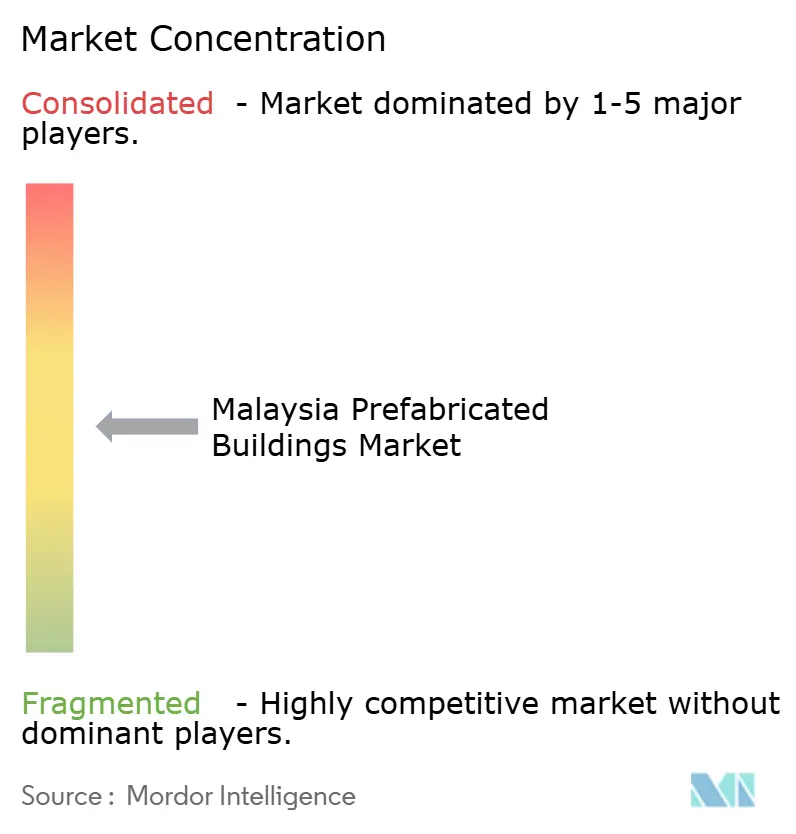
| Market Concentration | Medium |
Major Players *Disclaimer: Major Players sorted in no particular order Image © Mordor Intelligence. Reuse requires attribution under CC BY 4.0. | |
Malaysia Prefabricated Buildings Market Analysis by Mordor Intelligence
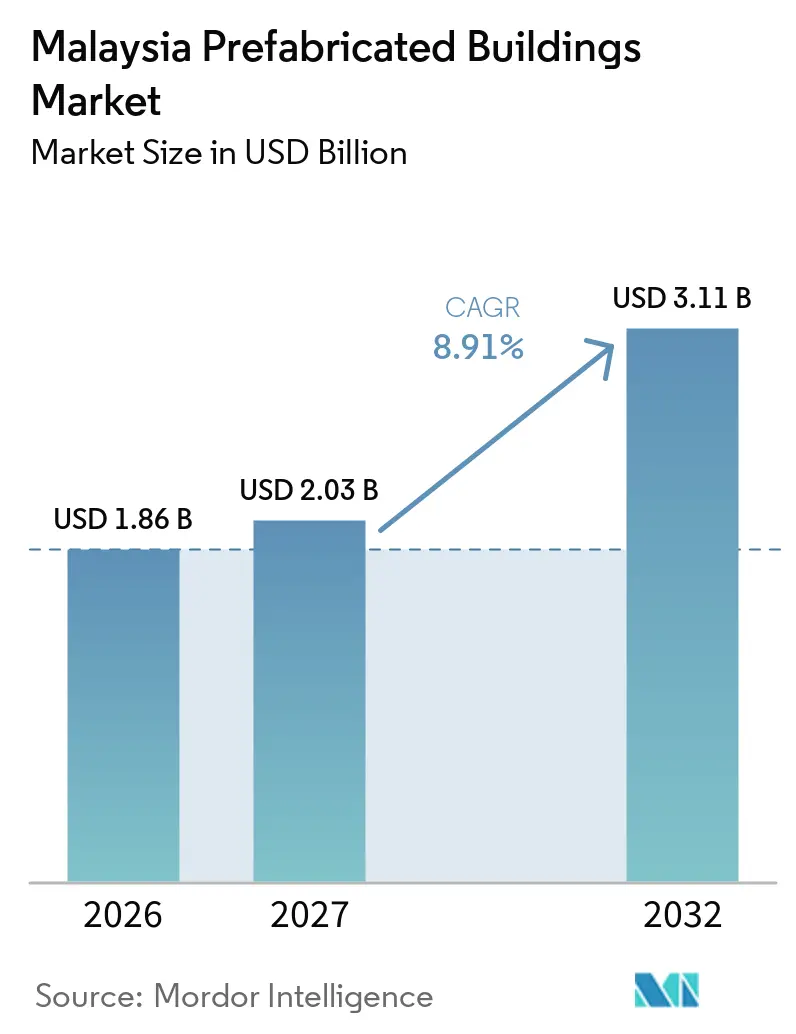
The Malaysia Prefabricated Buildings Market size is expected to grow from USD 1.86 billion in 2026 to USD 2.03 billion in 2027 and is forecast to reach USD 3.11 billion by 2032 at 8.91% CAGR over 2027-2032.
The Malaysia prefabricated buildings market is supported by public construction policy, affordable housing programs, and demand for facilities that must be delivered quickly, because developers increasingly need predictable construction sequences when site conditions, labor availability, and approval schedules are difficult to manage. The Construction Action Plan for 2026 to 2030 places quality, safety, digital delivery, and green certification requirements at the center of construction activity, which favors controlled factory production. A constrained supply of skilled site labor also makes industrialized building methods more relevant for contractors seeking predictable schedules. Large technology and advanced manufacturing projects are increasing the need for repeatable structural components, power modules, and cooling systems. These conditions create opportunities for producers that can combine certified capacity, design coordination, dependable delivery, and transparent quality assurance across the Malaysia prefabricated buildings market, particularly when project owners need one party to coordinate the transfer from design information to factory output and site installation.
Key Report Takeaways
- By material, concrete held 40.4% of the Malaysia prefabricated buildings market share in 2026, while timber is forecast to grow at a CAGR of 9.67% through 2032.
- By application, residential held 43.2% of the Malaysia prefabricated buildings market share in 2026, while other applications, including industrial, institutional, infrastructure, and energy, are forecast to grow at a CAGR of 9.55% through 2032.
- By product type, modular buildings accounted for 46.7% of the market in 2026, while panelized and componentized systems are forecast to grow at a CAGR of 9.70% through 2032, contributing to the Malaysia prefabricated buildings market size.
- By geography, Kuala Lumpur held 26.6% of the Malaysia prefabricated buildings market share in 2026, while Johor Bahru is forecast to grow at a CAGR of 9.95% through 2032.
Note: Market numbers in this report are based on Mordor Intelligence's proprietary estimation framework, which combines nine months of actuals with Q4 projections for base year 2026.
Market Trends and Insights
Drivers Impact Analysis of Malaysia Prefabricated Buildings Market*
| Drivers | (~) % Impact on CAGR Forecast | Geographic Relevance | Impact Timeline |
|---|---|---|---|
| Government IBS mandates supporting prefabricated construction adoption | +2.2% | National, concentrated in Kuala Lumpur, Putrajaya, and Johor Bahru | Long term (≥ 4 years) |
| Affordable housing programs raising demand for standardized components | +1.8% | National, with early momentum in Penang, Johor, and Lembah Klang | Medium term (2-4 years) |
| Data center and advanced manufacturing investment creating specialized prefab demand | +1.5% | Johor Bahru, Selangor, and Penang corridor | Short term (≤ 2 years) |
| Workforce shortages encouraging factory-built construction | +1.3% | National, with acute impact in Klang Valley and Johor growth corridors | Medium term (2-4 years) |
| Green building targets strengthening demand for low-waste methods | +0.9% | National, with regional spillover from green certification requirements | Long term (≥ 4 years) |
| BIM-enabled design and digital manufacturing improving precision | +0.7% | National, with higher penetration in Kuala Lumpur and Petaling Jaya | Medium term (2-4 years) |
| Source: Mordor Intelligence | |||
Government IBS Mandates are Moving into Project-Level Enforcement
Malaysia prefabricated buildings market demand is reinforced as Industrialized Building System, or IBS, requirements become part of government project delivery. The Construction Action Plan 2026 to 2030 requires 80% compliance under the Construction Quality Assessment System, known as QLASSIC, and the Safety and Health Assessment System, known as SHASSIC, for its stated quality and safety agenda[1]. The plan also calls for green certification in 50% of building projects valued above USD 9.1 million. The Ministry of Works reported that its July 2026 committee meeting considered IBS, Building Information Modeling, known as BIM, and pre-approved plans in government construction. Public Works Department pilots of Prefabricated Prefinished Volumetric Construction, known as PPVC, in housing and modular precast systems in schools provide practical routes for wider use. Clearer procurement rules can give manufacturers a steadier pipeline and reduce uncertainty around investment in capacity, while also allowing contractors to train specialists and develop supplier relationships around known technical standards rather than isolated projects.
Affordable Housing Programs are Anchoring Demand for Standardized Components
The Malaysia prefabricated buildings market has a long demand runway from the national commitment to build 1 million affordable homes between 2026 and 2035. Standardized housing layouts allow producers to repeat design and manufacturing processes over many units. This improves the fit of IBS and PPVC for large multiunit programs that must balance cost, quality, and delivery time. SkyWorld Development began the SkyWorld Pearlmont project in Seberang Jaya in July 2026 and identified PPVC as its construction method for the development. Its planned module factory in Penang shows how a large housing pipeline can support dedicated local production. The effect extends beyond a single developer because suppliers, installers, and design teams can build repeatable capabilities around similar programs, helping the Malaysia prefabricated buildings market move from project-by-project activity toward a more consistent manufacturing and installation base.
Data Centers and Advanced Manufacturing are Expanding Specialized Demand
Digital infrastructure and factory investment are broadening the Malaysia prefabricated buildings market beyond conventional housing and commercial uses. Such facilities require rapid construction, consistent quality, and tightly coordinated mechanical and electrical systems. IJM Construction secured a USD 280 million contract for a semiconductor manufacturing project in Kulim in October 2026, with IBS precast elements included in the project design and a Leadership in Energy and Environmental Design Gold target for the production building[2]. Vertiv opened a Johor manufacturing facility in July 2026 to produce prefabricated power modules and cooling infrastructure for artificial intelligence and digital infrastructure applications[3]. These projects place more value on engineering coordination and qualified manufacturing than on simple component supply. They also create room for suppliers that can meet technology clients' requirements for schedule certainty and system integration, since digital infrastructure owners may prefer partners that can deliver structural, power, cooling, and related elements through coordinated manufacturing plans.
Workforce Shortages are Increasing the Value of Factory Assembly
Malaysia prefabricated buildings market adoption is strengthened where site labor constraints disrupt conventional construction schedules. Factory assembly moves repetitive work into a controlled setting and reduces the number of activities that must be completed on congested sites. IJM's SMART IBS plant in Bestari Jaya has a stated annual capacity of 500,000 cubic meters and uses digital twins and real-time monitoring. The company stated that projects supplied by the plant have achieved construction timeline reductions of up to 40%. MGB also uses IBS precast systems on its Penang CLQ contract, illustrating continued contractor investment in controlled production. The labor case is strongest when the design is repeatable, and installation can be planned before work starts on site, as early coordination makes it easier to assign factory tasks, confirm lifting sequences, and reduce disruption from changes during construction.
Restraints Impact Analysis of Malaysia Prefabricated Buildings Market*
| Restraints | (~) % Impact on CAGR Forecast | Geographic Relevance | Impact Timeline |
|---|---|---|---|
| High capital requirements for prefabrication facilities and automated equipment | -1.2% | National, with acute constraint in East Malaysia and secondary cities | Long term (≥ 4 years) |
| Transportation and crane-handling constraints for large modules | -0.9% | National, strongest in dense urban areas such as Kuala Lumpur and Penang Island | Medium term (2-4 years) |
| Project-specific design customization limiting standardization | -0.7% | National, with highest exposure in commercial and bespoke institutional projects | Long term (≥ 4 years) |
| Inconsistent quality control among smaller suppliers | -0.6% | National, with concentration in secondary cities | Medium term (2-4 years) |
| Source: Mordor Intelligence | |||
High Capital Entry Barriers are Concentrating Production Capacity
Large manufacturing plants require capital, technical skills, quality controls, and dependable order pipelines before they can operate efficiently. IJM's SMART IBS plant represented a USD 37.5 million investment, while Gamuda has invested nearly USD 113.6 million across its Banting and Sepang IBS facilities. These commitments put modern capacity beyond the reach of many small contractors. Limited access to modular project finance can make the problem more difficult because cash needs begin before site installation. Research on IBS adoption in Malaysia also identifies financing knowledge and technical capability as adoption barriers. The result is a two-tier supply base, with established operators holding much of the certified output and smaller firms relying on subcontracting or narrower product ranges, which can limit the ability of smaller participants to bid independently for large and technically demanding work.
Transportation Logistics Can Reduce the Cost Advantage of Volumetric Systems
The Malaysia prefabricated buildings market faces a practical limit when large modules must move through dense cities or constrained roads. Transport and crane handling can account for up to 30% of total cost on a modular project, according to CIDB Malaysia's volumetric module guidance. These tasks require route planning, permits, lifting equipment, and site space that is not always available. The issue is more pronounced for fully volumetric modules than for flat panels that can use conventional freight equipment. Bespoke designs can also weaken scale benefits because components cannot be used repeatedly across projects. Stronger supplier qualification and early design coordination are therefore important for limiting rework, transport disruption, and acceptance concerns, especially when the Malaysia prefabricated buildings market serves dense city projects with restricted delivery windows and limited storage space.
*Our forecasts treat driver/restraint impacts as directional, not additive. The impact forecasts reflect baseline growth, mix effects, and variable interactions.
Malaysia Prefabricated Buildings Market Segment Analysis
By Material:
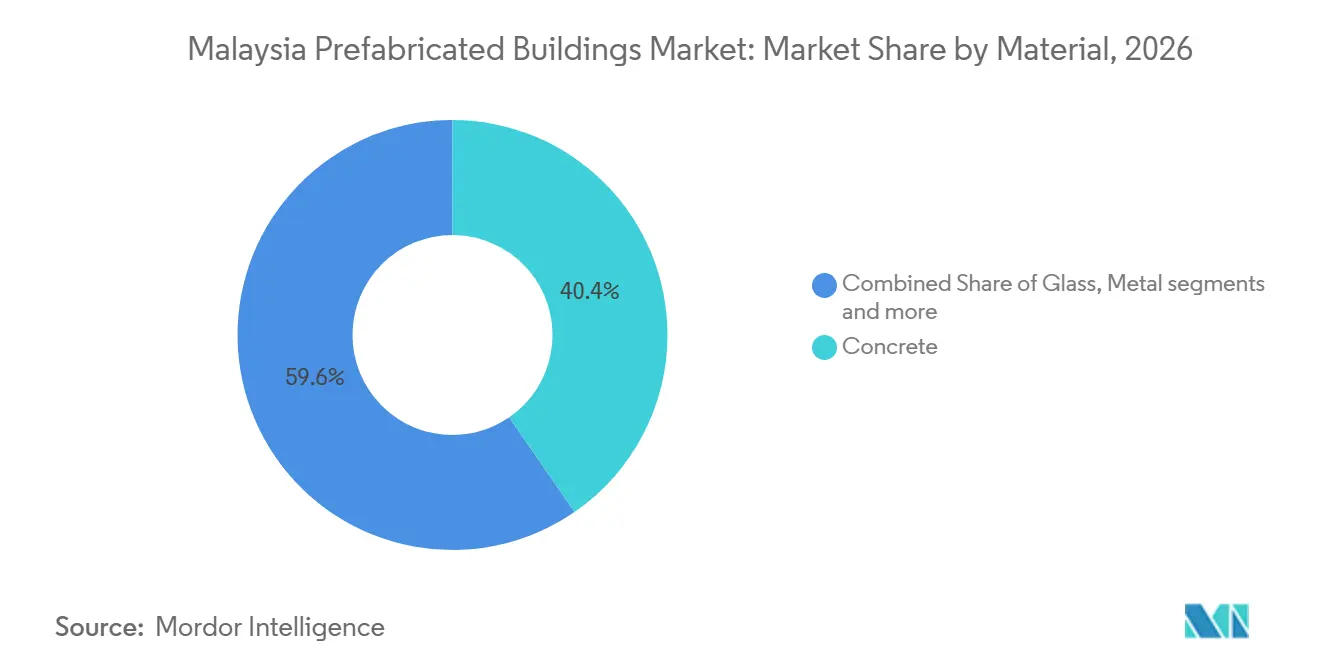
Concrete Leads While Timber Gains GroundConcrete held 40.4% of the Malaysia prefabricated buildings market size by material in 2026, reflecting its long-established role in public housing and infrastructure. Precast concrete fits projects where structural requirements, unit repetition, and local production capacity are clear, and it remains familiar to contractors, regulators, and clients working on housing blocks, schools, transport-related structures, and other developments that use repeated structural elements. MGB received a USD 45.6 million award for the Penang CLQ project in April 2026 using IBS precast concrete. This contract indicates that concrete remains relevant for large residential programs outside the Klang Valley. Metal and glass retain roles in commercial facades, industrial enclosures, and specialized cladding. Other materials serve smaller applications such as acoustic systems and interior partitions.
Timber is projected to record the fastest material growth at a 9.67% CAGR through 2032. Demand is linked to interest in lower-load structural options and building designs that respond to green standards. The Green Building Index introduced its Non-Residential New Construction Version 2.0 tool in 2026, increasing attention on operational sustainability in commercial development. Research on Sarawak peatlands identifies cross-laminated timber as a potential alternative housing system where lower superstructure loading can be beneficial. Timber will still depend on material availability, code acceptance, and capable design teams. Concrete is likely to retain its broad base. At the same time, engineered timber develops in selected low-rise and East Malaysia applications, where reduced structural weight, local site conditions, and sustainability objectives may create a more favorable case for alternative material systems.

By Application:
Residential Remains the Largest While Others, Including Industrial, Institutional, Infrastructure, and Energy Uses AdvanceResidential applications captured 43.2% of the Malaysia prefabricated buildings market share in 2026. The segment is supported by affordable housing initiatives that require a large number of repeatable units. PPVC and precast systems help developers standardize kitchens, bathrooms, structures, and building envelopes where layouts are repeated. SkyWorld Pearlmont uses PPVC for its first 1,846 units in Seberang Jaya. SCIB Industrialized Building System also held a revised contract to deliver 632 PR1MA affordable housing units in Kota Bharu. These projects show why housing provides predictable demand for established construction formats, as developers can repeat approved designs at a volume that justifies production planning, specialized workforce training, and longer-term procurement arrangements in the Malaysia prefabricated buildings market.
Other applications, including industrial, institutional, infrastructure, and energy, are forecast to grow at a 9.55% CAGR through 2032. Semiconductor facilities, data centers, and power infrastructure need shorter delivery periods and more consistent technical installation. IJM's Kulim project brings IBS precast into a high-value manufacturing environment. Vertiv's Senai operation supports a separate layer of demand for factory-built power and cooling modules. Public schools and healthcare facilities can also benefit where standardized designs are approved before construction begins. Commercial projects continue to use precast components where facade patterns and floor layouts make standardization viable. However, bespoke architectural requirements can reduce the savings that manufacturers achieve from repeated molds and production runs.
By Product Type:
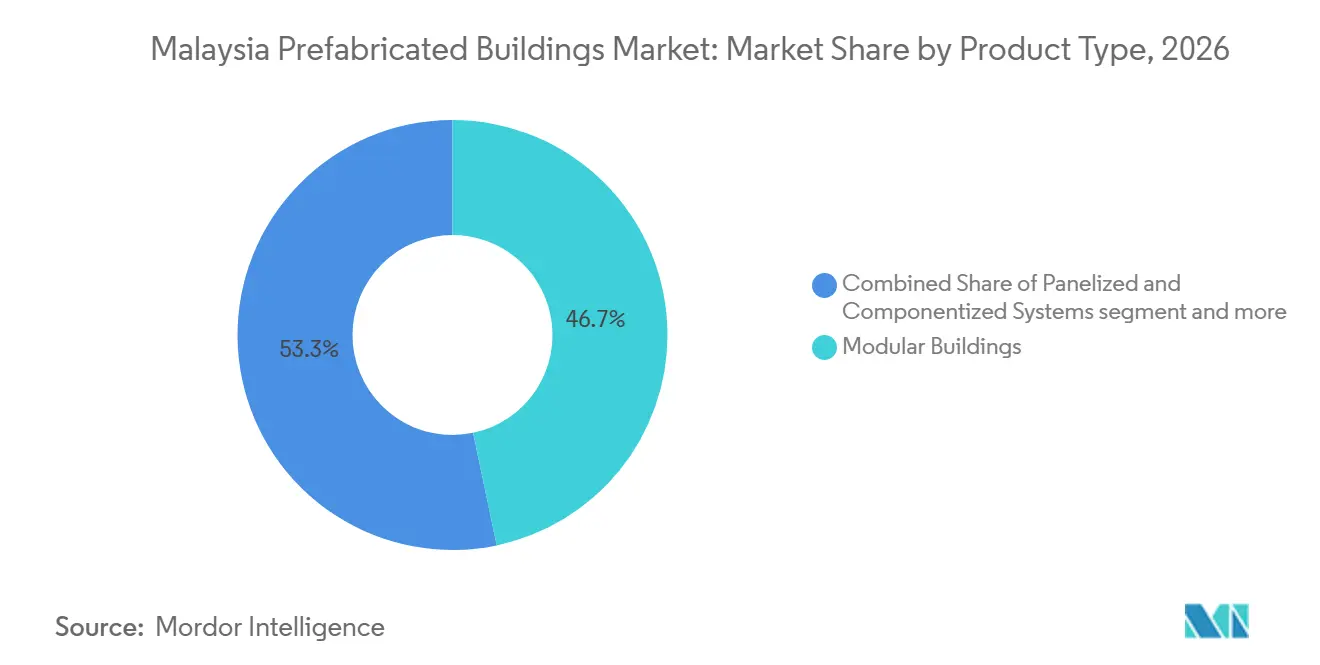
Modular Buildings Hold the Lead as Panelized and Componentized Systems ExpandModular buildings held 46.7% of the Malaysia prefabricated buildings market size by product type in 2026. Volumetric construction is suited to repeated room layouts, especially bathrooms, accommodation units, and residential modules. Gamuda's Banting facility has produced more than 15,000 volumetric units, including prefabricated bathroom units, small compartment units, and PPVC modules. This established production base supports the use of modular systems in major projects, while giving developers access to production experience that can improve consistency across repeated units and support closer coordination of finishes, services, and structural components before transport. The format can also give developers better control over finishes and quality before delivery to site. Its main constraint remains the need to transport, lift, and install large completed modules, which can add cost and operational risk when routes are restricted, crane access is limited, or the project site cannot hold modules before installation. This makes early logistics planning a core commercial requirement rather than a later construction detail. Manufacturers and contractors must agree on module dimensions, delivery timing, lifting points, storage needs, and installation sequence before factory output begins. When these decisions are settled early, volumetric systems can still deliver reliable quality and reduce on-site work in the Malaysia prefabricated buildings market.
Panelized and componentized systems are projected to grow fastest at a 9.70% CAGR through 2032. Flat panels generally use truck space more efficiently than complete modules and can be deployed across mid-rise commercial and industrial structures. Their use may increase where building forms are more varied, but walls, slabs, and structural components can still be repeated. Research in Buildings found that transfer learning combined with BIM can improve prefabricated building design optimization. This can help teams identify clashes before production and avoid costly changes after delivery. Hybrid approaches and other prefab types remain relevant for complex projects that cannot support a fully modular specification, allowing contractors to combine factory-made elements with site-based work where transport limits, irregular geometry, or phased construction prevent a single construction format.
Geography Analysis
Kuala Lumpur held 26.6% of the Malaysia prefabricated buildings market share in 2026, supported by government projects, mixed-use development, and the wider Klang Valley construction base. The city benefits from proximity to major developers, consultants, suppliers, and logistics services, which makes it easier for project teams to coordinate technical reviews, manage deliveries, and draw on experienced installers when a project has complex phasing or strict completion requirements. National BIM investment also supports the use of digital project coordination in the region. MRCB Building System used its proprietary modular approach at Residensi Tujuh in Kwasa Damansara City Centre, showing that major developers are expanding in-house capabilities. Petaling Jaya absorbs activity from the Kuala Lumpur area and provides sites for mixed-use and commercial construction.
Johor Bahru is forecast to grow at a CAGR of 9.95% through 2032, the highest rate among the key cities in the Malaysia prefabricated buildings market. Investment linked to the Johor-Singapore Special Economic Zone, data centers, and manufacturing supports demand for fast and quality-controlled construction. Vertiv opened its 21,900 square meter Senai facility in July 2026 to manufacture prefabricated power modules and cooling systems. This expands Johor's role from construction destination to a production base for digital infrastructure. Government infrastructure allocations and modular school building plans can add public-sector demand where designs are repeatable.
Penang is a focal point for PPVC housing and precast manufacturing activity. SkyWorld's Pearlmont groundbreaking brought a full PPVC affordable housing project to Seberang Jaya. The Penang Light Rail Transit project also supports local precast capability through its casting yard in Kulim. The rest of Malaysia remains an emerging opportunity, especially in Sabah and Sarawak, where hybrid and timber-based solutions can respond to local site conditions. Manufacturing gaps in these locations create room for producers that can balance local delivery with reliable quality control. Still, the commercial case will depend on whether project pipelines are sufficient to support equipment, trained crews, local material handling, and distribution networks.
Competitive Landscape
The Malaysia prefabricated buildings market is moderately concentrated in high-capacity IBS manufacturing and remains fragmented among contractors and component suppliers. Gamuda, IJM, and MGB have established capacity, recognized project records, and the ability to invest in digital production systems. IJM's SMART IBS plant combines digital twins, real-time monitoring, and an annual production capacity of 500,000 cubic meters. These capabilities matter when clients require short schedules, certified quality, and coordinated structural delivery. Smaller firms can compete in specialized supply, regional projects, installation, and hybrid systems, but they face higher barriers in scale production. The resulting structure favors companies that can own manufacturing assets and integrate them with project execution, because they can better align production schedules, technical approvals, storage decisions, and site installation responsibilities under one operating model.
Strategic moves are centered on capacity expansion, vertical integration, and higher-value project delivery. SkyWorld is developing a PPVC module factory in Penang after acquiring land through its Prefab Master subsidiary, linking manufacturing investment directly to its housing pipeline. MGB expanded internationally through a 50:50 venture for the Al Madina Al Monawara project in Saudi Arabia, using its IBS experience in an urban development project. IJM's Kulim semiconductor project combines IBS precast delivery with a Leadership in Energy and Environmental Design Gold target. These actions show that leading firms are positioning prefabrication as an integrated quality and sustainability offering. They also raise the value of engineering skills, supply chain coordination, and compliance credentials, as clients in the Malaysia prefabricated buildings market increasingly assess delivery capability alongside price when selecting partners for complex facilities.
The mid-tier is changing as companies reassess whether to own manufacturing assets or focus on project execution. SCIB completed the disposal of its concrete manufacturing subsidiary to YTL Cement Sarawak in May 2026, allowing it to focus on construction and engineering, procurement, construction, and commissioning activities. This approach contrasts with developers that are building their own production facilities, and it indicates that participants are making different choices on whether manufacturing ownership or flexible project execution offers the better path to growth in the Malaysia prefabricated buildings market. East Malaysia and institutional retrofitting remain less fully served opportunities because local capacity is thinner and standardized public designs are still developing. Engineered timber and cross-laminated timber hybrids may gain relevance on projects that place more weight on material choice and site conditions. However, their use will remain dependent on design familiarity, compliant supply, and clear performance requirements from project owners.
Malaysia Prefabricated Buildings Industry Leaders
-
Gamuda Berhad
-
IJM Corporation Berhad
-
MGB Berhad
-
Sunway Construction Group Berhad
-
Malaysian Resources Corporation Berhad
- *Disclaimer: Major Players sorted in no particular order
Malaysia Prefabricated Buildings Market Companies Covered in this Report
- Gamuda Berhad
- IJM Corporation Berhad
- MGB Berhad
- Sunway Construction Group Berhad
- Malaysian Resources Corporation Berhad
- Sarawak Consolidated Industries Berhad
- OSK Holdings Berhad
- SkyWorld Development Berhad
- Eversendai Corporation Berhad
- WCT Holdings Berhad
- YTL Corporation Berhad
- UEM Sunrise Berhad
- S P Setia Berhad
- Bina Puri Holdings Bhd
- Kumpulan Jetson Berhad
- AWC Berhad
- Chin Hin Group Berhad
- Bestari Bina Ventures (M) Sdn. Bhd.
- Golden Sharp Sdn. Bhd.
- PCG Global System Sdn. Bhd.
- Vertiv Corporation
- China State Construction Engineering Corporation Limited
- HSS Engineering Berhad
- MRCB Building System Sdn. Bhd.
Recent Industry Developments in Malaysia Prefabricated Buildings Market
- October 2026: IJM Construction Sdn. Bhd. secured a USD 280 million contract for a semiconductor manufacturing facility at Kulim Hi-Tech Park, Kedah, incorporating Industrialized Building System (IBS) precast components and targeting Leadership in Energy and Environmental Design (LEED) Gold certification for the production building.
- August 2026: IJM Construction added USD 214 million across two fast-track projects: a semiconductor facility in Kulim and a medical device manufacturing plant for Intuitive Surgical Malaysia Sdn. Bhd. at Batu Kawan Technology Park, Penang.
- July 2026: Vertiv Corporation opened its 236,000-square-foot facility in Senai, Johor, producing prefabricated power modules, cooling systems, and integrated infrastructure for artificial intelligence and data center applications across Asia Pacific.
Malaysia Prefabricated Buildings Market Report Scope
Segmentation Overview
| Concrete |
| Glass |
| Metal |
| Timber |
| Other Materials |
| Residential |
| Commercial |
| Others, Including Industrial, Institutional, Infrastructure, and Energy |
| Modular Buildings |
| Panelized and Componentized Systems |
| Other Prefab Types |
| Kuala Lumpur |
| Penang (George Town) |
| Johor Bahru |
| Petaling Jaya |
| Rest of Malaysia |
| By Material | Concrete |
| Glass | |
| Metal | |
| Timber | |
| Other Materials | |
| By Application | Residential |
| Commercial | |
| Others, Including Industrial, Institutional, Infrastructure, and Energy | |
| By Product Type | Modular Buildings |
| Panelized and Componentized Systems | |
| Other Prefab Types | |
| By Key Cities | Kuala Lumpur |
| Penang (George Town) | |
| Johor Bahru | |
| Petaling Jaya | |
| Rest of Malaysia |
Key Questions Answered in the Report
What is the projected value of Malaysia prefabricated buildings in 2032?
The sector is projected to reach USD 3.11 billion by 2032, growing at an 8.91% CAGR from 2027 to 2032. Growth is linked to public housing, formal IBS adoption, demand from digital and advanced manufacturing facilities, and the operational need to reduce dependence on on-site work where skilled labor remains constrained.
Which material leads prefabricated construction in Malaysia?
Concrete leads with a 40.4% share in 2026, supported by its established use in precast housing and infrastructure.
Which application is growing fastest through 2032?
Others, Industrial, institutional, infrastructure, and energy applications are forecast to grow at a 9.55% CAGR through 2032.
Why are developers using PPVC and IBS methods?
These methods help developers standardize repeated units, manage site labor needs, and improve schedule control on suitable projects.
Which city has the highest projected growth rate?
Johor Bahru is projected to grow at a 9.95% CAGR through 2032, supported by digital infrastructure and manufacturing investment.
Who are the leading participants in Malaysian prefabrication?
Gamuda, IJM, and MGB have significant manufacturing capability, while SkyWorld and SCIB illustrate different approaches to vertical integration and project delivery.