
Malaysia Paints and Coatings Market Size and Share
Market Overview
| Study Period | 2021 - 2031 |
|---|---|
| Forecast Data Period | 2026 - 2031 |
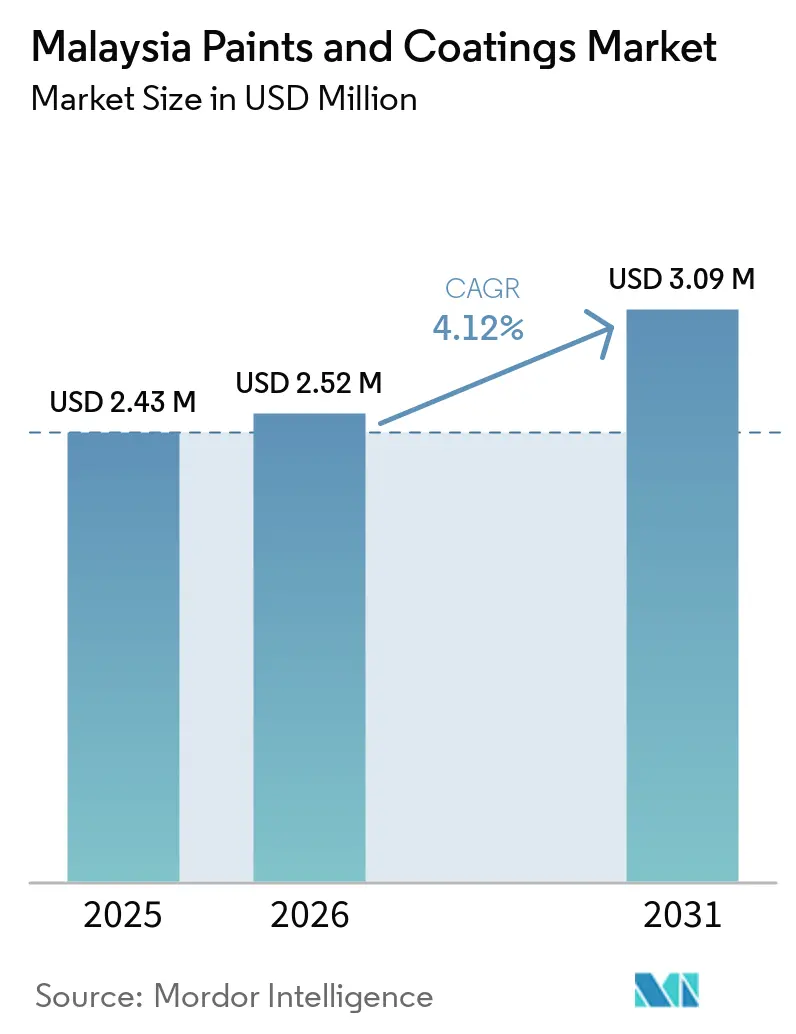
| Base Year Market Size (2025) | USD 2.43 Million |
| Market Size (2026) | USD 2.52 Million |
| Market Size (2031) | USD 3.09 Million |
| Growth Rate (2026 - 2031) | 4.12 % |
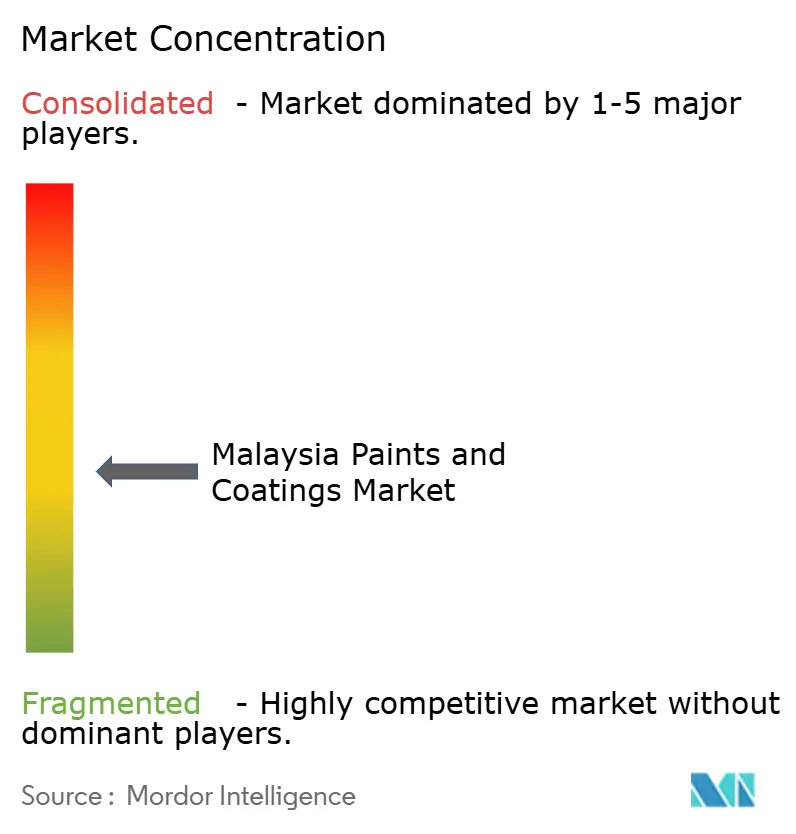
| Market Concentration | Medium |
Major Players *Disclaimer: Major Players sorted in no particular order Image © Mordor Intelligence. Reuse requires attribution under CC BY 4.0. | |
Malaysia Paints and Coatings Market Analysis by Mordor Intelligence
The Malaysia Paints and Coatings market size was estimated at USD 2.43 billion in 2025 and is estimated to grow from USD 2.52 billion in 2026 to USD 3.09 billion by 2031, at a CAGR of 4.12% during the forecast period (2026-2031). Construction activity remains the primary driver of demand, supporting sales of architectural paints, primers, and specialist coatings. The composition of building activity is also changing, as nonresidential facilities, industrial sites, and data centers require more protective systems than standard decorative coatings. Investment in automotive assembly is strengthening demand for waterborne primers, electro-deposition coatings, and durable topcoats. Regulatory requirements for lower volatile organic compound (VOC) products are increasing the adoption of waterborne and powder technologies, while raising formulation and certification costs for smaller producers. The Malaysian paints and coatings market, therefore, combines steady construction-led demand with growing demand for higher-value industrial applications.
Key Report Takeaways
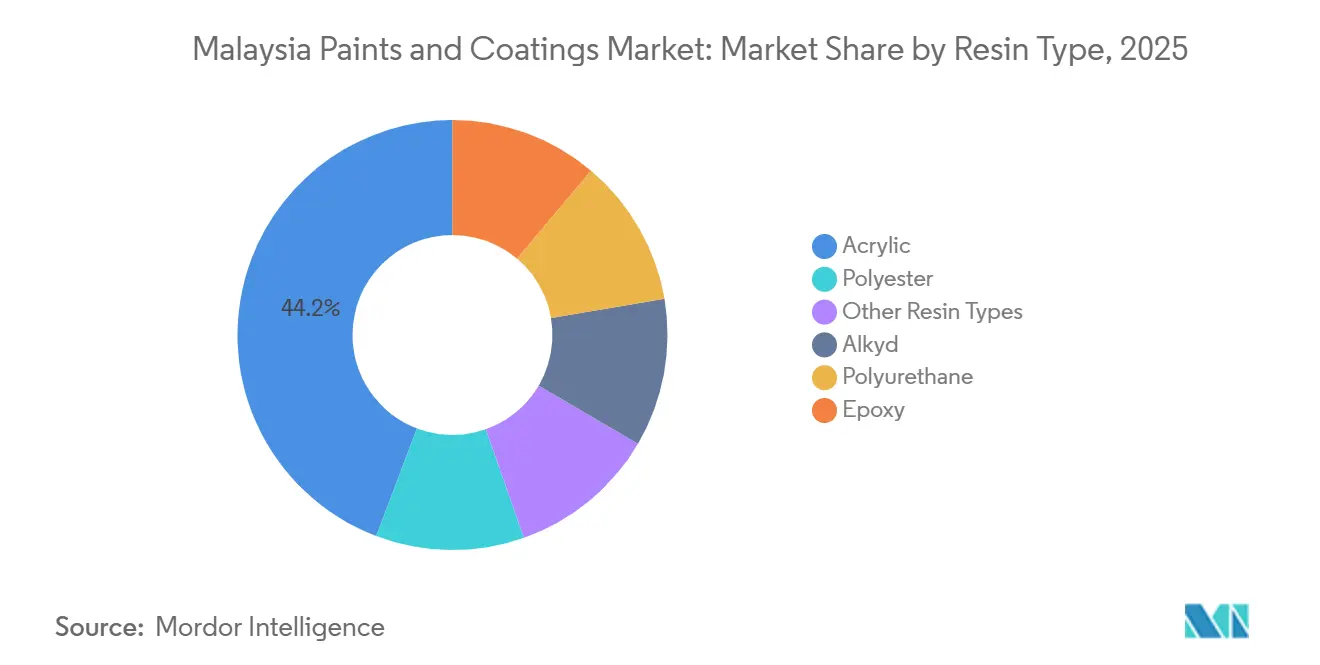
- By resin type, acrylic held 44.23% of the Malaysia Paints and Coatings market share in 2025, while polyurethane is forecast to grow at a 4.67% CAGR through 2031.
- By technology, water-borne coatings accounted for 63.52% of the Malaysia Paints and Coatings market share in 2025, while powder coating is forecast to expand at a 5.12% CAGR through 2031.
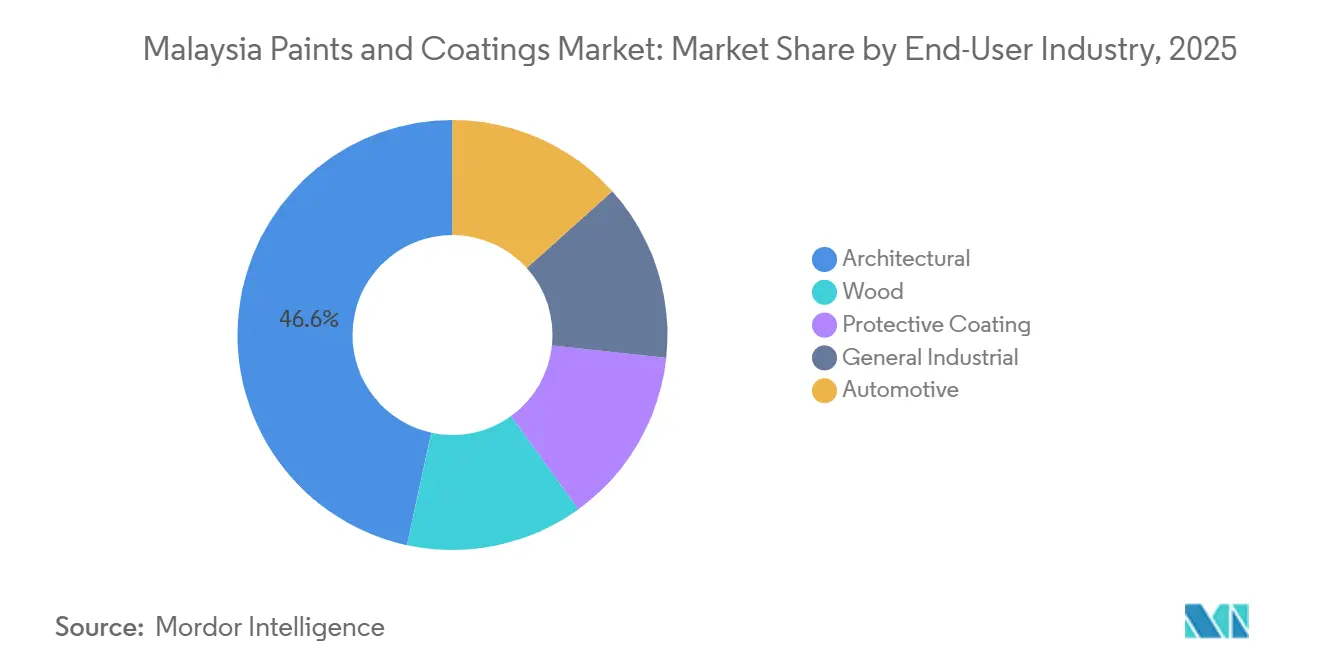
- By end-user industry, architectural coatings held 46.61% of market value in 2025, while automotive coatings are forecast to record a 5.33% CAGR through 2031.
Note: Market size and forecast figures in this report are generated using Mordor Intelligence’s proprietary estimation framework, updated with the latest available data and insights as of January 2026.
Malaysia Paints and Coatings Market Trends and Insights
Drivers Impact Analysis*
| Drivers | (~) % Impact on CAGR Forecast | Geographic Relevance | Impact Timeline |
|---|---|---|---|
| Residential, Commercial, and Infrastructure Construction Pipeline | +1.5% | National, with outsized gains in Johor, Selangor, and Penang | Short term (≤ 2 years) |
| Automotive and Electric Vehicle Manufacturing Expansion | +0.8% | Johor, Kedah, Melaka, Selangor (AHTV corridor) | Medium term (2-4 years) |
| Electronics, Data Center, and Electrical Equipment Cluster Growth | +0.6% | Johor (Iskandar), Selangor (Cyberjaya), Penang (Electrical and Electronics (E&E) zone) | Medium term (2-4 years) |
| Protective Coating Demand from Renewable Power, Marine, and Energy Assets | +0.5% | National, with the Peninsular West Coast and East Malaysia marine zones | Long term (≥ 4 years) |
| Low-Volatile Organic Compound (VOC) and Water-Borne Specification Shift | +0.4% | National, led by Klang Valley Green Building Index (GBI)-certified projects | Medium term (2-4 years) |
| Tropical-Climate Heat-Reflective and Antimicrobial Coating Adoption | +0.3% | National, concentrated in dense urban zones (Kuala Lumpur, Penang, Johor Bahru) | Long term (≥ 4 years) |
| Source: Mordor Intelligence | |||
Residential, Commercial, and Infrastructure Construction Pipeline
Malaysia's construction sector generated MYR 178.6 billion (USD 40.3 billion) in work value in 2025, representing 12.5% year-over-year growth. Construction activity remains the largest direct source of architectural coating consumption across residential, commercial, and public projects. The 2025 Budget allocated MYR 10 billion (USD 2.3 billion) to the Ministry of Housing, along with mortgage guarantee facilities to support first-time homebuyers. New homes require paint, primers, waterproofing systems, and related finishing materials at multiple stages of construction. The Malaysia Paints and Coatings market also benefits as work progresses from structural construction to interior and exterior finishing. This demand is broad-based, as building starts generate consumption across dealer channels, contractors, and project specifications.
The mix of construction work is becoming as important as total construction output. Nonresidential buildings grew 56.7% in the second quarter of 2025, while special trade activities grew 22.2%, both exceeding residential growth. These projects use epoxy floor coatings, fire-resistant systems, roof finishes, and other specialized products more frequently than conventional interior emulsions. A larger industrial and commercial project base can therefore shift the value mix toward more protective applications. Johor, Selangor, and Penang remain important locations, combining construction activity with industrial development. The Malaysia Paints and Coatings market is directly linked to this building pipeline, as coatings are required at project completion and during subsequent maintenance cycles.
Automotive and Electric Vehicle Manufacturing Expansion
Automotive manufacturing is expanding the addressable base for coatings in Malaysia. Pure electric vehicle registrations reached 30,848 units in 2025, reflecting 42% growth, according to Kenanga Research as cited by the New Straits Times. Inokom launched Paint Shop 3 at its Kulim complex in August 2026, with an investment of MYR 300 million (USD 73 million)[1]Sime Darby Berhad, “Inokom Strengthens Malaysia’s Automotive Assembly Capabilities Through Local Expertise and Global Partnerships,” Sime Darby, sime.com.. The facility adds 50,000 units of annual capacity per shift, bringing total paint-shop throughput to 100,000 vehicle bodies per year. Local vehicle assembly requires coating to be applied in Malaysia rather than importing pre-painted vehicle bodies, creating demand across the e-coat primer, basecoat, and clearcoat stages.
EP Manufacturing Berhad began construction of a MYR 200 million (USD 46 million) vehicle painting facility in Pegoh, Melaka, in June 2026. The planned facility targets 30,000 vehicle bodies annually and is designed to support BEV, HEV, PHEV, and ICE platforms. New assembly lines require suppliers to qualify waterborne primer and topcoat systems, electrodeposition coatings, and durable clearcoats. These specifications support demand for polyurethane and high-solids formulations rather than commodity emulsions. The Malaysia Paints and Coatings market benefits from this shift, as automotive coatings are selected based on performance and production requirements. This expansion also increases the importance of reliable local technical service for vehicle manufacturers.
Electronics, Data Center, and Electrical Equipment Cluster Growth
Data center construction is generating demand for industrial protective coatings outside traditional architectural applications. As of the second quarter of 2025, Johor had 42 approved data center projects valued at MYR 164.45 billion (USD 39.08 billion). These facilities require anti-corrosion systems on steel structures, epoxy systems for raised floors, and intumescent products for fire protection. The project pipeline also requires coatings for external surfaces and supporting infrastructure. Such applications differ from standard decorative paint demand, as the products must meet engineering and durability requirements. The Malaysia Paints and Coatings market can capture this demand through suppliers with protective-coating expertise and project approval capabilities.
Penang's semiconductor and electronics manufacturing services cluster provides a separate source of demand. Precision-cleaned metal enclosures and printed circuit board substrates use UV-cured and powder-coated finishes that differ from solvent-borne decorative products. These applications require surface consistency, rapid curing, and controlled processing conditions. Electronics plants can therefore support technology adoption in the Malaysia Paints and Coatings market even where coating output is smaller than in construction. Johor, Cyberjaya, and Penang are particularly relevant, as they concentrate data center, digital, and electronics investment. Growth in this cluster also favors suppliers that can provide technical support and product specifications for industrial equipment.
Protective Coating Demand from Renewable Power, Marine, and Energy Assets
Malaysia's renewable energy and marine assets support demand for protective coating systems. A 2 GW utility-scale solar tender was launched at the start of 2025, generating coating requirements for racking, inverter housings, and junction boxes exposed to ultraviolet radiation, humidity, and coastal conditions. Solar projects use epoxy and fluoropolymer systems where components require corrosion protection and durability. The LSS5, LSS5+, and LSS6 programs are expected to generate an engineering, procurement, construction, and commissioning pipeline of MYR 15 billion (~USD 3.70 billion) to MYR 18 billion (~USD 4.44 billion) over 24 months. This project activity provides a longer-cycle opportunity for suppliers serving the energy infrastructure segment. The Malaysia Paints and Coatings market can benefit when coating products are specified during equipment and structure design.
Ports such as Tanjung Pelepas and Pasir Gudang sustain demand for marine maintenance coatings. Vessel traffic and port infrastructure require antifouling, epoxy, and zinc-rich primer systems, which are selected based on technical specifications and asset protection requirements. Demand from marine, renewable power, and energy assets is less dependent on residential building cycles and extends coating applications into East Malaysian marine zones and West Coast industrial locations. The Malaysia Paints and Coatings market has an opportunity in these applications where suppliers can meet performance, maintenance, and corrosion-control requirements.
Restraints Impact Analysis*
| Restraints | (~) % Impact on CAGR Forecast | Geographic Relevance | Impact Timeline |
|---|---|---|---|
| Resin, Titanium Dioxide, Pigment, and Solvent Cost Volatility | -0.7% | Global supply-chain impact, most acute for Peninsular-based manufacturers importing from China | Short term (≤ 2 years) |
| Volatile Organic Compound (VOC), Hazardous Air Pollutant, and Product Compliance Costs | -0.5% | National, most acute in Klang Valley and Penang Electrical and Electronics (E&E) manufacturing zones | Medium term (2-4 years) |
| Fragmented Competition and Contractor-Led Price Pressure | -0.4% | National, most severe in Tier-2 and Tier-3 township housing projects | Short term (≤ 2 years) |
| Commercial Office Oversupply and Project Timing Risk | -0.3% | Klang Valley, Johor Bahru fringe areas | Medium term (2-4 years) |
| Source: Mordor Intelligence | |||
Resin, Titanium Dioxide, Pigment, and Solvent Cost Volatility
Raw material volatility creates direct margin risk for coating producers, particularly those with limited purchasing capacity. Titanium dioxide is central to this risk, accounting for 25% to 30% of cash production costs for architectural paints and 12% to 18% for industrial formulations. Chinese domestic rutile titanium dioxide averaged 14,461 yuan (equivalent to USD 2,000) per ton in the first half of 2025, down 6.65% from the same period in 2024. Western suppliers announced price increases of USD 100-150 per ton for the fourth quarter of 2025. Smaller domestic producers are less able to absorb these price movements, as they typically lack long-term supply contracts.
Trade actions can further compound pricing pressures. EU anti-dumping duties on Chinese titanium dioxide ranged from 14.4% to 39.7%. Tariffs imposed by the EU and Brazil redirected Chinese exports toward Asia-Pacific Economic Cooperation (APEC) markets, including Malaysia. While greater short-term supply availability can reduce commodity prices, lower prices can intensify pressure on manufacturers that are unable to shift to higher-value formulations. The Malaysia paints and coatings market is exposed to this tension, where imported inputs and contractor-led pricing operate simultaneously. Resin, pigment, solvent, and titanium dioxide costs remain material factors affecting producer margins.
Volatile Organic Compound (VOC), Hazardous Air Pollutant, and Product Compliance Costs
Compliance costs represent a structural burden for producers without extensive in-house research and development capability. Malaysia's Environmental Quality (Amendment) Act 2024, Act A1712, increased fines and introduced mandatory imprisonment for non-compliance, raising the financial consequences of formulation and emissions failures. Jabatan Standard Malaysia issued revised editions of MS 134 for emulsion paint and MS 132 for undercoating paint for gloss enamel in July 2025[2]Jabatan Standard Malaysia, “Kelulusan Malaysian Standards (MS) Bil. 3/2025,” Jabatan Standard Malaysia, jsm.gov.my.. Product ranges may require reformulation and renewed testing to remain aligned with these updated standards. The Malaysia paints and coatings market faces this cost pressure across both architectural and industrial products.
Green Building Index specifications favor low-VOC paint for certified buildings. Waterborne and low-VOC systems can require equipment upgrades, changes in cure-time management, and third-party testing. These investments are more difficult for smaller local manufacturers to distribute across limited production runs. The compliance burden is particularly relevant in Klang Valley and Penang, where green building and electronics manufacturing requirements are significant. At the same time, compliance requirements can strengthen the competitive position of manufacturers that already possess formulation expertise and certified products. The Malaysia paints and coatings market will continue to shift toward lower-emission products, though this transition carries both cost and capability requirements.
*Our forecasts treat driver/restraint impacts as directional, not additive. The impact forecasts reflect baseline growth, mix effects, and variable interactions.
Segment Analysis
By Resin Type: Acrylic Underpins Stability, Polyurethane Gains Structural Momentum
Acrylic held 44.23% of the 2025 value, giving it the largest share by resin type in the Malaysia Paints and Coatings market. Its broad use in exterior and interior architectural paints supports this position. Weather resistance, color retention, and accessible formulation costs align with the requirements of residential and commercial buildings. Acrylic can serve as both an economical roller-coat emulsion and a premium elastomeric exterior system. This versatility gives the resin a wide base across dealer and project channels.
Alkyd remains in use in wood finishing and general industrial applications where oil-based gloss paints are still specified. Epoxy is important for protective coatings on industrial floors and marine assets. Polyester is used in powder coating for metal furniture, architectural aluminum, and appliance finishes. Polyurethane is forecast to expand at a 4.67% CAGR through 2031, making it the fastest-growing resin type in the Malaysia Paints and Coatings market. Automotive topcoats, data center steel structures, and renewable energy racking support this growth. Proton expanded its AHTV plant to 42,000 units annually in May 2026, reinforcing the local vehicle-production base for two-pack clearcoats. The market for polyurethane is also supported by its use in flexible and scratch-resistant applications. Revised MS 134 requirements further support interest in low-VOC polyurethane and acrylic-polyurethane systems.



By Technology: Water-Borne Dominates, Powder Coating Accelerates on Industrial Demand
Water-borne coatings accounted for 63.52% of 2025 technology value in the Malaysia Paints and Coatings market. They are widely used in architectural, wood, and general industrial applications. Green Building Index specifications and government procurement guidelines for low-VOC materials have supported their use in commercial new-build projects. This position is supported by product specifications and compliance requirements rather than price alone. Water-borne systems are therefore established in core end uses as a principal route to lower-VOC compliance.
Solvent-borne coatings continue to be used in protective coatings, marine maintenance, and rural architectural applications. Specifiers may still question water-borne curing performance under high-humidity conditions in these settings. Powder coating is forecast to grow at a 5.12% CAGR through 2031, the fastest rate among the technology categories. Inokom's Paint Shop 3 includes a dry-scrubber filtration system designed for future compatibility with water-borne and powder coatings. The facility has 32 painting and sealant robots and can switch among 27 colors in less than 10 seconds. UV-cured coatings also serve precision electronics applications in Penang, where fast curing and dimensional control are important.
By End-User Industry: Architectural Leads, Automotive Drives the Upside
Architectural coatings held 46.61% of 2025 end-user value in the Malaysia Paints and Coatings market. Housing funding and broad construction activity sustained demand for primers, interior coatings, exterior finishes, and waterproofing products. Nippon Paint Malaysia expanded its dealer network in Melaka to more than 130 stores in April 2025, indicating that the architectural segment is developing distribution beyond the largest urban centers. Wood coatings remain stable within furniture manufacturing in Muar and the Klang Valley. Protective coatings for oil and gas, renewable energy, and marine assets offer specification-led demand and higher margin potential.
Automotive coatings are forecast to grow at a 5.33% CAGR from 2026 to 2031. Electric vehicle registrations increased 286% from 2022 to 2023, then 114% to 21,789 units in 2024, and 42% to 30,848 units in 2025. Local assembly creates demand for e-coat primer, color basecoat, and clearcoat within Malaysia. Stellantis began assembly of Leapmotor vehicles in Kedah in June 2026. MG Motor Malaysia rolled out the locally assembled MG S5 EV in Melaka in March 2026.
Geography Analysis
Malaysia is a single reporting geography, but regional demand varies by the mix of construction, manufacturing, and infrastructure activity. Selangor contributed MYR 9.7 billion (USD 2.2 billion) in construction work in Q2 2025, representing 22.2% of the national total. The Klang Valley has the largest demand base for architectural and general industrial coatings, driven by commercial projects, mixed-use developments, and industrial estates. This concentration supports the largest share of the Malaysia Paints and Coatings market within the country. Older Grade B and lower office stock recorded a 28.3% vacancy rate at the end of 2024, which limits refurbishment demand. Grade A net absorption increased 11.5% year over year in 2025, supporting demand for higher-specification paint systems.
Johor is the fastest-growing regional source of demand for industrial and protective coatings. As of Q2 2025, its 42 approved data center projects were valued at MYR 164.45 billion (USD 39.08 billion). These projects require coatings for steel structures, raised-floor systems, and building envelopes. Iskandar Malaysia also hosts logistics, aerospace maintenance, and port infrastructure that use antifouling, epoxy, and zinc-rich primers. Tanjung Pelepas and Pasir Gudang support the marine maintenance segment of the Malaysia Paints and Coatings market. Melaka is a secondary growth hub, supported by the planned EPMB painting facility scheduled to begin operations in June 2027.
Penang's electronics and semiconductor manufacturing services cluster drives demand for UV-cured and powder coatings on precision enclosures, printed circuit board assemblies, and semiconductor handling equipment. These applications require dedicated technical support and serve a more specialized portion of the Malaysia Paints and Coatings market. Sabah and Sarawak contribute through hydropower maintenance, offshore oil and gas refurbishment, timber processing, and marine activity. These states have lower total coating output than the main Peninsular centers but generate protective and wood-coating demand outside the construction cycle. High ultraviolet exposure, year-round humidity above 80%, and coastal salt exposure influence formulation and durability requirements across the country. These conditions support demand for products with extended durability warranties. The Malaysia Paints and Coatings market is therefore shaped by both broad national climate requirements and regional differences in project activity.
Competitive Landscape
The Malaysia paints and coatings market is moderately fragmented. Nippon Paint, AkzoNobel, PPG Industries, Jotun, and Sherwin-Williams compete for specification-driven architectural and protective projects. Federal Paints, Kossan Paint, MCI Paint, KTH Paint, and other domestic manufacturers address mainstream segments through contractor relationships and distribution density. This mix supports price competition in mainstream applications while meeting the technical requirements of premium projects. Contractor-led purchasing intensifies price pressure, particularly in lower-tier township housing projects. The market, therefore, combines multinational product portfolios with dense local route-to-market coverage.
AkzoNobel opened a research and development center in Nilai in June 2025 as a regional hub for decorative paint technologies and eco-friendly solutions. The investment improved local access to formulation and product development capabilities. PPG expanded its Malaysian plant in 2024 to manufacture non-stick and low-friction coatings, targeting electronics and precision engineering applications rather than commodity architectural output. Nippon Paint submitted acquisition bids for AkzoNobel's decorative paints business in July 2026. A completed transaction would alter the competitive landscape across ASEAN, including Malaysia. The market also faces a technical entry barrier, as MS ISO 16000-9:2024 applies VOC emission measurement requirements for building products.
Domestic suppliers compete through price, dealer reach, and contractor loyalty, while some pursue functional differentiation. Nippon Paint Malaysia launched its AI-PPS Self-Healing Invisible Armor Paint Protective Spray-On for automotive refinish applications in 2025. MCI Paint's Baoma Shield Flexicool product incorporates heat-reflective technology that can reduce exterior surface temperatures by up to 5°C. AkzoNobel deployed its Dulux Weathershield KeepCool system in Malacca social housing. Heat-reflective coatings have become a direct area of product competition. Data center protective coatings and solar asset coatings remain specialist opportunities, as they require technical sales capability and formulation expertise. Multinational suppliers hold an advantage in these areas, where global reference installations and specialized expertise are important factors.
Malaysia Paints and Coatings Industry Leaders
Nippon Paint Holdings Co., Ltd.
Akzo Nobel N.V.
Jotun
TOA Paint Public Company Limited
PPG Industries, Inc.
- *Disclaimer: Major Players sorted in no particular order

Recent Industry Developments
- August 2026: Inokom Corporation launched Paint Shop 3 (PS3) at its Kulim, Kedah manufacturing complex, backed by a MYR 300 million (USD 73 million) investment. The facility expands Inokom's total automotive paint capacity to 100,000 vehicle bodies annually, incorporates 32 painting and sealant robots, and is designed for future waterborne-paint readiness. It also features a regenerative thermal oxidizer that reduces CO₂ emissions by approximately 60%.
- June 2026: EP Manufacturing Berhad (EPMB) broke ground on a MYR 200 million (USD 46 million) vehicle painting facility in Pegoh, Melaka, targeting an annual capacity of 30,000 vehicle bodies at a line speed of 15 units per hour. The facility supports ICE, HEV, PHEV, and BEV platforms and is scheduled to commence operations in June 2027.


Malaysia Paints and Coatings Market Report Scope
Paints and coatings are liquid, paste, or powder materials applied to surfaces to form a solid, thin film. Paint primarily serves decorative purposes, while coatings are engineered layers designed for physical protection, waterproofing, and rust prevention.
The malaysia paints and coatings market is segmented by resin type, technology, and end-user industry. By resin type, the market is segmented into acrylic, alkyd, polyurethane, epoxy, polyester, and other resin types. By technology, the market is segmented into water-borne, solvent-borne, powder coating, and UV-cured coating. By end-user industry, the market is segmented into architectural, automotive, wood, protective coating, and general industrial. The market sizes and forecasts are provided in terms of value (USD).
| Acrylic |
| Alkyd |
| Polyurethane |
| Epoxy |
| Polyester |
| Other Resin Types |
| Water-Borne |
| Solvent-Borne |
| Powder Coating |
| UV-Cured Coating |
| Architectural |
| Automotive |
| Wood |
| Protective Coating |
| General Industrial |
| By Resin Type | Acrylic |
| Alkyd | |
| Polyurethane | |
| Epoxy | |
| Polyester | |
| Other Resin Types | |
| By Technology | Water-Borne |
| Solvent-Borne | |
| Powder Coating | |
| UV-Cured Coating | |
| By End-User Industry | Architectural |
| Automotive | |
| Wood | |
| Protective Coating | |
| General Industrial |


Key Questions Answered in the Report
What is current market size of Malaysia Paints and Coatings Market?
The Malaysia Paints and Coatings market size was estimated at USD 2.43 billion in 2025 and is estimated to grow from USD 2.52 billion in 2026 to USD 3.09 billion by 2031, at a CAGR of 4.12% during the forecast period (2026-2031).
Which resin type leads the demand for coatings in Malaysia?
Acrylic led with a 44.23% value share in 2025, supported by widespread architectural use.
Which coating technology is growing fastest in Malaysia?
Powder coating is forecast to grow at a 5.12% CAGR through 2031, supported by demand from the automotive and electronics manufacturing sectors.
What is the largest end-user application for coatings in Malaysia?
Architectural coatings held 46.61% of end-user value in 2025, reflecting the importance of housing and construction activity.
Page last updated on:





