
Market Overview
| Study Period | 2021 - 2031 |
|---|---|
| Forecast Data Period | 2026 - 2031 |
| Historical Data Period | 2021 - 2024 |
| Growth Rate | 1.97 % |
| Market Concentration | Medium |
Major Players *Disclaimer: Major Players sorted in no particular order Image © Mordor Intelligence. Reuse requires attribution under CC BY 4.0. | |
Malaysia Oil And Gas Midstream Market Analysis by Mordor Intelligence
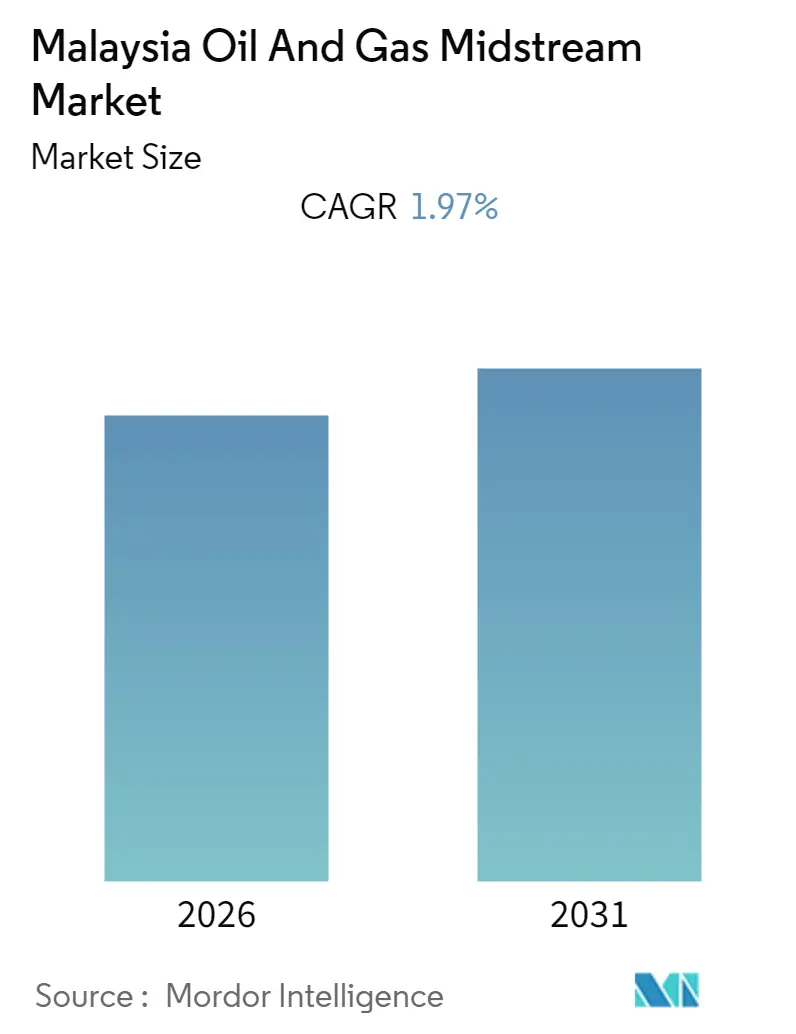
The Malaysia Oil and Gas Midstream Market size is expected to register a CAGR of 1.97% during the forecast period (2026-2031).
COVID-19 negatively impacted the market in 2020. Presently the market has reached pre-pandemic levels.
- Over the medium term, the increasing demand for oil and gas and increasing pipeline projects are expected to drive the market.
- On the other hand, the country's decreasing oil and gas production is expected to hinder the market's growth.
- Nevertheless, increasing gas trading with Asia has resulted in neighboring countries turning to Malaysia for storage. Companies in Malaysia can meet the rising storage demands. This is expected to create enormous opportunities for the Malaysia oil and gas midstream market.
Note: Market size and forecast figures in this report are generated using Mordor Intelligence’s proprietary estimation framework, updated with the latest available data and insights as of 2026.
Malaysia Oil And Gas Midstream Market Trends and Insights
LNG Terminals Segment is Expected to Dominate the Market
- The Liquefied natural gas (LNG) terminals segment is expected to dominate the midstream market of Malaysia due to the increasing demand for natural gas in the country and neighboring regions. The majority of countries want to reduce their carbon emissions to control the air quality in the environment, which has increased the consumption of natural gas in various end-user segments.
- Satu Malaysia Terminal is an LNG terminal in Sarawak, Malaysia. It constitutes three LNG trains and has a capacity of 8.1 million metric tons per annum (MTPA). It is a part of the Malaysia LNG Complex, also known as the Petronas Bintulu LNG Complex.
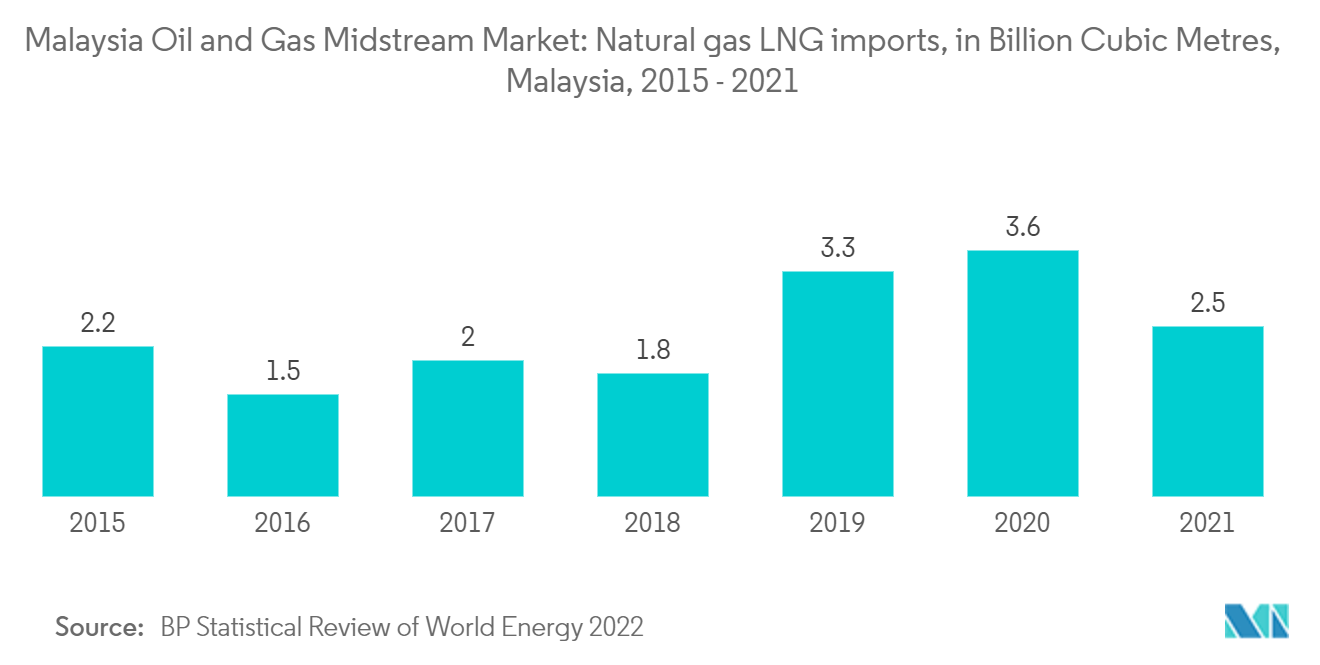
- As of 2021, the natural gas imports in the country were around 2.5 billion cubic meters per day. The imports were less in 2021 compared to 2020. This decrease in imports signifies the operation of new LNG terminals.
- For instance, in January 2022, the Malaysian State of Sabah and Petronas announced plans for a two million metric tons/year (mmty) liquefied natural gas (LNG) terminal. The new facility planned for the Sipitang Oil and Gas Industrial Park is a part of Petronas's collaboration with the state to expand Sabah's distribution of cleaner energy to industrial and commercial businesses.
- Furthermore, in August 2021, the Indian Oil Corporation (IOC) entered a joint venture with Malaysia's state-run Petronas to include building liquefied natural gas (LNG) terminals, fuel retailing, and gas distribution, driving the growth of the segment.


Decreasing Production of Gas to Restrain the Market
- Malaysia heavily relies on oil and gas as its primary energy source. According to BP statistics, in 2021, the share of oil and gas in countries' primary energy consumption was close to 70%. This signifies the dependency on oil and gas in Malaysia. Although the country has been taking steps to reduce its dependency and diversify to other sources for the short term, the trend is expected to continue.
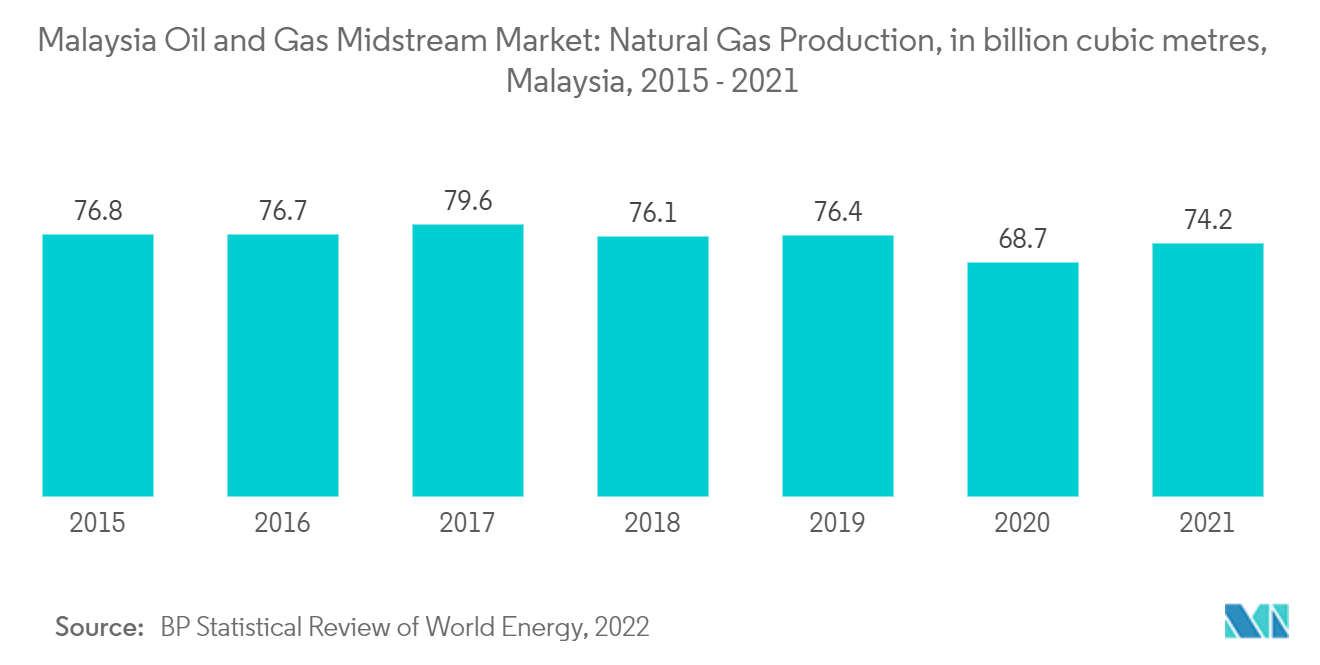
- Moreover, between 2015 to 2020, the country noticed a decline in domestic natural gas production, reducing to 68.7 billion cubic meters in 2020 compared to 76.7 billion cubic meters in 2015. However, a sharp rise was recorded in 2021 at 74.2 billion cubic meters, but the production is expected to decline in the coming years.
- Malaysia's diminishing output is due to aging fields, notably its larger resources in the shallow waters offshore of Peninsular Malaysia, which constrain the country's midstream market.
- Furthermore, Malaysia's oil pipeline network could be more modest. The country primarily relies on tankers and vehicles to transfer midstream petroleum products onshore. The pipeline transports oil products from Indonesia's Dumai oil refinery to Malaysia's Melaka oil refinery.
- As a result of lower natural gas consumption and production and a limited pipeline network, Malaysia's oil and gas midstream business is constrained. However, an increase in oil and gas consumption, as well as increased investment in the sector, is going to drive the market over the projected period.
Regulatory Landscape
Malaysia's gas midstream is governed by the Gas Supply Act 1993 (and subsequent amendments) and regulated by the Energy Commission (Suruhanjaya Tenaga) for piped gas supply, including Third Party Access (TPA) to import, regasify, and transport gas in Peninsular Malaysia. A key regulatory anchor is the Gas Supply (Amendment) Regulations 2025, gazetted on 26 December 2025 and effective 31 December 2025, which tightened the modernized regulatory perimeter ahead of the next phase of gas market reforms.
For tariff regulation, the Energy Commission applies Incentive-Based Regulation (IBR) for transportation facility tariffs and related access arrangements under the TPA framework. The government approved Regulatory Period 3 (RP3) gas transportation and regasification tariffs for 2026-2028, effective 1 January 2026, covering the Peninsular Gas Utilisation (PGU) network and regasification terminals at Sungai Udang and Pengerang. For upstream and offshore midstream approvals, PETRONAS (via Malaysia Petroleum Management) remains the custodian of petroleum resources under the Petroleum Development Act 1974 and oversees approvals related to offshore developments and pipelines in Malaysian waters.
Value Chain Analysis
Malaysia's oil and gas midstream value chain covers gas gathering and processing, LNG liquefaction and regasification, storage terminals, and transportation via pipelines and marine logistics to power plants, industrial users, and downstream distribution. The core infrastructure is the Peninsular Gas Utilisation (PGU) pipeline network as the main trunkline system supplying sales gas across Peninsular Malaysia. This is complemented by LNG import regasification terminals and storage hubs such as Pengerang and Sungai Udang, as well as major LNG export infrastructure at the PETRONAS Bintulu LNG Complex in Sarawak.
The chain is supported by PETRONAS (through Malaysia Petroleum Management for resource stewardship and project approvals) and midstream operators including PETRONAS Gas Berhad (gas processing, transportation, regasification), Dialog Group (terminal and tank storage infrastructure), and other storage and trading participants. In Sarawak, Petroleum Sarawak (Petros) became the gas aggregator effective 1 March 2025, shaping how gas volumes are aggregated and distributed under the state framework. On operating capabilities, PETRONAS Gas Berhad reported completing the expansion of LNG storage at Regasification Terminal Pengerang and commencing operations at the Kluang Compressor Station in 2025, consistent with ongoing debottlenecking and reliability upgrades within the midstream system.
Competitive Landscape
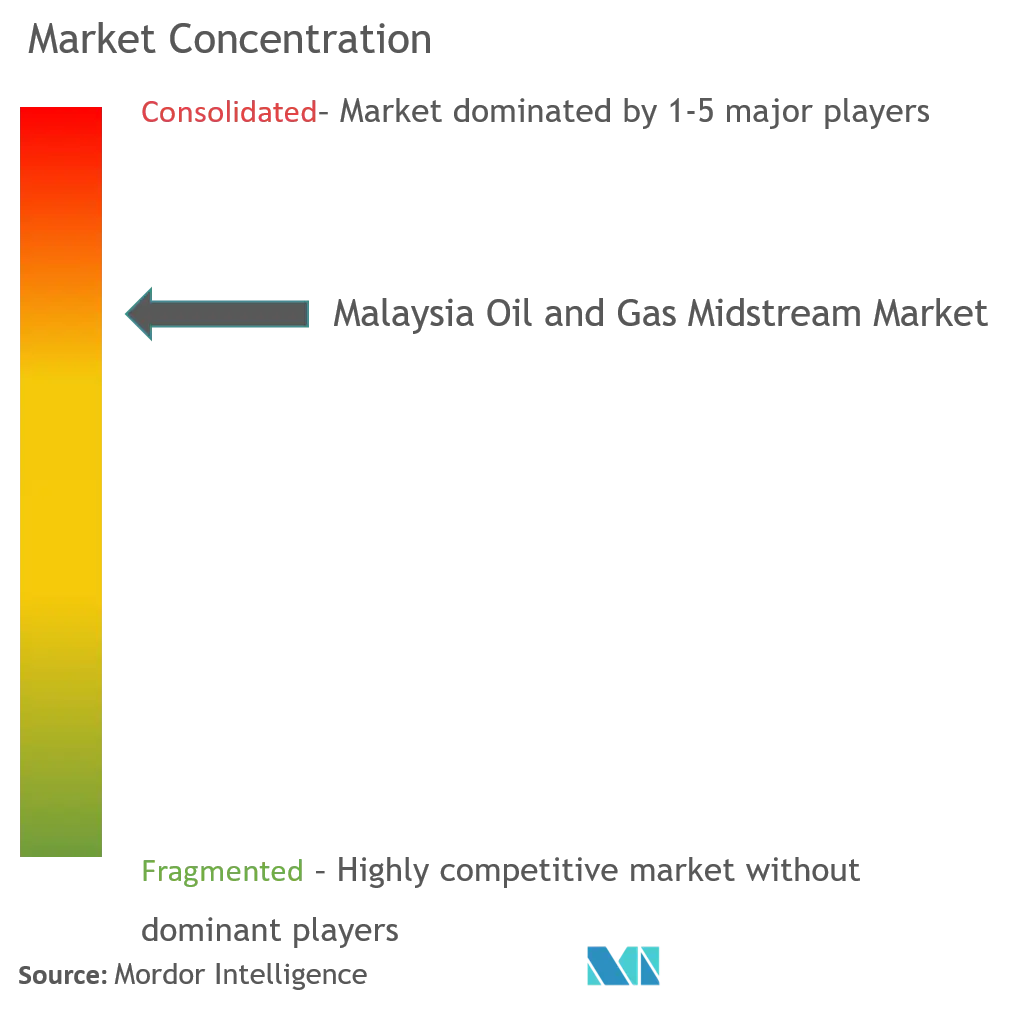
The Malaysian oil and gas midstream market is moderately consolidated. A few major companies (in no particular order) include Fluor Corporation, Petroliam Nasional Berhad (PETRONAS), Dialog Group Berhad, Vitol Group, and Royal Vopak N.V., among others.
Malaysia Oil And Gas Midstream Industry Leaders
Petroliam Nasional Berhad (PETRONAS)
Dialog Group Berhad
Fluor Corporation
Royal Vopak N.V.
Vitol Group
- *Disclaimer: Major Players sorted in no particular order

Market Opportunities and Future Outlook
In Malaysia, midstream opportunities are linked to additions in LNG import, regasification, and storage capacity, which support supply flexibility as domestic gas production matures and demand concentrates in Peninsular Malaysia. A key 2026 anchor is the move toward a third regasification terminal (RGT-3) in Lumut, Perak, where Petronas Gas Berhad received notification from the Ministry of Economy on 30 April 2026 to proceed. Tenaga Nasional Berhad and Petronas Gas later signed a heads of agreement in June 2026 to jointly develop the project, featuring an FSRU with 170,000 cubic metre storage and 500 MMscfd regasification capacity. The project suggests room for new LNG-related midstream assets beyond existing hubs, including FSRU-based regasification, associated pipelines, and balancing storage.
Policy and market structure changes also affect investable scope for operators and service providers. The Ministry of Economy signaled the National Gas Roadmap for release by Q3 2026, with a focus on natural gas pricing, supply regulation, and infrastructure capital requirements, which can influence contracting and access conditions across transportation and regasification. Separately, decarbonization-linked infrastructure is starting to appear alongside the midstream system. PETRONAS has articulated development of three CCS hubs by 2030 (two in Peninsular Malaysia and one in Sarawak) targeting a combined storage capacity of 15 million tonnes per annum, creating potential demand for CO2 transport and storage-enabling midstream capabilities alongside conventional gas and liquids logistics.
Recent Industry Developments
- June 2026: Tenaga Nasional Berhad (TNB) and Petronas Gas Berhad signed a heads of agreement to jointly develop the third regasification terminal (RGT-3) in Lumut, Perak. The project structure brings a major power utility directly into LNG import infrastructure development, strengthening fuel-security linkage between gas midstream capacity and the power sector.
- April 2026: Dialog Group Berhad began expansion works on Phase 3 of Pengerang Deepwater Terminals (PDT) in Johor, adding 614,000 cubic metres of storage capacity for refined petroleum and biofuels. The added tankage increases Malaysia's ability to handle larger traded volumes and broadens the terminal's role as a regional storage and logistics hub.
- February 2025: The Malaysian government confirmed Petroleum Sarawak (Petros) as Sarawak's gas aggregator effective 1 March 2025 under the state's gas distribution framework. This changed how gas volumes are aggregated and commercialized in Sarawak, influencing midstream interfacing, contracting pathways, and the flow of gas into liquefaction and domestic supply chains.


Research Methodology Framework and Report Scope
Market Definition and Coverage
This market covers paid midstream services in Malaysia that move and hold crude oil, refined products, and natural gas between production areas and end markets, including pipelines and marine transport, storage terminals, and LNG terminals.
Scope exclusions: We do not count upstream production value, downstream refining and retail fuel marketing, or pure equipment sales unless it is bundled as a midstream service revenue.
Segmentation Overview
- Type
- Transportation
- Storage
- LNG Terminals
Data Sources, Market Sizing, and Validation
Desk Research
Desk research was used to set the hard boundaries of what counts as midstream revenue in Malaysia and to build the first demand and supply picture before speaking to industry participants. We relied on public datasets that show liquids and gas flows, trade direction, and infrastructure usage, which are needed to avoid sizing the same volumes twice.
Typical sources included official energy and statistics publications such as Malaysia government energy and trade releases, customs and port statistics, LNG and shipping movement data where available, and international references such as IEA and OPEC country tables. We also reviewed operator annual reports, investor decks, project announcements, and reputed press for terminal additions, throughput guidance, and tariff style cues. For cross checks, a paid subscription covering company financials and a shipment-level import-export database were used selectively to validate revenue ranges and trade-linked volume assumptions. These examples are not exhaustive, and many other public sources were consulted to collect data points, verify timelines, and clarify gaps.
Primary Interviews and Surveys
Primary work focused on confirming which services are actually monetized in Malaysia and how pricing is applied across pipeline transport, terminaling, and LNG handling. Interviews covered midstream operators, logistics and terminal service providers, industry advisors, and large end users, and they helped us pressure test utilization assumptions, tariff movement, and USD-MYR translation assumptions across the country.
Distribution of primary research fieldwork respondents
| Company type | Respondent position |
|---|---|
| Top tier: 28% | CXOs: 13% |
| Mid tier: 51% | Functional/Unit leaders: 43% |
| Smaller Players: 21% | Managers: 44% |
Market-Sizing & Forecasting
Market size is built using a top-down reconstruction from Malaysia hydrocarbon movement and handling activity, and then it is translated into service revenues using realistic tariff and fee assumptions for the main midstream functions. In practice, the model starts from indicators such as LNG import and export throughput, natural gas pipeline transmission volumes, liquids movement by coastal shipping and pipeline, and storage terminal throughput and utilization, which are then aligned to the capacity and operating status of major assets.
To keep the totals grounded, we corroborated the result with selective bottom-up checks, such as rolling up a sample of operator revenue disclosures, using channel checks on typical per-ton or per-MMBtu handling fees, and validating implied revenue per unit of throughput. Where company disclosures were missing, gaps were handled by using asset capacity, utilization bands from interviews, and reasonable fee ranges adjusted for contract structure (take-or-pay versus spot handling).
For forecasting, scenario analysis was used so the outlook can reflect different utilization paths tied to LNG demand, domestic gas balancing, petrochemical and power consumption, and new midstream capacity additions. The final forecast set was aligned to what primary respondents considered a practical range for utilization, pricing pass-through, and USD-MYR translation impacts over the forecast window.
Data Validation & Update Cycle
Outputs are validated through triangulation across independent signals, including throughput series, trade direction shifts, asset startup timelines, and implied revenue per unit moved or stored. When a variance appears, the assumptions are rechecked, and follow-up calls are triggered to confirm whether the issue is scope, pricing, utilization, or timing.
Before sign-off, the model is reviewed in steps by another analyst to ensure inputs, units, and currency conversions are consistent across the historical and forecast years. The report is refreshed annually, and interim updates are added when there are material events such as new terminal commissioning, major outages, or policy changes affecting tariffs. Right before delivery, we do a final pass so the numbers reflect the latest available public updates and interview feedback.
Mordor Intelligence's Malaysia Oil and Gas Midstream Market Size Measured Against Other Published Estimates
It is normal to see different market sizes for Malaysia oil and gas midstream because publishers do not always use the same revenue boundary, year timing, and pricing basis. Differences also show up when estimates mix asset value with service revenue, or when they apply a single global fee assumption that does not fit local contract structures.
A key driver in this market is refresh and currency timing, since USD conversion can shift the reported value even if volumes are steady, and tariff escalation can be applied at different points in the year. The sizing here prioritizes fresh throughput and utilization checks, then applies fee logic that is tied to the service actually billed, which is why Mordor Intelligence may land away from figures that lean heavily on older averages or broader oil and gas value chain coverage.
Benchmark comparison
| Source | Market Size | Gaps in Research Methodology |
|---|---|---|
| Mordor Intelligence | USD 4.75 B (2026) | |
| Industry Publisher A | USD 11.44 B (2024) | This figure appears to size the wider Malaysia oil and gas industry across multiple value chain stages, so upstream and downstream revenues can be included rather than only midstream transportation, storage, and LNG terminal services. |
| Industry Publisher B | USD 4.80 B (2026) | The scope seems to extend beyond core midstream services into processing or distribution activities, and the long-range forecast setup can embed more aggressive price and utilization lift than near-term contract-linked fee progression. |
The table shows that the tightest alignment happens when the scope is limited to midstream service revenues and the same year is used. The larger gap comes when broader oil and gas activities are counted, or when fee and FX assumptions are applied without checking them against current utilization and contract patterns, which can quickly inflate the implied revenue pool.


Key Questions Answered in the Report
What is the current Malaysia Oil and Gas Midstream Market size?
The Malaysia Oil and Gas Midstream Market is projected to register a CAGR of 1.97% during the forecast period (2026-2031)
Who are the key players in Malaysia Oil and Gas Midstream Market?
Petroliam Nasional Berhad (PETRONAS), Dialog Group Berhad, Fluor Corporation, Royal Vopak N.V. and Vitol Group are the major companies operating in the Malaysia Oil and Gas Midstream Market.
What years does this Malaysia Oil and Gas Midstream Market cover?
The report covers the Malaysia Oil and Gas Midstream Market historical market size for years: 2020, 2021, 2022, 2023 and 2024. The report also forecasts the Malaysia Oil and Gas Midstream Market size for years: 2026, 2027, 2028, 2029, 2030 and 2031.
Page last updated on:





