
Malaysia Islamic Finance Market Size and Share
Market Overview
| Study Period | 2021 - 2032 |
|---|---|
| Forecast Data Period | 2027 - 2032 |
| Base Year Market Size (2026) | USD 0.89 Trillion |
| Market Size (2027) | USD 0.95 Trillion |
| Market Size (2032) | USD 1.35 Trillion |
| Growth Rate (2027 - 2032) | 7.10 % |
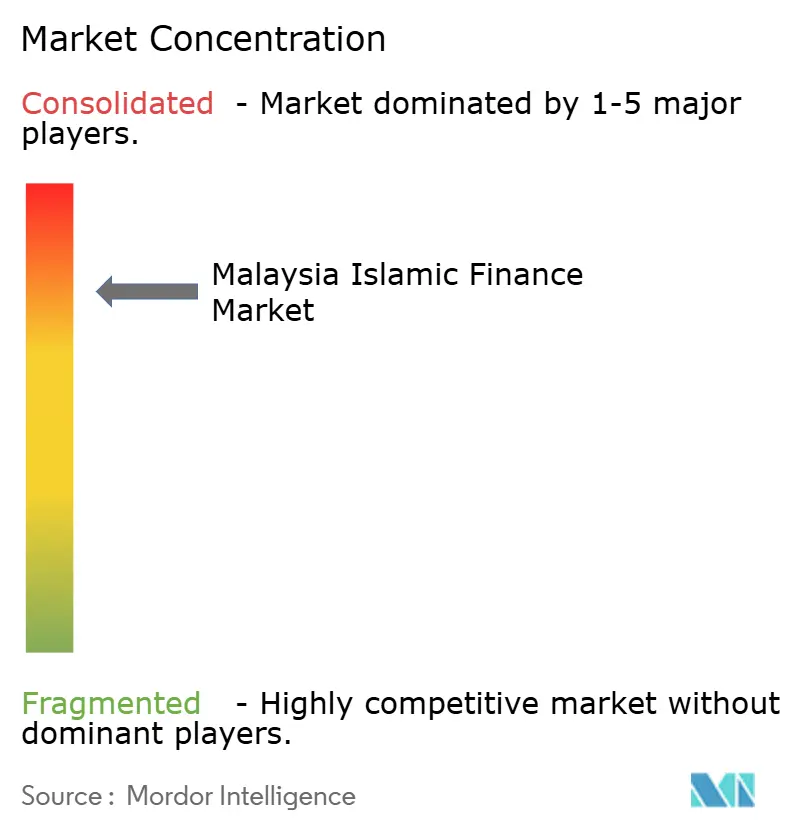
| Market Concentration | High |
Major Players *Disclaimer: Major Players sorted in no particular order Image © Mordor Intelligence. Reuse requires attribution under CC BY 4.0. | |
Malaysia Islamic Finance Market Analysis by Mordor Intelligence
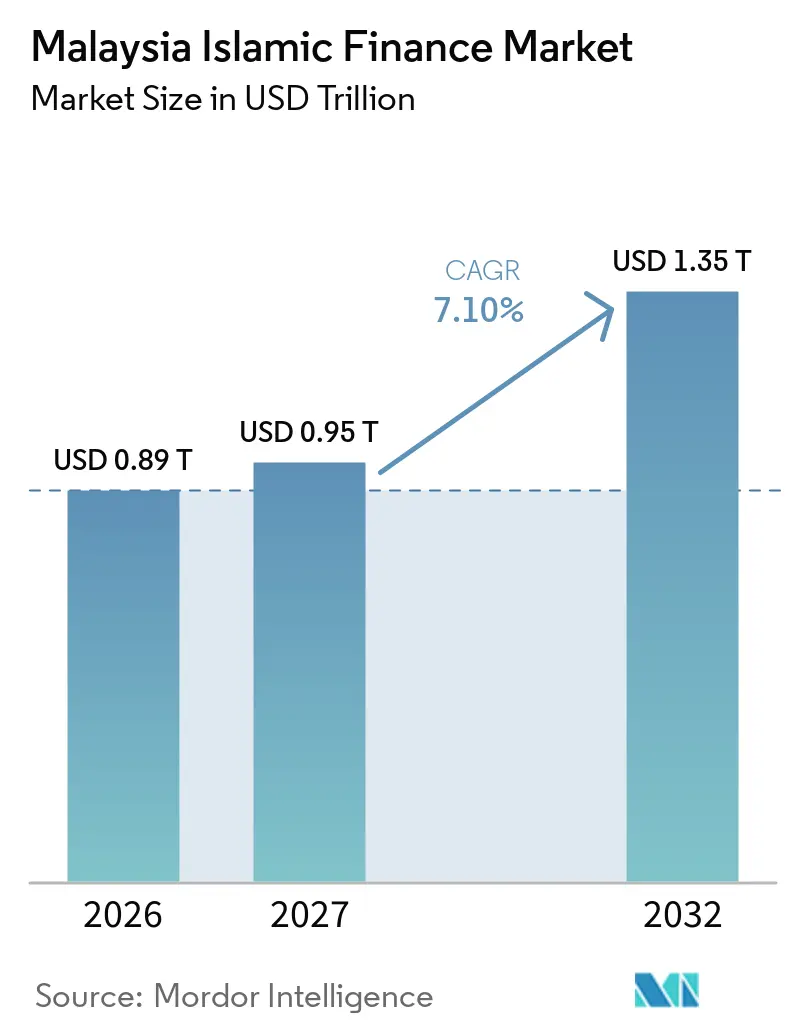
The Malaysia Islamic Finance Market size is expected to grow from USD 0.89 trillion in 2026 to USD 0.95 trillion in 2027 and is forecast to reach USD 1.35 trillion by 2032 at 7.10% CAGR over 2027-2032.
Islamic financing reached 48% of total financing in 2025, compared with 42% in 2023, which shows that Shariah-compliant finance has become a central part of the national financial system. The Islamic capital market stood at MYR 2.7 trillion (USD 601 billion) and represented 63% of Malaysia’s financial system in 2025. Malaysia’s role in sukuk, digital product development, and value-based intermediation supports the depth of the Malaysia Islamic finance market. Policy measures are also widening access to risk-sharing, social protection, and sustainable-finance structures. These conditions create room for established banks, specialized providers, and digital platforms to serve different financing needs.
Key Report Takeaways
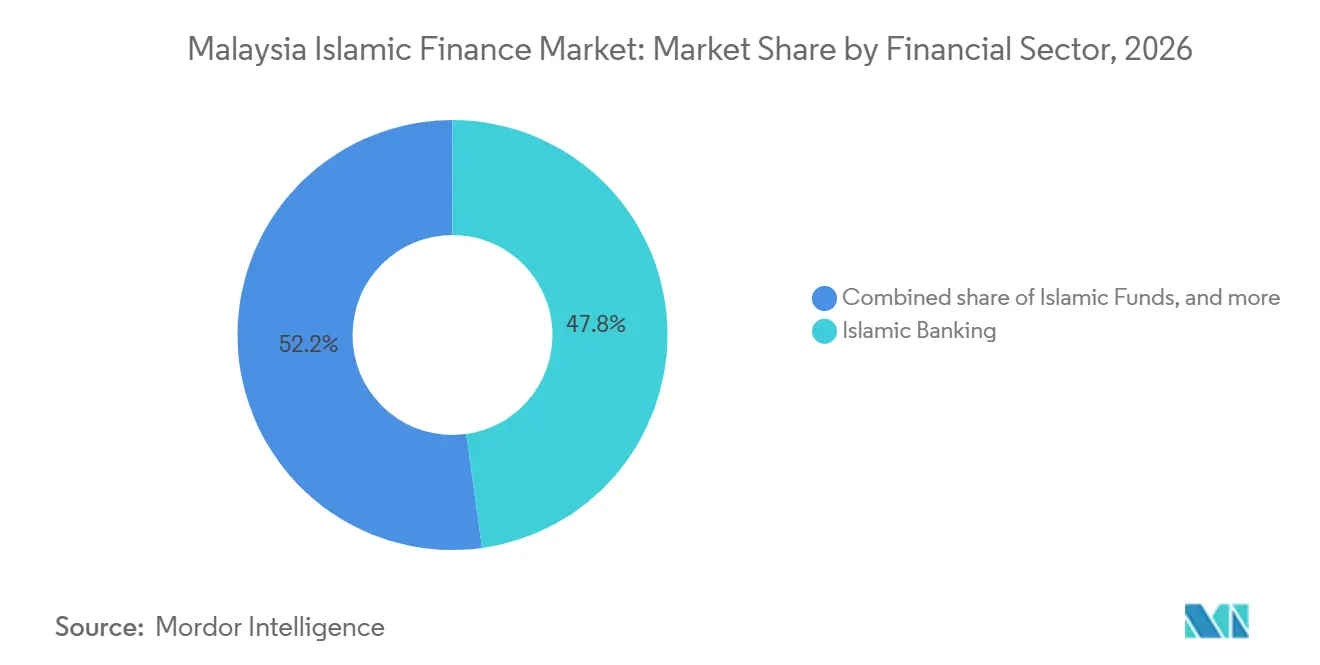
- By financial sector, Islamic banking captured 47.8% of the Malaysia Islamic finance market share in 2026, while Islamic funds are projected to grow at 9.5% CAGR through 2032.
- By customer type, retail and individual customers held 42.4% of the Malaysia Islamic finance market share in 2026, while MSMEs are projected to grow at 9.2% CAGR through 2032.
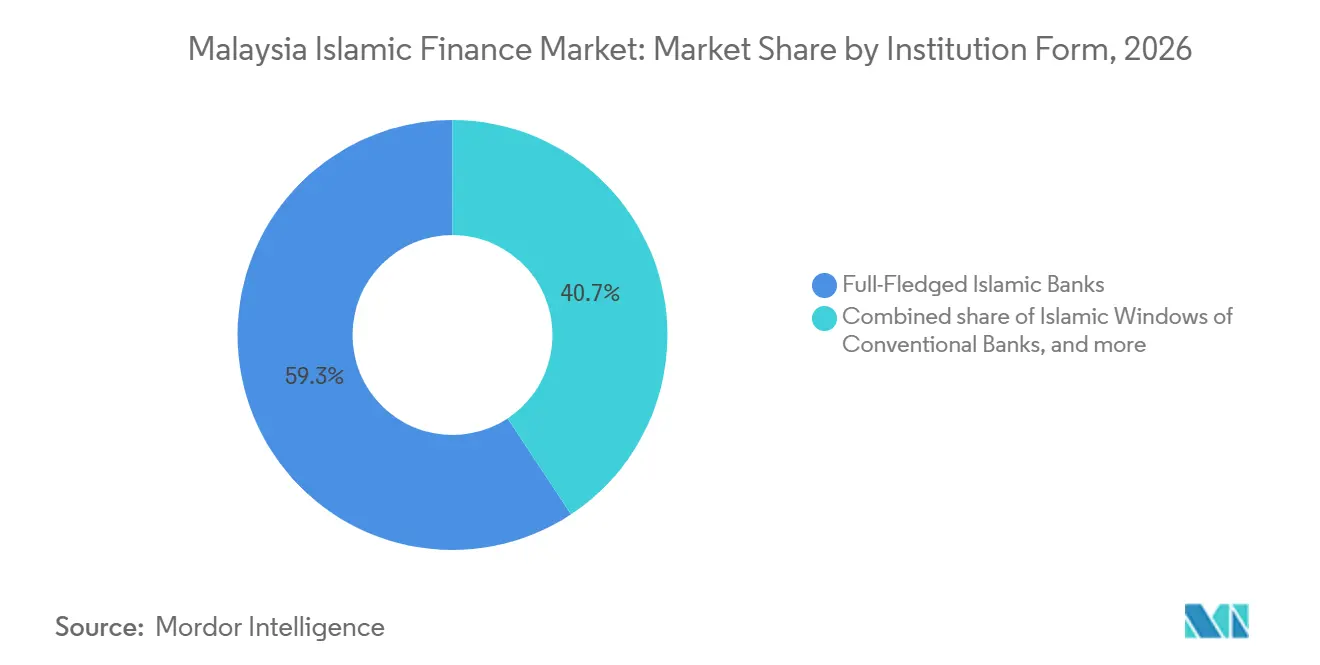
- By institution form, full-fledged Islamic banks held 59.3% of the Malaysia Islamic finance market share in 2026, while Islamic fintech and specialist lenders are projected to grow at 11.2% CAGR through 2032.
- By geography, the central region held 46.1% of the Malaysia Islamic finance market share in 2026, while East Malaysia is projected to grow at 9.0% CAGR through 2032.
Note: Market numbers in this report are based on Mordor Intelligence's proprietary estimation framework, which combines nine months of actuals with Q4 projections for base year 2026.
Malaysia Islamic Finance Market Trends and Insights
Drivers Impact Analysis*
| Driver | (~) % Impact on CAGR Forecast | Geographic Relevance | Impact Timeline |
|---|---|---|---|
| Rising Islamic Financing Penetration in Household and MSME Segments | +2.2% | National, with MSME gains in East Malaysia, the East Coast, and the Northern regions | Short term (≤ 2 years) |
| Deepening Sukuk and Islamic Capital-Market Infrastructure | +1.8% | National with global reach, including the Gulf Cooperation Council and the Association of Southeast Asian Nations, cross-border activity | Medium term (2-4 years) |
| Expansion of Sustainable, Social, and Maqasid-Aligned Islamic Finance | +1.2% | National, with strong relevance in East Malaysia and the Northern region | Medium term (2-4 years) |
| Regulatory Support for Inclusion and Risk-Sharing Finance | +0.9% | National, with a rural focus in East Malaysia and the East Coast | Short term (≤ 2 years) |
| MYOR-i Transition for Pricing and Liquidity Infrastructure | +0.8% | National, with interbank activity concentrated in the Central region | Medium term (2-4 years) |
| Digitalization of Islamic Financial Services | +1.1% | National, with accelerated relevance in East Malaysia and the rural East Coast | Medium term (2-4 years) |
| Source: Mordor Intelligence | |||
Rising Islamic Financing Penetration Across Malaysian Household and SME Segments
Islamic financing accounted for 48% of total financing in Malaysia in 2025, up from 45.6% in 2023, demonstrating the continued expansion of Islamic banking within the country's financial system. Islamic financial institutions also intermediated MYR 148.6 billion (USD 31.6 billion) into value-based intermediation-aligned activities in 2024, supporting areas including SMEs, green financing, and social finance. In September 2025, Bank Negara Malaysia launched the MYR 100 million (USD 21.3 million) i-CITA matching-fund programme to encourage risk-sharing contracts such as mudarabah and musyarakah for activities including food security, climate resilience, and new businesses[1]. BNM also expanded iTEKAD Protection to provide more affordable social takaful protection for microentrepreneurs. These initiatives are broadening the application of Islamic financing and protection products across households, microenterprises, and SMEs while supporting financial inclusion and economic resilience.
Deepening Sukuk Market and Islamic Capital-Market Infrastructure
Malaysia continued to hold a leading position in the global sukuk market, accounting for approximately 37% of global sukuk outstanding, while its Islamic capital market reached around MYR 2.7 trillion (USD 600 billion) in 2025[2]. Sukuk outstanding stood at approximately MYR 1.4 trillion (USD 311.1 billion), representing around 64% of total domestic bonds outstanding and 85% of corporate issuance. BNM has also strengthened Islamic capital-market infrastructure through structures such as wakalah bi al-khadamat and the continued development of Islamic money-market instruments. Secured Islamic interbank activity increased from MYR 12.6 billion (USD 2.8 billion) in 2023 to MYR 42.6 billion (USD 9.5 billion) in 2024, before reaching MYR 34.8 billion (USD 7.7 billion) in the first half of 2025. The MYR 100 million (USD 22.2 million) tokenized sukuk issued by Khazanah in 2026 further demonstrates the expansion of Malaysia's Shariah-compliant capital-market infrastructure into digital formats.
MYOR-i Transition Strengthening Islamic Pricing and Liquidity Infrastructure
The Malaysia Islamic Overnight Rate (MYOR-i) is a transaction-based Islamic benchmark designed to improve price discovery and liquidity management across Malaysia's Islamic financial system[3]. Launched in 2022, MYOR-i is based on transaction-weighted overnight unsecured Shariah-compliant interbank transactions and replaced the Kuala Lumpur Islamic Reference Rate (KLIRR). Bank Negara Malaysia plans to make MYOR-i mandatory for new Islamic financial products from 1 July 2027, supporting greater standardization of Islamic financial pricing. In 2026, CIMB Islamic and Cagamas completed Malaysia's first MYOR-i-referenced sukuk, Islamic Profit Rate Swap, and Islamic Asset Purchase Transaction, demonstrating increasing market adoption. The transition is strengthening the benchmark, pricing, and hedging infrastructure required for the development of more sophisticated Islamic financing and capital market products.
Digitalization of Islamic Financial Services and Technology-Enabled Distribution
Digitalisation is expanding the channels through which Malaysian consumers and businesses access Shariah-compliant financial services. Bank Muamalat launched ATLAS in June 2025 as a digital-first Islamic banking platform, while AEON Bank had already become Malaysia's first licensed Islamic digital bank in 2024[4]. In 2026, SEDANIA As-Salam Capital deployed its As-Sidq digital commodity-trading infrastructure within ATLAS to strengthen the processing and governance of Shariah-compliant transactions. The Securities Commission Malaysia also established FIKRALab in March 2026 to support innovation in Islamic capital-market products, including Islamic social finance, sustainability, and transition finance. These developments are strengthening digital distribution, transaction infrastructure, and product innovation across Malaysia's Islamic finance ecosystem.
Restraints Impact Analysis*
| Restraint | (~) % Impact on CAGR Forecast | Geographic Relevance | Impact Timeline |
|---|---|---|---|
| Structural Complexity and Limited Secondary-Market Tradability of Some Sukuk Structures | -0.7% | National, with particular relevance in Labuan offshore and Gulf Cooperation Council cross-border transactions | Medium term (2-4 years) |
| Competition From Malaysia’s Established Conventional Financial System | -0.5% | National, with a concentration in the Central and Southern regions | Medium term (2-4 years) |
| Need for Deeper Multidisciplinary Talent and Innovation Capabilities | -0.4% | National, with particular relevance in Northern and East Malaysia | Long term (≥ 4 years) |
| Need to Broaden the International Investor Base for Malaysian Islamic Instruments | -0.3% | National, with particular relevance for hard-currency sukuk development | Long term (≥ 4 years) |
| Source: Mordor Intelligence | |||
Structural Complexity and Secondary-Market Tradability Considerations for Some Sukuk Structures
Some sukuk structures, particularly debt-based structures such as murabahah, face secondary-market tradability considerations because Shariah interpretations can differ regarding the trading of debt-based instruments. Bank Negara Malaysia has identified the need to address these structural considerations and align sukuk structures with international Shariah interpretations to improve tradability and market accessibility. In 2024, BNM introduced wakalah bi al-khadamat as an alternative structure designed to meet the secondary-market tradability criteria of both domestic and international Shariah authorities. The inaugural sovereign issuance using this structure was targeted for 2026, demonstrating Malaysia's efforts to broaden the range of tradable Shariah-compliant instruments. These requirements can increase structuring complexity and the need for specialised Shariah and legal expertise, particularly for issuers targeting international investors.
Competitive Pressure From Malaysia's Established Conventional Financial System
Malaysia's Islamic financial system operates alongside an established conventional financial system, giving households, businesses, and investors access to both conventional and Shariah-compliant products. This dual structure creates competitive pressure on Islamic financial institutions to remain competitive on pricing, product features, service quality, and customer experience. Islamic financing accounted for 48% of total financing in 2025, demonstrating substantial penetration while conventional financing continued to represent a significant share of the financial system. Competition is particularly relevant in corporate and institutional segments, where customers can evaluate alternative financing structures and funding costs. Islamic financial institutions, therefore, need to strengthen product innovation, service delivery, and funding efficiency to expand their market presence within Malaysia's mature dual financial system.
*Our forecasts treat driver/restraint impacts as directional, not additive. The impact forecasts reflect baseline growth, mix effects, and variable interactions.
Segment Analysis
By Financial Sector: Islamic Banking Anchors Scale, Funds Expand Faster
Islamic banking accounted for approximately 48% of Malaysia’s total financing in 2025, with financing growing by 7.7% to MYR 1.22 trillion (USD 0.30 trillion). The sector continued to serve retail, business, and institutional financing needs through Shariah-compliant products. Takaful participation reached 24.5% in 2025, reflecting the sector’s expanding role in meeting household and business protection needs.
Sukuk outstanding totalled MYR 1.43 trillion (USD 0.35 trillion) at the end of 2025, representing 63.7% of Malaysia’s total outstanding bonds and sukuk. Malaysia’s Islamic capital market reached MYR 2.75 trillion (USD 0.68 trillion), equivalent to 63.7% of the country’s total capital market. Islamic funds under management increased to MYR 274.01 billion (USD 67.61 billion) in 2025, up from MYR 246.09 billion (USD 60.02 billion) in 2024, representing approximately 11.3% year-on-year growth. Islamic asset management benefits from Malaysia’s established Shariah-compliant investment ecosystem, diverse fund offerings, and regulatory support for the development of domestic and international investment opportunities.
By Customer Type: Retail Demand Sustains Scale, MSMEs Expand Faster
Retail and individual customers held a 42.4% share in 2026. Demand in this group is supported by Islamic mortgages, auto financing, and personal financing products. Seven major Islamic banks converted credit card contracts from Ujrah to Tawarruq between October 2025 and January 2026. This transition standardized Shariah governance across retail accounts. Retail demand provides the Malaysia Islamic finance market with a large customer base and recurring product relationships. It also creates opportunities to offer protection, savings, and wealth management services alongside financing.
MSMEs are projected to record a 9.2% CAGR between 2027 and 2032. The i-CITA program provides MYR 100 million (USD 22.7 million) for risk-sharing contracts that can support eligible ventures. iTEKAD Protection offers a social takaful option for microentrepreneurs. Large corporates, government entities, and government-related entities support sukuk issuance and capital market activity. Financial institutions support Islamic interbank liquidity, with cumulative Islamic Interbank Money Market transactions exceeding MYR 1 trillion (USD 227.3 billion) during the five years through 2025. The Malaysia Islamic finance market can therefore expand through both household demand and business funding needs.
By Institution Form: Full-Fledged Banks Lead, Fintech Providers Extend Access
Full-fledged Islamic banks held 59.3% share in 2026. Their position is supported by dedicated Shariah governance, integrated product offerings, and established distribution systems. Bank Negara Malaysia’s revised Islamic banking window policy took effect in January 2025. It imposed standalone prudential requirements on conventional banks’ Islamic operations, including capital, liquidity, and single-counterparty exposure requirements. This framework increases the operational distinction between dedicated banks and window-based models in the Malaysia Islamic finance market. Full-fledged Islamic banks are also positioned to originate Shariah-compliant syndications, takaful cross-selling, and Islamic wealth-management services.
Islamic fintech and specialist lenders are projected to grow at 11.2% CAGR between 2027 and 2032. The Malaysia Islamic finance market size for this institutional form is supported by digital distribution and technology-based assessment. Tazee launched in Malaysia in March 2026 as a Shariah-first digital consumer-financing brand. FINODYN, established by Bank Islam and RELDYN Tech in February 2025, provides Islamic banking-as-a-service infrastructure. Takaful operators continue to develop protection products, while fund managers benefit from tax exemptions through 2027. These forms widen access to finance while maintaining the country’s existing bank-led structure.
Geography Analysis
The Central region accounted for 46.1% of the Malaysia Islamic finance market in 2026, reflecting its position as the country’s primary financial and Islamic capital market hub. Kuala Lumpur hosts major Islamic banks, capital market institutions, and supporting financial infrastructure, which facilitate financing origination, sukuk issuance, Shariah advisory services, trading, and investment distribution. Malaysia is also strengthening its Islamic financial infrastructure through the adoption of MYOR-i, new sukuk structures, and digital capital market initiatives. In 2026, Malaysia completed its first MYR 100 million (USD 22.2 million) tokenized sukuk, while MYOR-i-referenced transactions expanded the application of the Islamic benchmark across sukuk and Islamic risk-management products. The concentration of financial institutions, market infrastructure, and specialist expertise supports the Central region’s leading position in the Malaysia Islamic finance market.
The Northern and Southern regions provide opportunities for Islamic finance growth through manufacturing, agriculture, industrial development, and infrastructure investment. The Northern region has a substantial manufacturing and agricultural base, creating potential demand for Shariah-compliant working capital, investment financing, and structured financing solutions. Bank Negara Malaysia’s approval of salam-based agriculture financing in 2025 expanded the range of Shariah-compliant structures available for agricultural activities. In the Southern region, Sime Darby Property established a MYR 2.6 billion (USD 577.8 million) sukuk wakalah program in 2026 to support its New Economy Venture Fund, including investments in data centers and industrial and logistics assets. These developments demonstrate how Islamic financing and sukuk can support real-economy investment across Malaysia beyond the country’s Central financial hub.
East Malaysia is projected to record a 9.0% CAGR through 2032, indicating significant potential for expansion within the Malaysia Islamic finance market. The region’s agriculture, plantation, microenterprise, and small-business sectors provide opportunities for greater adoption of Shariah-compliant financing and financial-inclusion products. Bank Negara Malaysia’s 2025 approval of salam-based agriculture financing provides an additional Shariah-compliant mechanism that can be applied to agricultural activities and supports the development of financing solutions for productive sectors. BNM’s broader financial-inclusion and value-based intermediation initiatives, including programs supporting microentrepreneurs and SMEs, can further improve access to Islamic financial services in underserved communities. The combination of economic activity, financial-inclusion initiatives, and expanding Shariah-compliant financing options provides a foundation for East Malaysia’s projected growth in the Islamic finance market.
Competitive Landscape
The Malaysia Islamic finance market is consolidated, with leading Islamic banking groups accounting for a substantial share of financing, deposits, investment, and capital market activity, alongside specialized takaful operators, fund managers, and emerging digital providers. Maybank Islamic, Bank Islam Malaysia, CIMB Islamic, and RHB Islamic are among the major domestic Islamic banking providers, while international institutions such as Al Rajhi Bank Malaysia and Kuwait Finance House Malaysia compete in selected segments. Maybank Islamic has also expanded its ecosystem through Salaam Market, a business-to-business halal marketplace designed to connect businesses with halal products, services, and financing opportunities. Bank Muamalat has expanded its digital proposition through ATLAS, its digital banking platform. Malaysia is also strengthening Islamic capital market innovation, with Khazanah's MYR 100 million (USD 21.3 million) tokenized sukuk in 2026 representing the country's first tokenized sukuk and involving CIMB Islamic as a key structuring institution.
Competition extends beyond Islamic banking into takaful, Islamic asset management, and sustainable investment products, with providers differentiating through product innovation, distribution networks, Shariah governance, and digital capabilities. The Sustainable and Responsible Investment Sukuk Framework and related initiatives by the Securities Commission Malaysia have supported the development of sustainability-focused Islamic capital market instruments, while tax incentives for qualifying SRI sukuk are available through 2027. Malaysia also continues to promote risk-sharing structures such as mudarabah and musyarakah, including through BNM's MYR 100 million (USD 21.3 million) i-CITA matching-fund program, although these structures remain less prevalent than commonly used financing structures such as tawarruq. Digitalization is creating additional competitive opportunities as banks and fintech providers develop digital onboarding, transaction processing, and alternative approaches to customer assessment. FIKRALab, established by the Securities Commission Malaysia in 2026, provides a platform for developing new Islamic capital market solutions. Cross-border Islamic finance, including connections with ASEAN and Middle Eastern markets, provides further opportunities for Malaysian institutions to leverage the country's established Islamic finance infrastructure and international market position.
Malaysia also remains a major global hub for Islamic capital market activity, with Malaysian issuers accounting for a significant share of global sustainable and ESG sukuk issuance. The domestic SRI sukuk market reached MYR 52.3 billion (USD 11.1 billion) at the end of 2025, up substantially from MYR 5.3 billion (USD 1.1 billion) in 2020, reflecting the expansion of sustainability-linked Islamic capital market products. These instruments allow issuers and financial institutions to combine Shariah-compliant funding with environmental and social objectives, strengthening Malaysia's position in sustainable Islamic finance. The competitive landscape, therefore, spans large integrated Islamic banks, specialized Islamic financial institutions, takaful operators, asset managers, international banks, and emerging digital providers. Overall, the market is best classified as consolidated, with competitive positioning primarily determined by financing and distribution scale, capital market capabilities, Shariah expertise, digital infrastructure, product innovation, and institutional relationships.
Malaysia Islamic Finance Industry Leaders
-
Maybank Islamic Berhad
-
CIMB Islamic Bank Berhad
-
RHB Islamic Bank Berhad
-
Bank Islam Malaysia Berhad
-
Public Islamic Bank Berhad
- *Disclaimer: Major Players sorted in no particular order
Recent Industry Developments
- July 2026: New Pantai Expressway Sdn Bhd issued an initial MYR 54 million (USD 11.5 million) Sustainability-Linked Sukuk to finance the New Pantai Highway Extension (NPE2), under its unrated Islamic Medium Term Notes Programme of up to MYR 1.42 billion (USD 302 million). The sukuk links financing terms to occupational health and safety and green infrastructure performance indicators, demonstrating the application of sustainability-linked structures to Malaysian highway infrastructure.
- April 2026: Khazanah Nasional, in collaboration with the Securities Commission Malaysia, priced Malaysia's first tokenized sukuk at a nominal value of MYR 100 million (USD 21.2 million) using distributed ledger technology, with CIMB Islamic as the sole structuring bank and Maybank as the primary subscriber.
- March 2026: CIMB Islamic and Cagamas delivered Malaysia's first three MYOR-i-referenced transactions: a MYR 300 million (USD 67.2 million) sukuk, a MYR 100 million (USD 22.4 million) Islamic Profit Rate Swap, and a MYR 250 million (USD 56.1 million) Islamic asset-purchase transaction.
- March 2026: The Securities Commission Malaysia established FIKRALab as a co-creation and applied research and development platform for developing Maqasid al-Shariah-guided Islamic capital market products. CIMB Group and Bursa Malaysia serve as pilot partners.
Malaysia Islamic Finance Market Report Scope
| Islamic Banking |
| Takaful / Islamic Insurance |
| Sukuk |
| Islamic Funds |
| Retail / Individual Customers |
| MSMEs |
| Large Corporates |
| Government & Government-Related Entities |
| Financial Institutions |
| Other Customer Types |
| Full-Fledged Islamic Banks |
| Islamic Windows of Conventional Banks |
| Takaful / Cooperative Insurers |
| Islamic Fund Managers |
| Islamic Fintech & Specialist Lenders |
| Central (Selangor, W.P. Kuala Lumpur, W.P. Putrajaya) |
| Northern (Perlis, Kedah, Pulau Pinang, Perak) |
| Southern (Negeri Sembilan, Melaka, Johor) |
| East Coast (Pahang, Terengganu, Kelantan) |
| East Malaysia (Sabah, Sarawak, W.P. Labuan) |
| By Financial Sector | Islamic Banking |
| Takaful / Islamic Insurance | |
| Sukuk | |
| Islamic Funds | |
| By Customer Type | Retail / Individual Customers |
| MSMEs | |
| Large Corporates | |
| Government & Government-Related Entities | |
| Financial Institutions | |
| Other Customer Types | |
| By Institution Form | Full-Fledged Islamic Banks |
| Islamic Windows of Conventional Banks | |
| Takaful / Cooperative Insurers | |
| Islamic Fund Managers | |
| Islamic Fintech & Specialist Lenders | |
| By Region | Central (Selangor, W.P. Kuala Lumpur, W.P. Putrajaya) |
| Northern (Perlis, Kedah, Pulau Pinang, Perak) | |
| Southern (Negeri Sembilan, Melaka, Johor) | |
| East Coast (Pahang, Terengganu, Kelantan) | |
| East Malaysia (Sabah, Sarawak, W.P. Labuan) |
Key Questions Answered in the Report
What is the forecast growth rate for Islamic finance in Malaysia?
The Malaysia Islamic finance market is projected to grow at a 7.10% CAGR from 2027 to 2032, increasing from USD 955.12 billion in 2027 to USD 1,352.32 billion by 2032.
Which financial sector holds the largest share in Malaysia?
Islamic Banking holds the largest share at 47.8% in 2026, with USD 312 billion in assets.
Which customer group is growing fastest in Malaysia’s Shariah-compliant finance sector?
MSMEs are the fastest-growing customer segment, with a projected 9.2% CAGR through 2032.
Which institution form is expected to grow the fastest?
Islamic Fintech and Specialist Lenders are projected to grow at 11.2% CAGR between 2027 and 2032.
Which Malaysian region leads Islamic finance activity?
The Central region led with 46.1% share in 2026, supported by financial institutions, sukuk origination, and capital-market infrastructure.
Why is East Malaysia important for Shariah-compliant finance growth?
East Malaysia is projected to grow at 9.0% CAGR through 2032, supported by inclusion programs, MSME funding, agriculture financing, and Labuan’s offshore services.