
Machine Vision System Leasing Market Size and Share
Market Overview
| Study Period | 2020 - 2031 |
|---|---|
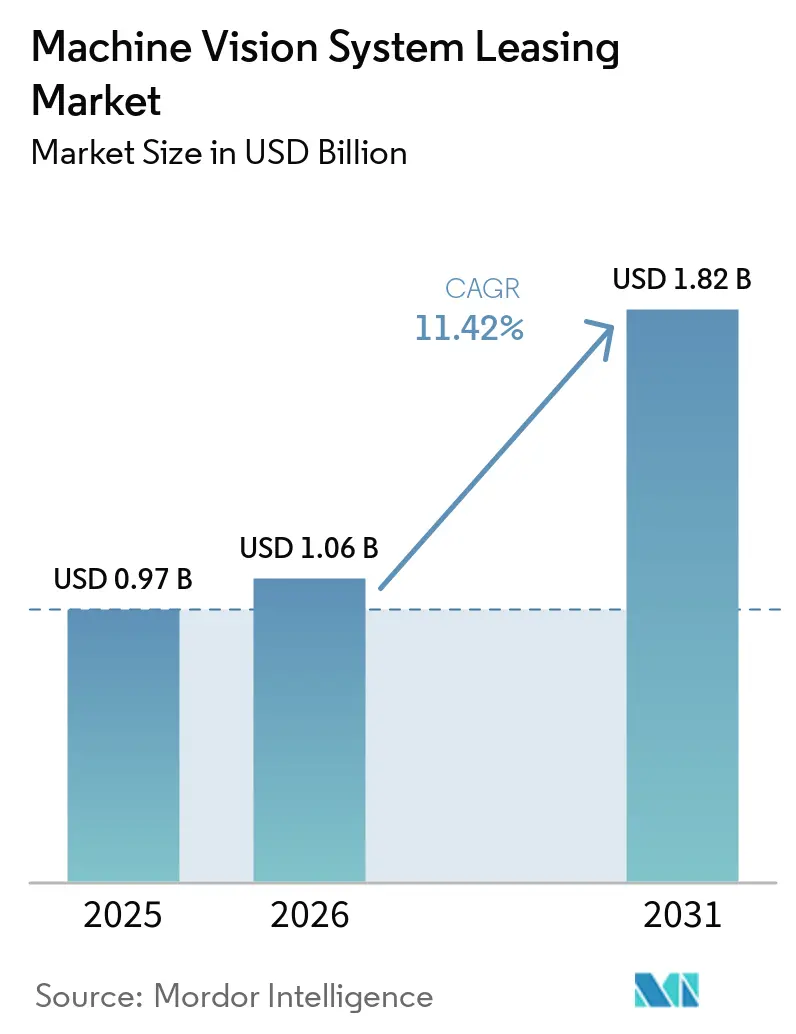
| Market Size (2026) | USD 1.06 Billion |
| Market Size (2031) | USD 1.82 Billion |
| Growth Rate (2026 - 2031) | 11.42 % |
| Fastest Growing Market | Middle East and Africa |
| Largest Market | Asia-Pacific |
| Market Concentration | Medium |
Major Players *Disclaimer: Major Players sorted in no particular order Image © Mordor Intelligence. Reuse requires attribution under CC BY 4.0. | |
Machine Vision System Leasing Market Analysis by Mordor Intelligence
The machine vision system leasing market size was USD 1.06 billion in 2026 and is forecast to reach USD 1.82 billion by 2031, accelerating at a CAGR of 11.42% over 2026-2031. The machine vision system leasing market is supported by manufacturers seeking current inspection hardware without assuming the full depreciation risk of frequent technology changes. Embedded AI, cloud-to-edge software, and more capable processing hardware have shortened the practical replacement cycle for many production systems. Leasing also lets customers combine hardware access with integration, calibration, and model support. This structure is relevant for factories that need reliable quality checks but lack specialist engineering teams. Competitive positioning increasingly depends on complete systems, service coverage, and the ability to update installed equipment across multiple facilities.
Key Report Takeaways
- By equipment type, machine vision cameras held 31.23% of the machine vision system leasing market share in 2025, while specialized imaging systems are projected to expand at a 12.62% CAGR through 2031.
- By vision technology, 2D imaging accounted for 65.54% of the market in 2025, while hyperspectral and multispectral imaging are projected to expand at a 12.19% CAGR through 2031.
- By application, inspection and quality control accounted for 28.85% of the machine vision system leasing market in 2025, while robotic vision is projected to expand at a 12.58% CAGR through 2031.
- By lease duration, medium-term contracts held 44.53% of the market in 2025, while short-term leases are projected to expand at a 12.02% CAGR through 2031.
- By end-user industry, automotive and EV held 26.89% of the market in 2025, while logistics and warehousing are projected to expand at a 12.78% CAGR through 2031.
- By geography, Asia-Pacific held 37.66% of the market in 2025, while the Middle East and Africa are projected to expand at a 12.37% CAGR through 2031.
Note: Market size and forecast figures in this report are generated using Mordor Intelligence’s proprietary estimation framework, updated with the latest available data and insights as of January 2026.
Global Machine Vision System Leasing Market Trends and Insights
Drivers Impact Analysis*
| Driver | (~) % Impact on CAGR Forecast | Geographic Relevance | Impact Timeline |
|---|---|---|---|
| Industry 4.0 Quality Automation and Zero-Defect Manufacturing | +3.0% | Global | Long term (≥ 4 years) |
| Vision-Guided Robotics and Flexible Production | +2.2% | Global, with Asia-Pacific as the core and spillover to North America and Europe | Long term (≥ 4 years) |
| AI-Enabled Inspection Across Key Manufacturing Sectors | +1.8% | Asia-Pacific, North America, and Europe | Medium term (2-4 years) |
| Labor Shortages and Demand for Consistent Inspection | +1.5% | Global, with North America and Europe most acute | Medium term (2-4 years) |
| Leasing and Vision-as-a-Service Lowering Upfront Capital Costs | +1.4% | Global, especially SME-heavy markets in Europe and Asia-Pacific | Short term (≤ 2 years) |
| Faster Technology Replacement Cycles Favoring Access Over Ownership | +1.0% | North America and Europe | Medium term (2-4 years) |
| Source: Mordor Intelligence | |||
Industry 4.0 Quality Automation and Zero-Defect Manufacturing
Zero-defect requirements now extend beyond aerospace and automotive into semiconductor packaging and pharmaceutical tablet inspection. The machine vision system leasing market benefits from higher inspection density, which requires equipment that can be refreshed as production thresholds become more demanding. Cognex introduced the In-Sight 3900 Vision System in May 2026, featuring Qualcomm DragonWing technology to enable embedded AI inspection without an external PC.[1]Cognex Corporation, “Cognex Launches Highest Performance Embedded AI Vision System Powered by Qualcomm,” Cognex Corporation, cognex.com. The release showed that inspection depth and line speed are increasingly addressed through embedded computing rather than through separate computing infrastructure. Cognex OneVision also supports centrally trained AI models that can be deployed across systems at several sites. The machine vision system leasing market can therefore serve as a channel for continuous quality improvement, not only as a means of financing equipment.
Vision-Guided Robotics and Flexible Production
Vision systems are becoming integral parts of robot work cells rather than separate inspection stations. The International Federation of Robotics reported more than 542,000 global robot installations in 2024, with 70% in Asia. This installed base creates recurring demand for vision guidance, positioning, and inspection capability. Basler and Orbbec introduced the Basler Stereo mini camera in March 2026 for AMR, AGV, and industrial 3D vision uses. Robot lessors can bundle cameras and related vision components within broader equipment contracts. The machine vision system leasing market consequently gains demand from flexible production lines that need current sensor and compute capability.
AI-Enabled Inspection Across Key Manufacturing Sectors
AI-based inspection is raising the technical requirements for systems used in EV batteries, semiconductor production, pharmaceuticals, and food processing. Defect classification, electrode alignment, and contamination detection often require AI accelerators that legacy rule-based systems cannot support. Teledyne DALSA introduced its Kaleido SWIR hyperspectral camera in May 2026 with up to 1,280-pixel spatial resolution and line rates above 2.3 kHz. The camera targets food safety and pharmaceutical inspection, where material identification can be important for compliance. These systems can carry higher acquisition and deployment costs than conventional cameras. The machine vision system leasing market provides customers with access to newer capabilities while limiting their exposure to technology replacement risk.
Labor Shortages and Demand for Consistent Inspection
Skilled labor shortages in Germany, the United States, Japan, and South Korea are increasing interest in automated inspection. Zebra Technologies reported in June 2026 that 92% of manufacturing leaders treated digital transformation as a strategic priority, while 98% expected to deploy machine vision by 2029. Many facilities still lack the internal staff needed to configure and maintain advanced vision equipment. Service-backed contracts can include integration, calibration, and model updates. This can reduce the operational barrier for smaller manufacturers and newer automation users. The machine vision system leasing market is especially relevant where local integrator networks remain limited.
Restraints Impact Analysis*
| Restraint | (~) % Impact on CAGR Forecast | Geographic Relevance | Impact Timeline |
|---|---|---|---|
| Premium Vision Systems | -1.4% | Global, most acute for lessors in North America and Europe | Long term (≥ 4 years) |
| Shortage of Skilled Integrators and Application Engineers | -1.1% | Global, including North America, Europe, and emerging Asia-Pacific markets | Medium term (2-4 years) |
| Uncertain Residual Value of Fast-Obsolescing Vision Assets | -0.8% | Global, with Europe and North America most exposed | Medium term (2-4 years) |
| Data Residency, Cybersecurity, and Model Liability Concerns | -0.6% | Europe, North America, and regulated Asia-Pacific markets | Short term (≤ 2 years) |
| Source: Mordor Intelligence | |||
High Total Cost of Ownership for Premium Vision Systems
Premium 3D and hyperspectral configurations can remain costly even when acquired through an operating lease. High system costs can translate into monthly payments that smaller customers find difficult to justify. Lessors also bear residual-value risk if an asset's value at the end of the contract is lower than originally expected. Service obligations further increase the capital required for each contract. The German leasing association reported that production-machinery leasing declined by 5.5% to EUR 4.96 billion (USD 5.38 billion) in 2025, amid delayed investment decisions in the automotive and chemical sectors.[2]Bundesverband Deutscher Leasing-Unternehmen, “Leasing als Sicherheitsnetz,” Bundesverband Deutscher Leasing-Unternehmen, bdl.de. The machine vision system leasing market needs stronger secondary equipment channels to manage this risk outside North America and Western Europe.
Shortage of Skilled Integrators and Application Engineers
A leased system only creates value when it is configured, calibrated, and validated for its intended production task. Integrator availability can, therefore, limit deployment even when a customer can secure financing. AI model updates can require additional testing and validation compared with fixed-parameter installations. STEMMER IMAGING expanded its North American presence through the October 2025 transition of Phase 1 Technology to STEMMER IMAGING USA. It also launched the SIS-TA digital procurement platform in June 2026 to improve access to cameras, optics, lighting, and frame grabbers. The machine vision system leasing market favors providers that can combine hardware availability with application support and service capacity.
*Our forecasts treat driver/restraint impacts as directional, not additive. The impact forecasts reflect baseline growth, mix effects, and variable interactions.
Segment Analysis
By Equipment Type: Cameras Lead, While Specialized Systems Gain Ground
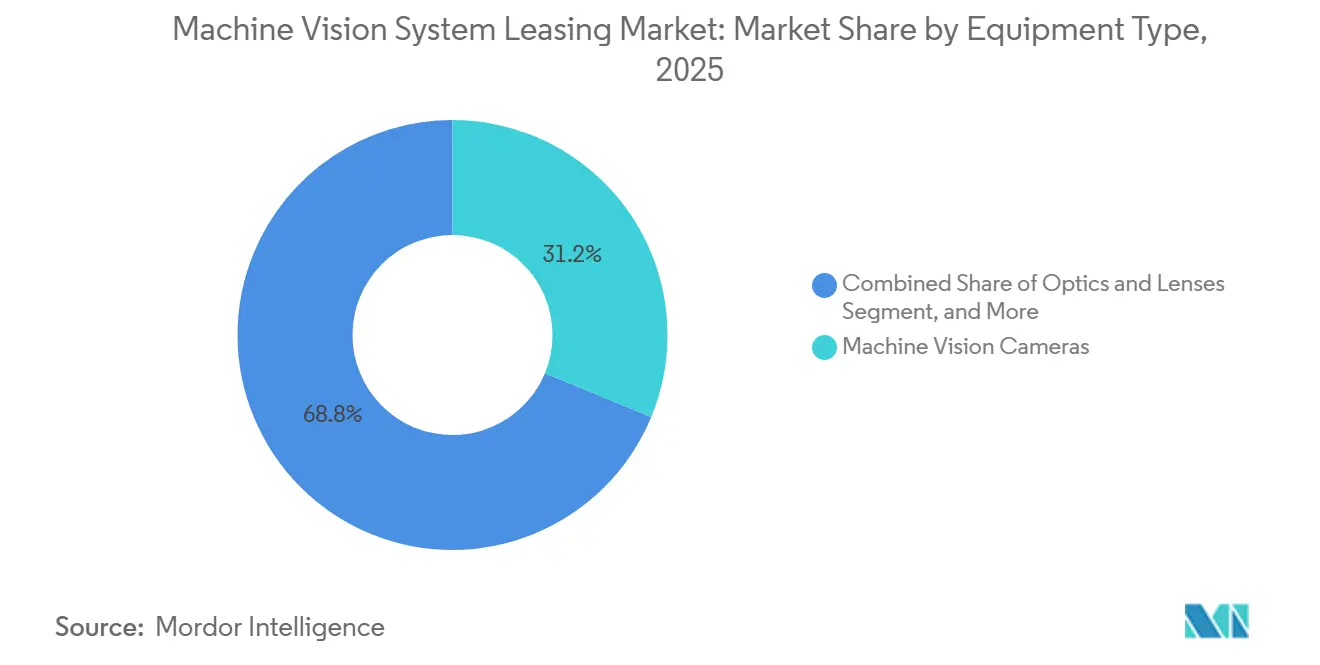
Machine vision cameras held 31.23% of the equipment-type segment in 2025. This position reflects their use in industrial automation, inline inspection, and robotic guidance across many production settings. Cameras are often the starting point for a leased system because they can support a wide range of applications. Customers can lease camera bodies while purchasing optics and illumination separately. This approach can lower the initial contractual commitment for basic deployments. The machine vision system leasing market benefits from this modular structure because it supports contracts suited to different technical requirements. Optics and lenses remain important in packages where image quality or field of view must be tailored to a specific line. Illumination systems also remain necessary because lighting conditions can determine whether a camera can consistently identify a defect. Vision processing equipment provides the computing capability needed to run inspection models and communicate results to factory controls.
Integrated vision systems combine several elements in a single offering and appeal to customers who value simpler procurement. These systems can reduce coordination requirements between hardware suppliers, integrators, and finance providers. Specialized imaging systems are projected to expand at a 12.62% CAGR through 2031. Hyperspectral, SWIR, and multispectral platforms are being used more widely in food safety, pharmaceutical sorting, and recycling. Teledyne DALSA designed the Kaleido with a 10 GigE interface that complies with GigE Vision and GenICam standards. Standardized interfaces can simplify system integration for providers and customers. The machine vision system leasing market can help users adopt specialized equipment while avoiding ownership of an asset whose performance may be surpassed quickly. This matters where new imaging capability can change the economics of inspection or sorting.



By Vision Technology: 2D Imaging Remains Core, While Spectral Imaging Accelerates
2D imaging accounted for 65.54% of the vision-technology segment in 2025. It remains widely used for barcode reading, surface inspection, dimensional measurement, and label verification. Its broad role makes it the main technology base for many lease portfolios. 2D systems can also be updated through software releases during the contract period. This means a customer may receive improving inspection logic without replacing every hardware component. The machine vision system leasing market uses this model to offer access to current software and system support. 1D imaging continues to serve narrower scanning and traceability roles in warehouse and logistics operations. 3D imaging has gained relevance in automotive assembly verification and electronics solder-joint inspection. These uses require depth information that cannot be captured through standard 2D cameras.
Hyperspectral and multispectral imaging is projected to expand at a 12.19% CAGR through 2031. This technology can support food contamination detection, pharmaceutical tablet coating checks, and sorting of recycled materials. It analyzes information across a broader range of wavelengths than a conventional camera. The resulting data can improve material distinction, although it also adds processing and integration requirements. Teledyne introduced the Kaleido in 2026 as a platform to help system builders reduce integration complexity. The machine vision system leasing market can package optical hardware with AI inference software for these applications. This creates contracts that combine equipment access, data processing, and support. Such structures narrow the practical difference between equipment leasing and vision-as-a-service.
By Application: Inspection Leads, While Robotic Vision Expands
Inspection and quality control held 28.85% of the application segment in 2025. The category serves automotive, electronics, food and beverage, and pharmaceutical manufacturing lines. Its position stems from the need to identify defects before a product moves to the next stage of production. Measurement and metrology form a steady demand area for dimensional verification in precision engineering and semiconductor packaging. Identification and traceability applications support barcode and QR code reading across supply chains. Guidance and positioning systems help equipment locate and orient items during automated handling. Defect detection adds a more focused layer of analysis when flaws require classification or escalation. The machine vision system leasing market can serve these application requirements through different combinations of cameras, lighting, processing equipment, and software. The diversity of use cases also supports contracts with varying terms and service levels.
Robotic vision is projected to expand at a 12.58% CAGR through 2031. AMR fleets and collaborative robots are increasing the need for systems that guide movement, verify placement, and identify materials. OMRON demonstrated integrated vision, safety, and machine control for manufacturing and logistics workflows at Automate 2026. This approach places vision within the operating system of a larger automated process. Robot fleets are often financed or leased as grouped assets. The machine vision system leasing market can follow that structure by bundling vision hardware and software into a single contract. Providers can create a more complete offer by addressing system integration alongside finance. The result is a closer link between demand for mobile robotics and demand for vision capability.
By Lease Duration: Medium-Term Contracts Lead, While Short-Term Demand Rises
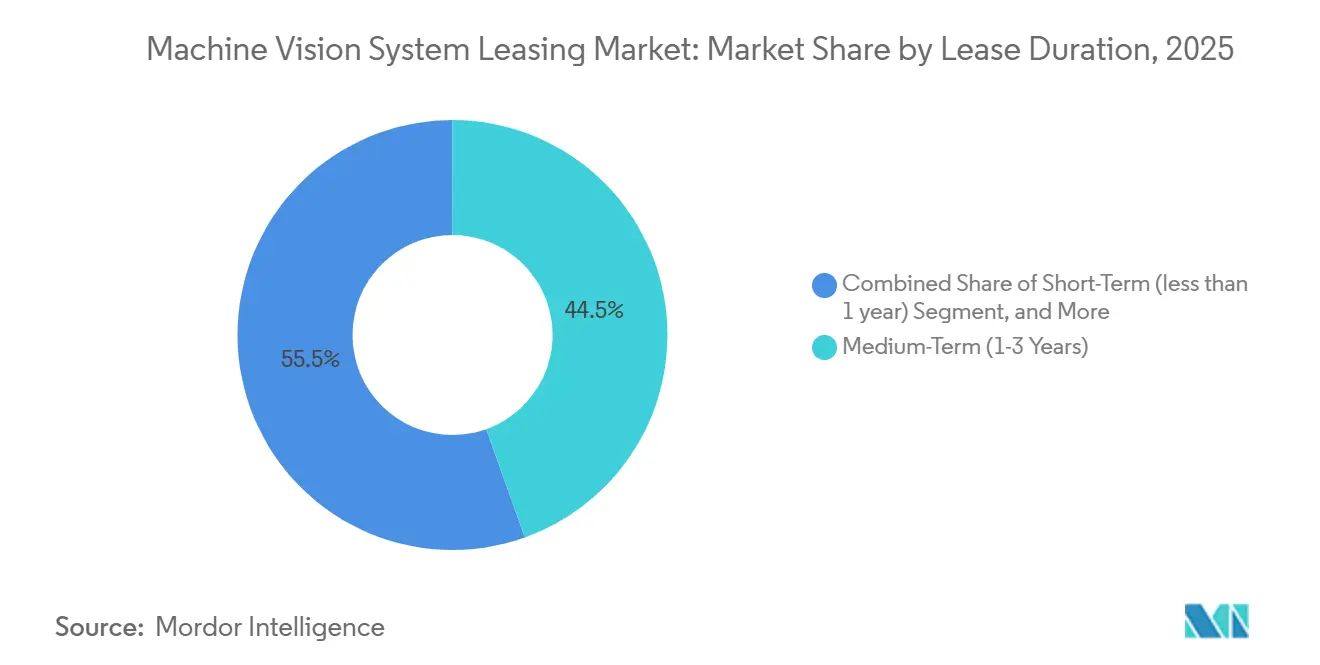
Medium-term contracts of 1-3 years held 44.53% of the lease-duration segment in 2025. This duration gives customers time to absorb integration costs while retaining a choice at the end of the contract. It also aligns with the replacement cycle of many AI-enabled vision platforms. Both the lessor and the customer can plan residual value and upgrade options with greater confidence over this period. Long-term contracts of more than 3 years remain relevant for stable production settings. They can suit customers with predictable inspection needs and lower requirements for frequent technology changes. The machine vision system leasing market uses these contracts to provide cost certainty for equipment that can remain productive for longer periods. Long-term arrangements can also be practical when a system has been fully validated for a regulated process. However, rapid changes in product design or AI hardware can make longer commitments less attractive for some users.
Short-term contracts of less than 1 year are projected to expand at a 12.02% CAGR through 2031. Food and beverage processors can use them to manage seasonal production and harvest peaks. Electronics contract manufacturers can use them for specific product programs without committing to permanent capacity. Pilot projects also use short contracts to test AI-based inspection before a multi-year agreement. This flexibility can be important when a factory is evaluating a vision-as-a-service model. Robotics leasing practices indicate that customers may retain the option to return, buy, or upgrade equipment when a contract ends. The machine vision system leasing market can use comparable options to support more granular production planning. Shorter contracts may increase utilization complexity for providers, but they can reach customers with variable production schedules. They can also provide a practical entry route for businesses that have not previously used advanced machine vision.
By End-User Industry: Automotive and EV Leads, Logistics and Warehousing Accelerates
Automotive and EV held 26.89% of the end-user segment in 2025. Inline inspection needs are high across battery-cell production, body-panel assembly, and powertrain component manufacturing. Battery chemistry changes can alter inspection parameters as designs move between NMC, LFP, and emerging solid-state formats. This makes owned hardware more difficult to manage when a production line must adapt quickly. Electronics and semiconductor manufacturers represent another important area of demand. They use vision systems for die-bonding verification, PCB solder-joint inspection, and wafer-level defect detection. Food and beverage producers use vision for contamination detection, fill-level verification, and label inspection. Seasonal activity can make short-term access to equipment particularly relevant for those producers. Pharmaceutical and medical device manufacturers use systems to check tablet coating uniformity and packaging integrity. The machine vision system leasing market can appeal to regulated users who prefer validated, service-backed equipment rather than self-managed assets.
Packaging and other end-user industries add a stable source of demand for label verification and format-change applications. Logistics and warehousing are projected to expand at a 12.78% CAGR through 2031. The segment uses vision systems for AMR navigation, pallet dimension measurement, and item identification workflows. OMRON expanded the OL-450S AMR platform with modular mast configurations in April 2026 to support different facility layouts. This shows how vision and related automation capabilities can be configured to suit a site’s operating conditions. Leasing can help logistics operators change capacity without purchasing every component outright. The machine vision system leasing market is positioned to benefit where robotic equipment and vision functions are acquired as a combined solution. Contracts that cover deployment, maintenance, and upgrades can be especially useful for operators managing varied sites and workflow demands.
Geography Analysis
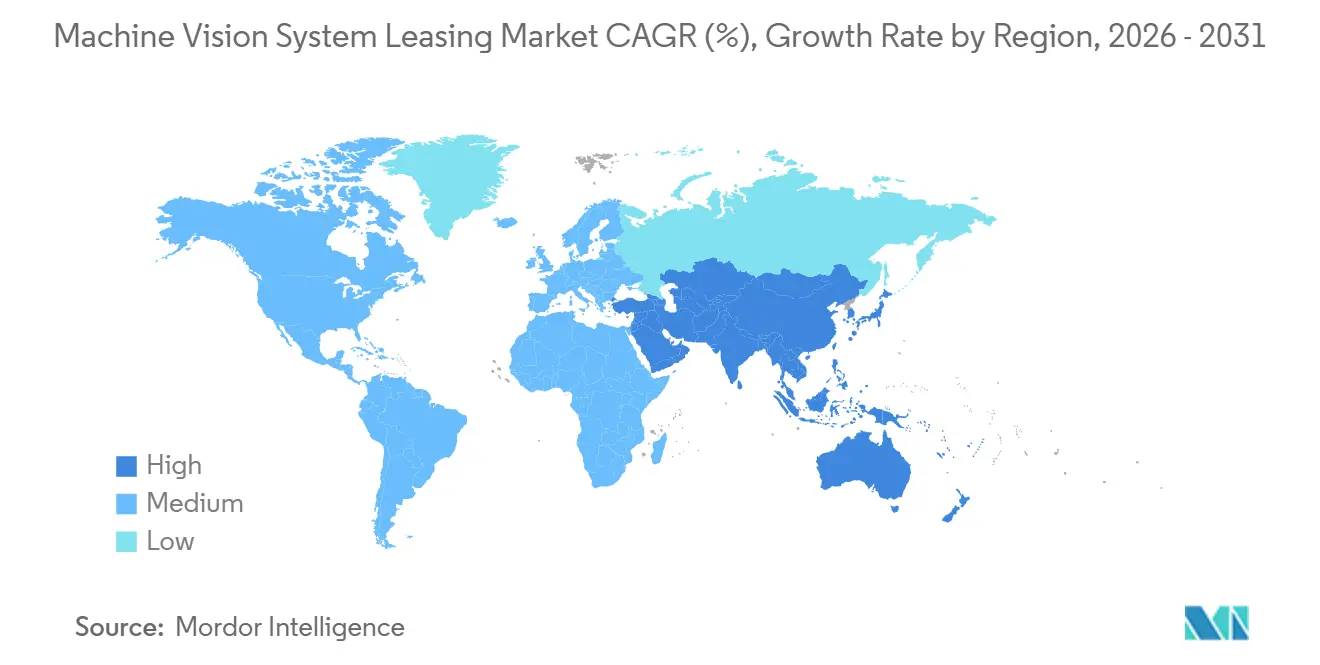
Asia-Pacific held 37.66% of the geographic segment in 2025. The region combines major centers for electronics assembly, semiconductor fabrication, EV battery production, and automotive manufacturing. China, Japan, South Korea, India, and ASEAN countries each contribute to demand through different industrial strengths. Japan and South Korea have mature adoption environments for precision manufacturing and advanced imaging. China’s local supplier base supports leasing volume but can limit premium pricing for international providers. India remains at an earlier stage, with electronics assembly, automotive, and pharmaceutical companies updating inspection workflows. TKH Group reported a strong Asia-Pacific contribution to machine vision in its H1 2026 results, driven by demand from battery, factory automation, semiconductor, and consumer electronics. The scale and pace of manufacturing investment support the machine vision system leasing market in the region.
North America and Europe are the next major geographic blocks and have established leasing infrastructure. North America benefits from a mature asset-finance environment and higher levels of automation in automotive, semiconductor, and food processing. Labor costs and reshoring plans also support investment in machine vision equipment. Europe has a deep industrial automation base, with Germany remaining an important reference point for the sector. The German leasing quota reached 26.6% of total equipment investment in 2025, while new business rose 3.2% to EUR 83.12 billion (USD 90.19 billion). This supports the use of operating lease structures even when capital investment decisions are cautious. South America represents a smaller demand base concentrated in Brazil’s automotive and food-processing sectors. Leasing can address capital-access constraints and currency volatility risk in those settings.
The Middle East and Africa are projected to expand at a 12.37% CAGR through 2031. Industrial diversification programs in Saudi Arabia and the UAE support demand for advanced manufacturing capability. Leasing lets users access inspection equipment without committing to permanent ownership while facilities are being developed. South Africa provides an established base through mining-related and food-processing manufacturing. The broader African opportunity remains in its early stages but is moving in a positive direction. Large regional projects are often delivered by international engineering, procurement, and construction contractors. These contractors may obtain leased equipment through global channels rather than local distributors. The machine vision system leasing market can therefore be accessible to international providers without immediate investment in a local subsidiary.

Competitive Landscape
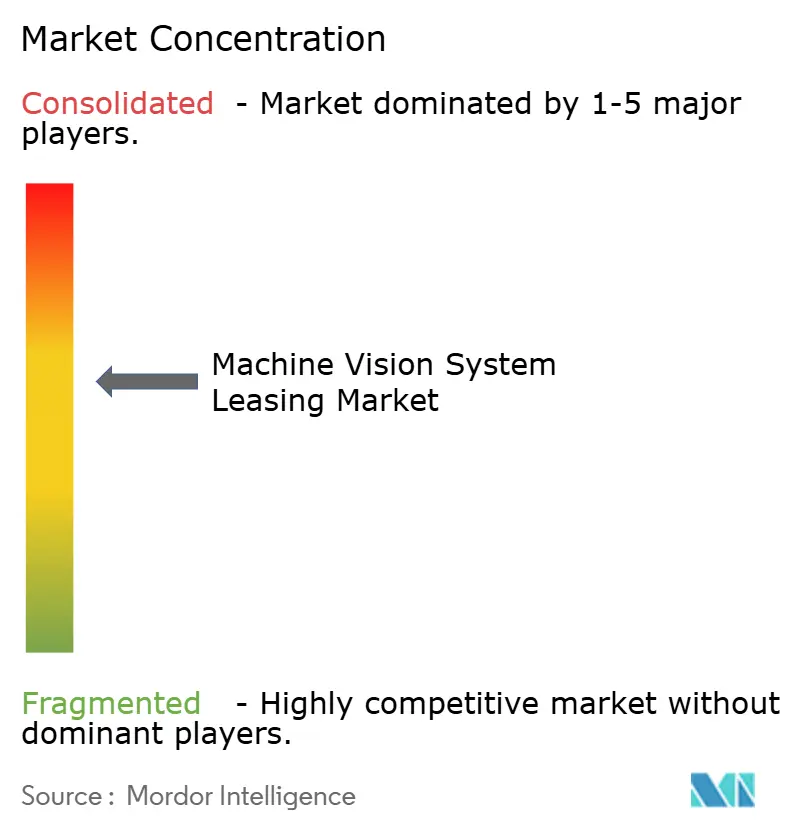
The machine vision system leasing market has a layered structure that includes direct-leasing hardware manufacturers, system integrators, financial lessors, and vision-as-a-service providers. These participants compete across hardware supply, application design, financing, and ongoing support. Global concentration is moderate, while some component categories are becoming more consolidated. TKH Group united Allied Vision, Chromasens, Mikrotron, NET, and SVS-Vistek under the Allied Vision brand in January 2026. The move created a broader 2D machine vision portfolio for system integrators and OEMs. Providers with wider portfolios can offer a more complete lease package than a single-component supplier. The machine vision system leasing market also rewards firms that can manage equipment lifecycles and service obligations across multiple locations. This gives integrated providers an advantage when customers want fewer supplier relationships.
Cognex’s OneVision platform is an example of a cloud-to-edge model that connects centrally trained models with deployed In-Sight systems. This capability can make a hardware contract part of a continuing software relationship. It can also increase switching costs when several facilities use common inspection models and workflows. Teledyne DALSA’s Kaleido system illustrates competition through specialized imaging and system differentiation. Its technical design supports higher-value uses in food, pharmaceuticals, recycling, and waste sorting. Basler’s partnership with Advantech in April 2026 added an integrated GMSL-based vision and robotics computing platform powered by NVIDIA Jetson.[3]Advantech, “Advantech Partners with Basler to Propel Physical AI,” Advantech, advantech.com. The machine vision system leasing market is becoming more competitive, where hardware, computing, and robotics functions are delivered together.
Opportunities are visible in hyperspectral leasing for recycling and waste management, validated vision-as-a-service offers for pharmaceuticals, and packages linked to AMR and collaborative-robot contracts. These areas require more than simple hardware access because users also need application knowledge and ongoing updates. STEMMER IMAGING’s transition of Phase 1 Technology to its United States operation expanded its service reach in North America. Its digital store, launched in June 2026, also addressed buyers seeking faster access to vision components. Smaller specialists can compete by bringing differentiated technology or strong vertical expertise. Larger providers can compete through wider catalogs, financing relationships, and multiregional service. The machine vision system leasing market remains open to both approaches because contracts vary by equipment complexity, application risk, and support needs.
Machine Vision System Leasing Industry Leaders
Cognex Corporation
Keyence Corporation
OMRON Corporation
Teledyne Technologies Incorporated
IDS Imaging Development Systems GmbH
- *Disclaimer: Major Players sorted in no particular order

Recent Industry Developments
- June 2026: Zebra Technologies debuted the CV70 CXP ultra-compact machine vision camera at Automate 2026 in Chicago, targeting EV battery assembly, small-parts inspection, and semiconductor inspection. The CV70 is paired with Aurora software, frame grabbers, and vision controllers in a single-vendor complete system architecture, with significant implications for bundled leasing packages.
- June 2026: STEMMER IMAGING launched SIS-TA, Smart Industry Store, Technology Access, a fully digital transactional platform for machine vision components including cameras, optics, lighting, and frame grabbers, a strategic move to serve procurement-driven buyers who prioritize speed and price transparency over consultative sales models.
- May 2026: Cognex launched the In-Sight 3900 Vision System powered by Qualcomm Dragonwing, delivering embedded AI inspection without an external PC. When paired with the OneVision platform, the system enables cloud-to-edge AI model deployment across multiple leased units simultaneously, a meaningful upgrade to the economics of multi-site leasing contracts.
- May 2026: Teledyne DALSA announced the Kaleido SWIR hyperspectral camera with up to 1,280-pixel spatial resolution and line rates exceeding 2.3 kHz, designed for recycling, food safety, pharmaceutical, and waste management sorting, broadening the addressable market for specialized imaging system leasing.


Global Machine Vision System Leasing Market Report Scope
The Machine Vision System Leasing Market refers to the market for leasing machine vision equipment and integrated vision systems to industrial, commercial, and other end users for a defined contractual period in exchange for periodic lease payments. The market enables organizations to access machine vision technologies without incurring the full upfront capital investment required to purchase such equipment outright. Leasing arrangements may support the deployment of vision systems for production operations, quality control, automation, inspection, measurement, traceability, robotics, and other industrial applications.
The Machine Vision System Leasing Market Report is Segmented by Equipment Type (Machine Vision Cameras, Optics and Lenses, Illumination Systems, Vision Processing Equipment, Integrated Vision Systems, and Specialized Imaging Systems), Vision Technology (1D Imaging, 2D Imaging, 3D Imaging, and Hyperspectral and Multispectral Imaging), Application (Inspection and Quality Control, Measurement and Metrology, Identification and Traceability, Guidance and Positioning, Defect Detection, and Robotic Vision), Lease Duration (Short-Term, Medium-Term, and Long-Term), End-User Industry (Automotive and EV, Electronics and Semiconductor, Food and Beverage, Pharmaceuticals and Medical Devices, Packaging, Logistics and Warehousing, and Other End-User Industries), and Geography (North America, South America, Europe, Asia-Pacific, and Middle East and Africa). The Market Forecasts are Provided in Terms of Value (USD).
| Machine Vision Cameras |
| Optics and Lenses |
| Illumination Systems |
| Vision Processing Equipment |
| Integrated Vision Systems |
| Specialized Imaging Systems |
| 1D Imaging |
| 2D Imaging |
| 3D Imaging |
| Hyperspectral and Multispectral Imaging |
| Inspection and Quality Control |
| Measurement and Metrology |
| Identification and Traceability |
| Guidance and Positioning |
| Defect Detection |
| Robotic Vision |
| Short-Term |
| Medium-Term |
| Long-Term |
| Automotive and EV |
| Electronics and Semiconductor |
| Food and Beverage |
| Pharmaceuticals and Medical Devices |
| Packaging |
| Logistics and Warehousing |
| Other End-User Industries |
| North America | United States | |
| Canada | ||
| Mexico | ||
| South America | Brazil | |
| Argentina | ||
| Rest of South America | ||
| Europe | Germany | |
| United Kingdom | ||
| France | ||
| Italy | ||
| Spain | ||
| Rest of Europe | ||
| Asia-Pacific | China | |
| Japan | ||
| India | ||
| South Korea | ||
| ASEAN | ||
| Rest of Asia-Pacific | ||
| Middle East and Africa | Middle East | Saudi Arabia |
| United Arab Emirates | ||
| Rest of the Middle East | ||
| Africa | South Africa | |
| Rest of Africa | ||
| By Equipment Type | Machine Vision Cameras | ||
| Optics and Lenses | |||
| Illumination Systems | |||
| Vision Processing Equipment | |||
| Integrated Vision Systems | |||
| Specialized Imaging Systems | |||
| By Vision Technology | 1D Imaging | ||
| 2D Imaging | |||
| 3D Imaging | |||
| Hyperspectral and Multispectral Imaging | |||
| By Application | Inspection and Quality Control | ||
| Measurement and Metrology | |||
| Identification and Traceability | |||
| Guidance and Positioning | |||
| Defect Detection | |||
| Robotic Vision | |||
| By Lease Duration | Short-Term | ||
| Medium-Term | |||
| Long-Term | |||
| By End-User Industry | Automotive and EV | ||
| Electronics and Semiconductor | |||
| Food and Beverage | |||
| Pharmaceuticals and Medical Devices | |||
| Packaging | |||
| Logistics and Warehousing | |||
| Other End-User Industries | |||
| By Geography | North America | United States | |
| Canada | |||
| Mexico | |||
| South America | Brazil | ||
| Argentina | |||
| Rest of South America | |||
| Europe | Germany | ||
| United Kingdom | |||
| France | |||
| Italy | |||
| Spain | |||
| Rest of Europe | |||
| Asia-Pacific | China | ||
| Japan | |||
| India | |||
| South Korea | |||
| ASEAN | |||
| Rest of Asia-Pacific | |||
| Middle East and Africa | Middle East | Saudi Arabia | |
| United Arab Emirates | |||
| Rest of the Middle East | |||
| Africa | South Africa | ||
| Rest of Africa | |||


Key Questions Answered in the Report
What is the machine vision system leasing market size?
The machine vision system leasing market size was USD 1.06 billion in 2026 and is forecast to reach USD 1.82 billion by 2031 at an 11.42% CAGR.
What is driving demand for leased machine vision systems?
Manufacturers use leasing to access current inspection hardware, integration support, and AI software updates without taking full ownership risk.
Which equipment category held the largest position in 2025?
Machine vision cameras held 31.23% of the equipment-type segment in 2025, supported by uses in automation, inspection, and robotic guidance.
Which vision technology is expanding fastest through 2031?
Hyperspectral and multispectral imaging is projected to expand at a 12.19% CAGR through 2031, supported by food, pharmaceutical, and recycling applications.
Which end-user application is expected to advance fastest?
Logistics and warehousing is projected to expand at a 12.78% CAGR through 2031, driven by AMR navigation, pallet measurement, and item identification.
Which region had the largest position in 2025?
Asia-Pacific held 37.66% of the geographic segment in 2025 because of its concentration of electronics, semiconductor, EV battery, and automotive production.
Page last updated on:





