
Machine Vision Hardware-as-a-Service Market Size and Share
Market Overview
| Study Period | 2020 - 2031 |
|---|---|
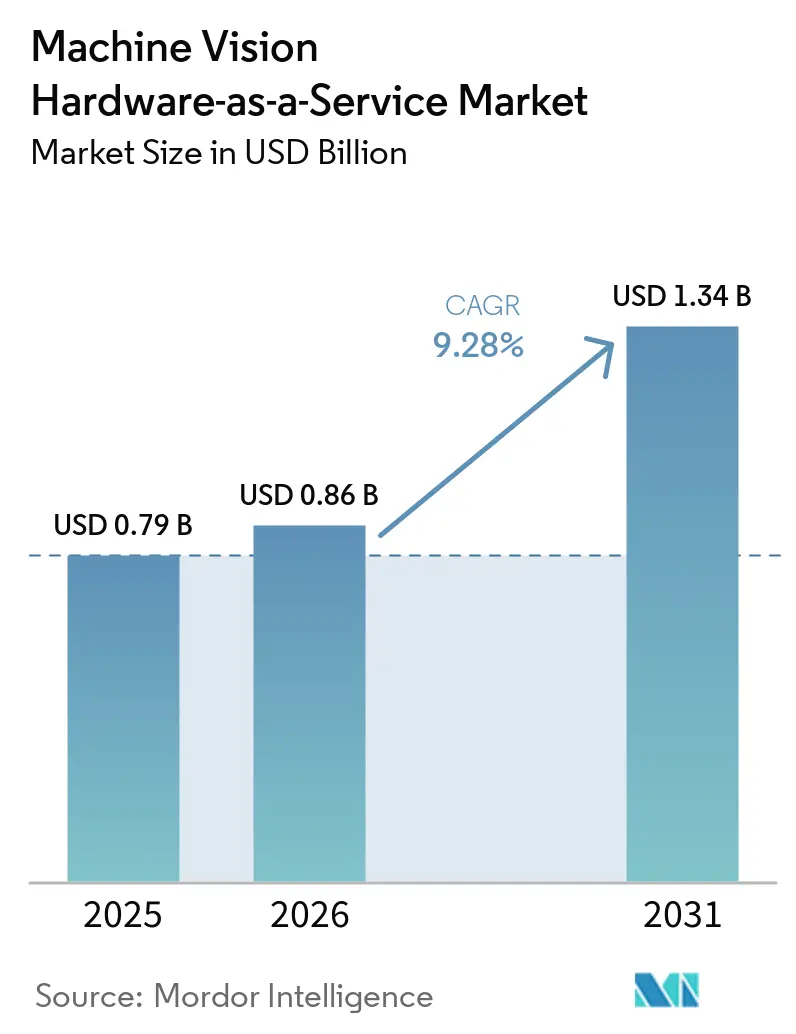
| Market Size (2026) | USD 0.86 Billion |
| Market Size (2031) | USD 1.34 Billion |
| Growth Rate (2026 - 2031) | 9.28 % |
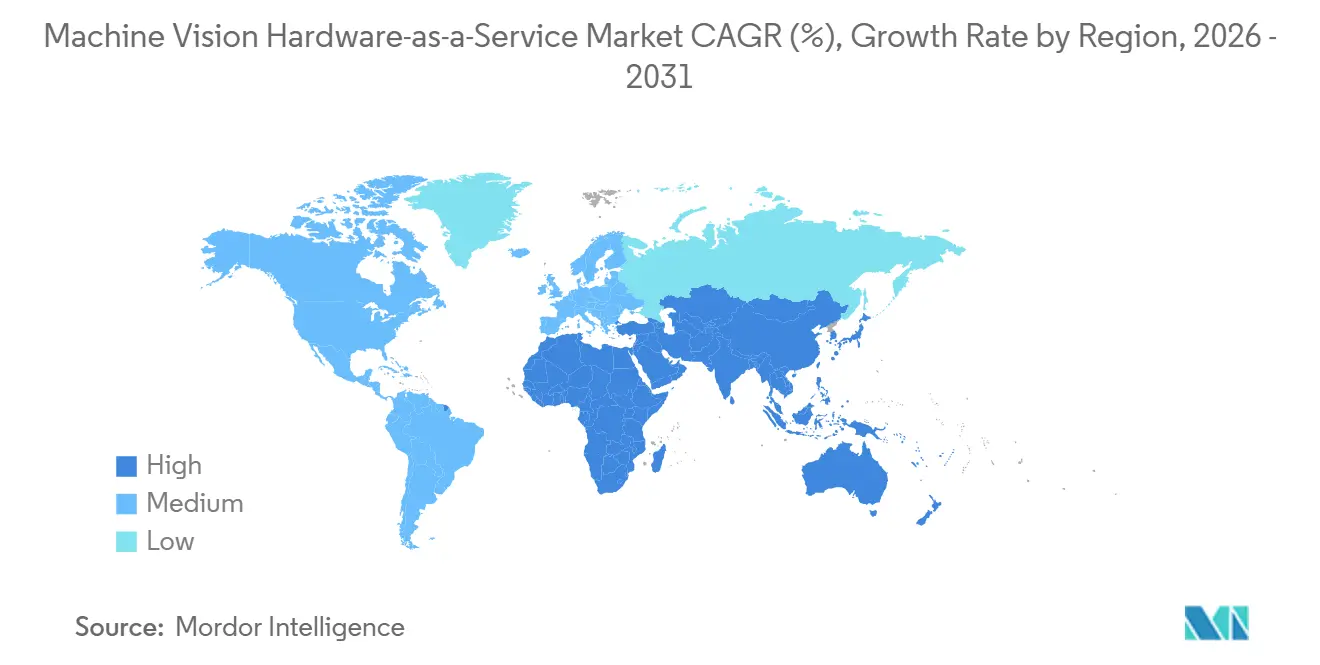
| Fastest Growing Market | Middle East and Africa |
| Largest Market | Asia-Pacific |
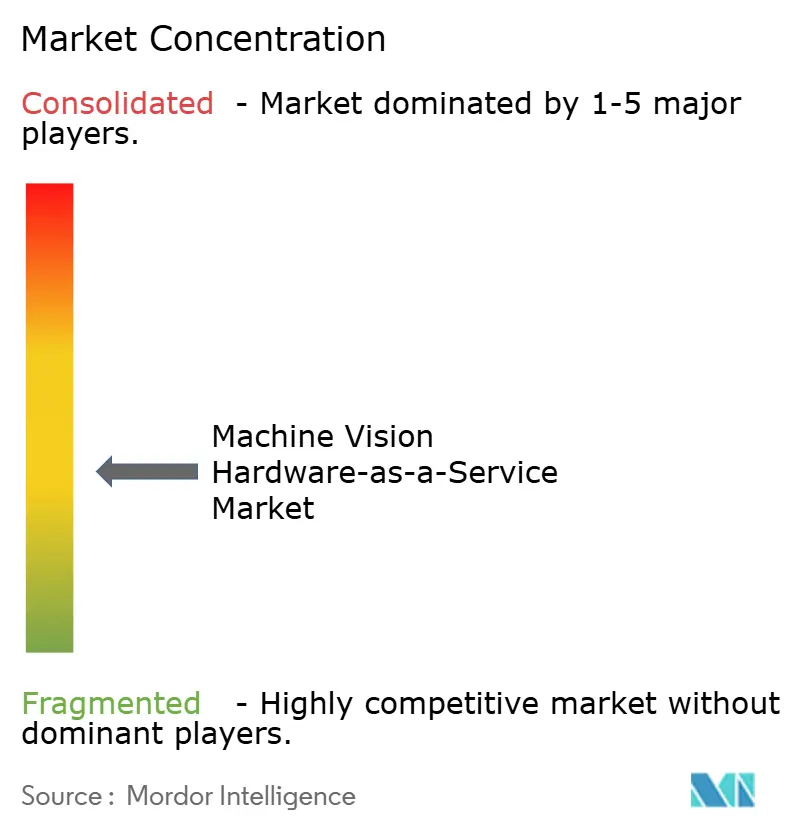
| Market Concentration | Medium |
Major Players *Disclaimer: Major Players sorted in no particular order Image © Mordor Intelligence. Reuse requires attribution under CC BY 4.0. | |
Machine Vision Hardware-as-a-Service Market Analysis by Mordor Intelligence
The machine vision hardware-as-a-service market size is estimated at USD 0.79 billion in 2025 and expected to reach USD 1.34 billion by 2031, registering a CAGR of 9.28% between 2026 to 2031. Manufacturers are moving from one-time hardware purchases toward service contracts that place vision equipment and related support within operating budgets. Smart-factory programs are increasing demand for automated quality systems across Asia-Pacific, Europe, and North America. Edge-based inference and centralized model management are helping providers operate distributed camera fleets with fewer integration costs. This approach creates opportunities for suppliers that can support multiple sites, manage models over time, and provide dependable field service. It also increases the importance of cybersecurity, interoperability, and proof of inspection performance for customers when choosing a provider.
Key Report Takeaways
- By hardware type, machine vision cameras held 34.59% of the machine vision hardware-as-a-service market share in 2025, while specialized imaging hardware is projected to expand at an 11.34% CAGR through 2031.
- By contract model, subscription-based HaaS accounted for 41.37% of the machine vision hardware-as-a-service market share in 2025, while outcome-based and managed HaaS is projected to expand at a 13.47% CAGR through 2031
- By application, inspection and quality control retained 37.89% of the segment in 2025, while robotic vision is projected to expand at an 11.13% CAGR through 2031.
- By end-use industry, electronics and semiconductors accounted for 24.19% of the segment in 2025, while logistics and warehousing are projected to expand at a 12.65% CAGR through 2031.
- By geography, Asia-Pacific accounted for 33.21% of the machine vision hardware-as-a-service market in 2025, while the Middle East and Africa are projected to expand at a 10.51% CAGR through 2031.
Note: Market size and forecast figures in this report are generated using Mordor Intelligence’s proprietary estimation framework, updated with the latest available data and insights as of January 2026.
Global Machine Vision Hardware-as-a-Service Market Trends and Insights
Drivers Impact Analysis*
| Driver | (~) % Impact on CAGR Forecast | Geographic Relevance | Impact Timleine |
|---|---|---|---|
| Industry 4.0 Smart-Factory Investment | +2.5% | Global, concentrated in China, Germany, Japan, and South Korea | Long term (≥ 4 years) |
| Subscription Pricing Replaces Upfront Capital Expenditure | +2.0% | Global, with early gains in North America and Europe | Medium term (2-4 years) |
| AI-Enabled Inspection Accuracy and No-Code Deployment | +1.7% | Global, with leading adoption in Asia-Pacific and North America | Medium term (2-4 years) |
| Zero-Defect Manufacturing and Recall Avoidance | +1.4% | Global, critical in automotive and EV hubs and pharmaceutical clusters | Long term (≥ 4 years) |
| Outcome-Based Quality Contracts for Distributed Production | +0.8% | North America and Europe, with early expansion to Asia-Pacific | Long term (≥ 4 years) |
| Federated Defect-Library Network Effects | +0.6% | North America and Europe, with early adoption in Asian electronics hubs | Medium term (2-4 years) |
| Source: Mordor Intelligence | |||
Industry 4.0 Smart-Factory Investment
Smart-factory investment is making machine vision a core part of digital production systems. A July 2026 review in Discover Mechanical Engineering screened 1,625 records across 7 databases. Most of the included deep-learning machine vision studies were published in 2024 and 2025. Recent research supports a continuing flow of industrial applications. Germany's Industrie 4.0 ecosystem and China's advanced manufacturing programs support sensor-rich factory environments. These settings link vision inspection more closely with manufacturing execution systems. Each deployment can also reduce the cost of later vision projects at the same site. This improves the commercial case for the machine vision hardware-as-a-service market across multi-line facilities.
Subscription Pricing Replaces Upfront Capital Expenditure
Subscription contracts can reduce the initial financial hurdle for manufacturers that need inspection equipment. The model replaces a large equipment purchase with recurring payments and service support. It can also avoid capital approval processes that delay smaller projects. Cognex made OneVision generally available in May 2026 after a beta phase involving more than 100 customers. The platform supports cloud-based model management with inspection running at the edge. Cognex stated that the platform reduced inspection scaling costs by up to 50%. Schneider Electric reported a doubled yield and fewer false rejects after adoption. These results support the use of subscription-based models in the machine vision hardware-as-a-service market.[1]Cognex Corporation, “Cognex OneVision Adoption Ramps as Manufacturers Scale AI Vision Globally,” Cognex Investor Relations, investor.cognex.com.
AI-Enabled Inspection Accuracy and No-Code Deployment
AI-based inspection can reduce the need for repeated rule changes in high-mix manufacturing. This is important where products, materials, or defect patterns change frequently. The July 2026 scientific review reported a mean average precision of 98.6% for YOLO variants on printed circuit board defect datasets. It also reported 98.2% accuracy for a U-Net-EfficientNet-B4 combination on metal-surface datasets with 8 categories and 147,824 images. These results show why AI tools are being used in more demanding inspection work. No-code interfaces can also allow plant teams to train models without relying on specialist integrators. This shortens the path from a set of sample images to a usable inspection workflow. It strengthens the appeal of the machine vision hardware-as-a-service market for contract manufacturers with frequent changeovers.
Zero-Defect Manufacturing and Recall Avoidance
Escaped defects can lead to high direct costs for manufacturers and their suppliers. Automotive electronics and sensor failures have led to recalls exceeding USD 1 billion before reputational costs are factored in. This exposure increases the value of dependable automated inspection. Pharmaceutical producers also require documented outputs and auditable records under FDA 21 CFR Part 11. KEYENCE introduced its VS-G Series in 2025 with a 32-core AI engine and dedicated image storage. The system supports 100% visual traceability from a single controller. Outcome-based contracts can place more responsibility for uptime and inspection accuracy on the provider. This arrangement aligns service fees with the quality requirements that support the machine vision hardware-as-a-service market.
Restraints Impact Analysis*
| Restraint | (~) % Impact on CAGR Forecast | Geographic Relevance | Impact Timeline |
|---|---|---|---|
| Legacy MES, ERP, SCADA, and PLC Integration Complexity | -1.8% | Global, acute in brownfield plants in Europe and North America | Long term (≥ 4 years) |
| Defect-Image Sovereignty and Cybersecurity Exposure | -1.2% | North America and Europe, with expansion to Asia-Pacific | Medium term (2-4 years) |
| Vision-AI Talent Shortage | -0.9% | Global, most acute in Middle East and Africa and South America | Medium term (2-4 years) |
| Model Drift and Revalidation in High-Mix Production | -0.6% | Global, concentrated in high-mix contract manufacturing hubs | Medium term (2-4 years) |
| Source: Mordor Intelligence | |||
Legacy MES, ERP, SCADA, and PLC Integration Complexity
Brownfield sites offer a large potential customer base, but their older control systems remain difficult to connect with modern inspection tools. Many proprietary SCADA and PLC systems from the 1990s and 2000s lack standard data interfaces. Adding OPC UA gateways and connectors can increase deployment costs by 30-50%. It can also extend commissioning by 3-6 months. These additions can weaken the economic case for a subscription service. China's Ministry of Industry and Information Technology issued guidance on industrial data in May 2026, recommending standardized cross-platform interfaces for vision inspection equipment. Adoption of common interfaces would reduce integration barriers over time. Until then, existing plant systems will limit installations of machine vision hardware-as-a-service.
Defect-Image Sovereignty and Cybersecurity Exposure
Production images may contain information on tool wear, geometry tolerances, and batch parameters. Manufacturers can regard that information as commercially sensitive. Cloud-connected platforms can raise concerns when images leave the plant's direct control. In defense-related supply chains, CMMC 2.0 was formalized in DFARS in November 2025. The framework can treat inspection imagery for controlled parts as potential Controlled Unclassified Information. Its Phase 2 enforcement milestone in November 2026 limits cloud-hosted configurations for sensitive components. European cybersecurity requirements also increase the minimum security expectations for industrial controllers. Providers need credible edge, on-premises, or air-gapped options to address this restraint in the machine vision hardware-as-a-service market.
*Our forecasts treat driver/restraint impacts as directional, not additive. The impact forecasts reflect baseline growth, mix effects, and variable interactions.
Segment Analysis
By Hardware Type: Cameras Lead Demand While Specialized Imaging Expands Scope
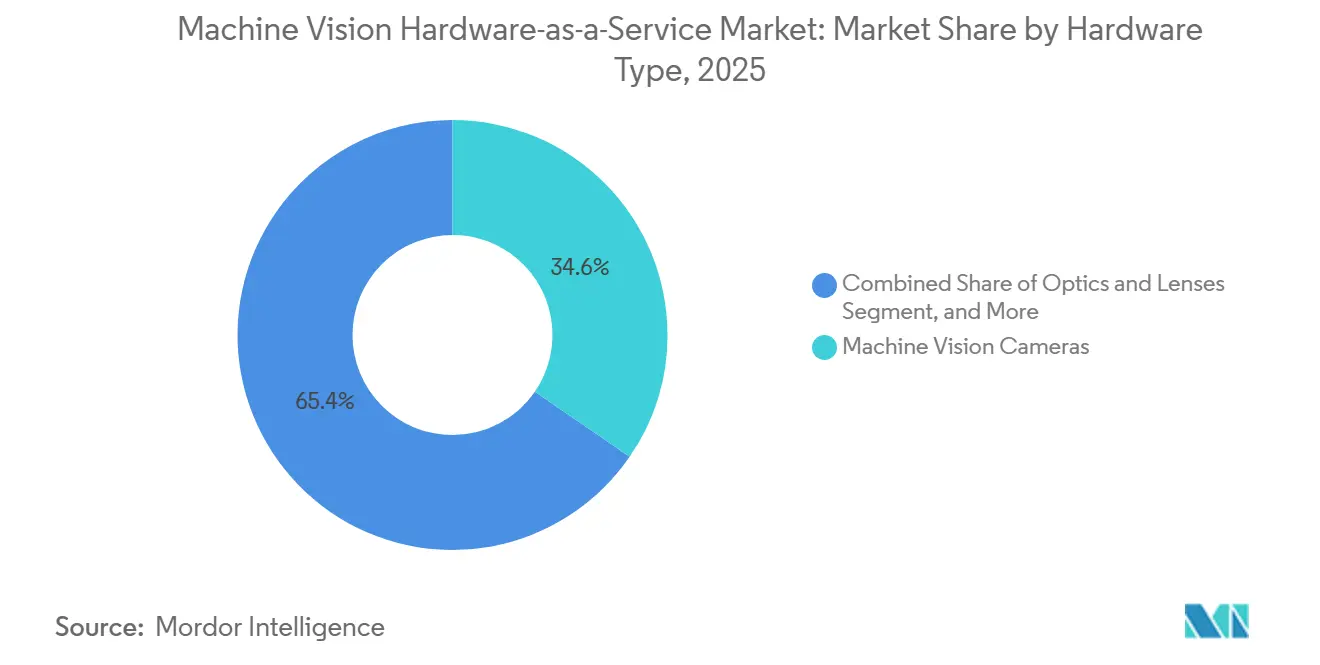
Machine vision cameras held 34.59% of the hardware-type segment in 2025. This position reflects their role as the primary sensing device in area-scan and line-scan inspection. Cameras are used across discrete and process manufacturing settings. The shift from 2D systems to 3D structured-light and time-of-flight systems is increasing the capability of camera deployments. It also supports higher value configurations for complex inspection tasks. The machine vision hardware-as-a-service market size for camera deployments benefits from the familiar role of cameras in plant inspection architectures. Customers can integrate camera services into existing lines without redesigning every workflow. This keeps cameras important in both replacement projects and new facilities.
Specialized imaging hardware is projected to expand at an 11.34% CAGR from 2026 to 2031. Hyperspectral sensors, TDI line-scan cameras, and neuromorphic vision chips address tasks beyond the capabilities of standard CMOS sensitivity. These tasks include semiconductor wafer handling, tablet coating inspection, and battery cell production. Teledyne DALSA launched the Linea HS2 8k in June 2026. The camera offered a maximum line rate of 1 MHz and 5 µm resolution. Its specifications serve high-speed inspection in low-light applications. Processing hardware is also changing as edge AI reduces reliance on external computers. Integrated vision systems combine cameras, illumination, processing, and software in a single serviceable unit. This can simplify replacement and maintenance for the service provider.[2]Teledyne Vision Solutions, “Teledyne Launches Linea HS2 8k Camera for Ultra-High-Speed Imaging in Low-Light Conditions,” Teledyne Vision Solutions, teledynevisionsolutions.com.



By Contract Model: Subscription Revenue Leads While Managed Services Shift Risk
Subscription-based HaaS accounted for 41.37% of the contract-model segment in 2025. It gives plant finance teams predictable billing and reduces exposure to hardware impairment. It also gives suppliers recurring revenue and operational telemetry from connected equipment. These data can identify support needs across devices and sites. Subscription contracts suit manufacturers that want to scale inspection after an initial installation. They can move from a single line to a wider fleet without matching capital purchases. This explains the leading share held by subscriptions in the machine vision hardware-as-a-service market. It also establishes the commercial base from which providers can offer more extensive services.
Outcome-based and managed HaaS is projected to expand at a 13.47% CAGR from 2026 to 2031. Under these arrangements, providers accept obligations for inspection accuracy and uptime. The buyer transfers more performance risk to the service partner. Suppliers, therefore, need reliable AI retraining, field support, and enough experience to support performance guarantees. Equipment leasing remains useful for firms that want an ownership option at the end of a term. Usage-based billing is relevant for contract manufacturers with fluctuating volumes. Manufacturers can begin with leasing, move to subscriptions, and later consider performance contracts. This progression can increase switching costs as the provider's model and service records become more embedded in operations.
By Application: Quality Inspection Leads While Robotic Vision Advances
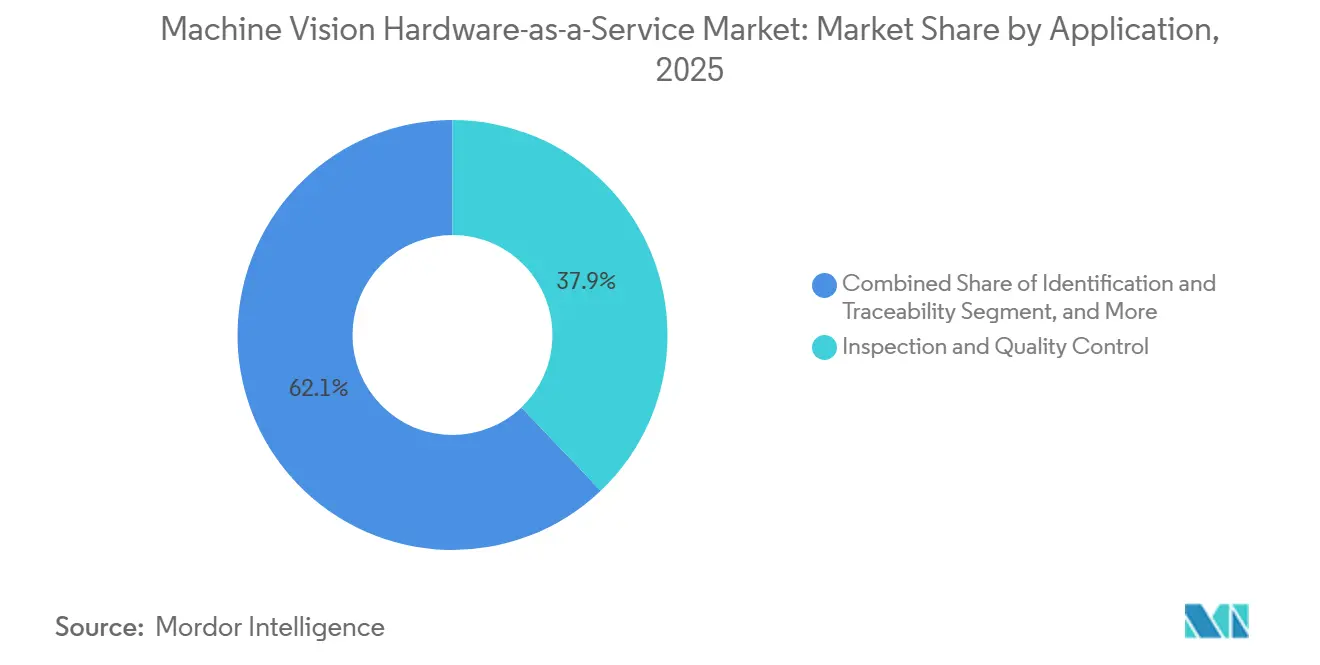
Inspection and quality control retained 37.89% of the application segment in 2025. Automated defect detection remains a direct route to improving yield and limiting quality escapes. Automotive, electronics, and food-processing lines have used vision inspection for many years. Further demand can come from greenfield sites and from converting manual tasks to AI-based systems. Identification and traceability applications serve documentation-intensive environments. Measurement and metrology support precision-dependent manufacturing. Guidance and positioning support reliable product movement and assembly. The 37.89% share shows why inspection remains central to the machine vision hardware-as-a-service market.
Robotic vision is projected to expand at an 11.13% CAGR from 2026 to 2031. Collaborative robots and autonomous mobile robots need reliable visual inputs for changing environments. This supports demand in logistics, electronics assembly, and flexible production cells. ABB Robotics made a strategic investment in Landing AI in September 2025. The companies integrated LandingLens into ABB's robotics software suite. They targeted up to 80% less time for robot vision AI training and deployment. This move places vision intelligence within an established robotics ecosystem. It can help integrators retrain models independently as operating conditions change. The machine vision hardware-as-a-service market can benefit as more robotic installations need managed vision capability.
By End-Use Industry: Electronics Leads Spending While Logistics and Warehousing Accelerates
Electronics and semiconductors held 24.19% of the end-use segment in 2025. Advanced chip packaging requires inspection of wire bonding, die attachment, and solder-joint geometry. Small tolerances make automated optical inspection an important production requirement. Specialized hardware supports tasks that standard cameras may not address. Automotive and EV production also needs inspection across battery, electronics, and assembly processes. Pharmaceutical and medical device producers need traceability features that support FDA 21 CFR Part 11 and ISO 13485 requirements. Food and beverage, packaging, and consumer goods remain separate demand pools. Electronics, therefore, accounted for the largest share of the machine vision hardware-as-a-service market among end-use industries.
Logistics and warehousing are projected to expand at a 12.65% CAGR from 2026 to 2031. Vision systems can automate receiving, bin picking, sorting, and inventory-related processes. E-commerce volumes and warehouse labor constraints support this demand. The driver differs from conventional manufacturing investment cycles. Kargo and Lineage reported in August 2026 that camera towers at Lineage's Decatur, Alabama, facility had recorded more than 64,000 automated receipts over a 6-month period. The example shows the use of vision systems in active cold-chain receiving operations. Providers can package these applications as managed services rather than capital projects. This supports wider use of the machine vision hardware-as-a-service market across distributed warehouse networks.
Geography Analysis
Asia-Pacific held 33.21% of the machine vision hardware-as-a-service market share in 2025. China, Japan, South Korea, Taiwan, and ASEAN concentrate most of the world's electronics manufacturing capacity. High production volumes make defect detection critical to wafer- and board-level yields. The region is moving from rule-based inspection to AI-enabled platforms on subscription terms. China's May 2026 industrial data guidance recommended standard interfaces and lightweight data-ownership attestation for vision equipment. That policy direction is influencing equipment specifications in Chinese factory networks. India and ASEAN are adding greenfield sites as supply chains diversify. These facilities can adopt cloud-native inspection architectures from the outset.
North America ranked second, supported by EV battery inspection, semiconductor fabrication, and defense-related manufacturing. CMMC 2.0 is changing vendor selection in US defense supply chains. Providers with air-gapped or on-premises options can better address those requirements. Europe benefits from Germany's Industrie 4.0 ecosystem and strict quality requirements in automotive and pharmaceutical production. South America remains a smaller contributor to the machine vision hardware-as-a-service market. Brazil supports regional demand by processing food and inspecting agricultural equipment. These markets offer adoption opportunities, but older plant systems can increase deployment effort.
The Middle East and Africa are projected to expand at a 10.51% CAGR from 2026 to 2031. Industrial diversification programs are directing investment toward AI-enabled manufacturing infrastructure. Saudi Arabia's Vision 2030 agenda and the UAE's Make it in the Emirates initiative support the expansion of new manufacturing capacity. Greenfield plants can include vision inspection from the start rather than through later retrofits. This reduces some of the integration barriers found in established industrial bases. The region's machine vision hardware-as-a-service market size can benefit from demand for locally governed data and inspection systems. Providers that combine edge deployment with regional service capability are positioned to address this demand.

Competitive Landscape
The machine vision hardware-as-a-service market is moderately fragmented. Global hardware suppliers offer broad product ranges, while AI-focused providers and regional integrators compete on deployment speed and total integration cost. Cognex's OneVision platform separates cloud model management from edge-based inspection execution. This structure is designed for latency-sensitive applications where production decisions cannot depend on remote processing. Cognex made the platform generally available in May 2026 after a beta involving more than 100 customers. It reported up to 50% lower inspection scaling costs. Schneider Electric reported a doubled yield and fewer false rejects following adoption.
SICK expanded its Nova platform with AI-powered 3D quality inspection in August 2026. The platform combines deep-learning algorithms with per-pixel height data. It supports on-device training and inference without additional compute hardware. This capability strengthens edge-based inspection for complex surfaces. Musashi AI also introduced the commercial configuration of its second-generation Cendiant system at Automate 2026. The company described a standardized automated optical inspection platform that can serve small precision components and vehicle-door assemblies. The product approach reduces deployment complexity and can lower system costs.[3]SICK AG, “Where Height Meets Intelligence: SICK Launches AI-Powered 3D Quality Inspection with Nova Machine Vision Platform,” SICK AG, sick.com.
Teledyne DALSA introduced the Linea HS2 8k camera in June 2026 for high-speed, low-light imaging. The product supports semiconductor wafer, high-density interconnect, battery cell, and genomics flow cell inspection. Cognex also launched the In-Sight 3900 in May 2026 with Qualcomm Dragonwing platforms for deterministic edge AI inference. These moves show that hardware suppliers are embedding AI capability closer to the production line. Providers that combine hardware, software, servicing, and secure deployment options can compete more effectively for long-term contracts. The presence of global suppliers, AI-focused firms, and regional integrators indicates a fragmented competitive structure.
Machine Vision Hardware-as-a-Service Industry Leaders
Cognex Corporation
KEYENCE CORPORATION
OMRON Corporation
Teledyne Technologies Incorporated
Siemens AG
- *Disclaimer: Major Players sorted in no particular order

Recent Industry Developments
- September 2026: Basler announced its portfolio at VISION 2026 in Stuttgart for October 6-8, repositioning as a full-line vision solutions provider with integrated cameras, lens and lighting control, vision simulation software, and a managed services layer, a strategic shift signaling the commoditization of standalone vision hardware and the transition toward integrated service contracts.
- August 2026: SICK launched AI-powered 3D quality inspection on its Nova machine vision platform, combining deep-learning algorithms with per-pixel height data for on-device training and inference without additional compute hardware. SICK reported EUR 1.8 billion (USD 1.94 billion) in group revenue for fiscal 2025.
- June 2026: Musashi AI unveiled the commercial configuration of its second-generation Cendiant inspection system at Automate 2026 in Chicago, featuring generalized deep learning models and a standardized automated optical inspection platform scalable from small precision components to vehicle-door assemblies, substantially reducing deployment complexity and total system cost.
- June 2026: Teledyne DALSA launched the Linea HS2 8k backside-illuminated TDI camera with a 1 MHz maximum line rate and 5 µm resolution, advancing ultra-high-speed imaging capability for semiconductor wafer, high-density interconnect, battery-cell, and genomics flow-cell inspection applications.


Global Machine Vision Hardware-as-a-Service Market Report Scope
The machine vision hardware-as-a-service (HaaS) market involves providing machine vision hardware to end users through contractual or recurring commercial models that allow customers to access, use, or operate the equipment without purchasing it outright. The market includes hardware supplied through leasing, subscription, usage-based, and outcome-based or managed service arrangements, with the provider retaining ownership of the equipment or assuming responsibility for its lifecycle, depending on the contract structure.
The Machine Vision Hardware-as-a-Service Market Report is Segmented by Hardware Type (Machine Vision Cameras, Optics and Lenses, Illumination Systems, Vision Processing Hardware, Integrated Vision Systems, and Specialized Imaging Hardware), Contract Model (Equipment Leasing, Subscription-Based HaaS, Usage-Based HaaS, and Outcome-Based/Managed HaaS), Application (Inspection and Quality Control, Identification and Traceability, Measurement and Metrology, Guidance and Positioning, Robotic Vision, and Other Applications), End-User Industry (Automotive and EV, Electronics and Semiconductor, Food and Beverage, Pharmaceutical and Medical Devices, Packaging, Consumer Goods, Logistics and Warehousing, and Other End-User Industries), and Geography (North America, South America, Europe, Asia-Pacific, Middle East and Africa). The Market Forecasts are Provided in Terms of Value (USD).
| Machine Vision Cameras |
| Optics and Lenses |
| Illumination Systems |
| Vision Processing Hardware |
| Integrated Vision Systems |
| Specialized Imaging Hardware |
| Equipment Leasing |
| Subscription-Based HaaS |
| Usage-Based HaaS |
| Outcome-Based / Managed HaaS |
| Inspection and Quality Control |
| Identification and Traceability |
| Measurement and Metrology |
| Guidance and Positioning |
| Robotic Vision |
| Other Applications |
| Automotive and EV |
| Electronics and Semiconductor |
| Food and Beverage |
| Pharmaceutical and Medical Devices |
| Packaging |
| Consumer Goods |
| Logistics and Warehousing |
| Other End-User Industries |
| North America | United States | |
| Canada | ||
| Mexico | ||
| South America | Brazil | |
| Argentina | ||
| Rest of South America | ||
| Europe | Germany | |
| United Kingdom | ||
| France | ||
| Italy | ||
| Spain | ||
| Rest of Europe | ||
| Asia-Pacific | China | |
| Japan | ||
| India | ||
| South Korea | ||
| ASEAN | ||
| Rest of Asia-Pacific | ||
| Middle East and Africa | Middle East | Saudi Arabia |
| United Arab Emirates | ||
| Rest of the Middle East | ||
| Africa | South Africa | |
| Rest of Africa | ||
| By Hardware Type | Machine Vision Cameras | ||
| Optics and Lenses | |||
| Illumination Systems | |||
| Vision Processing Hardware | |||
| Integrated Vision Systems | |||
| Specialized Imaging Hardware | |||
| By Contract Model | Equipment Leasing | ||
| Subscription-Based HaaS | |||
| Usage-Based HaaS | |||
| Outcome-Based / Managed HaaS | |||
| By Application | Inspection and Quality Control | ||
| Identification and Traceability | |||
| Measurement and Metrology | |||
| Guidance and Positioning | |||
| Robotic Vision | |||
| Other Applications | |||
| By End-User Industry | Automotive and EV | ||
| Electronics and Semiconductor | |||
| Food and Beverage | |||
| Pharmaceutical and Medical Devices | |||
| Packaging | |||
| Consumer Goods | |||
| Logistics and Warehousing | |||
| Other End-User Industries | |||
| By Geography | North America | United States | |
| Canada | |||
| Mexico | |||
| South America | Brazil | ||
| Argentina | |||
| Rest of South America | |||
| Europe | Germany | ||
| United Kingdom | |||
| France | |||
| Italy | |||
| Spain | |||
| Rest of Europe | |||
| Asia-Pacific | China | ||
| Japan | |||
| India | |||
| South Korea | |||
| ASEAN | |||
| Rest of Asia-Pacific | |||
| Middle East and Africa | Middle East | Saudi Arabia | |
| United Arab Emirates | |||
| Rest of the Middle East | |||
| Africa | South Africa | ||
| Rest of Africa | |||


Key Questions Answered in the Report
What is the machine vision hardware-as-a-service market size?
The machine vision hardware-as-a-service market was estimated at USD 0.79 billion in 2025 and is expected to reach USD 1.34 billion by 2031 at a 9.28% CAGR.
Which hardware category leads machine vision HaaS deployments?
Machine vision cameras led the hardware-type segment with a 34.59% share in 2025, reflecting their central role in inspection systems.
Which contract model is expanding fastest?
Outcome-based and managed HaaS is projected to expand at a 13.47% CAGR from 2026 to 2031 as buyers transfer more performance responsibility to providers.
Why are manufacturers choosing machine vision HaaS?
Subscription models reduce upfront equipment commitments and can combine hardware, model management, support, and fleet oversight in one service arrangement.
Which end-use area is projected to expand fastest?
Logistics and warehousing is projected to expand at a 12.65% CAGR through 2031, supported by receiving, bin-picking, and warehouse automation needs.
Which region leads current demand?
Asia-Pacific led with a 33.21% share in 2025 because of its strong electronics manufacturing base and growing adoption of AI-enabled inspection.
Page last updated on:





