
Machine Vision-as-a-Service Market Size and Share
Market Overview
| Study Period | 2020 - 2031 |
|---|---|
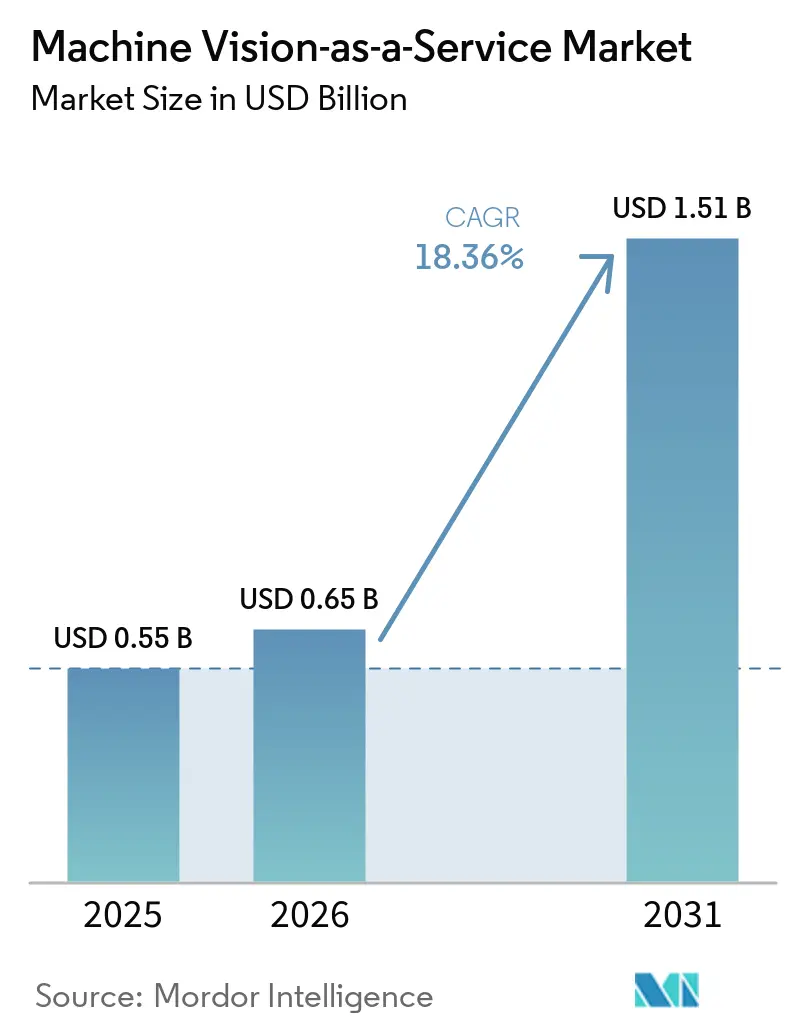
| Market Size (2026) | USD 0.65 Billion |
| Market Size (2031) | USD 1.51 Billion |
| Growth Rate (2026 - 2031) | 18.36 % |
| Fastest Growing Market | Asia-Pacific |
| Largest Market | North America |
| Market Concentration | Medium |
Major Players *Disclaimer: Major Players sorted in no particular order Image © Mordor Intelligence. Reuse requires attribution under CC BY 4.0. | |
Machine Vision-as-a-Service Market Analysis by Mordor Intelligence
The Machine Vision-as-a-Service Market size was valued at USD 0.55 billion in 2025 and is estimated to grow from USD 0.65 billion in 2026 to reach USD 1.51 billion by 2031, at a CAGR of 18.36% during the forecast period (2026-2031).
Industrial automation is increasing demand for inspection systems that can identify defects during production. Subscription and outcome-based services shift quality spending from large hardware purchases toward recurring operating costs. This structure makes the Machine Vision-as-a-Service market more accessible to mid-sized manufacturers that lack capital or specialized integration teams. Edge AI allows factories to keep time-sensitive decisions close to the production line while cloud platforms manage models across sites. Providers are responding by combining software, hardware, integration, and performance commitments within broader service offerings.
Key Report Takeaways
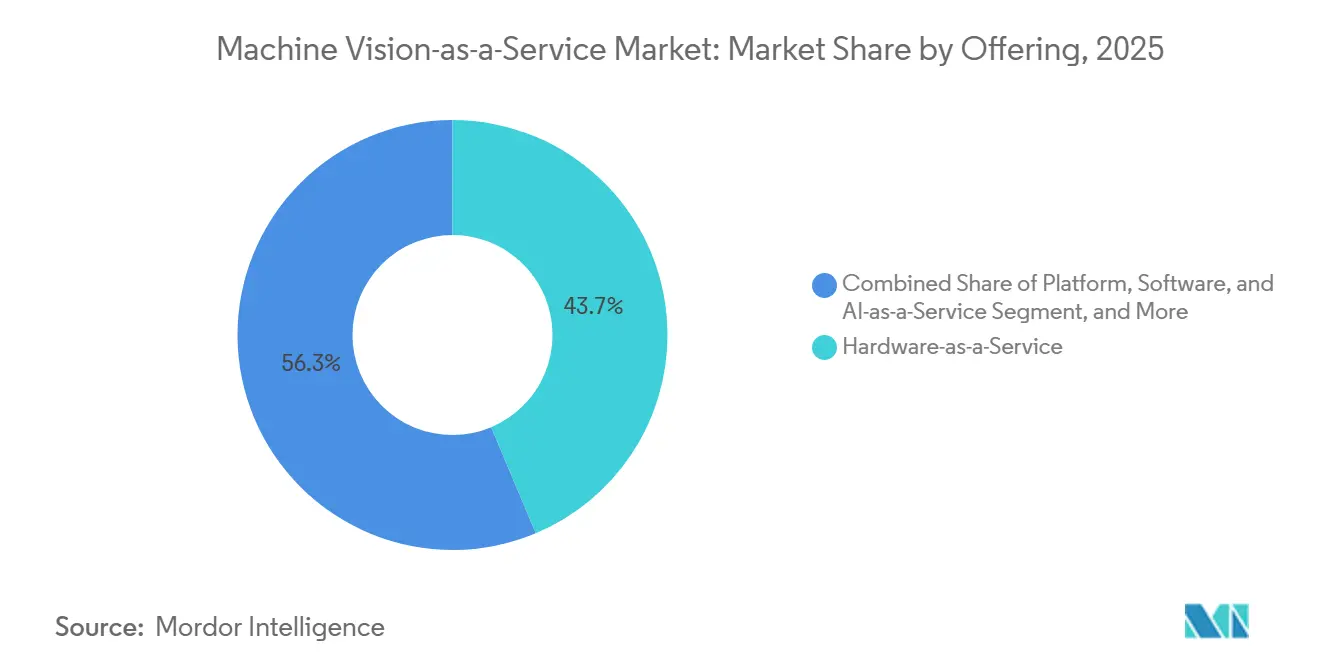
- By offering, Hardware-as-a-Service held 43.67% share of the Machine Vision-as-a-Service market in 2025, while Platform, Software, and AI-as-a-Service is projected to expand at a 21.89% CAGR through 2031.
- By deployment model, On-Premises and Edge held 52.66% of revenue in 2025, while Cloud-Based deployment is projected to expand at a 22.31% CAGR through 2031.
- By service model, Subscription-Based pricing held 63.45% of revenue in 2025, while Outcome-Based Contracts are projected to expand at a 22.11% CAGR through 2031.
- By product architecture, PC-Based Systems held 48.21% of revenue in 2025, while Edge and Embedded Systems are projected to expand at a 21.56% CAGR through 2031.
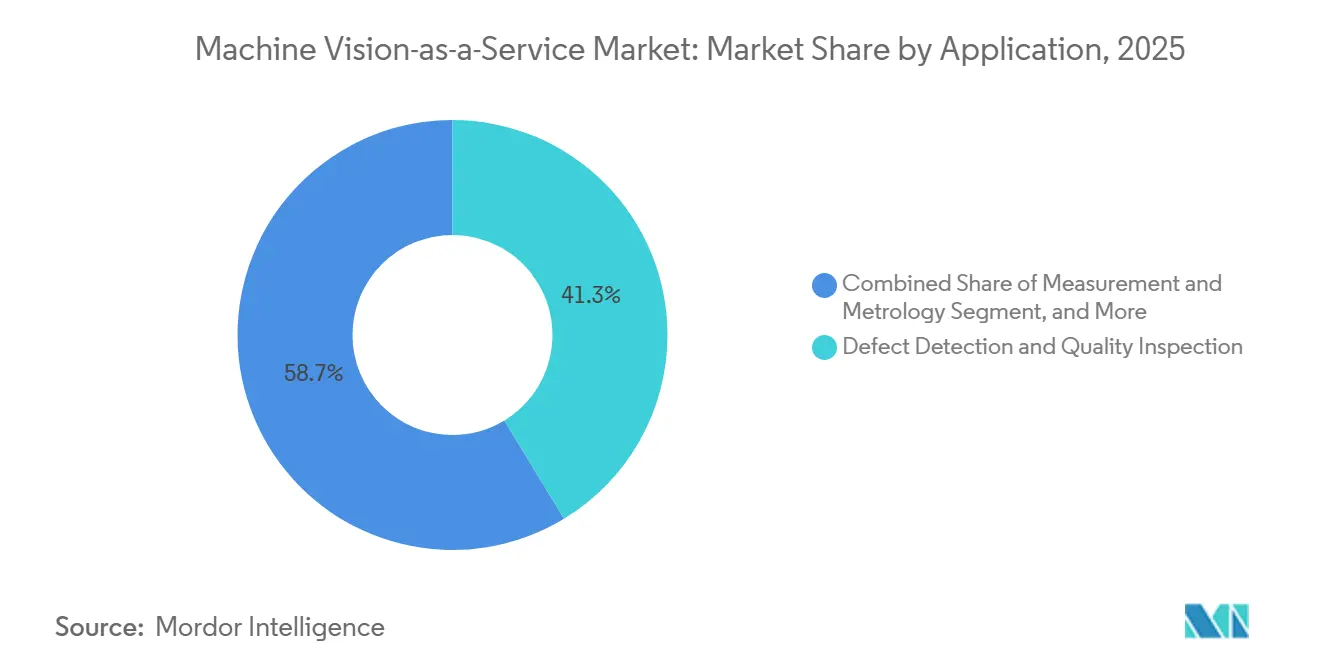
- By application, Defect Detection and Quality Inspection held 41.32% of the Machine Vision-as-a-Service market share in 2025, while Process Monitoring and Control is projected to expand at a 21.13% CAGR through 2031.
- By end-user industry, Automotive held 25.32% of revenue in 2025, while Logistics and Warehousing is projected to expand at a 20.44% CAGR through 2031.
- By geography, North America held 32.23% of revenue in 2025, while Asia-Pacific is projected to expand at a 21.33% CAGR through 2031.
Note: Market size and forecast figures in this report are generated using Mordor Intelligence’s proprietary estimation framework, updated with the latest available data and insights as of January 2026.
Global Machine Vision-as-a-Service Market Trends and Insights
Drivers Impact Analysis*
| Driver | (~) % Impact on CAGR Forecast | Geographic Relevance | Impact Timeline |
|---|---|---|---|
| AI-Enabled Inspection of Complex and Variable Defects | +4.2% | Global, concentrated in North America and Asia-Pacific | Short term (≤ 2 years) |
| Subscription Conversion of Capital Expenditure to Operating Expenditure | +3.6% | Global, strongest in North America and Europe | Short term (≤ 2 years) |
| Zero-Defect Manufacturing and Recall Avoidance | +2.8% | Global, led by automotive in North America, Europe, and Asia-Pacific | Medium term (2-4 years) |
| Vision-Guided Robotics and Flexible Automation | +2.2% | Global, Asia-Pacific core, with spillover to North America | Medium term (2-4 years) |
| Embedded Edge Inference for Low-Latency Quality Decisions | +1.8% | Global, strongest in electronics and semiconductor hubs | Short term (≤ 2 years) |
| Federated Defect Libraries and Outcome-Based Quality Contracts | +1.1% | North America and Europe, with early gains in automotive and pharmaceuticals | Long term (≥ 4 years) |
| Source: Mordor Intelligence | |||
AI-Enabled Inspection of Complex and Variable Defects
Deep learning has changed industrial inspection by reducing dependence on rule-based recipes. Rule-based systems can require weeks of engineering for one defect type. Transformer-based models can train on 10-20 reference images and recognize unfamiliar surface conditions. Cognex launched the In-Sight 6900 Vision Controller in April 2026 with NVIDIA Jetson processing and 157 TOPS of AI performance.[1]Cognex Corporation, “Cognex Launches In-Sight Vision Controller Powered by NVIDIA,” Cognex Corporation, investor.cognex.com A January 2026 survey of industrial studies reported defect-detection accuracy above 95% in live production settings, with some configurations reaching 98-100%. Central model governance and edge inference, therefore, give providers a way to improve models without disrupting line-level decisions.
Subscription Conversion of Capital Expenditure to Operating Expenditure
Subscription pricing changes how manufacturers evaluate machine vision deployments. Recurring service fees can replace large initial purchases of hardware and integration services. This model can lower the entry barrier for firms that previously could not justify a traditional machine vision installation. It also lets customers start with a production line and add systems as performance needs become clearer. The Machine Vision-as-a-Service market benefits when service providers can package cameras, software, maintenance, and support within predictable contracts. Providers can then build renewal relationships rather than relying only on periodic equipment replacements.
Zero-Defect Manufacturing and Recall Avoidance
Manufacturers are placing greater value on inspection systems that work in-line across all units. Defects identified during production cost less than issues found at final assembly or after shipment. A 2025 academic analysis found that AI-enabled edge-cloud inspection reduced data latency by 40% and produced a 22% return on investment over 5 years in high-volume settings. The same work found that federated learning between plants reduced inter-site data transfer by 60% without reducing model accuracy. Automotive supplier agreements increasingly require documented and time-stamped inspection evidence. Service providers can use this need to offer multi-year contracts tied to inspection performance.
Vision-Guided Robotics and Flexible Automation
Vision-guided robots support tasks that fixed automation cannot easily manage. Edge-based perception helps robots respond to occlusion, lighting variation, and changing part positions. A 2026 study found that lightweight CNN perception in a closed-loop architecture improved task success and reduced latency under those operating conditions. KUKA described Automation 2.0 in March 2026 as an approach that adds intent-based AI above rule-based automation. This framing supports gradual adoption because manufacturers can extend existing automation instead of replacing it. The Machine Vision-as-a-Service market can gain when customers apply one platform to inspection, pick-and-place, and assembly verification.
Restraints Impact Analysis*
| Restraint | (~) % Impact on CAGR Forecast | Geographic Relevance | Impact Timeline |
|---|---|---|---|
| Integration Friction with Legacy PLC and MES Environments | -2.1% | Global, most acute in Europe and legacy industrial corridors of North America | Medium term (2-4 years) |
| Data Sovereignty and Cybersecurity Exposure in Connected Vision | -1.6% | Europe and Asia-Pacific, where data-localization rules apply | Medium term (2-4 years) |
| Shortage of Machine-Vision Deployment and Validation Talent | -1.2% | Global, most critical in the European Union and Southeast Asia | Long term (≥ 4 years) |
| Uncertain Payback for Low-Volume and High-Mix Production | -0.8% | Global, concentrated in contract manufacturing and small and medium-sized enterprise clusters | Medium term (2-4 years) |
| Source: Mordor Intelligence | |||
Integration Friction with Legacy PLC and MES Environments
The central deployment challenge is often the connection between AI inspection output and existing PLC and MES systems. Older PLCs may rely on Profibus, Profinet, or Modbus TCP rather than native OPC-UA support. Each connection can require middleware and continuing engineering support when connected systems change. A 2026 study identified the lack of standardized protocols for AI-to-legacy-hardware interaction as a major reason that 77% of machine vision AI pilots remained in pilot stages. Providers can address this issue through pre-certified OPC-UA connectors and standardized templates for leading MES platforms. Long-term support for older protocols can also increase renewal rates and customer switching costs.
Data Sovereignty and Cybersecurity Exposure in Connected Vision
Cloud-connected vision systems can create concerns over the handling of production imagery and process data. These concerns are stronger in regulated manufacturing settings and cross-border supply chains. Germany implemented its national NIS2 requirements in December 2025, increasing cybersecurity risk-management obligations for covered organizations. The European Union Cyber Resilience Act also raises security expectations for connected AI-enabled devices. Federated learning can reduce exposure by retaining raw images on site and sharing limited model updates between plants. A 2024 academic study documented this approach for data-driven manufacturing networks that need to protect digital sovereignty. This need supports demand for air-gapped systems, edge-native inference, and sovereign deployment options.
*Our forecasts treat driver/restraint impacts as directional, not additive. The impact forecasts reflect baseline growth, mix effects, and variable interactions.
Segment Analysis
By Offering: Cloud-Native AI Accelerates the Platform Layer
Hardware-as-a-Service held 43.67% of the 2025 offering revenue within the Machine Vision-as-a-Service market. Manufacturers still need cameras, lighting, compute, and integration for turnkey inspection stations. The HaaS model bundles these requirements into a predictable monthly fee. This practical need has kept hardware services ahead of other offerings in the current installed base. The hardware layer also gives suppliers a path to standardize maintenance and support. It remains important for customers who cannot build their own inspection stations.
Platform, Software, and AI-as-a-Service are projected to expand at a 21.89% CAGR through 2031. Manufacturers are shifting model training, version control, and multi-site governance toward centrally managed cloud environments. Cognex made OneVision generally available in May 2026 to train and govern models centrally before local deployment to edge systems. Managed Vision Inspection Services remain the smallest offering tier, but they carry higher contract values because providers assume responsibility for uptime, model accuracy, and compliance records. Multi-offering suppliers can move customers from equipment access toward software and performance services over time.



By Deployment Model: Edge Holds the Latency-Critical Layer While Cloud Governs Intelligence
On-Premises and Edge deployments held 52.66% of revenue in 2025. Production lines moving 300 units per minute can allow fewer than 200 milliseconds for inference and reject action. Network round-trip time can consume that window. Local processing, therefore, remains necessary for consistent pass-fail decisions. On-site architecture also limits the transfer of sensitive production images. These factors keep the Machine Vision-as-a-Service market share of edge deployments ahead of cloud-only systems.
Cloud-Based deployment is projected to expand at a 22.31% CAGR through 2031. It supports training, governance, analytics, and model distribution across factories. Cognex stated that its OneVision platform manages model lifecycles centrally while In-Sight systems perform inference locally. Hybrid deployments combine these functions by keeping inference at the edge and moving training and statistical analysis to the cloud. This approach can let factories share defect patterns without sending raw images across borders. Standardized hybrid templates can reduce implementation risk for multi-plant operators.
By Service Model: Subscriptions Define the Floor, Outcomes Drive the Ceiling
Subscription-Based pricing held 63.45% of service-model revenue in 2025. It has become the usual starting point for customers evaluating line-level AI vision. Predictable recurring charges reduce the organizational risk of an initial deployment. They also allow manufacturers to add capacity as inspection needs change. Pay-per-Use has gained relevance in high-mix and variable-volume operations. Logistics sorting centers and food-packaging lines illustrate settings where fluctuating throughput can suit this model.
Outcome-Based Contracts are projected to expand at a 22.11% CAGR through 2031. These contracts align provider compensation with quality key performance indicators instead of camera counts. A 2025 review of industrial cases identified 20 criteria for designing outcome-based contracts. It found that lifecycle profit and risk management were most sensitive to ownership responsibilities and payment-model design.[2]Journal of Business Models, “Designing Outcome-Based Contracts for Machine Manufacturers: A Taxonomy of Decision Criteria,” Journal of Business Models, doi.org Providers need longer defect-data histories to price these commitments with confidence. Early contracts can develop into multi-year agreements that cover several production lines.
By Product Architecture: PC-Based Systems Anchor Enterprise Workloads, Embedded AI Surges
PC-Based Systems held 48.21% of the 2025 product architecture revenue. Semiconductor fabrication, precision automotive components, and 3D reconstruction can require substantial computing capacity. Enterprise users also value the flexibility to retrain models and redeploy them without changing the full station. These needs continue to support PC-based systems in complex inspection workloads. The architecture is particularly relevant where multiple defect categories must be assessed at once. It remains the established option for applications that need high-resolution metrology.
Edge and Embedded Systems are projected to expand at a 21.56% CAGR through 2031. AI-focused system-on-chip products are bringing stronger inference performance into controller-sized formats. Smaller training data requirements can also lower the effort needed for embedded inspection. Renesas completed its acquisition of Irida Labs in May 2026 to integrate lightweight Vision AI software into its processing portfolio.[3]Renesas Electronics Corporation, “Renesas Completes Acquisition of Irida Labs to Expand Vision AI Software Capabilities,” Renesas Electronics Corporation, renesas.com Smart camera systems sit between these architectures by combining fixed imaging with onboard inference. Local processing can leave cloud services to manage training and governance rather than real-time inference.
By Application: Defect Detection Commands Share, Process Intelligence Scales Fastest
Defect Detection and Quality Inspection held 41.32% of the 2025 application revenue. The application leads because it provides a direct link between finding defects early and avoiding downstream losses. Manufacturers are moving from sample checks toward 100% inline coverage. This change increases inspection data and makes model retraining a continuous requirement. Assembly verification, identification, traceability, and metrology also support broader factory digitalization. OMRON released its VHV5-SRV Barcode Verification System in June 2026 for production-speed, standards-compliant barcode verification.
Process Monitoring and Control is projected to expand at a 21.13% CAGR through 2031. These systems observe production conditions such as thermal plumes, weld-pool geometry, coating uniformity, and solder deposition. They can send corrections to PLCs in near real time. A 2026 IEEE paper reported 97.1% mean average precision across 8 welding-defect categories from more than 90,000 images at 20 stations. The Machine Vision-as-a-Service market size for this application is supported when providers can attach additional sensor inputs to the same service platform. This model can increase the value of an installed system without requiring a separate procurement process.
By End-User Industry: Automotive Anchors Volume, Logistics Accelerates Demand
Automotive held 25.32% of the 2025 end-user revenue. OEM supplier scorecards require rigorous inline quality inspection across Tier-1 supply chains. Electric vehicle battery production adds further inspection needs for capacity, resistance, surface defects, electrode alignment, and separator films. These conditions require AI models that can recognize a wider range of defects than conventional body-panel inspection. Electronics and Semiconductor, Food and Beverage, and Pharmaceuticals and Medical Devices provide a stable demand base. Serialization and traceability need support for inspection investment in those sectors.
Logistics and warehousing is projected to expand at a 20.44% CAGR through 2031. Bin picking and autonomous mobile robots are increasing the need for adaptable visual perception. Warehouses also need systems that can work across changing product flows and handling requirements. Standardized services can reduce the need for specialized in-house deployment teams. Consumer Goods uses label inspection and assembly verification to support product consistency. Aerospace, defense, and solar manufacturing are adopting AI vision at a measured pace. Drone-enabled inspection can serve assets where fixed-camera systems are not cost-effective.
Geography Analysis
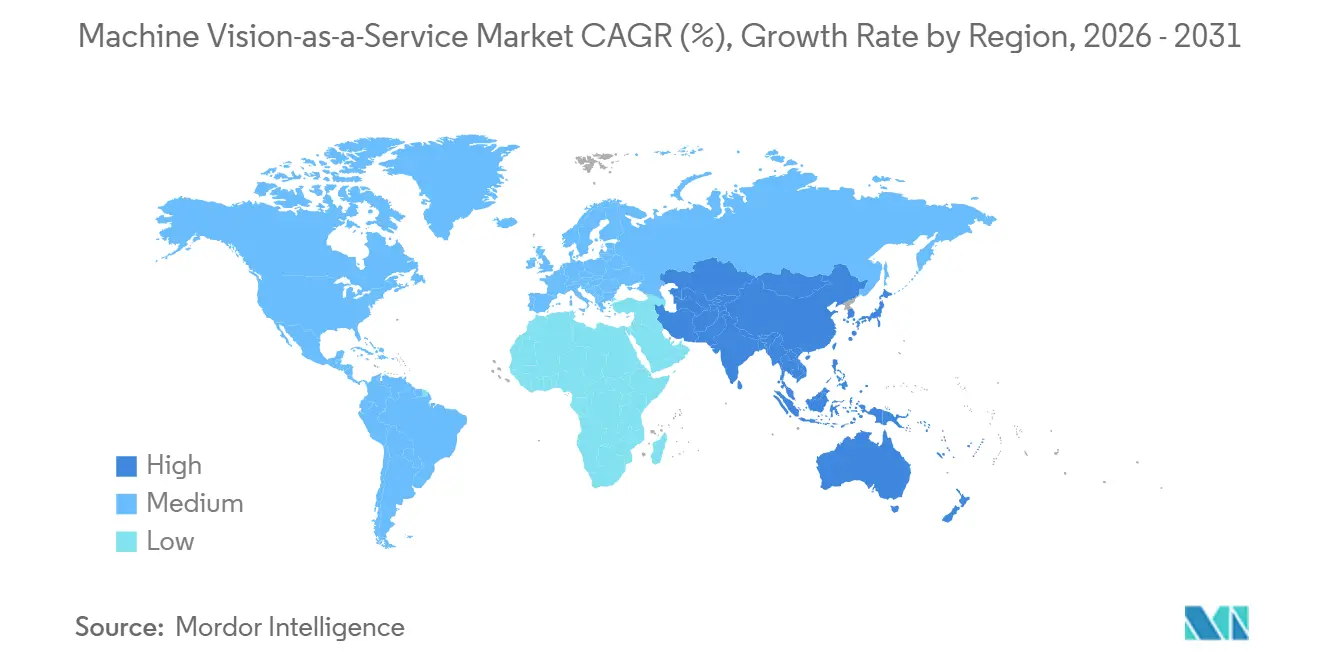
North America held 32.23% of 2025 revenue, giving it the largest regional position. The region has a dense base of machine vision integrators and established automotive demand in the Midwest. Semiconductor investments in Texas and Arizona also require demanding metrology workloads. The CHIPS and Science Act has supported domestic wafer-fabrication investment. The United States has become an early setting for outcome-based inspection contracts in medical device and aerospace supply chains. Canada’s food manufacturing and Quebec pharmaceutical clusters provide additional opportunities.
Asia-Pacific is projected to expand at a 21.33% CAGR through 2031. China, South Korea, and Japan provide demand for electronics, display panels, and semiconductor inspection. South Korea and Japan require vision systems that can work at sub-micron tolerances for advanced wafers. India and Southeast Asia are gaining relevance as global OEMs diversify electronics sourcing. Vietnam’s Logistics Services Development Strategy for 2025-2035 identifies digital transformation and vision automation as priorities. These manufacturing additions increase the regional opportunity for subscription and edge-based systems.
Europe combines deep industrial automation experience with stricter data-governance requirements. Basler reported EUR 152.4 million (USD 169.2 million) in first-half 2026 revenue, a 36% increase from the prior year.[4]Basler AG, “Basler AG Financial Results for the First 6 Months of 2026,” EQS News, eqs-news.com Germany’s NIS2 implementation and the Cyber Resilience Act are directing customers toward secure on-premises and air-gapped deployments. South America, the Middle East, and Africa remain earlier-stage areas. Saudi Arabia and the United Arab Emirates are creating greenfield opportunities through industrialization and smart-manufacturing programs.

Competitive Landscape
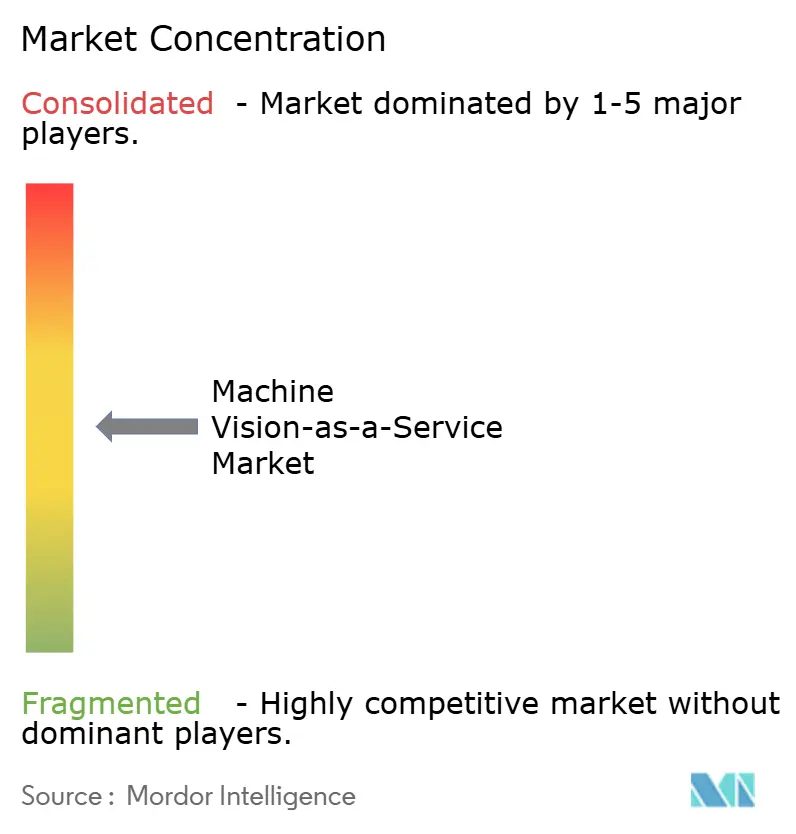
The Machine Vision-as-a-Service market is moderately fragmented in platform and intelligence services but fragmented across hardware and integration. Cognex, KEYENCE, OMRON, Basler, and SICK form the established supplier tier. Their hardware installed bases give them a channel for subscription and managed-service conversion. Their strategies increasingly combine software with existing imaging and automation products. Cognex’s OneVision platform represents this approach by linking cloud-based model development with edge deployment.
Outcome-based contracts remain an open area, particularly for multi-plant customers. Providers that can commit to inspection results may gain higher-value and longer-term relationships. Teledyne Technologies and STEMMER IMAGING operate as integration and distribution channels for smaller system builders. Cognex reduced scaling costs by up to 50% for OneVision users moving from single-line pilots to multi-site deployments. Mitsubishi Electric and Sony Semiconductor Solutions agreed in July 2026 to form Advanced Vision Solutions, combining image sensors, edge AI, factory automation, and digital-platform capabilities. The agreement shows how system suppliers are combining hardware and software capabilities.
Semiconductor suppliers and robotics OEMs are also becoming more relevant competitors. Renesas acquired Irida Labs to bring embedded Vision AI software into its product portfolio. Camtek agreed to acquire Visual Layer in April 2026 to strengthen visual AI in semiconductor inspection and metrology. Hikrobot and OPT Machine Vision Tech compete on price-performance in Asia-Pacific and are expanding their AI offerings. Federated learning could become a durable advantage for suppliers with broad and diverse defect libraries. Larger data sets can help those providers train models that work across more production settings.
Machine Vision-as-a-Service Industry Leaders
Cognex Corporation
KEYENCE CORPORATION
OMRON Corporation
Basler AG
Allied Vision Technologies GmbH
- *Disclaimer: Major Players sorted in no particular order

Recent Industry Developments
- July 2026: Mitsubishi Electric Corporation and Sony Semiconductor Solutions Corporation agreed to establish Advanced Vision Solutions Co., Ltd., a joint venture, Mitsubishi Electric 60% and Sony 40%, scheduled to begin operations in October 2026. The venture will develop AI-powered vision sensors integrating Sony’s image-sensor and edge-AI technologies with Mitsubishi Electric’s factory automation control systems and Serendie digital platform, targeting labor-saving and autonomous manufacturing operations.
- June 2026: OMRON Automation released the VHV5-SRV Barcode Verification System, an inline solution verifying barcode quality at up to 1,200 parts per minute during production, replacing end-of-run sampling with calibrated real-time ISO/IEC 15416- and GS1-compliant verification for automotive, pharmaceutical, and food traceability applications.
- May 2026: Cognex announced the general availability of OneVision, its collaborative AI vision development environment, with more than 100 customers worldwide having progressed from single-line applications to multi-site rollouts since the June 2025 beta launch, reducing scaling costs by up to 50%.
- May 2026: Renesas Electronics completed the acquisition of Irida Labs, a Greece-based developer of embedded software for AI-powered visual perception systems, planning to integrate Irida Labs’ lightweight Vision AI software into its Renesas 365 cloud development platform for end-to-end Vision AI and deep-learning development.


Global Machine Vision-as-a-Service Market Report Scope
The Machine Vision-as-a-Service (MVaaS) is a cloud-ready, subscription-based enterprise model that delivers advanced automated inspection, image recognition, and data analysis capabilities without requiring upfront capital expenditure in dedicated infrastructure.
The Machine Vision-As-A-Service Market Report is Segmented by Offering (Hardware-as-a-Service, Platform, Software, and AI-as-a-Service, and Managed Vision Inspection Services), Deployment Model (Cloud-Based, On-Premises / Edge, and Hybrid), Service Model (Subscription-Based, Pay-per-Use, and Outcome-Based Contracts), Product Architecture (PC-Based Systems, Smart Camera-Based Systems, and Edge and Embedded Systems), Application (Defect Detection and Quality Inspection, Measurement and Metrology, Identification and Traceability, Assembly Verification, Process Monitoring and Control, and Other Applications), End-User Industry (Automotive, Electronics and Semiconductor, Food and Beverage, Pharmaceuticals and Medical Devices, Consumer Goods, Logistics and Warehousing, and Other End-User Industries), and Geography (North America, Europe, Asia-Pacific, Middle East, and Africa). The Market Forecasts are Provided in Terms of Value (USD).
| Hardware-as-a-Service |
| Platform, Software, and AI-as-a-Service |
| Managed Vision Inspection Services |
| Cloud-Based |
| On-Premises / Edge |
| Hybrid |
| Subscription-Based |
| Pay-per-Use |
| Outcome-Based Contracts |
| PC-Based Systems |
| Smart Camera-Based Systems |
| Edge and Embedded Systems |
| Defect Detection and Quality Inspection |
| Measurement and Metrology |
| Identification and Traceability |
| Assembly Verification |
| Process Monitoring and Control |
| Other Applications |
| Automotive |
| Electronics and Semiconductor |
| Food and Beverage |
| Pharmaceuticals and Medical Devices |
| Consumer Goods |
| Logistics and Warehousing |
| Other End-User Industries |
| North America | United States |
| Canada | |
| Mexico | |
| South America | Brazil |
| Argentina | |
| Rest of South America | |
| Europe | Germany |
| United Kingdom | |
| France | |
| Italy | |
| Spain | |
| Rest of Europe | |
| Asia-Pacific | China |
| Japan | |
| India | |
| South Korea | |
| ASEAN | |
| Rest of Asia-Pacific | |
| Middle East | Saudi Arabia |
| United Arab Emirates | |
| Rest of the Middle East | |
| Africa | South Africa |
| Rest of Africa |
| By Offering | Hardware-as-a-Service | |
| Platform, Software, and AI-as-a-Service | ||
| Managed Vision Inspection Services | ||
| By Deployment Model | Cloud-Based | |
| On-Premises / Edge | ||
| Hybrid | ||
| By Service Model | Subscription-Based | |
| Pay-per-Use | ||
| Outcome-Based Contracts | ||
| By Product Architecture | PC-Based Systems | |
| Smart Camera-Based Systems | ||
| Edge and Embedded Systems | ||
| By Application | Defect Detection and Quality Inspection | |
| Measurement and Metrology | ||
| Identification and Traceability | ||
| Assembly Verification | ||
| Process Monitoring and Control | ||
| Other Applications | ||
| By End-User Industry | Automotive | |
| Electronics and Semiconductor | ||
| Food and Beverage | ||
| Pharmaceuticals and Medical Devices | ||
| Consumer Goods | ||
| Logistics and Warehousing | ||
| Other End-User Industries | ||
| By Geography | North America | United States |
| Canada | ||
| Mexico | ||
| South America | Brazil | |
| Argentina | ||
| Rest of South America | ||
| Europe | Germany | |
| United Kingdom | ||
| France | ||
| Italy | ||
| Spain | ||
| Rest of Europe | ||
| Asia-Pacific | China | |
| Japan | ||
| India | ||
| South Korea | ||
| ASEAN | ||
| Rest of Asia-Pacific | ||
| Middle East | Saudi Arabia | |
| United Arab Emirates | ||
| Rest of the Middle East | ||
| Africa | South Africa | |
| Rest of Africa | ||


Key Questions Answered in the Report
What is the Machine Vision-as-a-Service market size?
The Machine Vision-as-a-Service market size is projected to be USD 0.65 billion in 2026 and USD 1.51 billion by 2031, at an 18.36% CAGR.
What is driving adoption of machine vision services?
Demand is supported by AI-enabled inspection, subscription pricing, zero-defect requirements, and vision-guided automation.
Which deployment model leads machine vision services?
On-Premises and Edge deployments held 52.66% of revenue in 2025 because factories need low-latency local inference.
Which application has the largest role in machine vision services?
Defect Detection and Quality Inspection held 41.32% of 2025 application revenue, supported by the shift toward 100% inline inspection.
Which end-user sector is expanding fastest for machine vision services?
Logistics and Warehousing is projected to expand at a 20.44% CAGR through 2031 as bin picking and mobile robotics adoption increase.
How are suppliers competing in machine vision services?
Leading suppliers are linking cloud model management, edge inference, embedded AI, and outcome-based service models.
Page last updated on:





