
LWIR Industrial Camera Market Size and Share
Market Overview
| Study Period | 2020 - 2031 |
|---|---|
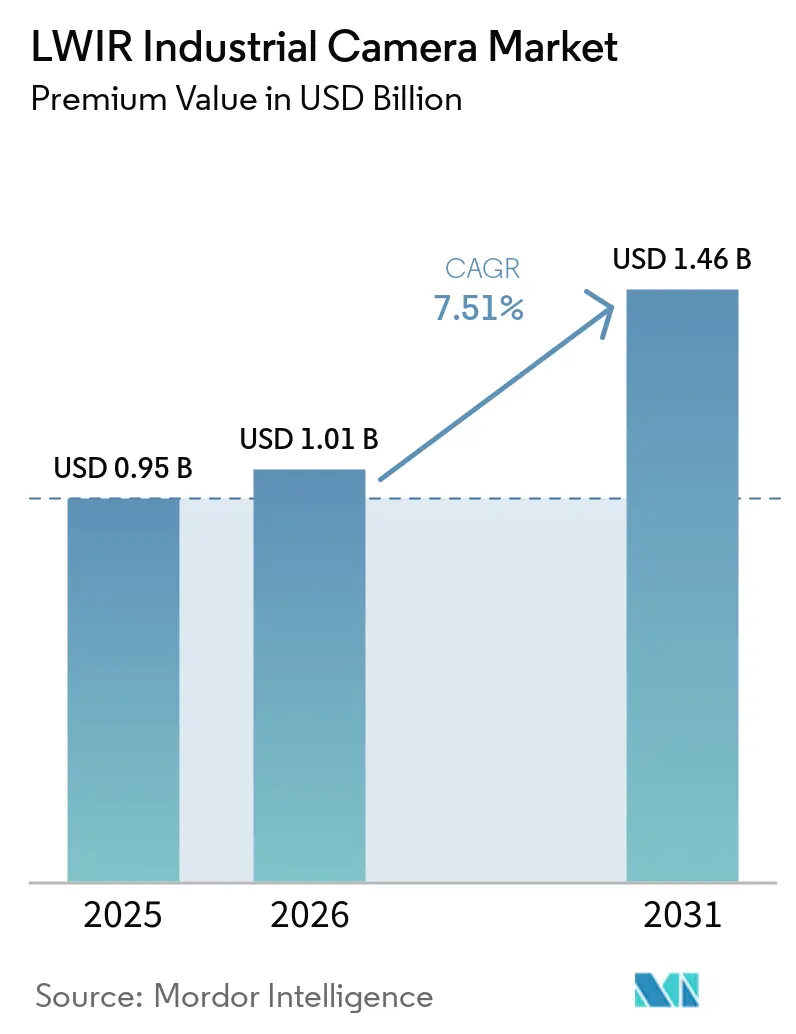
| Market Size (2026) | USD 1.01 Billion |
| Market Size (2031) | USD 1.46 Billion |
| Growth Rate (2026 - 2031) | 7.51 % |
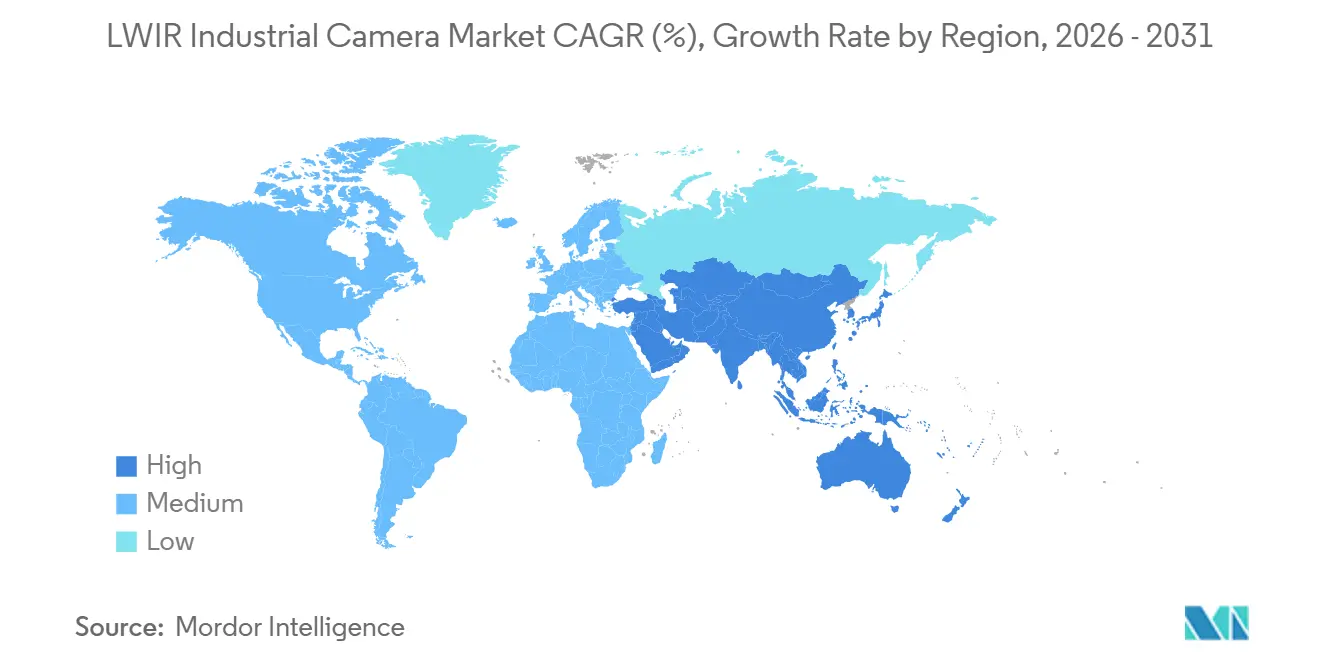
| Fastest Growing Market | Asia-Pacific |
| Largest Market | North America |
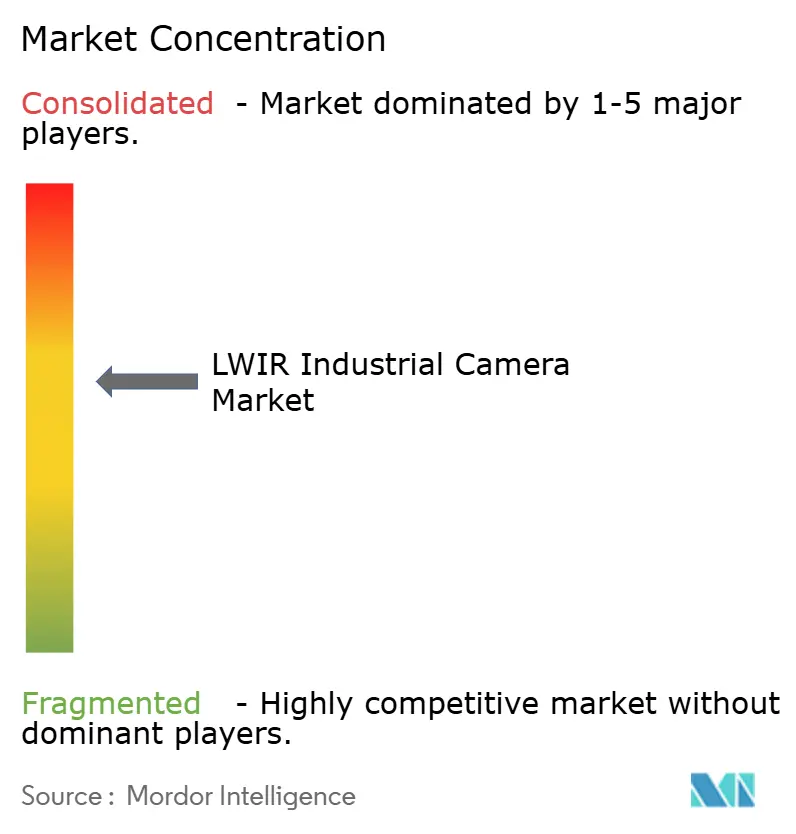
| Market Concentration | Medium |
Major Players *Disclaimer: Major Players sorted in no particular order Image © Mordor Intelligence. Reuse requires attribution under CC BY 4.0. | |
LWIR Industrial Camera Market Analysis by Mordor Intelligence
The LWIR industrial camera market size is expected to reach USD 1.46 billion by 2031, expanding at a CAGR of 7.51% from 2026 to 2031. Demand is shifting from periodic thermographic surveys toward continuous monitoring of industrial assets. Aging electrical and mechanical infrastructure supports this shift, as facilities need earlier fault warning. Automation programs also increase the number of inspection points that can use thermal sensing. Suppliers are responding with embedded modules, analytics software, and systems designed for specific industrial tasks. Trade restrictions and procurement preferences are also changing supplier choices across the LWIR industrial camera market.
Key Report Takeaways
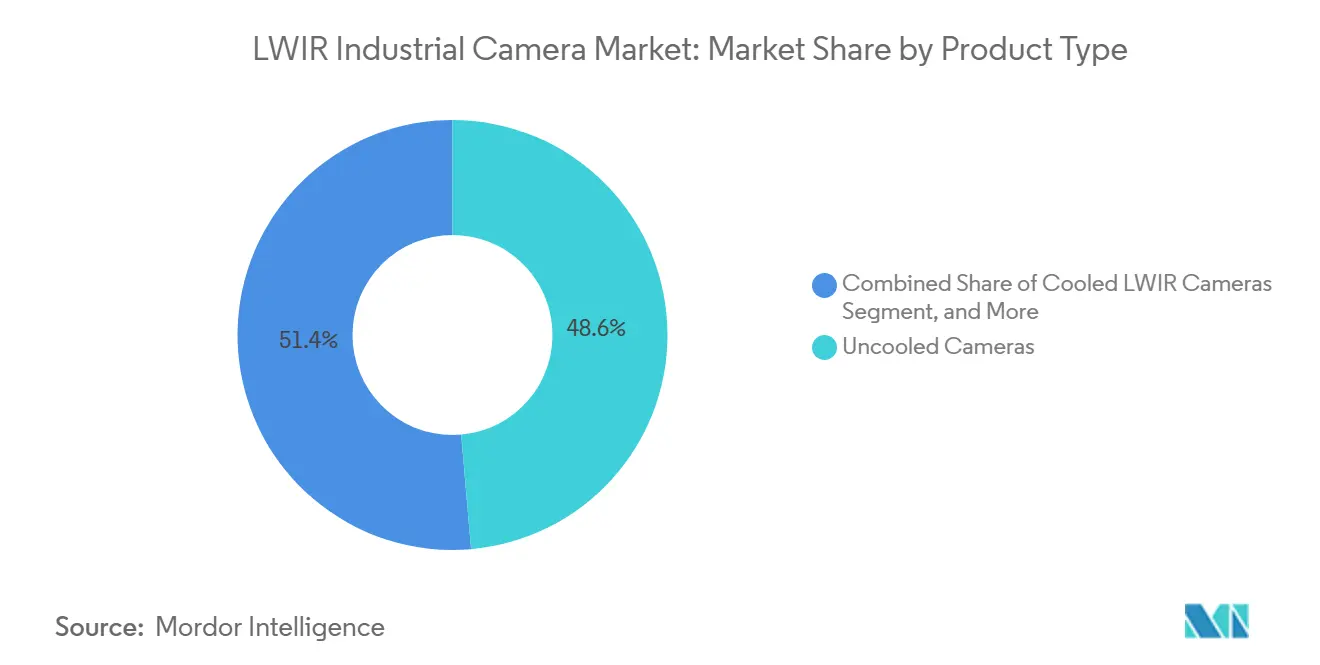
- By product type, uncooled cameras held 48.62% of the LWIR industrial camera market share in 2025, while camera cores and modules are projected to expand at a 9.34% CAGR through 2031.
- By form factor, fixed-mount cameras held 42.18% share in 2025, while embedded camera cores and modules are projected to expand at a 10.12% CAGR through 2031.
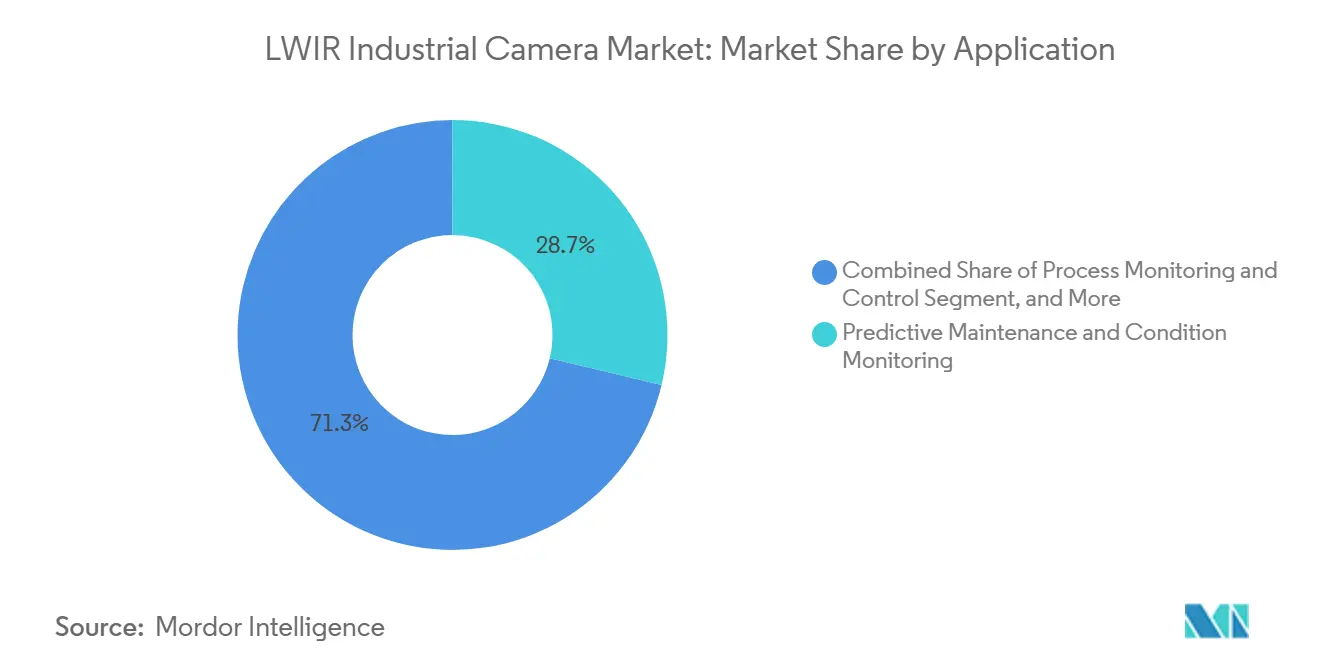
- By application, predictive maintenance and condition monitoring held 28.74% share in 2025, while quality assurance and machine vision are projected to expand at a 9.06% CAGR through 2031.
- By end-user industry, manufacturing held 27.36% share in 2025, while electronics and semiconductors are projected to expand at a 9.48% CAGR through 2031.
- By geography, North America held 34.21% of revenue in 2025, while Asia-Pacific is projected to expand at a 9.67% CAGR through 2031.
Note: Market size and forecast figures in this report are generated using Mordor Intelligence’s proprietary estimation framework, updated with the latest available data and insights as of January 2026.
Global LWIR Industrial Camera Market Trends and Insights
Drivers Impact Analysis*
| Driver | (~) % Impact on CAGR Forecast | Geographic Relevance | Impact Timeline |
|---|---|---|---|
| Industrial Predictive Maintenance and Condition Monitoring | +2.3% | Global, led by North America and Europe | Short term (≤ 2 years) |
| Expansion of AI-Enabled Thermal Analytics | +1.6% | Global, with early concentration in North America, Germany, Japan, and South Korea | Medium term (2-4 years) |
| Falling Uncooled Microbolometer Costs | +1.2% | Global, driven by Asia-Pacific manufacturing scale | Short term (≤ 2 years) |
| Industrial Automation and Inline Quality Inspection | +0.9% | Asia-Pacific core, with spillover to North America and Europe | Medium term (2-4 years) |
| Wafer-Level Packaging and Smaller Pixel Pitches | +0.6% | Asia-Pacific manufacturing hubs and US and European OEMs | Medium term (2-4 years) |
| Thermal Monitoring of Battery and Power-Electronics Manufacturing | +0.5% | Asia-Pacific and Europe, with early gains in US Midwest EV corridors | Short term (≤ 2 years) |
| Source: Mordor Intelligence | |||
Industrial Predictive Maintenance and Condition Monitoring Drives Baseline Demand
Continuous thermal monitoring can identify developing faults in electrical connections, motors, bearings, and heat exchangers before equipment fails. The US Department of Energy reported that predictive maintenance programs can reduce reactive maintenance costs by 30-40% and equipment breakdowns by 70-75%.[1] NFPA 70B was revised in 2023 to require electrical equipment maintenance at intervals of no more than 12 months. Condition 3 assets require thermographic surveys every 6 months under that standard. These requirements encourage the permanent installation of cameras in switchgear rooms, electrical distribution systems, and motor control centers. The same installations create thermal data streams that can support analytics platforms across the LWIR industrial camera market.
Expansion of AI-Enabled Thermal Analytics Elevates Camera Utilization
AI-enabled analytics are transforming thermal cameras from imaging devices into diagnostic tools capable of classifying fault conditions. A 2025 study of the ThermoNet architecture reported diagnostic accuracy of 0.987 and inference latency of 0.0017 seconds for real-time machinery health monitoring. The study validated a 24-hour operating thermal dataset against real camera measurements. These systems can help maintenance teams prioritize work orders by separating fault signatures from ambient temperature changes. This capability broadens the practical use of uncooled cameras with NETD values of 40-60 mK in applications once served by higher-sensitivity manual inspection equipment. Continuous AI-supported monitoring can therefore make thermal investments easier to assess through avoided downtime and maintenance savings.
Falling Uncooled Microbolometer Costs Open Adjacent Deployment Tiers
Smaller pixel pitches are reducing the material content needed for uncooled microbolometer arrays. Teledyne FLIR OEM released the Boson SX8 in June 2026 with an 8 µm pixel pitch and 1280 × 1024 resolution. Production formats already include 12 µm pitch devices, while 8 µm designs are entering higher-resolution formats. Moving from 17 µm to 12 µm pitch can reduce die area by 40%, allowing more sensors to be fabricated per wafer. Smaller arrays can reduce detector costs, although tighter optical tolerances can offset some of the savings. Lynred inaugurated its EUR 100 million (USD 113 million) Infrared Campus in June 2026, with a target capacity of 1 million bolometers per year by 2030. This production investment supports wider deployment of uncooled equipment in the LWIR industrial camera market and supports supply availability.
Industrial Automation and Inline Quality Inspection Creates Non-Cyclical Volume
LWIR-enabled machine vision supports 100% inline inspection where temperature patterns affect product quality. Relevant uses include weld integrity, solder joint formation, packaging seals, and polymer curing. Thermal monitoring in robotic welding cells can identify porosity, lack of fusion, and overheating within 100 milliseconds of a weld event. This allows defective parts to be rejected before they move through later production steps. It also supports inspection requirements under ISO 5817 and ISO 17635. Camera demand is linked to production-line count rather than plant count, which supports deployment across the LWIR industrial camera market as EV, semiconductor, and consumer electronics capacity expands.
Restraints Impact Analysis*
| Restraint | (~) % Impact on CAGR Forecast | Geographic Relevance | Impact Timeline |
|---|---|---|---|
| High Initial System and Calibration Costs | -1.3% | Global, most acute in South America, Middle East, and Africa | Medium term (2-4 years) |
| Performance Gap Between Uncooled and Cooled Detectors | -0.8% | Global, with highest impact in precision process industries in North America, Europe, and Japan | Long term (≥ 4 years) |
| Export Controls and Dual-Use Trade Restrictions | -0.5% | Primarily US and allied exporters shipping to China, Middle East, and select Asian markets | Medium term (2-4 years) |
| Inconsistent Calibration and Emissivity Practices | -0.3% | Global, particularly among small and medium-sized enterprise adopters in Southeast Asia and South America | Long term (≥ 4 years) |
| Source: Mordor Intelligence | |||
High Initial System and Calibration Costs Limit Small and Medium-Sized Enterprise Adoption
A fixed-mount system may require investment in the camera, mounting hardware, software licenses, calibration, and integration with SCADA or CMMS platforms. This cost can be difficult for small and medium-sized manufacturers to justify against periodic inspections conducted by outside thermographers. Radiometric recalibration is needed to maintain measurement accuracy as detector response changes over time. Technicians also need to establish emissivity values for each monitored asset class. These requirements can delay adoption among smaller operators while larger facilities spread the cost across more assets. Camera-as-a-service and subscription offerings can reduce the initial burden by shifting costs from capital budgets to operating budgets in the LWIR industrial camera market.
Performance Gap Between Uncooled and Cooled Detectors Restricts High-Precision Applications
Uncooled microbolometers commonly deliver NETD values of 30-60 mK in commercial formats. Cooled MWIR photon detectors can reach sensitivity below 20 mK with 10-15 µm pixel-pitch arrays.[2] The difference matters for minute temperature changes and fast-moving targets. Glass tempering, laser processing, and steel rolling can require detection at 0.1°C or frame rates above 100 Hz. These applications require cooled systems despite their higher cost. Teledyne FLIR launched the A6450 cooled MWIR camera in February 2026, with a stated operating life of 27,000 hours, demonstrating how suppliers are addressing maintenance concerns for continuous industrial use.
*Our forecasts treat driver/restraint impacts as directional, not additive. The impact forecasts reflect baseline growth, mix effects, and variable interactions.
Segment Analysis
By Product Type: Uncooled Cameras Anchor Revenue, Cores Support Faster Adoption
Uncooled cameras held 48.62% of product-type revenue in 2025. Their position reflects suitability for ambient-temperature monitoring without cryogenic cooling and supports broad use in the LWIR industrial camera market. VOx microbolometer detectors operate in the 8-14 µm spectral range, covering emissions from electrical connections, motors, bearings, and process piping. These asset classes are common targets for predictive maintenance, which makes uncooled units the standard choice for continuous condition-monitoring installations. Smaller size, lower power consumption, and lower ownership costs also support their deployment in distributed monitoring systems.
The LWIR industrial camera market size for cores and modules is projected to expand at a 9.34% CAGR through 2031. Machine builders and system integrators embed OEM thermal cores into proprietary inspection platforms to enable application-specific integration and preserve system-level margins. Cooled LWIR cameras are used for non-destructive testing, high-speed inspection, and gas visualization where uncooled sensitivity is insufficient. Integrated systems combine detectors, analytics software, and communication interfaces for safety-critical fire detection and gas-leak monitoring. A 2024 study found that wafer-level vacuum packaging with Au-In transient liquid phase bonding achieved hermeticity as low as 0.1 × 10⁻⁹ atm·cc/s under MIL-STD 883.

By Form Factor: Fixed-Mount Systems Lead, Embedded Cores Accelerate
Fixed-mount cameras accounted for 42.18% of form-factor revenue in 2025. Permanent installation supports continuous monitoring of switchgear, rotating equipment, and process vessels throughout operating hours in the LWIR industrial camera market. This approach differs from scheduled handheld surveys that capture conditions only during an inspection visit. It suits facilities with large asset populations and recurring thermographic requirements, particularly where faults can develop between visits. The move toward installed networks reflects the need for persistent visibility of critical junctions and assets.
Embedded camera cores and modules are projected to expand at a 10.12% CAGR from 2026 to 2031. Automation OEMs integrate them into robotic welding cells, visual inspection stations, and conveyor-side quality systems instead of procuring standalone cameras. Handheld cameras remain useful for field diagnostics, periodic surveys, and facilities that cannot yet justify the cost of fixed infrastructure. Line-scan cameras support web manufacturing in textiles, paper, steel strip, and film, while pan-tilt-zoom units serve security and large-area scans. Workswell released its WEOM HD core in September 2025 with 1280 × 1024 resolution and NETD below 50 mK for fixed industrial and machine-vision equipment.
By Application: Predictive Maintenance Leads, Quality Assurance Advances Fastest
Predictive maintenance and condition monitoring accounted for 28.74% of application revenue in 2025. Facilities use these systems to identify anomalies before they result in equipment failure, keeping this application central to the LWIR industrial camera market. The US Department of Energy stated that properly implemented predictive maintenance programs can reduce overall maintenance costs by 25-30%. The same guidance cited a 70-75% reduction in equipment breakdowns. These outcomes give plant managers an operational basis for evaluating thermal monitoring infrastructure.
Quality assurance and machine vision are projected to expand at a 9.06% CAGR through 2031. The application supports inline inspection in EV battery assembly, semiconductor wafer processing, and PCB manufacturing, where each unit can be inspected. A 2025 study detected interfacial debonding as small as 0.7 mm in thermal barrier coatings within 0.2 seconds using infrared thermography and eddy current testing. Process monitoring and control support glass melting, steel rolling, chemical reactors, and cement kilns, extending the LWIR industrial camera market into high-temperature operations. Other applications include non-destructive testing, electrical inspection, fire detection, industrial safety, leak detection, and gas visualization.
By End-User Industry: Manufacturing Holds the Largest Share, Electronics Leads Growth
Manufacturing held 27.36% of end-user revenue in 2025. It covers predictive maintenance, inline quality inspection, fire detection, and process monitoring across a range of equipment in the LWIR industrial camera market. Automotive and heavy manufacturing plants use thermal monitoring for robotic and laser welding operations. These uses range from individual devices to multi-camera networks, especially in materials production, where continuous temperature monitoring is required. Manufacturing, therefore, remains the largest end-user base for thermal imaging equipment.
The LWIR industrial camera market size for electronics and semiconductors is projected to expand at a 9.48% CAGR from 2026 to 2031. Advanced-node wafer fabrication, power semiconductor production, and high-density PCB assembly need consistent thermal conditions across process steps. Exosens identifies thermal defect detection and temperature distribution monitoring as uses of infrared imaging in semiconductor production. Power generation and utilities are the second-largest end-user vertical, while oil and gas, automotive and EVs, metals, chemicals and petrochemicals, food and beverage, and aerospace and defense have separate needs. Raythink described an architecture connecting production-line cameras, its VIS3000 data platform, battery management systems, and fire protection networks at EV battery facilities.
Geography Analysis
North America held 34.21% of global LWIR industrial camera revenue in 2025. The region currently combines established automation, aging electrical infrastructure, and compliance requirements that support permanent monitoring. The United States includes major camera manufacturers and systems integrators, while Gulf Coast petrochemical facilities use cameras for gas visualization, process monitoring, and fire detection. Automotive and aerospace sites use fixed installations for predictive maintenance and non-destructive testing.
Canada adds demand from oil sands and mining operations that require rugged monitoring equipment. Mexico’s expanding automotive manufacturing base supports demand for inline inspection in precision assembly. The 2023 NFPA 70B requirements support recurring investment in fixed installations across North American facilities. Europe is supported by precision manufacturing, chemical processing, energy production, and supply-chain sovereignty requirements. Germany remains an important buyer of process monitoring systems used in steel, glass, chemicals, and automotive production.
Asia-Pacific is projected to expand at a 9.67% CAGR from 2026 to 2031. China is both a significant producer and user of thermal imaging equipment, while South Korea’s semiconductor and display facilities support demand for automated process control. Japan supports upgrade cycles in steel, chemical, and automotive production. India is expanding its use in power utilities, oil refineries, and pharmaceutical manufacturing. South America, the Middle East, and Africa are smaller parts of the LWIR industrial camera market, with demand linked to Brazilian oil and gas operations, Gulf refining and utilities, and mining and infrastructure activity in South Africa and Egypt.
Competitive Landscape
The LWIR industrial camera market comprises a moderately concentrated, high-performance tier alongside fragmented competition in standard industrial formats. Teledyne FLIR has broad product coverage, thermal modules, and application software for the LWIR industrial camera market, with ITAR-free and NDAA-compliant modules relevant in defense-adjacent industrial procurement. Chinese manufacturers include Wuhan Guide Infrared, HIKMICRO Sensing Technology, Zhejiang Dali Technology, and Yantai Raytron Technology. These suppliers compete in the LWIR industrial camera market through vertically integrated production of detectors and optics and competitive pricing.
The US Bureau of Industry and Security reached a USD 1 million civil penalty settlement with Teledyne FLIR in February 2026 for 19 violations of the Export Administration Regulations.[3] The order involved unauthorized reexports of certain thermal cameras to China through a Swedish affiliate, among other violations. The case shows the compliance exposure that suppliers face when serving markets with different trade-control rules. Suppliers that integrate camera modules with AI edge computing platforms can provide validated packages for battery monitoring, wafer inspection, and weld control. This offers suppliers in the LWIR industrial camera market a path to compete on integration rather than on hardware price alone.
European and Israeli suppliers, including InfraTec, Optris, DIAS Infrared, Xenics, Opgal, and Workswell, emphasize application expertise, radiometric precision, and supply chain credentials. InfraTec’s ImageIR 12300 provides 5.2 megapixels of native resolution in a radiometrically calibrated system. Workswell’s EU-designed WEOM HD core provides an ITAR-free option for buyers seeking regional supply alternatives. Optris extended the PI 640i G7 to a 3,000°C measurement range in June 2025 for high-temperature glass and laser applications. Analytics features and application-specific thermal classification are becoming important product differentiators across the LWIR industrial camera market for industrial buyers.
LWIR Industrial Camera Industry Leaders
-
Teledyne FLIR LLC
-
Lynred USA Inc.
-
Exosens S.A.
-
Wuhan Guide Infrared Co., Ltd.
-
Zhejiang Dali Technology Co., Ltd.
- *Disclaimer: Major Players sorted in no particular order
Recent Industry Developments
- June 2026: Lynred inaugurated its EUR 100 million (USD 113 million), Infrared Campus in Veurey-Voroize near Grenoble, France, doubling its cleanroom footprint to 8,000 m² and targeting annual production capacity of 1 million bolometers by 2030. The facility, backed by co-shareholders Safran and Thales, is the largest dedicated infrared detector production site in Europe and directly addresses defense and industrial demand growth while reinforcing French and European industrial sovereignty in detector supply chains.
- June 2026: Teledyne FLIR OEM released the Boson SX8, the first NDAA-compliant, ITAR-free, volume-production uncooled LWIR thermal camera module combining an 8 µm pixel pitch with SXGA, 1280 × 1024, resolution. It delivers 4 times the resolution of standard VGA modules in a similarly sized package and enables performance previously available only in larger, heavier cooled MWIR systems. The module targets UAS, counter-UAS, perimeter security, and industrial handheld applications, and is manufactured at volume in the United States.
- February 2026: The US Bureau of Industry and Security reached a USD 1 million civil penalty settlement with Teledyne FLIR LLC for 19 violations of the Export Administration Regulations from 2017 to 2024. The violations included unauthorized reexports of ECCN 6A003 thermal cameras to China via a Swedish affiliate and unlicensed exports to a company on the Entity List. The enforcement action also addressed de minimis calculation errors and signaled heightened scrutiny of supply-chain compliance obligations for dual-use thermal imaging products.
- February 2026: Teledyne FLIR launched the A6450 long-life cooled MWIR cameras for 24/7 industrial automation, process control, and non-destructive testing. The product features a HOT MWIR detector with an operational lifespan of 27,000 hours. This extended the maintenance cycle compared with conventional cooled cameras and reduced lifetime service costs in continuous deployment environments.
Global LWIR Industrial Camera Market Report Scope
The LWIR Industrial Camera Market comprises specialized thermal imaging cameras and camera-based imaging solutions designed to detect and visualize long-wave infrared (LWIR) radiation, typically in the 8-14 μm wavelength range, for industrial inspection, monitoring, measurement, safety, and process control applications. LWIR industrial cameras convert thermal radiation emitted by objects, equipment, and processes into digital images, enabling users to identify temperature variations, thermal anomalies, equipment faults, and other conditions that may not be visible through conventional imaging technologies.
The LWIR Industrial Camera Market Report is Segmented by Product Type (Uncooled LWIR Cameras, Cooled LWIR Cameras, LWIR Camera Cores and Modules, and Integrated LWIR Imaging Systems), Form Factor (Fixed-Mount Cameras, Handheld Cameras, Line-Scan Cameras, Pan-Tilt-Zoom Cameras, and Embedded Camera Cores and Modules), Application (Predictive Maintenance and Condition Monitoring, Process Monitoring and Control, Quality Assurance and Machine Vision, Non-Destructive Testing, Electrical and Power-Equipment Inspection, Fire Detection and Industrial Safety, Leak Detection and Gas Visualization, and Other Applications), End-User Industry (Manufacturing, Power Generation and Utilities, Oil and Gas, Automotive and Electric Vehicles, Electronics and Semiconductors, Metals, Chemicals and Petrochemicals, Food and Beverage, Aerospace and Defense, and Other End-User Industries), and Geography (North America, South America, Europe, Asia-Pacific, Middle East, and Africa). The Market Forecasts are Provided in Terms of Value (USD).
| Uncooled LWIR Cameras |
| Cooled LWIR Cameras |
| LWIR Camera Cores and Modules |
| Integrated LWIR Imaging Systems |
| Fixed-Mount Cameras |
| Handheld Cameras |
| Line-Scan Cameras |
| Pan-Tilt-Zoom Cameras |
| Embedded Camera Cores and Modules |
| Predictive Maintenance and Condition Monitoring |
| Process Monitoring and Control |
| Quality Assurance and Machine Vision |
| Non-Destructive Testing |
| Electrical and Power-Equipment Inspection |
| Fire Detection and Industrial Safety |
| Leak Detection and Gas Visualization |
| Other Applications |
| Manufacturing |
| Power Generation and Utilities |
| Oil and Gas |
| Automotive and Electric Vehicles |
| Electronics and Semiconductors |
| Metals |
| Chemicals and Petrochemicals |
| Food and Beverage |
| Aerospace and Defense |
| Other End-User Industries |
| North America | United States |
| Canada | |
| Mexico | |
| South America | Brazil |
| Argentina | |
| Rest of South America | |
| Europe | Germany |
| United Kingdom | |
| France | |
| Italy | |
| Spain | |
| Rest of Europe | |
| Asia-Pacific | China |
| Japan | |
| South Korea | |
| India | |
| Rest of Asia-Pacific | |
| Middle East | Saudi Arabia |
| United Arab Emirates | |
| Rest of Middle East | |
| Africa | South Africa |
| Egypt | |
| Rest of Africa |
| By Product Type | Uncooled LWIR Cameras | |
| Cooled LWIR Cameras | ||
| LWIR Camera Cores and Modules | ||
| Integrated LWIR Imaging Systems | ||
| By Form Factor | Fixed-Mount Cameras | |
| Handheld Cameras | ||
| Line-Scan Cameras | ||
| Pan-Tilt-Zoom Cameras | ||
| Embedded Camera Cores and Modules | ||
| By Application | Predictive Maintenance and Condition Monitoring | |
| Process Monitoring and Control | ||
| Quality Assurance and Machine Vision | ||
| Non-Destructive Testing | ||
| Electrical and Power-Equipment Inspection | ||
| Fire Detection and Industrial Safety | ||
| Leak Detection and Gas Visualization | ||
| Other Applications | ||
| By End-User Industry | Manufacturing | |
| Power Generation and Utilities | ||
| Oil and Gas | ||
| Automotive and Electric Vehicles | ||
| Electronics and Semiconductors | ||
| Metals | ||
| Chemicals and Petrochemicals | ||
| Food and Beverage | ||
| Aerospace and Defense | ||
| Other End-User Industries | ||
| By Geography | North America | United States |
| Canada | ||
| Mexico | ||
| South America | Brazil | |
| Argentina | ||
| Rest of South America | ||
| Europe | Germany | |
| United Kingdom | ||
| France | ||
| Italy | ||
| Spain | ||
| Rest of Europe | ||
| Asia-Pacific | China | |
| Japan | ||
| South Korea | ||
| India | ||
| Rest of Asia-Pacific | ||
| Middle East | Saudi Arabia | |
| United Arab Emirates | ||
| Rest of Middle East | ||
| Africa | South Africa | |
| Egypt | ||
| Rest of Africa | ||
Key Questions Answered in the Report
What is the LWIR industrial camera market size?
The LWIR industrial camera market is expected to reach USD 1.46 billion by 2031, expanding at a 7.51% CAGR from 2026 to 2031.
Why are industrial facilities using LWIR cameras?
Facilities use them for continuous monitoring of electrical equipment, motors, bearings, process assets, and production quality. This supports earlier maintenance action and ongoing thermal visibility, particularly where periodic inspection schedules cannot capture changes between planned surveys or provide a complete record of asset conditions.
Which product type held the largest share in 2025?
Uncooled LWIR cameras held 48.62% of product-type revenue in 2025 because they suit ambient-temperature monitoring without cryogenic cooling. Their design also supports lower power use and smaller installed systems.
Which application is advancing fastest through 2031?
Quality assurance and machine vision are projected to expand at a 9.06% CAGR through 2031, supported by inline inspection in battery, semiconductor, and electronics production. Thermal inspection allows production teams to assess all units rather than only a sample.
Which end-user sector has the highest projected CAGR?
Electronics and semiconductors are projected to expand at a 9.48% CAGR through 2031 due to thermal process control and yield-management needs. Advanced fabrication requires consistent temperature conditions during critical production steps.
Which region is advancing fastest?
Asia-Pacific is projected to expand at a 9.67% CAGR through 2031, supported by electronics fabrication, EV battery manufacturing, and automated production capacity. China, South Korea, Japan, and India provide the principal regional demand base, and the LWIR industrial camera market benefits from new automated production lines across these economies.