
Industrial Camera Trigger and IO Modules Market Size and Share
Market Overview
| Study Period | 2020 - 2031 |
|---|---|
| Market Size (2026) | USD 344.91 Million |
| Market Size (2031) | USD 501.08 Million |
| Growth Rate (2026 - 2031) | 7.76 % |
| Fastest Growing Market | Asia-Pacific |
| Largest Market | Europe |
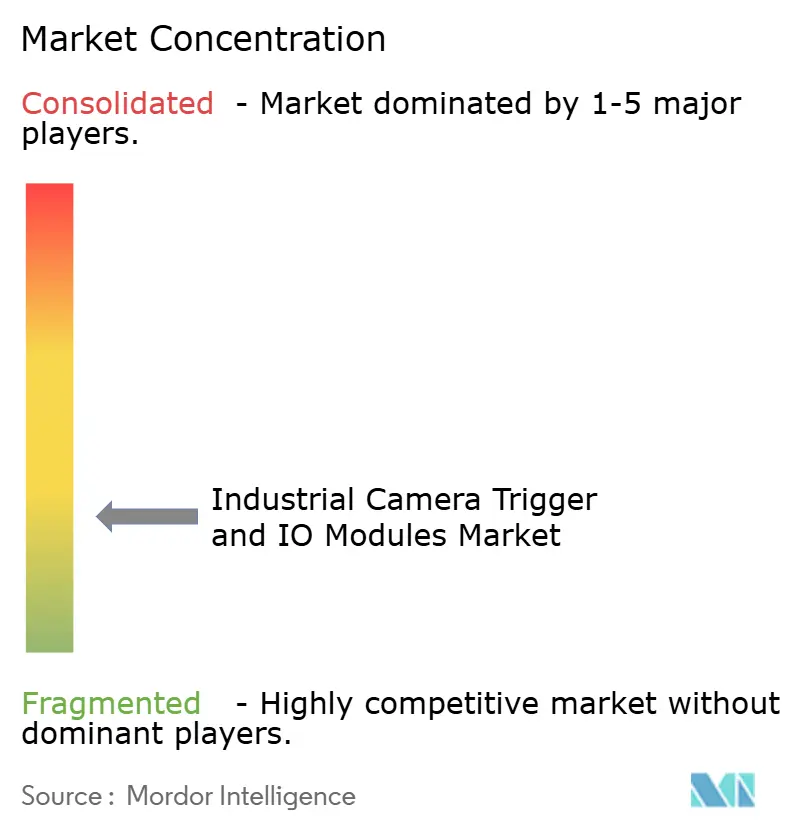
| Market Concentration | Low |
Major Players *Disclaimer: Major Players sorted in no particular order Image © Mordor Intelligence. Reuse requires attribution under CC BY 4.0. | |
Industrial Camera Trigger and IO Modules Market Analysis by Mordor Intelligence
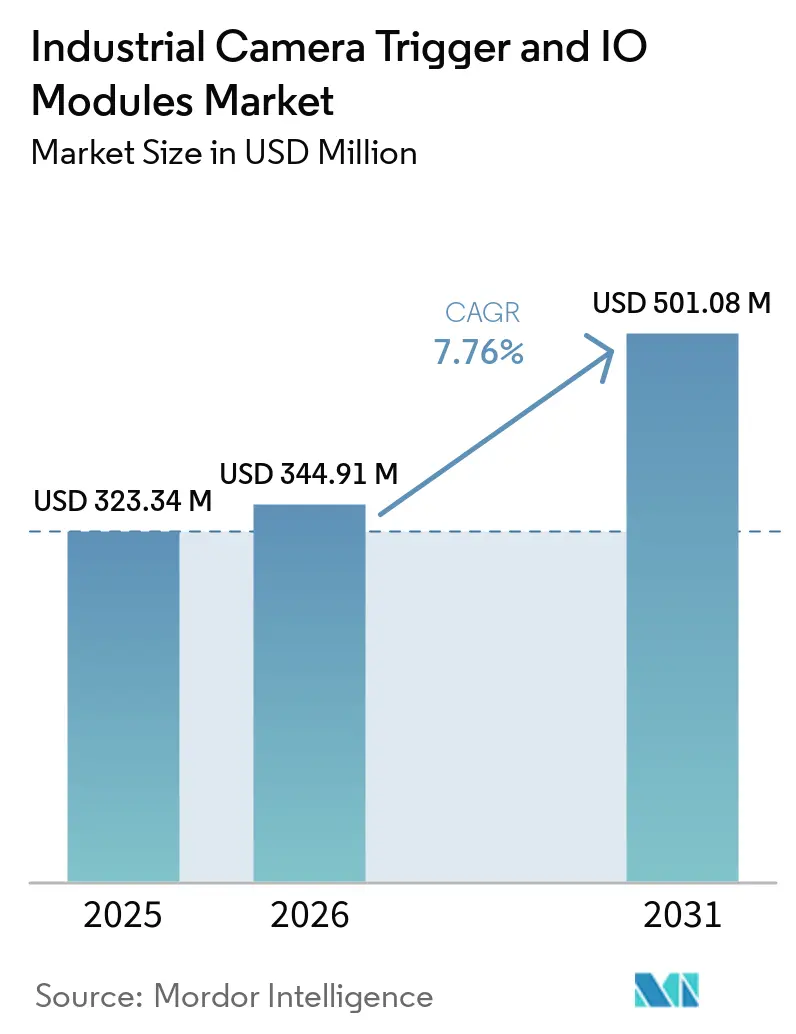
The Industrial Camera Trigger and IO Modules Market size was valued at USD 323.34 million in 2025 and estimated to expand from USD 344.91 million in 2026 to reach USD 501.08 million by 2031, at a CAGR of 7.76% during the forecast period (2026-2031). Demand reflects the need for consistent image capture in electronics, semiconductor, and automotive production. Manufacturers are using more multi-camera inspection cells, which need accurate timing between cameras, lighting, and programmable logic controllers. Edge-based inspection also underscores the need for reliable input and output connections, as pass/fail results must reach production equipment without delay. The Industrial Camera Trigger and IO Modules Market therefore benefits when users replace separate components with systems that combine timing, image processing, and control functions. Compatibility across CoaXPress, GigE Vision, USB3 Vision, and Camera Link remains important because mixed interfaces can increase integration work and project cost.
Key Report Takeaways
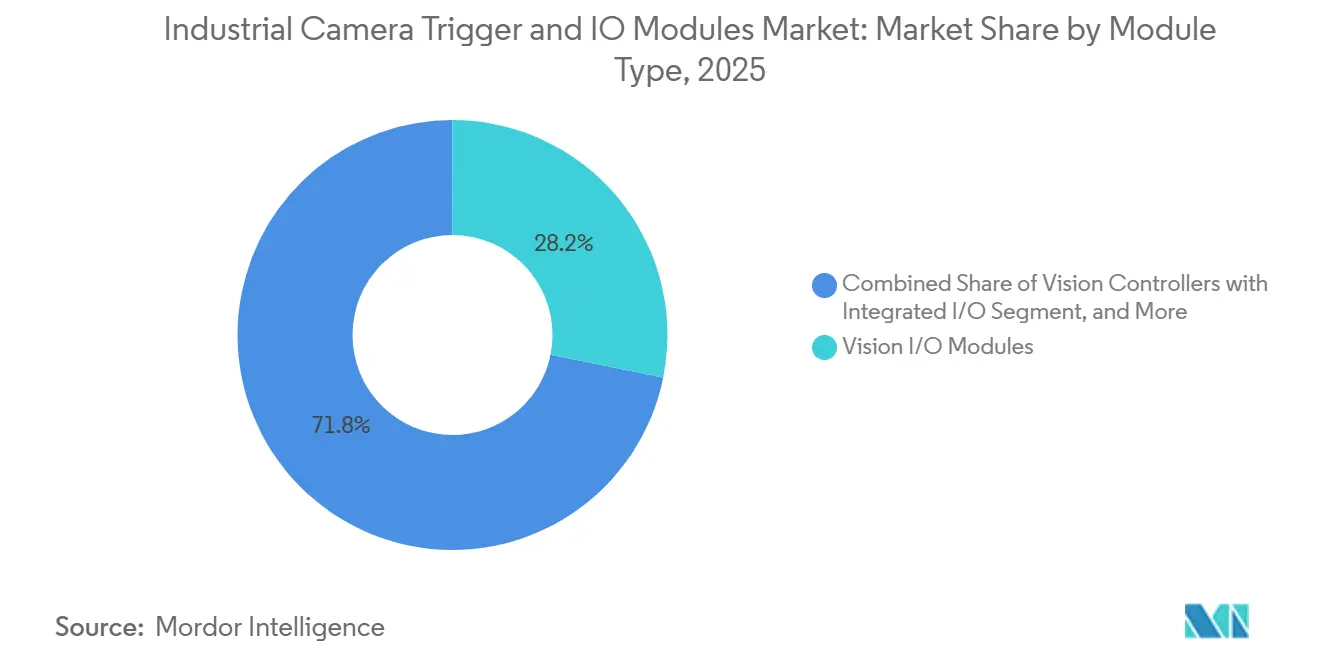
- By module type, Vision I/O Modules held 28.17% of the Industrial Camera Trigger and IO Modules Market share in 2025, while Vision Controllers with Integrated I/O are projected to expand at a 9.23% CAGR through 2031.
- By signal type, TTL and LVTTL signals held 31.24% share in 2025, while Opto-Isolated and Photo-Coupled signals are projected to expand at a 9.71% CAGR through 2031.
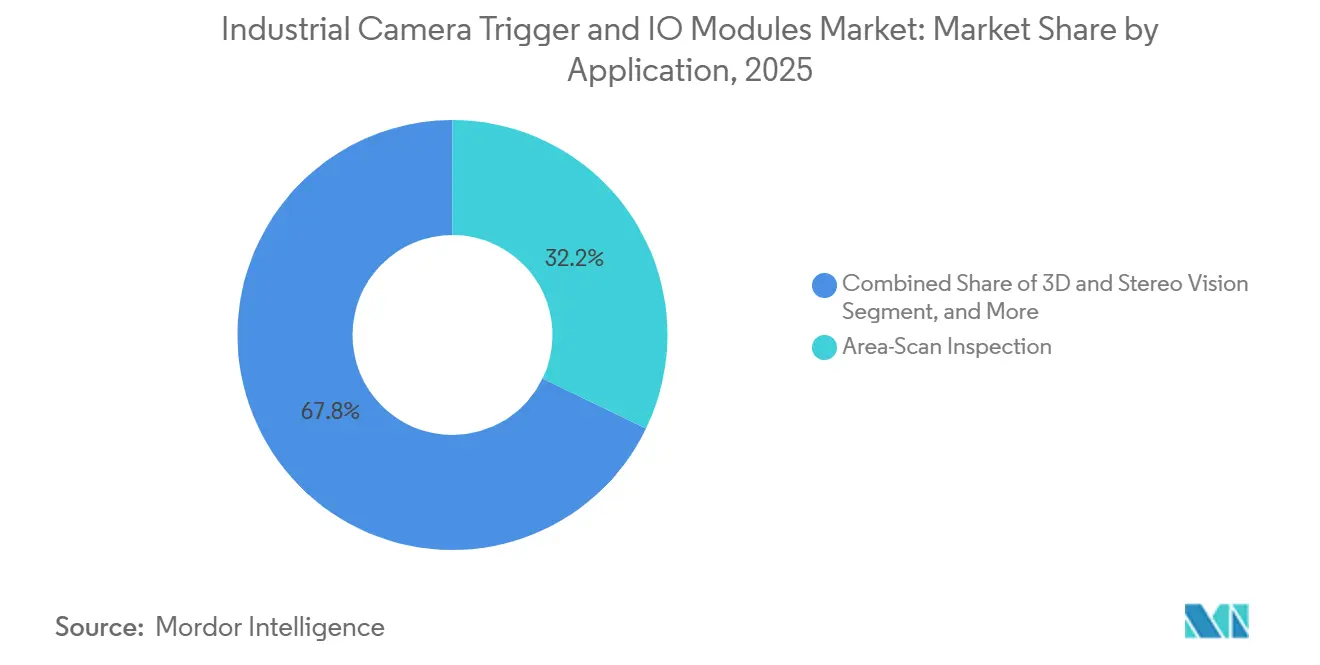
- By application, Area-Scan Inspection accounted for 32.16% Industrial Camera Trigger and IO Modules Market share in 2025, while 3D and Stereo Vision is projected to expand at a 10.27% CAGR through 2031.
- By end-user industry, Electronics and Semiconductor held 29.13% share in 2025, while Automotive and EV Battery are projected to expand at a 10.13% CAGR through 2031.
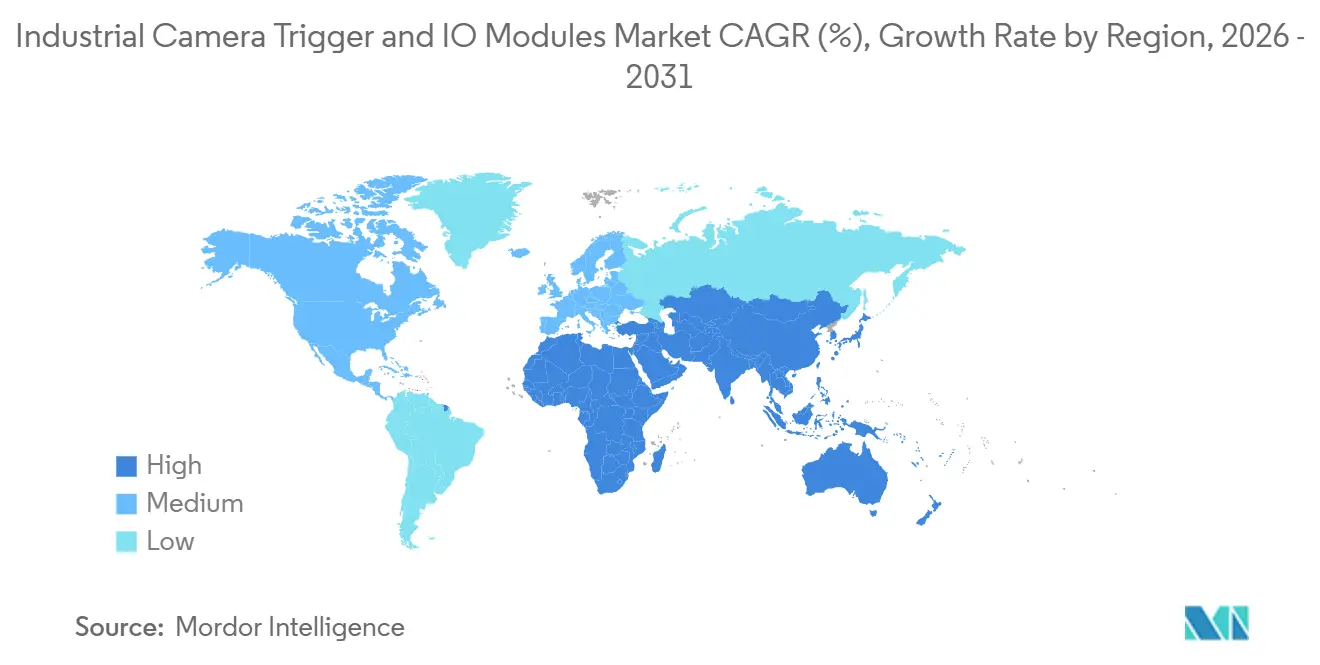
- By geography, Europe held 34.27% share of the Industrial Camera Trigger and IO Modules Market in 2025, while Asia-Pacific is projected to expand at a 9.17% CAGR through 2031.
Note: Market size and forecast figures in this report are generated using Mordor Intelligence’s proprietary estimation framework, updated with the latest available data and insights as of January 2026.
Global Industrial Camera Trigger and IO Modules Market Trends and Insights
Drivers Impact Analysis*
| Driver | (~) % Impact on CAGR Forecast | Geographic Relevance | Impact Timeline |
|---|---|---|---|
| Deterministic Triggering for High-Speed Inspection | +1.8% | Global, with core demand in North America and Europe | Short term (≤ 2 years) |
| Electronics, Semiconductor, and EV Battery AOI Expansion | +1.7% | Asia-Pacific core, with expansion in North America and Europe | Short term (≤ 2 years) |
| Multi-Camera and Synchronized 3D Vision Systems | +1.4% | Global, with early gains in Germany, China, Japan, and South Korea | Medium term (2-4 years) |
| High-Bandwidth CoaXPress and 10GigE Vision Adoption | +1.2% | Global, particularly Europe and Asia-Pacific | Medium term (2-4 years) |
| Edge-Based Timing and Lower Host-CPU Load | +0.9% | Global, with fast adoption in North America and Asia-Pacific | Medium term (2-4 years) |
| Galvanically Isolated Industrial I/O Retrofits | +0.7% | North America and Europe | Long term (≥ 4 years) |
| Source: Mordor Intelligence | |||
Rising Use of Deterministic Triggering in High-Speed Inspection
Production lines operating at 1,200 parts per minute allow a 50-millisecond inspection window for each part. A delay in the trigger can affect image position and cause a missed or false inspection event. Hardware triggers avoid software scheduling delays and can provide sub-microsecond jitter between a programmable logic controller signal and camera exposure. AI-based edge inference adds a timing requirement because the model output must remain aligned with line speed. A 2025 Sensors study reported a mean end-to-end inspection latency of 54.7 milliseconds, with a standard deviation of 6.3 milliseconds, at a network load of 50%. The Industrial Camera Trigger and IO Modules Market benefits when inspection accuracy remains above 93% under varying lighting conditions and lens contamination.[1] Dariusz Maślanka, Andrzej Jancarczyk, and Janusz Rysinski, “Integration of Machine Vision and PLC-Based Control Systems in Industrial Quality Inspection,” Sensors, pmc.ncbi.nlm.nih.gov
Expansion of Electronics, Semiconductor, and EV Battery AOI
Electronics, semiconductor, and battery production lines require repeated inspection at wafer, package, cell, module, and pack stages. This requirement supports demand for trigger hardware that coordinates cameras, lighting, and motion systems. Battery inspection requires several camera and lighting sequences across safety-related production steps. The Industrial Camera Trigger and IO Modules Market gains from systems that coordinate those sequences with production equipment. Electronics and Semiconductor accounted for 29.13% of the 2025 demand, reflecting its established inspection base. JOT Automation identifies real-time monitoring and multi-axis control coordination as part of high-speed battery test operations.
Growth of Multi-Camera and Synchronized 3D Vision Systems
Multi-camera 3D cells require that cameras be exposed simultaneously to avoid errors in stereo or structured-light reconstruction. Trigger distribution modules can send one controller signal to several cameras with low jitter. A 2025 study validated sub-0.03 mm accuracy with synchronized 8-camera arrays operating at 400 fps.[2]C. Xu et al., “Multi-Camera 3D Digital Image Correlation With Pointwise-Optimized Model-Based Stereo Pairing,” Sensors, mdpi.com Research presented at the Optica Imaging Congress also connected precise trigger-to-exposure timing with on-machine surface metrology. Basler and Orbbec introduced the Basler Stereo mini for AMR and logistics automation in 2026. This expands 3D deployment beyond fixed inspection cells and creates a broader need for compact trigger I/O modules in the Industrial Camera Trigger and IO Modules Market.[3]Basler AG and Orbbec Inc., “Basler AG and Orbbec Technology Partnership for Industrial 3D Vision,” Basler AG, baslerweb.com
Migration Toward High-Bandwidth CoaXPress and 10GigE Vision
CoaXPress v2.1 raised the uplink trigger rate above 500 kHz for CXP-10 and CXP-12 links. The change supports line-scan and time-delay integration cameras used for flat-panel, battery-cell, and wafer inspection. CoaXPress v3.0 is expected to add forward error correction and faster triggering capabilities. GigE Vision 3.0 introduced RDMA and RoCEv2 capabilities that reduce image transfer overhead on the host computer.[4]Association for Advancing Automation, “GigE Vision 3.0 Standard Answers to Frequently Asked Questions,” Association for Advancing Automation, automate.org Higher camera counts can increase demand for modules that distribute a single master trigger across multiple cameras. The Industrial Camera Trigger and IO Modules Market can therefore benefit from trigger fan-out requirements that rise faster than individual camera shipments.
Restraints Impact Analysis*
| Restraint | (~) % Impact on CAGR Forecast | Geographic Relevance | Impact Timeline |
|---|---|---|---|
| Fragmented Trigger, Encoder, and Vision Interface Standards | -1.5% | Global | Short term (≤ 2 years) |
| Shortage of Vision-Control Engineers for Timing Integration | -1.2% | Global, most severe in North America and Europe | Medium term (2-4 years) |
| Cost and Availability of High-Speed Frame-Grabber Architectures | -0.9% | Global, particularly affecting smaller system builders in Asia-Pacific | Medium term (2-4 years) |
| Electromagnetic Interference and Thermal Limits in Dense Vision Cells | -0.6% | Global, particularly in dense manufacturing environments | Long term (≥ 4 years) |
| Source: Mordor Intelligence | |||
Fragmentation Across Trigger, Encoder, and Vision Interface Standards
The Industrial Camera Trigger and IO Modules Market uses at least 5 physical transport standards: CoaXPress, GigE Vision, USB3 Vision, Camera Link, and Camera Link HS. Within the Industrial Camera Trigger and IO Modules Market, each standard uses different timing models, signal levels, and control approaches. System integrators may need separate knowledge of I/O hardware and software for each interface. GenICam Package Version 2025.10 standardizes certain aspects of device control, but it does not eliminate the need to route physical signals or match voltage levels. Encoder inputs also differ between line-scan and area-scan installations. These requirements raise engineering, commissioning, and compliance costs for smaller system builders.
Scarcity of Vision-Control Engineers for Timing Integration
Multi-camera trigger systems require knowledge of FPGA firmware, GenICam device models, programmable logic controller logic, and signal integrity. The Industrial Camera Trigger and IO Modules Market depends on skills that are difficult to combine in a single engineering role. AI inference, encoder-synchronized acquisition, and multi-host I/O distribution add to the commissioning effort. Buyers may instead select controllers with integrated I/O and preset trigger logic. This supports the faster outlook for Vision Controllers with Integrated I/O at a 9.23% CAGR. It also shifts spending from separate hardware toward integrated platforms where installation simplicity has priority.
*Our forecasts treat driver/restraint impacts as directional, not additive. The impact forecasts reflect baseline growth, mix effects, and variable interactions.
Segment Analysis
By Module Type: Integrated Controllers Are Changing I/O Architecture
Vision I/O Modules held 28.17% share in 2025. The segment serves the installed base of PC-based vision systems that use separate hardware to route and condition trigger signals. It supports retrofits when users upgrade camera resolution while retaining existing programmable logic controller wiring. Trigger Boards serve high-speed systems that need GPIO extensions with opto-coupled or TTL signal paths. Their demand is linked to the use of line-scan and time-delay integration cameras in solar cell and printed circuit board inspection. Standalone Trigger Timing Controllers meet the needs of the gap between discrete boards and full controller platforms. Frame Grabber-Integrated I/O provides a related option for users seeking precision timing within an acquisition system. These mature formats face lower unit momentum as new projects use more consolidated designs. The Industrial Camera Trigger and IO Modules Market continues to need them where existing wiring and camera interfaces must remain in service.
Vision Controllers with Integrated I/O are projected to expand at a 9.23% CAGR through 2031. These systems combine trigger management, inference, and discrete control in one enclosure. Cognex’s In-Sight 6900 includes 2 opto-isolated trigger inputs, 4 general-purpose discrete inputs, and 8 discrete outputs. The controller uses NVIDIA Jetson processing for on-site inspection. This design can reduce the number of separate components in a cabinet. Compact platforms can be useful in pharmaceutical and medical device inspection, where space is limited. The Industrial Camera Trigger and IO Modules Market is also affected by compact multi-camera bridge designs. Such designs combine camera connectivity and processing functions within less cabinet space. These examples show why integrated I/O is becoming more relevant for new installations.



By Signal Type: Opto-Isolation Addresses Industrial Electrical Conditions
TTL and LVTTL signals held 31.24% share in 2025. They remain common in frame-grabber GPIO and fixed automation cells, with wiring inside controlled cabinets. Existing compatible infrastructure and a low per-channel cost support their continued use. Open Collector and NPN/PNP signals are used when sensors and actuators operate on 12 V or 24 V DC logic. This is common in food, beverage, and logistics facilities that use inductive proximity sensors. Differential Line Driver signals support encoder-synchronized line-scan systems over cable runs above 10 meters. Relay and Industrial Contact outputs remain relevant for high-voltage load switching in older semiconductor and glass inspection equipment. Each signal type serves a different electrical environment and retrofit requirement. This diversity sustains demand for modules with varied input and output options.
Opto-Isolated and Photo-Coupled signals are projected to expand at a 9.71% CAGR through 2031. These signals separate sensitive controller electronics from voltage transients and common-mode interference. Servo drives, welding robots, and induction heaters can create these electrical conditions in production cells. Basler trigger extension boards for microEnable 5 and imaFlex 2 systems support 8 opto-coupled inputs and 8 outputs. The boards support industrial signals from 4.5 V to 28 V. Isolation can also help users address IEC 61010 electrical safety requirements. South Korea’s semiconductor and display panel facilities are a demand center for high-isolation I/O. The Industrial Camera Trigger and IO Modules Market uses these designs to connect TTL-based acquisition equipment to factory signals. Their adoption reflects the need to protect vision hardware without redesigning the full power architecture.
By Application: 3D Vision Raises Timing and Channel Requirements
Area-Scan Inspection held 32.16% share in 2025. It is used widely in printed circuit boards, semiconductor packages, and food product inspection. Many installations use one fixed camera and simple trigger logic. A programmable logic controller output, one TTL trigger input, and a strobe output can support a basic cell. This limits hardware cost and helps shorten commissioning work. Line-Scan Inspection, Metrology and Dimensional Measurement, and Robot Guidance and Pick-and-Place require more specialized timing. Line-scan systems need encoder-synchronized trigger generation. Robot cells need coordinated trigger sequences that integrated controllers can manage. Tracking, sorting, and Reject Control systems also require fast outputs because actuators must act within conveyor takt time.
3D and Stereo Vision is projected to expand at a 10.27% CAGR through 2031. The Industrial Camera Trigger and IO Modules Market uses structured light, photometric stereo, and passive stereo approaches in this application. It supports automotive welding verification, EV battery tab measurement, and semiconductor die-attach inspection. Multi-spectral lighting sequences need phase-coherent strobe outputs aligned with several camera triggers. This increases the need for modules with more channels and tighter timing control. The Industrial Camera Trigger and IO Modules Market size for 3D and Stereo Vision is projected to expand at a 10.27% CAGR between 2026 and 2031. Optica research confirmed that on-machine strobo-stereoscopy needs accurate trigger-to-exposure alignment for rotating-part inspection. These requirements make 3D systems more demanding than standard 2D printed-circuit-board inspection. Wider use of 3D measurement, therefore, supports specialized trigger hardware.
By End-User Industry: Automotive and EV Battery Is the Fastest-Growing User Group
Electronics and Semiconductor held 29.13% share in 2025. Wafer fabrication and printed circuit board assembly lines use multiple inspection stations within a single facility. Some lines use more than 20 automated optical inspection stations. Qualification requirements can be strict at semiconductor fabs and contract electronics manufacturers. These requirements create barriers for suppliers without established approval status. They also support repeat orders when approved facilities expand or replace equipment. Food and Beverage, Pharmaceuticals and Medical Devices, Logistics and Packaging, Metals, Glass, and Other Continuous Materials are additional user groups. Pharmaceutical inspection favors isolated I/O for controlled wiring environments. Metals and glass applications depend on encoder-synchronized line-scan triggers for continuous material inspection.
Automotive and EV Battery is projected to expand at a 10.13% CAGR through 2031. The Industrial Camera Trigger and IO Modules Market requires inspection across cells, modules, and packs in battery manufacturing. Pouch, cylindrical, and prismatic cells each use different camera and lighting arrangements. A single battery facility can therefore use 3 or more trigger architectures. High-speed testing also requires synchronized camera triggers, reject-actuator control, and data binding. JOT Automation describes real-time monitoring and multi-axis coordination in its battery test solution. The Industrial Camera Trigger and IO Modules Market size for Automotive and EV Battery is projected to expand at a 10.13% CAGR between 2026 and 2031. This application places a premium on reliable timing because the product quality requirements are safety-related. Its forecast supports demand for higher-density I/O designs.
Geography Analysis
Europe held 34.27% share in 2025. The Industrial Camera Trigger and IO Modules Market in Europe is supported by Germany’s precision engineering base and the regional presence of Basler, IDS Imaging Development Systems, and Euresys. Automotive, semiconductor optics, and packaging machinery contribute to regional demand. ZEISS SMT expanded cleanroom and production capacity at German and international locations through 2025 and 2026. Italy, France, Spain, and the United Kingdom add demand through pharmaceutical machinery, aerospace, food processing, and automotive supply chains.
Asia-Pacific is projected to expand at a 9.17% CAGR through 2031. The Industrial Camera Trigger and IO Modules Market in Asia-Pacific is supported by China’s electronics and EV manufacturing base, South Korea’s semiconductor and display facilities, and Japan’s precision automation sector. South Korean facilities influence specifications for high-speed line-scan and multi-spectral I/O. India is an emerging source of demand for entry-level trigger and I/O hardware. Machine Vision Products expanded Malaysian operations in 2025 to assemble MVP 900 Series automated optical inspection systems for Asian electronics customers.
North America and the remaining regions account for the balance of demand. North America benefits from semiconductor facility expansion and from suppliers such as Teledyne DALSA, Pleora Technologies, and Emergent Vision Technologies. Brazil supports South American demand through automotive and agri-food inspection. The Middle East and Africa demand is concentrated in GCC countries, with expanding electronics and semiconductor investment.

Competitive Landscape
The Industrial Camera Trigger and IO Modules Market is fragmented. Basler, Teledyne DALSA, and Euresys compete by offering integrated cameras, frame grabbers, firmware, software development kits, and GPIO support. This approach gives customers a tested platform rather than separate components. Gardasoft Vision focuses on precise pulse and strobe control for demanding lighting applications. Kaya Instruments and Emergent Vision Technologies address high-bandwidth CoaXPress and 100GigE installations.
Programmable FPGA logic is increasingly embedded in frame grabbers and vision controllers. Basler’s imaFlex 2 Dual 100 includes a 34-pin GPIO trigger extension interface and FPGA-programmable trigger applets. The system can reduce the number of external modules in a vision cell. Allied Vision merged Chromasens, Mikrotron, NET, SVS-Vistek, and TKH Vision Italy under the Allied Vision name in January 2026. Pleora introduced the iPORT GEV-TB external frame grabber in June 2026 for compact computing platforms using Thunderbolt connectivity.
Wireless, time-synchronized distribution for mobile robot vision cells remains a potential opening. Hazardous-area-certified I/O modules are also relevant to petrochemical and pharmaceutical spray-coating inspection. GenICam certification and GigE Vision conformance testing favor suppliers with dedicated compliance engineering resources. This supports established vendor positions at the higher-performance end of the Industrial Camera Trigger and IO Modules Market.
Industrial Camera Trigger and IO Modules Industry Leaders
Basler AG
Teledyne DALSA, Inc.
Allied Vision Technologies GmbH
Euresys S.A.
Active Silicon Limited
- *Disclaimer: Major Players sorted in no particular order

Recent Industry Developments
- August 2026: LUCID Vision Labs announced the availability of an open-source AI development toolkit for its Triton Smart camera, enabling developers to build and deploy custom inference models directly on Sony's IMX501 intelligent vision sensor for on-camera trigger decision logic.
- August 2026: Microchip announced Revision 2.0 of its PolarFire FPGA Ethernet Sensor Bridge, supporting up to 4 cameras with a 60% smaller form factor than the first generation, directly enabling compact multi-camera trigger and acquisition platforms for machine vision and robotics applications.
- June 2026: Teledyne DALSA launched the Linea HS2 8k backside-illuminated 1 MHz TDI camera, a line-scan platform requiring high-bandwidth CoaXPress trigger support at kilohertz-level encoder synchronization rates for semiconductor, battery, and print inspection.
- June 2026: Pleora Technologies introduced the iPORT GEV-TB external frame grabber, designed to connect GigE Vision cameras to compact computing platforms via Thunderbolt. IEEE 1588 and PoE support are planned for future variants, enabling cobot and edge-deployed trigger I/O configurations.


Global Industrial Camera Trigger and IO Modules Market Report Scope
Industrial Camera Trigger and I/O Modules are specialized hardware components designed to provide precise timing synchronization, signal conditioning, and electrical isolation between industrial cameras, sensors, and automation equipment, ensuring accurate image capture and reliable system integration in high-speed machine vision applications.
The Industrial Camera Trigger and IO Modules Market Report is Segmented by Module Type (Trigger Boards, Standalone Trigger Timing Controllers, Vision I/O Modules, Frame Grabber-Integrated I/O, and Vision Controllers with Integrated I/O), Signal Type (TTL and LVTTL, Opto-Isolated and Photo-Coupled, Open Collector and NPN/PNP, Differential Line Driver, and Relay and Industrial Contact), Application (Area-Scan Inspection, Line-Scan Inspection, 3D and Stereo Vision, Metrology and Dimensional Measurement, Robot Guidance and Pick-and-Place, Tracking, Sorting, and Reject Control, and Other Applications), End-User Industry (Electronics and Semiconductor, Automotive and EV Battery, Food and Beverage, Pharmaceuticals and Medical Devices, Logistics and Packaging, Metals, Glass, and Other Continuous Materials, Aerospace and Defense, and Other End-User Industries), and Geography (North America, South America, Europe, Asia-Pacific, Middle East and Africa). The Market Forecasts are Provided in Terms of Value (USD).
| Trigger Boards |
| Standalone Trigger Timing Controllers |
| Vision I/O Modules |
| Frame Grabber-Integrated I/O |
| Vision Controllers with Integrated I/O |
| TTL and LVTTL |
| Opto-Isolated and Photo-Coupled |
| Open Collector and NPN/PNP |
| Differential Line Driver |
| Relay and Industrial Contact |
| Area-Scan Inspection |
| Line-Scan Inspection |
| 3D and Stereo Vision |
| Metrology and Dimensional Measurement |
| Robot Guidance and Pick-and-Place |
| Tracking, Sorting, and Reject Control |
| Other Applications |
| Electronics and Semiconductor |
| Automotive and EV Battery |
| Food and Beverage |
| Pharmaceuticals and Medical Devices |
| Logistics and Packaging |
| Metals, Glass, and Other Continuous Materials |
| Aerospace and Defense |
| Other End-User Industries |
| North America | United States | |
| Canada | ||
| Mexico | ||
| South America | Brazil | |
| Argentina | ||
| Rest of South America | ||
| Europe | Germany | |
| United Kingdom | ||
| France | ||
| Italy | ||
| Spain | ||
| Rest of Europe | ||
| Asia-Pacific | China | |
| Japan | ||
| India | ||
| South Korea | ||
| Rest of Asia-Pacific | ||
| Middle East and Africa | Middle East | Saudi Arabia |
| United Arab Emirates | ||
| Turkey | ||
| Rest of the Middle East | ||
| Africa | South Africa | |
| Nigeria | ||
| Rest of Africa | ||
| By Module Type | Trigger Boards | ||
| Standalone Trigger Timing Controllers | |||
| Vision I/O Modules | |||
| Frame Grabber-Integrated I/O | |||
| Vision Controllers with Integrated I/O | |||
| By Signal Type | TTL and LVTTL | ||
| Opto-Isolated and Photo-Coupled | |||
| Open Collector and NPN/PNP | |||
| Differential Line Driver | |||
| Relay and Industrial Contact | |||
| By Application | Area-Scan Inspection | ||
| Line-Scan Inspection | |||
| 3D and Stereo Vision | |||
| Metrology and Dimensional Measurement | |||
| Robot Guidance and Pick-and-Place | |||
| Tracking, Sorting, and Reject Control | |||
| Other Applications | |||
| By End-User Industry | Electronics and Semiconductor | ||
| Automotive and EV Battery | |||
| Food and Beverage | |||
| Pharmaceuticals and Medical Devices | |||
| Logistics and Packaging | |||
| Metals, Glass, and Other Continuous Materials | |||
| Aerospace and Defense | |||
| Other End-User Industries | |||
| By Geography | North America | United States | |
| Canada | |||
| Mexico | |||
| South America | Brazil | ||
| Argentina | |||
| Rest of South America | |||
| Europe | Germany | ||
| United Kingdom | |||
| France | |||
| Italy | |||
| Spain | |||
| Rest of Europe | |||
| Asia-Pacific | China | ||
| Japan | |||
| India | |||
| South Korea | |||
| Rest of Asia-Pacific | |||
| Middle East and Africa | Middle East | Saudi Arabia | |
| United Arab Emirates | |||
| Turkey | |||
| Rest of the Middle East | |||
| Africa | South Africa | ||
| Nigeria | |||
| Rest of Africa | |||


Key Questions Answered in the Report
What is the Industrial Camera Trigger and IO Modules Market size?
The Industrial Camera Trigger and IO Modules Market was valued at USD 323.34 million in 2025, stands at USD 344.91 million in 2026, and is forecast to reach USD 501.08 million by 2031.
Which module type leads demand?
Vision I/O Modules led with 28.17% share in 2025, supported by retrofits of PC-based machine vision systems.
Which signal type is expanding fastest?
Opto-Isolated and Photo-Coupled signals are projected to expand at a 9.71% CAGR through 2031 because they help protect equipment in electrically demanding cells.
Why does 3D vision need specialized trigger hardware?
Synchronized cameras and multi-channel lighting require precise timing for accurate reconstruction and measurement.
Which end-user group has the strongest forecast?
Automotive and EV Battery is projected to expand at a 10.13% CAGR through 2031, supported by inspection across cell, module, and pack production.
Which region is expanding fastest?
Asia-Pacific is projected to expand at a 9.17% CAGR through 2031, supported by electronics, semiconductor, and EV manufacturing.
Page last updated on:


 Your data is secure and never sold or shared.


