
MWIR Industrial Camera Market Size and Share
Market Overview
| Study Period | 2020 - 2031 |
|---|---|
| Market Size (2026) | USD 405.27 Million |
| Market Size (2031) | USD 594.69 Million |
| Growth Rate (2026 - 2031) | 7.97 % |
| Fastest Growing Market | Asia-Pacific |
| Largest Market | North America |
| Market Concentration | Medium |
Major Players *Disclaimer: Major Players sorted in no particular order Image © Mordor Intelligence. Reuse requires attribution under CC BY 4.0. | |
MWIR Industrial Camera Market Analysis by Mordor Intelligence
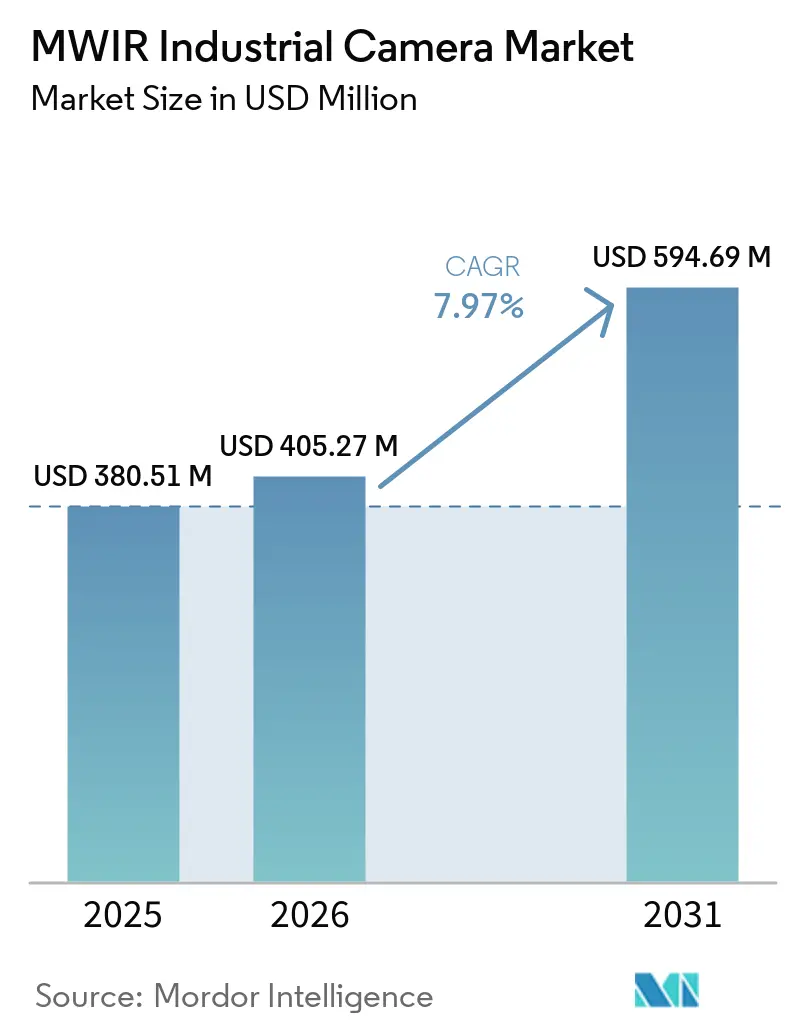
The MWIR Industrial Camera Market size is projected to be USD 380.51 million in 2025, USD 405.27 million in 2026, and reach USD 594.69 million by 2031, growing at a CAGR of 7.97% from 2026 to 2031. Defense procurement is supporting demand for cooled systems that can meet detection, targeting, and persistent surveillance requirements over long program cycles. Emissions rules are also making optical gas imaging equipment a necessary investment for many oil and gas operators. Longer-life coolers and embedded analytics are making fixed thermal systems more practical for continuous industrial use. These changes are expanding the MWIR industrial camera market beyond field inspection to include production monitoring, remote inspection, and automated security systems. Suppliers are responding with modular products, software-ready electronics, and camera designs that reduce maintenance needs while maintaining detection performance.
Key Report Takeaways
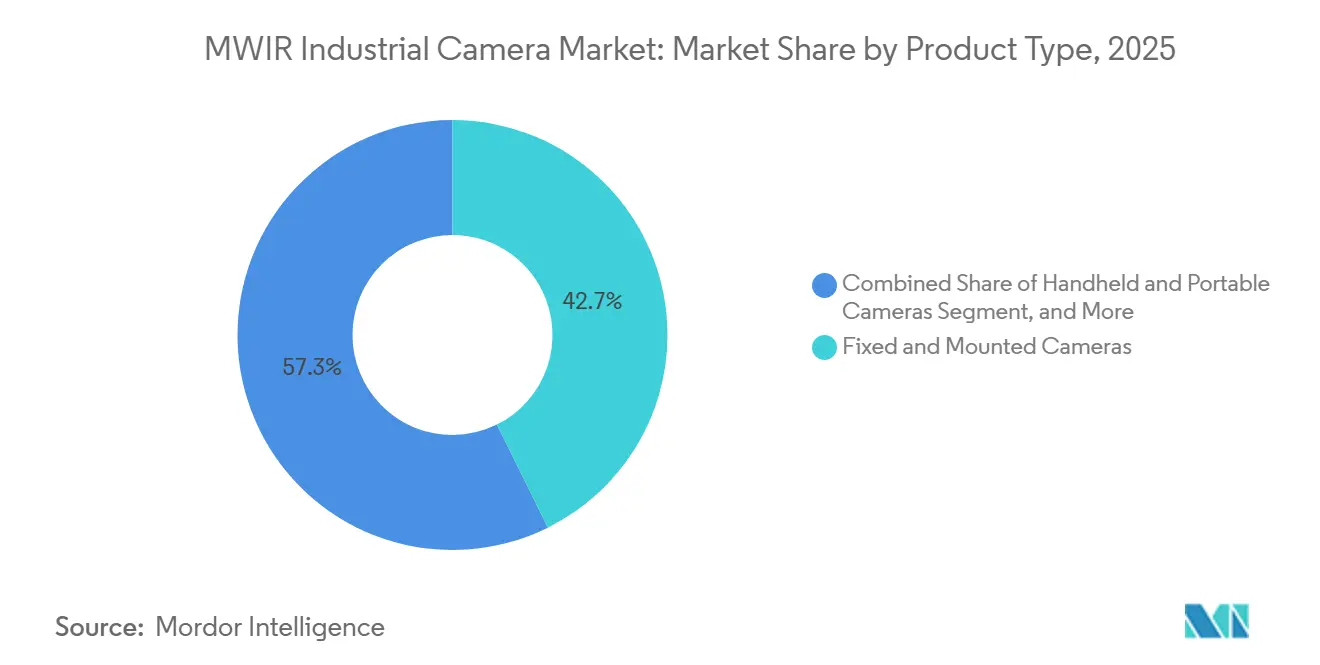
- By product type, fixed and mounted cameras held 42.68% of the MWIR industrial camera market share in 2025, while OEM camera cores and modules are projected to expand at a 9.84% CAGR through 2031.
- By detector technology, cooled MWIR cameras accounted for 87.42% of the MWIR industrial camera market share in 2025, while uncooled/HOT MWIR cameras are projected to expand at a 9.26% CAGR through 2031.
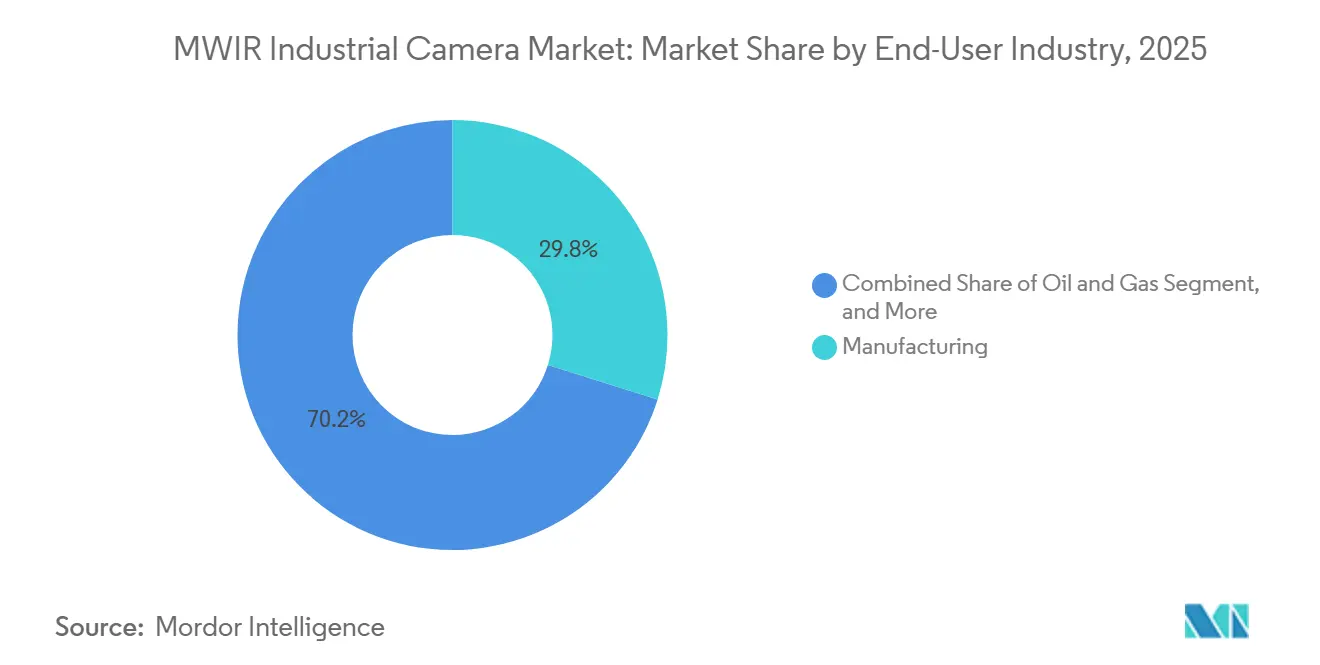
- By end-user industry, manufacturing held 29.84% of the MWIR industrial camera market share in 2025, while oil and gas is projected to expand at a 9.63% CAGR through 2031.
- By geography, North America held 38.76% of the MWIR industrial camera market share in 2025, while Asia-Pacific is projected to expand at a 9.41% CAGR through 2031.
Note: Market size and forecast figures in this report are generated using Mordor Intelligence’s proprietary estimation framework, updated with the latest available data and insights as of January 2026.
Global MWIR Industrial Camera Market Trends and Insights
Drivers Impact Analysis*
| Driver | (~) % Impact on CAGR Forecast | Geographic Relevance | Impact Timeline |
|---|---|---|---|
| Defense Modernization and Persistent ISR Procurement | +2.8% | Global, concentrated in North America, Europe, and Asia-Pacific | Long term (≥ 4 years) |
| Industrial Predictive Maintenance and Process Automation | +2.1% | Global | Medium term (2-4 years) |
| Optical Gas Imaging and Emissions Compliance Deployment | +1.4% | North America and EU core, spillover to Asia-Pacific | Medium term (2-4 years) |
| Drone-Integrated Inspection and Counter-UAS Adoption | +1.1% | Global | Medium term (2-4 years) |
| Edge AI Reducing MWIR Integration Friction | +0.9% | Global | Long term (≥ 4 years) |
| High-Temperature Process Visibility Through Flames and Smoke | +0.7% | Asia-Pacific, Europe, and Middle East | Short term (≤ 2 years) |
| Source: Mordor Intelligence | |||
Defense Modernization and Persistent ISR Procurement
Defense spending programs across NATO and Indo-Pacific countries are supporting more predictable procurement cycles for the MWIR industrial camera market. Armed drones, counter-UAS batteries, and persistent ground surveillance systems require more thermal sensors across programs. Buyers need systems with a wide performance range, compact designs, and low power requirements for land, naval, and airborne platforms. The Indian Navy acquired cooled high-definition MWIR EO/IR systems from Tonbo Imaging for more than 40 naval vessels during 2025, with vessel detection beyond 25 km. Teledyne FLIR OEM introduced the Neutrino SX8 ISR 50-1000 in February 2026, combining a 27,000-hour cooler rating, AI-ready processing, and a 34 km vehicle detection range. As platform volumes rise, suppliers are competing more directly on cooler life, integration readiness, and electronics that support automated image processing.
Industrial Predictive Maintenance and Process Automation
Industrial sites are moving from periodic thermal inspections toward installed systems that collect thermal information throughout the operating cycle. This transition supports demand for MWIR cameras that can detect abnormal heat patterns before equipment failures disrupt operations. The US Department of Energy identifies predictive maintenance as a route to lower operating costs when compared with reactive maintenance practices.[1]U.S. Department of Energy, “Operations and Maintenance Best Practices: A Guide to Achieving Operational Efficiency,” Federal Energy Management Program, energy.gov. Manufacturing buyers use this rationale when evaluating cameras for blast furnace monitoring, composite inspection, battery cell quality control, and semiconductor production. FLIR launched the A6450 in February 2026 with a linear cooler designed for up to 27,000 hours of operation, addressing a prior barrier to continuous deployment of cooled cameras. Thermographic maintenance guidance under NFPA 70B further supports consistent inspection practices for electrical infrastructure, manufacturing equipment, and utility assets.
Optical Gas Imaging and Emissions Compliance Deployment
US and European methane requirements are changing optical gas imaging from an optional safety practice into required compliance equipment for covered facilities. US EPA requirements under Subpart OOOOb and related provisions define performance expectations for optical gas imaging at crude oil and natural gas facilities. The specified resolution and sensitivity requirements favor cooled MWIR technology for prescribed methane and volatile organic compound detection work. Compliance deadlines can concentrate purchases into defined implementation periods rather than spreading them across routine capital budgets. LightPath Technologies introduced an industrial-grade cooled MWIR optical gas imaging camera in June 2025 and stated that it had been validated under the relevant US EPA procedures. Drone-mounted systems are also extending coverage to offshore and remote facilities where sending inspection crews is difficult or costly.
Drone-Integrated Inspection and Counter-UAS Adoption
Drone-mounted MWIR systems allow operators to inspect pipelines, offshore platforms, utility corridors, and confined assets without placing crews in difficult locations. These systems also support counter-UAS operations because passive thermal sensing can detect aerial targets without broadcasting an active signal. SLB states that its Aura optical gas imaging camera can detect methane leaks as small as 0.02 kg/h and provides stronger leak visibility than standard optical gas imaging resolution. LYNRED launched the DRACO MW SL in June 2026, a cooled SXGA MWIR detector with 1,280 × 1,024 pixels, 7.5 µm pixel pitch, and 130 K operation for land and counter-UAS uses. HGH Infrared Systems integrated SPYNEL-X MWIR panoramic cameras with the UNIFY.C2 counter-UAS command platform during January 2026. These developments make the MWIR industrial camera market relevant to inspection and security applications that require rapid data fusion and limited operator workload.
Restraints Impact Analysis*
| Restraint | (~) % Impact on CAGR Forecast | Geographic Relevance | Impact Timeline |
|---|---|---|---|
| Cryogenic Cooling Cost and Maintenance Burden | -0.7% | Global | Long term (≥ 4 years) |
| Export Controls and ITAR/EAR Procurement Friction | -0.5% | North America, affects Asia-Pacific export channels | Medium term (2-4 years) |
| Specialist Detector and Cooler Supply Constraints | -0.3% | Global, acute in Asia-Pacific | Medium term (2-4 years) |
| Calibration, Integration and Operator Skills Bottlenecks | -0.2% | Global, acute in developing markets | Short term (≤ 2 years) |
| Source: Mordor Intelligence | |||
Cryogenic Cooling Cost and Maintenance Burden
Cryogenic cooling remains a high-cost and service-related constraint for cooled MWIR cameras outside defense and high-value industrial applications. Legacy Stirling cryocoolers often required factory overhauls after 8,000-12,000 operating hours, creating downtime and service-planning challenges. This issue is especially important for manufacturers, utilities, and automotive facilities that need high equipment availability but do not maintain dedicated electro-optics support teams. Advances in HOT detector design are reducing cooling power needs and limiting mechanical wear at higher operating temperatures. Research on InAs/InAsSb nBn devices reported stable operation at 230 K, with noise-equivalent temperature differences below 15 mK. Research published in 2025 also reported that AI-based image enhancement could improve images from xBn MWIR cameras operating at 180 K.
Export Controls and ITAR/EAR Procurement Friction
Export controls create additional lead times and compliance work for camera manufacturers and international buyers of dual-use MWIR products. Cameras under ECCN 6A003 can require licenses when their frame rate or resolution exceeds applicable thresholds for certain destinations. In February 2026, the US Bureau of Industry and Security imposed a USD 1 million civil penalty on Teledyne FLIR for 19 violations involving unlicensed reexports and de minimis calculations. Government-to-Government processes for ITAR-controlled systems can also lengthen procurement schedules for program-sensitive applications. Teledyne FLIR OEM classified the Neutrino SX8 ISR 50-1000 as ITAR-free under EAR ECCN 6A003.b.4.a, giving foreign integrators greater sourcing flexibility. LYNRED began the EUR 39.16 million (USD 43.08 million) SPIRIT initiative in May 2026 to support a European infrared detector supply chain and reduce exposure to non-European component dependencies.
*Our forecasts treat driver/restraint impacts as directional, not additive. The impact forecasts reflect baseline growth, mix effects, and variable interactions.
Segment Analysis
By Product Type: Fixed Cameras Lead While OEM Modules Support Easier Integration
Fixed and mounted cameras held 42.68% of the MWIR industrial camera market share in 2025. Their position reflects use in continuous monitoring across production lines, oil and gas sites, and permanent border security installations. A longer, cooler service life makes fixed cooled systems more suitable for long operating cycles. GigE Vision and GenICam protocols also support integration with existing industrial automation environments. Handheld and portable cameras remain important for field LDAR, military reconnaissance, and inspection work where mobility is essential. Pan-tilt-zoom and multi-sensor systems serve long-range perimeter surveillance, naval installations, and applications that require motorized positioning or sensor fusion.
OEM camera cores and modules are projected to expand at a 9.84% CAGR through 2031 within the MWIR industrial camera market size. Drone, robotics, and autonomous vehicle developers can add MWIR capability without building an entire camera system. This approach reduces the need for each integrator to develop cryogenic, optical, and processing expertise internally. It also places greater emphasis on standardized interfaces, dependable supply, and application-specific calibration. LYNRED’s PlugUp platform standardizes cooled MWIR detector interfaces across product families, supporting common choices for detector, cooler, and readout integration. The wider availability of modules can extend MWIR use into specialized applications without requiring module suppliers to serve every end market directly.



By Detector Technology: Cooled Cameras Retain The Largest Position As HOT Designs Advance
Cooled MWIR cameras accounted for 87.42% of the MWIR industrial camera market size in 2025. Defense targeting, long-range intelligence, surveillance, and reconnaissance missions require the sensitivity that cooled InSb and MCT arrays provide. High-temperature industrial process monitoring also benefits from the contrast and detection capability of cooled systems. Long defense platform lifecycles reinforce this position because architecture decisions are usually made at the start of a program. FLIR’s FL100 linear Stirling cooler is rated for more than 27,000 operating hours through accelerated and SADA-profile life testing. This reliability improvement supports use in industrial systems that must operate over multiple years.
Uncooled/HOT MWIR cameras are projected to expand at a 9.26% CAGR through 2031. T2SL and nBn architectures allow higher operating temperatures of 150-230 K and can lower cooler power needs. LYNRED reported HOT II-VI detector developments in January 2026, featuring SXGA-format arrays, 7.5 µm pixel pitch, external quantum efficiency near 85%, and low spatio-temporal noise at temperatures up to 150 K. Cooled cameras are expected to retain their role in defense and premium industrial work through 2031. HOT systems are better suited to adjacent commercial and drone payload applications with demanding size, weight, and power limits. Image enhancement methods that address residual thermal noise can further support higher-temperature camera operation
By End-User Industry: Manufacturing Holds The Largest Position While Oil And Gas Leads Growth
Manufacturing held 29.84% of the MWIR industrial camera market share in 2025. The segment uses cameras for non-destructive testing of aerospace composites, in-line battery cell inspection, and process monitoring in steel, glass, and semiconductor fabrication. These environments benefit from thermal contrast at elevated process temperatures. FLIR and edevis combined the A6450’s 125 Hz MWIR imaging capability with laser-based thermal excitation during 2026. The combined system supports automated identification of subsurface defects in metals, composites, and battery components on production lines. MWIR cameras also support blast furnace tuyere monitoring, where regular thermal profiles can guide replacement planning before visible failure occurs.
Oil and gas are projected to expand at a 9.63% CAGR through 2031 within the MWIR industrial camera market. Mandatory leak detection and repair programs are driving demand for fixed and drone-mounted optical gas imaging systems. Aerospace and defense remain a stable high-value user group through government contracts, modernization programs, and use in targeting pods, missile warning, and maritime surveillance. Utilities use MWIR cameras for transformer monitoring, wind turbine blade inspection, and critical infrastructure security. Automotive and transportation users apply the technology to advanced driver-assistance testing and battery thermal management validation during electric vehicle production. Research institutes require high-specification hyperspectral and high-frame-rate systems for materials science, atmospheric observation, and defense research and development.
Geography Analysis
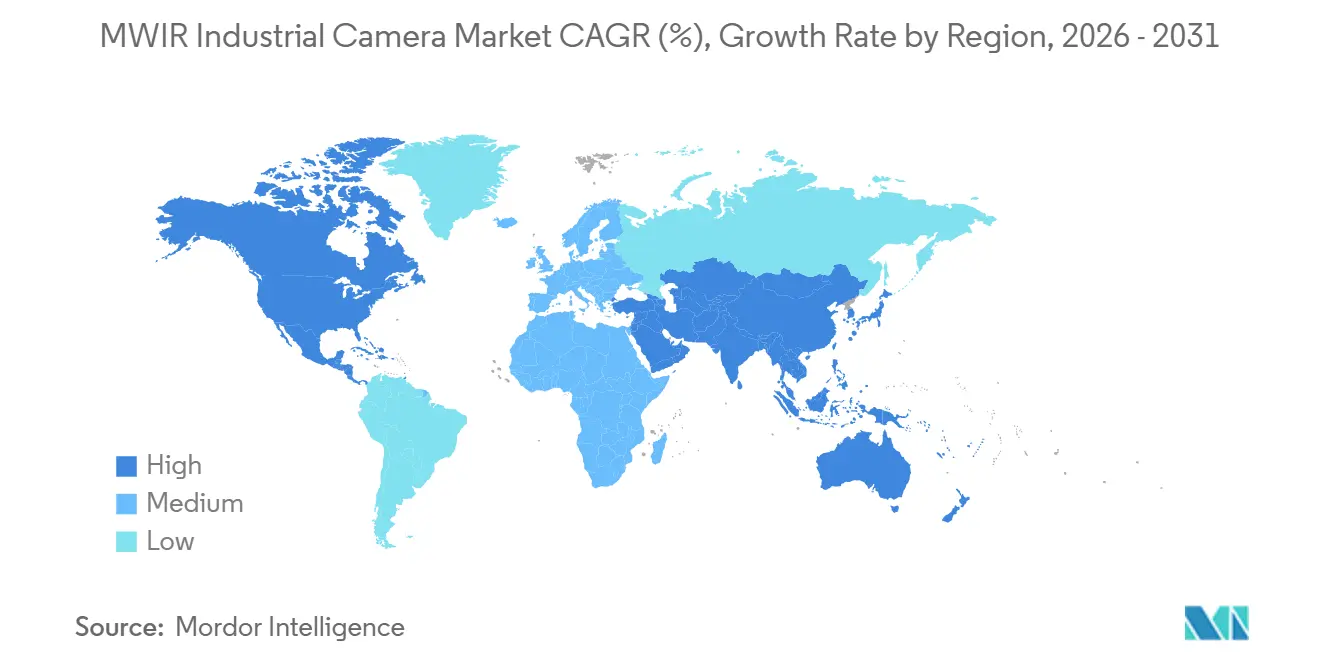
North America held 38.76% of the MWIR industrial camera market share in 2025. US defense ISR procurement has established optical gas imaging requirements and installed cameras at petrochemical, power, and aerospace sites to support its position. Canada’s oil sands operations require remote pipeline emissions monitoring. Mexico’s manufacturing expansion is adding demand for predictive maintenance systems. China’s germanium export restrictions led buyers to place greater importance on secure domestic optical and detector supply. LightPath Technologies has redesigned certain infrared optical assemblies using BlackDiamond materials to reduce exposure to future germanium supply disruptions.
Asia-Pacific is projected to expand at a 9.41% CAGR through 2031. China, India, South Korea, Taiwan, and Japan are increasing their defense capabilities and investment in industrial automation. In 2025, Tonbo Imaging supplied cooled high-definition MWIR EO/IR systems for more than 40 Indian Navy vessels, with detection capabilities beyond 25 km. China’s investment in HgCdTe detector production supports domestic consumption and competition in commercial camera applications. Japan allocated USD 52 million for the procurement of counter-drone systems in fiscal 2026. Taiwan’s semiconductor and advanced electronics plants are adopting MWIR systems for process monitoring and non-destructive inspection of advanced packages.
Europe has an important MWIR industrial camera market because of its defense base and emissions-monitoring requirements. The United Kingdom, Germany, France, and Scandinavian countries support demand across defense and industrial applications. LYNRED’s SPIRIT initiative involves 15 organizations from 9 European countries. It has a EUR 39.16 million (USD 43.08 million) budget, including EUR 29 million (USD 31.9 million) in European Defense Fund co-funding.[2]LYNRED, “LYNRED Launches SPIRIT, a Strategic European Project to Prepare the Next Generation of Sovereign Infrared Detectors,” LYNRED, lynred.com. The Middle East and Africa are buying systems for offshore patrol vessels, coastal surveillance, and critical infrastructure. South America has a developing demand for oil and gas emissions monitoring, while African demand centers on border security and infrastructure protection.

Competitive Landscape
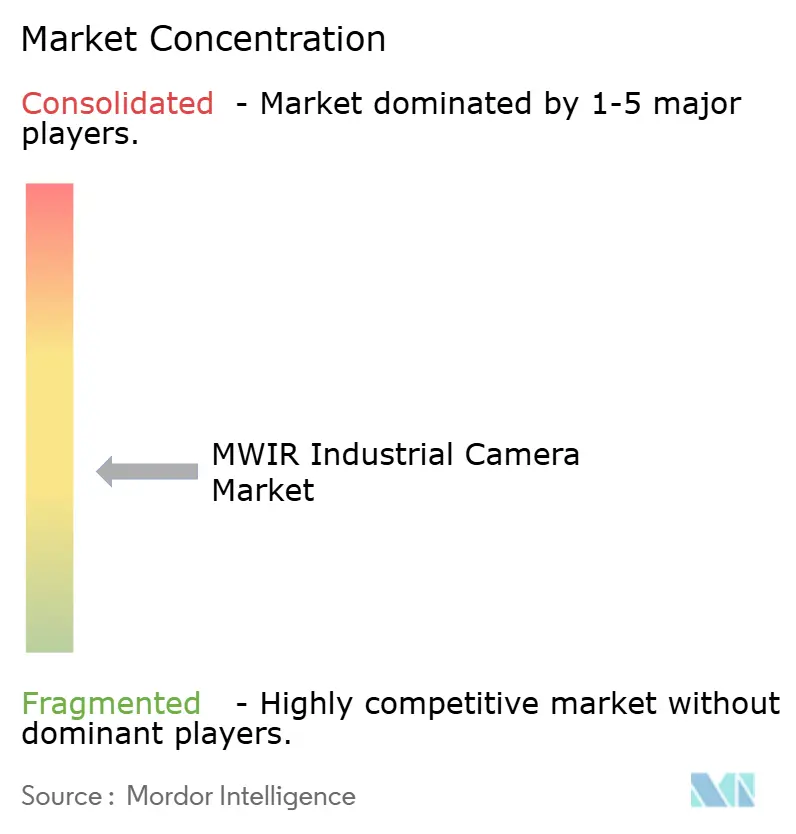
Teledyne FLIR has a broad portfolio covering defense modules, industrial automation cameras, and optical gas imaging systems. This portfolio gives it strong coverage across major end-user groups and geographic markets. The MWIR industrial camera market becomes moderately fragmented below the largest suppliers. Regional specialists, detector companies expanding into cameras, and defense subcontractors serve different parts of the value chain. Defense and ISR customers focus on performance, export classification, and long-term cooler reliability. Industrial customers place more weight on lifetime cost, straightforward integration, and software analytics.
HGH Infrared Systems signed contracts with Thales worth EUR 50 million (USD 55 million) in March 2026 for SPYNEL MWIR surveillance units supporting European air defense and national security applications.[3]HGH Infrared Systems, “HGH Announces the Signing of Major Contracts With Thales for Ground-Based Air Defense,” HGH Infrared Systems, hgh-infrared.com. HGH also secured a June 2026 contract with Abu Dhabi Ship Building, under EDGE Group, for the Kuwait Navy AL DORRA vessels. The contract covers SPYNEL 360° MWIR surveillance systems integrated with Leonardo’s Combat Management System. LYNRED is extending its detector business through standardized module platforms and investments in European supply capability. Exosens acquired Emberion in April 2026, adding 25 patent families related to quantum dot infrared sensor technology. These moves show that supplier strategies increasingly combine component technology, platform integration, and access to specialized defense applications.
Opportunities remain in drone-based optical gas imaging for remote or offshore oil and gas sites. AI-enabled MWIR modules also address inspection robots in semiconductor plants and battery factories, where continuous monitoring is valuable. The Emberion acquisition strengthens Exosens’ position in sensing technologies near the SWIR-MWIR boundary. Compliance controls remain a central consideration for suppliers selling to international defense buyers. The February 2026 Bureau of Industry and Security action involving Teledyne FLIR showed the importance of de minimis valuation and customer screening. The competitive structure may consolidate as detector specialists, electro-optics integrators, and larger suppliers acquire differentiated technologies.
MWIR Industrial Camera Industry Leaders
Teledyne FLIR LLC
Telops Inc.
Sierra-Olympic Technologies, Inc.
InfraTec GmbH
Exosens S.A.
- *Disclaimer: Major Players sorted in no particular order

Recent Industry Developments
- June 2026: HGH Infrared Systems secured a contract with Abu Dhabi Ship Building under EDGE Group to equip 8 Offshore Patrol Vessels of Kuwait Navy’s AL DORRA program with SPYNEL 360° MWIR infrared surveillance systems, fully integrated with Leonardo’s Combat Management System, a significant naval MWIR deployment demonstrating the growing demand for ship-borne MWIR panoramic sensors in Gulf states’ maritime modernization programs.
- June 2026: LYNRED launched the DRACO MW SL at Eurosatory 2026, a new cooled SXGA MWIR detector with 1,280 × 1,024 pixels, 7.5 µm pixel pitch, T2SL technology, full 3.7-4.8 µm spectral coverage, 60 Hz frame rate, and 130 K operating temperature, optimized for counter-UAS sensing systems and land vehicle optronics, positioned within the PlugUp standardized integration platform to accelerate OEM camera development.
- May 2026: LYNRED launched the SPIRIT project in partnership with 14 European organizations across 9 countries, backed by a total estimated budget of EUR 39.16 million (USD 43.08 million) with EUR 29 million (USD 31.9 million) in European Defence Fund co-funding, targeting sovereign infrared detectors with ≥3 megapixel resolution and sub-7 µm pixel pitches for missile detection, drone detection, naval, and camouflage-detection applications.
- April 2026: Exosens acquired 100% of Emberion, a Finland and United Kingdom-based company specializing in quantum dot infrared sensors supported by 25 patent families worldwide, strengthening Exosens’ infrared imaging portfolio for defense, surveillance, and industrial control applications.


Global MWIR Industrial Camera Market Report Scope
The MWIR Industrial Camera Market comprises specialized imaging systems that detect and capture radiation in the mid-wave infrared (MWIR) spectrum, generally covering wavelengths of approximately 3-5 μm, for industrial inspection, condition monitoring, process control, security, measurement, and research applications. MWIR cameras use infrared detector technologies to generate thermal or spectral images of objects, materials, equipment, and processes, enabling visualization and analysis in conditions where visible-light imaging may be ineffective.
The MWIR Industrial Camera Market Report is Segmented by Product Type (Fixed and Mounted Cameras, Handheld and Portable Cameras, OEM Camera Cores and Modules, and Pan Tilt Zoom and Multi Sensor Systems), by Detector Technology (Cooled MWIR Cameras, and Uncooled/HOT MWIR Cameras), by End-User Industry (Manufacturing, Oil and Gas, Power Generation and Utilities, Aerospace and Defense, Automotive and Transportation, Research Institutes, and Other End-User Industries), and Geography (North America, South America, Europe, Asia-Pacific, Middle East, and Africa). The Market Forecasts are Provided in Terms of Value (USD).
| Fixed and Mounted Cameras |
| Handheld and Portable Cameras |
| OEM Camera Cores and Modules |
| Pan Tilt Zoom and Multi Sensor Systems |
| Cooled MWIR Cameras |
| Uncooled/HOT MWIR Cameras |
| Manufacturing |
| Oil and Gas |
| Power Generation and Utilities |
| Aerospace and Defense |
| Automotive and Transportation |
| Research Institutes |
| Other End-User Industries |
| North America | United States |
| Canada | |
| Mexico | |
| South America | Brazil |
| Argentina | |
| Rest of South America | |
| Europe | Germany |
| United Kingdom | |
| France | |
| Italy | |
| Spain | |
| Rest of Europe | |
| Asia-Pacific | China |
| Japan | |
| South Korea | |
| India | |
| Taiwan | |
| Rest of Asia-Pacific | |
| Middle East | United Arab Emirates |
| Saudi Arabia | |
| Rest of Middle East | |
| Africa | South Africa |
| Egypt | |
| Rest of Africa |
| By Product Type | Fixed and Mounted Cameras | |
| Handheld and Portable Cameras | ||
| OEM Camera Cores and Modules | ||
| Pan Tilt Zoom and Multi Sensor Systems | ||
| By Detector Technology | Cooled MWIR Cameras | |
| Uncooled/HOT MWIR Cameras | ||
| By End-User Industry | Manufacturing | |
| Oil and Gas | ||
| Power Generation and Utilities | ||
| Aerospace and Defense | ||
| Automotive and Transportation | ||
| Research Institutes | ||
| Other End-User Industries | ||
| By Geography | North America | United States |
| Canada | ||
| Mexico | ||
| South America | Brazil | |
| Argentina | ||
| Rest of South America | ||
| Europe | Germany | |
| United Kingdom | ||
| France | ||
| Italy | ||
| Spain | ||
| Rest of Europe | ||
| Asia-Pacific | China | |
| Japan | ||
| South Korea | ||
| India | ||
| Taiwan | ||
| Rest of Asia-Pacific | ||
| Middle East | United Arab Emirates | |
| Saudi Arabia | ||
| Rest of Middle East | ||
| Africa | South Africa | |
| Egypt | ||
| Rest of Africa | ||


Key Questions Answered in the Report
What is the size of the MWIR industrial camera market?
The MWIR industrial camera market size is USD 405.27 million in 2026 and is projected to reach USD 594.69 million by 2031 at a 7.97% CAGR.
Which product type holds the largest share in MWIR industrial cameras?
Fixed and mounted cameras held the largest share at 42.68% in 2025 because they support continuous monitoring at industrial, oil and gas, and security sites.
Why are cooled MWIR cameras widely used?
Cooled MWIR cameras held 87.42% of value in 2025 because defense, long-range ISR, and high-temperature industrial processes need strong thermal sensitivity.
Which end user is expected to expand fastest through 2031?
Oil and gas is projected to expand at a 9.63% CAGR through 2031, supported by leak detection requirements and use of drone-mounted optical gas imaging.
Which region is expected to expand fastest?
Asia-Pacific is projected to expand at a 9.41% CAGR through 2031, supported by defense programs and industrial automation investment.
What technology development is reducing maintenance barriers?
New HOT detector designs and longer-life linear coolers, including FLIR’s 27,000-hour A6450 platform, support more continuous industrial deployment.
Page last updated on:





