
LWIR Industrial Imaging Systems Market Size and Share
Market Overview
| Study Period | 2020 - 2031 |
|---|---|
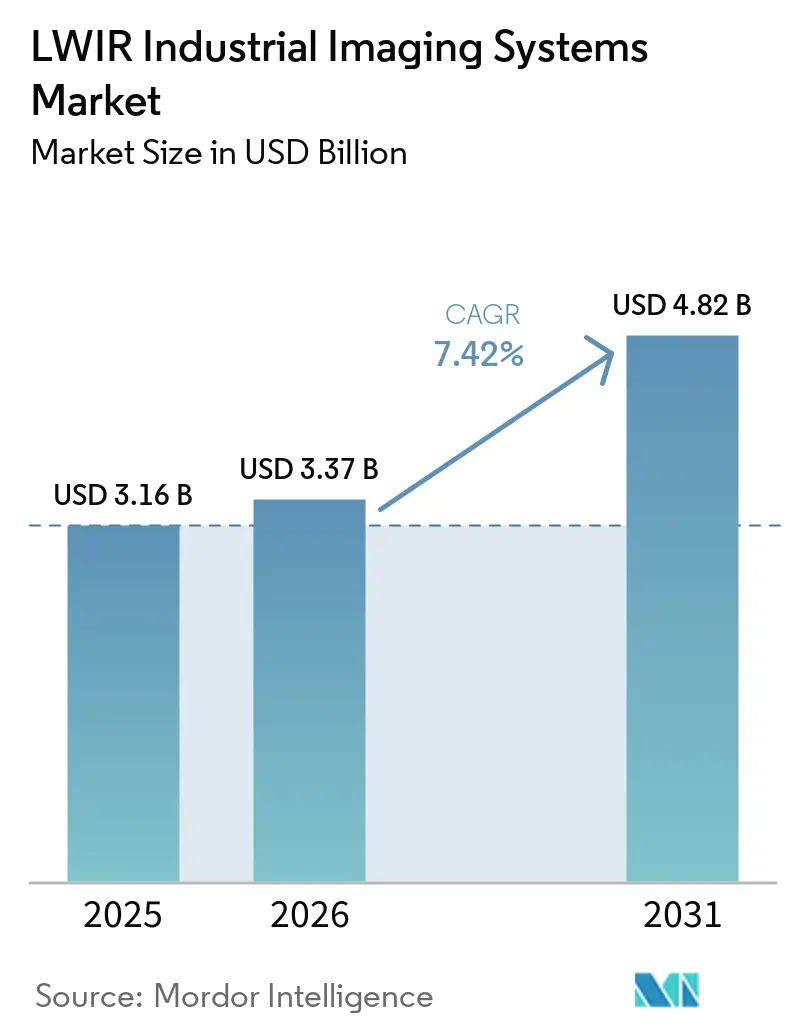
| Market Size (2026) | USD 3.37 Billion |
| Market Size (2031) | USD 4.82 Billion |
| Growth Rate (2026 - 2031) | 7.42 % |
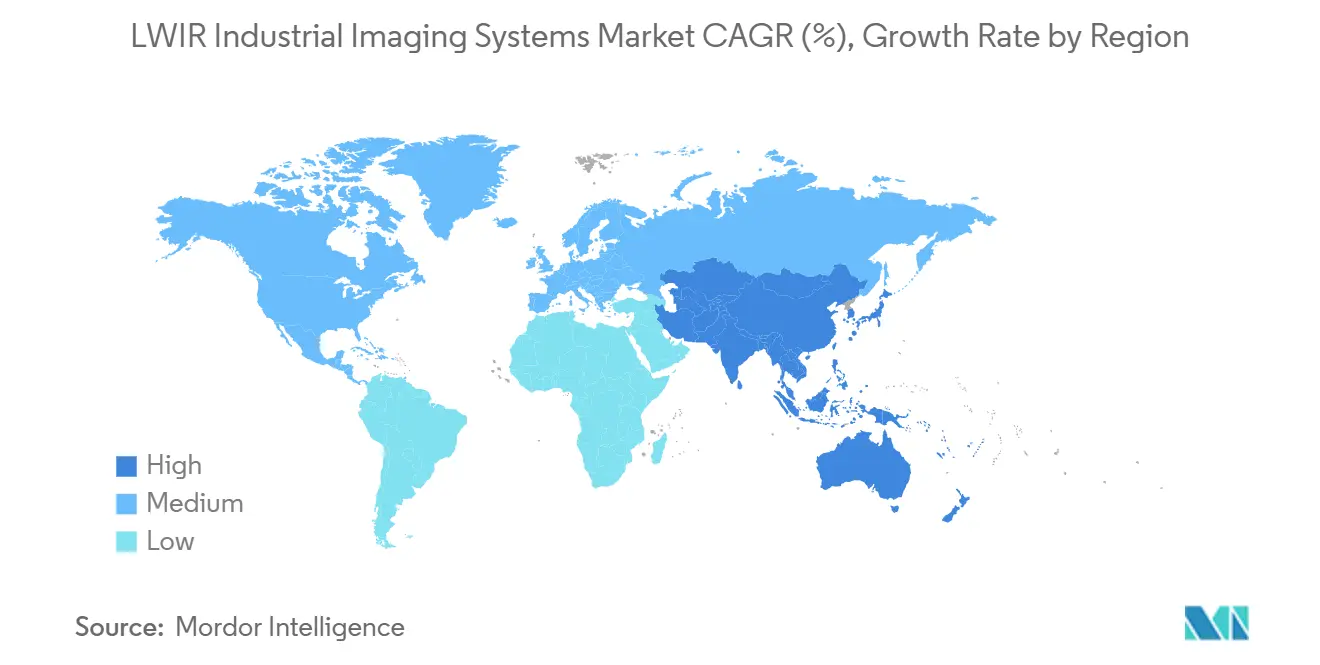
| Fastest Growing Market | Asia-Pacific |
| Largest Market | North America |
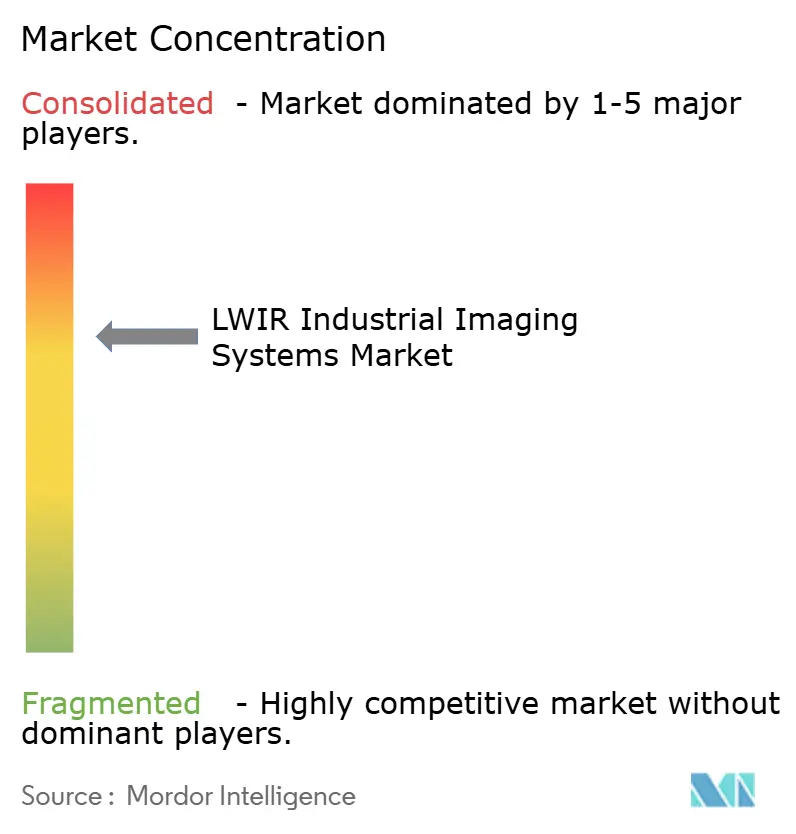
| Market Concentration | Medium |
Major Players *Disclaimer: Major Players sorted in no particular order Image © Mordor Intelligence. Reuse requires attribution under CC BY 4.0. | |
LWIR Industrial Imaging Systems Market Analysis by Mordor Intelligence
The LWIR industrial imaging systems market size is projected to expand from USD 3.16 billion in 2025 and USD 3.37 billion in 2026 to USD 4.82 billion by 2031, registering a CAGR of 7.42% between 2026 to 2031. The LWIR industrial imaging systems market enters 2026 with demand across optical gas imaging, non-destructive testing, and process thermography. Smaller-pixel detectors are lowering the cost of uncooled systems and making thermal sensing more practical for a wider set of industrial users. Methane monitoring rules are making leak detection a recurring procurement need for oil and gas operators. Edge computing is also allowing thermal data to support automated inspection platforms instead of periodic manual surveys. These conditions support continued expansion of the LWIR industrial imaging systems market through 2031.
Key Report Takeaways
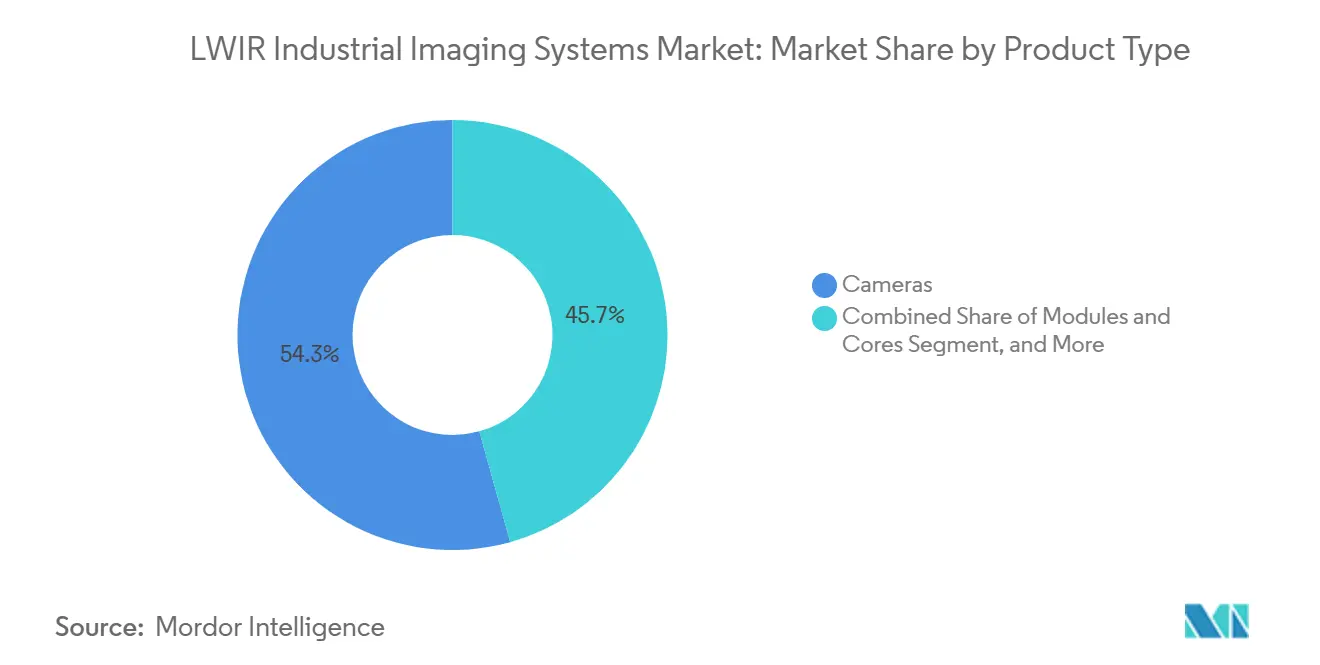
- By product type, cameras held 54.32% of the LWIR industrial imaging systems market share in 2025, while modules and cores are expected to be the fastest-growing product segment through 2031.
- By technology, uncooled systems held 82.47% of revenue in 2025, while cooled LWIR is expected to be the fastest-growing technology segment through 2031.
- By form factor, fixed-mount configurations held 38.65% of revenue in 2025, while vehicle-mounted and drone-mounted finished payload systems are projected to expand at a 7.93% CAGR through 2031.
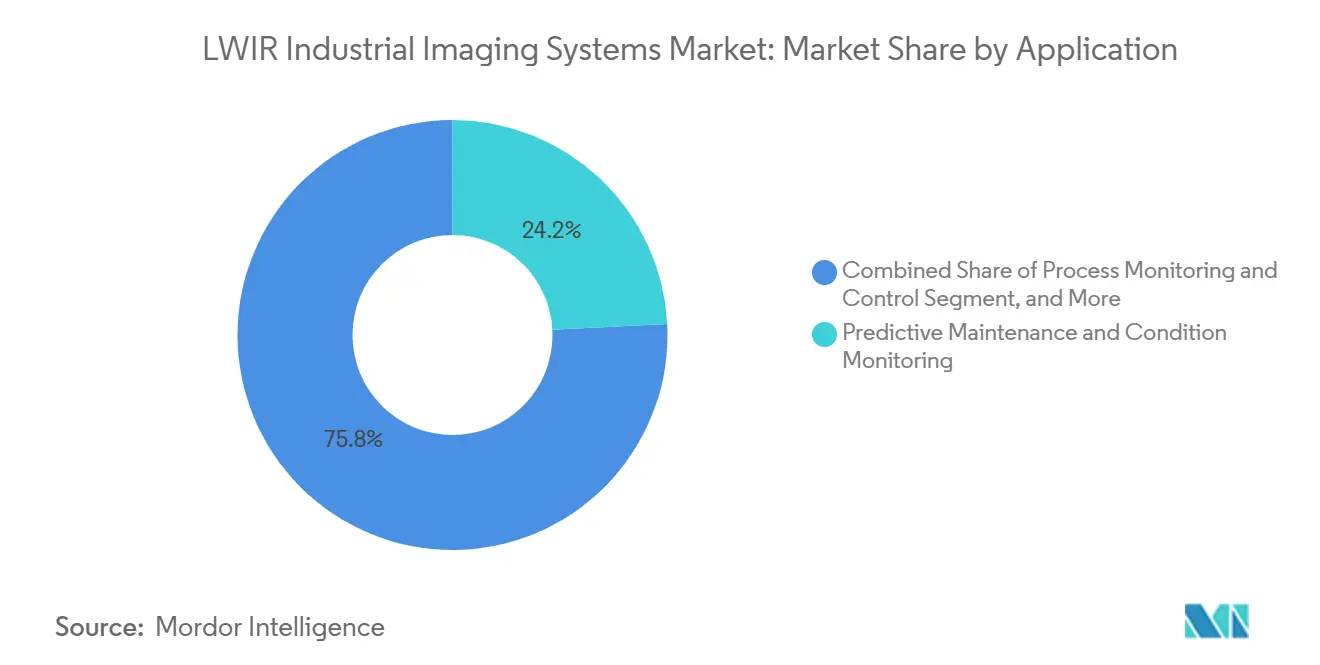
- By application, predictive maintenance and condition monitoring held 24.18% of revenue in 2025, while optical gas imaging and emissions monitoring is projected to expand at an 8.22% CAGR through 2031.
- By end-user industry, industrial manufacturing held 26.73% of revenue in 2025, while semiconductor and electronics is projected to expand at an 8.14% CAGR through 2031.
- By geography, North America held 33.92% of global revenue in 2025, while Asia-Pacific is projected to expand at an 8.16% CAGR through 2031.
Note: Market size and forecast figures in this report are generated using Mordor Intelligence’s proprietary estimation framework, updated with the latest available data and insights as of January 2026.
Global LWIR Industrial Imaging Systems Market Trends and Insights
Drivers Impact Analysis*
| Driver | (~) % Impact on CAGR Forecast | Geographic Relevance | Impact Timeline |
|---|---|---|---|
| Industrial Predictive Maintenance Adoption | +2.0% | Global, with primary demand in North America, Europe, and Asia-Pacific industrial corridors | Medium term (2-4 years) |
| Falling Cost of Uncooled Microbolometer Cores | +1.8% | Global, led by Asia-Pacific manufacturing hubs with spill-over to North America and Europe | Short term (≤ 2 years) |
| Methane and Fugitive-Emission Monitoring Requirements | +1.4% | North America and EU core, with growing application in Middle East and South America | Medium term (2-4 years) |
| AI-Enabled Thermal Analytics in Smart Factories | +1.0% | Global, led by Germany, Japan, South Korea, and the United States | Medium term (2-4 years) |
| Edge-Ready LWIR Modules for Autonomous Inspection Robots | +0.7% | North America, Europe, and East Asia, with spill-over to ASEAN industrial parks | Long term (≥ 4 years) |
| Germanium-Free Optics and Wafer-Level Packaging Innovation | +0.5% | Global, led by US defense programs and Asia-Pacific consumer-grade OEM channels | Short term (≤ 2 years) |
| Source: Mordor Intelligence | |||
Industrial Predictive Maintenance Adoption
Industrial operators in power generation, chemicals, and precision manufacturing are moving from time-based maintenance toward condition-based programs. These programs use thermal monitoring to identify abnormal heat before equipment failures become more serious. The 2026 edition of NFPA 70B requires US industrial facilities to establish defensible, evidence-based maximum maintenance intervals for electrical equipment. This requirement supports the procurement of cameras and related inspection services for repeatable electrical surveys. ISO 18434-1 provides a technical framework for condition monitoring of machines through thermography, which can reduce procurement uncertainty for cautious buyers. Thermal imaging software connections within industrial platforms also support automated fault classification and reduce the need for manual hotspot review.
Falling Cost of Uncooled Microbolometer Cores
Falling detector costs are widening the practical reach of the LWIR industrial imaging systems market. Pixel pitch has moved from 17 µm to 12 µm and is now commercially available at 8 µm. This progression reduces die area and lowers material requirements while supporting higher resolution. LYNRED launched its YOCTO family in January 2026 with an 8.5-µm pitch, a 1,024×768 XGA array, and an 18×18×4.85 mm³ package. The company stated that the product delivers 40% better detection, recognition, and identification performance than 12-µm benchmarks and fits 2.5 times more pixels in the same sensor footprint.[1]LYNRED, “LYNRED Unveils YOCTO, a New Ultra-Compact 8µm Microbolometer Pushing Uncooled Thermal Imaging to a New Level,” LYNRED, lynred.com. Lower-cost cores can bring food processing, electronics quality control, and building diagnostics within the reachable demand base for thermal imaging.
Methane and Fugitive-Emission Monitoring Requirements
Optical gas imaging is becoming more closely tied to compliance activity in the LWIR industrial imaging systems market. The US Environmental Protection Agency requires leak detection and repair surveys at oil and gas facilities under Subpart OOOOb and Emissions Guidelines OOOOc. Appendix K specifies a minimum methane detection sensitivity of 19 g/hr at 2 meters for the optical gas imaging instrument. EU Regulation 2024/1787 entered into force on June 13, 2024, and sets methane monitoring, reporting, and verification requirements for energy-sector operators.[2]European Parliament and Council, “Regulation EU 2024/1787 on the Reduction of Methane Emissions in the Energy Sector,” EUR-Lex, eur-lex.europa.eu. From 2027, fossil-fuel importers into the EU will need to demonstrate equivalent measurement standards. These rules favor cooled LWIR and specialized gas-filter-correlation cameras where sensitivity and spectral specificity are needed in complex outdoor settings.
AI-Enabled Thermal Analytics in Smart Factories
AI-enabled analysis gives thermal cameras a more direct role in production decisions. The EU Horizon Europe-funded Zero Defects, Zero Waste project showed that AI-driven thermal inspection can support closed-loop process control in thermoforming lines.[3]Zero Defects, Zero Waste Consortium, “AI and Digital Twin Driven Closed-Loop Thermal Inspection,” Zenodo, zenodo.org. This approach can identify process variation before it reaches later stages of production. Research on steel reheating furnaces reported strong anomaly-detection performance across burner zones using thermal video and deep-learning models. IRmodules states that its NEXUS LV0619B combines a neural processing unit with a high-resolution detector on the same printed circuit board. The module runs full thermal detection pipelines with low power consumption and without an external compute board, supporting real-time analysis on payload-constrained drone platforms.
Restraints Impact Analysis*
| Restraint | (~) % Impact on CAGR Forecast | Geographic Relevance | Impact Timeline |
|---|---|---|---|
| Calibration and Measurement-Traceability Cost | -0.9% | Global, most acute in regulated industries across North America and Europe | Medium term (2-4 years) |
| High Cost of Cooled and High-Resolution Configurations | -0.8% | Global, particularly limiting adoption in SME segments and cost-sensitive emerging markets | Long term (≥ 4 years) |
| Germanium Supply Concentration and Price Volatility | -0.7% | North America and Europe primarily, with indirect effects in Asia-Pacific OEM channels | Short term (≤ 2 years) |
| Export-Control and Cybersecurity Qualification Burden | -0.5% | North America, EU, and cross-border programs in Asia-Pacific and the Middle East | Medium term (2-4 years) |
| Source: Mordor Intelligence | |||
Calibration and Measurement-Traceability Cost
Calibration costs can slow purchasing decisions in regulated parts of the LWIR industrial imaging systems market. Quantitative thermography needs periodic calibration when temperature readings support process control, insurance audits, or compliance records. ISO/IEC 17025-accredited calibration links instruments to national measurement systems. IEC prEN 63144 sets procedures for metrological characterization and calibration of thermographic imagers used in industrial process control. The standard addresses blackbody radiator requirements, calibration temperature ranges, and repeatability verification. Those requirements create recurring costs that rise with fleet size, even when systems are not used continuously.
High Cost of Cooled and High-Resolution Configurations
Cooled and high-resolution products remain costly for many prospective users of the LWIR industrial imaging systems market. Industrial cooled LWIR systems with InSb or HgCdTe arrays can exceed USD 50,000 per unit. These products are used for optical gas imaging, high-speed metallurgical inspection, and sub-millikelvin non-destructive testing. Cryocooler costs and servicing needs also add to lifetime ownership costs. Teledyne FLIR introduced the A6450 Long-Life Cooled MWIR camera in February 2026 for continuous industrial automation, process control, and non-destructive testing. Its extended-life cooling architecture addresses downtime from cryocooler replacement, but cooled adoption remains concentrated in applications with high asset value.
*Our forecasts treat driver/restraint impacts as directional, not additive. The impact forecasts reflect baseline growth, mix effects, and variable interactions.
Segment Analysis
By Product Type: Cameras Support Current Revenue and Modules Extend OEM Use
Cameras held 54.32% of the LWIR industrial imaging systems market share in 2025. Their position reflects the integrated form factor, which combines optics, a calibrated detector, processing electronics, and an output interface. This arrangement reduces integration work for end users that need fast deployment. Handheld cameras support field inspection, while fixed-mount systems are used for electrical panels and continuous process observation. The LWIR industrial imaging systems market size associated with cameras is also supported by recurring replacement demand in substations, process-heat monitoring locations, and building-envelope diagnostics.
Modules and cores are the fastest-growing product segment through 2031. Automation-equipment builders, drone-payload manufacturers, and process-control providers use these components in wider sensor architectures. Their use gives OEMs more flexibility over optics, software, packaging, and system design. LYNRED positioned its January 2026 YOCTO launch for compact OEM integration at an 8.5-µm pixel pitch. Integrated imaging systems also appeal where embedded analytics and configured data logging reduce commissioning work. Other product types continue to serve specialized requirements that do not fit standard camera or module offerings, keeping the category relevant where buyers need a configuration designed around a particular workflow, installation setting, interface requirement, or level of analytical capability rather than a standard form factor.



By Technology: Uncooled Systems Lead While Cooled Products Serve Demanding Uses
Uncooled systems accounted for 82.47% of revenue in 2025. Vanadium-oxide microbolometer production has reduced unit costs and expanded resolution choices toward 640×512 and SXGA formats. Ambient-temperature operation removes the need for a cryocooler. This feature supports long operating life in continuous factory and infrastructure monitoring. The LWIR industrial imaging systems market share of uncooled technology, therefore, rests on lower complexity, lower ownership costs, and broad suitability for routine thermography.
Cooled LWIR is the fastest-growing technology segment through 2031. Its higher sensitivity supports optical gas imaging, high-speed metallurgical monitoring, and applications that exceed uncooled performance limits. Exosens announced plans in July 2026 to triple total thermal-camera production capacity during 2026, including an earlier plan to double cooled infrared camera output. In April 2026, Exosens completed its acquisition of Emberion, expanding its position in quantum-dot infrared sensor technology for semiconductor inspection and portable defense and surveillance imaging. Emerging LWIR technologies may serve specialized needs where conventional uncooled and cooled designs do not provide the required combination of performance and integration, particularly when an application places equal importance on measurement quality, physical size, operating reliability, and a practical path to deployment within an existing industrial process.
By Form Factor: Fixed Systems Lead and Mobile Payloads Expand Coverage
Fixed-mount configurations held 38.65% of form-factor revenue in 2025. They are used for permanent process monitoring, conveyor inspection, and other applications where the same asset needs repeated observation. A fixed system can produce consistent data from a known position and can support calibration and service arrangements. Handheld instruments retain a role in field compliance work and maintenance rounds. The LWIR industrial imaging systems market size for fixed installations benefits from demand at established industrial sites, where operators can justify permanent equipment when it supports frequent observation, consistent measurement conditions, planned service work, and a record of temperature information for maintenance and process-management teams.
Vehicle-mounted and drone-mounted finished payload systems are projected to expand at a 7.93% CAGR through 2031. Utilities, pipeline operators, wind farms, and large manufacturing campuses use mobile platforms where ground inspections are difficult. The 8-14 µm band can support aerial work in dust, smoke, and low-visibility conditions. Exosens introduced its MicroCube XP series for drone integration, with shutterless operation and instant startup. OEM-integrated modules are also gaining use as automotive, consumer-electronics, and gas-detection manufacturers incorporate LWIR sensing during product design, allowing each manufacturer to align the thermal component with its own enclosure, interface, software environment, power budget, and wider product requirements before production begins.
By Application: Compliance and Process Information Support Distinct Demand Areas
Predictive maintenance and condition monitoring held 24.18% of application revenue in 2025. Electrical inspection fleets require recurring surveys, replacement equipment, and calibration activity. Utilities, industrial manufacturers, and oil and gas operators use thermography to identify heat patterns linked to possible equipment problems. Thermography and general inspection also address broad professional field requirements. The LWIR industrial imaging systems market share for predictive maintenance is supported by repeatable work across large installed equipment bases, because the same equipment population can require routine checks over many years, and gives users a clear reason to standardize inspection practices, reporting, and follow-up actions.
Optical gas imaging and emissions monitoring are projected to expand at an 8.22% CAGR through 2031. US EPA requirements and the EU Methane Regulation are increasing the importance of close-range direct measurement and leak detection. Process monitoring and control serve glass, metals, and ceramics production. Machine vision and quality assurance identify heat-related defects in food sealing, printed circuit board assembly, and composites. Fire detection supports public-sector procurement at critical infrastructure sites, while non-destructive testing requires higher-resolution systems for aerospace and civil construction, leaving the application mix dependent on whether the buyer needs broad early warning, routine process data, regulatory evidence, or detailed analysis of a specific asset.
By End-User Industry: Industrial Manufacturing Leads and Semiconductor Demand Advances
Industrial manufacturing retained 26.73% of end-user revenue in 2025. This segment includes electrical maintenance, conveyor monitoring, and inline quality inspection. Its demand base is spread across many facilities and use cases. Thermal imaging can fit routine inspection programs as well as fixed production environments. The LWIR industrial imaging systems market share held by industrial manufacturing reflects this broad operational use, since plants can apply thermal equipment to maintenance, material movement, equipment reliability, and quality verification without limiting its value to one narrowly defined production task or physical location.
Semiconductor and electronics are projected to expand at an 8.14% CAGR through 2031. Advanced packaging uses chiplet integration, 3D stacking, and through-silicon-via architectures that require precise inline thermal verification. Oil, gas, power, and utilities sustain high spending at individual sites. Aerospace and defense support demand for premium cooled detectors. Automotive and transportation use LWIR systems for electric-vehicle battery thermal-management verification, while food and consumer products, buildings and infrastructure, chemicals, and mining and metals complete the demand base, creating a broad collection of customers with different purchasing cycles, performance needs, and service expectations.
Geography Analysis
North America held 33.92% of the LWIR industrial imaging systems market revenue in 2025. The United States has dense upstream energy infrastructure, electrical maintenance programs, and defense-related thermal-sensor procurement. The FY2026 National Defense Authorization Act directs the elimination of covered-nation infrared optics from defense supply chains by 2030. This direction is supporting domestic detector qualification and supply-chain work for US suppliers. Canada’s oil sands and Mexico’s electronics manufacturing add regional demand. Europe is shaped by replacement cycles for optical gas imaging cameras as methane rules move toward fuller compliance in 2027, which makes regulatory readiness, documented inspection capability, and dependable measurement procedures important considerations for operators that need to plan equipment purchases across several facilities.
Asia-Pacific is projected to expand at an 8.16% CAGR through 2031. Semiconductor fabrication investment, electric-vehicle battery gigafactory expansion, and industrial automation programs support procurement across the region. China combines detector fabrication, optics, and camera assembly through vertically integrated suppliers. Guide Infrared, HIKMICRO, and InfiRay Technology have shifted commercial thermal-imaging price points downward through this model. South Korea’s semiconductor sector creates concentrated demand for wafer-level thermal inspection. Japan has a role in cooled detector materials, while India is a fast-growing end-use location for factory predictive maintenance, so regional activity combines component supply, system production, and expanding use at industrial sites rather than depending on a single thermal-imaging purchasing pattern.
South America, the Middle East, and Africa represented a smaller but expanding revenue base. Brazil’s industrial manufacturing and Argentina’s upstream oil and gas operations support thermal inspection activity. Saudi Arabia and the UAE are expanding predictive maintenance programs at refinery and petrochemical sites. Turkey adds demand for process thermography. South Africa’s mining and power utilities support African demand, while Nigeria’s oil and gas activity has potential that is limited by access to calibration services, illustrating how local support capabilities can influence adoption where instruments must be maintained, verified, and returned to service without long delays or high logistics costs.

Competitive Landscape
The LWIR industrial imaging systems market has a moderately concentrated global structure. Teledyne FLIR LLC has a broad portfolio across cameras, OEM modules, integrated systems, and edge-AI development platforms. Its product range covers both cooled and uncooled technology lines. European specialists such as LYNRED S.A.S., Exosens and its Xenics brand, and Optris GmbH hold premium positions through detector development. LYNRED coordinates the SPIRIT sovereignty initiative across 15 entities in 9 countries, bringing detector development into a broader regional effort that addresses technology capability, supply-chain resilience, and the need for suppliers to maintain specialist positions in high-value thermal-imaging applications.
InfiRay Technology Co., Ltd., HIKMICRO, and Guide Infrared Co., Ltd. compete through vertical integration and lower pricing in mid-resolution uncooled products. This approach is extending into professional, industrial, and optical gas imaging products where customers are price sensitive. The LWIR industrial imaging systems market contains a gap in cooled systems priced from USD 10,000 to USD 30,000. Western suppliers protect premium margins, while Chinese producers have not fully qualified cooled platforms for industrial process-control requirements. Teledyne FLIR OEM launched the Boson SX8 in June 2026 as an NDAA-compliant, volume-production uncooled LWIR module with an 8-µm pixel pitch and 1,280×1,024 SXGA resolution. The product uses an ITAR-free package for defense and industrial integration.
Thermal hardware and edge-AI compute are also encouraging alliances between component providers and system integrators. Teledyne FLIR OEM launched the Lepton XDS in February 2026, combining a 160×120 radiometric thermal sensor with a 5-megapixel visible camera for embedded, mobile, and industrial OEM development. The company also introduced Tura in January 2026 as an ASIL-B LWIR camera developed for autonomous vehicle and advanced driver-assistance applications. NDAA compliance and ITAR-free designations have become product-architecture considerations for global OEM customers. These requirements can favor suppliers that qualify their components for restricted procurement environments, because customers in defense-linked and sensitive industrial programs may assess compliance status early in the selection process alongside detector performance, package size, software compatibility, delivery assurance, and product lifecycle support.
LWIR Industrial Imaging Systems Industry Leaders
Teledyne FLIR LLC
Fluke Corporation
Opgal Optronic Industries Ltd.
Exosens
Lynred S.A.S.
- *Disclaimer: Major Players sorted in no particular order

Recent Industry Developments
- July 2026: Exosens announced plans to triple its total thermal camera production capacity in 2026, complementing an earlier announcement to double cooled infrared camera output. The expansion targets drone and counter-drone defense applications where cooled infrared technology enables threat detection at distances of several tens of kilometers, day and night.
- June 2026: Teledyne FLIR OEM launched the Boson SX8, the first NDAA-compliant, volume-production uncooled LWIR camera module combining an 8-µm pixel pitch with 1280×1024 SXGA resolution, four times the pixel count of leading VGA modules, in an ITAR-free package designed for SWaP-constrained defense and industrial integration.
- April 2026: Exosens completed the acquisition of Emberion, a Finland- and UK-based company specializing in quantum dot infrared sensor design and manufacturing. The acquisition strengthens Exosens’ position in emerging high-resolution infrared sensors applicable to semiconductor inspection and portable defense and surveillance imaging.
- February 2026: Teledyne FLIR launched the A6450 Long-Life Cooled MWIR cameras, purpose-built for 24/7 continuous industrial automation, process control, and non-destructive testing. The A6450 incorporates a revolutionary extended-life cooling architecture to address cryocooler-replacement downtime, the primary barrier to cooled thermal camera adoption in production-line settings.


Global LWIR Industrial Imaging Systems Market Report Scope
LWIR Industrial Imaging Systems Market refers to long-wave infrared (LWIR) thermal cameras and imaging solutions that detect and map thermal radiation in the 7 to 14 µm wavelength range for non-contact temperature measurement and heat-pattern analysis in industrial environments.
The LWIR Industrial Imaging Systems Market Report is Segmented by Product Type (Cameras, Modules and Cores, Integrated Imaging Systems, and Other Product Types), Technology (Uncooled, Cooled, and Other Technologies), Form Factor (Handheld, Fixed-Mount, OEM-Integrated Module, and Vehicle-Mounted/Drone-Mounted (Finished Payload Systems)), Application (Thermography and Inspection, Predictive Maintenance and Condition Monitoring, Optical Gas Imaging and Emissions Monitoring, Process Monitoring and Control, Machine Vision and Quality Assurance, Fire Detection and Wildfire Monitoring, Security and Critical Infrastructure Monitoring, and Non-Destructive Testing), End-User Industry (Industrial Manufacturing, Oil and Gas, Power and Utilities, Chemicals and Petrochemicals, Mining and Metals, Automotive and Transportation, Aerospace and Defense, Semiconductor and Electronics, Buildings and Infrastructure, Food and Consumer Products, and Other End-User Industries), and Geography (North America, South America, Europe, Asia-Pacific, Middle East, and Africa). The Market Forecasts are Provided in Terms of Value (USD).
| Cameras |
| Modules and Cores |
| Integrated Imaging Systems |
| Other Product Types |
| Uncooled LWIR |
| Cooled LWIR |
| Other Technologies |
| Handheld |
| Fixed-Mount |
| OEM-Integrated Module |
| Vehicle-Mounted/Drone-Mounted (Finished Payload Systems) |
| Thermography and Inspection |
| Predictive Maintenance and Condition Monitoring |
| Optical Gas Imaging and Emissions Monitoring |
| Process Monitoring and Control |
| Machine Vision and Quality Assurance |
| Fire Detection and Wildfire Monitoring |
| Security and Critical Infrastructure Monitoring |
| Non-Destructive Testing |
| Industrial Manufacturing |
| Oil and Gas |
| Power and Utilities |
| Chemicals and Petrochemicals |
| Mining and Metals |
| Automotive and Transportation |
| Aerospace and Defense |
| Semiconductor and Electronics |
| Buildings and Infrastructure |
| Food and Consumer Products |
| Other End-User Industries |
| North America | United States |
| Canada | |
| Mexico | |
| South America | Brazil |
| Argentina | |
| Rest of South America | |
| Europe | Germany |
| United Kingdom | |
| France | |
| Italy | |
| Spain | |
| Rest of Europe | |
| Asia-Pacific | China |
| Japan | |
| South Korea | |
| India | |
| ASEAN | |
| Rest of Asia-Pacific | |
| Middle East | Saudi Arabia |
| United Arab Emirates | |
| Turkey | |
| Rest of Middle East | |
| Africa | South Africa |
| Nigeria | |
| Rest of Africa |
| By Product Type | Cameras | |
| Modules and Cores | ||
| Integrated Imaging Systems | ||
| Other Product Types | ||
| By Technology | Uncooled LWIR | |
| Cooled LWIR | ||
| Other Technologies | ||
| By Form Factor | Handheld | |
| Fixed-Mount | ||
| OEM-Integrated Module | ||
| Vehicle-Mounted/Drone-Mounted (Finished Payload Systems) | ||
| By Application | Thermography and Inspection | |
| Predictive Maintenance and Condition Monitoring | ||
| Optical Gas Imaging and Emissions Monitoring | ||
| Process Monitoring and Control | ||
| Machine Vision and Quality Assurance | ||
| Fire Detection and Wildfire Monitoring | ||
| Security and Critical Infrastructure Monitoring | ||
| Non-Destructive Testing | ||
| By End-User Industry | Industrial Manufacturing | |
| Oil and Gas | ||
| Power and Utilities | ||
| Chemicals and Petrochemicals | ||
| Mining and Metals | ||
| Automotive and Transportation | ||
| Aerospace and Defense | ||
| Semiconductor and Electronics | ||
| Buildings and Infrastructure | ||
| Food and Consumer Products | ||
| Other End-User Industries | ||
| By Geography | North America | United States |
| Canada | ||
| Mexico | ||
| South America | Brazil | |
| Argentina | ||
| Rest of South America | ||
| Europe | Germany | |
| United Kingdom | ||
| France | ||
| Italy | ||
| Spain | ||
| Rest of Europe | ||
| Asia-Pacific | China | |
| Japan | ||
| South Korea | ||
| India | ||
| ASEAN | ||
| Rest of Asia-Pacific | ||
| Middle East | Saudi Arabia | |
| United Arab Emirates | ||
| Turkey | ||
| Rest of Middle East | ||
| Africa | South Africa | |
| Nigeria | ||
| Rest of Africa | ||


Key Questions Answered in the Report
What is the size of the LWIR industrial imaging systems market?
The LWIR industrial imaging systems market was USD 3.37 billion in 2026 and is projected to reach USD 4.82 billion by 2031 at a 7.42% CAGR.
Which product type leads industrial LWIR imaging?
Cameras led product revenue with a 54.32% share in 2025 because they offer an integrated system for rapid deployment.
Why are uncooled LWIR systems widely used?
Uncooled systems held 82.47% of revenue in 2025 because they avoid cryocooler complexity and serve routine continuous monitoring needs.
Which application is expanding fastest through 2031?
Optical gas imaging and emissions monitoring is projected to expand at an 8.22% CAGR as methane-monitoring obligations increase.
Which end-user area has the highest forecast rate?
Semiconductor and electronics is projected to expand at an 8.14% CAGR through 2031, supported by advanced packaging and inline thermal verification needs.
Which region has the highest forecast rate?
Asia-Pacific is projected to expand at an 8.16% CAGR through 2031, supported by semiconductor investment, battery production, and industrial automation.
Page last updated on:





