
LTPS LCD Module (LCM) In Automotive Market Size and Share
Market Overview
| Study Period | 2021 - 2032 |
|---|---|
| Market Size (2027) | USD 6.70 Billion |
| Market Size (2032) | USD 9.40 Billion |
| Growth Rate (2027 - 2032) | 7.01 % |
| Fastest Growing Market | Asia-Pacific |
| Largest Market | Asia-Pacific |
| Market Concentration | Medium |
Major Players *Disclaimer: Major Players sorted in no particular order Image © Mordor Intelligence. Reuse requires attribution under CC BY 4.0. | |
LTPS LCD Module (LCM) In Automotive Market Analysis by Mordor Intelligence
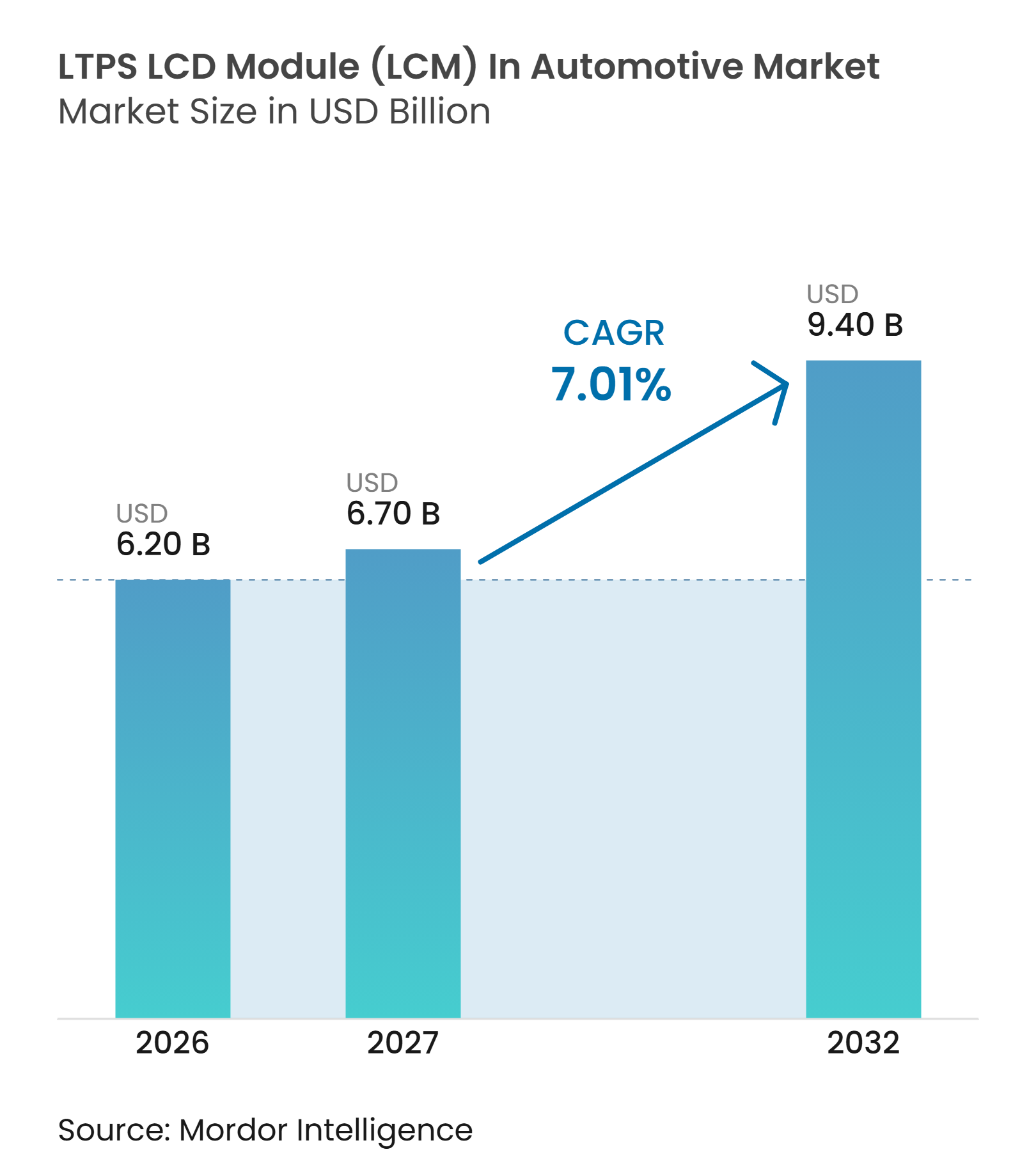
The LTPS LCD module (LCM) in automotive market size is projected to expand from USD 6.20 billion in 2026 and USD 6.70 billion in 2027 to USD 9.40 billion by 2032, registering a CAGR of 7.01% between 2027 to 2032. The LTPS LCD module (LCM) in automotive market is shifting from amorphous silicon LCD as vehicle cockpit teams require higher resolution, brighter screens, and integrated touch functions. Software-defined vehicle designs are increasing the number of displays that must operate as one coordinated interface. Display suppliers with qualified automotive production lines are therefore positioned to retain program wins for longer periods. Limited new LTPS capacity through 2028 places greater weight on yield improvement, line utilization, and established customer qualifications. Trade exposure, long qualification cycles, and the restricted non-China fabrication base may limit sourcing flexibility for the LTPS LCD module (LCM) in automotive market.
Key Report Takeaways
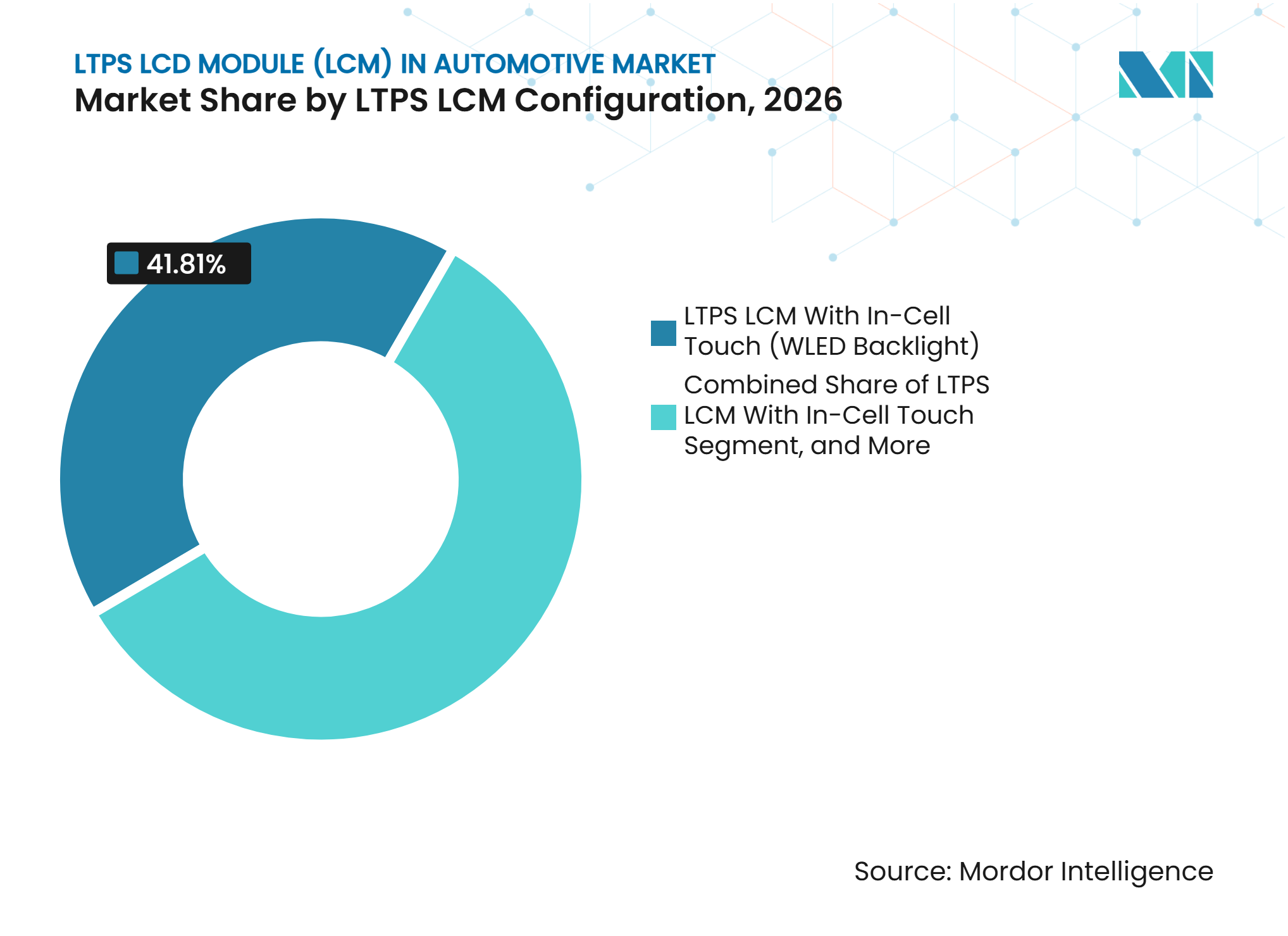
- By LTPS LCM configuration, LTPS LCM With In-Cell Touch and WLED Backlight held 41.81% in 2026, while LTPS LCM With Mini-LED Backlight and In-Cell Touch is projected to expand at an 8.69% CAGR through 2032.
- By application, center stack and infotainment accounted for 44.52% of the LTPS LCD module (LCM) in automotive market size in 2026, while the pillar-to-pillar center console is projected to advance at an 8.78% CAGR through 2032.
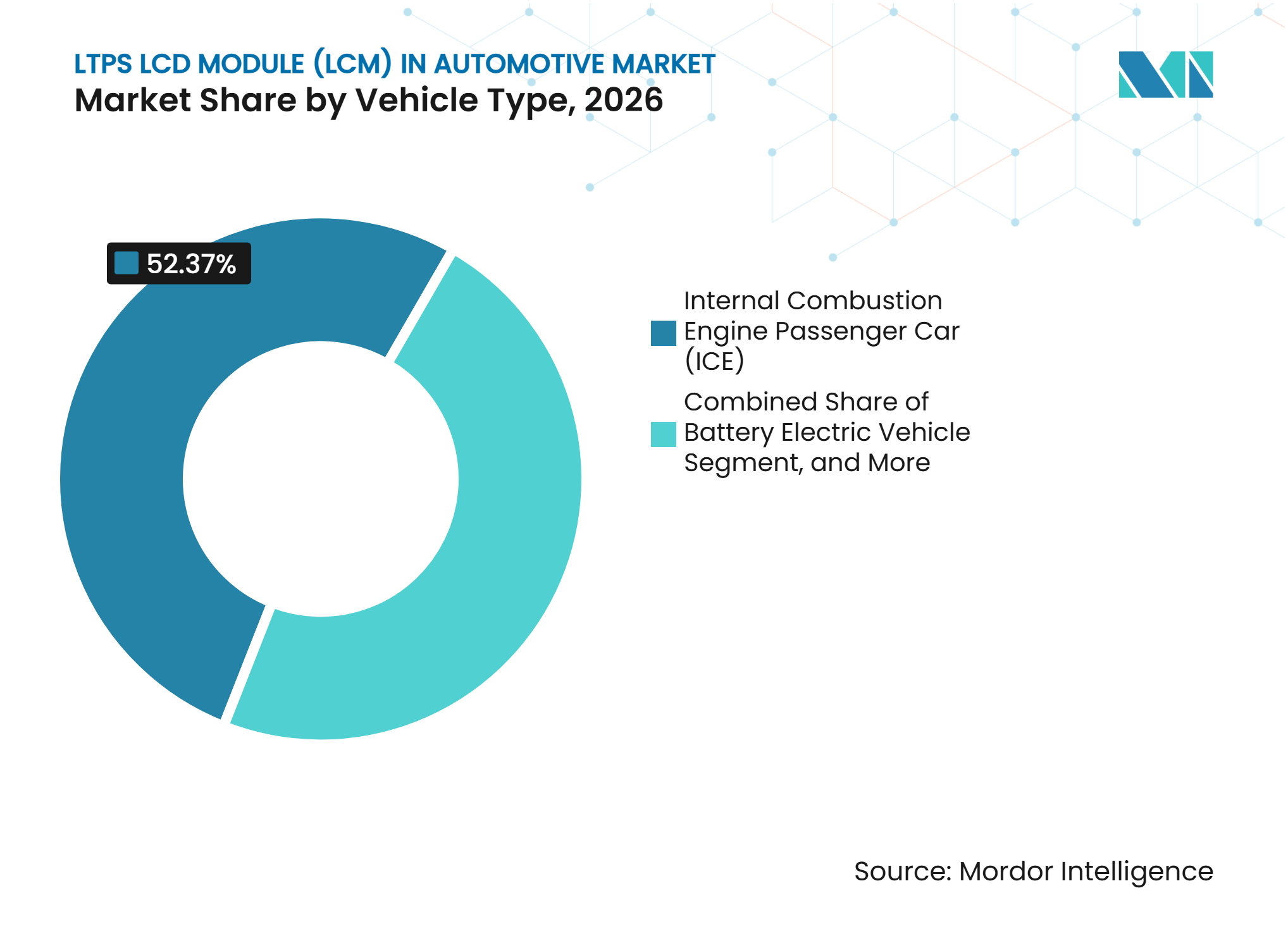
- By vehicle type, ICE passenger cars held 52.37% in 2026, while BEVs are projected to expand at an 8.86% CAGR through 2032.
- By bonding process, FOG held 61.73% in 2026, while COG is projected to expand at an 8.74% CAGR through 2032.
- By geography, Asia-Pacific held 48.65% in 2026 and is projected to expand at an 8.78% CAGR through 2032.
Note: Market numbers in this report are based on Mordor Intelligence's proprietary estimation framework, which combines nine months of actuals with Q4 projections for base year 2026.
Market Trends and Insights
Drivers Impact Analysis of LTPS LCD Module (LCM) In Automotive Market*
| Driver | (~) % Impact on CAGR Forecast | Geographic Relevance | Impact Timeline |
|---|---|---|---|
| Growth of Large, High-Resolution Automotive Displays | +2.0% | Global | Short term (≤ 2 years) |
| Rising In-Cell Touch Adoption in Center Stack Displays | +1.6% | Global, with early gains in Asia-Pacific and Europe | Short term (≤ 2 years) |
| EV and Hybrid Vehicle Display Upgrade Cycle | +1.3% | Asia-Pacific core, spill-over to Europe and North America | Medium term (2-4 years) |
| Demand for High-Brightness, Low-Power Displays in Sunlit Cabins | +0.7% | Global | Medium term (2-4 years) |
| LTPS Compatibility With Multi-Display Software-Defined Cockpits | +0.5% | Global | Long term (≥ 4 years) |
| Limited New LTPS Capacity Increasing the Value of Yield and Design Wins | +0.3% | Global, most acute in non-China manufacturing regions | Long term (≥ 4 years) |
| Source: Mordor Intelligence | |||
Growth of Large, High-Resolution Automotive Displays
Center stack modules are moving to 15-inch and larger formats, raising LTPS content area and module value per vehicle in the LTPS LCD module (LCM) in automotive market. Qualification periods for automotive-grade panels begin well before vehicle production, which favors suppliers that already hold a design win. Marelli presented a 44.8-inch pillar-to-pillar LCD Mini-LED unit with brightness of up to 12,000 nits at Auto China 2026.[1] The demonstration shows the screen performance being considered for production cockpit programs. LTPS supports the pixel density, brightness uniformity, and defect control required for these larger interfaces. FMVSS No. 101 influences how vehicle controls and displays must be presented, which supports the use of clear high-resolution display surfaces.[2]
Rising In-Cell Touch Adoption in Center Stack Displays
In-cell touch removes the need for a separate digitizer, reducing module thickness and component layers in center stack assemblies. The manufacturing process must meet automotive defect requirements, which narrows the qualified supplier base. Visteon produced a 12.3-inch narrow-border driver display for the 2026 Lexus ES that combines optical bonding and high-brightness LTPS technology.[3] This program demonstrates in-cell capability at the Tier 1 integration level. Suppliers that have completed validation can be more difficult to replace during a vehicle program. The resulting qualification barrier supports price stability for established module and substrate suppliers in the LTPS LCD module (LCM) in automotive market.
EV and Hybrid Vehicle Display Upgrade Cycle
BEV cabin layouts allow wider console spans and rear-seat screens, increasing display surface area per vehicle in the LTPS LCD module (LCM) in automotive market. Vehicle teams can specify the interface around digital user experience requirements rather than around legacy ICE packaging constraints. AUO Mobility Solutions combined AUO display capabilities with BHTC automotive human-machine interface expertise when it launched its mobility operation in January 2026. The move reflects the shift of display suppliers toward complete cockpit solutions. LTPS capacity released as OLED replaces LTPS in smartphones can serve automotive programs while electric cockpit demand expands. Each BEV program can therefore carry greater display revenue for module suppliers than a comparable conventional vehicle program.
Demand for High-Brightness, Low-Power Displays in Sunlit Cabins
Sunlight readability above 1,000 nits is relevant to driver response in bright conditions, and ambient contrast is becoming a more important purchasing measure. In the LTPS LCD module (LCM) in automotive market, LTPS supports a higher aperture ratio and luminance at lower backlight drive currents than amorphous silicon. This efficiency matters in BEVs because display power use competes with the vehicle energy budget. Mini-LED backlighting raises the available luminance ceiling for large cockpit screens. Marelli's 12,000-nit pillar-to-pillar unit demonstrates the level of brightness being pursued for curved and wide cabin layouts. The performance gap between Mini-LED LTPS and OLED can narrow where OEMs evaluate brightness performance against system cost.
Restraints Impact Analysis of LTPS LCD Module (LCM) In Automotive Market*
| Restraint | (~) % Impact on CAGR Forecast | Geographic Relevance | Impact Timeline |
|---|---|---|---|
| High LTPS Panel and Module Integration Costs | -0.9% | Global, most acute in non-China and premium-segment programs | Short term (≤ 2 years) |
| Qualification Cycles and OEM Design-Lock Lead Times | -0.7% | Global | Medium term (2-4 years) |
| Mature Non-China LTPS Fab Base Limits Flexibility | -0.5% | Non-China, particularly Japan, South Korea, and Taiwan | Long term (≥ 4 years) |
| Trade Policy and Tariff Exposure Across the Display Supply Chain | -0.3% | North America and Europe most exposed | Short term (≤ 2 years) |
| Source: Mordor Intelligence | |||
High LTPS Panel and Module Integration Costs
LTPS costs rise sharply as panel area increases because optical bonding, Mini-LED control, and thermal management add work to the module. Premium and BEV OEMs can absorb more of this bill of materials than high-volume ICE programs. AEC-Q105 qualification also adds certification expense that must be spread across lower automotive volumes. Visteon's optical bonding operation in Thailand for the Lexus ES program shows how higher production volumes can spread integration overhead across several programs. Smaller suppliers without comparable volume remain at a disadvantage in cost-sensitive program bids within the LTPS LCD module (LCM) in automotive market. This division can slow the adoption of complex large-screen modules outside premium vehicle lines.
Qualification Cycles and OEM Design-Lock Lead Times
Automotive display qualification commonly extends from 24 to 36 months because OEMs prioritize supply reliability. Once a module is designed into a vehicle, changing the panel process can expose the OEM to obsolescence and revalidation risk. These timelines are especially significant for Mini-LED LTPS designs because consumer display technology can change during the validation period. Modular designs can allow a backlight or driver integrated circuit to change without requalifying the entire module, but they require early engineering investment. The National Highway Traffic Safety Administration is researching novel human-machine interface designs, which may extend the regulatory attention applied to display validation. Long program cycles therefore protect incumbent suppliers but slow technology changes within the LTPS LCD module (LCM) in automotive market.
*Our forecasts treat driver/restraint impacts as directional, not additive. The impact forecasts reflect baseline growth, mix effects, and variable interactions.
LTPS LCD Module (LCM) In Automotive Market Segment Analysis
By LTPS LCM Configuration:
In-Cell Touch Leads as Mini-LED Gains MomentumLTPS LCM With In-Cell Touch and WLED Backlight held 41.81% of the LTPS LCD module (LCM) in automotive market share in 2026. The configuration is established across vehicle lines from mid-premium to luxury segments. Its integrated touch design has improved yields and received wider OEM acceptance. These gains allow it to replace external touch overlays in many new platform designs. Standard LTPS LCM with WLED Backlight and no touch remains relevant where vehicle programs face strict cost limits. LTPS LCM With Mini-LED Backlight and no touch continues to serve selected instrument cluster and head-up display applications.
LTPS LCM With Mini-LED Backlight and In-Cell Touch is projected to expand at an 8.69% CAGR through 2032. OEMs are pairing local dimming with integrated touch in flagship cockpit programs that require sunlight readability above 1,000 nits. BOE Varitronix delivered a 14.6-inch QD Mini-LED center display for the eighth-generation Hyundai Avante with 2,560 × 1,440 resolution, 1,000-nit peak brightness, and 627 local dimming zones. The delivery demonstrates that the configuration is moving beyond concept displays into production vehicle programs. In-cell touch is also expected to move beyond the center stack into instrument clusters and rear-seat displays. That shift supports a higher share of configurations with greater display and integration content in the LTPS LCD module (LCM) in automotive market.



By Application:
Center Stack Anchors Volume While Pillar-to-Pillar Raises the Growth CeilingCenter stack and infotainment accounted for 44.52% of the LTPS LCD module (LCM) in automotive market size in 2026. It remains the principal human-machine interface across vehicle classes. Software-defined vehicle architectures place more computing and interaction functions at this position in the cockpit. The resulting systems require reliable touch response and display clarity. Instrument clusters retain a stable role because primary driving information must remain accessible to the driver. Rear-seat entertainment and passenger screens are an emerging volume layer, especially in premium BEV programs.
The pillar-to-pillar center console is projected to expand at an 8.78% CAGR through 2032. OEMs use continuous, software-managed surfaces to reduce the number of separate display frames, brackets, and sealing interfaces. Marelli demonstrated a QNX-based cockpit at Auto China 2026 that combined infotainment, cluster visualization, and cabin intelligence in one compute domain. The system included a 44.8-inch pillar-to-pillar LCD Mini-LED unit. This form factor raises module complexity and integration value in each vehicle program. It also places more emphasis on suppliers that can coordinate displays, bonding, software, and vehicle validation for the LTPS LCD module (LCM) in automotive market.
By Vehicle Type:
ICE Sustains Volume as BEV Accelerates the Technology MixICE passenger cars held 52.37% in 2026. OEMs continue to upgrade ICE cabins with digital interfaces as a cost-conscious response to consumer demand for modern interiors. This preserves LTPS demand across a much broader vehicle base than electric platforms alone. HEV and PHEV models sit between the two powertrain groups. Their cockpit designs increasingly use LTPS displays comparable to those found in BEVs. This approach helps OEMs use a more consistent interface across powertrain versions.
BEVs are projected to expand at an 8.86% CAGR through 2032. Their screen-focused cabin design increases display area per vehicle relative to many ICE models. Light commercial vehicles remain a smaller category but require LTPS clusters and center stack displays as telematics and driver-assistance information becomes more detailed. Visteon reported USD 3.5 billion in new display business wins in 2025, representing 48.6% of its USD 7.4 billion total new business. The figures show that display programs have become an important revenue source for leading Tier 1 suppliers in the LTPS LCD module (LCM) in automotive market. Cross-powertrain program wins can help LTPS module makers spread development and manufacturing investments across more vehicle types.

By Bonding Process:
FOG Dominates While COG Advances in Precision FormatsFOG accounted for 61.73% of the LTPS LCD module (LCM) in automotive market size in 2026. Flexible printed circuit connections provide layout flexibility for center stack and instrument cluster modules. FOG is particularly suited to large-format displays because the film-to-glass connection can accommodate panel movement and vibration. This is relevant to wide pillar-to-pillar layouts. LOCA and OCA film options are used within both FOG and COG process flows. OCA film is preferred for flat or mildly curved applications because it removes UV curing steps and supports high-volume assembly.
COG is projected to expand at an 8.74% CAGR through 2032. Suppliers use it to pursue thinner assemblies, fewer interconnects, and reliability during automotive temperature cycling. Compact applications place a higher value on these characteristics. tesa and AUMOVIO announced a debondable adhesive solution in April 2026 for automotive display mechanical integration. The work indicates that reworkability and end-of-life serviceability are becoming relevant design considerations in the LTPS LCD module (LCM) in automotive market. Bonding selection will therefore reflect both module dimensions and the ability to assemble, repair, and validate the finished display.
Geography Analysis
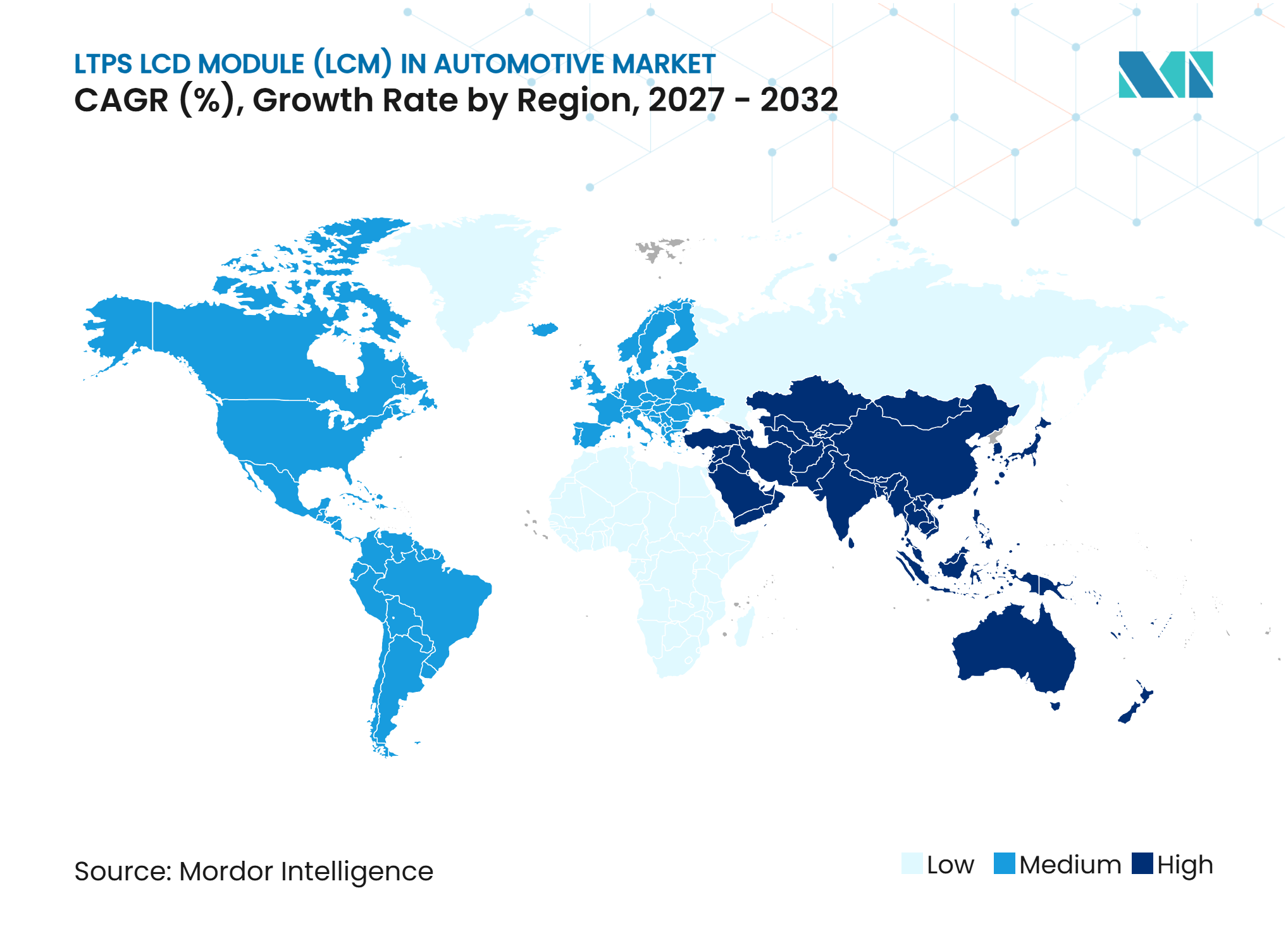
Asia-Pacific: Manufacturing Concentration Supports Volume and Growth Leadership
Asia-Pacific held 48.65% of the LTPS LCD module (LCM) in automotive market share in 2026 and is projected to expand at an 8.78% CAGR through 2032. China-based panel makers are forecast to account for 65.2% of global automotive display shipments in the second half of 2026, compared with 28.1% in 2019. Japan contributes precision-oriented LTPS modules through suppliers with established OEM qualification histories. South Korea supports automotive strategies from Samsung Display and LG Display. Taiwan is expanding its automotive exposure through AUO Mobility Solutions and Innolux's CarUX unit. AUO Mobility Solutions officially began operations on January 1, 2026, strengthening its role as a cockpit solution provider. Chinese domestic BEV programs are specifying large-format LTPS surfaces at a faster cadence than many global peers. This combination of panel capacity and vehicle demand keeps the region central to the LTPS LCD module (LCM) in automotive market.
Europe: Software-Defined Cockpits Sustain a Premium LTPS Pull
European premium OEM programs are requesting LTPS modules with high brightness, narrow bezels, and reliable optical bonding. German automakers are extending cockpit digitization from flagship vehicles into mid-volume C- and D-segment platforms. This broadens the potential use of automotive-grade LTPS modules. AUMOVIO provides a Tier 1 integration point for European cockpit programs. Its April 2026 work with tesa on debondable adhesive solutions reflects attention to precise assembly and lifecycle serviceability. ZEISS and tesa established a partnership to industrialize large-scale holographic technology for automotive applications. The work indicates a route toward new transparent display components that can complement established cockpit screens. First serial production for the technology is targeted for 2029.
North America and Other Regions: Integration Capability and Emerging Demand Shape the Mix
North American demand is supported by cockpit electronics supply chains serving Detroit-based and Japanese-transplant OEM programs. Visteon's USD 3.5 billion in new display business wins in 2025 shows the role of North American-headquartered Tier 1 suppliers in global module integration. The region's contribution lies more in system integration and optical bonding than in panel fabrication. South America and the Middle East and Africa remain smaller markets because electrification is lower and many OEMs source finished modules from Asian or European hubs. India and Southeast Asia are incremental demand areas within the wider Asia-Pacific supply network. BOE Varitronix's Vietnam facility produced the Hyundai Avante center display, showing that manufacturing is beginning to diversify within Asia-Pacific. This diversification can give OEMs additional assembly options while panel fabrication remains concentrated. The LTPS LCD module (LCM) in automotive market therefore combines regional demand growth with a supply chain that continues to rely heavily on Asian manufacturing.
Competitive Landscape
Market Concentration
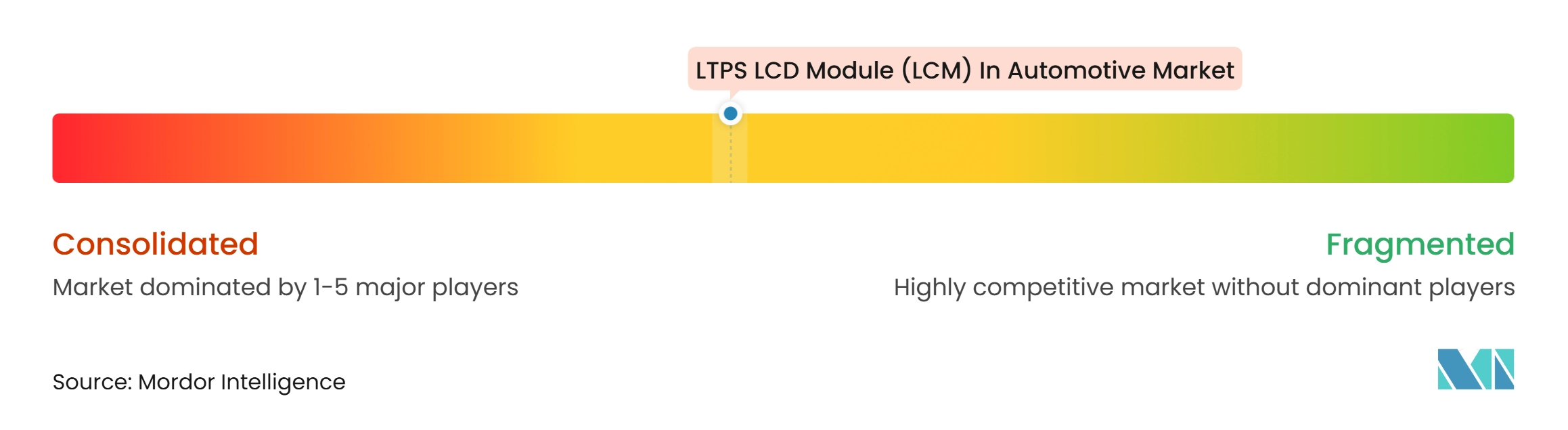
The LTPS LCD module (LCM) in automotive market is moderately concentrated at the front-end panel fabrication layer. A limited group of LTPS-capable fabrication lines supplies most automotive-grade substrates. No major new LTPS LCD capacity is planned through 2028. Competitive position consequently depends on yields, design-win retention, and use of existing production lines. The Tier 1 module integration layer is broader and more competitive. Suppliers distinguish themselves through optical bonding scale, in-house display construction, and software-defined vehicle integration capability.
Visteon completed in-house display construction and optical bonding at its Thailand facility for the 2026 Lexus ES program. This move shows how vertical integration can improve control over display quality and module assembly. AEC-Q105 qualification requirements increase the validation burden for automotive electronic components. NHTSA research into novel human-machine interfaces also points to continued regulatory attention on vehicle display design. These factors favor suppliers with established automotive testing and engineering resources. They also make it more difficult for a new supplier to enter a qualified vehicle program.
BOE Varitronix began mass production of its Hyundai Avante QD Mini-LED center display in 2026. Innolux's CarUX unit announced the acquisition of Pioneer Electronics at CES 2026 to access Japanese OEM relationships and audio integration expertise. Samsung Display, LG Display, and BOE are developing tandem RGB OLED designs that may compete with LTPS in high-end cockpits after 2028. Hyundai Mobis formed an alliance with ZEISS, tesa, and Sekurit to develop holographic windshield displays. LTPS suppliers are responding by improving Mini-LED brightness performance and system cost. The LTPS LCD module (LCM) in automotive market remains supported by the breadth of vehicle programs that need mature, qualified LCD technology.
LTPS LCD Module (LCM) In Automotive Industry Leaders
-
BOE Technology Group Co., Ltd.
-
Tianma Microelectronics Co., Ltd.
-
AUO Corporation
-
Japan Display Inc.
-
LG Display
- *Disclaimer: Major Players sorted in no particular order
LTPS LCD Module (LCM) In Automotive Market Companies Covered in this Report
- LG Display
Recent Industry Developments in LTPS LCD Module (LCM) In Automotive Market
- August 2026: BOE Varitronix announced mass production delivery of its 14.6-inch QD Mini-LED center display exclusively for the eighth-generation Hyundai Avante, featuring 2,560 × 1,440 resolution, 1,000-nit peak brightness, and 627 local dimming zones, marking the first mass production project at its Vietnam vehicle display facility.
- June 2026: Visteon Corporation announced production of its 12.3-inch Narrow Border Driver Display in the newly launched Lexus ES, completing full in-house display construction and optical bonding at its Thailand facility, representing Visteon's first production win in Lexus driver information systems.
- April 2026: Marelli showcased a unified SDV cockpit with a 44.8-inch pillar-to-pillar LCD Mini-LED FALD picture-generation unit reaching up to 12,000 nits at Auto China 2026 in Beijing, combining QNX-based mixed-criticality compute with zonal E/E architecture and targeting sunlight readability and curved cabin configurations for production-bound programs.
- April 2026: Tesa and AUMOVIO announced a debondable adhesive solution for automotive display mechanical integration, enabling automated assembly and reworkability in module production.
Global LTPS LCD Module (LCM) In Automotive Market Report Scope
The LTPS LCD Module (LCM) in Automotive Market encompasses the development, manufacturing, and supply of automotive-grade display modules using Low-Temperature Polycrystalline Silicon (LTPS) technology. These modules deliver high-resolution visuals, enhanced display performance, and power efficiency for advanced vehicle interfaces. Market growth is driven by increasing vehicle digitalization, adoption of sophisticated cockpit systems, and demand for high-quality automotive displays.
The LTPS LCD Module (LCM) in Automotive Market Report is Segmented by LTPS LCM Configuration (Standard LTPS LCM (WLED Backlight, No Touch), LTPS LCM with In-Cell Touch (WLED Backlight), LTPS LCM with Mini-LED Backlight (No Touch), and LTPS LCM with Mini-LED Backlight and In-Cell Touch), Application (Center Stack/Infotainment, Instrument Cluster, Pillar-to-Pillar Center Console, and Rear Seat Entertainment and Passenger Screen), Vehicle Type (Battery Electric Vehicle (BEV), Hybrid / Plug-in Hybrid Electric Vehicle (HEV/PHEV), Internal Combustion Engine Passenger Car (ICE), and Light Commercial Vehicle (LCV)), Bonding Process (Film on Glass (FOG), and Chip on Glass (COG)), and Geography (North America, South America, Europe, Asia-Pacific, Middle East, Africa). The Market Forecasts are Provided in Terms of Value (USD).
Segmentation Overview
| Standard LTPS LCM (WLED Backlight, No Touch) |
| LTPS LCM With In-Cell Touch (WLED Backlight) |
| LTPS LCM With Mini-LED Backlight (No Touch) |
| LTPS LCM With Mini-LED Backlight and In-Cell Touch |
| Center Stack / Infotainment |
| Instrument Cluster |
| Pillar-to-Pillar Center Console |
| Rear Seat Entertainment and Passenger Screen |
| Battery Electric Vehicle (BEV) |
| Hybrid / Plug-in Hybrid Electric Vehicle (HEV/PHEV) |
| Internal Combustion Engine Passenger Car (ICE) |
| Light Commercial Vehicle (LCV) |
| Film on Glass (FOG) |
| Chip on Glass (COG) |
| North America | United States |
| Canada | |
| Mexico | |
| Europe | Germany |
| United Kingdom | |
| France | |
| Italy | |
| Rest of Europe | |
| Asia-Pacific | China |
| Japan | |
| South Korea | |
| Taiwan | |
| Rest of Asia-Pacific | |
| Rest of the World |
| By LTPS LCM Configuration | Standard LTPS LCM (WLED Backlight, No Touch) | |
| LTPS LCM With In-Cell Touch (WLED Backlight) | ||
| LTPS LCM With Mini-LED Backlight (No Touch) | ||
| LTPS LCM With Mini-LED Backlight and In-Cell Touch | ||
| By Application | Center Stack / Infotainment | |
| Instrument Cluster | ||
| Pillar-to-Pillar Center Console | ||
| Rear Seat Entertainment and Passenger Screen | ||
| By Vehicle Type | Battery Electric Vehicle (BEV) | |
| Hybrid / Plug-in Hybrid Electric Vehicle (HEV/PHEV) | ||
| Internal Combustion Engine Passenger Car (ICE) | ||
| Light Commercial Vehicle (LCV) | ||
| By Bonding Process | Film on Glass (FOG) | |
| Chip on Glass (COG) | ||
| By Geography | North America | United States |
| Canada | ||
| Mexico | ||
| Europe | Germany | |
| United Kingdom | ||
| France | ||
| Italy | ||
| Rest of Europe | ||
| Asia-Pacific | China | |
| Japan | ||
| South Korea | ||
| Taiwan | ||
| Rest of Asia-Pacific | ||
| Rest of the World | ||
Key Questions Answered in the Report
What is the projected value of automotive LTPS LCD modules?
The LTPS LCD module (LCM) in automotive market is projected at USD 6.20 billion in 2026, USD 6.70 billion in 2027, and USD 9.40 billion by 2032.
What is driving demand for automotive LTPS LCD modules?
Larger cockpit displays, integrated touch, BEV cabin design, and sunlight-readable display requirements are supporting demand.
Which LTPS LCM configuration leads automotive demand?
LTPS LCM With In-Cell Touch and WLED Backlight led with 41.81% share in 2026.
Which automotive application is expanding fastest for LTPS LCD modules?
The pillar-to-pillar center console is projected to expand at an 8.78% CAGR through 2032.
Which vehicle type is expected to adopt LTPS LCD modules fastest?
BEVs are projected to expand at an 8.86% CAGR through 2032 because their cabin designs use more display area.
Which region leads automotive LTPS LCD module demand?
Asia-Pacific held 48.65% in 2026 and is projected to expand at an 8.78% CAGR through 2032.