
LPDDR5 For IoT Edge and Industrial AI Market Size and Share
Market Overview
| Study Period | 2020 - 2031 |
|---|---|
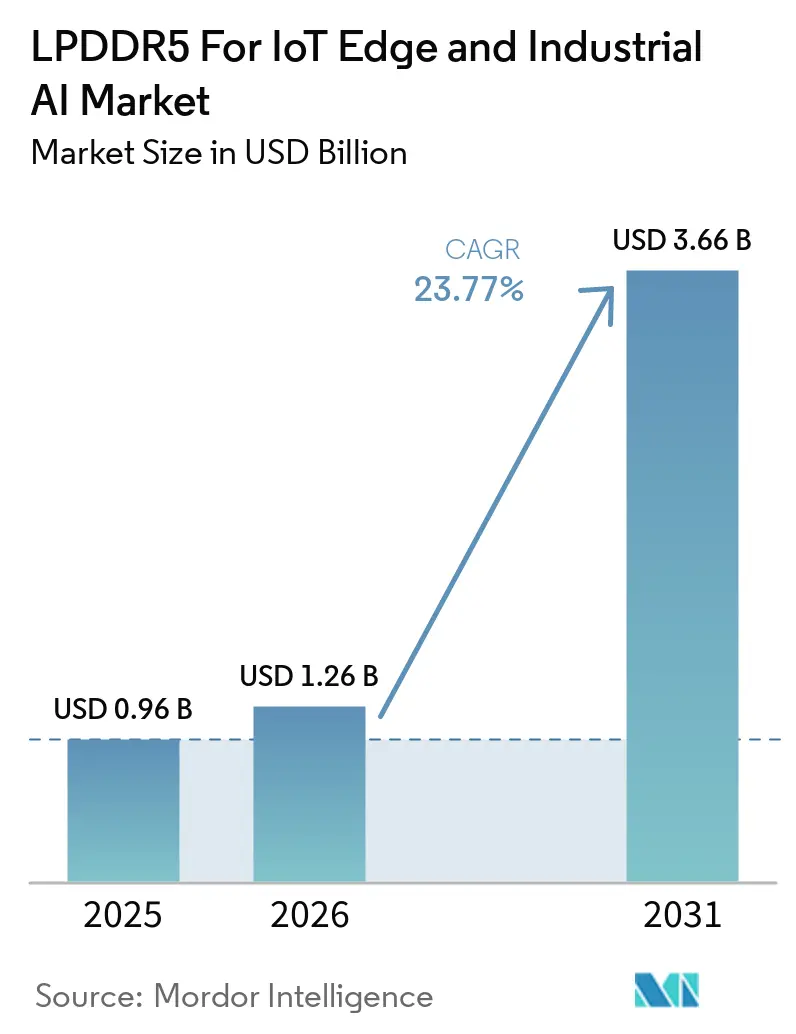
| Market Size (2026) | USD 1.26 Billion |
| Market Size (2031) | USD 3.66 Billion |
| Growth Rate (2026 - 2031) | 23.77 % |
| Fastest Growing Market | Asia-Pacific |
| Largest Market | Asia-Pacific |
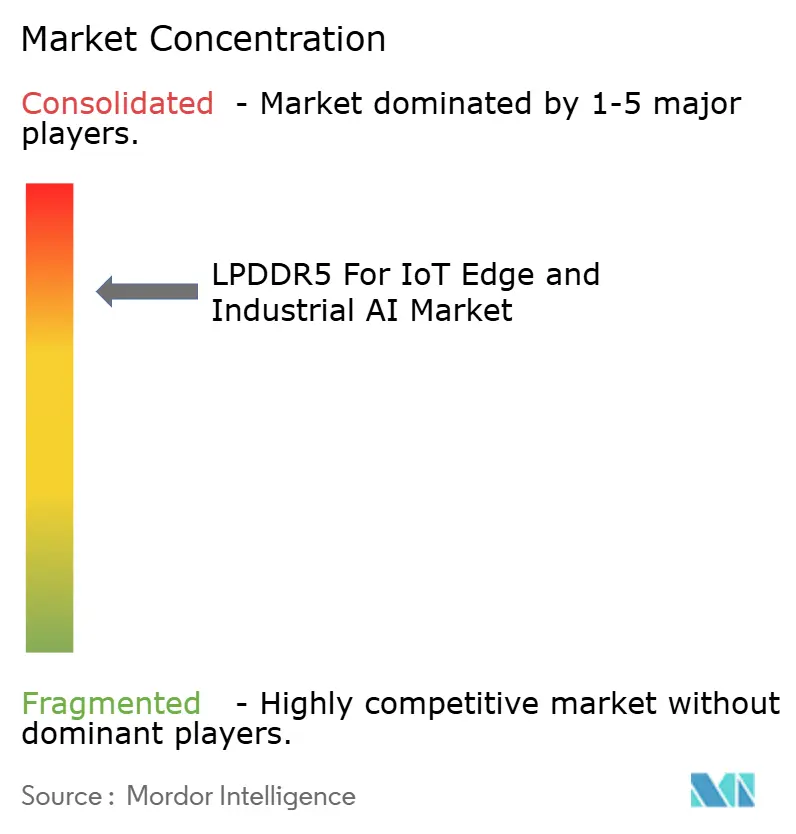
| Market Concentration | High |
Major Players *Disclaimer: Major Players sorted in no particular order Image © Mordor Intelligence. Reuse requires attribution under CC BY 4.0. | |
LPDDR5 For IoT Edge and Industrial AI Market Analysis by Mordor Intelligence
The LPDDR5 for IoT Edge and Industrial AI market size is expected to increase from USD 0.96 billion in 2025 to USD 1.26 billion in 2026 and reach USD 3.66 billion by 2031, growing at a CAGR of 23.8% over 2026-2031. The LPDDR5 for IoT Edge and Industrial AI market is moving into a phase where higher bandwidth and lower voltage are no longer premium features, but core design needs for edge inference systems. Industrial robots, smart cameras, edge controllers, and real-time sensor fusion platforms are raising memory requirements across factory, logistics, and infrastructure deployments. Supply remains concentrated in a small group of large memory vendors, while wafer allocation toward AI server memory is tightening procurement conditions for industrial buyers. Design decisions made in 2026 carry unusual weight because many industrial platforms lock component choices for 5 to 10 years. The LPDDR5 for IoT Edge and Industrial AI market also has a clear opportunity window in robotics, machine vision, and transportation platforms, where compact form factors and sustained inference workloads are pushing OEMs toward LPDDR5X and denser package designs.
Key Report Takeaways
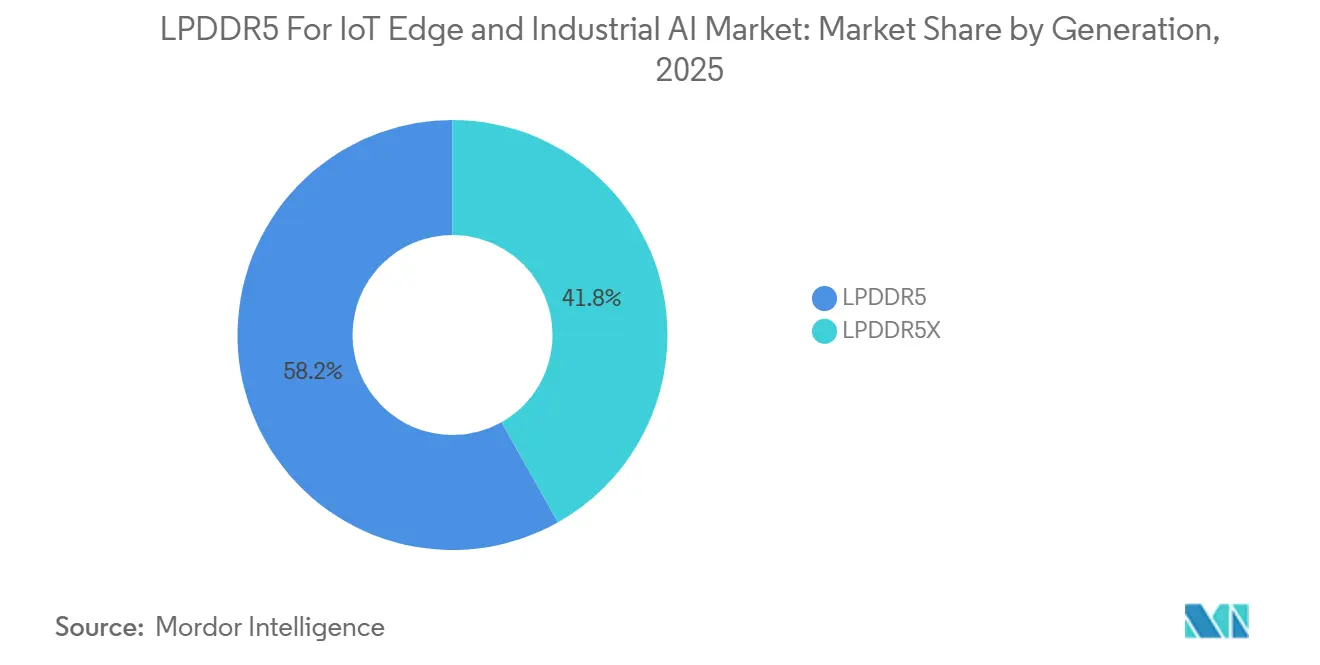
- By generation, LPDDR5 led with 58.16% share in 2025, while LPDDR5X is forecast to expand at a 25.12% CAGR through 2031.
- By capacity, the 8 GB to 16 GB tier accounted for 43.77% share in 2025, while the above 16 GB is projected to grow at a 25.81% CAGR through 2031.
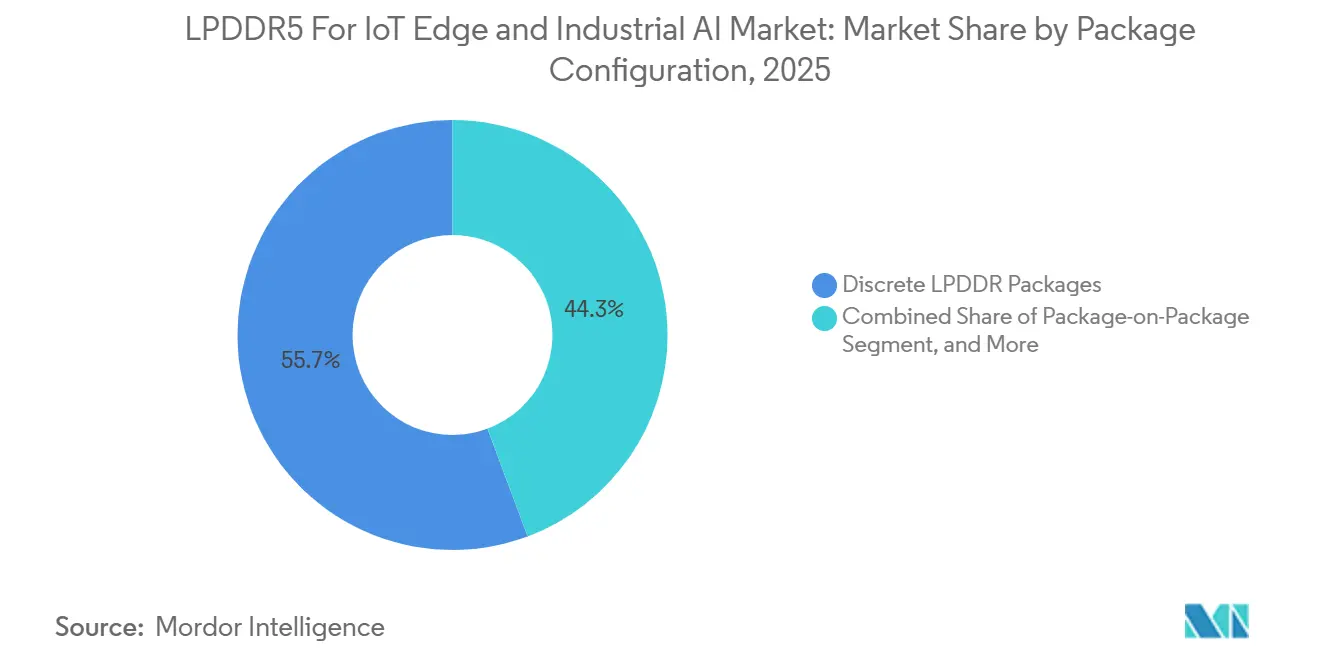
- By package configuration, Discrete packages held 55.69% share in 2025, while Embedded and SiP-Based formats are expected to advance at a 25.67% CAGR through 2031.
- By application, Industrial Edge AI Computing accounted for 26.18% share of the LPDDR5 for IoT Edge and Industrial AI market size in 2025, while Robotics, Cobots, and AMRs are set to record the fastest CAGR at 26.25% through 2031.
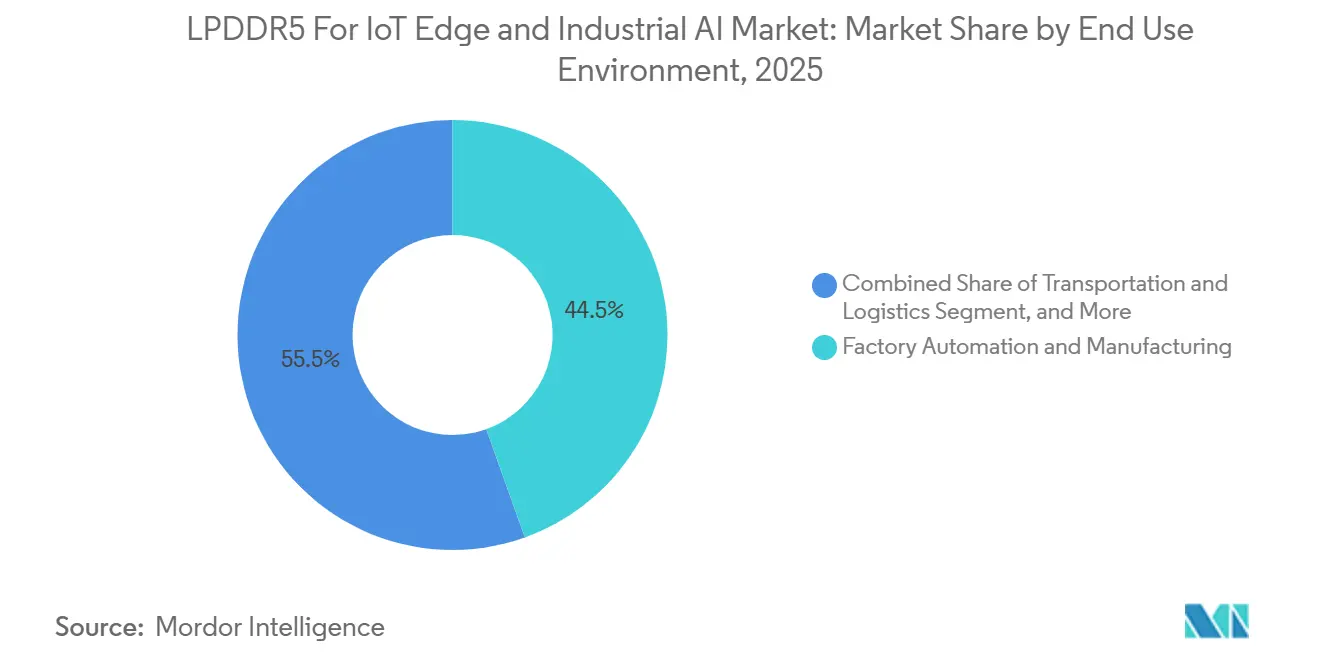
- By end-use environment, Factory Automation and Controls captured 44.53% share in 2025, while Transportation, Warehousing, and Logistics is projected to expand at a 25.93% CAGR through 2031.
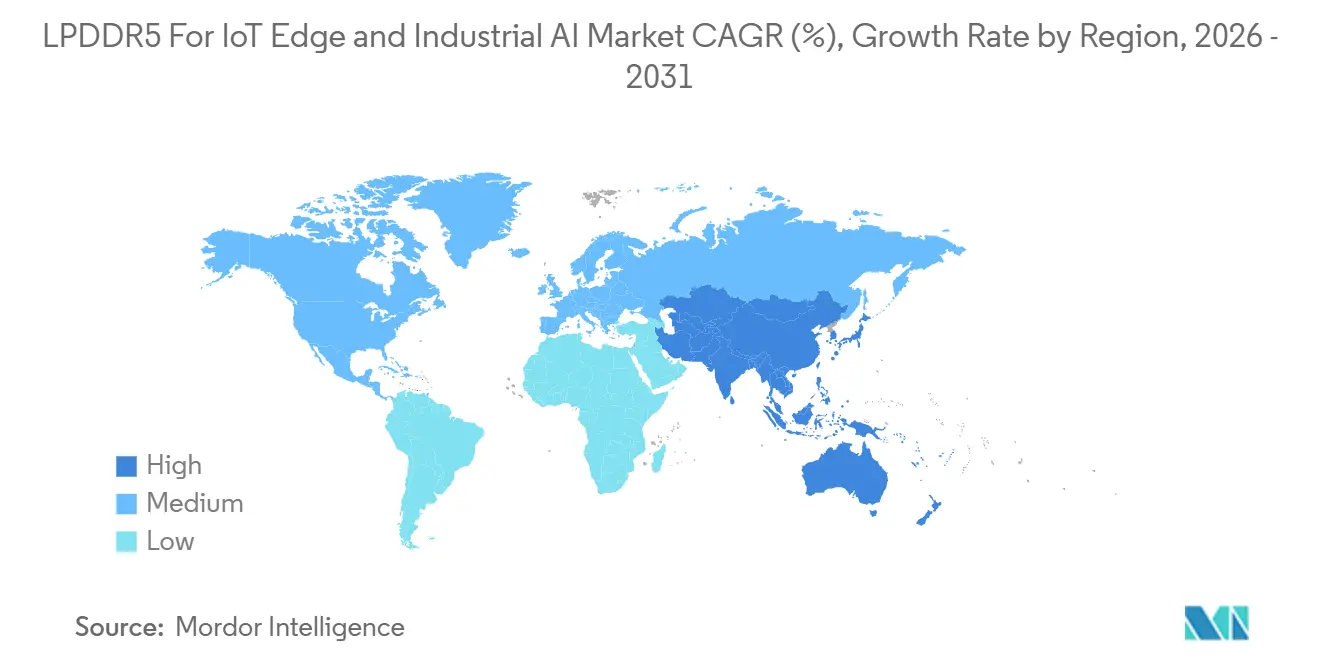
- By geography, Asia Pacific held 54.92% of the LPDDR5 for IoT Edge and Industrial AI market share in 2025 and is also the fastest-growing region with a 24.96% CAGR through 2031.
Note: Market size and forecast figures in this report are generated using Mordor Intelligence’s proprietary estimation framework, updated with the latest available data and insights as of January 2026.
Global LPDDR5 For IoT Edge and Industrial AI Market Trends and Insights
Drivers Impact Analysis*
| Driver | (~) % Impact on CAGR Forecast | Geographic Relevance | Impact Timeline |
|---|---|---|---|
| Rising On-Device AI Memory Demand Across Industrial Platforms | +5.2% | Global | Short term (≤ 2 years) |
| Power-Efficiency Requirements for Battery-Powered and Fanless Industrial Deployments | +4.4% | Global | Medium term (2-4 years) |
| Higher Memory Bandwidth Requirements for Edge Inference Workloads | +3.7% | APAC core, North America, Europe | Medium term (2-4 years) |
| Accelerated Shift Toward LPDDR5X Across Industrial and IoT Platforms | +3.1% | Global | Short term (≤ 2 years) |
| Longer Product Lifecycle Requirements in Industrial Applications | +2.4% | North America, Europe, Japan | Long term (≥ 4 years) |
| Qualification Pull From Industrial OEM Platform Specifications | +1.8% | APAC, North America | Medium term (2-4 years) |
| Source: Mordor Intelligence | |||
Rising On-Device AI Memory Demand Across Industrial Platforms
On-device AI inference has moved from pilot activity to routine deployment across factories, logistics hubs, and industrial infrastructure. The LPDDR5 market for IoT Edge and Industrial AI is benefiting as these deployments increasingly run multiple models on the same edge device. DEEPX positioned its DX-M1 processor with Rambus LPDDR5 and LPDDR5X controller IP for factory automation, edge servers, smart cameras, and robotics, showing how validated memory interfaces are becoming part of the industrial AI stack.[1] Advantech launched the AIR-055 with 36 GB of LPDDR5 memory and up to 100 TOPS at under 60 W, underscoring how much memory current vision AI systems already carry in compact industrial form factors.[2] These systems are increasingly limited by data delivery rather than raw compute, so memory bandwidth has become a direct factor in usable inference performance. The sharpest demand increase in 2026 comes from multi-model workloads in quality inspection, anomaly detection, and predictive maintenance, which is raising memory content per deployed node across the LPDDR5 for IoT Edge and Industrial AI market.
Power-Efficiency Requirements for Battery-Powered and Fanless Industrial Deployments
Battery-powered and fanless industrial nodes have tight thermal budgets, making power efficiency a primary criterion for memory selection. The IoT Edge and Industrial AI market is seeing faster adoption of LPDDR5X because LPDDR4X cannot meet the same inference performance envelope in many compact systems. Micron states that LPDDR5X can reduce power consumption by 20% to 25% compared to LPDDR5 through a dual-domain voltage architecture and dynamic voltage and frequency scaling.[3] Samsung also began mass production of 0.65 mm LPDDR5X packages with improved heat resistance and a lower profile, which helps dense robotic controllers and compact AI modules.[4] Thinner packages reduce thermal bottlenecks in co-packaged designs, which supports the rise of embedded and system-in-package memory layouts in the LPDDR5 for IoT Edge and Industrial AI market. Mobile robot and industrial gateway OEMs that need 8 to 15 hours of duty cycle are among the clearest beneficiaries of these efficiency gains.
Higher Memory Bandwidth Requirements for Edge Inference Workloads
Multi-stream video inference and transformer-based edge models are pushing many industrial platforms to the practical bandwidth limits of LPDDR5. The LPDDR5 market for IoT Edge and Industrial AI is responding with a stronger shift toward LPDDR5X and more integrated packaging approaches. Research in Microelectronics International showed that wafer-level packaging integration of LPDDR5X can preserve signal integrity at levels comparable to on-board interconnections, thereby supporting co-packaged AI SoC design paths. SK hynix reported LPDDR6 development on its 1c-node process, but industrial qualification and volume deployment remain behind the current LPDDR5X adoption cycle. Machine vision systems with 4 to 6 high-resolution camera streams can exhaust LPDDR5 bandwidth headroom, especially in autonomous inspection lines and precision assembly cells. That gap between current bandwidth demand and available qualified alternatives is reinforcing near-term upgrade demand across the LPDDR5 market for IoT Edge and Industrial AI.
Accelerated Shift Toward LPDDR5X Across Industrial And IoT Platforms
The move from LPDDR5 to LPDDR5X is happening faster than many industrial roadmaps originally planned. The LPDDR5 market for IoT Edge and Industrial AI is shifting not only because of higher speed but also because ecosystem support now favors LPDDR5X in new designs. JEDEC updated the LPDDR5 and LPDDR5X Serial Presence Detect standard in March 2026 with enhanced mode-switching support, which better fits duty-cycled AI platforms that move between active inference and low-power states. Samsung’s thinner LPDDR5X packaging and Micron’s power-efficiency framing have also pushed system designers toward the newer generation when they refresh compact AI modules. LPDDR5 still had a strong installed base in 2025, but that base is now acting as a redesign pool rather than a barrier to migration. As OEMs update qualification files and new schematics are introduced, LPDDR5X is increasingly becoming the default high-performance option within the LPDDR5 for IoT Edge and Industrial AI markets.
Restraints Impact Analysis*
| Restraint | (~) % Impact on CAGR Forecast | Geographic Relevance | Impact Timeline |
|---|---|---|---|
| High Vendor Concentration and Supply Chain Dependency | -1.8% | Global | Short term (≤ 2 years) |
| Design-In Complexity and Extended Qualification Lead Times | -1.5% | Global | Medium term (2-4 years) |
| Cost Premium Versus Legacy LPDDR4X and Alternative DRAM Standards | -1.1% | APAC, South America, Middle East and Africa | Short term (≤ 2 years) |
| Limited Compatibility With Legacy Industrial SoC Platforms | -0.7% | APAC, Europe | Long term (≥ 4 years) |
| Source: Mordor Intelligence | |||
High Vendor Concentration And Supply Chain Dependency
The LPDDR5 for IoT Edge and Industrial AI markets still depend on a very small group of suppliers for advanced LPDDR5X volume. This creates purchasing risk for industrial OEMs that lack the scale to secure preferred allocation. SK hynix started mass production of the 192 GB SOCAMM2 in April 2026 for NVIDIA’s Vera Rubin platform, underscoring how aggressively advanced low-power memory capacity is being pulled toward larger AI programs. Micron also shipped 256 GB SOCAMM2 customer samples in March 2026, indicating the same upstream focus on very high-capacity AI memory formats. When industrial buyers enter qualification cycles during this kind of supply redirection, price discipline weakens and lead times become harder to manage. CXMT is beginning to offer a partial offset, but qualification depth and industrial temperature support still matter before it can serve as a full substitute across the LPDDR5 for IoT Edge and Industrial AI market.
Design-In Complexity And Extended Qualification Lead Times
LPDDR5 integration is more difficult in industrial edge systems than in consumer devices. Each platform must validate memory behavior across vendor-specific settings such as refresh timing, power-down behavior, and termination profiles. NXP described a broad approach to memory interoperability around i.MX 93 processors, which illustrate how much engineering effort is required before a memory component enters volume production on an embedded platform. Industrial requirements for operation from -40°C to 105°C necessitate thermal stress testing, which can extend qualification cycles by months. IEC 60068 environmental reliability demands also narrow the supplier pool for transportation and outdoor deployments, because not every available component can pass the same validation path. These long cycles slow purchasing decisions for LPDDR5 in the IoT Edge and Industrial AI markets, even when demand conditions support a faster migration.
*Our forecasts treat driver/restraint impacts as directional, not additive. The impact forecasts reflect baseline growth, mix effects, and variable interactions.
Segment Analysis
By Generation: LPDDR5X Emerges as the Industrial AI Upgrade Standard
LPDDR5 held 58.16% of generation demand in 2025, while LPDDR5X is projected to grow at a 25.12% CAGR through 2031. That split shows a market where the installed base remains large, but the momentum in new design has already shifted. LPDDR5 became the practical baseline for platforms that completed qualification between 2022 and 2024, especially in industrial gateways and early AI-enabled controllers. The LPDDR5 for IoT Edge and Industrial AI market, therefore, entered 2026 with a strong legacy position for LPDDR5, but not with lasting insulation from a newer standard. LPDDR5X is gaining traction because it improves both power efficiency and thermal performance within the same design envelope.
Micron’s description of dual-domain voltage control helps explain why LPDDR5X is more attractive in fanless and battery-aware systems that already run close to thermal limits. Samsung’s 0.65 mm LPDDR5X package adds another push, as improved heat resistance enables smaller industrial modules and denser board layouts. The LPDDR5 for IoT Edge and Industrial AI industries is also seeing faster adoption as developers increasingly refresh older LPDDR4X-based platforms with AI-capable hardware. LPDDR6 remains visible on the roadmap, but it is not yet the qualified volume option for near-term industrial deployment. That leaves LPDDR5X as the most practical upgrade target across the LPDDR5 for IoT Edge and Industrial AI market during the current design cycle.
By Capacity: High-Density Configurations Drive AI Inference Scalability
The 8 GB to 16 GB tier led with 43.77% of capacity demand in 2025, while above 16 GB is expected to expand at a 25.81% CAGR through 2031. This range remains the current balance point for many factory automation and industrial gateway systems. It is large enough for meaningful local inference, but still manageable within common thermal and power budgets. The LPDDR5 for IoT Edge and Industrial AI market is now moving upward because advanced robotics and machine vision systems need more working memory for continuous model execution. Connect Tech’s 2026 launch note on the Jetson T3000, with 32 GB of LPDDR5X and 273 GB/s of bandwidth, shows how memory floors are rising for autonomous systems.
The Up to 8 GB tier still serves legacy gateways, safety controllers, and lower-complexity edge nodes, but its role is increasingly tied to older architectures. Above 16 GB is expanding faster because robotics, industrial edge servers, and multi-stream vision systems push beyond the practical working set of 16 GB. Rambus also highlighted ongoing work toward LPDDR6-PIM with DEEPX, which signals a future where extra memory capacity also carries stronger compute value for certain edge AI workloads. Safety-sensitive energy and utility use cases are adding interest in higher-capacity memory because error tolerance and continuous monitoring need more robust platform configurations. That pattern keeps the LPDDR5 for IoT Edge and Industrial AI market tilted toward denser configurations as industrial AI models become more persistent and more local.
By Package Configuration: Discrete Packages Hold Volume, SiP Formats Redefine the Edge Footprint
Discrete packages held 55.69% of the package configuration segment in 2025, while Embedded and SiP-Based formats are forecast to grow at a 25.67% CAGR through 2031. Discrete designs still dominate because many industrial boards use familiar layouts and prioritize easier sourcing for long-lifecycle programs. The LPDDR5 market for IoT Edge and Industrial AI, nevertheless, has a clear packaging transition underway. Space-constrained robots, autonomous mobile systems, and compact edge modules benefit from co-packaged memory that reduces board area and improves integration density. Innodisk’s LPCAMM2 sampling program for humanoid robots, AMRs, and fanless edge devices showed how serviceability and compactness can now be combined in low-power memory solutions.
Research in Microelectronics International showed that wafer-level LPDDR5X integration can preserve signal integrity while supporting on-package memory strategies for AI SoCs. Samsung’s 2025 IEEE ECTC paper also highlighted thermal-aware fan-out packaging approaches that suit on-device AI use cases where area and heat must be managed together. Package-on-Package remains useful where industrial HMI boards inherit mobile design logic, while multichip packages stay relevant in cost-sensitive nodes that combine DRAM and flash. Even so, the fastest packaging movement in the LPDDR5 for IoT Edge and Industrial AI market is shifting toward embedded and SiP layouts because they fit the physical limits of next-generation autonomous equipment. This is one area where packaging innovation is influencing product direction almost as much as memory generation.

By Application: Industrial Edge AI Computing Leads Volume, Robotics Raises Memory Content
Industrial Edge AI Computing accounted for 26.18% share in 2025, while Robotics, Cobots, and AMRs is projected to post the fastest CAGR at 26.25% through 2031. Industrial Edge AI Computing held the largest role because factories already use local inference for inspection, predictive maintenance, and real-time anomaly detection. That installed base gave this segment a leading share of the LPDDR5 market for IoT Edge and Industrial AI in 2025. Robotics is advancing faster because each new platform offers far more memory capacity than earlier control systems. Micron described next-generation robots as requiring 16 GB to 128 GB of LPDDR5 and LPDDR5X memory, underscoring how quickly memory density is climbing in autonomous machines.
Machine Vision and Sensing is also expanding because semiconductor inspection, pharmaceutical packaging, and precision assembly depend on high-resolution multi-channel streaming. High-Performance IoT and Industrial Controllers continue to serve the broadest installed base, but many are only now moving beyond LPDDR4X-era bandwidth assumptions. The DEEPX and Rambus collaboration shows how specialized edge AI processors now embed validated LPDDR5 and LPDDR5X controller logic from the start, rather than treating memory as a secondary subsystem. That shift is important because application-specific AI hardware pulls memory selection earlier into the product design cycle. As a result, the LPDDR5 for IoT Edge and Industrial AI market is seeing demand rise both from broad edge computing volume and from a sharper jump in memory content inside robotics.
By End Use Environment: Factory Automation Anchors Volume, Transportation Leads Growth
Factory Automation and Controls accounted for 44.53% of demand in 2025, while Transportation, Warehousing, and Logistics is expected to grow at a 25.93% CAGR through 2031. Factory automation leads because programmable logic controllers, quality inspection gateways, and robotic arm controllers already form a large installed base for industrial memory adoption. This segment provides the LPDDR5 for the IoT Edge and Industrial AI markets with a strong volume anchor across automotive, electronics, and precision manufacturing plants. Transportation is advancing faster because fleet AI gateways, autonomous forklifts, and port logistics platforms combine sensing, inference, storage, and rugged duty cycles into a single device. Micron’s 2026 discussion of intelligent fleet gateways highlighted how memory and storage must be optimized together in vehicle-mounted edge systems.
Energy and Utilities is also building a meaningful path, as smart grid nodes and substation monitoring systems now require real-time anomaly detection with long service-life expectations. Smart Infrastructure adds a slower but steady source of demand as cities and industrial parks move AI processing closer to the node. Other Industrial IoT Applications still represent a diverse base of embedded gateways and sensors, but this is where smaller specialists often find their first commercial opening. Etron’s MemorAiLink platform, aimed at robotics, drones, and industrial AI use cases, illustrates how companies outside the top-tier DRAM group are targeting this broader edge system layer. Together, these patterns show that the LPDDR5 for IoT Edge and Industrial AI market is expanding from a factory-centered base into a wider set of mobile and infrastructure-heavy environments.
Geography Analysis
Asia Pacific held 54.92% of the LPDDR5 market share in the IoT Edge and Industrial AI markets in 2025 and is projected to grow at a 24.96% CAGR through 2031. This combination of scale and growth reflects the region’s rare balance of supply strength and end-use demand. South Korea remains a major supply anchor because Samsung and SK hynix continue to define performance, packaging, and advanced-node execution across low-power DRAM programs. Taiwan adds a different advantage through packaging, integration, and platform-level memory design for compact AI form factors. Japan supports the regional position through industrial OEM demand that values extended-temperature qualification and strict quality testing for automation equipment.
China is becoming the main variable in the Asia Pacific. CXMT entered mass production of LPDDR5X and later filed for a USD 4.3 billion IPO to fund a much larger facility, which shows that domestic Chinese supply is moving toward meaningful scale. This matters because Chinese industrial OEMs can increasingly specify a domestic source in addition to global leaders. That shift can change pricing behavior in China-first procurement channels and gradually affect neighboring APAC markets.
North America holds an important role through industrial OEM demand and Micron’s strategic position in advanced low-power memory development. Micron’s 256 GB SOCAMM2 sample shipment in March 2026 showed how the region stays relevant in high-capacity low-power memory innovation, even when industrial qualification follows a slower path. Europe remains a qualification-heavy market tied to automotive-adjacent automation, precision manufacturing, rail systems, and energy infrastructure. Buyers there often favor established suppliers with long lifecycle support and strong certification depth. Rest of the World is still in an earlier adoption stage, with growth driven more by global platform rollouts than by local memory design activity.
Competitive Landscape
The LPDDR5 for IoT Edge and Industrial AI market has a highly concentrated supply structure centered on Samsung Electronics, SK hynix, and Micron Technology. These companies shape pricing, availability, and technology direction because they control the most advanced LPDDR5X production paths. Samsung is using packaging depth as a competitive tool through thinner LPDDR5X packages and thermal-aware architecture work that supports on-device AI systems. SK hynix is extending its AI memory credibility through LPDDR6 development and a close association with NVIDIA-led AI memory programs. Micron is differentiating through a system-level message that links low-power DRAM with rugged storage for transportation and mobile edge deployments.
The strongest white space sits in industrial-grade LPDDR5X with extended-temperature support, functional safety alignment, and long-lifecycle continuity. That gap exists because the largest suppliers historically optimized more aggressively for mobile and high-volume compute than for small-batch industrial qualification. CXMT is the clearest disruptor because it is building volume around LPDDR5X and can pressure pricing in markets where domestic sourcing matters more than full certification depth. Etron is pursuing a platform-first route through MemorAiLink, which combines AI memory, sensing, and transmission logic for robotics and industrial OEM use cases. Rambus occupies a different strategic layer by supplying controller IP that lets fabless chip developers build around validated LPDDR5 and LPDDR5X interfaces without creating full proprietary memory stacks.
Competitive behavior in the LPDDR5 for IoT Edge and Industrial AI market is therefore shaped by both manufacturing control and ecosystem leverage. The leading companies are not only selling memory dies, but also influencing packaging paths, qualification timing, and AI platform compatibility. Smaller firms tend to compete where flexibility, integration support, or China-centered procurement gives them room to differentiate. This leaves the LPDDR5 for IoT Edge and Industrial AI market concentrated at the core, but still open to selective disruption at the platform and regional supply layers.
LPDDR5 For IoT Edge and Industrial AI Industry Leaders
-
Samsung Electronics Co., Ltd.
-
SK hynix Inc.
-
Micron Technology, Inc.
-
ChangXin Memory Technologies, Inc.
-
Nanya Technology Corporation
- *Disclaimer: Major Players sorted in no particular order
Recent Industry Developments
- July 2026: ChangXin Memory Technologies filed for a USD 4.3 billion IPO on Shanghai's STAR Market. Proceeds are earmarked for a new production facility projected to be 2 to 3 times larger than the existing Hefei site, targeting 300,000 wafers per month capacity. The CXMT LPDDR5X family supports data transfer rates up to 10,667 Mbps, matching the mainstream flagship tier from the top 3 global memory manufacturers.
- April 2026: SK hynix began mass production of the 192 GB SOCAMM2, built on the sixth-generation 10nm-class (1c) LPDDR5X process. The module is designed for the NVIDIA Vera Rubin AI platform, marking the first volume shipment of SK hynix's 1c-node. The company plans to extend this process into conventional LPDDR5X and edge AI form factors in subsequent product generations.
- April 2026: Samsung Electronics ceased accepting new LPDDR4 and LPDDR4X orders, with last production expected through end-2026 before production lines convert to LPDDR5, LPDDR5X, and HBM from Q1 2027. This end-of-life decision eliminates the legacy fallback and compresses the transition window for industrial OEMs with extended LPDDR4X lifecycle dependencies.
- March 2026: Micron Technology shipped the industry's first 256 GB SOCAMM2 customer samples, enabled by the first monolithic 32 Gb LPDDR5X die. The module offers 33% more capacity than the 192 GB products from Samsung and SK hynix, targeting large-context AI inference workloads in data center and edge AI servers.
Global LPDDR5 For IoT Edge and Industrial AI Market Report Scope
The LPDDR5 market for IoT, edge, and industrial AI comprises low-power DDR5 DRAM memory solutions used in connected devices, edge computing platforms, and industrial AI systems that require high bandwidth and low power consumption. It includes LPDDR5 memory chips and packages deployed in industrial gateways, smart cameras, robotics, machine vision systems, autonomous equipment, and AI-enabled IoT devices. LPDDR5 delivers data rates of up to 6.4 Gbps per pin, supporting real-time AI inference, sensor processing, and edge analytics. The market focuses on low power consumption, compact form factors, thermal efficiency, high bandwidth, and reliable operation in resource-constrained environments. It covers revenues generated from LPDDR5 memory products supplied by DRAM manufacturers for qualifying IoT, edge, and industrial AI applications.
The LPDDR5 for IoT Edge and Industrial AI Market is segmented by Generation (LPDDR5 and LPDDR5X), Capacity (Up to 8 GB, 8 GB to 16 GB, and Above 16 GB), Package Configuration (Discrete LPDDR Packages, Package-on-Package (PoP), Multichip Packages (MCP/uMCP), and Embedded/SiP-Based Solutions), Application (Industrial Edge AI Computers and Box PCs, High-Performance IoT Gateways, Industrial Controllers and HMIs, Machine Vision and Smart Cameras, and Robotics, Cobots, AMRs and AGVs), End-Use Environment (Factory Automation and Manufacturing, Energy and Utilities, Transportation, Warehousing and Logistics, Smart Infrastructure, and Other Industrial IoT Applications), and Geography (North America, Europe, Asia Pacific, and Rest of the World). The market forecasts are provided in terms of value (USD).
| LPDDR5 |
| LPDDR5X |
| Up to 8 GB |
| 8 GB to 16 GB |
| Above 16 GB |
| Discrete LPDDR Packages |
| Package-on-Package (PoP) |
| Multichip Packages (MCP/uMCP) |
| Embedded / SiP-Based Solutions |
| Industrial Edge AI Computers and Box PCs |
| High-Performance IoT Gateways |
| Industrial Controllers and HMIs |
| Machine Vision and Smart Cameras |
| Robotics, Cobots, AMRs and AGVs |
| Factory Automation and Manufacturing |
| Energy and Utilities |
| Transportation, Warehousing and Logistics |
| Smart Infrastructure |
| Other Industrial IoT Applications |
| North America | |
| Europe | |
| Asia Pacific | China |
| Japan | |
| South Korea | |
| Taiwan | |
| Rest of Asia Pacific | |
| Rest of the World |
| By Generation | LPDDR5 | |
| LPDDR5X | ||
| By Capacity | Up to 8 GB | |
| 8 GB to 16 GB | ||
| Above 16 GB | ||
| By Package Configuration | Discrete LPDDR Packages | |
| Package-on-Package (PoP) | ||
| Multichip Packages (MCP/uMCP) | ||
| Embedded / SiP-Based Solutions | ||
| By Application | Industrial Edge AI Computers and Box PCs | |
| High-Performance IoT Gateways | ||
| Industrial Controllers and HMIs | ||
| Machine Vision and Smart Cameras | ||
| Robotics, Cobots, AMRs and AGVs | ||
| By End Use Environment | Factory Automation and Manufacturing | |
| Energy and Utilities | ||
| Transportation, Warehousing and Logistics | ||
| Smart Infrastructure | ||
| Other Industrial IoT Applications | ||
| By Geography | North America | |
| Europe | ||
| Asia Pacific | China | |
| Japan | ||
| South Korea | ||
| Taiwan | ||
| Rest of Asia Pacific | ||
| Rest of the World | ||
Key Questions Answered in the Report
Why is LPDDR5X gaining faster than LPDDR5 in industrial AI hardware?
LPDDR5X is gaining popularity because it offers lower operating power, better suitability for fanless systems, and stronger support for compact AI modules. It is the fastest-growing generation with a 25.12% CAGR through 2031.
Which application area leads the current demand?
Industrial Edge AI Computing held the largest application share at 26.18% in 2025 because factories already use local inference for inspection, predictive maintenance, and anomaly detection.
Which application area is growing the fastest?
Robotics, Cobots, and AMRs are growing the fastest at a 26.25% CAGR through 2031, driven by sharply higher memory content per robot and more autonomous processing at the edge.
Which region is most important for suppliers and buyers?
Asia Pacific is the core region because it held 54.92% share in 2025 and is also the fastest-growing regional market at a 24.96% CAGR through 2031. The region combines strong manufacturing capacity with rising industrial AI deployments.
How concentrated is supplier control in this space?
Supplier control is high because Samsung Electronics, SK hynix, and Micron Technology together represented more than 89% of global DRAM revenue in Q1 2026, while newer challengers such as CXMT are only beginning to scale.