
Low-Dielectric Glass Fiber Market Size and Share
Market Overview
| Study Period | 2022 - 2032 |
|---|---|
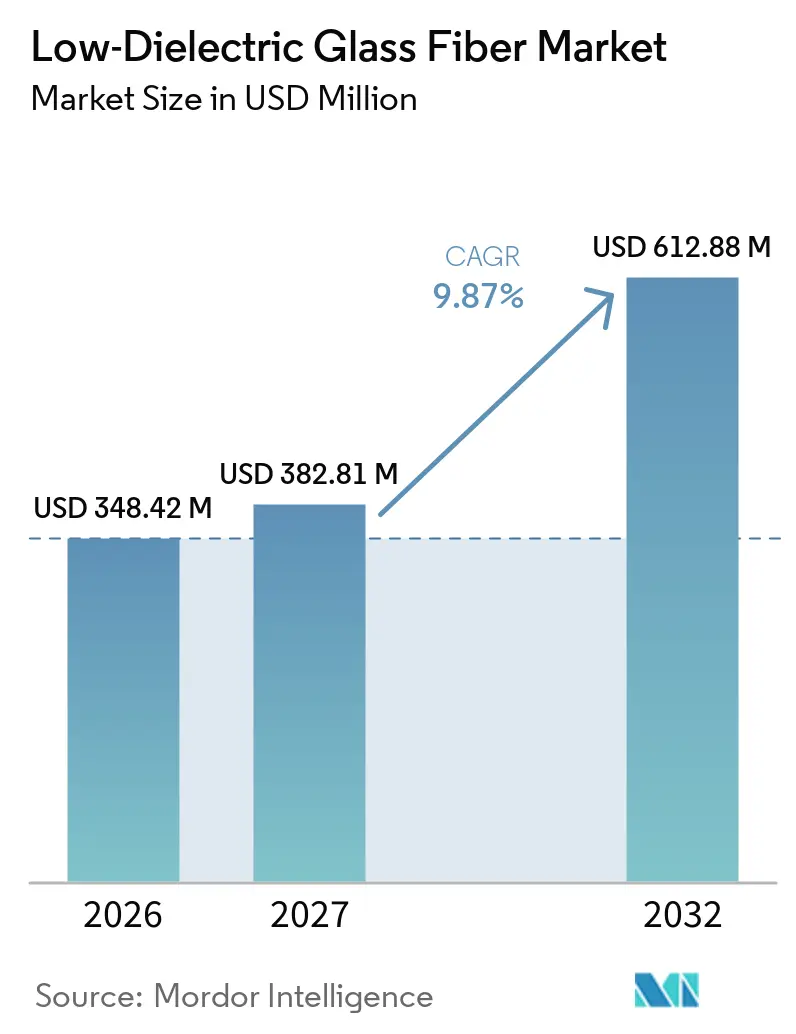
| Market Size (2027) | USD 382.81 Million |
| Market Size (2032) | USD 612.88 Million |
| Growth Rate (2027 - 2032) | 9.87 % |
| Fastest Growing Market | Asia-Pacific |
| Largest Market | Asia-Pacific |
| Market Concentration | High |
Major Players *Disclaimer: Major Players sorted in no particular order Image © Mordor Intelligence. Reuse requires attribution under CC BY 4.0. | |
Low-Dielectric Glass Fiber Market Analysis by Mordor Intelligence
The Low-Dielectric Glass Fiber Market size was valued at USD 348.42 million in 2026 and is estimated to grow from USD 382.81 million in 2027 to reach USD 612.88 million by 2032, at a CAGR of 9.87% during the forecast period (2027-2032). The low-dielectric glass fiber market is being shaped by rising signal-loss requirements in high-frequency electronics, where conventional E-glass laminates can exceed channel-loss budgets. Demand from Artificial Intelligence (AI) servers, 5G networks, and advanced automotive electronics is bringing glass fiber composition into material selection earlier in the design process. Japan, South Korea, mainland China, and Taiwan remain important qualification and production locations because they combine glass fiber capability with copper-clad laminate (CCL) and printed circuit board (PCB) manufacturing. The low-dielectric glass fiber market also faces a capacity timing risk because new furnace lines can take 18-24 months to qualify, and several additions may arrive at the same time. Resin and glass co-design may reduce fiber use per advanced substrate, although a shift toward higher-performance grades can still support value growth.
Key Report Takeaways
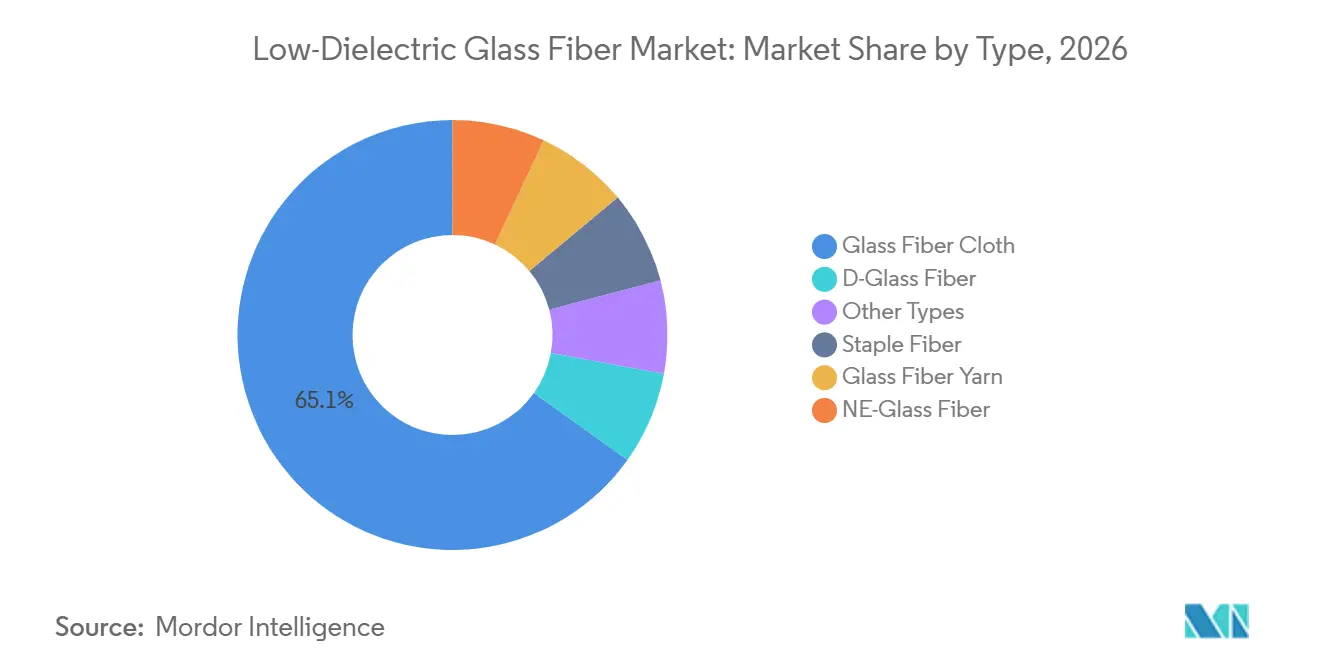
- By type, glass fiber cloth held 65.13% of the low-dielectric glass fiber market share in 2026, while NE-glass fiber is projected to advance at an 11.45% CAGR through 2032.
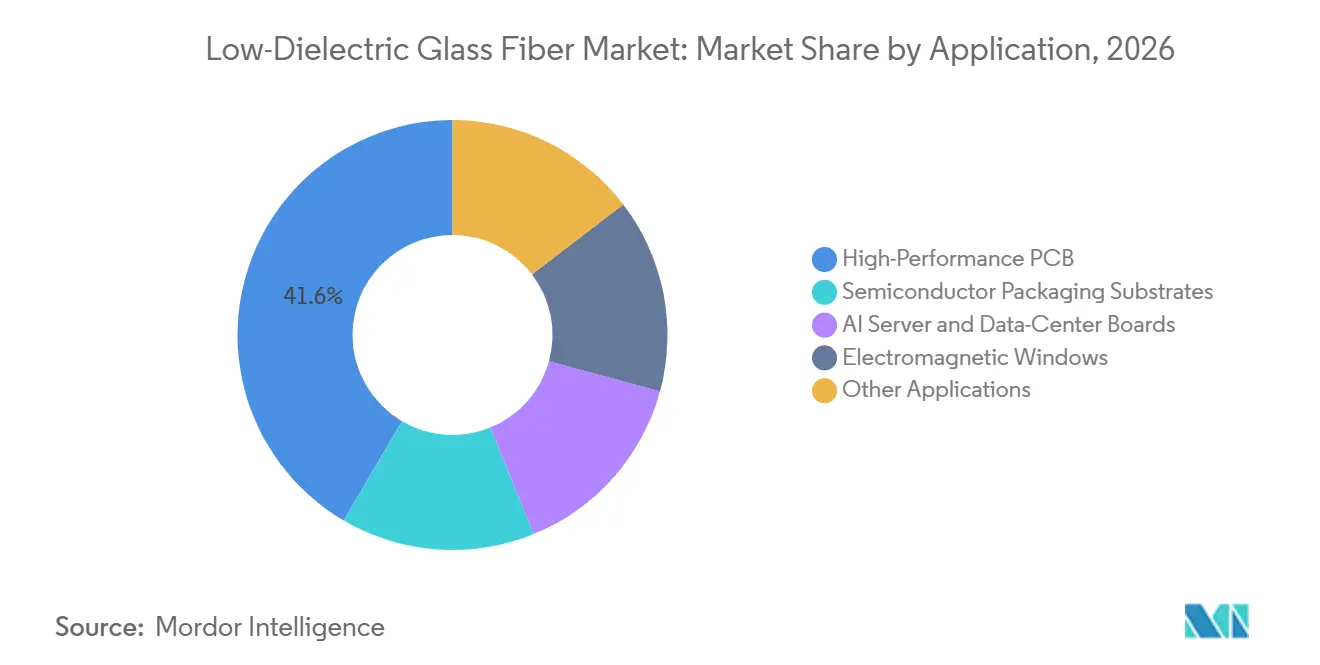
- By application, high-performance PCB held 41.56% of the low-dielectric glass fiber market share in 2026 and is projected to advance at a 12.04% CAGR through 2032.
- By geography, Asia-Pacific held 50.38% of the low-dielectric glass fiber market share in 2026 and is projected to advance at an 11.36% CAGR through 2032.
Note: Market numbers in this report are based on Mordor Intelligence's proprietary estimation framework, which combines nine months of actuals with Q4 projections for base year 2026.
Global Low-Dielectric Glass Fiber Market Trends and Insights
Drivers Impact Analysis*
| Driver | (~) % Impact on CAGR Forecast | Geographic Relevance | Impact Timeline |
|---|---|---|---|
| High-Speed Data Transmission and 5G Infrastructure Expansion | +2.8% | Global; APAC core, spillover to North America & EU | Medium term (2-4 years) |
| AI Server, 112G/224G Signaling and Data-Center Substrate Requirements | +2.3% | Global; early leadership in North America & APAC | Short term (≤ 2 years) |
| Miniaturization and Higher Layer Counts in High-Performance PCBs | +1.8% | APAC core (Taiwan, South Korea, Japan), spillover to North America | Short term (≤ 2 years) |
| Growth in Automotive Radar, LiDAR and Advanced Driver-Assistance Systems | +1.2% | North America & EU; early APAC adoption via China EV OEMs | Medium term (2-4 years) |
| Co-Design of Low-Dk Glass Cloth and Resin Systems for Controlled Impedance | +0.8% | Global; R&D leadership in Japan & North America | Long term (≥ 4 years) |
| Source: Mordor Intelligence | |||
High-Speed Data Transmission and 5G Infrastructure Expansion
5G frequency scaling from sub-6 GHz bands to millimeter-wave bands increases the importance of low-loss PCB materials. The 3rd Generation Partnership Project (3GPP) n257 and n258 bands cover 26.5-29.5 GHz and 24.25-27.5 GHz, respectively, where dielectric loss can constrain conventional E-glass laminates. The Association Connecting Electronics Industries (IPC) Specification 4103 defines the testing framework for high-speed and high-frequency-based materials. These testing and qualification requirements make low-Dk cloth a required material choice for certain designs rather than an optional performance upgrade. Japan and South Korea have dense millimeter-wave deployments and are important early qualification locations for specialty cloth. Approvals in these locations can support broader supply agreements, which strengthen demand visibility for the low-dielectric glass fiber market.
AI Server, 112G/224G Signaling and Data-Center Substrate Requirements
The low-dielectric glass fiber market benefits from the move toward 112G and 224G pulse amplitude modulation with 4-level signaling in server and data-center hardware. The Institute of Electrical and Electronics Engineers 802.3dj work formalizes Ethernet development at speeds reaching 1.6 Tb/s[1]. Long PCB traces at these data rates need lower dielectric loss and closer control of material properties. AGC Multimaterial reported that 224G channels require glass and resin co-engineering to reach a dielectric constant below 2.6 at 28 GHz and a dissipation factor of 0.001. This requirement ties fiber producers more closely to laminate chemists and PCB material developers. CPIC revised its low-dielectric fabric project in August 2026 as customer demand shifted toward second-generation Low Dielectric Constan (LDK) grades, raising planned investment to RMB 3 billion (approximately USD 418 million) and targeting 25.13 million meters of annual output. The change indicates that early qualification of second-generation products is becoming more important across the low-dielectric glass fiber market.
Miniaturization and Higher Layer Counts in High-Performance PCBs
Higher layer counts in AI server boards raise specialty cloth use per board beyond what unit-shipment data alone suggests. A 40-layer AI server PCB can consume 5-7 times the specialty cloth area of a 12-layer enterprise switch PCB. Finer weave constructions, such as 1035 and 106 grades, use narrower filaments than conventional 2116-style fabrics. These filaments are drawn at a lower throughput per bushing position, which reduces effective output from a production line. Material qualification under IPC 4103 and IPC 4101 limits the number of suppliers that can serve advanced designs. The low-dielectric glass fiber market, therefore, gains from both increased board complexity and the manufacturing constraints involved in producing fine, uniform cloth.
Growth in Automotive Radar, LiDAR and Advanced Driver-Assistance Systems
Automotive radar operating at 76-81 GHz needs PCB materials with controlled dielectric loss and stable dimensions. These boards must also withstand thermal cycling from -40 °C to +125 °C without material drift. Low-Dk glass cloth with controlled coefficient of thermal expansion is well suited to these combined electrical and reliability requirements. Rogers Corporation launched RO4830 Plus laminates in February 2025 for 76-81 GHz automotive corner radar applications. The product was designed with a dielectric constant of 3.03 at 77 GHz and an insertion loss of 1.5 dB per inch at 5 mil thickness. Automotive programs have longer procurement cycles than many consumer electronics programs, which gives the low-dielectric glass fiber market a second demand base beyond communications hardware.
Restraints Impact Analysis*
| Restraint | (~) % Impact on CAGR Forecast | Geographic Relevance | Impact Timeline |
|---|---|---|---|
| High Production Cost Compared With Conventional E-Glass | -1.8% | Global; most acute in cost-sensitive APAC CCL markets | Medium term (2-4 years) |
| Limited Availability of Specialized Raw Materials and Qualified Capacity | -1.2% | Global; concentrated in Japan & North America | Short term (≤ 2 years) |
| Difficult Melting, Drawing and Scale-Up of Boron-Rich Low-Dk Glass Compositions | -0.8% | Global; affects all producers regardless of geography | Long term (≥ 4 years) |
| Source: Mordor Intelligence | |||
High Production Cost Compared With Conventional E-Glass
Low-Dk glass fiber has a structural cost premium over conventional E-glass because it uses more boron oxide and specialized bushing configurations. NE-glass formulations generally contain 14%-20% boron oxide by weight, while D-glass variants contain 20%-26%, compared with less than 10% for standard E-glass grades. Volatile boron emissions during melting can lower furnace yields. CCL producers can face margin pressure when their laminate prices are constrained during large customer contract cycles. A new cloth construction must also complete dielectric testing and enter a laminate supplier's approved-material list, which can take 6-12 months. This qualification period limits rapid switching to lower-cost alternatives and remains a constraint for the low-dielectric glass fiber market.
Limited Availability of Specialized Raw Materials and Qualified Capacity
Boric acid and boric oxide are primary inputs for low-Dk glass compositions. Türkiye held more than 70% of global boron mineral reserves in 2025, according to the U.S. Geological Survey[2]. Supply concentration in both mineral extraction and refining can create continuity risks for fiber producers without long-term supply agreements. Qualified fiber-drawing capacity is also scarce because fine-filament low-Dk yarn has a narrow forming-temperature window. Standard E-glass furnace lines cannot be converted without substantial modification and a new qualification cycle. These material and capacity constraints cannot be resolved quickly, even when demand from the low-dielectric glass fiber market is clear.
*Our forecasts treat driver/restraint impacts as directional, not additive. The impact forecasts reflect baseline growth, mix effects, and variable interactions.
Segment Analysis
By Type: Glass Fiber Cloth Leads Revenue, While NE-Glass Fiber Expands
Glass fiber cloth held 65.13% of the low-dielectric glass fiber market size in 2026 because it is the direct press-ready material for CCL manufacturers. Its use is reinforced by existing qualification records and long-running supply relationships with CCL producers in Japan, Taiwan, and South Korea. Qualified weavers of NE-glass and D-glass grades have built process knowledge in weave uniformity and material handling. These capabilities limit the ability of new suppliers to displace established producers quickly. Glass fiber yarn supports both woven cloth and downstream composite uses, so yarn availability remains central to the low-dielectric glass fiber industry. Staple fiber and other types serve smaller reinforcement uses where thermal or mechanical properties can matter more than dielectric performance.
NE-glass fiber is projected to grow at an 11.45% CAGR through 2032, supported by its processability and its dielectric constant of 4.7 at 10 GHz. Established producers can supply the yarn to third-party weavers, which allows wider commercial use. Nippon Electric Glass Co., Ltd. launched D2 Fiber in December 2025 with a dielectric loss tangent of 0.0017 tanδ at 10 GHz. The company positioned D2 Fiber for AI server motherboards and semiconductor packaging substrates. D-glass can reach dielectric constant values as low as 4.1 at 1 GHz, although its higher boron oxide content makes scaling more difficult. The low-dielectric glass fiber market is moving from first-generation products toward technically differentiated NE-glass and D-glass grades as second-generation LDK cloth capacity expands.

By Application: High-Performance PCB Anchors Market Value and Growth
High-performance PCB accounted for 41.56% of the low-dielectric glass fiber market size in 2026 and is projected to expand at a 12.04% CAGR through 2032. Its lead reflects demand for materials that can support 112G and 224G SerDes interfaces. These designs require low-loss glass cloth and place tight limits on variability across the board. IPC ultra-low-loss material requirements narrow the qualified material pool to NE-glass, D-glass, and emerging second-generation LDK grades. Isola Group's TerraGreen 400G2 laminate uses second-generation ultra-low-Dk glass and ultra-smooth HVLP3 copper foil for data rates above 100 Gbps. This type of material combination makes qualified specialty glass a durable input for advanced board designs.
Semiconductor packaging substrates are an adjacent use where Flip-Chip Ball Grid Array (FC-BGA) substrates for AI accelerators need glass-cloth-reinforced Ajinomoto Build-up Film panels. Panel-level dielectric uniformity can be as important as bulk dielectric values for these substrates. AI server and data-center boards also need uniform weave patterns to control differential skew in midplane and backplane designs. Industrial sensors, medical imaging boards, and satellite electronics add steady demand at lower growth rates. The low-dielectric glass fiber industry benefits from this mix because each use needs a different balance of electrical, thermal, and mechanical performance.
Geography Analysis
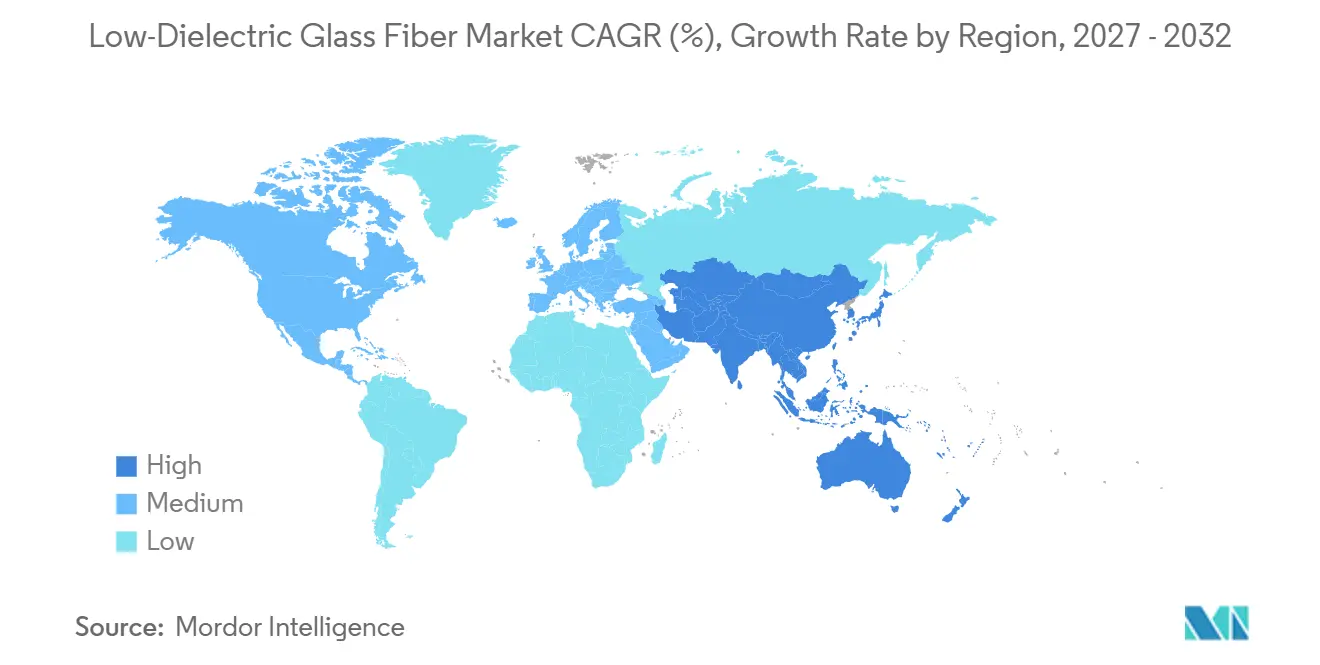
Asia-Pacific held 50.38% of the low-dielectric glass fiber market share in 2026 and is projected to advance at an 11.36% CAGR through 2032. The region combines CCL production in mainland China with advanced PCB and substrate fabrication in Taiwan and South Korea. Taiwan has an important role in cloth weaving. Fulltech Industries Corp. and TAIWAN GLASS IND. CORP. supply NE-glass and low-Dk cloth to laminate producers that serve advanced substrate lines.
Japan contributes strongly at the fiber technology level through the D2 Fiber launch by Nippon Electric Glass Co., Ltd. in December 2025. Nitto Boseki Co., Ltd. remains important in T-glass and NER-glass supply, which makes yarn production more concentrated than cloth weaving. North America has a different demand base centered on defense electronics, aerospace PCBs, and AI data centers. AGY Holding Corp. introduced L-High-Density Interconnect (L-HDI) glass fiber in August 2025 for advanced packaging substrates and AI hardware. The product was manufactured at the company's Aiken, South Carolina, facility and addressed dimensional stability and thermal reliability needs in high-density interconnect substrates. U.S. semiconductor packaging initiatives support the preference for domestic materials in some programs.
Europe is led by automotive original equipment manufacturers and Tier 1 radar-module demand in Germany, France, and the Nordic countries. Advanced driver-assistance system platforms have program durations of 5-10 years and use controlled-impedance PCBs at 76-81 GHz. Saint-Gobain Vetrotex has a regional manufacturing position where local traceability requirements can favor domestic sources. South America's contribution remains limited in 2026 and is concentrated in Brazil's electronics assembly sector. The Middle East and Africa are at an early stage, although Saudi Arabia's Vision 2030 data-center investments and telecommunications upgrades in South Africa can create demand for high-frequency PCB materials. These regions are more likely to be electronics import destinations than domestic low-Dk glass fiber production locations within the forecast period.
Competitive Landscape
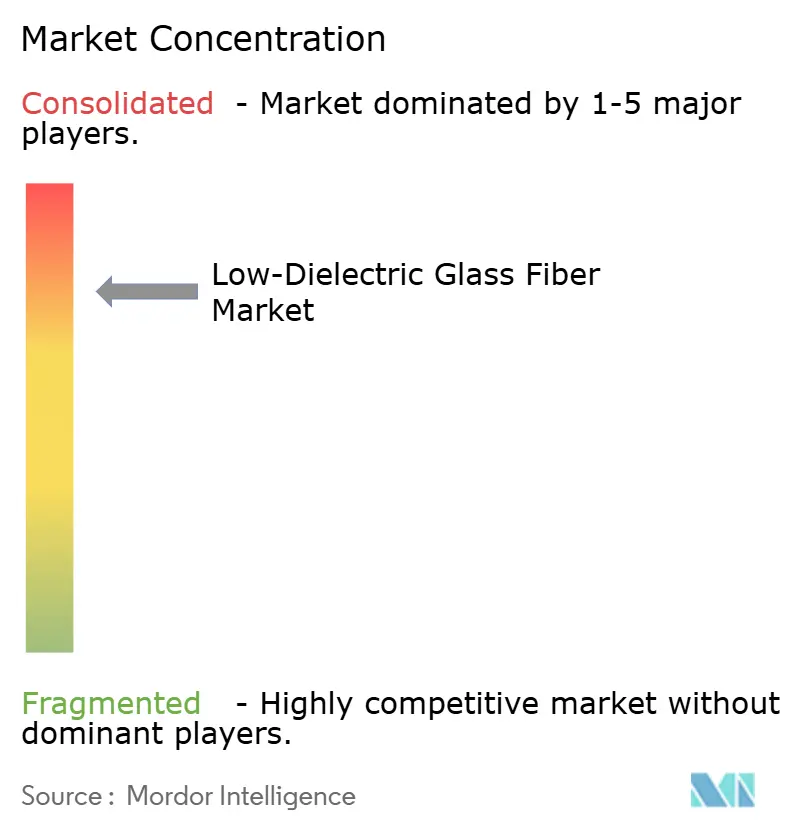
The low-dielectric glass fiber market is consolidated, with the top five players including Nitto Boseki Co., Ltd., Saint-Gobain Vetrotex, AGY Holding Corp., CPIC (Chongqing Polycomp International Corp.), and CTG Group (Taishan Fiberglass INC.). NE-glass and T-glass production requires qualified compositions and proven forming processes, which limits the number of suppliers at the high-performance end. Cloth weaving is distributed across Taiwan, mainland China, Japan, and the United States. Weavers compete on uniformity, void ratio, conductive anodic filament resistance, and their ability to process second-generation LDK yarns. The difference between upstream concentration and downstream fragmentation shapes pricing and qualification strategies across the low-dielectric glass fiber market.
Nippon Electric Glass Co., Ltd. customer-qualified D2 Fiber with glass cloth manufacturers before its commercial launch in December 2025. That approach links new yarn grades to customer processing requirements before broad market deployment. AGY Holding Corp. expanded an AI-focused portfolio that includes L, L2, and L-HDI grades for application-specific use in semiconductor and networking platforms. CPIC increased its LDK fabric investment in August 2026 as second-generation grades gained demand. These steps show that capacity expansion and customer qualification are occurring together. They also widen the number of potential cloth suppliers as additional qualified yarn sources enter the supply chain.
Chinese patent CN121181254A from 2025 targeted boron-rich glass fiber formulations with a dielectric constant below 4.3 and a dissipation factor below 0.0015 at 10 GHz. This places intellectual property alongside production scale as a competitive factor in second-generation LDK materials. A gap remains between ultra-low-loss performance and automotive-grade reliability. Automotive Electronics Council (AEC) Q200 and International Automotive Task Force 16949 certification remain uncommon for low-Dk glass cloth suppliers. Suppliers that secure these quality registrations can support longer radar-program commitments. The low-dielectric glass fiber market, therefore, remains differentiated by the ability to meet electrical targets, process consistently, and complete demanding customer qualifications.
Low-Dielectric Glass Fiber Industry Leaders
-
Nitto Boseki Co., Ltd.
-
Saint-Gobain Vetrotex
-
AGY Holding Corp.
-
CPIC (Chongqing Polycomp International Corp.)
-
CTG Group (Taishan Fiberglass INC.)
- *Disclaimer: Major Players sorted in no particular order
Recent Industry Developments
- September 2026: CPIC (Chongqing Polycomp International Corp.) increased investment in an electronic-grade glass fiber project targeting 25.13 million meters/year of first- and second-generation low-dielectric glass fiber fabric. The expansion supported the Low-Dielectric Glass Fiber Market by increasing supply for high-frequency and high-speed applications such as copper-clad laminates, PCBs, and AI servers.
- December 2025: Nippon Electric Glass Co., Ltd. launched D2 Fiber, a second-generation low-dielectric glass fiber for AI server motherboards, high-frequency communication equipment, and semiconductor package substrates. The product reduced transmission loss and power consumption, supporting growing demand for low-dielectric materials in high-speed data infrastructure.
Global Low-Dielectric Glass Fiber Market Report Scope
Low-dielectric glass fiber is a specialized glass reinforcement material designed to provide a low dielectric constant and low dielectric loss while maintaining mechanical strength and dimensional stability. It is used in high-frequency and high-speed electronic systems where signal integrity and reliable electrical performance are critical.
The Low-Dielectric Glass Fiber Market is segmented by type, application, and geography. By type, the market is segmented into glass fiber cloth, staple fiber, glass fiber yarn, D-glass fiber, NE-glass fiber, and other types. By application, the market is segmented into high-performance PCB, semiconductor packaging substrates, AI server and data-center boards, electromagnetic windows, and other applications. The report also covers the market size and forecasts for low-dielectric glass fiber across 15 countries. For each segment, the market sizing and forecasts have been done on the basis of value (USD).
| Glass Fiber Cloth |
| Staple Fiber |
| Glass Fiber Yarn |
| D-Glass Fiber |
| NE-Glass Fiber |
| Other Types |
| High-Performance PCB |
| Semiconductor Packaging Substrates |
| AI Server and Data-Center Boards |
| Electromagnetic Windows |
| Other Applications |
| Asia-Pacific | China |
| India | |
| Japan | |
| South Korea | |
| ASEAN Countries | |
| Rest of Asia-Pacific | |
| North America | United States |
| Canada | |
| Mexico | |
| Europe | Germany |
| United Kingdom | |
| France | |
| Italy | |
| NORDIC Countries | |
| Rest of Europe | |
| South America | Brazil |
| Argentina | |
| Rest of South America | |
| Middle East and Africa | Saudi Arabia |
| South Africa | |
| Rest of Middle East and Africa |
| By Type | Glass Fiber Cloth | |
| Staple Fiber | ||
| Glass Fiber Yarn | ||
| D-Glass Fiber | ||
| NE-Glass Fiber | ||
| Other Types | ||
| By Application | High-Performance PCB | |
| Semiconductor Packaging Substrates | ||
| AI Server and Data-Center Boards | ||
| Electromagnetic Windows | ||
| Other Applications | ||
| By Geography | Asia-Pacific | China |
| India | ||
| Japan | ||
| South Korea | ||
| ASEAN Countries | ||
| Rest of Asia-Pacific | ||
| North America | United States | |
| Canada | ||
| Mexico | ||
| Europe | Germany | |
| United Kingdom | ||
| France | ||
| Italy | ||
| NORDIC Countries | ||
| Rest of Europe | ||
| South America | Brazil | |
| Argentina | ||
| Rest of South America | ||
| Middle East and Africa | Saudi Arabia | |
| South Africa | ||
| Rest of Middle East and Africa | ||
Key Questions Answered in the Report
What is the size of the low-dielectric glass fiber market?
The Low-Dielectric Glass Fiber Market size was valued at USD 348.42 million in 2026 and is estimated to grow from USD 382.81 million in 2027 to reach USD 612.88 million by 2032, at a CAGR of 9.87% during the forecast period (2027-2032).
What is driving demand for low-dielectric glass fiber?
AI servers, 112G and 224G signaling, 5G networks, high-layer-count PCBs, and automotive radar are increasing the need for lower-loss substrate materials.
Which type led the low-dielectric glass fiber market in 2026?
Glass fiber cloth led with 65.13% share in 2026 because it is the direct press-ready input used by CCL manufacturers.
Which application is expected to grow fastest through 2032?
High-performance PCBs are projected to advance at a 12.04% CAGR through 2032, supported by advanced server and networking board requirements.