
Lithium Mining Market Size and Share
Market Overview
| Study Period | 2022 - 2032 |
|---|---|
| Market Size (2027) | USD 12.76 Billion |
| Market Size (2032) | USD 20.76 Billion |
| Growth Rate (2027 - 2032) | 10.23 % |
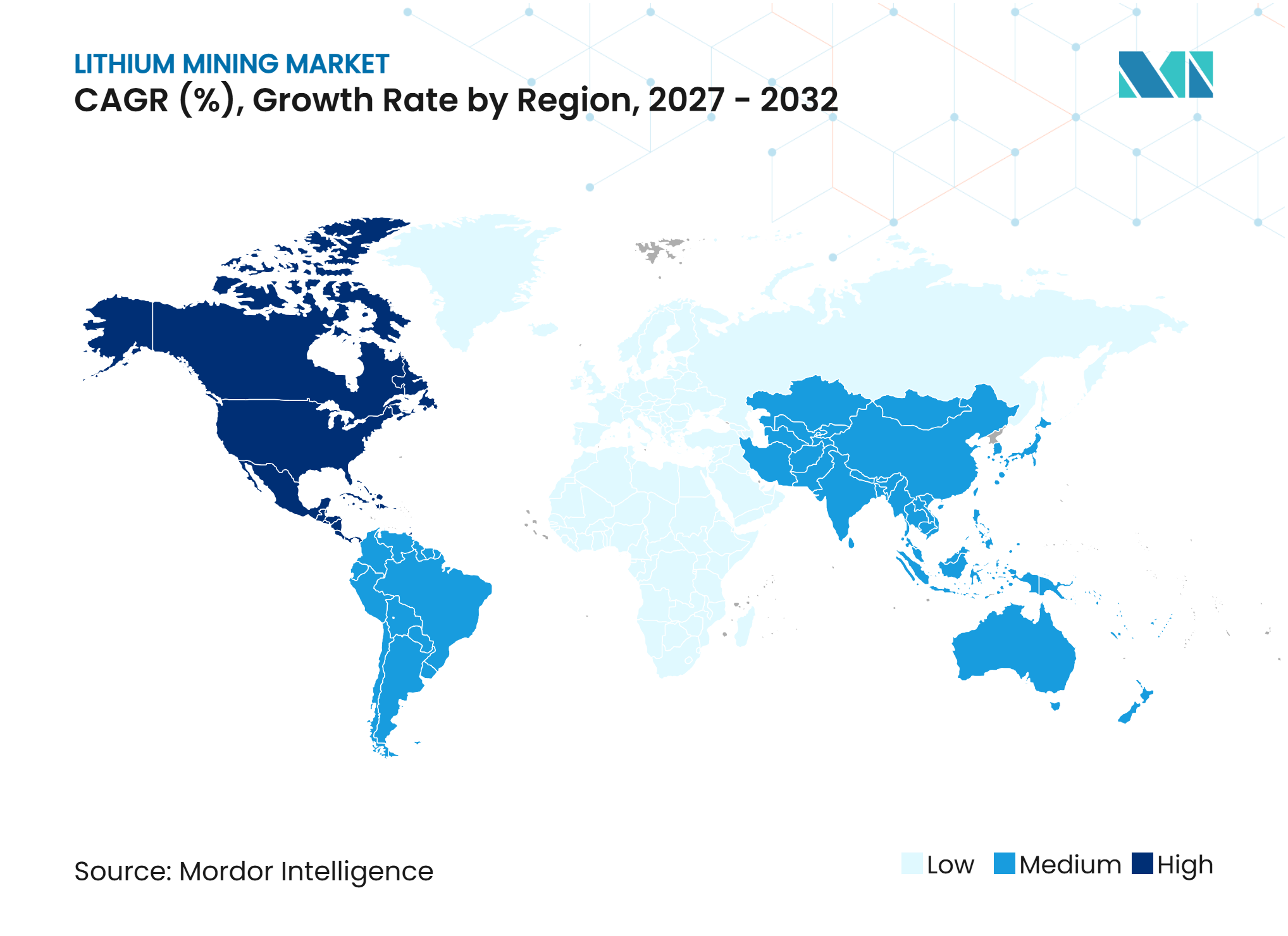
| Fastest Growing Market | Asia-Pacific |
| Largest Market | North America |
| Market Concentration | Medium |
Major Players *Disclaimer: Major Players sorted in no particular order Image © Mordor Intelligence. Reuse requires attribution under CC BY 4.0. | |
Lithium Mining Market Analysis by Mordor Intelligence
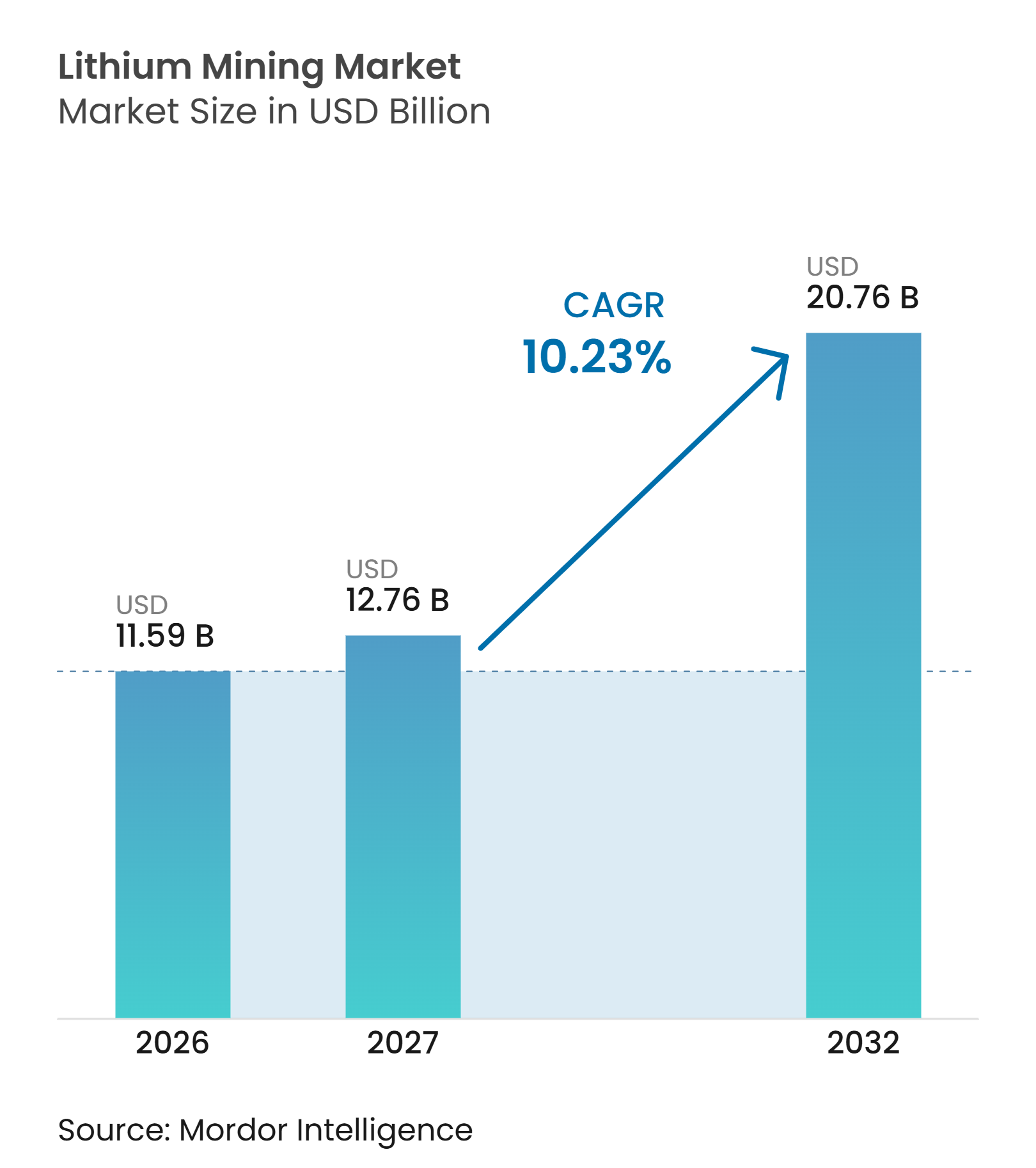
The Lithium Mining Market size was valued at USD 11.59 billion in 2026 and is estimated to grow from USD 12.76 billion in 2027 to reach USD 20.76 billion by 2032, at a CAGR of 10.23% during the forecast period (2027-2032). Demand is supported by battery production for electric vehicles and stationary storage, while producers also face a supply cycle shaped by new capacity, price changes, and project timing. Chile’s copper commission reached 1.34 million metric tons in 2025. This demand base gives the lithium mining market a wider set of end uses than vehicle sales alone, although it also exposes miners to changing battery chemistries. Lower prices have shifted attention toward operating costs, project execution, and secure offtake arrangements. Large producers are extending their positions through vertically integrated mining and chemical conversion assets, while newer projects are focused on domestic supply requirements and lower-water extraction methods.
Key Report Takeaways
- By source, brine held 66.45% of the lithium mining market share in 2026, while hard rock is projected to advance at a 10.78% CAGR through 2032.
- By product type, lithium carbonate held 45.71% of the lithium mining market share in 2026, while lithium hydroxide is projected to advance at an 11.14% CAGR through 2032.
- By application, batteries held 71.23% of the lithium mining market share in 2026 and are projected to advance at an 11.81% CAGR through 2032.
- By geography, Asia-Pacific held 42.82% of the lithium mining market share in 2026, while North America is projected to advance at an 11.62% CAGR through 2032.
Note: Market numbers in this report are based on Mordor Intelligence's proprietary estimation framework, which combines nine months of actuals with Q4 projections for base year 2026.
Market Trends and Insights
Drivers Impact Analysis of Lithium Mining Market*
| Driver | (~) % Impact on CAGR Forecast | Geographic Relevance | Impact Timeline |
|---|---|---|---|
| Rising Lithium-Ion Battery Demand | +3.5% | Global | Short term (≤ 2 years) |
| Energy Storage System Deployment | +2.0% | Global, especially APAC and North America | Medium term (2-4 years) |
| Direct Lithium Extraction Commercialization | +0.9% | Global, especially South America and North America | Long term (≥ 4 years) |
| Demand for Battery-Grade Lithium Chemicals | +0.7% | Global, especially APAC | Medium term (2-4 years) |
| Lithium Supply-Chain Localization | +0.5% | North America and EU | Short to medium term |
| Source: Mordor Intelligence | |||
Rising Lithium-Ion Battery Demand
The lithium mining market is supported by continued adoption of lithium-ion batteries in passenger vehicles and grid-connected storage. The International Energy Agency projected total lithium demand at 455 kilotonnes by 2030, compared with 205 kilotonnes in 2024, with clean energy technologies accounting for most of the increase[1]. Battery makers are also balancing lithium iron phosphate cells with nickel-rich chemistries, which require lithium hydroxide that meets demanding purity standards. This mix limits the ability of suppliers to treat all lithium chemicals as interchangeable products. The lithium mining market therefore depends on both mined volume and the capacity to refine material to battery specifications. Producers with established conversion assets are better positioned to serve cell manufacturers that need predictable product quality.
Energy Storage System Deployment
Stationary energy storage is creating a second source of lithium demand alongside electric vehicles. CoCHILCO (Comisión Chilena del Cobre) stated that stronger energy storage system demand contributed to the recovery in lithium carbonate prices during the second half of 2025. Utility-scale projects often secure supply through longer arrangements, which favors companies able to commit volumes over several years. This gives large brine producers an advantage, as they can maintain stable output and meet customer qualification requirements. The lithium mining market also benefits because storage demand can remain active when passenger vehicle sales fluctuate. The expansion of renewable power capacity will continue to make storage procurement a material consideration for lithium suppliers.
Direct Lithium Extraction Commercialization
Direct lithium extraction is moving from pilot activity toward larger projects in the United States and Argentina. The U.S. Department of Energy offered a conditional commitment of up to USD 1.36 billion for EnergySource Minerals’ ATLiS facility in California, which targets 20,000 metric tons per year of lithium hydroxide from geothermal brine[2]. Smackover Lithium completed a field-pilot milestone in Arkansas during March 2025, and Equinor confirmed a USD 225 million federal award for the project. Rio Tinto’s Rincon project in Argentina is planned to use direct lithium extraction and target 53,000 metric tons per year of battery-grade lithium carbonate. These projects could broaden the lithium mining market beyond conventional evaporation ponds, but early plants must still prove consistent performance under local brine conditions. Their operating results will determine whether lower water use and shorter processing times translate into dependable production.
Demand for Battery-Grade Lithium Chemicals
Battery manufacturers are setting stricter specifications for lithium inputs, especially for material used in high-nickel cathodes. Lithium hydroxide monohydrate for these applications generally requires impurities such as sodium, calcium, and sulfate to remain below 50 parts per million. Albemarle Corporation shifted 10,000 metric tons per year of capacity at its Qinzhou plant from hydroxide to carbonate production in 2025 in response to demand for carbonate. The decision reflects the current strength of lithium iron phosphate battery demand in China, while premium applications continue to need high-purity hydroxide. Ganfeng Lithium Group Co., Ltd. and Tianqi Lithium Co. Ltd. are also developing materials for advanced battery applications. This product split gives the lithium mining market an incentive to maintain flexible conversion capacity instead of relying on a single chemical product.
Restraints Impact Analysis of Lithium Mining Market*
| Restraint | (~) % Impact on CAGR Forecast | Geographic Relevance | Impact Timeline |
|---|---|---|---|
| Lithium Price Volatility and Project Deferrals | -1.8% | Global | Short to medium term |
| Water Stress and Brine-Aquifer Uncertainty | -0.9% | South America (Lithium Triangle); spillover to MEA | Long term (≥ 4 years) |
| Permitting and Community-License Delays | -0.5% | Europe and North America; spillover to APAC | Long term (≥ 4 years) |
| Source: Mordor Intelligence | |||
Lithium Price Volatility and Project Deferrals
The lithium mining market remains sensitive to price movements because marginal projects depend on higher selling prices to support construction and operating costs. COCHILCO recorded lithium carbonate CIF Asia prices above USD 30,000 per metric ton before the downturn, a low of USD 8,975 per metric ton in mid-2025, and USD 11,300 per metric ton by the end of 2025. SQM S.A.’s average realized lithium price fell from USD 10,936 per metric ton in 2024 to USD 9,174 per metric ton in 2025, despite record sales volumes of 258,000 metric tons of lithium carbonate equivalent. IGO LIMITED fully impaired its Kwinana lithium hydroxide refinery after the plant averaged 35% of nameplate capacity across 3 years. When weak prices delay projects, the future supply base becomes less prepared for demand recovery.
Water Stress and Brine-Aquifer Uncertainty
Brine production in the Lithium Triangle depends on water and brine management in areas with limited freshwater availability. Albemarle Corporation stated that its Salar de Atacama operations are subject to authorized extraction limits and groundwater thresholds that could require it to reduce or halt pumping. Chilean authorities continue to refine aquifer monitoring practices, making hydrological data more important for capacity planning. Lithium Argentina AG produced 34,100 metric tons of lithium carbonate at Caucharí-Olaroz in 2025 and included a 5,000 metric ton per year direct lithium extraction demonstration module in Stage 2 planning. The approach is intended to reduce brine extraction per unit of output. Water management will remain a practical constraint for the lithium mining market as operators seek to expand existing salars.
*Our forecasts treat driver/restraint impacts as directional, not additive. The impact forecasts reflect baseline growth, mix effects, and variable interactions.
Lithium Mining Market Segment Analysis
By Source:
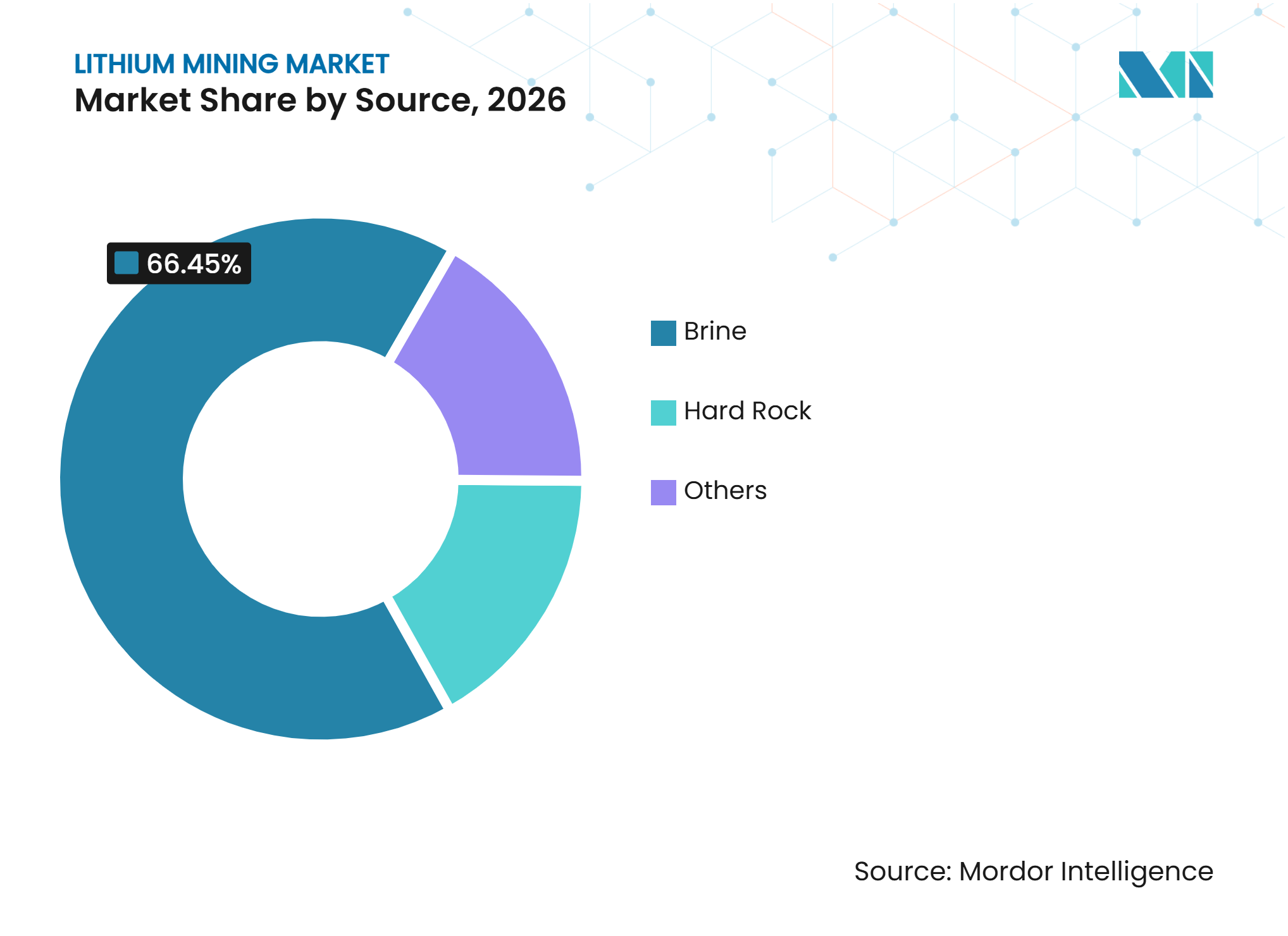
Brine Retains Its Cost Position as Hard Rock Capacity ExpandsBrine held a 66.45% share in 2026, supported by evaporation operations in Chile, Argentina, and Bolivia. SQM S.A. and Codelco formed the Nova Andino Litio joint venture, which is expected to expand permitted extraction by 56,361 metric tons and target 240,000 metric tons per year of lithium carbonate capacity by 2028. Brine producers face longer construction periods for new ponds and closer scrutiny of water and aquifer conditions. The other category, which includes geothermal brines, clays, and produced-water recovery, remains small but is attracting public support.
Hard rock is projected to advance at a 10.78% CAGR through 2032 as buyers diversify sources and support projects outside the Lithium Triangle. Geoscience Australia confirmed that Australia had 8 operating mines and proved ore reserves of 4,601 kilotonnes of lithium at the end of 2024. International Organization for Standardization (ISO) 14001 is increasingly relevant as purchasers embed sustainability standards into supply qualification. The source will remain important to the lithium mining industry because it offers different geopolitical and customer access advantages.



By Product Type:
Lithium Carbonate Leads While Lithium Hydroxide ExpandsLithium carbonate held a 45.71% share in 2026 because lithium iron phosphate batteries remain widely used in China’s electric vehicle production. Carbonate also serves ceramics, glass, and other industrial applications, giving producers more than one route to market. Albemarle Corporation’s decision to convert Qinzhou capacity to carbonate indicates that conversion assets need flexibility as battery chemistry demand changes. Lithium chloride and lithium metal remain relevant to selected industrial and advanced battery uses.
Lithium hydroxide is projected to advance at an 11.14% CAGR through 2032 as high-nickel cathode production requires high-purity inputs. Tianqi’s Zhangjiagang facility confirmed battery-grade output from its 30,000 metric ton per year hydroxide line in October 2025. The facility can switch between hydroxide and carbonate production, helping it respond to customer demand. Higher purity requirements could narrow the approved supplier base for premium cathode applications.
By Application:
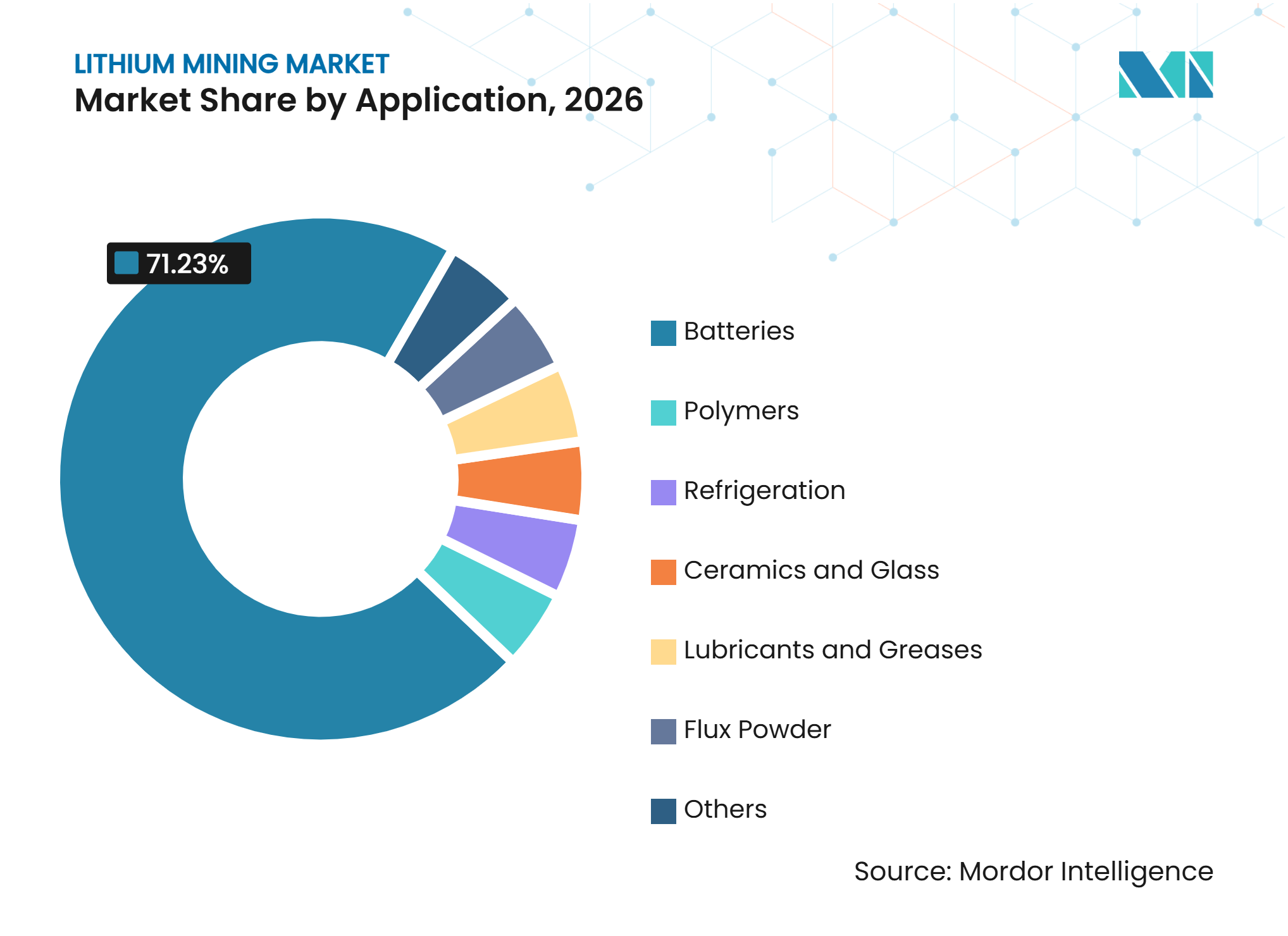
Batteries Anchor Demand Across Mobility and StorageBatteries held a 71.23% share in 2026 and are projected to advance at an 11.81% CAGR through 2032. The application covers electric vehicles and stationary storage, which creates two linked sources of demand for lithium chemicals. Lithium-ion batteries are expected to remain the principal technology, although sodium-ion batteries are gaining use in cost-sensitive and short-range vehicle applications. The lithium mining market must therefore align mining output with the chemical specifications of different cell formats.
Ceramics and glass remain established uses for lithium carbonate because it can lower melting temperatures and improve thermal shock resistance. Lubricants and greases, polymers, flux powder, and refrigeration represent smaller applications with specialized technical requirements. Lithium-based grease thickeners can be relevant to products that follow International Organization for Standardization 6743 classifications and food-grade requirements. These applications provide a broader demand base when battery-related purchasing conditions change.

Geography Analysis
Asia-Pacific
Asia-Pacific held a 42.82% share in 2026, reflecting its combined position in extraction, refining, and battery manufacturing. Tianqi Lithium Co. Ltd.’s Greenbushes operation produced 1.35 million metric tons of spodumene concentrate in 2025 and accounted for 18.9% of global hard rock output. South Korean battery manufacturers remain important buyers of lithium hydroxide, while the Japan Organization for Metals and Energy Security supports strategic reserve arrangements. China’s strategic mineral rules and green mine requirements make regulatory compliance a continuing operational factor. The region’s supply position will depend on meeting chemical quality requirements and tighter environmental expectations.
North America
North America is projected to advance at an 11.62% CAGR through 2032. The Inflation Reduction Act’s domestic content requirements and 2025 federal actions are directing investment to local supply chains. Thacker Pass is under construction, while California and Arkansas projects could add geothermal and oilfield brine supply. National Environmental Policy Act review and tribal consultation shape project development in the United States. Policy support alone does not guarantee rapid production growth.
Europe, South America, and Middle East and Africa
The European Union selected 47 strategic projects in 2025 under the Critical Raw Materials Act, and 6 covered lithium extraction or processing. Rio Tinto’s USD 2.5 billion Rincon project received approval under Argentina’s large investment incentive framework, while Sigma Lithium paused its Grota do Cirilo mine for an equipment upgrade in 2025. Mines in Zimbabwe are expanding hard rock concentrate exports. These locations diversify the lithium mining market beyond Australia and South American salars, although processing capacity and transport links remain constraints.
Competitive Landscape
Market Concentration
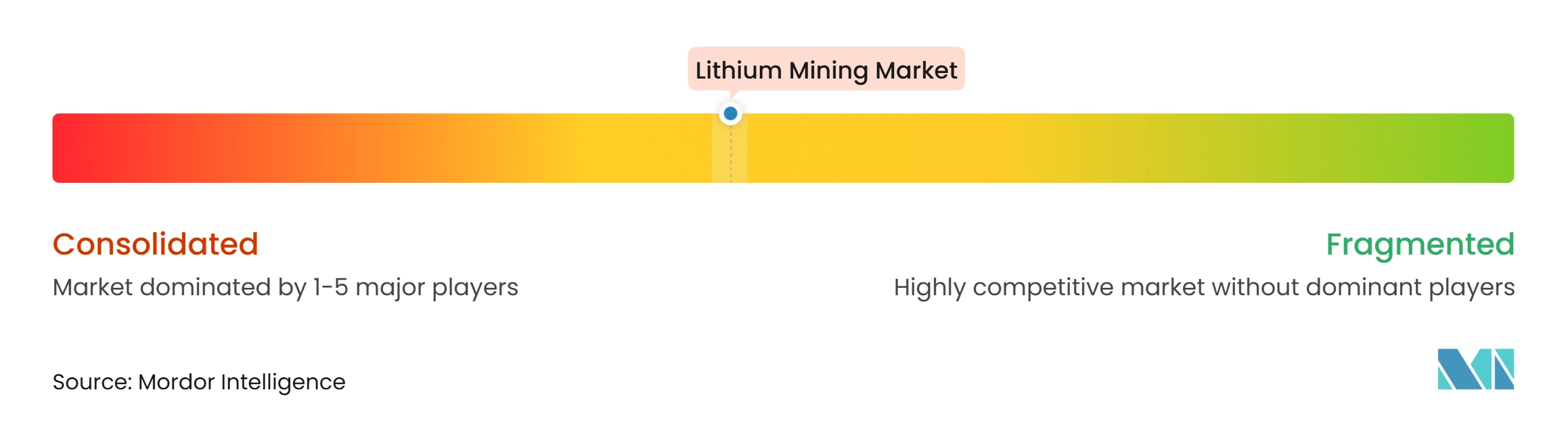
The lithium mining market is moderately concentrated, with top players including SQM S.A., Albemarle Corporation, Ganfeng Lithium Group Co., Ltd., Tianqi Lithium Co. Ltd., and Rio Tinto. Ganfeng Lithium Group Co., Ltd. reported plans to build total annual lithium product capacity to 600,000 metric tons by 2030. This structure can reduce exposure to individual mine disruptions and give large producers broader customer access.
Rio Tinto completed its USD 6.7 billion acquisition of Arcadium Lithium in March 2025 and created the Rio Tinto Lithium business. Rio Tinto also received approval for its USD 2.5 billion Rincon direct lithium extraction project, which targets 53,000 metric tons per year of battery-grade lithium carbonate. Tianqi Lithium Co. Ltd. completed Chemical Grade Plant 3 at Greenbushes in December 2025, increasing nameplate capacity to 2.14 million metric tons per year. These moves show that scale, product flexibility, and control of upstream assets remain key competitive factors.
Second-tier operators compete through asset quality, production growth, and partnerships. PLS Group Limited completed its P1000 expansion during fiscal year 2025 and achieved record production of 755,000 metric tons of spodumene. Liontown Ltd moved Kathleen Valley to underground mining during 2025, with steady-state underground production targeted by the end of fiscal year 2027. Companies in Brazil and Zimbabwe are adding alternative hard rock supply, while direct lithium extraction creates opportunities for brine deposits not suited to evaporation ponds. The lithium mining market will reward companies that combine reliable operations with qualified chemical output and clear compliance practices.
Lithium Mining Industry Leaders
-
SQM S.A.
-
Albemarle Corporation
-
Ganfeng Lithium Group Co., Ltd.
-
Tianqi Lithium Co. Ltd.
-
Rio Tinto
- *Disclaimer: Major Players sorted in no particular order
Lithium Mining Market Companies Covered in this Report
- Albemarle Corporation
- Ganfeng Lithium Group Co., Ltd.
- IGO LIMITED
- Liontown Ltd
- Lithium Americas Corp.
- Lithium Argentina AG
- Livent Corporation
- Mineral Resources
- PLS Group Limited
- Rio Tinto
- Sichuan Yahua Industrial Group Co., Ltd.
- Sigma Lithium
- Sinomine Resource Group Co., Ltd.
- SQM S.A.
- Tianqi Lithium Co. Ltd.
Recent Industry Developments in Lithium Mining Market
- October 2026: Rio Tinto officially opened its Fénix 1B expansion and Sal de Vida lithium operation in Argentina following a combined investment of approximately USD 1.4 billion. The projects are expected to add 25,000 metric tons per year of lithium carbonate equivalent (LCE) capacity once fully ramped up, expanding Argentina’s lithium production base.
- July 2026: Wesfarmers Limited and SQM S.A. approved the expansion of the Mt Holland lithium project in Western Australia, including a second concentrator and an integrated ore-sorting facility. The expansion is expected to double spodumene concentrate production capacity from approximately 380,000 to 760,000 metric tons per year, with first output from the expansion targeted for the first half of 2030.
Global Lithium Mining Market Report Scope
Lithium mining involves the extraction and processing of lithium-bearing resources from natural deposits, primarily brine reservoirs and hard-rock minerals such as spodumene. The extracted lithium is processed into various chemical compounds and refined products for use across energy storage, manufacturing, and industrial applications. Growing demand for lithium-ion batteries has increased the importance of lithium mining in supporting electric mobility and renewable energy storage.
The Lithium Mining Market is segmented by source, product type, application, and geography. By source, the market is segmented into brine, hard rock, and others. By product type, the market is segmented into lithium carbonate, lithium hydroxide, lithium chloride, lithium metal, and others. By application, the market is segmented into batteries, ceramics and glass, lubricants and greases, polymers, flux powder, refrigeration, and others. The report also covers the market size and forecasts for lithium mining in 15 countries across major regions. For each segment, the market sizing and forecasts have been done on the basis of value (USD).
Segmentation Overview
| Brine |
| Hard Rock |
| Others |
| Lithium Carbonate |
| Lithium Hydroxide |
| Lithium Chloride |
| Lithium Metal |
| Others |
| Batteries |
| Ceramics and Glass |
| Lubricants and Greases |
| Polymers |
| Flux Powder |
| Refrigeration |
| Others |
| Asia-Pacific | China |
| India | |
| Japan | |
| South Korea | |
| ASEAN Countries | |
| Rest of Asia-Pacific | |
| North America | United States |
| Canada | |
| Mexico | |
| Europe | Germany |
| United Kingdom | |
| France | |
| Italy | |
| NORDIC Countries | |
| Rest of Europe | |
| South America | Brazil |
| Argentina | |
| Rest of South America | |
| Middle East and Africa | Saudi Arabia |
| South Africa | |
| Rest of Middle East and Africa |
| By Source | Brine | |
| Hard Rock | ||
| Others | ||
| By Product Type | Lithium Carbonate | |
| Lithium Hydroxide | ||
| Lithium Chloride | ||
| Lithium Metal | ||
| Others | ||
| By Application | Batteries | |
| Ceramics and Glass | ||
| Lubricants and Greases | ||
| Polymers | ||
| Flux Powder | ||
| Refrigeration | ||
| Others | ||
| By Geography | Asia-Pacific | China |
| India | ||
| Japan | ||
| South Korea | ||
| ASEAN Countries | ||
| Rest of Asia-Pacific | ||
| North America | United States | |
| Canada | ||
| Mexico | ||
| Europe | Germany | |
| United Kingdom | ||
| France | ||
| Italy | ||
| NORDIC Countries | ||
| Rest of Europe | ||
| South America | Brazil | |
| Argentina | ||
| Rest of South America | ||
| Middle East and Africa | Saudi Arabia | |
| South Africa | ||
| Rest of Middle East and Africa | ||
Key Questions Answered in the Report
What is the size of the lithium mining market?
The lithium mining market size was valued at USD 11.59 billion in 2026 and is estimated to grow from USD 12.76 billion in 2027 to reach USD 20.76 billion by 2032, at a CAGR of 10.23% during the forecast period (2027-2032).
What is driving lithium mining demand?
The lithium mining market is driven by battery demand from electric vehicles and stationary energy storage.
Which source held the largest share in 2026?
Brine led with a 66.45% share in 2026 within the lithium mining market because Lithium Triangle operations provide a low-cost production base.
Which product type is projected to advance fastest through 2032?
Lithium hydroxide is projected to advance at an 11.14% CAGR through 2032 in the lithium mining market as high-nickel cathodes need high-purity inputs.