
Lithium-Ion Battery Transportation Market Size and Share
Market Overview
| Study Period | 2022 - 2032 |
|---|---|
| Market Size (2027) | USD 15.55 Billion |
| Market Size (2032) | USD 26.45 Billion |
| Growth Rate (2027 - 2032) | 11.21 % |
| Fastest Growing Market | Asia-Pacific |
| Largest Market | Asia-Pacific |
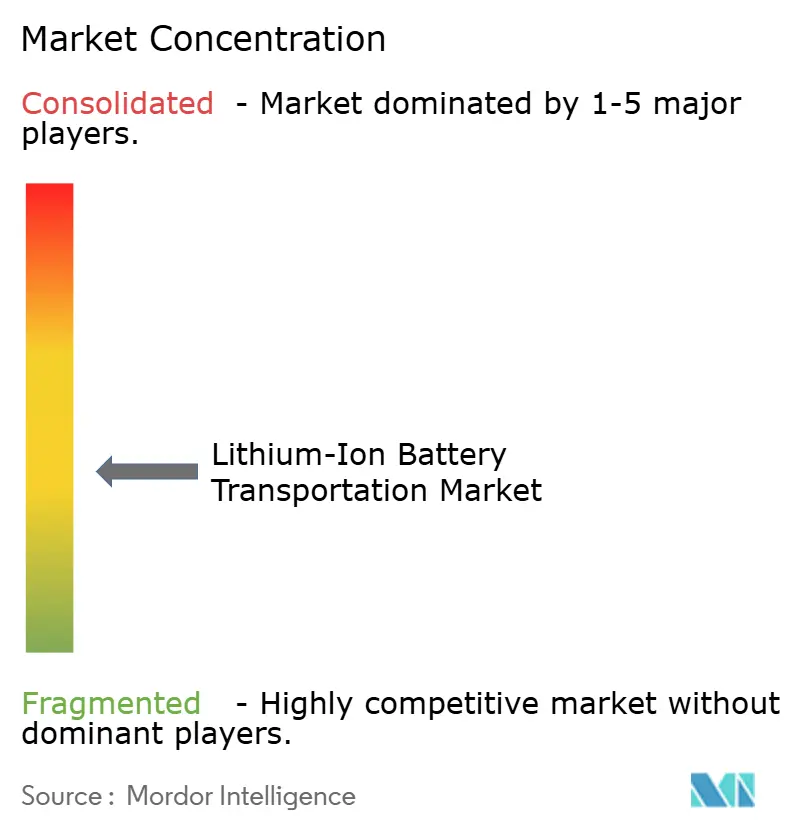
| Market Concentration | Medium |
Major Players *Disclaimer: Major Players sorted in no particular order Image © Mordor Intelligence. Reuse requires attribution under CC BY 4.0. | |
Lithium-Ion Battery Transportation Market Analysis by Mordor Intelligence
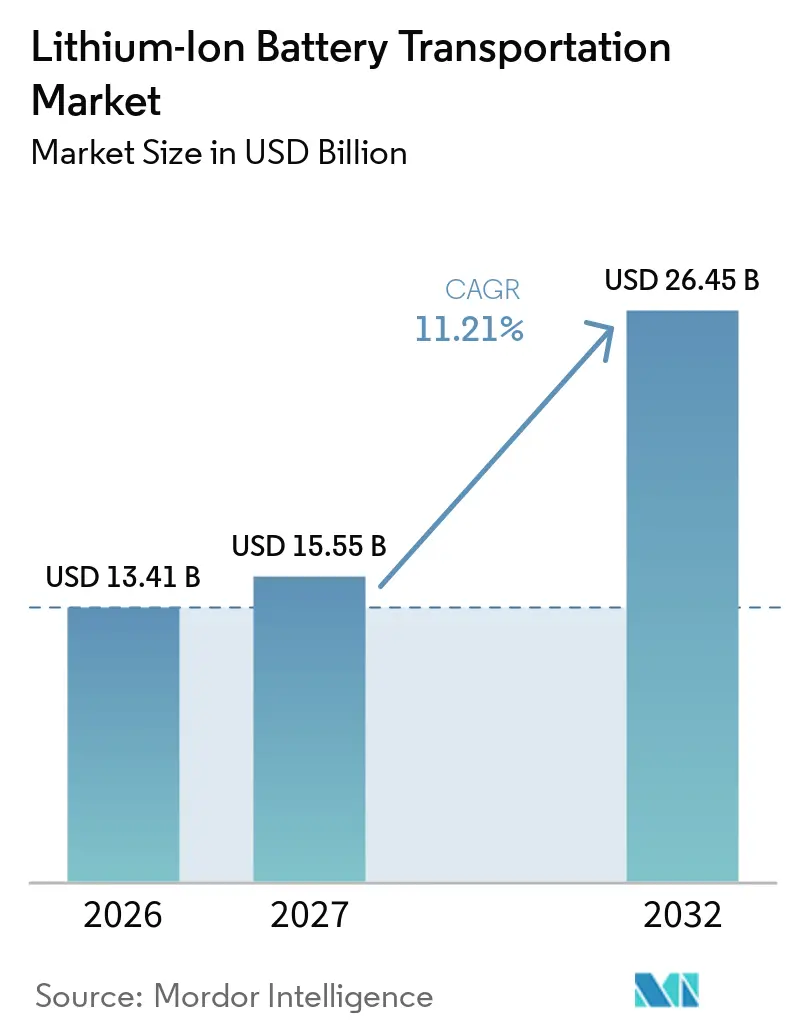
The Lithium-Ion Battery Transportation Market size was valued at USD 13.41 billion in 2026 and is estimated to grow from USD 15.55 billion in 2027 to reach USD 26.45 billion by 2032, at a CAGR of 11.21% during the forecast period (2027-2032). The lithium-ion battery transportation market is becoming more specialized as battery volumes rise across electric vehicles, consumer electronics, and stationary energy storage. Dangerous-goods expertise, live shipment visibility, and reliable regulatory controls are increasingly important when logistics providers compete for battery contracts. Battery production remains concentrated while demand is spread across regions, which keeps cross-border transportation central to the lithium-ion battery transportation market. New manufacturing clusters in Europe and North America are adding routes alongside established Asia-linked corridors, while recycling requirements are creating a separate flow for returned batteries. These conditions favor operators that can coordinate compliant transport, controlled storage, packaging, data capture, and handoffs across several modes of transport.
Key Report Takeaways
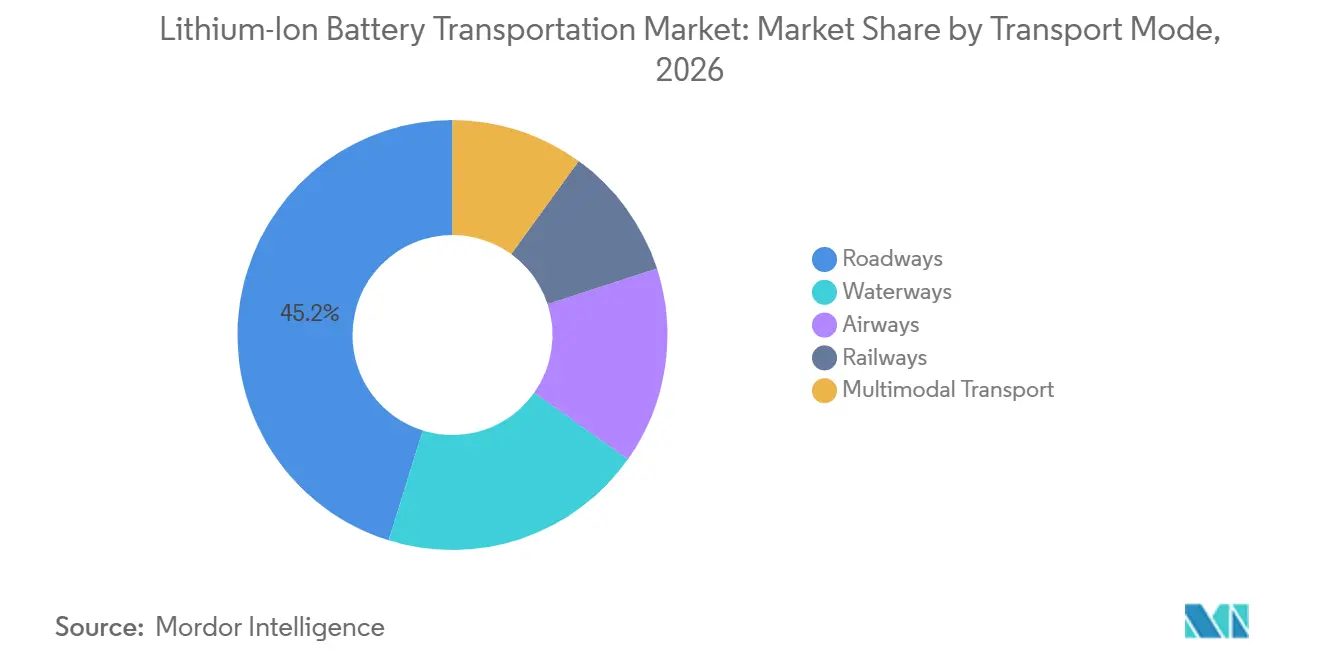
- By transport mode, Roadways held 45.2% of revenue in 2026, while Multimodal Transport is projected to grow at an 11.3% CAGR through 2032.
- By battery status, New Cells and Packs accounted for 62.1% of revenue in 2026, while End-of-life Batteries are projected to grow at a 12.5% CAGR through 2032.
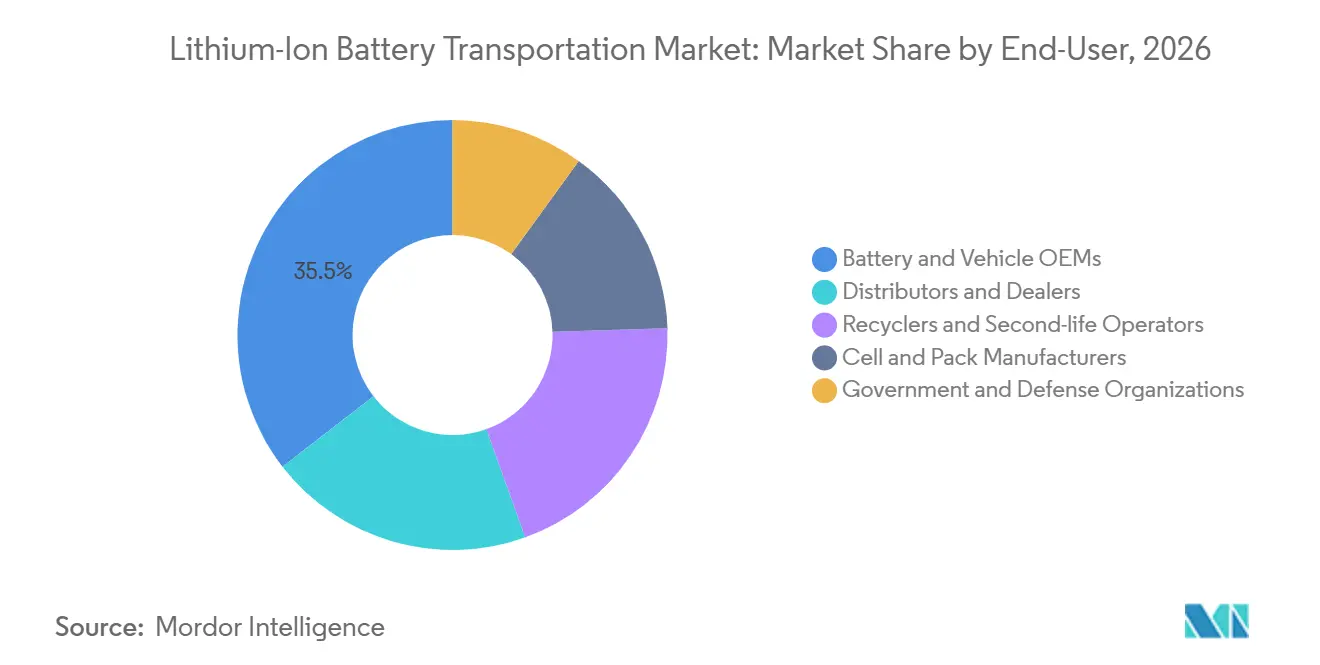
- By end user, Battery and Vehicle Original Equipment Manufacturers (OEMs) held 35.5% of revenue in 2026, while Recyclers and Second-life Operators are projected to grow at a 13.6% CAGR through 2032.
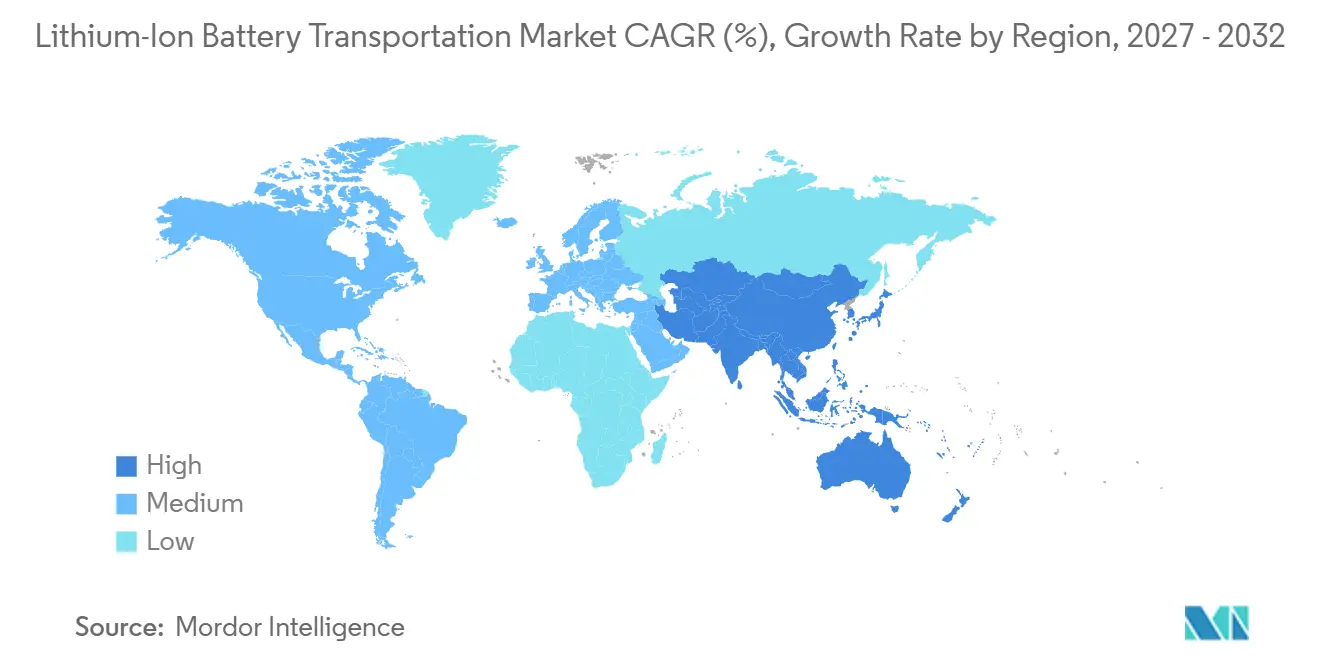
- By geography, Asia-Pacific held 44.3% of revenue in 2026, while are projected to grow at 12.2% CAGR through 2032.
Note: Market numbers in this report are based on Mordor Intelligence's proprietary estimation framework, which combines nine months of actuals with Q4 projections for base year 2026.
Market Trends and Insights
Drivers Impact Analysis of Lithium-Ion Battery Transportation Market*
| Driver | (~) % Impact on CAGR Forecast | Geographic Relevance | Impact Timeline |
|---|---|---|---|
| Electrification of Vehicles, Consumer Electronics, and Energy Storage | +3.2% | Global, concentrated in China, United States, and Europe | Long term (≥ 4 years) |
| Cross-Border Battery Manufacturing and Trade Expansion | +2.0% | China-to-global, Asia-Pacific core, Europe, and North America | Medium term (2-4 years) |
| Specialized Dangerous-Goods Compliance and Certified Packaging Demand | +1.5% | Global, with the strongest regulatory influence in Europe and the United States | Short term (≤ 2 years) |
| Reverse Logistics Growth From Battery Replacement and Recycling | +1.6% | Europe, China, and North America, with spillover into Southeast Asia | Medium term (2-4 years) |
| State-of-Health Data as a Logistics Service Differentiator | +0.7% | Global, with earliest adoption in European and East Asian OEM corridors | Long term (≥ 4 years) |
| Battery Passport and Chain-of-Custody Requirements | +1.0% | Europe, with adoption pressure on global export partners | Short term (≤ 2 years) to Medium term (2-4 years) |
| Source: Mordor Intelligence | |||
Electrification of Vehicles, Consumer Electronics, and Energy Storage
The lithium-ion battery transportation market benefits from higher movement volumes across vehicle, electronics, and stationary storage supply chains. The International Energy Agency expects global electric-vehicle battery demand to exceed 3 TWh by 2030 under its Stated Policies Scenario.[1] Larger battery packs increase shipment weight, packaging needs, and documentation requirements for each unit transported. North American electric vehicles carry battery packs that are larger than European equivalents, which raises handling requirements on many routes.[2] Consumer electronics and battery energy storage systems add shipment needs across more than one product category. This breadth gives the lithium-ion battery transportation market a wider demand base than one dependent only on passenger electric vehicles.
Cross-Border Battery Manufacturing and Trade Expansion
The lithium-ion battery transportation market depends on cross-border movement because production capacity and end demand remain in different locations. Battery exports from China reached record levels in 2025, with 114 countries or territories each buying at least USD 10 million of Chinese batteries through September. European and U.S. capacity additions will change trade patterns, but ramp-up periods still require inbound cells and materials from Asia. China restricted overseas transfers of 8 battery manufacturing technologies in July 2025, including Lithium Iron Phosphate (LFP) cathode production processes. Existing supply relationships and the freight networks serving them therefore remain commercially important. The lithium-ion battery transportation market will continue to adjust as trade moves are redistributed rather than removed.
Specialized Dangerous-Goods Compliance and Certified Packaging Demand
Battery shipments need controls that general freight networks do not always provide, which supports specialized services in the lithium-ion battery transportation market. Batteries move under dangerous goods rules that cover classification, state of charge, packaging, labeling, and transport documentation. The International Air Transport Association (IATA) Dangerous Goods Regulations made the 30% state-of-charge limit mandatory from January 1, 2026, for batteries packed with equipment and batteries in vehicles carried by air.[3] This requires shippers and carriers to maintain more consistent information before freight reaches an airport. Certified packaging and trained handling teams can reduce errors during loading, transfer, and storage. The lithium-ion battery transportation market therefore gives an advantage to providers that can demonstrate compliance instead of relying on general freight procedures.
Reverse Logistics and Battery Traceability Requirements
The lithium-ion battery transportation market is gaining a separate reverse flow as batteries leave vehicles and equipment. CEVA Logistics expects Battery Logistics Centers in 10 European countries by 2027 and aims to cover 80% of European end-of-life battery volumes by 2030. Returned batteries arrive from dealerships and dismantlers in irregular volumes, which makes collection more difficult than the movement of newly produced packs. A 2025 review of 165 studies found that effective reverse operations require collection routing, transportation, and facility location decisions to work together.[4] The European Union requires QR-code-accessible battery passports for covered batteries from February 18, 2027. State-of-health records, handling events, and data exchange at modal handoffs will become more valuable to the lithium-ion battery transportation market as these flows increase.
Restraints Impact Analysis of Lithium-Ion Battery Transportation Market*
| Restraints | Impact (%) | Geographic Context | Timeline |
|---|---|---|---|
| Thermal Runaway and Fire-Liability Exposure | -1.8 | Global, with the highest severity in ocean RoRo and air cargo | Long term (≥ 4 years) |
| Fragmented Cross-Border Dangerous-Goods Requirements | -1.4 | Cross-border corridors, with the highest friction in Asia, Middle East and Africa, and Latin America routes | Medium term (2-4 years) |
| Limited Certified Capacity and Specialized Warehousing | -0.9 | Europe, North America, and emerging Southeast Asian corridors | Short term (≤ 2 years) to Medium term (2-4 years) |
| Uncertain Classification of Damaged, Defective, and Recalled Batteries | -0.6 | Global, with the highest compliance burden in the United States and Europe | Short term (≤ 2 years) |
| Source: Mordor Intelligence | |||
Thermal Runaway and Fire-Liability Exposure
Thermal runaway presents a safety and liability constraint for the lithium-ion battery transportation market. The National Transportation Safety Board found that improperly secured battery energy storage system units shifted during heavy weather aboard Genius Star XI in 2025, triggering thermal runaway in 3 units and 2 cargo-hold fires. The incident caused USD 3.8 million in damage. The Morning Midas fire also drew attention to the difficulty of stopping thermal runaway after it spread through cells. Ocean and air carriers must account for fire risk when setting acceptance criteria, packaging standards, and cargo positions. This leaves a continuing operational constraint in the lithium-ion battery transportation market, especially for high-energy battery loads.
Fragmented Cross-Border Dangerous-Goods Requirements
The lithium-ion battery transportation market operates under different rules for road, ocean, and air shipments. Road movements in Europe follow the Agreement concerning the International Carriage of Dangerous Goods by Road (ADR) 2025, sea movements follow the International Maritime Dangerous Goods (IMDG) Code, and air shipments follow International Air Transport Association (IATA) requirements. U.S. Department of Transportation rules under 49 Code of Federal Regulations (CFR) 173.185 differ from European requirements on packaging counts and placarding thresholds. Canada adds its Transportation of Dangerous Goods framework to movements across North American corridors. A route from a South Korean cell producer through Malaysia to a German assembly plant can therefore face several legal frameworks. Different requirements add dwell time, training needs, and liability exposure to the lithium-ion battery transportation market.
*Our forecasts treat driver/restraint impacts as directional, not additive. The impact forecasts reflect baseline growth, mix effects, and variable interactions.
Lithium-Ion Battery Transportation Market Segment Analysis
By Transport Mode:
Roadways Lead Current Movements While Multimodal Networks ExpandRoadways accounted for 45.2% of the lithium-ion battery transportation market size in 2026. Truck transport supports domestic and regional trips between gigafactories, assembly plants, distribution centers, service networks, and recycling facilities. Road carriers can provide direct pickup and delivery, which reduces handoffs for time-sensitive or high-value battery shipments. European Agreement concerning the International Carriage of Dangerous Goods by Road (ADR) compliance is widely understood among established, which supports carrier qualification for these movements. The road segment of the lithium-ion battery transportation industry remains important because most battery supply chains require a road leg before or after another mode.
Multimodal transport is projected to grow at an 11.3% CAGR from 2027 to 2032. Integrated providers can combine air, sea, road, and rail when lead time, cost, disruption exposure, and documentation need to be balanced. Battery passport requirements create a need for auditable data during each modal handoff under Regulation (EU) 2023/1542. Kuehne+Nagel identifies sea-air combinations as one option for reducing dependency on a single mode. Airways serve urgent, lower-volume movements, while waterways remain necessary for major intercontinental flows. Railways offer a lower-emission continental option where route capability and rules allow. Prototype batteries require bespoke handling across every mode because special provisions and unit-specific controls can apply.

By Battery Status:
New Cells and Packs Lead, While End-of-Life Batteries Gain RelevanceNew Cells and Packs represented a 62.1% share of the lithium-ion battery transportation market in 2026. This category benefits from production flows that remain much larger than retirement flows. New packs generally follow a more predictable process because testing, classification, charge control, packaging, and shipment information are prepared before dispatch. Standardized documents and packaging can make these shipments easier to plan than returned or damaged units. The lithium-ion battery transportation industry relies on this segment for regular factory-to-factory and factory-to-vehicle flows.
End-of-Life Batteries are projected to grow at 12.5% CAGR from 2027 to 2032. These units return in uneven batches from dealerships and dismantlers rather than in scheduled factory quantities. State-of-health assessment is needed before a battery can move toward second-life use or recycling. A study titled "Battery Passports for Sustainable Battery Systems: A Review of Roles, Data Requirements, and Implementation Challenges Across Value Chain Stages," published in the Journal of Climate Change in June 2026, noted that battery passports can support chemistry-based sorting, although the transition will still depend on manual or semi-automated diagnosis and uneven data quality. Damaged and defective batteries require technical assessment to determine whether transport is permitted and what packaging conditions apply. This creates demand for controlled storage, diagnostic capability, and experienced collection services within the lithium-ion battery transportation market.
By End User:
OEMs Set Requirements While Recyclers Create Faster GrowthBattery and Vehicle OEMs accounted for 35.5% of the lithium-ion battery transportation market in 2026. Their procurement teams set packaging specifications, state-of-charge protocols, carrier approval conditions, and reporting expectations across their supply chains. Cell and pack manufacturers also move materials and finished products through several production stages. Distributors and dealers serve local repair and replacement needs, where dangerous goods capability can vary more widely. Government and defense organizations use specialized battery formats and prototype shipments that need tailored service conditions.
Recyclers and Second-life Operators are projected to grow at 13.6% CAGR from 2027 to 2032. The European Union’s battery requirements and growing retirement volumes support more organized collection and recovery activity. A 2025 Nature Communications study found that advanced direct cathode recycling in China could create USD 58 billion in cumulative recycling profit in a closed-loop scenario. That outcome depends on reverse networks that can collect, consolidate, and move used batteries under compliant conditions. CEVA Logistics is developing Battery Logistics Centers that combine Agreement Concerning the International Carriage of Dangerous Goods by Road (ADR)-compliant transport with diagnosis and reconditioning. This makes the lithium-ion battery transportation market more closely connected to processing decisions at the end of a battery’s useful life.
Geography Analysis
APAC Lithium-Ion Battery Transportation Market
Asia-Pacific held 44.3% of the lithium-ion battery transportation market share in 2026. China remains central to regional and global battery movements because its export base serves a broad range of destinations. China’s 2025 export controls on cathodes, graphite anodes, and battery-related technology require permits and add compliance work to trade flows. South Korea and Japan supply high-value Nickel Manganese Cobalt (NMC) and specialty cells to vehicle producers in North America and Europe. Vietnam, Thailand, and Indonesia are moving toward broader assembly and logistics roles. Indonesia’s support for Lithium Iron Phosphate (LFP)-related materials and electric-vehicle adoption points to further regional production dispersion. These changes add routes to the lithium-ion battery transportation market rather than replacing China-linked trade lanes.
Europe and Africa Lithium-Ion Battery Transportation Market
Europe is shaped by production activity and a detailed regulatory framework. The EU battery passport requirement begins in February 2027 for covered batteries. This is encouraging logistics investment in traceable storage, handling, and reporting systems. DHL Supply Chain began construction in May 2026 on a 17,000 m² Battery Logistics Hub in Holtum, Netherlands, for high-voltage battery storage and service. Germany, France, Poland, and the United Kingdom serve as major nodes because of their manufacturing links and established ADR-certified carrier networks. Morocco’s announced battery-related investment base creates a North Africa-Europe corridor linked to phosphate resources, trade agreements, and automotive production. The lithium-ion battery transportation market in Europe therefore places unusual importance on regulatory readiness and regional storage capacity.
The Americas and MEA Lithium-Ion Battery Transportation Market
North American movement is shaped by domestic-content aims and persistent cross-border supply requirements. Maersk estimated U.S. lithium-ion battery transportation spending at USD 2.4 billion to USD 3.0 billion in June 2026. United States, Canadian, and Mexican transport rules create a demanding compliance environment for carriers operating across the region. South America supports outbound mineral movements from Chile, Argentina, and Brazil toward Asian and European processing locations. The Middle East and Africa remain smaller contributors today, but Morocco’s investment pipeline and Gulf battery energy storage projects support incremental demand. These regions add sourcing, manufacturing, and deployment routes that widen the geographic scope of the lithium-ion battery transportation market.
Competitive Landscape
The lithium-ion battery transportation market is moderately consolidated among major full-service providers. Maersk, DHL Group, Kuehne+Nagel, DSV, and CMA CGM compete through transport coverage, dangerous-goods capability, and digital custody controls. Their scale helps them coordinate ocean, air, road, rail, warehousing, and customs-related activities for large customers. DSV completed its acquisition of DB Schenker in April 2025 for an enterprise value of DKK 106.7 billion, stated as EUR 14.3 billion in the company release. The transaction expanded DSV’s dangerous-goods network across key battery trade corridors. DHL Group is bringing its Supply Chain, Global Forwarding, and Express capabilities into a battery logistics platform serving more than 20 sites globally. These strategies show that the lithium-ion battery transportation market rewards operators that can serve complex shipments across several services.
Competition is more open in services for damaged, recalled, and end-of-life batteries. FedEx and UPS limit movements of damaged or defective batteries to ground services under special conditions, which leaves a role for specialist dangerous-goods carriers. Operators with controlled storage, trained staff, specialist fleet equipment, and suitable permits can compete in these harder-to-handle categories. State-of-health monitoring, state-of-charge reporting, and battery passport data capture are also becoming part of service selection. CEVA Logistics became the first logistics provider to receive IATA Centers of Excellence for Independent Validators (CEIV) Lithium Battery certification, reflecting the importance of independently assessed quality practices. ISO 9001 and International Automotive Task Force (IATF) 16949 are increasingly relevant in OEM tender requirements. The lithium-ion battery transportation market therefore has both global competition and narrower specialist opportunities.
Several recent actions show how providers are securing capabilities and customer relationships. Kuehne+Nagel and Contemporary Amperex Technology Co., Limited (CATL) signed a collaboration agreement covering battery logistics, heavy-truck fleet electrification, battery recycling, and a battery-swapping pilot in China. DHL Supply Chain signed a long-term agreement with Fortum Battery Recycling in June 2025 to develop logistics solutions for electric-vehicle battery recycling across Europe. Maersk launched a dedicated Class 9 ground-freight solution in North America in June 2026, covering more than 65 stations, 7 regional hubs, and over 42,000 U.S. ZIP codes. These moves address capacity, compliance, and reverse-flow needs rather than simple freight volume alone. The combination of broad providers and certified specialists is consistent with a moderately consolidated lithium-ion battery transportation market.
Lithium-Ion Battery Transportation Industry Leaders
-
DHL Group
-
DSV A/S
-
Kuehne + Nagel International AG
-
CMA CGM Group
-
A.P. Moller – Maersk
- *Disclaimer: Major Players sorted in no particular order
Lithium-Ion Battery Transportation Market Companies Covered in this Report
- A.P. Moller – Maersk
- Bertling Logistics
- C.H. Robinson Worldwide, Inc.
- CMA CGM Group
- DGD Transport
- DHL Group
- DSV A/S
- Expeditors International of Washington, Inc.
- FedEx Corporation
- GEODIS
- GXO Logistics, Inc.
- Hellmann Worldwide Logistics SE & Co. KG
- Kintetsu World Express, Inc.
- Kuehne + Nagel International AG
- Nippon Express Holdings, Inc.
- Rhenus Group
- Sinotrans Limited
- Toll Group
- United Parcel Service, Inc. (UPS)
- Yusen Logistics Co., Ltd.
Recent Industry Developments in Lithium-Ion Battery Transportation Market
- June 2026: A.P. Moller – Maersk launched a dedicated Class 9 lithium-ion battery transportation solution within its North American ground freight network, covering 65+ stations, seven regional hubs, and over 42,000 US ZIP codes. The service targets automotive and EV manufacturing customers with cross-border compliance protocols for the US, Canada, and Mexico.
- May 2026: DHL Supply Chain broke ground on a 17,000 m² European Battery Logistics Hub in Holtum, Limburg, Netherlands, adjacent to its existing automotive campus, scheduled to go live in early 2027. The facility targets high-voltage EV battery storage and service as an integrated one-stop solution for the European EV sector.
- September 2025: CEVA Logistics announced a dedicated reverse logistics solution for end-of-life EV batteries, backed by a multi-million-euro investment. The rollout targets Battery Logistics Centers across 10 European countries by 2027, aiming to cover 80% of European end-of-life battery volumes by 2030.
- April 2025: DSV closed the acquisition of DB Schenker from Deutsche Bahn for an enterprise value of DKK 106.7 billion, stated as EUR 14.3 billion in the company release, one of the largest logistics M&A transactions ever recorded. The combined entity gains a significantly expanded dangerous-goods handling capability across key battery trade corridors.
Global Lithium-Ion Battery Transportation Market Report Scope
Lithium-ion battery transportation refers to the specialized logistics process of moving lithium-ion batteries across supply chains via land, sea, or air, while adhering to strict international dangerous goods regulations. These batteries are legally classified as Class 9 hazardous materials (dangerous goods) due to their risk of short-circuiting, overheating, and thermal runaway, which requires specific packaging, labeling, and handling protocols.
The global lithium-ion battery transportation market is segmented by transport mode, battery status, end user, and geography. By transport mode, the market is segmented into roadways, airways, waterways, railways, and multimodal transportation. By battery status, the market is segmented into new cells and packs, used and returned batteries, damaged and defective batteries, prototype batteries, and end-of-life batteries. By end user, the market is segmented into battery and vehicle original equipment manufacturers (OEMs), cell manufacturers, distributors, recyclers, and government entities. The report also covers the market size and forecasts for the global lithium-ion battery transportation market across 26 countries in key regions. For each segment, the market sizing and forecasts have been provided on the basis of value (USD).
Segmentation Overview
| Roadways |
| Airways |
| Waterways |
| Railways |
| Multimodal Transport |
| New Cells and Packs |
| Used and Returned Batteries |
| Damaged and Defective Batteries |
| Prototype Batteries |
| End-of-life Batteries |
| Battery and Vehicle OEMs |
| Cell and Pack Manufacturers |
| Distributors and Dealers |
| Recyclers and Second-life Operators |
| Government and Defense Organizations |
| North America | United States |
| Canada | |
| Mexico | |
| Europe | Germany |
| France | |
| Italy | |
| Spain | |
| United Kingdom | |
| Poland | |
| Russia | |
| Rest of Europe | |
| Asia-Pacific | China |
| India | |
| Japan | |
| South Korea | |
| Australia | |
| Indonesia | |
| Vietnam | |
| Thailand | |
| Rest of Asia-Pacific | |
| South America | Brazil |
| Argentina | |
| Chile | |
| Rest of South America | |
| Middle East and Africa | Saudi Arabia |
| United Arab Emirates | |
| Egypt | |
| South Africa | |
| Morocco | |
| Rest of Middle East and Africa |
| By Transport Mode | Roadways | |
| Airways | ||
| Waterways | ||
| Railways | ||
| Multimodal Transport | ||
| By Battery Status | New Cells and Packs | |
| Used and Returned Batteries | ||
| Damaged and Defective Batteries | ||
| Prototype Batteries | ||
| End-of-life Batteries | ||
| By End User | Battery and Vehicle OEMs | |
| Cell and Pack Manufacturers | ||
| Distributors and Dealers | ||
| Recyclers and Second-life Operators | ||
| Government and Defense Organizations | ||
| By Geography | North America | United States |
| Canada | ||
| Mexico | ||
| Europe | Germany | |
| France | ||
| Italy | ||
| Spain | ||
| United Kingdom | ||
| Poland | ||
| Russia | ||
| Rest of Europe | ||
| Asia-Pacific | China | |
| India | ||
| Japan | ||
| South Korea | ||
| Australia | ||
| Indonesia | ||
| Vietnam | ||
| Thailand | ||
| Rest of Asia-Pacific | ||
| South America | Brazil | |
| Argentina | ||
| Chile | ||
| Rest of South America | ||
| Middle East and Africa | Saudi Arabia | |
| United Arab Emirates | ||
| Egypt | ||
| South Africa | ||
| Morocco | ||
| Rest of Middle East and Africa | ||
Key Questions Answered in the Report
What is the forecast for lithium-ion battery transportation through 2032?
The sector is forecast to grow from USD 13.41 billion in 2026 to USD 26.45 billion by 2032 at an 11.21% CAGR from 2027 to 2032.
Which transport mode leads battery transportation?
Roadways lead with 45.2% of revenue in 2026 because they support direct domestic and regional movements between manufacturing, service, and recycling sites.
Why are multimodal battery logistics services growing?
Multimodal Transport is forecast to grow at an 11.3% CAGR through 2032, supported by the need to coordinate cost, speed, disruption risk, and chain-of-custody data.
Which battery category is growing fastest?
End-of-life Batteries are forecast to grow at a 12.5% CAGR through 2032 as collection, diagnosis, second-life use, and recycling requirements expand.
Why do battery passport requirements matter to logistics providers?
Covered batteries will require a QR-code-accessible passport from February 18, 2027, requiring stronger custody records and handling data across transport handoffs.
Which end-user group will grow fastest through 2032?
Recyclers and Second-life Operators are forecast to grow at a 13.6% CAGR, supported by rising battery retirement volumes and reverse-logistics requirements.