
Lithium-Ion Battery Conductive Additives and Dispersants Market Size and Share
Market Overview
| Study Period | 2022 - 2032 |
|---|---|
| Market Size (2027) | USD 2.84 Billion |
| Market Size (2032) | USD 4.65 Billion |
| Growth Rate (2027 - 2032) | 10.39 % |
| Fastest Growing Market | Asia-Pacific |
| Largest Market | Asia-Pacific |
| Market Concentration | Medium |
Major Players *Disclaimer: Major Players sorted in no particular order Image © Mordor Intelligence. Reuse requires attribution under CC BY 4.0. | |
Lithium-Ion Battery Conductive Additives and Dispersants Market Analysis by Mordor Intelligence
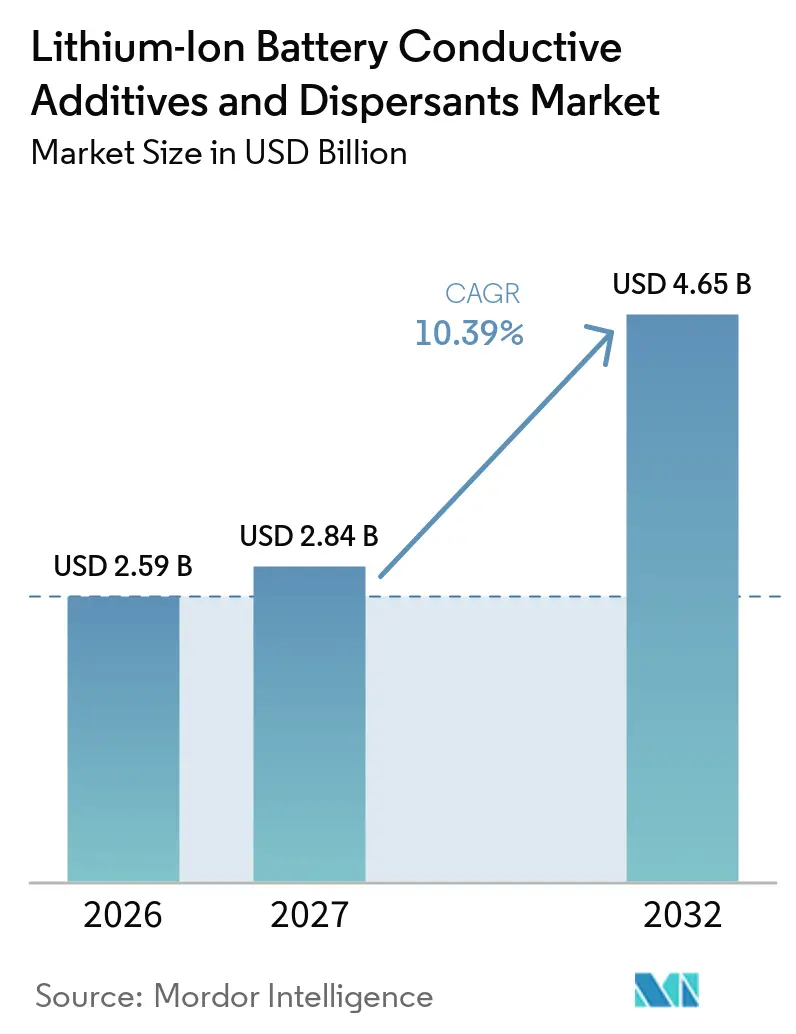
The Lithium-Ion Battery Conductive Additives and Dispersants Market size was valued at USD 2.59 billion in 2026 and is estimated to grow from USD 2.84 billion in 2027 to reach USD 4.65 billion by 2032, at a CAGR of 10.39% during the forecast period (2027-2032). Battery gigafactory construction across Asia-Pacific, North America, and Europe is increasing demand for electrode materials with reliable conductivity, controlled viscosity, and slurry stability. High-nickel cathodes and silicon-composite anodes require more specialized formulations, which raises the value of additives used per gigawatt-hour of cell capacity and increases the importance of consistent material quality. Suppliers are therefore competing through material performance, application support, local production, and long qualification programs with battery makers. In the lithium-ion battery conductive additives and dispersants market, these requirements favor suppliers that can link laboratory-scale formulation knowledge with high-volume customer production. Regional production is becoming more important as cell manufacturers seek traceable and locally qualified supply, particularly where their procurement strategies reduce reliance on a single supply region. The lithium-ion battery conductive additives and dispersants market also faces cost pressure in standard lithium iron phosphate cells, where advanced nanocarbon materials must demonstrate clear cell-level benefits before they can displace widely used carbon black products.
Key Report Takeaways
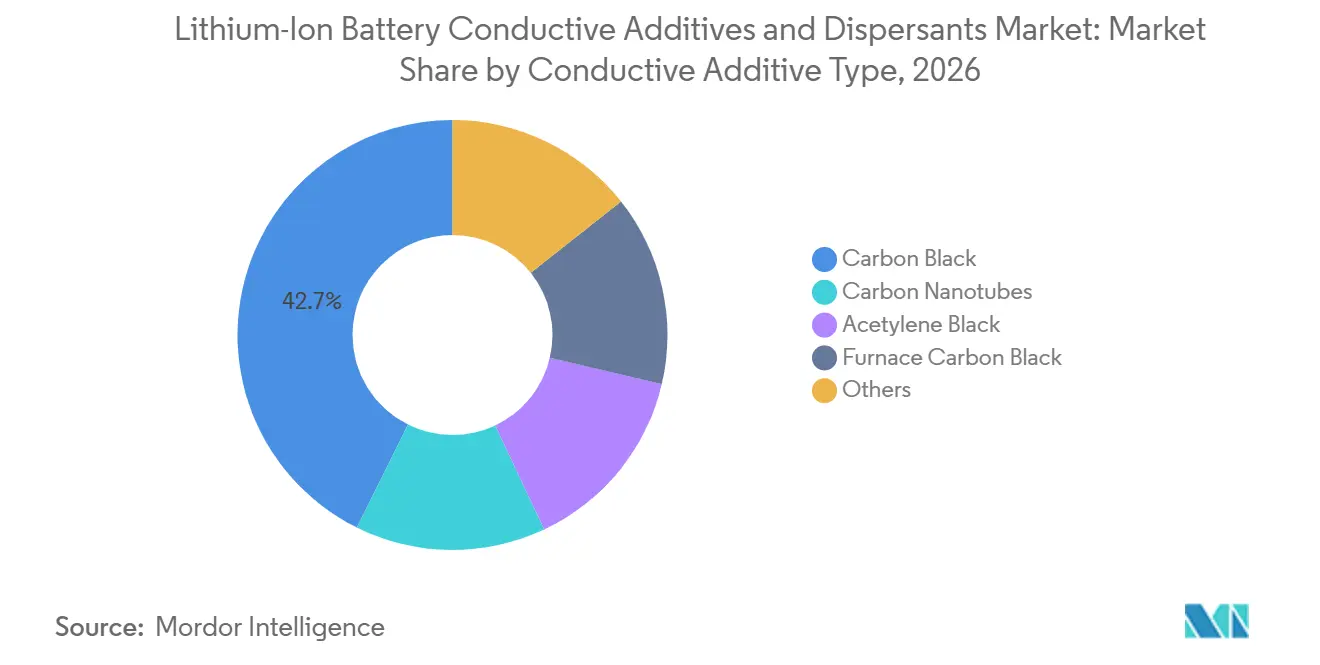
- By conductive additive type, carbon black held 42.67% of the lithium-ion battery conductive additives and dispersants market share in 2026, while carbon nanotubes are forecast to advance at an 11.45% CAGR through 2032.
- By dispersant type, polymeric dispersants held 49.71% of the lithium-ion battery conductive additives and dispersants market share in 2026 and are forecast to advance at an 11.73% CAGR through 2032.
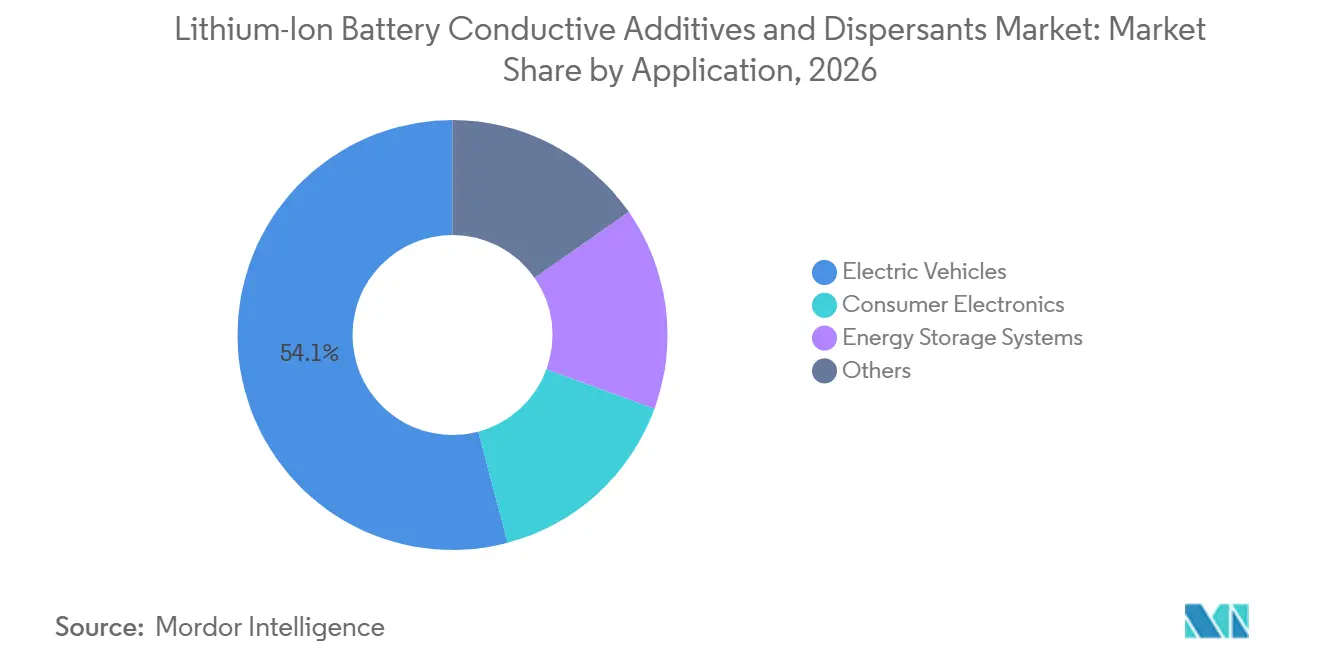
- By application, electric vehicles held 54.13% of the lithium-ion battery conductive additives and dispersants market share in 2026, while energy storage systems are forecast to advance at a 12.17% CAGR through 2032.
- By geography, Asia-Pacific held 46.82% of the lithium-ion battery conductive additives and dispersants market share in 2026 and is forecast to advance at a 12.04% CAGR through 2032.
Note: Market numbers in this report are based on Mordor Intelligence's proprietary estimation framework, which combines nine months of actuals with Q4 projections for base year 2026.
Global Lithium-Ion Battery Conductive Additives and Dispersants Market Trends and Insights
Drivers Impact Analysis*
| Driver | (~) % Impact on CAGR Forecast | Geographic Relevance | Impact Timeline |
|---|---|---|---|
| EV and Grid-Storage Battery Expansion | +3.5% | Global | Short term (≤ 2 years) |
| Silicon-Rich Anodes and High-Nickel Cathodes | +2.2% | Asia-Pacific & North America core, spillover to Europe | Medium term (2-4 years) |
| Lower Inactive-Material Loading for Higher Energy Density | +1.4% | Global | Medium term (2-4 years) |
| Shift Toward Water-Based and High-Solids Processing | +1.0% | Europe & East Asia, expanding globally | Medium term (2-4 years) |
| Qualification-Ready Local Supply Chains | +0.7% | North America & Europe | Short to medium term |
| Source: Mordor Intelligence | |||
EV and Grid-Storage Battery Expansion
Electric vehicle production and stationary storage deployment are expanding demand for electrode additives and dispersants. Global battery storage additions reached 108 GW in 2025, more than 40% above the 2024 level, according to the International Energy Agency[1]. This growth broadens the addressable base for the lithium-ion battery conductive additives and dispersants market beyond automotive batteries and gives suppliers demand from two battery-use patterns. Stationary storage cells often need strong rate capability for energy shifting and ancillary services, rather than only the vehicle-range performance required in many passenger-car cells. That operating requirement can raise conductive additive loading relative to some automotive cells and can increase the value of materials used for each unit of installed storage capacity. Battery manufacturers are also commissioning new facilities, so slurry formulation capacity, process support, and dependable material supply must grow alongside cell production capacity.
Silicon-Rich Anodes and High-Nickel Cathodes
Silicon-composite anodes and high-nickel cathodes need conductive networks that maintain performance during repeated cycling. Research published in 2025 found that a carbon nanotube conductive agent reduced silicon-electrode expansion to 27%, compared with 170% for carbon black, while capacity retention after 100 cycles reached 94.6%, compared with 77% for the carbon-black reference. The lithium-ion battery conductive additives and dispersants market benefits because these electrode designs support demand for carbon nanotube-enhanced and hybrid systems instead of one-material formulations. Cell makers pursuing energy densities above 300 Wh/kg are likely to require more complex conductive networks that hold their performance as active materials expand and contract. Suppliers with established technical service capabilities are better positioned to support these formulation changes and translate laboratory performance into repeatable manufacturing results.
Lower Inactive-Material Loading for Higher Energy Density
Cathodes with active-material loading above 95% by mass need additives that preserve electron pathways at concentrations below 1.5%. Multi-walled and single-walled carbon nanotubes can form longer conductive pathways than conventional carbon black and use their high aspect ratio to bridge more of the electrode. A 2025 study reported binder-free electrodes using monodispersed ultra-long single-walled carbon nanotubes with stable capacity of 243 mAh/g at 5C after 2,000 cycles. This evidence supports the shift toward high-aspect-ratio materials in thick-electrode designs, where short-range particle contacts may be insufficient. Lower additive use can leave more space for active material and improve cell-level energy density without adding inactive mass. The effect can reduce the practical cost gap between nanotube systems and conventional carbon black in the lithium-ion battery conductive additives and dispersants market, even where nanotubes have a higher unit price.
Shift Toward Water-Based and High-Solids Processing
Manufacturers are developing water-based slurry systems to reduce reliance on N-methyl-2-pyrrolidone (NMP). The European Union Battery Regulation requires carbon-footprint declarations for electric-vehicle batteries beginning in 2026, increasing attention to solvent use and traceable supply chains[2]. Water-based processing remains difficult for high-nickel cathodes because water can raise slurry pH, form lithium hydroxide, and contribute to aluminum current-collector corrosion. A 2025 publication described the need to preserve electrode adhesion and active lithium during waterborne NMC811 cathode processing. Polymeric dispersants can combine steric stabilization with pH management, making them central to high-solid-content formulations and to efforts to keep coating quality consistent. Another 2025 study reported that 0.25 wt% of a polymeric copolymer dispersant reduced lithium iron phosphate slurry viscosity by 74.6% at 62 wt% solid content, which supports higher-throughput coating without sacrificing electrochemical performance.
Restraints Impact Analysis*
| Restraint | (~) % Impact on CAGR Forecast | Geographic Relevance | Impact Timeline |
|---|---|---|---|
| Premium Cost of CNT and Graphene Systems | -2.3% | Global, most pronounced in cost-sensitive LFP markets in Asia | Long term (≥ 4 years) |
| Long Cell-Qualification and Change-Control Cycles | -1.5% | Global | Short to medium term |
| Waterborne Slurry Stability and Cathode Compatibility | -0.9% | Europe & North America, expanding globally | Medium term (2-4 years) |
| Source: Mordor Intelligence | |||
Premium Cost of CNT and Graphene Systems
Multi-walled carbon nanotubes and graphene systems offer performance benefits but cost more than battery-grade specialty carbon black. This limits their use in standard lithium iron phosphate batteries, where manufacturers work within tight cost targets and place strong emphasis on material cost per unit of cell capacity. The lithium-ion battery conductive additives and dispersants market therefore has different adoption conditions for premium electric-vehicle cells and high-volume lithium iron phosphate lines. Advanced materials must show lower usage rates, higher energy density, longer cycle life, or measurable operating gains to justify their price. Process scale-up can help suppliers reduce costs over time, while hybrid formulations can limit the amount of nanocarbon material used. Until then, broad demand is likely to remain concentrated in cells where performance requirements are high, and the value of better conductivity is clear.
Long Cell-Qualification and Change-Control Cycles
A new conductive additive or dispersant must complete electrode and cell qualification before automotive use. These programs can require 18 to 36 months of cycle-life, thermal-abuse, and calendar-aging testing, which makes the commercial process substantially longer than initial material development. This creates an advantage for suppliers already approved by major battery manufacturers and familiar with their slurry processes, cell designs, and quality expectations. OCSiAl was named as a supplier to PowerCo’s Salzgitter facility in June 2026 after customer audits and extended qualification work. Smaller suppliers can face a greater burden because they must maintain multiple technical programs across different customer specifications and provide application-engineering support throughout the process. These long approval cycles slow the conversion of laboratory results into material commercial sales and favor companies with established qualification portfolios.
*Our forecasts treat driver/restraint impacts as directional, not additive. The impact forecasts reflect baseline growth, mix effects, and variable interactions.
Segment Analysis
By Conductive Additive Type: Carbon Black Anchors Revenue, as Carbon Nanotubes Redefine Performance Ceilings
Carbon black held 42.67% of the lithium-ion battery conductive additives and dispersants market in 2026. Its broad use reflects established slurry processing, competitive cost, and compatibility with NMP-based and aqueous formulations. Acetylene black and furnace carbon black serve different electrode requirements. Acetylene black is used in applications that require high purity and controlled particle-size distribution. Furnace carbon black supports high-volume, cost-sensitive cathode formulations, including standard lithium iron phosphate cells. This established position gives carbon black a practical role in the lithium-ion battery conductive additives and dispersants industry even as cell specifications change. It also gives the lithium-ion battery conductive additives and dispersants market a dependable demand base while new conductive materials progress through qualification.
Carbon nanotubes are projected to advance at an 11.45% CAGR through 2032, the highest rate among conductive additive types. Silicon-anode commercialization and thick-electrode designs are raising the need for long-range conductive pathways. Hybrid formulations combine carbon black with multi-walled carbon nanotubes to balance conductivity, loading, and cost. Imerys and Jiangsu Cnano Technology Co., Ltd. announced a partnership in July 2025 to develop such hybrid materials, with commercial-scale production started from Q3 2025. Graphene nanoplatelets, carbon nanofibers, and other hybrid carbon structures are also being evaluated for specialized cells.

By Dispersant Type: Polymeric Dispersants Lead on Scale and Growth Rate
Polymeric dispersants held 49.71% of the dispersant segment in 2026 and are projected to advance at an 11.73% CAGR through 2032. This segment supports high-nickel and high-solid-content electrodes that need stability across demanding pH conditions. A 2025 study found that a ternary copolymer improved lithium manganese iron phosphate cathode slurry dispersibility without gelation and improved rate capability and cycling performance. These materials can help maintain electrode uniformity during coating. Better slurry control may also reduce manufacturing defects and improve cell-production yields.
Surfactant-based dispersants remain relevant in established slurry processes where interfacial-tension control and cost are the primary considerations. Lignosulfonate-based dispersants from Borregaard AS are relevant to water-based anode formulations and procurement programs that consider renewable feedstocks. Other dispersant systems include cellulose-derived products and polymer blends under evaluation for aqueous cathode processing. Higher solids content can raise the value of effective dispersant use per kilogram of electrode material. Manufacturers are moving from slurry solids content of 50%-55% toward 60%-65% to reduce drying energy needs. That shift requires dispersants that can manage viscosity while preserving process consistency, a requirement that gives polymer chemistry a larger role in the lithium-ion battery conductive additives and dispersants market.
By Application: Electric Vehicles Drive Revenue as Energy Storage Systems Command Fastest Growth
Electric vehicles held 54.13% of the lithium-ion battery conductive additives and dispersants market size by application in 2026. Electric-vehicle battery plants require consistent electrode materials because repeatable slurry quality is important to cell yield and performance. Panasonic Energy began mass production at its De Soto, Kansas, facility in July 2025 with a planned annual capacity of 32 GWh. Toyota began production at its Liberty, North Carolina, plant in November 2025, a USD 13.9 billion facility with 30 GWh capacity. China’s large lithium iron phosphate production base supports demand for standard carbon black. Nickel manganese cobalt and nickel cobalt aluminum batteries create more demanding requirements for nanotube-enhanced additives and advanced dispersants.
Energy storage systems are projected to advance at a 12.17% CAGR through 2032. Global battery storage additions reached 108 GW in 2025 and exceeded the historical peak for any single power technology, according to the International Energy Agency. The lithium-ion battery conductive additives and dispersants market size for this application is supported by grid projects that require dependable rate capability and cycle life. Consumer electronics continue to provide a steady base for carbon black and polymeric-dispersant grades. Aerospace, defense, and electric vertical takeoff and landing applications remain smaller demand areas. Their specialized operating requirements can support premium prices for approved additive grades.
Geography Analysis
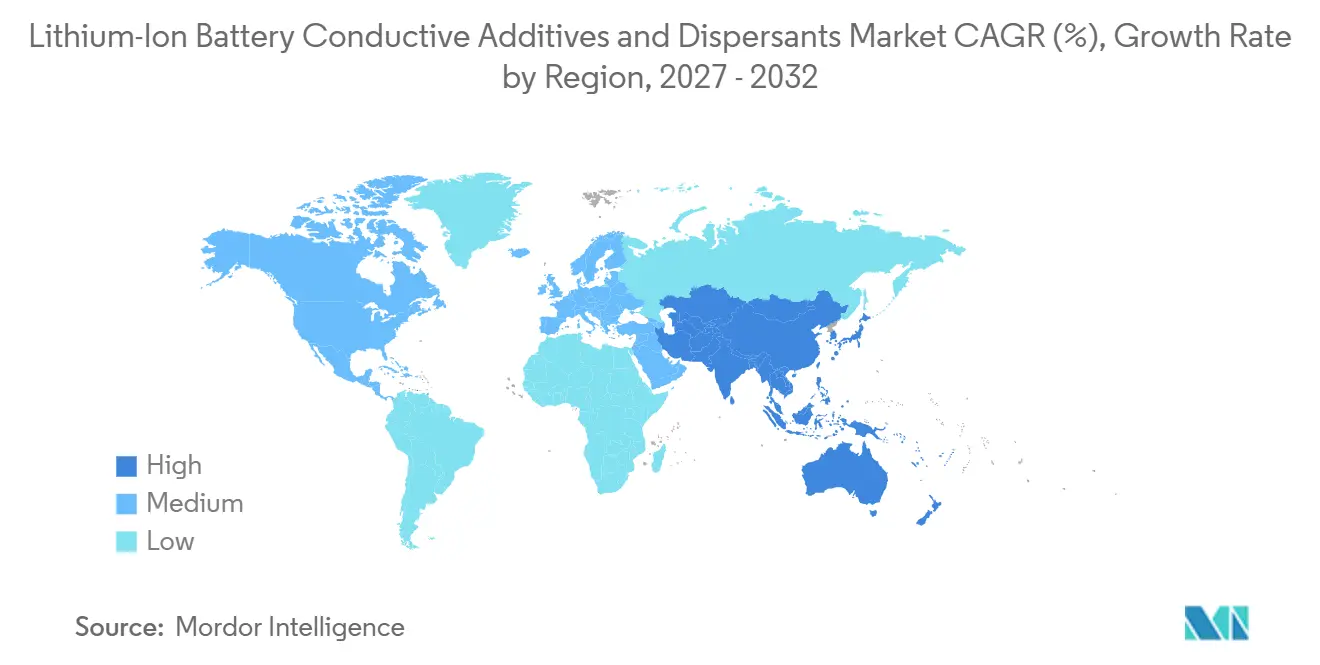
Asia-Pacific accounted for 46.82% of the market share in 2026 and is projected to advance at a 12.04% CAGR through 2032. China concentrates battery-cell production as well as upstream capacity for conductive additives and dispersants. This gives regional suppliers a large domestic base for product development and customer qualification. South Korean research has demonstrated the performance benefits of carbon nanotube systems for silicon-anode designs. Japan’s materials producers are expanding their involvement in single-walled carbon nanotube conductive paste. Nippon Zeon led a USD 20 million Series C investment in Sino Applied Technology in May 2025, supporting a planned increase in conductive-paste capacity from 5,000 to 25,000 metric tons per year by 2030. India and Association of Southeast Asian Nations (ASEAN) countries remain emerging demand centers linked to gigafactory construction schedules.
North America is adding demand through the opening of large battery plants and growing domestic energy-storage deployment. Panasonic Energy’s 32 GWh Kansas plant and Toyota’s 30 GWh North Carolina facility added a combined planned capacity of 62 GWh in 2025. This capacity requires locally supported supplies of high-specification carbon nanotubes and dispersants. North American producers still depend on imported additive precursors, particularly carbon nanotube paste from Asian suppliers. That dependence is encouraging cell makers to evaluate local alternatives that can meet qualification requirements. PowerCo began construction at its St. Thomas, Ontario, facility in October 2025, with planned investment of up to CAD 7 billion (USD 5.1 billion) and initial production targeted for 2027.
Europe is moving from announced battery projects toward active production demand for electrode materials. PowerCo’s Salzgitter facility is an approved destination for OCSiAl single-walled carbon nanotubes. Europe’s emphasis on traceability and carbon-footprint reporting favors locally qualified production with documented processing conditions. OCSiAl announced a USD 300 million graphene-nanotube facility in Luxembourg in November 2025. South America remains a smaller demand center despite battery-processing discussions connected to lithium resources in Argentina and Chile. The Middle East and Africa added more than 3 GW of battery storage in 2025, driven mainly by Saudi Arabia’s renewable-integration program.
Competitive Landscape
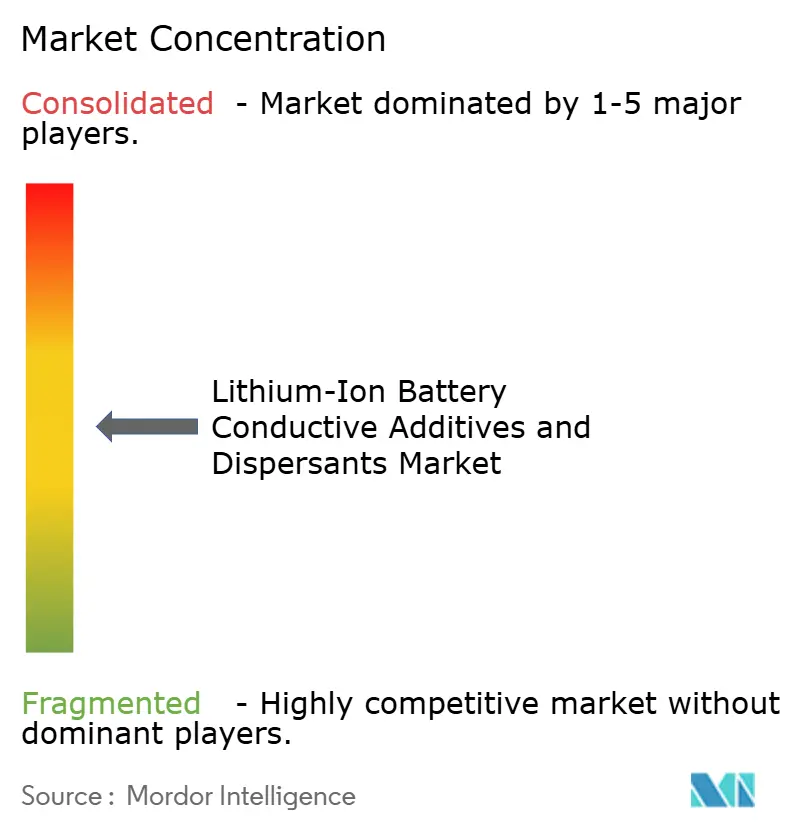
The lithium-ion battery conductive additives and dispersants market is moderately concentrated, with the top five players including Imerys, Cabot Corporation, Denka Company Limited, LG Chem, and OCSiAl. Carbon black grades are supplied by Arkema, Birla Carbon, Cabot Corporation, Denka Company Limited, Imerys, Mitsubishi Chemical Group Corporation, Orion S.A., and TORAY INDUSTRIES, INC. These suppliers compete through particle morphology, surface-area consistency, process knowledge, and supply reliability, which are important when a customer needs the same electrode behavior across extended production runs. Carbon black suppliers also need to adapt their products to cathode and anode formulations that vary by chemistry, loading level, and the customer’s preferred coating process. Commodity-grade materials face greater price pressure, particularly from large domestic producers in China. Higher-value grades are more closely linked to technical support, qualification records, and the ability to provide consistent material batches during customer scale-up. This leaves room for established suppliers that can meet both material and application requirements in the lithium-ion battery conductive additives and dispersants market, where technical performance is assessed alongside cost and supply continuity. The lithium-ion battery conductive additives and dispersants market consequently supports different business models for suppliers and for differentiated materials providers.
Carbon nanotube suppliers include CHASM, Jiangsu Cnano Technology Co., Ltd., LG Chem, NanoXplore, and OCSiAl. OCSiAl uses its TUBALL single-walled nanotube platform and states that the material powers 1 million electric vehicles. In June 2026, OCSiAl was named a supplier to PowerCo’s Salzgitter gigafactory for graphite-anode applications in Volkswagen Group’s Unified Cell platform. In November 2025, the company announced a USD 300 million production facility in Luxembourg for advanced carbon materials. These investments reflect the importance of European supply capacity for qualified battery materials and the wider lithium-ion battery conductive additives and dispersants market need for local, technically supported supply. This regional capacity can shorten supply routes and help customers manage qualification, audit, and traceability requirements.
BYK-Chemie GmbH and Arkema operate in dispersant and specialty-additive applications where cell maker collaboration is important. Borregaard AS supplies lignosulfonate-based materials that can support water-based anode processing and renewable-feedstock procurement objectives. Hybrid systems combining carbon black with carbon nanotubes or graphene are reducing the separation between traditional supplier categories. This change makes formulation knowledge and intellectual property more important to product differentiation because customers need the materials to work together in a validated electrode design. Suppliers must also respond when customers change from NMP-based to water-based processing or increase slurry solids content, since these decisions affect additive selection and the supporting formulation work. Suppliers that can provide materials from both European and North American locations may have an advantage with battery makers reducing single-region sourcing. Competitive positions in the lithium-ion battery conductive additives and dispersants market will depend on validated performance, local production, and the ability to support customer qualification programs.
Lithium-Ion Battery Conductive Additives and Dispersants Industry Leaders
-
Imerys
-
Cabot Corporation
-
Denka Company Limited
-
LG Chem
-
OCSiAl
- *Disclaimer: Major Players sorted in no particular order
Recent Industry Developments
- October 2026: Birla Carbon highlighted its Conductex i conductive carbon blacks, Nanocyl carbon nanotubes, and blended solutions at The Battery Show North America 2026. These materials support the lithium-ion battery conductive additives and dispersants market by improving electrode conductivity, fast-charging performance, and battery manufacturing efficiency.
- September 2026: Cabot Corporation announced plans to expand North American production of advanced battery conductive additives at its facilities in Louisiana and Texas, supported by a USD 50 million U.S. Department of Energy grant and approximately USD 75 million in company investment. The expansion will increase the supply of conductive carbon materials and carbon nanostructures for energy storage and electric vehicle batteries.
Global Lithium-Ion Battery Conductive Additives and Dispersants Market Report Scope
Lithium-ion battery conductive additives and dispersants are materials used to improve electrical conductivity and ensure uniform distribution of conductive particles within battery electrode formulations. They support efficient electron transport, electrode stability, and consistent battery performance across different lithium-ion battery applications.
The Lithium-Ion Battery Conductive Additives and Dispersants Market is segmented by conductive additive type, dispersant type, application, and geography. By conductive additive type, the market is segmented into carbon black, acetylene black, furnace carbon black, carbon nanotubes, and others. By dispersant type, the market is segmented into polymeric dispersants, surfactant-based dispersants, lignosulfonate-based dispersants, and others. By application, the market is segmented into electric vehicles, consumer electronics, energy storage systems, and others. The report also covers the market size and forecasts for lithium-ion battery conductive additives and dispersants across 15 countries. For each segment, the market sizing and forecasts have been done on the basis of value (USD).
| Carbon Black |
| Acetylene Black |
| Furnace Carbon Black |
| Carbon Nanotubes |
| Others |
| Polymeric Dispersants |
| Surfactant-Based Dispersants |
| Lignosulfonate-Based Dispersants |
| Others |
| Electric Vehicles |
| Consumer Electronics |
| Energy Storage Systems |
| Others |
| Asia-Pacific | China |
| India | |
| Japan | |
| South Korea | |
| ASEAN Countries | |
| Rest of Asia-Pacific | |
| North America | United States |
| Canada | |
| Mexico | |
| Europe | Germany |
| United Kingdom | |
| France | |
| Italy | |
| NORDIC Countries | |
| Rest of Europe | |
| South America | Brazil |
| Argentina | |
| Rest of South America | |
| Middle East and Africa | Saudi Arabia |
| South Africa | |
| Rest of Middle East and Africa |
| By Conductive Additive Type | Carbon Black | |
| Acetylene Black | ||
| Furnace Carbon Black | ||
| Carbon Nanotubes | ||
| Others | ||
| By Dispersant Type | Polymeric Dispersants | |
| Surfactant-Based Dispersants | ||
| Lignosulfonate-Based Dispersants | ||
| Others | ||
| By Application | Electric Vehicles | |
| Consumer Electronics | ||
| Energy Storage Systems | ||
| Others | ||
| By Geography | Asia-Pacific | China |
| India | ||
| Japan | ||
| South Korea | ||
| ASEAN Countries | ||
| Rest of Asia-Pacific | ||
| North America | United States | |
| Canada | ||
| Mexico | ||
| Europe | Germany | |
| United Kingdom | ||
| France | ||
| Italy | ||
| NORDIC Countries | ||
| Rest of Europe | ||
| South America | Brazil | |
| Argentina | ||
| Rest of South America | ||
| Middle East and Africa | Saudi Arabia | |
| South Africa | ||
| Rest of Middle East and Africa | ||
Key Questions Answered in the Report
What is the size of the lithium-ion battery conductive additives and dispersants market?
The lithium-ion battery conductive additives and dispersants market size was valued at USD 2.59 billion in 2026 and is estimated to grow from USD 2.84 billion in 2027 to reach USD 4.65 billion by 2032, at a CAGR of 10.39% during the forecast period (2027-2032).
Which conductive additive type held the largest share in 2026?
Carbon black held 42.67% of revenue in 2026 because it is widely integrated into established electrode slurry processes.
Which dispersant type is projected to advance fastest through 2032?
Polymeric dispersants are projected to advance at an 11.73% CAGR through 2032, supported by high-solid-content and water-based slurry requirements.
What is driving demand for carbon nanotube battery additives?
Silicon-rich anodes, high-nickel cathodes, and thick electrodes increase the need for conductive networks that operate at low loading levels.