
Lithium-ion Battery Binders Market Size and Share
Market Overview
| Study Period | 2022 - 2032 |
|---|---|
| Market Size (2027) | USD 4.14 Billion |
| Market Size (2032) | USD 6.77 Billion |
| Growth Rate (2027 - 2032) | 10.34 % |
| Fastest Growing Market | North America |
| Largest Market | Asia-Pacific |
| Market Concentration | Medium |
Major Players *Disclaimer: Major Players sorted in no particular order Image © Mordor Intelligence. Reuse requires attribution under CC BY 4.0. | |
Lithium-ion Battery Binders Market Analysis by Mordor Intelligence
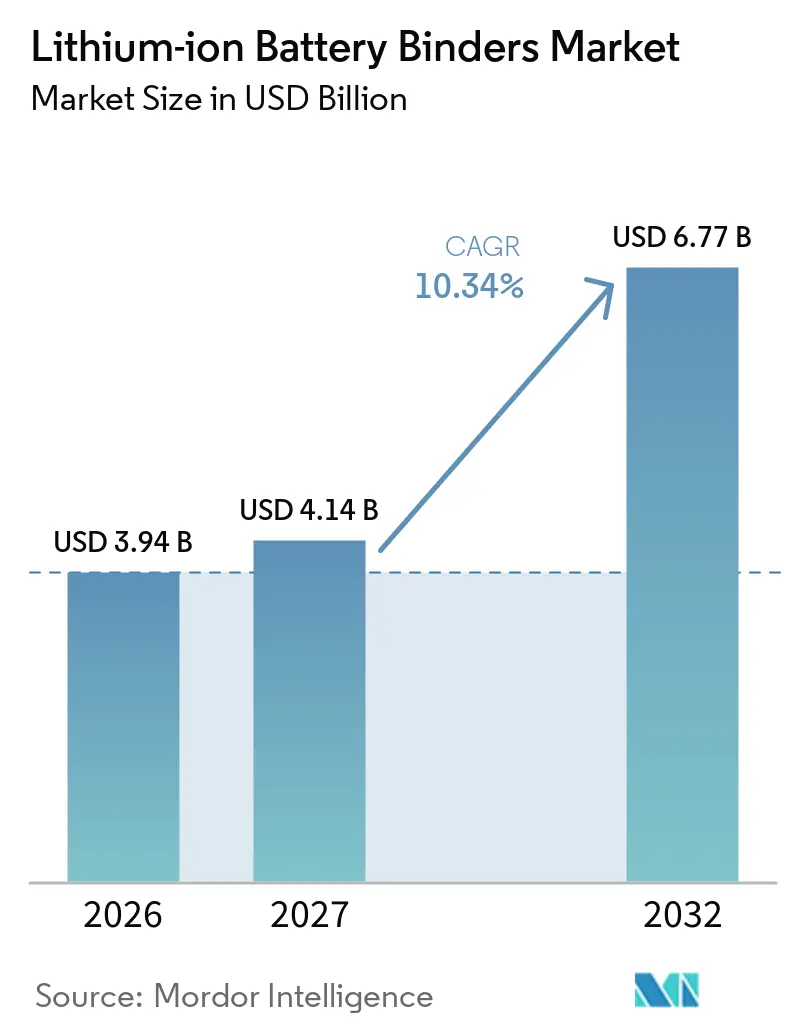
The Lithium-ion Battery Binders Market size is expected to increase from USD 3.94 billion in 2026 to USD 4.14 billion in 2027 and reach USD 6.77 billion by 2032, growing at a CAGR of 10.34% over 2027-2032. Electrode binders remain a small part of cell weight, yet their role in adhesion, production yield, and cycle durability makes them important as cell manufacturing capacity grows. Global lithium-ion battery manufacturing capacity exceeded 4 TWh at the end of 2025, while China held more than 80% of capacity and the European Union and United States each accounted for 6% to 7%.[1] EV battery deployment reached 1.2 TWh in 2025, rising by nearly 30% from the prior year, which supports demand for binder materials in vehicle and stationary storage cells. The lithium-ion battery binders market is also shaped by water-based processing, silicon-rich anodes, and dry-electrode development, which widen the range of binder performance requirements. Supply concentration in China and tighter feedstock availability are encouraging capacity additions and supplier qualification activity in North America and Europe.
Key Report Takeaways
- By binder material, Polyvinylidene Fluoride (PVDF) held 46.5% revenue share in 2026, while Styrene-Butadiene Rubber (SBR) is forecast to expand at an 11.6% CAGR through 2032.
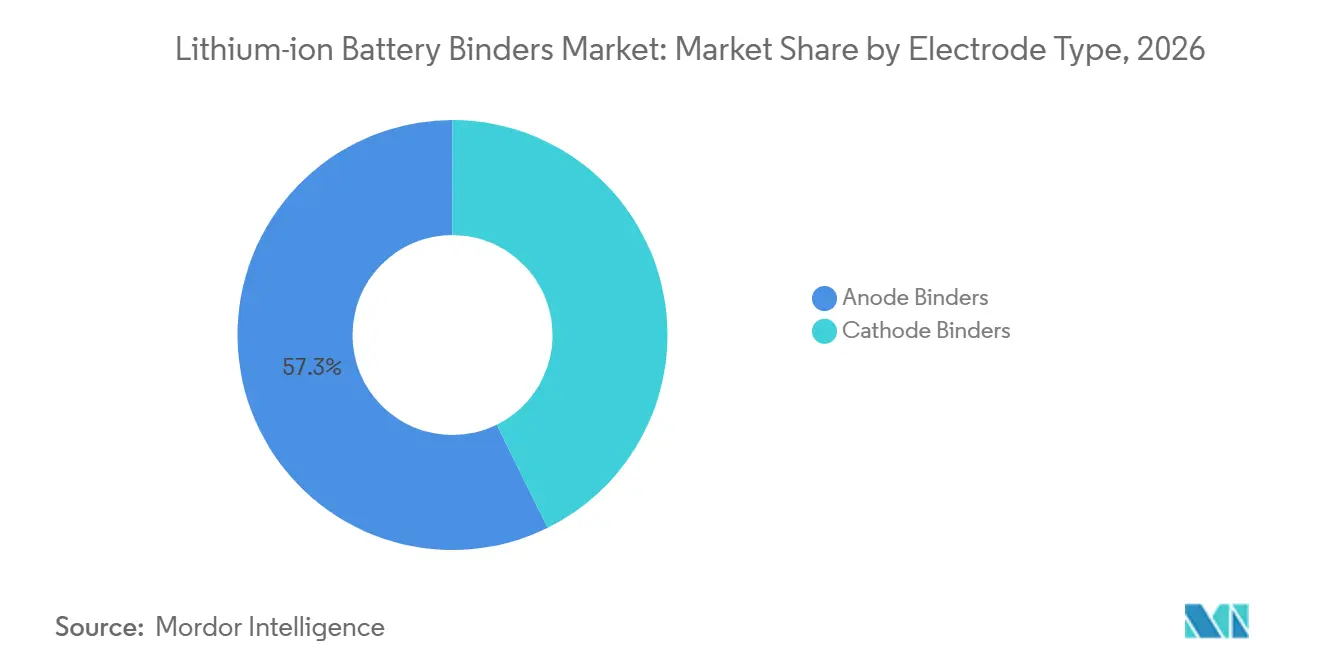
- By electrode type, anode binders held 57.3% of revenue share in 2026 and are forecast to grow at a 10.6% CAGR through 2032.
- By battery chemistry, Lithium Iron Phosphate (LFP) held 38.1% revenue share in 2026 and is forecast to grow at an 11.8% CAGR through 2032.
- By formulation and processing technology, solvent-based binders held a 61.2% revenue share in 2026, while Dry-electrode binders are forecast to expand at a 10.9% CAGR through 2032.
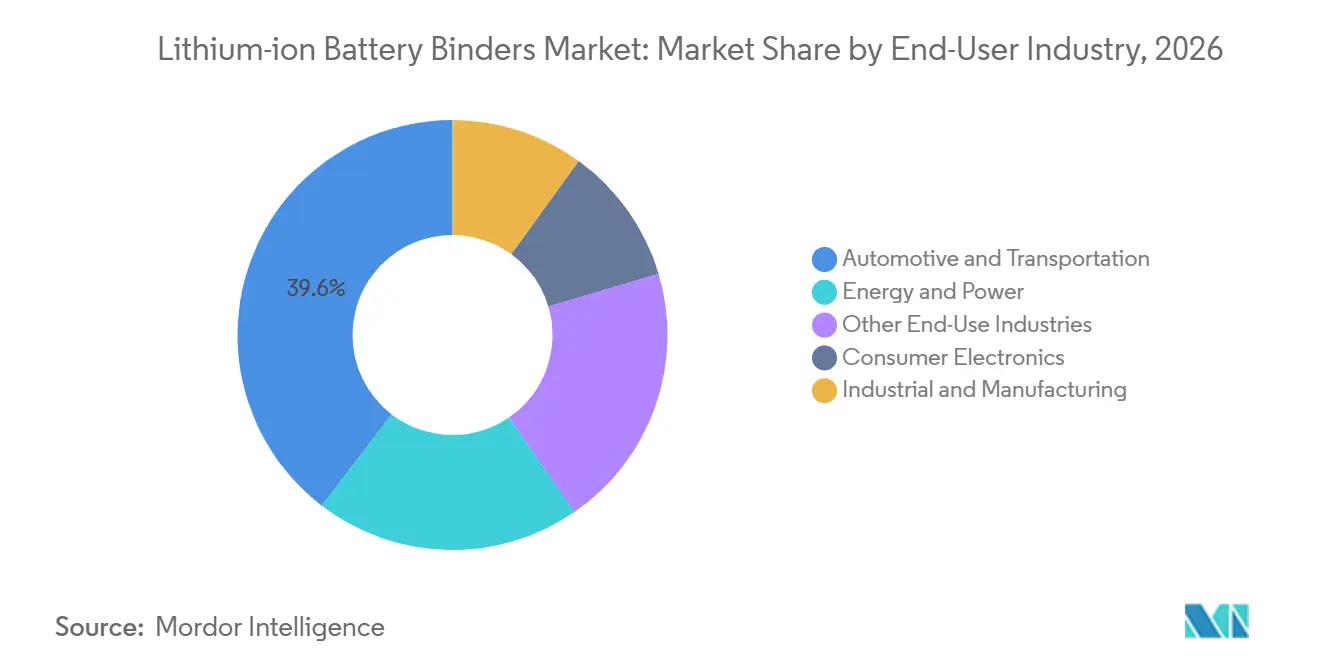
- By end-use industry, automotive and transportation held a 39.6% revenue share in 2026, while energy and power are forecast to expand at a 12.7% CAGR through 2032.
- By geography, Asia-Pacific held 47.5% revenue share in 2026, while North America is forecast to grow at a 12.4% CAGR through 2032.
Note: Market numbers in this report are based on Mordor Intelligence's proprietary estimation framework, which combines nine months of actuals with Q4 projections for base year 2026.
Market Trends and Insights
Drivers Impact Analysis of Lithium-ion Battery Binders Market*
| Driver | (~) % Impact on CAGR Forecast | Geographic Relevance | Impact Timeline |
|---|---|---|---|
| Electric Vehicle and Gigafactory Expansion | +3.5% | Global, with the largest gains in China, North America, and the European Union | Short term (≤ 2 years) |
| Grid-Scale Energy Storage Deployment | +2.0% | Global, with the largest near-term gains in the United States, China, and the European Union | Short term (≤ 2 years) |
| Water-Based Electrode Processing Adoption | +1.0% | Asia-Pacific, with spillover to Europe and North America | Medium term (2-4 years) |
| Silicon-Rich Anode Qualification | +0.8% | Asia-Pacific, especially Japan and South Korea, expanding to North America | Medium term (2-4 years) |
| Binder Qualification as a Process-Yield Differentiator | +0.5% | Global, led by regions with dense gigafactory activity | Medium term (2-4 years) |
| Localized Battery-Material Supply Strategies | +0.6% | North America and Europe | Long term (≥ 4 years) |
| Source: Mordor Intelligence | |||
Electric Vehicle and Gigafactory Expansion
Gigafactory expansion remains the strongest demand driver for the lithium-ion battery binders market. New cell plants turn binder materials from specialized inputs into products needed at large industrial volumes. Global EV battery deployment reached 1.2 TWh in 2025 and rose by nearly 30% from 2024.[2] Electric trucks more than doubled their battery demand in the same year, adding another route for electrode-material consumption. Suppliers that qualify materials during a plant’s initial production stage can become part of a supply relationship that continues through later production programs. This makes early work with cell designers important because binder specification affects line performance, product quality, and validation schedules.
Grid-Scale Energy Storage Deployment
Grid-scale storage gives the lithium-ion battery binders market a source of demand that is separate from vehicle production cycles. The United States installed 57.6 GWh of new energy storage capacity in 2025, 4 times the level recorded 3 years earlier.[3] Cumulative utility-scale storage in the country reached 137 GWh during 2025. LFP accounted for more than 90% of global stationary storage installations in 2025, which supports use of cost-focused SBR and Carboxymethyl Cellulose (CMC) binder systems. This demand base reduces dependence on automotive volumes for suppliers serving aqueous anode processing. It also supports SBR demand when EV adoption slows in an individual region.
Water-Based Electrode Processing Adoption
Water-based electrode processing is broadening the addressable space for aqueous binders in the lithium-ion battery binders market. A 2026 review found that aqueous binders for NMC cathodes can deliver performance comparable to NMP-processed electrodes when pH and aluminum collector corrosion are controlled.[4] The review covered NMC 111, 532, 622, and 811 cathode compositions. Arkema presented a waterborne PVDF binder for LFP and NMC cathodes in 2025, with the stated aim of avoiding NMP while retaining or improving first-cycle efficiency. The shift moves water-based processing beyond established anode use and into cathode development. It creates opportunities for SBR, Carboxymethyl Cellulose (CMC), aqueous PVDF, and other tailored polymer systems.
Silicon-Rich Anode Qualification
Silicon-rich anodes raise performance requirements for binders and create a higher-value part of the lithium-ion battery binders market. Silicon can undergo up to 300% volume expansion during charge cycles, which can damage electrode coatings if a binder does not provide suitable adhesion and elastic recovery. A 2025 study reported that a composite polyacrylic acid (PAA)-terpolymer binder achieved an initial discharge capacity of 3,572 mAh/g and 71% retention over 300 cycles in silicon anodes. These requirements favor PAA and functional elastomer binders where conventional SBR does not meet the needed performance. The result is a split between broader-volume graphite-anode systems and premium materials for silicon-graphite blends. This shift gives suppliers a reason to develop products around durability, adhesion, and lithium-ion transport rather than compete only in volume.
Restraints Impact Analysis of Lithium-ion Battery Binders Market*
| Restraint | (~) % Impact on CAGR Forecast | Geographic Relevance | Impact Timeline |
|---|---|---|---|
| High Qualification and Switching Costs | -1.5% | Global | Long term (≥ 4 years) |
| Fluoropolymer Feedstock and Supply Concentration | -1.2% | North America and Europe are most exposed | Medium term (2-4 years) |
| Binder Performance Trade-Offs in Emerging Chemistries | -0.7% | Global | Medium term (2-4 years) |
| Uncertain Scale-Up Timing for Dry-Electrode Processing | -0.4% | Global, most acutely in North America | Long term (≥ 4 years) |
| Source: Mordor Intelligence | |||
High Qualification and Switching Costs
Binder qualifications can limit the pace of change in the lithium-ion battery binders market. Cell manufacturers test electrochemical cycling, thermal stability, line adhesion, and safety performance before approving a material. These activities take multiple years and involve more than a single laboratory test. Once material is approved, changing to another supplier can introduce new cost and production-schedule risk. This process protects suppliers with existing qualifications, especially in high-nickel NMC and NCA applications with few established alternatives. It can also slow commercial adoption of bio-derived, PFAS-free, or otherwise differentiated binder systems even when technical results are promising.
Fluoropolymer Feedstock and Supply Concentration
PVDF supply is exposed to concentrated feedstocks and regulatory limits, which can restrain the lithium-ion battery binders market. The value chain runs from fluorspar and hydrofluoric acid through R142b and VDF monomer to PVDF resin. China remains highly concentrated in battery-material supply, including LFP precursors, and this concentration also affects PVDF availability. The phase-down of R142b under the Montreal Protocol can increase input costs and restrict expansion for producers without integrated feedstock positions. Standard PVDF additions in China do not necessarily resolve tight availability for high-purity grades used in Western NMC cathode programs. European PFAS restriction work and REACH compliance add documentation, and reformulation demands for suppliers selling fluoropolymer binders to European cell manufacturers.
*Our forecasts treat driver/restraint impacts as directional, not additive. The impact forecasts reflect baseline growth, mix effects, and variable interactions.
Lithium-ion Battery Binders Market Segment Analysis
By Binder Material:
PVDF Retains Cathode Leadership While SBR Leads GrowthPVDF held 46.5% of lithium-ion battery binders market share in 2026, supported by its long qualification history and stability in cathode formulations. Cathode manufacturing requires binder materials that remain reliable in oxidative environments. Arkema introduced Kynar HSV 1200 and HSV 1400 at Interbattery 2026 for LFP cathodes, with lower binder loading and higher active-material content as stated product objectives. CMC supports water-based anode slurry as a thickener and dispersant when used with SBR. The draft indicates that CMC and SBR are commonly used in a 1:3 weight ratio across anode coating lines. Polyacrylic Acid (PAA)-based binders are gaining relevance for silicon-rich anodes because their carboxyl groups can bond with silicon particles. This functional property responds to the adhesion demands created by cycling-related expansion.
SBR is forecast to grow at an 11.6% CAGR through 2032, making it the fastest-growing binder material. Growth is linked to aqueous anode processing and rising demand for silicon-compatible grades. Trinseo commercially launched VOLTABOND 211 in May 2026, reporting a 5% reduction in electrode surface resistivity and up to an 18% reduction in internal resistance compared with its earlier SBR generation. Polytetrafluoroethylene (PTFE) is used in dry-electrode processing to create self-supporting films, while PMMA is being evaluated for solid-state prototype cells. Sodium alginate is attracting research interest in aqueous LFP cathode applications. These materials widen the binder material set as cell makers pursue different processing routes and battery architectures.
By Electrode Type:
Anode Demand Leads as Cathode Applications Retain Higher ValueAnode binders held 57.3% of revenue share in 2026 and are forecast to grow at a 10.6% CAGR through 2032. Their share reflects the broad use of aqueous SBR and CMC systems in graphite anodes across commercial cell chemistries. Rising silicon content in commercial anode blends supports demand for functional polymer grades. The anode side therefore includes both high-volume conventional applications and higher-performance materials for silicon-containing systems. The lithium-ion battery binders market size for anode materials benefits from the large installed base of graphite-based cell production. It also gains from a gradual shift toward materials that can withstand repeated changes in electrode volume.
Cathode binders held the remaining 42.7% share in 2026 and tended to command higher selling prices because PVDF is a specialty material. Cathode environments require resistance to oxidation and compatibility with active materials. Water-based NMC cathode routes are moving from pilot work toward pre-commercial evaluation. The 2026 RSC Sustainability review identified pH management and aluminum corrosion as key barriers to wider aqueous NMC cathode deployment. Broad adoption of aqueous cathode processing would change procurement toward aqueous latex suppliers. That shift could reduce margins for suppliers whose current position rests mainly on high-value PVDF cathode grades.
By Battery Chemistry:
LFP Combines the Largest Share with the Fastest GrowthLFP accounted for 38.1% of revenue share in 2026 and is forecast to expand at an 11.8% CAGR through 2032. This makes LFP both the leading chemistry by share and the fastest-growing chemistry. In 2025, LFP exceeded 55% of global EV battery deployments and more than 90% of stationary storage installations. Its scale supports demand for SBR and CMC systems used in cost-focused anode processing. It also supports demand for LFP-focused PVDF grades, including the Arkema products introduced at Interbattery 2026. LFP demand therefore links vehicle production and stationary storage deployment to the same binder supply base.
High-nickel NMC 811 and NCMA variants need more stringent PVDF specifications because of their reactive cathode surfaces. LCO remains relevant to consumer electronics, where energy density is a central product requirement. NCA is used in cylindrical automotive cells and also depends on high-purity PVDF. LMO has more limited growth because its energy density is lower than that of LFP and NMC. LTO remains a niche chemistry for fast-charge and long-cycle-life infrastructure applications, where cost per cycle affects buying decisions. These chemistry differences require suppliers to maintain distinct material grades and qualification approaches.
By Formulation and Processing Technology:
Solvent-Based Systems Lead While Dry-electrode binders AdvanceSolvent-based binders held 61.2% of revenue share in 2026 because NMP-based PVDF systems remain established in cathode coating lines. Long qualification cycles support the continued position of solvent-based production infrastructure. Changing binder and solvent chemistry requires reformulation work and renewed validation. The lithium-ion battery binders market share held by solvent-based systems is therefore reinforced by existing plant investments. The structure of operating gigafactories favors materials already validated on their lines. This installed base creates a meaningful barrier for alternatives even when they may offer energy or environmental benefits.
Dry-electrode binders are forecast to grow at a 10.9% CAGR through 2032, although their current volume remains lower than solvent-based systems. Dry-electrode methods use PTFE as a primary binder to form solvent-free films under shear. Arkema’s patent filing for a non-fibrillizable fluoropolymer dry-electrode binder signals work beyond reliance on PTFE alone. Water-based binders are already standard in anodes and are moving into cathode applications. Arkema stated that solvent-free manufacturing could represent 10% to 15% of global EV battery production by 2033. BASF introduced Oppanol N PLUS in 2026 for cathode, anode, and electrolyte-interface requirements in solid-state battery development. These developments show that formulation choices are becoming closely tied to next-generation cell designs.
By End-Use Industry:
Automotive Leads While Energy and Power Expands FasterAutomotive and transportation accounted for 39.6% of revenue share in 2026. Vehicle cells use both PVDF cathode binders and SBR anode binders across NMC, NCA, and LFP formats. Joint development and qualification arrangements can keep a material specification in place for several years. This supports incumbent suppliers and can preserve premium pricing for approved products. The automotive position in the lithium-ion battery binders market size follows the continued scale-up of EV battery deployment. It also makes production requirements, safety validation, and coating-line consistency important commercial considerations.
Energy and power are forecast to grow at a 12.7% CAGR through 2032, the fastest rate among end-use industries. Grid-scale battery energy storage systems commonly use LFP formats with SBR and CMC binder systems. US battery cell manufacturing for stationary storage exceeded 21 GWh in 2025, while utility-scale storage reached 137 GWh . Consumer electronics remain important for lithium cobalt oxide (LCO) and premium NMC pouch and coin-cell formats that require consistent performance. Industrial and manufacturing uses broadly follow automotive binder specifications. Residential storage added 3.1 GWh in the United States in 2025, a 51% increase from the prior year, adding to LFP-related binder demand.
Geography Analysis
APAC Lithium-ion Battery Binders Market
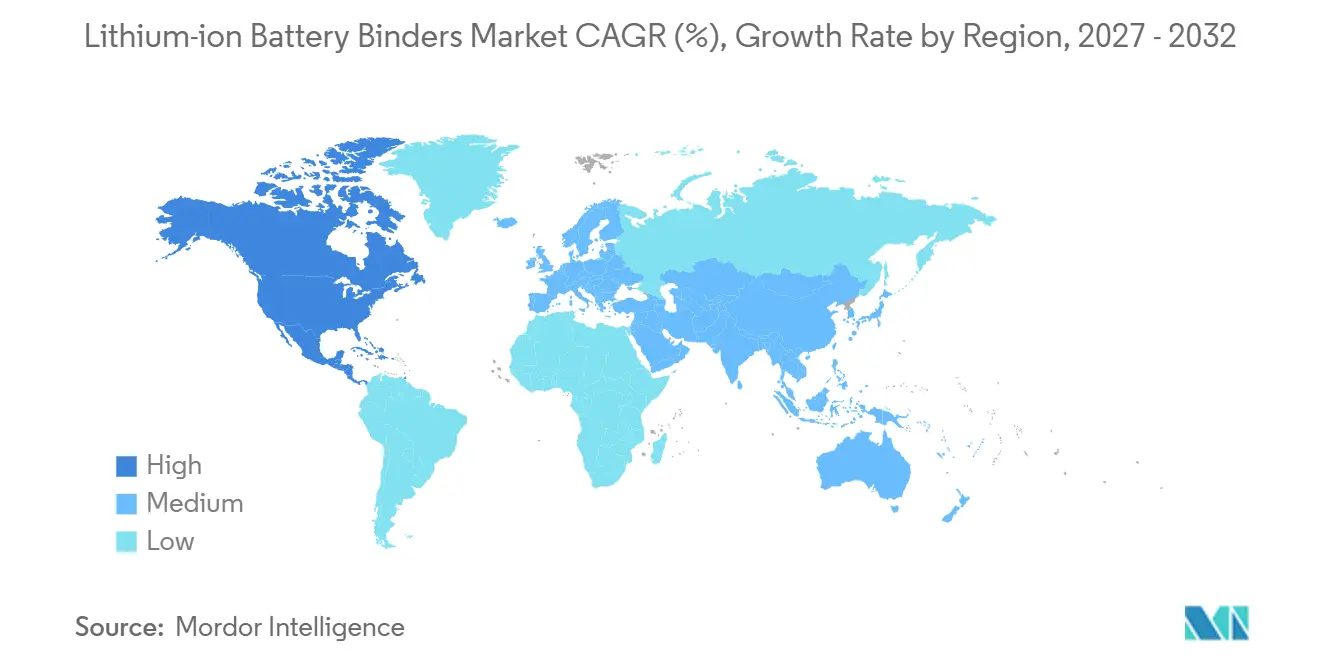
Asia-Pacific held 47.5% of revenue share in 2026, giving the region the largest position in the lithium-ion battery binders market. China held more than 80% of global lithium-ion battery nameplate capacity, and its battery-material supply chain includes highly concentrated LFP precursor production. This manufacturing base supports extensive demand for both cathode and anode binder materials. South Korea is another major regional demand center, supported by gigafactory programs run by LG Energy Solution, Samsung SDI, and SK On. Japan remains important as the home of Kureha and Zeon, as well as a base for silicon-anode and solid-state binder development.
North America Lithium-ion Battery Binders Market
North America is forecast to grow at a 12.4% CAGR through 2032, the fastest rate among geographic regions. Growth reflects the movement from announced plants toward operational electrode manufacturing. Syensqo is building a PVDF facility in Augusta, Georgia, backed by a USD 178 million Department of Energy grant, with capacity intended to serve more than 5 million EV batteries annually at full output. Arkema completed a 15% PVDF capacity expansion at its Calvert City, Kentucky, plant in June 2026. The Section 45X production tax credit supports localized battery-material output in the United States. These additions address a domestic supply gap while increasing the importance of local qualification and logistics.
EMEA and South America Lithium-ion Battery Binders Market
Europe has a meaningful position through cell plants and binder facilities in Germany, France, the United Kingdom, and Poland. Arkema expanded its Global Battery R&D Center of Excellence in Lyon with a EUR 10 million investment in October 2026. Syensqo’s Tavaux PVDF site further supports the region’s binder production base. European cell manufacturing capacity rose by 50% in 2025, compared with 25% in China. The EU Battery Regulation raises documentation requirements on recycled content, carbon footprint, and due diligence. South America is still developing battery-material processing around lithium resources, while the Middle East and Africa see additional demand from grid-scale storage projects.
Competitive Landscape
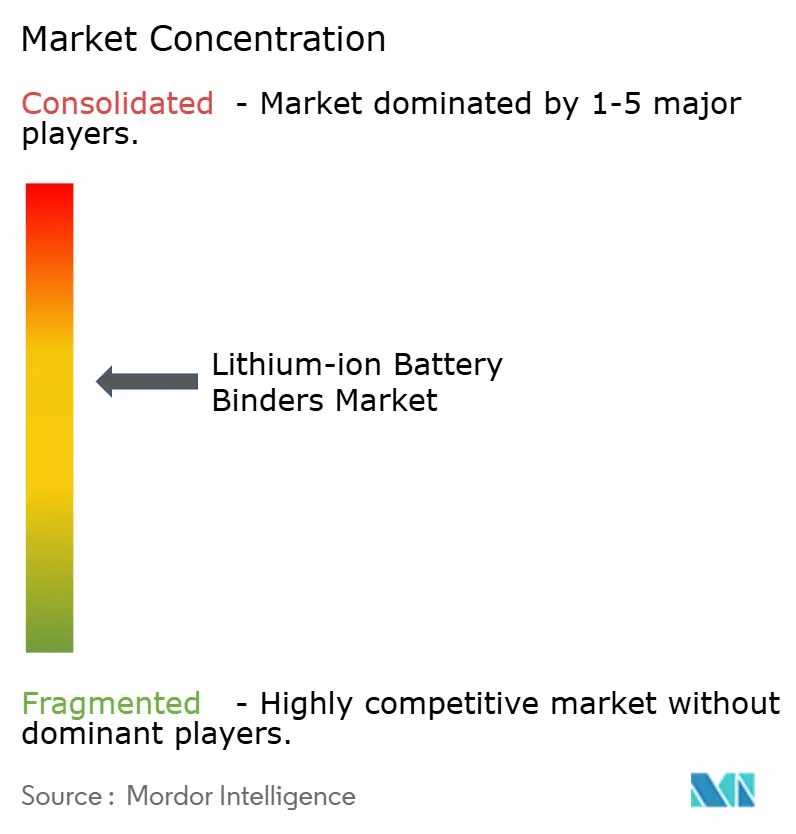
The lithium-ion battery binders market is moderately consolidated around suppliers with established PVDF and SBR qualifications. Kureha, Syensqo, and Arkema are central suppliers in cathode PVDF applications. Zeon, Trinseo, and JSR have prominent positions in SBR latex binders. Chinese producers, including Shanghai 3F New Materials and Suzhou Crystal Clear Chemical, are expanding PVDF capacity for LFP cathode applications. Their focus reflects domestic qualification access and lower specification intensity in some LFP uses. Competition is shaped by manufacturing location, product performance, and the ability to qualify materials with cell producers.
Leading suppliers are investing in local capacity, dry-electrode research, and silicon-anode platforms. Arkema completed its Kentucky PVDF expansion in 2026 and announced further growth in China. Kureha completed an expansion of battery-grade KF Polymer capacity to 8,000 tonnes per year at its Nishiki facility in 2025. Trinseo launched VOLTABOND 211 to address graphite and silicon anodes used in fast-charging vehicles and battery energy storage systems. LG Chem has taken a different approach through vertical integration across cathode active material, cathode binders, anode materials, and CNT conductive additives. These strategies are intended to secure positions as electrode designs and regional supply chains change.
PFAS-free cathode materials and ionic-liquid-compatible binders for solid-state interfaces remain areas of active opportunity. Regulatory scrutiny of fluoropolymers in Europe supports interest in non-fluorine alternatives. Patent activity is also becoming more important for dry-electrode processing. The European Patent Office issued decision T 0466/25 in July 2026 on Kureha’s resin composition patent for nonaqueous electrolyte secondary-battery electrodes. Arkema’s work on non-fibrillizable fluoropolymer binders illustrates competition around solvent-free electrode methods. The lithium-ion battery binders market remains dependent on qualification depth, which limits rapid displacement of established suppliers.
Lithium-ion Battery Binders Industry Leaders
-
Arkema S.A.
-
Syensqo S.A.
-
Kureha Corporation
-
Zeon Corporation
-
BASF SE
- *Disclaimer: Major Players sorted in no particular order
Lithium-ion Battery Binders Market Companies Covered in this Report
- Arkema S.A.
- Ashland Inc.
- BASF SE
- Daikin Industries, Ltd.
- Denka Company Limited
- Dow Inc.
- JSR Corporation
- Kureha Corporation
- LG Chem Ltd.
- Mitsubishi Chemical Group Corporation
- Mitsui Chemicals, Inc.
- Resonac Holdings Corporation
- Shanghai 3F New Materials Co., Ltd.
- Sumitomo Chemical Co., Ltd.
- Suzhou Crystal Clear Chemical Co., Ltd.
- Syensqo S.A.
- Synthomer plc
- Toray Industries, Inc.
- Trinseo PLC
- Zeon Corporation
Recent Industry Developments in Lithium-ion Battery Binders Market
- October 2026: Arkema announced a EUR 10 million expansion of its Global Battery Center of Excellence in Lyon, France, expanding R&D capabilities for advanced binder materials targeting solid-state, semi-solid, and dry-electrode battery architectures.
- June 2026: Arkema completed a 15% PVDF capacity expansion at its Calvert City, Kentucky, plant, adding North American supply of Kynar PVDF binder and separator coating grades. Arkema also announced a further 20% PVDF expansion at its China plant that is expected to complete in 2028.
- June 2026: BASF introduced Oppanol N PLUS, a polyisobutene-based binder for next-generation EV batteries. The product was engineered for solid-state battery cathode, anode, and solid-electrolyte interface applications.
- May 2026: Trinseo commercially launched VOLTABOND 211, the second product in its Fourth-Generation SBR Binder Platform. The water-based functional binder targets graphite and silicon anode systems used in fast-charging EV and BESS applications.
Global Lithium-ion Battery Binders Market Report Scope
The global lithium-ion battery binders market covers the manufacturing, distribution, and formulation of specialized polymer materials used to hold active materials and conductive agents together and secure them to current collectors within lithium-ion batteries.
The global lithium-ion battery binders market is segmented by binder material, electrode type, battery chemistry, formulation, end use, and geography. By binder material, the market is segmented into polyvinylidene fluoride (PVDF), styrene-butadiene rubber (SBR), carboxymethyl cellulose (CMC), polyacrylic acid (PAA), and other binder materials. By electrode type, the market is segmented into anode and cathode. By battery chemistry, the market is segmented into lithium iron phosphate (LFP), nickel manganese cobalt (NMC), lithium cobalt oxide (LCO), nickel cobalt aluminum (NCA), lithium titanate oxide (LTO), and other battery chemistries. By formulation, the market is segmented into solvent-based, water-based, dry electrode, and other formulations. By end use, the market is segmented into automotive, consumer electronics, energy and power, industrial, and other applications. The report also covers the market size and forecasts for the global lithium-ion battery binders market across 26 countries in key regions. For each segment, the market sizing and forecasts have been provided on the basis of value (USD).
Segmentation Overview
| Polyvinylidene Fluoride (PVDF) |
| Styrene-Butadiene Rubber (SBR) |
| Carboxymethyl Cellulose (CMC) |
| Polyacrylic Acid (PAA) |
| Polymethyl Methacrylate (PMMA) |
| Polytetrafluoroethylene (PTFE) |
| Sodium Alginate |
| Other Binder Materials |
| Anode Binders |
| Cathode Binders |
| Lithium Iron Phosphate (LFP) |
| Lithium Nickel Manganese Cobalt Oxide (NMC) |
| Lithium Cobalt Oxide (LCO) |
| Lithium Nickel Cobalt Aluminum Oxide (NCA) |
| Lithium Manganese Oxide (LMO) |
| Lithium Titanate Oxide (LTO) |
| Other Lithium-Ion Battery Chemistries |
| Solvent-Based Binders |
| Water-Based Binders |
| Dry Electrode Binders |
| Other Binder Formulations |
| Automotive and Transportation |
| Consumer Electronics |
| Energy and Power |
| Industrial and Manufacturing |
| Other End-Use Industries |
| North America | United States |
| Canada | |
| Mexico | |
| Europe | Germany |
| France | |
| Italy | |
| Spain | |
| United Kingdom | |
| Poland | |
| Russia | |
| Rest of Europe | |
| Asia-Pacific | China |
| India | |
| Japan | |
| South Korea | |
| Australia | |
| Indonesia | |
| Vietnam | |
| Thailand | |
| Rest of Asia-Pacific | |
| South America | Brazil |
| Argentina | |
| Chile | |
| Rest of South America | |
| Middle East and Africa | Saudi Arabia |
| United Arab Emirates | |
| Egypt | |
| South Africa | |
| Morocco | |
| Rest of Middle East and Africa |
| By Binder Material | Polyvinylidene Fluoride (PVDF) | |
| Styrene-Butadiene Rubber (SBR) | ||
| Carboxymethyl Cellulose (CMC) | ||
| Polyacrylic Acid (PAA) | ||
| Polymethyl Methacrylate (PMMA) | ||
| Polytetrafluoroethylene (PTFE) | ||
| Sodium Alginate | ||
| Other Binder Materials | ||
| By Electrode Type | Anode Binders | |
| Cathode Binders | ||
| By Battery Chemistry | Lithium Iron Phosphate (LFP) | |
| Lithium Nickel Manganese Cobalt Oxide (NMC) | ||
| Lithium Cobalt Oxide (LCO) | ||
| Lithium Nickel Cobalt Aluminum Oxide (NCA) | ||
| Lithium Manganese Oxide (LMO) | ||
| Lithium Titanate Oxide (LTO) | ||
| Other Lithium-Ion Battery Chemistries | ||
| By Formulation and Processing Technology | Solvent-Based Binders | |
| Water-Based Binders | ||
| Dry Electrode Binders | ||
| Other Binder Formulations | ||
| By End-Use Industry | Automotive and Transportation | |
| Consumer Electronics | ||
| Energy and Power | ||
| Industrial and Manufacturing | ||
| Other End-Use Industries | ||
| By Geography | North America | United States |
| Canada | ||
| Mexico | ||
| Europe | Germany | |
| France | ||
| Italy | ||
| Spain | ||
| United Kingdom | ||
| Poland | ||
| Russia | ||
| Rest of Europe | ||
| Asia-Pacific | China | |
| India | ||
| Japan | ||
| South Korea | ||
| Australia | ||
| Indonesia | ||
| Vietnam | ||
| Thailand | ||
| Rest of Asia-Pacific | ||
| South America | Brazil | |
| Argentina | ||
| Chile | ||
| Rest of South America | ||
| Middle East and Africa | Saudi Arabia | |
| United Arab Emirates | ||
| Egypt | ||
| South Africa | ||
| Morocco | ||
| Rest of Middle East and Africa | ||
Key Questions Answered in the Report
What is the projected size of the lithium-ion battery binders market by 2032?
The market is projected to reach USD 6.77 billion by 2032, rising from USD 4.35 billion in 2027 at a 10.34% CAGR.
Which binder material is growing fastest in lithium-ion batteries?
SBR is projected to record the fastest growth among binder materials at an 11.6% CAGR through 2032, supported by aqueous anode processing and silicon-compatible grades.
Why are battery binders important for EV cells?
Binders support electrode adhesion, production yield, and cycle durability. EV battery deployment reached 1.2 TWh in 2025, which increases demand for these materials.
Which battery chemistry creates the largest binder demand?
LFP held 38.1% share in 2026 and is projected to grow at an 11.8% CAGR through 2032. It represented more than 55% of global EV battery deployments in 2025.
Which end use is expected to grow fastest for binder suppliers?
Energy and power is forecast to expand at a 12.7% CAGR through 2032, supported by LFP-based grid-scale battery storage systems.
Which region is growing fastest for lithium-ion battery binders?
North America is projected to grow at a 12.4% CAGR through 2032 as local cell and PVDF capacity expands.