
Lithium Hexafluorophosphate Market Size and Share
Market Overview
| Study Period | 2021 - 2031 |
|---|---|
| Market Size (2026) | USD 3.09 Billion |
| Market Size (2031) | USD 5.63 Billion |
| Growth Rate (2026 - 2031) | 12.78 % |
| Fastest Growing Market | Asia-Pacific |
| Largest Market | Asia-Pacific |
| Market Concentration | Medium |
Major Players *Disclaimer: Major Players sorted in no particular order Image © Mordor Intelligence. Reuse requires attribution under CC BY 4.0. | |
Lithium Hexafluorophosphate Market Analysis by Mordor Intelligence
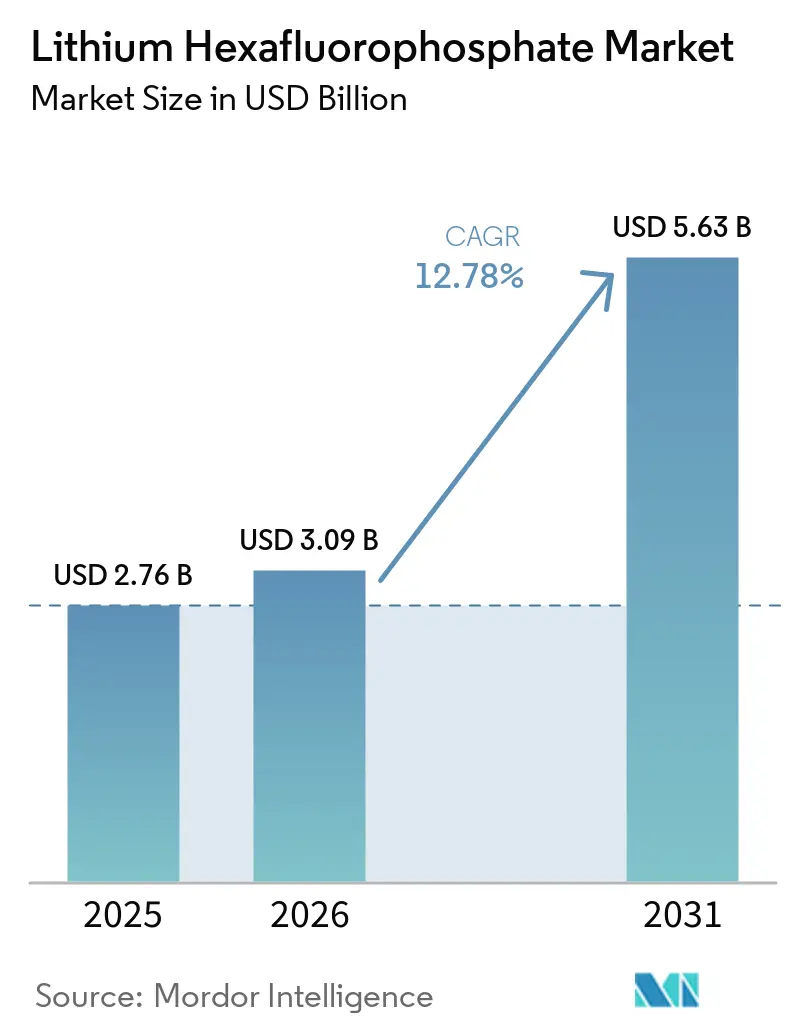
The lithium hexafluorophosphate market size was valued at USD 2.76 billion in 2025 and is estimated to grow from USD 3.09 billion in 2026 to reach USD 5.63 billion by 2031, at a CAGR of 12.78% during the forecast period (2026-2031). The lithium hexafluorophosphate market is supported by overlapping demand from electric vehicles and stationary energy storage, rather than separate cycles for these end uses. Battery manufacturers place greater value on supply reliability, material purity, and consistent qualification performance as cell production grows. Producers with control over inputs of lithium fluoride and anhydrous hydrogen fluoride hold a stronger position when raw material costs fluctuate. Global electric car sales exceeded 20 million units in 2025, accounting for more than 25% of cars sold worldwide, which supports continued demand for battery materials. The lithium hexafluorophosphate market also presents opportunities in regional supply chains, where battery plants in North America and Europe require locally sourced material.
Key Report Takeaways
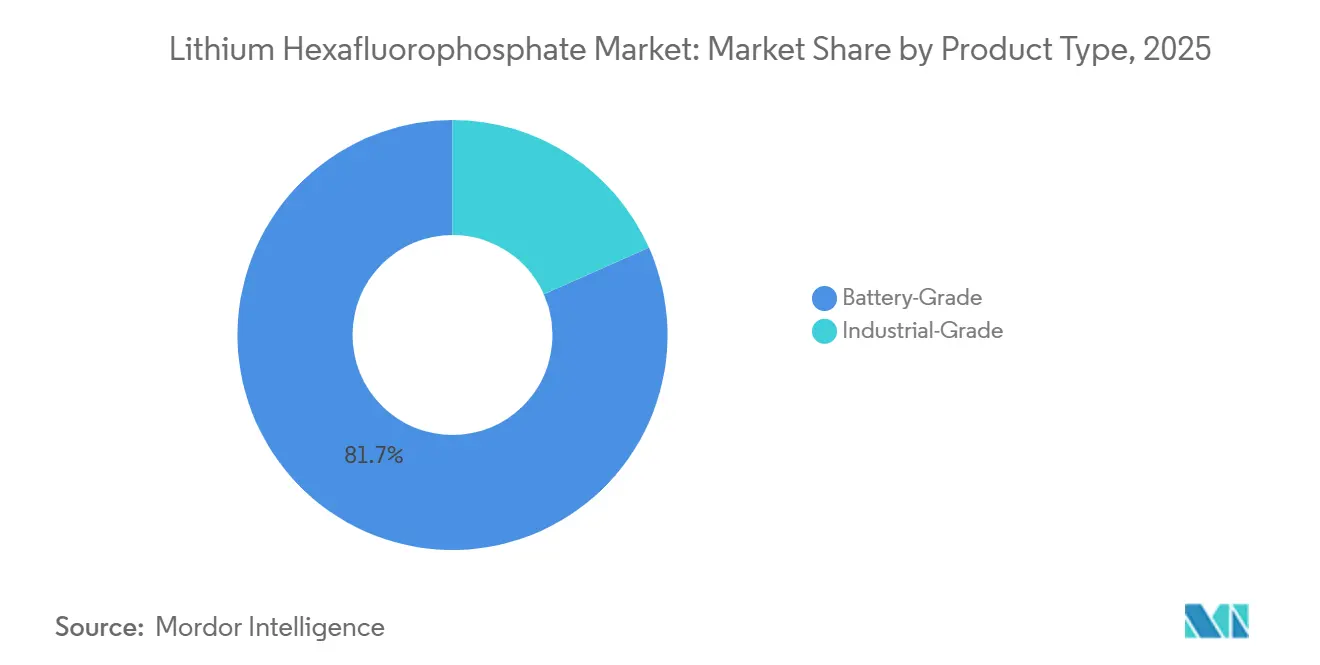
- By product type, battery-grade material led with 81.67% of the lithium hexafluorophosphate market share in 2025 and is forecast to expand at a 13.45% CAGR through 2031.
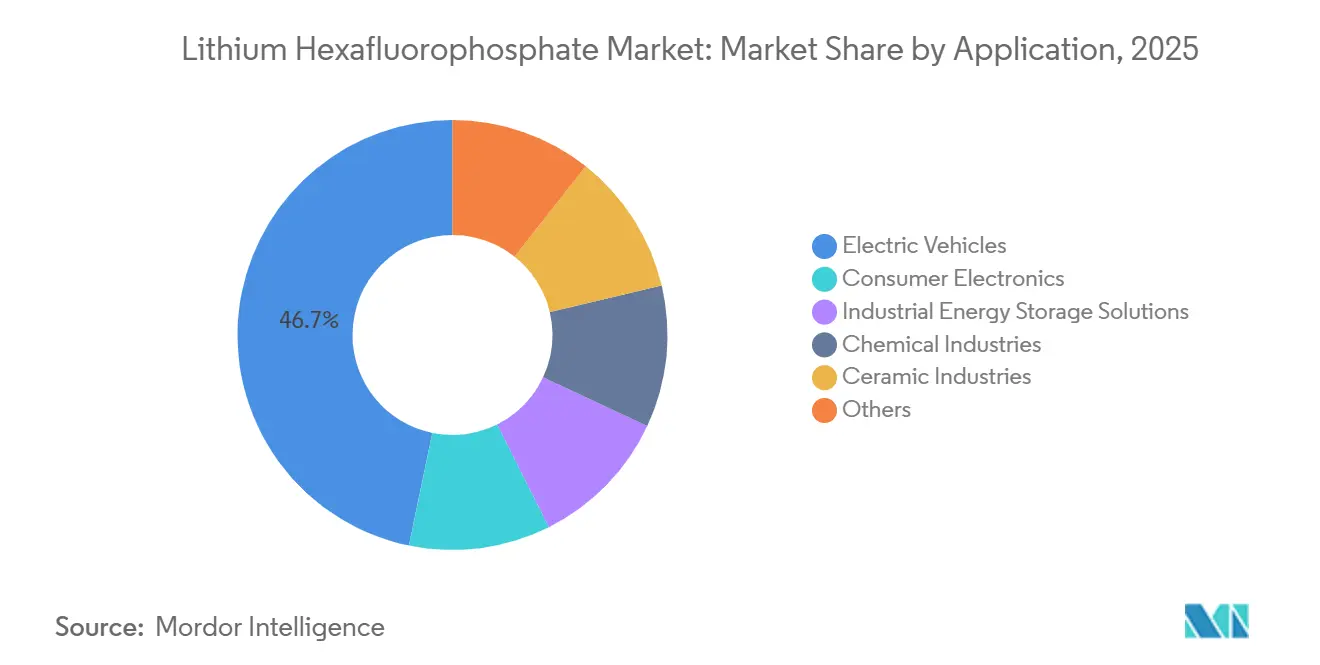
- By application, electric vehicles held 46.75% of the lithium hexafluorophosphate market share in 2025, while industrial energy storage solutions are forecast to expand at a CAGR of 13.78% through 2031.
- By geography, Asia-Pacific accounted for 47.23% of revenue in 2025 and is forecast to grow at 13.31% CAGR through 2031.
Note: Market size and forecast figures in this report are generated using Mordor Intelligence’s proprietary estimation framework, updated with the latest available data and insights as of January 2026.
Global Lithium Hexafluorophosphate Market Trends and Insights
Drivers Impact Analysis*
| Drivers | (~) % Impact on CAGR Forecast | Geographic Relevance | Impact Timeline |
|---|---|---|---|
| Electric Vehicle Battery Production Expansion | +5.2% | Global, concentrated in China, South Korea, Germany, and North America | Short term (≤ 2 years) |
| Industrial Energy Storage Deployment | +3.8% | Global, strongest in China, the United States, and Germany | Medium term (2-4 years) |
| High-Purity Electrolyte Demand for Higher-Performance Cells | +2.1% | Global, with premium demand in South Korea, Japan, and European Original Equipment Manufacturer (OEM) supply chains | Medium term (2-4 years) |
| Regional Battery-Supply-Chain Localization | +1.4% | North America and the EU, with early signals in India and Southeast Asia | Long term (≥ 4 years) |
| LiPF6 Qualification Stickiness in Existing Cell Platforms | +0.9% | Global, especially platforms using Japanese and South Korean electrolyte specifications | Medium term (2-4 years) |
| Source: Mordor Intelligence | |||
Electric Vehicle Battery Production Expansion
Global electric car sales exceeded 20 million units in 2025, with electric cars representing more than 25% of worldwide car sales[1]International Energy Agency, “Global EV Outlook 2025,” International Energy Agency, iea.org. This level of sales supports a sustained requirement for lithium-ion battery materials in the lithium hexafluorophosphate market. Battery pack demand can outpace vehicle deliveries as buyers opt for longer-range vehicles with larger battery packs. This pattern increases total battery capacity even when growth in vehicle unit sales becomes less pronounced. The lithium hexafluorophosphate market benefits because electrolyte demand rises with battery capacity, not only with the number of vehicles sold. Ultra-fast-charging battery development also increases the importance of stable electrolyte performance and reliable material quality.
Industrial Energy Storage Deployment
Industrial energy storage solutions are the fastest-growing application in the lithium hexafluorophosphate market. Stationary storage creates demand alongside electric vehicles, broadening the base of battery-related consumption. The International Energy Agency recorded more than 100 GWh of global utility-scale battery additions in 2024. Storage systems require long cycle life and dependable operation across repeated charge and discharge cycles. These operating requirements strengthen the role of electrolyte quality in battery design. Wider use of lithium-ion backup systems for data centers adds another source of demand for storage batteries.
High-Purity Electrolyte Demand for Higher-Performance Cells
The lithium hexafluorophosphate market is segmenting into standard and ultra-high-purity material categories as battery designs become more demanding. High-nickel cathode and silicon-rich anode designs require strict control of moisture and impurities in the electrolyte. Lithium hexafluorophosphate (LiPF6) degradation under storage conditions is influenced by temperature, electrolyte composition, and container materials. Trace moisture can contribute to hydrofluoric acid formation, which can damage cell materials and reduce cycle life. LiPF6 remains important for mainstream lithium-ion cells because it supports aluminum current-collector passivation and ionic conductivity. The lithium hexafluorophosphate market therefore favors suppliers that can demonstrate consistent purification and batch traceability.
Regional Battery-Supply-Chain Localization
Battery supply chains in North America and Europe are creating demand for materials produced closer to cell manufacturing sites. The lithium hexafluorophosphate market can benefit from this shift as battery producers seek shorter, more controllable supply routes. Argonne National Laboratory projected the commercially planned supply of battery components across North America through 2035, including substantial planned battery cell capacity. Local production can reduce logistics exposure for moisture-sensitive materials and support closer technical coordination with electrolyte blenders. It can also create a supply-security premium for producers able to meet local qualification requirements. This development does not eliminate the cost advantage of established Asian suppliers, but it creates room for regional capacity growth.
Restraints Impact Analysis*
| Restraints | (~) % Impact on CAGR Forecast | Geographic Relevance | Impact Timeline |
|---|---|---|---|
| Moisture Sensitivity and Hydrogen-Fluoride Formation Risk | -0.8% | Global, most acute in tropical and humid manufacturing hubs in Southeast Asia and India | Short term (≤ 2 years) |
| Lithium, Fluorine, and Phosphorus Feedstock Price Volatility | -0.6% | Global, concentrated in China, South Korea, and Japan, where cost pass-through is harder | Medium term (2-4 years) |
| Environmental, Health, and Hazardous-Process Compliance Burden | -0.5% | China, the EU, and North America | Long term (≥ 4 years) |
| Source: Mordor Intelligence | |||
Moisture Sensitivity and Hydrogen-Fluoride Formation Risk
LiPF6 is moisture-sensitive, which creates specific requirements for manufacturing, packaging, and logistics across the lithium hexafluorophosphate market. The material can hydrolyze in water to form lithium fluoride, hydrofluoric acid, and phosphoric acid. Research on commercially relevant storage conditions indicates that degradation behavior varies with temperature, electrolyte composition, and container materials[2]Orbia Fluor and Energy Materials, “Understanding Shelf Life of Electrolytes with LiPF6 Under Commercially Relevant Storage Conditions,” ECS Meeting Abstracts, iopscience.iop.org. Producers therefore require controlled manufacturing conditions, sealed packaging, and appropriate logistics arrangements. These requirements favor plants located near electrolyte blending operations and established battery supply chains. In humid manufacturing regions, careful storage and handling practices are necessary to maintain battery-grade quality.
Lithium, Fluorine, and Phosphorus Feedstock Price Volatility
The lithium hexafluorophosphate market depends on lithium, fluorine, and phosphorus inputs that follow different commodity cycles. A change in one input does not necessarily offset a price increase in another, which can make LiPF6 prices volatile even when lithium costs are lower. Producers with access to lithium fluoride and anhydrous hydrogen fluoride can reduce their exposure to fluctuations in purchased inputs. Vertical integration can also improve process control and supply availability during periods of tight supply. Independent producers may face greater pressure when customers resist absorbing higher input costs through the supply chain.
*Our forecasts treat driver/restraint impacts as directional, not additive. The impact forecasts reflect baseline growth, mix effects, and variable interactions.
Segment Analysis
By Product Type: Battery-Grade Material Leads Through Purity Requirements
Battery-grade material held 81.67% of revenue in 2025 and is forecast to grow at a 13.45% CAGR through 2031. This reflects the large share of LiPF6 consumed in lithium-ion batteries, where purity and moisture control directly affect cell quality. Demand for battery-grade material is supported by high-nickel cathode platforms that require tightly controlled electrolyte specifications. These cell designs are used in premium electric vehicles and stationary storage applications where battery performance is a core requirement. Ultra-high-purity material with purity above 99.95% and water content below 10 ppm addresses concerns about capacity fade and unwanted reactions within the cell.
Industrial-grade material is used in narrower applications in ceramics, catalysts, and general chemical processes. Its purity requirements are less strict than those for battery production, and LiPF6 is not the preferred electrolyte salt across all of these uses. Industrial-grade output has limited growth potential and faces competition from lower-cost fluorine compounds. The widening gap between the quality requirements of battery-grade and industrial-grade material continues to shape the broader lithium hexafluorophosphate industry. Japanese producers, including Kanto Denka Kogyo and Morita Chemical Industries, have invested in analytical systems and batch traceability to meet automotive qualification requirements. Chinese producers rely on scale and vertical integration to support quality control for battery customers.



By Application: Energy Storage Builds a Second Demand Base
Electric vehicles retained the largest application share at 46.75% in 2025, while industrial energy storage is projected to grow at a 13.78% CAGR through 2031. Electric vehicles remain the largest source of demand, as every additional battery pack requires electrolyte materials. Demand from this segment is also driven by larger packs in longer-range models. Industrial energy storage is expanding because stationary batteries require long calendar life and repeated cycling. Lithium iron phosphate battery systems used in storage applications depend on electrolyte formulations that support stable operation over extended periods.
The lithium hexafluorophosphate market is becoming less dependent on a single end use as energy storage grows in importance. Consumer electronics maintain stable but slower demand, as battery capacity per device has remained broadly unchanged. Demand from this segment is more closely linked to device shipments than to higher electrolyte loading. Chemical and ceramic applications remain smaller and more price-sensitive uses for LiPF6. Other applications include marine electrification and electric vertical takeoff and landing propulsion, where qualification is still underway and commercial output is expected to remain limited before 2027. This application mix gives suppliers reasons to balance battery demand with technically demanding storage requirements and emerging end uses.
Geography Analysis
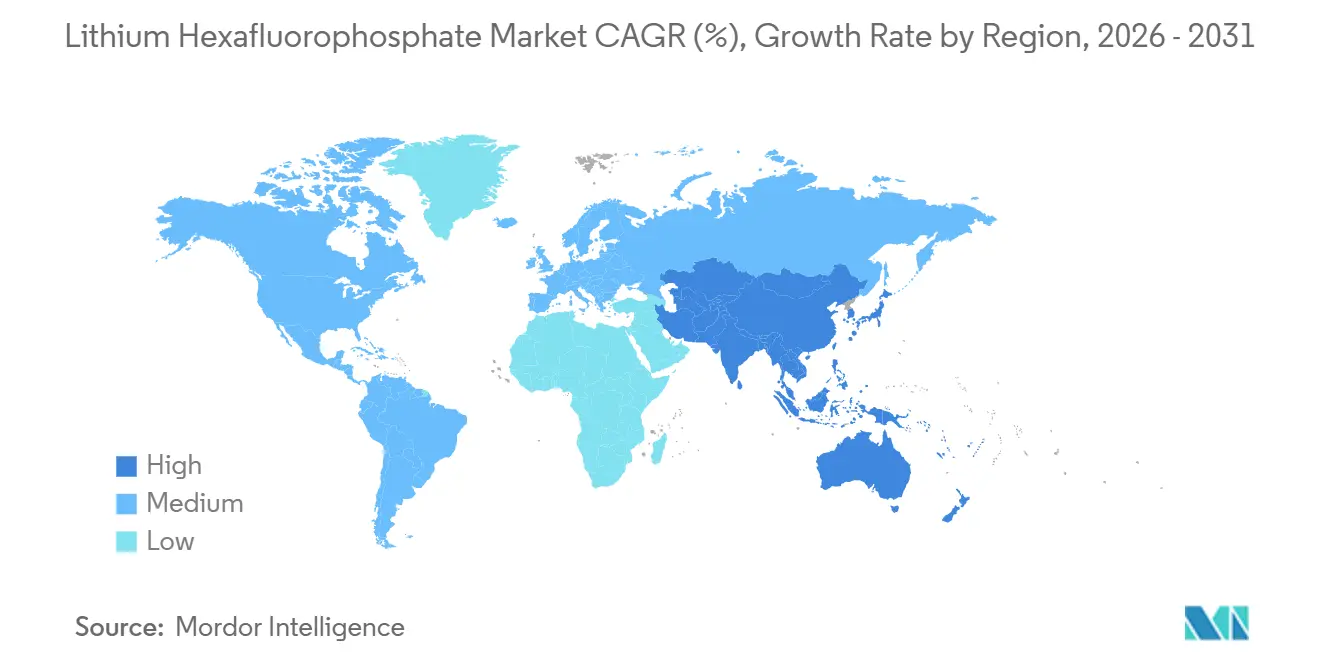
Asia-Pacific accounted for 47.23% of revenue in 2025 and is forecast to expand at a 13.31% CAGR through 2031. China accounts for more than 80% of global LiPF6 nameplate production capacity, placing the region at the center of the lithium hexafluorophosphate supply chain. China also combines high electric vehicle demand with growing stationary storage installations. South Korea is an important high-purity demand center, hosting LG Energy Solution, Samsung SDI, and SK On. Japan serves premium battery requirements through producers such as Stella Chemifa and Kanto Denka Kogyo, which follow stringent traceability and qualification practices.
India recorded more than 202,000 electric vehicle sales in 2025, creating early demand for battery materials as adoption progresses. Domestic LiPF6 production in India remains in its early stages, making it a developing demand market rather than a major supply center. North America is moving from reliance on imports toward a domestic battery-materials base. Argonne National Laboratory estimated that announced battery cell production capacity could reach 1,133 GWh in the United States and 207 GWh in Canada by 2030. This planned cell capacity supports long-term interest in localized material supply for the lithium hexafluorophosphate market.
Capchem held a groundbreaking ceremony for its electrolyte facility in Ironton, Ohio, in September 2026, its first North American production site. Europe is pursuing battery supply chain development alongside electric vehicle deployment and stricter emissions regulations. Germany is a major European demand center, while Nordic countries host gigafactory projects. South America, the Middle East, and Africa remain smaller demand areas, although policy support and battery investment are creating potential for future demand.

Competitive Landscape
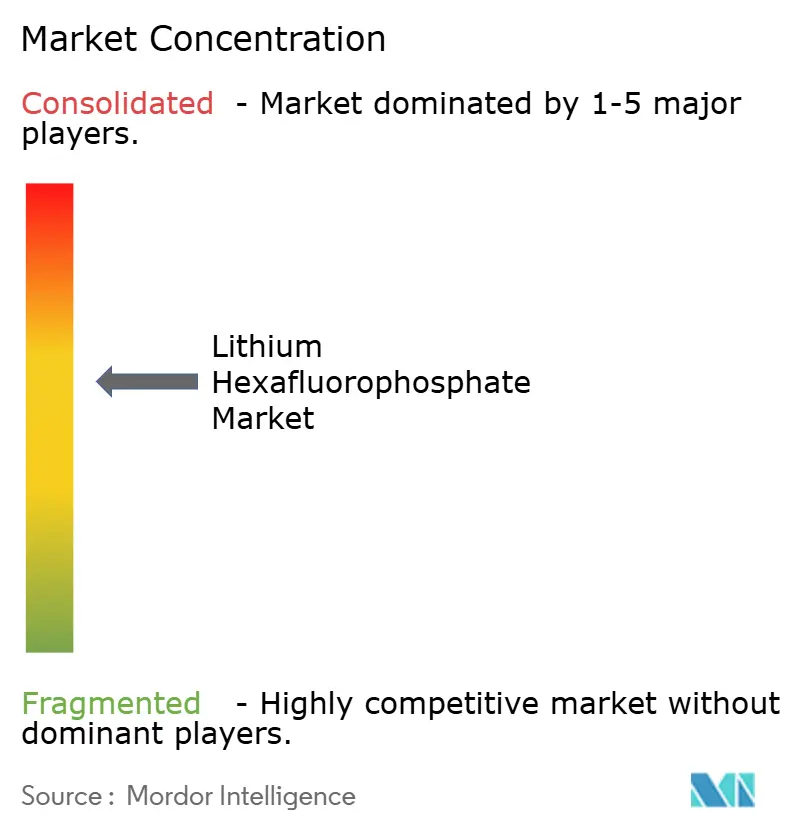
The lithium hexafluorophosphate market is moderately consolidated. Leading companies hold cost and supply advantages through vertical integration of lithium fluoride production, sourcing of anhydrous hydrogen fluoride, and related inputs. Tinci Materials reported a LiPF6 self-supply rate above 98%, supporting tighter control over inputs. Japanese companies Stella Chemifa and Kanto Denka Kogyo compete on ultra-high purity, quality systems, and established automotive qualification records rather than on output scale alone.
The market presents an opportunity for suppliers building production capacity outside Asia. New facilities can offer shorter supply routes and enhanced supply security for battery manufacturers in North America and Europe. Capchem began construction of its Ohio electrolyte facility in September 2026, positioning the company to supply U.S. battery customers and connect its operations in Poland, Malaysia, and China. This project illustrates how an integrated electrolyte producer is seeking a position near emerging Western cell-manufacturing capacity.
Supplier qualification is a key competitive factor, as battery producers must verify electrolyte performance before switching suppliers. Producers who maintain consistent quality benefit from this extended approval process. Chinese incumbents continue to expand capacity and technical capability, maintaining their advantage in scale. Competition therefore centers on cost control, high-purity production, input integration, and proximity to battery customers.
Lithium Hexafluorophosphate Industry Leaders
Guangzhou Tinci Materials Technology Co., Ltd.
Duofuduo New Energy Technology Co., Ltd
TONZE New Energy Technology Co., Ltd.
Jiangsu Jiujiujiu Technology Co., Ltd.
SINOCHEM LANTIAN CO., LTD.
- *Disclaimer: Major Players sorted in no particular order

Recent Industry Developments
- September 2026: Tinci Materials completed construction of its 35,000-ton Lithium Hexafluorophosphate (LiPF6) technical renovation production line. The company released capacity in batches based on downstream order flow to avoid overcapacity risk, maintaining full-capacity utilization on existing lines. Simultaneously, Tinci's solid-state battery material pilot line commenced trial production in Q3 2026, indicating a strategic shift toward next-generation electrolyte precursors.
- August 2026: Capchem USA held a groundbreaking ceremony for its lithium-ion battery electrolyte manufacturing facility in Ironton, Ohio, the company's first North American production site. The facility is intended to supply domestic U.S. battery customers and create synergies with Capchem's Lithium Hexafluorophosphate (LiPF6) operations in Poland, Malaysia, and China.


Global Lithium Hexafluorophosphate Market Report Scope
Lithium hexafluorophosphate is an inorganic chemical compound. It serves as the primary electrolyte salt in commercial lithium-ion batteries. The compound dissolves in organic carbonate solvents to form an electrolyte solution that facilitates the movement of lithium ions between the anode and cathode during charge and discharge cycles.
The lithium hexafluorophosphate market is segmented by product type, application, and geography. By product type, the market is segmented into battery-grade and industrial-grade. By application, the market is segmented into electric vehicles, consumer electronics, industrial energy storage solutions, chemical industries, ceramic industries, and others. The report also covers market size and forecasts for lithium hexafluorophosphate across 15 countries in major regions. The market sizes and forecasts are provided in terms of value (USD).
| Battery-Grade |
| Industrial-Grade |
| Electric Vehicles |
| Consumer Electronics |
| Industrial Energy Storage Solutions |
| Chemical Industries |
| Ceramic Industries |
| Others |
| Asia-Pacific | China |
| India | |
| Japan | |
| South Korea | |
| ASEAN Countries | |
| Rest of Asia-Pacific | |
| North America | United States |
| Canada | |
| Mexico | |
| Europe | Germany |
| United Kingdom | |
| France | |
| Italy | |
| NORDIC Countries | |
| Rest of Europe | |
| South America | Brazil |
| Argentina | |
| Rest of South America | |
| Middle East and Africa | Saudi Arabia |
| South Africa | |
| Rest of Middle East and Africa |
| By Product Type | Battery-Grade | |
| Industrial-Grade | ||
| By Application | Electric Vehicles | |
| Consumer Electronics | ||
| Industrial Energy Storage Solutions | ||
| Chemical Industries | ||
| Ceramic Industries | ||
| Others | ||
| By Geography | Asia-Pacific | China |
| India | ||
| Japan | ||
| South Korea | ||
| ASEAN Countries | ||
| Rest of Asia-Pacific | ||
| North America | United States | |
| Canada | ||
| Mexico | ||
| Europe | Germany | |
| United Kingdom | ||
| France | ||
| Italy | ||
| NORDIC Countries | ||
| Rest of Europe | ||
| South America | Brazil | |
| Argentina | ||
| Rest of South America | ||
| Middle East and Africa | Saudi Arabia | |
| South Africa | ||
| Rest of Middle East and Africa | ||


Key Questions Answered in the Report
What is current market size of Lithium Hexafluorophosphate Market?
The lithium hexafluorophosphate market size was valued at USD 2.76 billion in 2025 and is estimated to grow from USD 3.09 billion in 2026 to reach USD 5.63 billion by 2031, at a CAGR of 12.78% during the forecast period (2026-2031).
Which LiPF6 product type leads demand?
Battery-grade material led with 81.67% of revenue in 2025 and is forecast to grow at a 13.45% CAGR through 2031.
Which application is growing fastest?
Industrial energy storage solutions are forecast to grow at a 13.78% CAGR through 2031, while electric vehicles remained the largest application in 2025.
Why is high-purity LiPF6 important for batteries?
Moisture and impurities can affect electrolyte stability, so advanced battery cells need consistent material quality and controlled handling conditions.
Page last updated on:


 Your data is secure and never sold or shared.


