
Liquid Metal Composites Market Size and Share
Market Overview
| Study Period | 2022 - 2032 |
|---|---|
| Market Size (2027) | USD 721.37 Million |
| Market Size (2032) | USD 971.29 Million |
| Growth Rate (2027 - 2032) | 6.13 % |
| Fastest Growing Market | Asia-Pacific |
| Largest Market | Asia-Pacific |
| Market Concentration | Low |
Major Players *Disclaimer: Major Players sorted in no particular order Image © Mordor Intelligence. Reuse requires attribution under CC BY 4.0. | |
Liquid Metal Composites Market Analysis by Mordor Intelligence
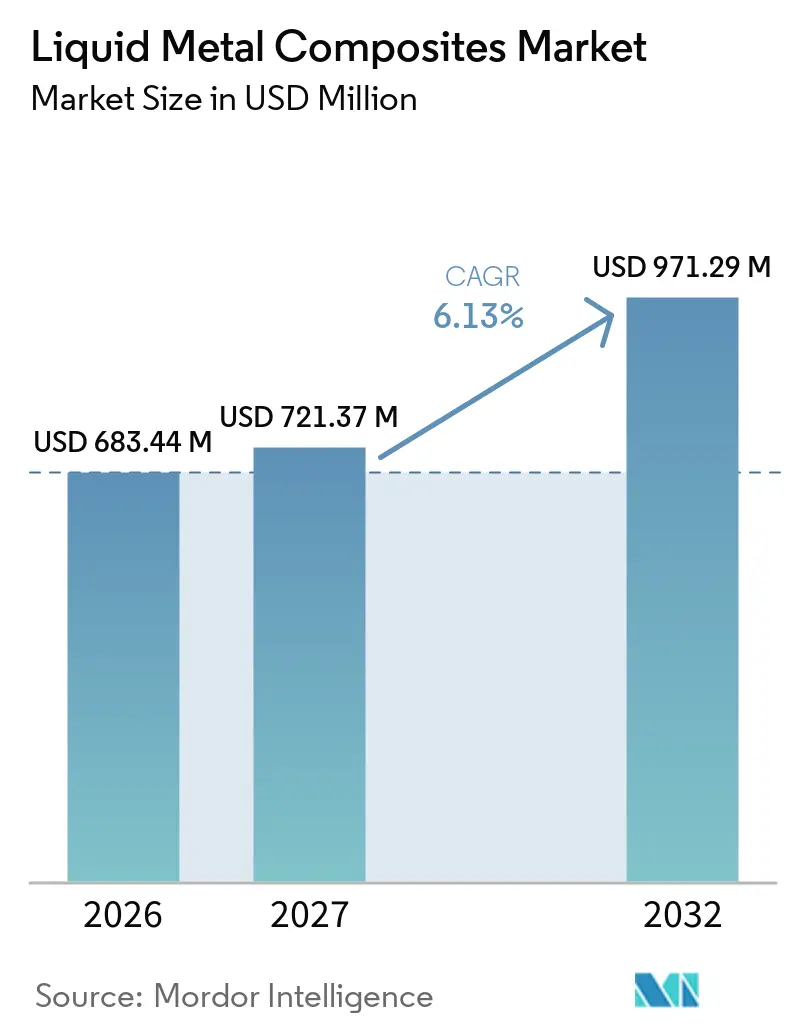
The Liquid Metal Composites Market size was valued at USD 683.44 million in 2026 and is estimated to grow from USD 721.37 million in 2027 to reach USD 971.29 million by 2032, at a CAGR of 6.13% during the forecast period (2027-2032). Demand is supported by the need to reduce vehicle weight, manage heat in power electronics, and meet aerospace and defense performance requirements. Material suppliers are adapting products for electric vehicle systems, high-voltage power equipment, and semiconductor assemblies, where heat transfer and dimensional stability are important. The liquid metal composites market also benefits from applications that require a higher stiffness-to-weight ratio than conventional alloys can offer. Processing quality, cost, and qualification requirements remain important limits on broader use. Manufacturers that can provide certified materials and collaborate with original equipment manufacturers have a clearer path to higher-value applications.
Key Report Takeaways
- By matrix metal, aluminum held 40.52% of the liquid metal composites market share in 2026 and is forecast to advance at a 6.67% CAGR through 2032.
- By reinforcement material, silicon carbide (SiC) held 36.24% of the liquid metal composites market share in 2026, while aluminum oxide (Al₂O₃) is forecast to advance at a 7.12% CAGR through 2032.
- By end-use industry, automotive and transportation held 48.17% of the liquid metal composites market share in 2026, while electrical and electronics is forecast to advance at a 7.33% CAGR through 2032.
- By geography, Asia-Pacific held 42.83% of the liquid metal composites market share in 2026 and is forecast to advance at a 6.84% CAGR through 2032.
Note: Market numbers in this report are based on Mordor Intelligence's proprietary estimation framework, which combines nine months of actuals with Q4 projections for base year 2026.
Global Liquid Metal Composites Market Trends and Insights
Drivers Impact Analysis*
| Driver | (~) % Impact on CAGR Forecast | Geographic Relevance | Impact Timeline |
|---|---|---|---|
| Lightweighting for Fuel, Range and Emissions Performance | +2.0% | Global; highest intensity in North America, EU, Japan, and South Korea | Medium term (2-4 years) |
| Thermal-Management Demand from Power Electronics and Semiconductor Packaging | +1.7% | Global; APAC core (China, Japan, South Korea), spillover to North America and Europe | Short term (≤ 2 years) |
| Electrification of Vehicles and High-Voltage Power Systems | +1.4% | Global; APAC-led with North America and Europe accelerating rapidly | Medium term (2-4 years) |
| Aerospace, Space and Defense Weight-to-Performance Requirements | +0.9% | North America and Europe; with growing procurement in APAC defense programs | Long term (≥ 4 years) |
| Localized Reinforcement for Large-Series Die-Cast Components | +0.6% | Europe and East Asia (Germany, Japan, South Korea) | Medium term (2-4 years) |
| Source: Mordor Intelligence | |||
Lightweighting for Fuel, Range and Emissions Performance
Fuel-economy requirements support demand for lightweight structural materials across global vehicle fleets. The National Highway Traffic Safety Administration finalized the Safer Affordable Fuel-Efficient Vehicles Rule III in September 2026, projecting an industry fleetwide average of 34.5 miles per gallon for model years through 2031[1]. The requirement sustains the case for reducing component mass in internal-combustion and electric vehicles. Aluminum-silicon carbide metal matrix composites delivered a 50% weight saving over steel brake discs on the Airbus A380. The FLAMINGo project reported recycling recovery above 91% for silicon carbide- and titanium carbide-reinforced aluminum composites. Its work also showed that high-pressure die-cast components can be integrated into existing automotive manufacturing lines, which can reduce the need for new production assets.
Thermal-Management Demand from Power Electronics and Semiconductor Packaging
The replacement of silicon insulated-gate bipolar transistors with silicon carbide metal-oxide-semiconductor field-effect transistors increases thermal-management needs in power modules. Silicon carbide metal-oxide-semiconductor field-effect transistors can operate at junction temperatures near 300 °C and create localized heat loads that exceed the limits of standard aluminum heat spreaders. Aluminum-silicon carbide composites can match the coefficient of thermal expansion of direct-bonded copper substrates while providing higher thermal conductivity than monolithic aluminum. The liquid metal composites market is, therefore, becoming more relevant to baseplates and heat spreaders in electric vehicle and semiconductor equipment assemblies. Mitsubishi Materials Corporation introduced an aluminum-silicon carbide metal matrix composite in April 2025 with a three-dimensional continuous metallic network and a low coefficient of thermal expansion. The material can use general metal-processing methods while serving electrified vehicle (xEV) semiconductor and semiconductor manufacturing equipment applications.
Electrification of Vehicles and High-Voltage Power Systems
High-voltage direct-current transmission systems and electric vehicle traction inverters require substrates with low thermal expansion and high thermal conductivity. These materials need to withstand repeated thermal cycles without delamination or cracking caused by thermal expansion mismatch. CPS Technologies reported that electronics customers are seeking materials with higher performance and reliability as high-voltage direct-current transmission and hybrid electric powertrain demand rise. Nano-reinforced metal matrix composite battery casings have shown improved heat dissipation and crash performance compared with monolithic aluminum enclosures. The liquid metal composites market can serve both vehicle electrification and grid modernization, which diversifies demand across two procurement cycles. Grid investments can also support longer replacement cycles than vehicle production programs.
Aerospace, Space and Defense Weight-to-Performance Requirements
Aerospace and defense programs require materials that combine low weight with stable mechanical and thermal performance. CPS Technologies secured a USD 1.15 million Phase II Army Small Business Technology Transfer award in September 2025 to develop a controlled-fragmentation tungsten composite warhead. The award illustrates demand for composite systems beyond aluminum-silicon carbide materials. Satellite structures, telescope mirror substrates, and inertial navigation housings need stability across temperatures from -196 °C to +150 °C. Aluminum-silicon carbide and titanium metal matrix composites can meet the required stiffness and temperature performance for these uses. The liquid metal composites market can gain repeat demand from satellite and defense platforms that require qualified materials.
Restraints Impact Analysis*
| Restraint | (~) % Impact on CAGR Forecast | Geographic Relevance | Impact Timeline |
|---|---|---|---|
| High Cost of Reinforcement, Tooling and Quality Assurance | -1.2% | Global; most pronounced in cost-sensitive APAC volume markets and South America | Medium term (2-4 years) |
| Porosity, Wetting and Interface-Control Risks in Liquid Processing | -0.8% | Global; highest impact in high-volume production environments in APAC and Europe | Short to medium term |
| Limited Design Databases, Standards and Repair Ecosystems | -0.5% | North America and Europe; where aerospace certification pathways add cost and time | Long term (≥ 4 years) |
| Source: Mordor Intelligence | |||
High Cost of Reinforcement, Tooling and Quality Assurance
Silicon carbide, aluminum oxide, and boron carbide reinforcements cost more than metallic matrix materials. Liquid-state processing also requires precision tooling and specialized production controls. These factors restrict adoption to applications where the performance benefit supports a higher component cost. Automotive brake discs and pistons must compete with established cast-iron production lines that have already absorbed much of their capital cost. X-ray density inspection, interface characterization, and statistical property testing add further expense and time. The liquid metal composites market will remain concentrated in applications where thermal, weight, or durability gains provide clear value.
Porosity, Wetting and Interface-Control Risks in Liquid Processing
Liquid-state routes can introduce defects that create variability and delay first-article qualification. Limited wetting between ceramic particles and molten aluminum can produce interfacial voids that weaken mechanical and thermal properties. Stir casting can also cause particle agglomeration and segregation at higher reinforcement loadings. A 2025 study found that squeeze casting at 80 MPa reduced porosity in aluminum-silicon carbide composites relative to gravity casting. Residual microporosity remained near particle clusters, even with pressure-assisted processing. Nonuniform mold cooling can then create reinforcement gradients and higher rejection rates at an industrial scale.
*Our forecasts treat driver/restraint impacts as directional, not additive. The impact forecasts reflect baseline growth, mix effects, and variable interactions.
Segment Analysis
By Matrix Metal: Aluminum Leads Across Processing Routes
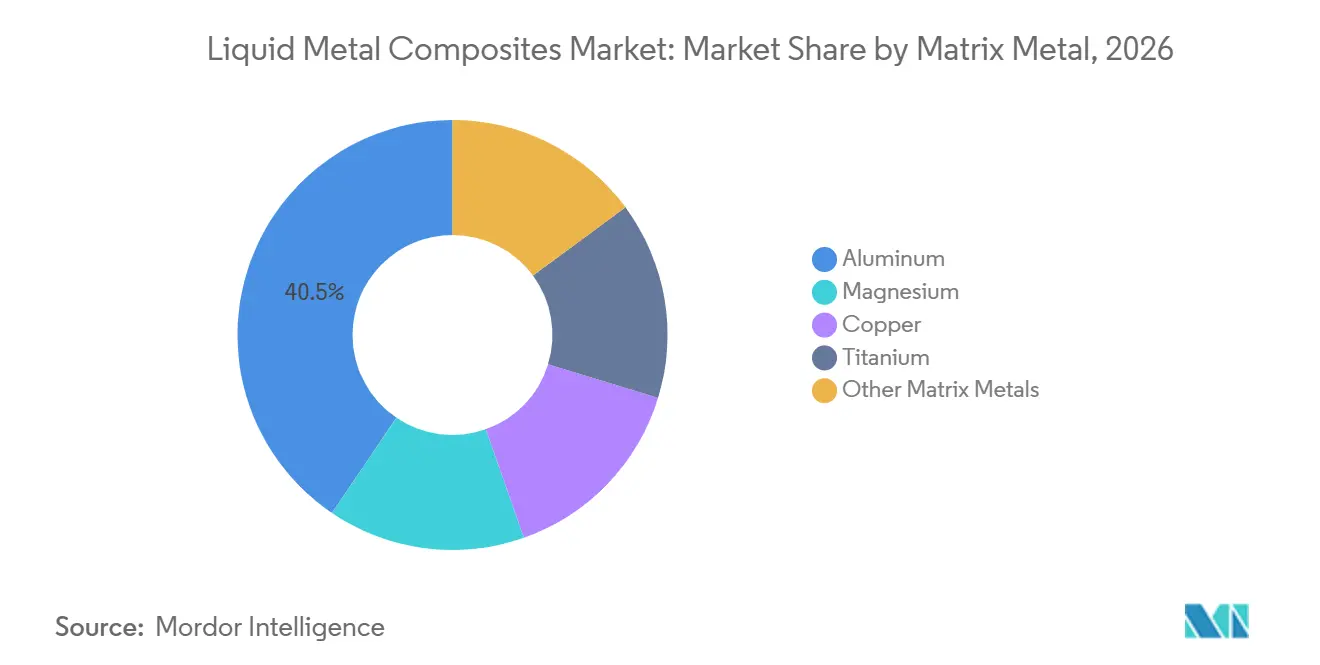
Aluminum held 40.52% of the market share in 2026 and is projected to advance at a 6.67% CAGR through 2032. Its low density, broad liquid-state processing compatibility, and established supply chain support this position. Squeeze casting, stir casting, and pressure infiltration are well developed for aluminum systems. This reduces development risk for automotive and electronics applications. The FLAMINGo project validated aluminum metal matrix composite production through low-pressure die casting, high-pressure die casting, and direct-chill casting.
The project also confirmed recycled silicon carbide recovery above 91%, supporting both circularity and feedstock-use arguments. Magnesium serves ultra-lightweight uses in robotics and unmanned aerial vehicles, where aluminum weight can still be limiting. Titanium matrices are used in high-temperature aerospace applications that exceed aluminum operating limits. Copper-matrix composites remain relevant for electrical contacts and heat sinks because copper offers high thermal and electrical conductivity. A 2026 study demonstrated digital light processing for complex silicon carbide and aluminum composite geometries, expanding design options for precision components. The liquid metal composites industry can use these alternative matrices where their performance benefits justify the additional material or process cost.

By Reinforcement Material: Aluminum Oxide Advances on Cost and Interface Versatility
Silicon carbide held 36.24% of the market share in 2026, while aluminum oxide is projected to advance at a 7.12% CAGR through 2032. Aluminum oxide has a cost advantage over silicon carbide and is suitable for electrical insulation and lower-cost structural applications. A 2025 study found that friction extrusion of aluminum oxide-reinforced AA6061 improved yield strength, tensile strength, and elongation beyond 20%. This result addresses the established strength-ductility trade-off in aluminum oxide composites. It also supports use in automotive and industrial components that require both formability and strength.
Silicon carbide retains a broad application base because of its high hardness, high elastic modulus, and established supply network. A 2026 study found that silica-rich interlayers around pre-oxidized silicon carbide particles increased ductility by 18.3% and toughness by 15.4% relative to unmodified systems. Boron carbide is used in defense and nuclear applications because it absorbs neutrons and has a density close to that of aluminum. A 2025 study reported that boron carbide and graphene nanoplatelet reinforcement improved both ballistic efficiency and structural integrity in aluminum composites. The liquid metal composites market can therefore support both broad thermal-management applications and specialized protective systems. The liquid metal composites industry relies on reinforcement selection to balance cost, thermal performance, strength, and manufacturing consistency.
By End-Use Industry: Electrical and Electronics Outpaces Automotive and Transportation Dominance
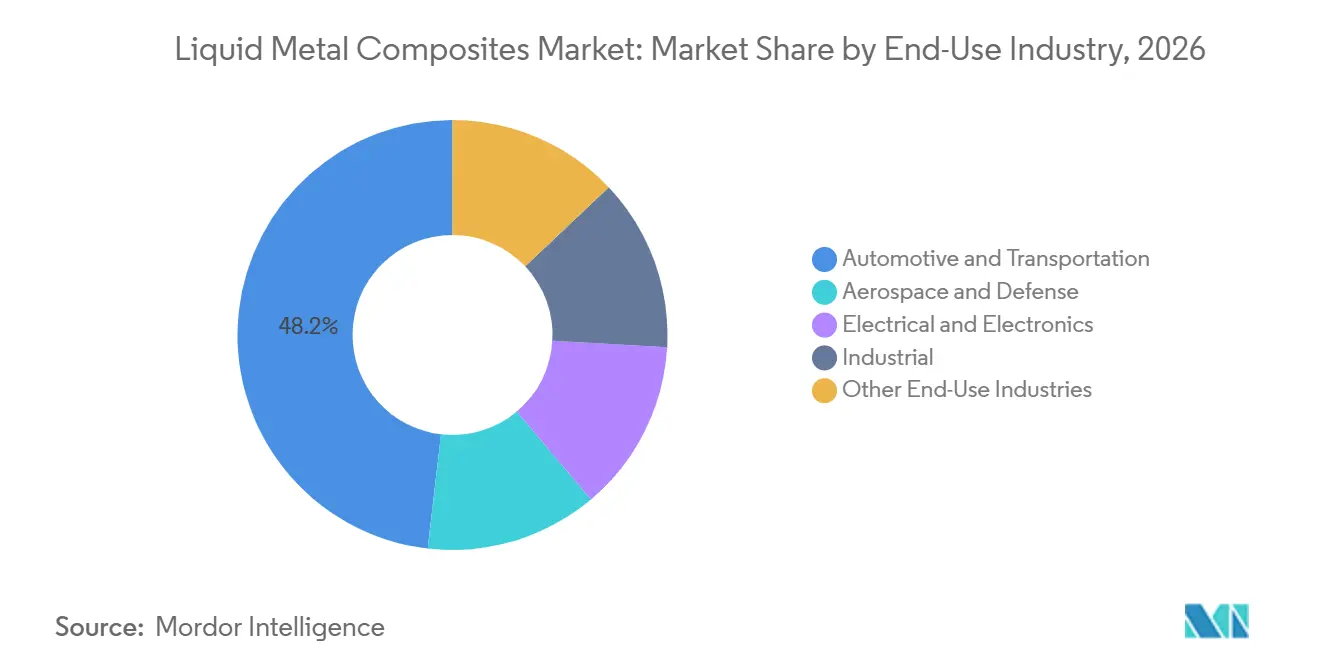
Automotive and transportation held 48.17% of the market share in 2026, supported by established qualification data and Tier-1 supply chains. A 2025 study validated AA6082 and silicon carbide composites in a rear-axle twin-tube damper application using a production-representative design. The work demonstrated a lightweight design path without hot isostatic pressing. Recyclability information for silicon carbide and aluminum oxide composites is becoming more relevant in automotive sourcing. European End-of-Life Vehicles Directive requirements and Registration, Evaluation, Authorisation and Restriction of Chemicals (REACH) requirements also influence reinforcement selection.
Electrical and electronics is projected to advance at a 7.33% CAGR through 2032. Rising silicon carbide power-module density requires baseplates that can manage higher heat flux without fatigue from thermal expansion mismatch. The liquid metal composites market size for electrical and electronics is supported by electric vehicle inverters, high-voltage direct-current converters, 5G equipment, and semiconductor manufacturing equipment. Aerospace and defense applications deliver high revenue per kilogram because qualified materials must meet stringent program requirements. Industrial applications include precision tooling, rotary machinery, and high-wear contact surfaces. The liquid metal composites industry also serves semiconductor equipment, where dimensional stability under thermal cycling supports performance.
Geography Analysis
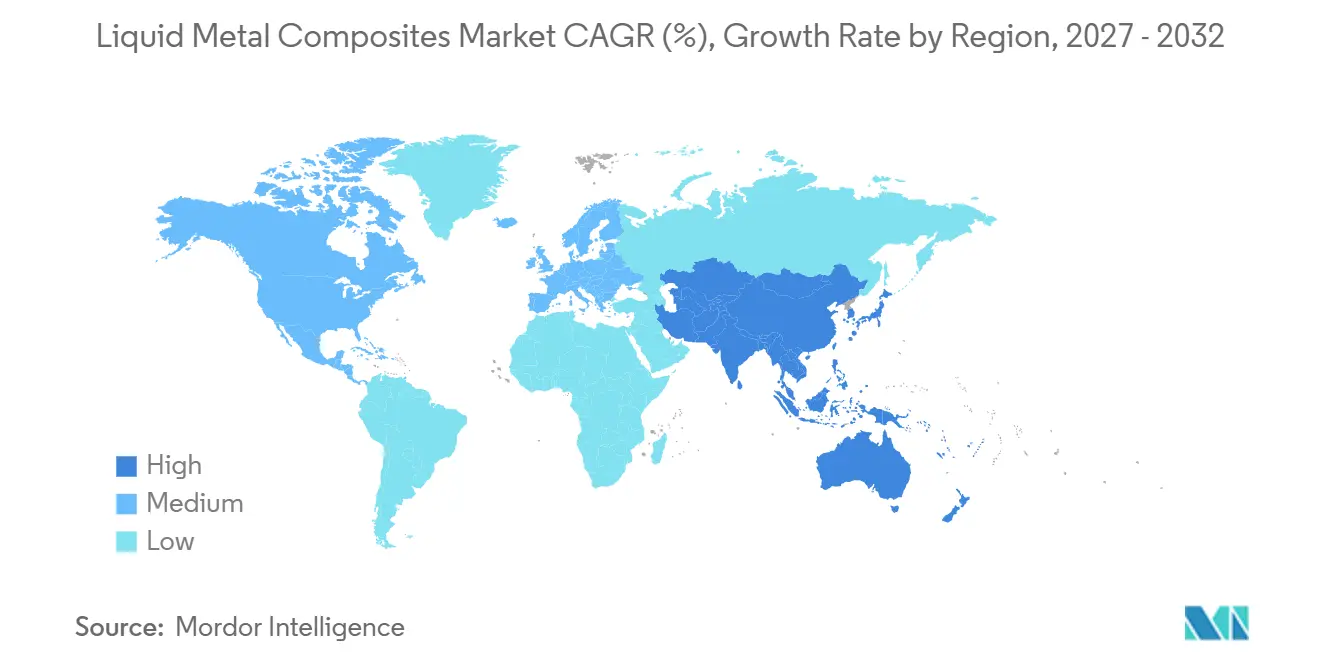
Asia-Pacific held 42.83% of the market share in 2026 and is projected to advance at a 6.84% CAGR through 2032. China supports regional demand through power semiconductor production and electric vehicle traction system consumption. Japan adds capacity in semiconductor packaging and precision components. Mitsubishi Materials Corporation launched an aluminum-silicon carbide composite in April 2025 for xEV semiconductor assemblies and semiconductor manufacturing equipment. South Korea and ASEAN countries broaden the regional electronics manufacturing base.
North America has a strong position in high-specification composite development through federal research and procurement programs. CPS Technologies received several federally funded awards during 2025, including the Phase II Army Small Business Technology Transfer contract announced in September. The Safer Affordable Fuel-Efficient Vehicles Rule III maintains incentives for vehicle weight reduction through model year 2031. Europe supports automotive and aerospace demand, with Germany serving as an important engineering and manufacturing center. The liquid metal composites market size in Europe can benefit from production routes validated by the FLAMINGo consortium for automotive components[2].
South America and the Middle East and Africa represent smaller demand areas with specific application needs. Brazil offers an entry point through automotive manufacturing, while Argentina has an emerging aerospace supplier base. Saudi Arabia’s defense localization objectives and South Africa’s mining-equipment sector can support limited demand for wear-resistant and thermal-management components. These regions are expected to depend on imports for high-specification materials through 2032. Capital-intensive processing equipment and limited aerospace-grade certification capability constrain local production. The liquid metal composites market is likely to serve these regions through imported components rather than extensive local manufacturing.
Competitive Landscape
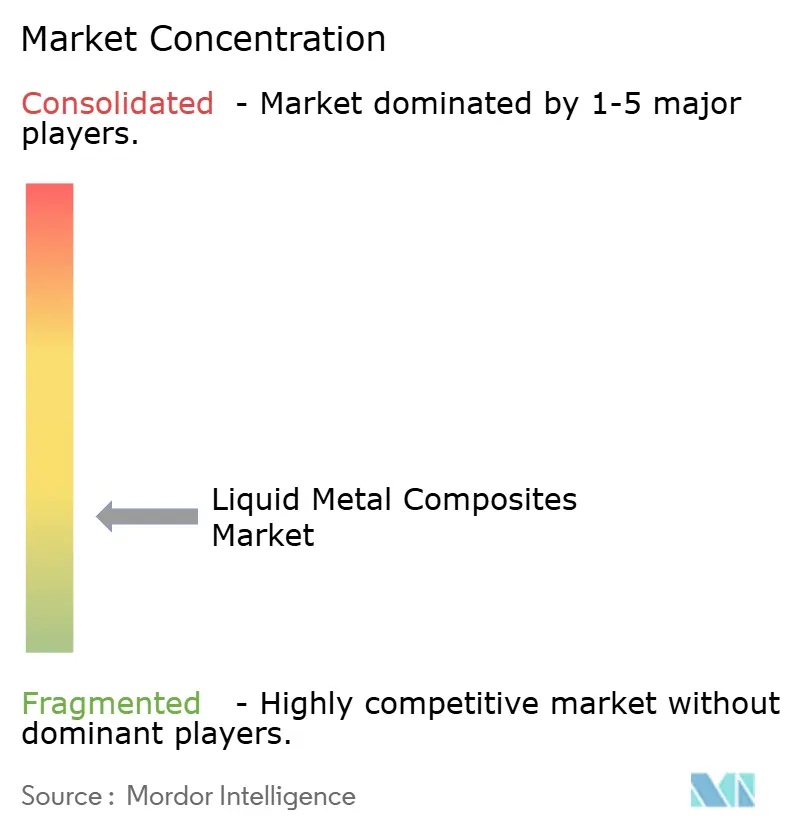
The liquid metal composites market is highly fragmented, with the top five players including MATERION CORPORATION, CPS Technologies, DWA Aluminum Composites USA, Inc., GKN Powder Metallurgy, and CeramTec GmbH. MATERION CORPORATION and Sumitomo Electric Industries, Ltd. bring wider materials portfolios and established customer relationships. CeramTec GmbH and Denka Company Limited participate upstream by supplying ceramic reinforcement materials. The market structure makes qualification history and specific processing capability important sources of differentiation. Suppliers with aerospace certifications retain an advantage because qualification can be time-consuming and costly.
CPS Technologies expanded its development activity through federally funded programs in 2025. Its September 2025 Army award applied its injection-molding process to tungsten composite geometries and broadened work beyond aluminum-silicon carbide systems. Mitsubishi Materials Corporation introduced its aluminum-silicon carbide material for thermal management in xEV and semiconductor equipment applications in April 2025. These moves show that participants are pursuing specialized applications rather than competing only on material volume. The liquid metal composites market favors companies that can align material formulation, processing, and customer qualification requirements.
Additive manufacturing offers a route to complex geometries that conventional casting and infiltration can struggle to provide. A 2026 research study on digital light processing of silicon carbide and aluminum composites demonstrated controlled interfacial oxide layers and enhanced mechanical properties. Patent activity around alternative reinforcement combinations also shows continued effort to protect process and material improvements. Smaller participants are pursuing recycled aluminum feedstocks and near-net-shape casting to reduce costs for automotive applications. The liquid metal composites market is therefore shaped by a mix of certified specialists, materials suppliers, and companies developing lower-cost production methods.
Liquid Metal Composites Industry Leaders
-
MATERION CORPORATION
-
CPS Technologies
-
DWA Aluminum Composites USA, Inc.
-
GKN Powder Metallurgy
-
CeramTec GmbH
- *Disclaimer: Major Players sorted in no particular order
Recent Industry Developments
- September 2026: Researchers at Virginia Tech demonstrated a 3D-printed liquid metal–silicone composite with directional heat conduction and self-healing electrical properties. The material achieved up to 40 times the thermal conductivity of pure silicone, supporting the liquid metal composites market through potential applications in flexible electronics, thermal management, and wearable devices.
- February 2026: Liquidmetal Technologies, Inc. established Liquidmorphium, LLC, a wholly owned subsidiary to manage future intellectual property related to amorphous alloys and manufacturing processes. The move supports the development and commercialization of advanced metal materials for robotics, consumer electronics, and medical devices.
Global Liquid Metal Composites Market Report Scope
Liquid metal composites are advanced materials that combine a metallic matrix with reinforcing materials to enhance properties such as strength, stiffness, wear resistance, and thermal performance. They are engineered to meet demanding structural and functional requirements across specialized industrial applications.
The Liquid Metal Composites Market is segmented by matrix metal, reinforcement material, end-use industry, and geography. By matrix metal, the market is segmented into aluminum, magnesium, copper, titanium, and other matrix metals. By reinforcement material, the market is segmented into silicon carbide (SiC), aluminum oxide (Al₂O₃), boron carbide (B₄C), and other reinforcement materials. By end-use industry, the market is segmented into automotive and transportation, aerospace and defense, electrical and electronics, industrial, and other end-use industries. The report also covers the market size and forecasts for liquid metal composites across 15 countries. For each segment, the market sizing and forecasts have been done on the basis of value (USD).
| Aluminum |
| Magnesium |
| Copper |
| Titanium |
| Other Matrix Metals |
| Silicon Carbide (SiC) |
| Aluminum Oxide (Al₂O₃) |
| Boron Carbide (B₄C) |
| Other Reinforcement Materials |
| Automotive and Transportation |
| Aerospace and Defense |
| Electrical and Electronics |
| Industrial |
| Other End-Use Industries |
| Asia-Pacific | China |
| India | |
| Japan | |
| South Korea | |
| ASEAN Countries | |
| Rest of Asia-Pacific | |
| North America | United States |
| Canada | |
| Mexico | |
| Europe | Germany |
| United Kingdom | |
| France | |
| Italy | |
| NORDIC Countries | |
| Rest of Europe | |
| South America | Brazil |
| Argentina | |
| Rest of South America | |
| Middle East and Africa | Saudi Arabia |
| South Africa | |
| Rest of Middle East and Africa |
| By Matrix Metal | Aluminum | |
| Magnesium | ||
| Copper | ||
| Titanium | ||
| Other Matrix Metals | ||
| By Reinforcement Material | Silicon Carbide (SiC) | |
| Aluminum Oxide (Al₂O₃) | ||
| Boron Carbide (B₄C) | ||
| Other Reinforcement Materials | ||
| By End-Use Industry | Automotive and Transportation | |
| Aerospace and Defense | ||
| Electrical and Electronics | ||
| Industrial | ||
| Other End-Use Industries | ||
| By Geography | Asia-Pacific | China |
| India | ||
| Japan | ||
| South Korea | ||
| ASEAN Countries | ||
| Rest of Asia-Pacific | ||
| North America | United States | |
| Canada | ||
| Mexico | ||
| Europe | Germany | |
| United Kingdom | ||
| France | ||
| Italy | ||
| NORDIC Countries | ||
| Rest of Europe | ||
| South America | Brazil | |
| Argentina | ||
| Rest of South America | ||
| Middle East and Africa | Saudi Arabia | |
| South Africa | ||
| Rest of Middle East and Africa | ||
Key Questions Answered in the Report
What is the size of the liquid metal composites market?
The liquid metal composites market size was valued at USD 683.44 million in 2026 and is estimated to grow from USD 721.37 million in 2027 to reach USD 971.29 million by 2032, at a CAGR of 6.13% during the forecast period (2027-2032).
Which matrix metal leads liquid metal composites demand?
Aluminum leads with a 40.52% share in 2026 and is projected to advance at a 6.67% CAGR through 2032.
Which reinforcement material is projected to advance fastest through 2032?
Aluminum oxide is projected to advance at a 7.12% CAGR through 2032.
Which end-use industry is projected to advance fastest through 2032?
Electrical and electronics is projected to advance at a 7.33% CAGR through 2032, supported by power-module thermal-management needs.