
Lignosulfonates Market Size and Share
Market Overview
| Study Period | 2022 - 2032 |
|---|---|
| Market Size (2027) | USD 1.32 Billion |
| Market Size (2032) | USD 1.64 Billion |
| Growth Rate (2027 - 2032) | 4.37 % |
| Fastest Growing Market | Asia-Pacific |
| Largest Market | Asia-Pacific |
| Market Concentration | Medium |
Major Players *Disclaimer: Major Players sorted in no particular order Image © Mordor Intelligence. Reuse requires attribution under CC BY 4.0. | |
Lignosulfonates Market Analysis by Mordor Intelligence
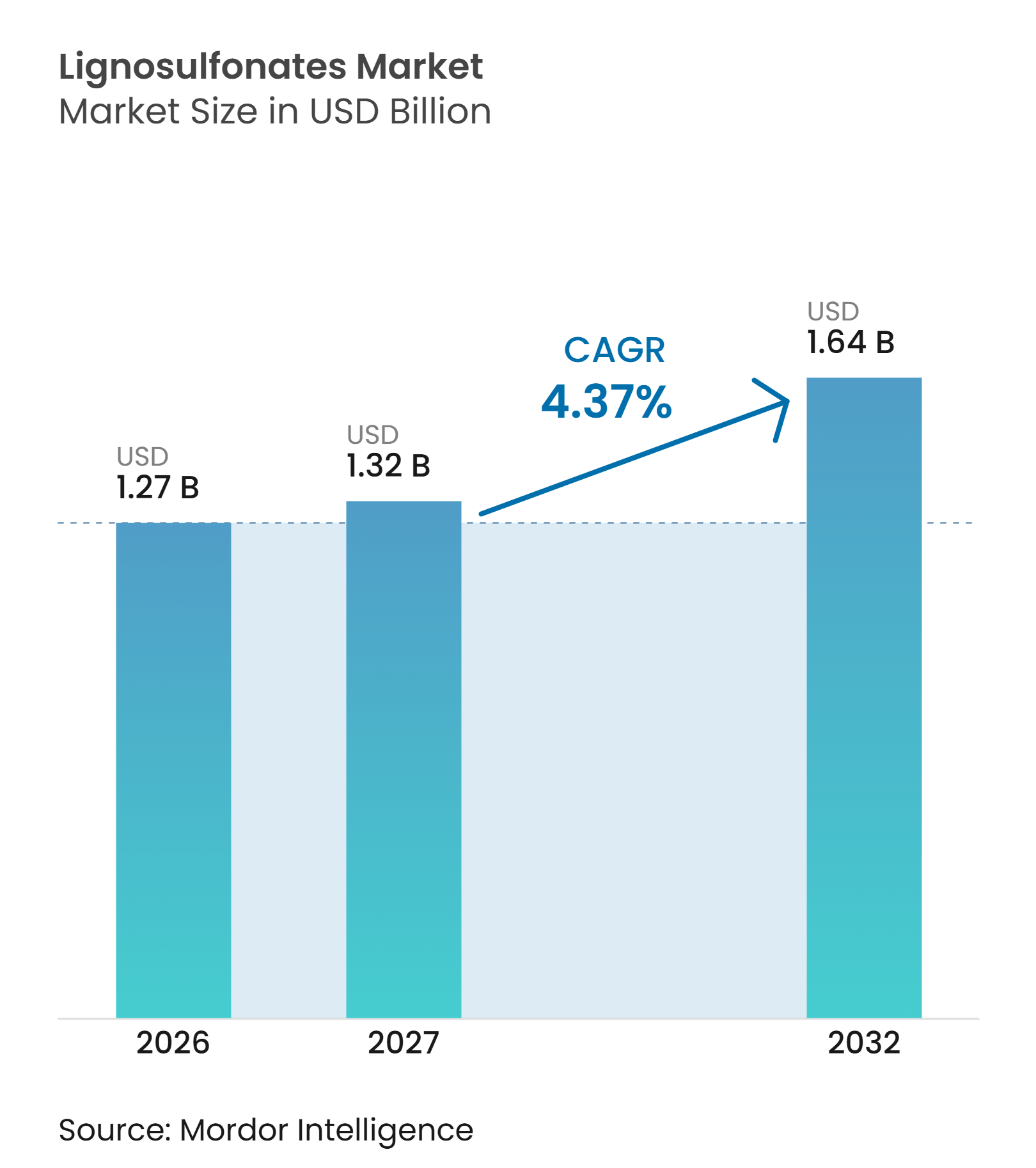
The Lignosulfonates Market size was valued at USD 1.27 billion in 2026 and is estimated to grow from USD 1.32 billion in 2027 to USD 1.64 billion by 2032, at a CAGR of 4.37% during the forecast period (2027-2032). The lignosulfonates market serves construction, animal nutrition, drilling, and dust-control applications with bio-based dispersants and binders recovered from sulfite pulping. Demand is supported by procurement requirements for renewable inputs, tighter product documentation, and the need to manage material costs in large-scale applications. Producers with certified specialty grades can access buyers that require verified supply chains, while standard grades continue to compete largely on price and local availability. The market also faces a supply constraint because output depends on sulfite pulp mill operations, even as demand in construction and agriculture follows separate cycles. Competition with synthetic superplasticizers remains strongest in high-performance concrete, while modified grades can improve compatibility and water-reduction performance for applications where compliance, technical qualification, and delivered cost shape purchasing decisions.
Key Report Takeaways
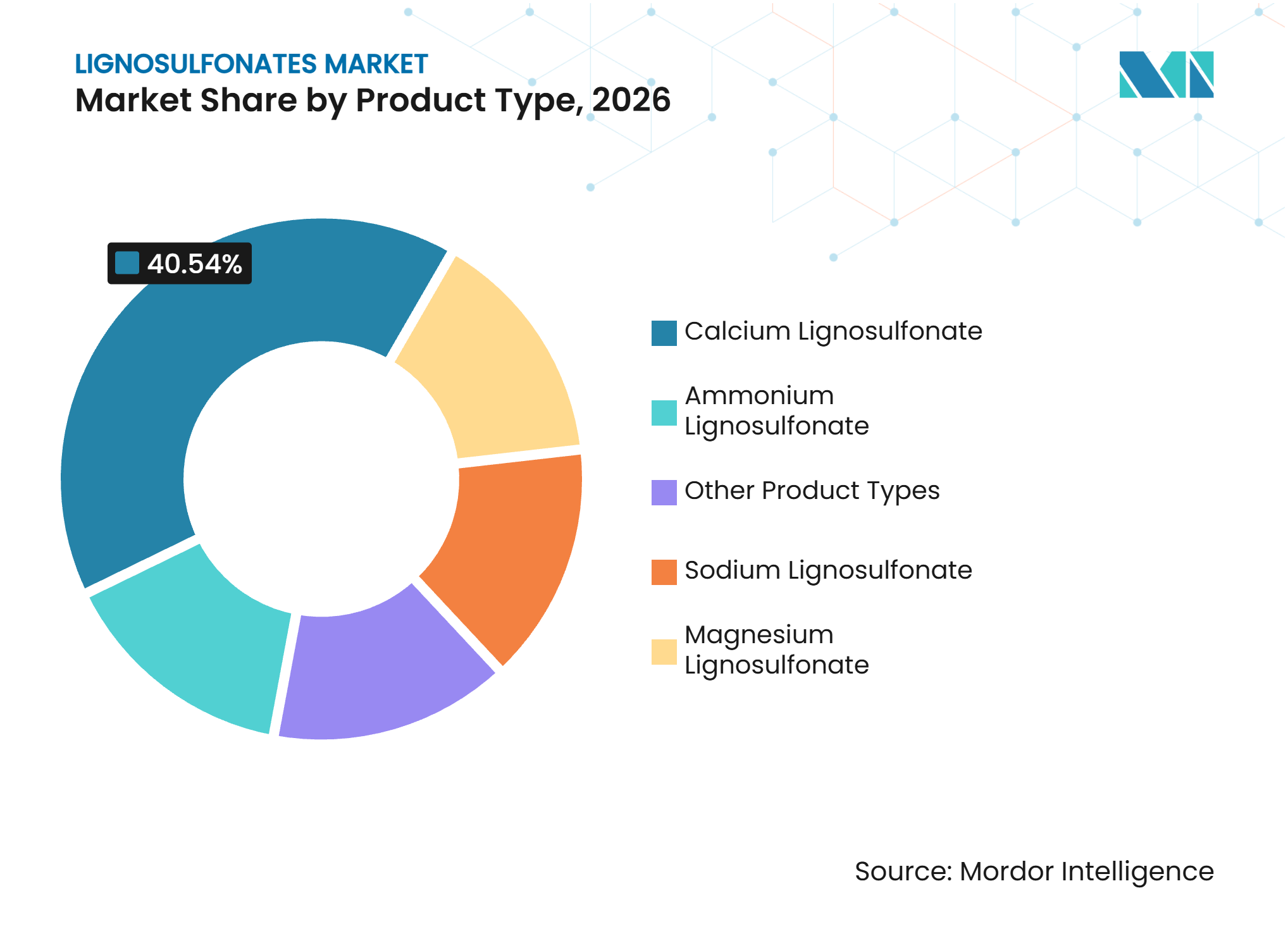
- By product type, calcium lignosulfonate held 40.54% of the Lignosulfonates Market share in 2026, while sodium lignosulfonate is forecast to grow at a CAGR of 4.78% through 2032.
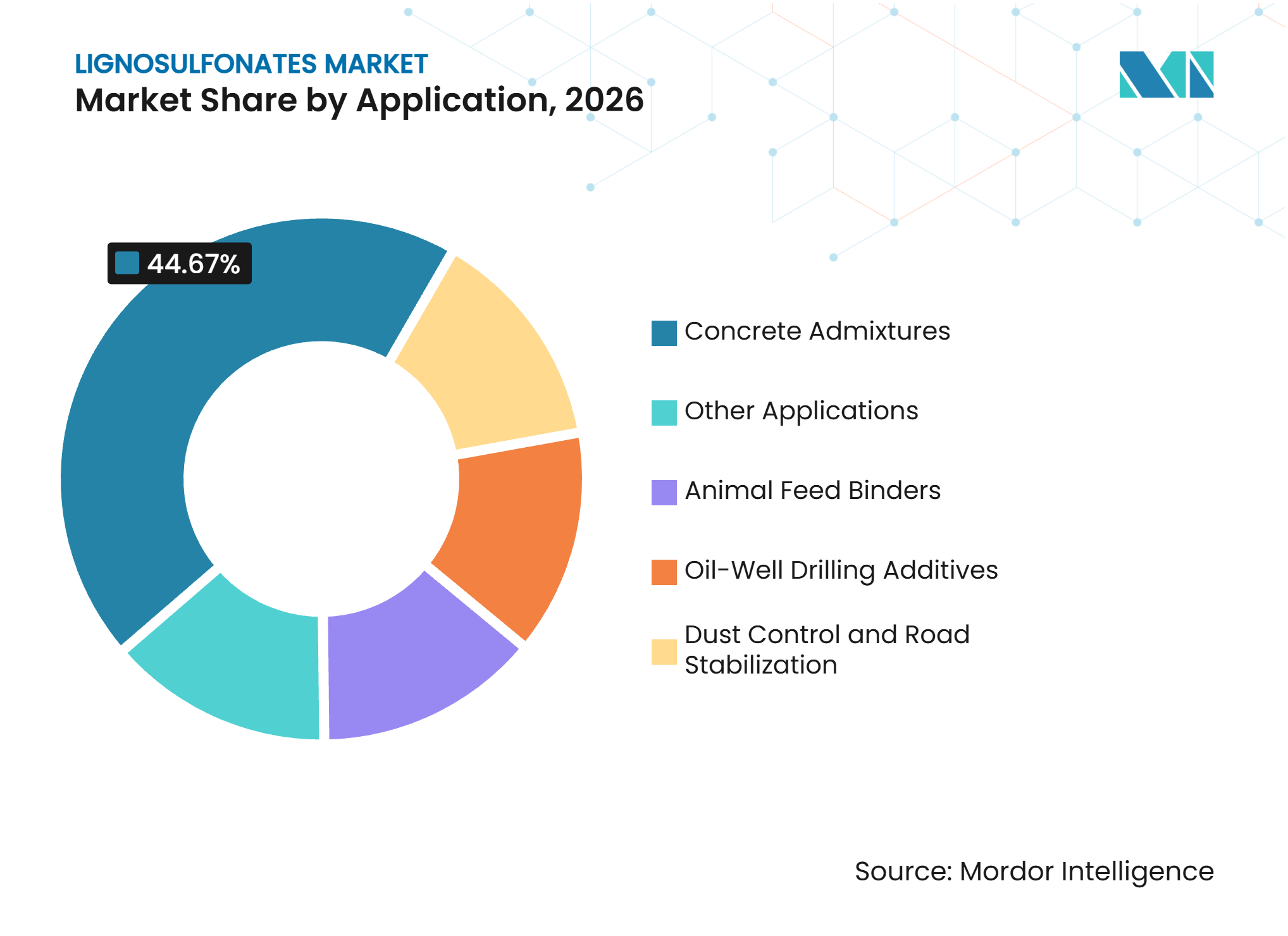
- By application, concrete admixtures accounted for 44.67% of the Lignosulfonates Market share in 2026, while oil-well drilling additives are forecast to grow at a CAGR of 5.21% through 2032.
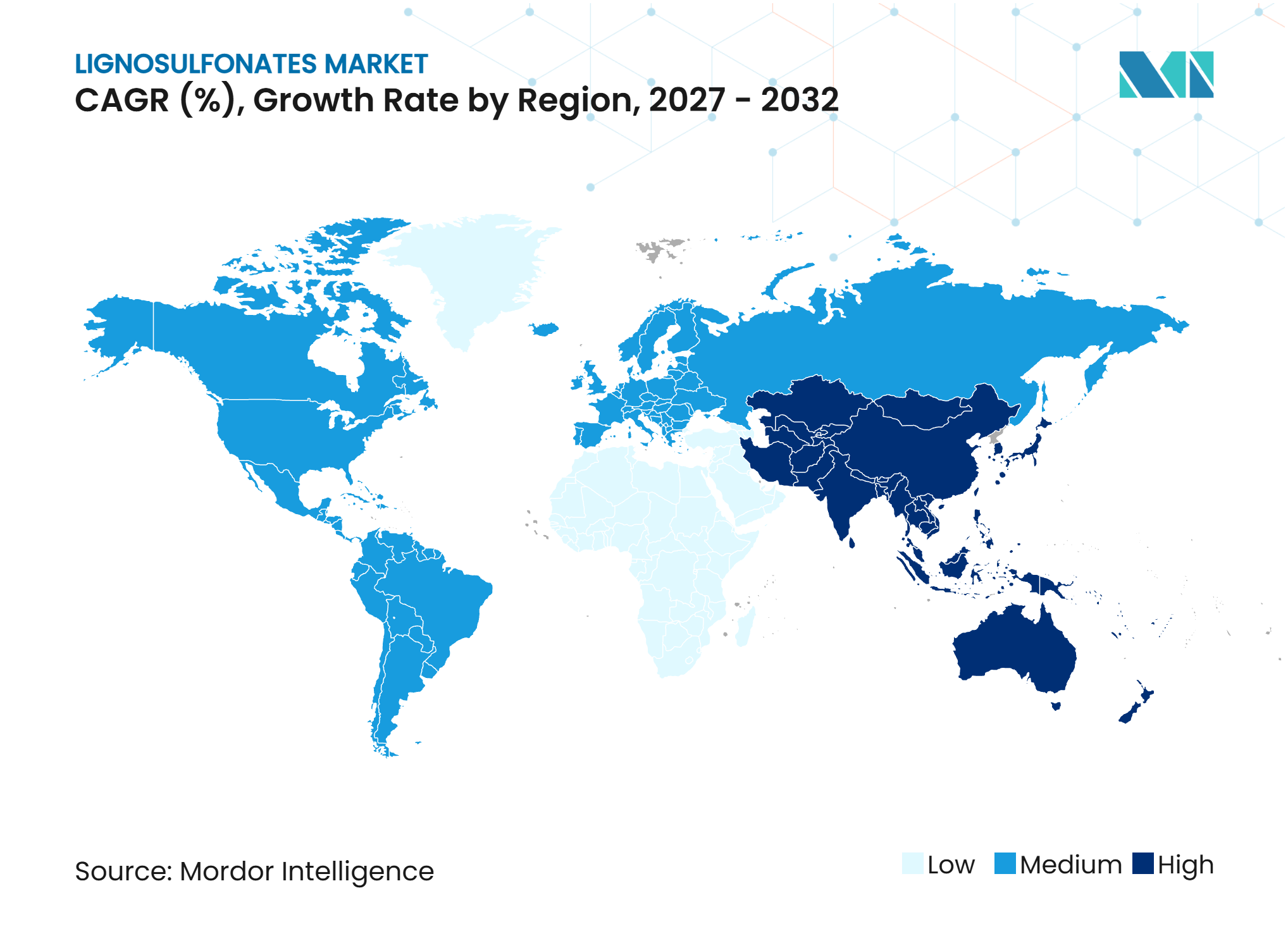
- By geography, Asia-Pacific held 38.13% of the Lignosulfonates Market share in 2026 and is forecast to grow at a CAGR of 5.03% through 2032.
Note: Market numbers in this report are based on Mordor Intelligence's proprietary estimation framework, which combines nine months of actuals with Q4 projections for base year 2026.
Market Trends and Insights
Drivers Impact Analysis of Lignosulfonates Market*
| Drivers | (~) % Impact on CAGR Forecast | Geographic Relevance | Impact Timeline |
|---|---|---|---|
| Rising Demand for Sustainable Bio-Based Additives and Pulp-Mill Co-Product Valorization | +1.6% | Global, with the strongest pull in the EU and North America and early gains in Nordic countries and Italy | Long term (≥ 4 years) |
| Infrastructure and Concrete Admixture Demand | +1.5% | Asia-Pacific core, including China, India, and ASEAN, with spillover to the Middle East and Africa and South America | Short term (≤ 2 years) |
| Expanding Animal Feed Pelletization | +0.7% | Global, with regulatory influence concentrated in the EU | Medium term (2-4 years) |
| Oil-Well Drilling Fluid Performance Requirements | +0.5% | North America and the Middle East and Africa, including the Gulf of Mexico, Middle East, and North Sea | Long term (≥ 4 years) |
| Pulp-Mill Co-Product Valorization and Circularity Mandates | +0.4% | EU and OECD markets; early gains in Nordic countries and Italy | Long term (≥4 years) |
| Source: Mordor Intelligence | |||
Rising Demand for Sustainable Bio-Based Additives and Pulp-Mill Co-Product Valorization
Corporate procurement programs increasingly assess the renewable content and traceability of industrial additives. This trend supports the use of lignosulfonates in construction, agriculture, and industrial processing where a bio-based alternative can meet performance requirements. Borregaard reported record BioSolutions EBITDA of NOK 1,209 million (~USD 131.11 million) in 2025, attributing the result to demand for multi-active bio-based ingredients and a renewed feed authorization for lignin products. Its International Sustainability and Carbon Certification (ISCC) PLUS-certified portfolio includes lignosulfonates, bioethanol, and vanillin, providing customers with documented information on renewable sourcing. The lignosulfonates market benefits when certification is part of supplier qualification, as verified specialty grades compete on more than just delivered cost. Producers that lack comparable documentation may remain active in standard grades but face narrower access to buyers with formal sustainability requirements.
Infrastructure and Concrete Admixture Demand
Infrastructure activity supports demand for lignosulfonate-based water reducers because cost control remains important in mass and conventional-strength concrete. The lignosulfonates market benefits from products that help reduce mixing water without requiring the performance level of high-end superplasticizers. A 2025 systematic review found that sodium lignosulfonate-based superplasticizers can support appropriate water-binder ratios in high-performance concrete when formulation conditions are optimized[1]. This evidence broadens the practical discussion beyond low-specification concrete, although the performance range still depends on dosage and system design. Modified lignosulfonates can improve their position in mid-range concrete formulations through refining and grafting processes that reduce compatibility barriers. This gives integrated producers a reason to develop application-specific grades rather than relying solely on commodity construction output.
Expanding Animal Feed Pelletization
Feed manufacturers use binders to improve pellet durability and reduce fines during handling and transport. Lignosulfonates remain relevant where mills need reliable binding performance alongside established compliance records. Borregaard reported in 2025 that its lignosulfonates secured authorization for use in animal feed in Europe, and cited this authorization as a contributor to BioSolutions' performance in 2025. Domsjö Fabriker holds GMP+ certification and supplies lignosulfonate to feed customers across more than 60 countries. These credentials favor suppliers that can combine consistent product quality with the documentation required by commercial feed producers.
Oil-Well Drilling Fluid Performance Requirements
Drilling operations seek alternatives to chrome-containing and oil-based thinning systems where environmental controls and disposal requirements are more demanding. This creates a higher-value opening for lignosulfonates that can meet fluid-performance requirements without relying on those materials. Sappi introduced Viscowell in 2025 as a renewable lignosulfonate drilling thinner intended to replace chrome and oil-based products. The product launch demonstrates that lignosulfonate suppliers can target drilling applications through formulation work rather than cost competition alone. Qualification by oil-field service providers depends on technical validation, supply reliability, and product documentation. The lignosulfonates market can therefore benefit from drilling demand, even as construction markets remain focused on lower-cost standard grades.
Restraints Impact Analysis of Lignosulfonates Market*
| Restraints | (~) % Impact on CAGR Forecast | Geographic Relevance | Impact Timeline |
|---|---|---|---|
| Competition from Polycarboxylate Ethers and Synthetic Dispersants | -1.8% | Global, most acute in high-specification concrete markets in North America, Europe, and advanced Asia-Pacific | Medium term (2-4 years) |
| Feedstock Dependence on Sulfite Pulping Availability and Rain Leaching Performance Variability | -1.3% | Global supply constraint, particularly in North America and Europe, with dust-control losses in high-rainfall ASEAN and equatorial Africa | Long term (≥ 4 years) |
| Rain Leaching and Performance Variability in Dust Control | -0.4% | National impact concentrated in high-rainfall regions; early losses in subtropical ASEAN and equatorial Africa | Short term (≤2 years) |
| Source: Mordor Intelligence | |||
Competition from Polycarboxylate Ethers and Synthetic Dispersants
Polycarboxylate ethers (PCE) offer stronger water reduction, flow, and slump retention in high-performance and self-compacting concrete. A 2025 systematic review concluded that PCE-based additives outperform naphthalene and lignosulfonate additives in applications requiring low water-binder ratios, high fluidity, strength, and durability. This performance advantage limits the use of standard lignosulfonates in specifications that prioritize high early strength or long slump retention. Modified lignosulfonates can narrow this gap in mid-range applications through sugar removal and graft copolymerization. Shenyang Xingzhenghe Chemical reported reduced sugar content and improved compatibility with PCE blends in its 2025 lignin product upgrade. The lignosulfonates market retains its strongest position where cost discipline and adequate, rather than maximum, water reduction guide material selection.
Feedstock Dependence on Sulfite Pulping Availability and Rain Leaching Performance Variability
Lignosulfonates are co-products of sulfite pulping, so producers cannot increase supply independently of pulp mill operations. RYAM notes that lignosulfonate growth depends on replacing fossil petrochemicals in end-use applications, while its output remains linked to its broader cellulose operations. This connection can expose buyers to supply tightness when pulp economics lead mills to reduce operating rates, and makes regional mill closures and restructurings relevant to material availability. In dust-control applications, heavy rainfall can reduce the durability of treated surfaces and undermine the value proposition in tropical settings. Suppliers need application guidance and product selection that reflect local precipitation conditions, rather than treating all road and mining uses as equivalent.
*Our forecasts treat driver/restraint impacts as directional, not additive. The impact forecasts reflect baseline growth, mix effects, and variable interactions.
Lignosulfonates Market Segment Analysis
By Product Type:
Calcium Grade Anchors Share While Sodium AcceleratesCalcium lignosulfonate held 40.54% of the lignosulfonates market share in 2026, reflecting its direct connection to common calcium bisulfite pulping chemistry. This route produces calcium-salt co-products without an additional conversion step, making calcium grades a natural output for many integrated producers. Burgo Group reported that its Tolmezzo plant produced 28,433 tons of lignosulfonates in 2025 within the calcium-grade Bretax range. The operating model links product availability to mill configuration and provides a stable base for concrete plasticizers and feed applications. Magnesium grades serve specialty ceramics, refractory products, and animal nutrition where magnesium can provide an additional functional benefit. Ammonium lignosulfonate is used in agrochemical granulation and dust-control applications where its nitrogen content can complement binding performance.
Sodium lignosulfonate is projected to grow at a CAGR of 4.78% through 2032, exceeding the growth rate of the overall lignosulfonates market. Its growth is supported by process improvements that lower reducing-sugar content and by modification approaches that improve blending with polycarboxylate ethers. Shenyang Xingzhenghe Chemical reported these outcomes in its December 2025 product upgrade, presenting them as improvements for export-grade performance. Improved compatibility can extend sodium lignosulfonate to mid-grade concrete specifications that were harder to meet with conventional materials. This does not eliminate the advantages of polycarboxylate ether (PCE) in demanding concrete systems. It can, however, allow customers in price-sensitive markets to reduce dependence on standalone PCE dosing in selected formulations.



By Application:
Concrete Holds Share While Drilling Opens ValueConcrete admixtures accounted for 44.67% of the lignosulfonates market share in 2026 and remain the main outlet for the material. Lignosulfonates are used as water reducers in mass and conventional-strength concrete, where reliable performance and cost are both important. Nippon Paper Group identifies concrete admixtures as part of its biomass-materials business, which generated JPY 20.0 billion in net sales in 2025. This presence within a broader biomaterials portfolio indicates that vertically integrated suppliers view construction as an established commercial channel. Animal-feed binders provide a second major outlet, as feed mills require dependable pellet quality and documented product compliance. European suppliers, including Borregaard and Domsjö Fabriker, are positioned in this channel through product authorization and Good Manufacturing Practice+ (GMP+) documentation.
Oil-well drilling additives are forecast to grow at a 5.21% CAGR through 2032, making them the fastest-growing application in the lignosulfonates market. The segment is supported by demand for drilling-fluid thinners that can replace chrome-based products in operations with strict environmental requirements. Sappi's 2025 Viscowell launch provides a commercial example of a renewable lignosulfonate grade designed for this use. The application can offer higher value than standard construction grades because qualification depends on technical performance, auditability, and consistent delivery. Dust control and road stabilization remain viable options. Still, they are subject to variability in areas with frequent rainfall, limiting their suitability in tropical Southeast Asia and equatorial Africa compared with drier road infrastructure and mining environments.

Geography Analysis
Asia-Pacific: Supply and Demand in the Same Geography
Asia-Pacific held 38.13% of the lignosulfonates market share in 2026 and is forecast to expand at a CAGR of 5.03% through 2032. The region combines significant sulfite-pulp co-production with infrastructure demand across China, India, and Southeast Asia. Chinese suppliers compete strongly in standard grades and are also investing in more specialized lignin products for export markets. Shenyang Xingzhenghe Chemical reported upgraded lignin grades for 2025, indicating a shift toward improved dispersion performance and polycarboxylate ether (PCE) compatibility. India adds demand from construction and animal nutrition, while activity in Vietnam, Indonesia, and the Philippines expands the regional construction base. Product documentation is becoming increasingly relevant as construction buyers demand proven admixture performance and sustainable material credentials.
North America: Restructuring Supply Creates White Space
North America faces changing supply conditions as established producers reshape industrial-specialties portfolios. Ingevity completed the transfer of its industrial specialties product line and North Charleston crude tall oil refinery to Mainstream Pine Products, effective January 1, 2026, while retaining lignin dispersant and pavement technologies products[2]. This change may encourage construction and agriculture customers to broaden approved supplier lists where supply continuity is required. RYAM remains an important producer of cellulose-based products and markets wood-based ARBO lignosulfonates through its BioNova France operation. The United States also has an established regulatory framework for lignin sulfonates as pelleting aids, which supports feed-related demand. Suppliers that can provide dependable logistics and product support are positioned to serve buyers managing supply uncertainty.
Europe, South America, and the Middle East and Africa: Differentiated Demand Profiles
European demand is supported by integrated suppliers that employ environmental management and quality systems to serve the construction, agriculture, and animal nutrition sectors. Domsjö Fabriker holds ISO 14001:2015 certification, which supports its environmental management approach. Burgo Group registered five environmental product declarations for Bretax lignosulfonates in 2025, with verification by SGS and registration on the international EPD platform. This type of documentation can help suppliers respond to construction buyers that require life-cycle product information. South America sees demand for animal-feed pelletization and mining-road applications, although its total output remains below that of Asia-Pacific. In the Middle East and Africa, export activity to Saudi Arabia and the United Arab Emirates in 2025 reflected demand from construction and oil-sector applications. The lignosulfonates market size in these regions depends on the growth of selective applications rather than a single, uniform demand pattern.
Competitive Landscape
Market Concentration
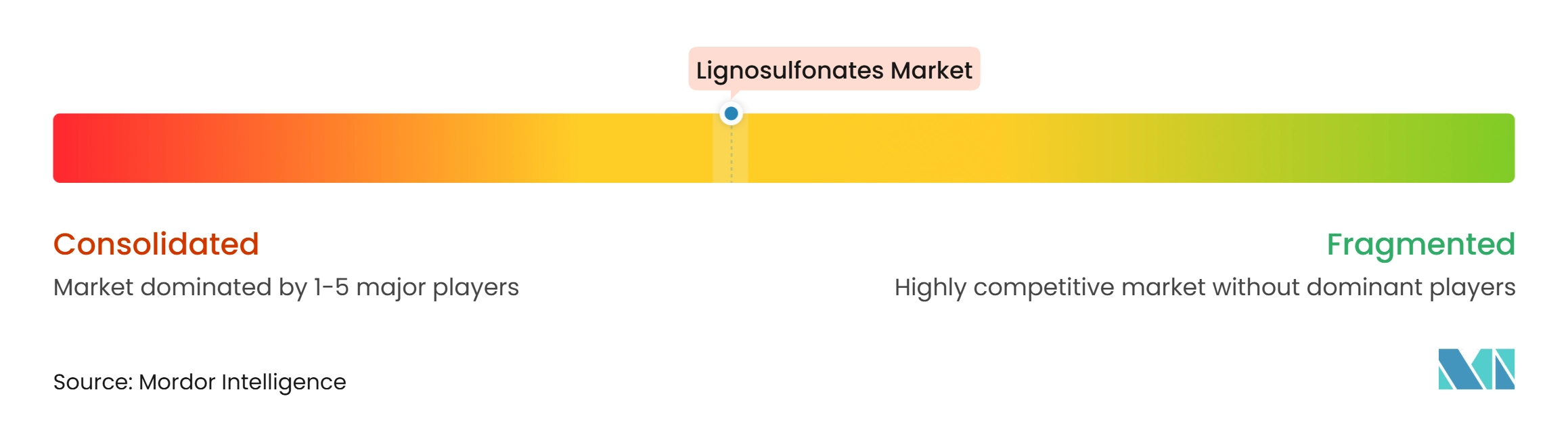
The lignosulfonates market is moderately consolidated. Borregaard, Burgo Group, Domsjö Fabriker, RYAM, Sappi, and Nippon Paper Industries compete through application knowledge, product documentation, and integrated production. Borregaard's BioSolutions business reported record EBITDA in 2025, supported by demand for bio-based ingredients and a broad specialty portfolio. European suppliers use certification, environmental declarations, and feed-related documentation to support premium procurement channels. Burgo Group's 2025 EPD registrations for its Bretax products represent a concrete step toward providing verified environmental data for several calcium, sodium, and ammonium grades. These capabilities reduce dependence on price competition at the specialty end of the market.
Chinese suppliers remain important in standard construction and agricultural grades, competing on price and broad product portfolios. Shenyang Xingzhenghe Chemical announced a 2025 upgrade focused on lower reducing sugar content, improved dispersion efficiency, and improved PCE-blend compatibility. This reflects a shift toward higher-performance applications rather than standard-grade supply alone. Sappi's 2025 introduction of Viscowell targets chrome-free thinning of drilling fluid with a renewable lignosulfonate product. RYAM stands out with ARBO lignosulfonates from its Tartas biorefinery, which it presents as wood-based materials for more sustainable industrial solutions. These product-specific strategies are relevant because end users increasingly require evidence of suitability for their specific applications.
Future competition will depend on which suppliers can maintain access to sulfite-based feedstock while improving product performance. Battery dispersants, carbon-black granulation, drilling fluids, and soil-related formulations are potential areas for technical development, but commercial success will require end-user validation. Environmental documentation and compliance with buyer requirements can influence supplier access in Europe and other regulated markets. The competitive pattern therefore varies by application, with commodity grades remaining price-driven and specialized grades rewarded for technical support.
Lignosulfonates Industry Leaders
-
Borregaard AS
-
RYAM
-
Sappi Limited
-
Nippon Paper Industries Co., Ltd.
-
Domsjö Fabriker
- *Disclaimer: Major Players sorted in no particular order
Lignosulfonates Market Companies Covered in this Report
- Abelin Polymers
- Borregaard AS
- Burgo Group S.p.A.
- Cardinal Chemicals Pvt Ltd.
- Domsjö Fabriker
- Green Agrochem
- Ingevity Corporation
- NIPPON PAPER INDUSTRIES CO., LTD.
- Qingdao New World Material Co., Ltd.
- RYAM
- Sappi Limited
- Shenyang Xingzhenghe Chemical Co., Ltd.
- The Dallas Group of America
- Tianjin Yeats Additive Co., Ltd.
- Tokyo Chemical Industry Co., Ltd.
Recent Industry Developments in Lignosulfonates Market
- February 2026: Burgo Group registered five Environmental Product Declarations (EPDs) for its Bretax lignosulfonate product line on the international EPD platform under ISO 14025:2006. The registered lignosulfonate products include Bretax C, Bretax CL, Bretax AML, Bretax SL, and Bretax CLRO2.
- January 2026: Ingevity Corporation completed the divestiture of its industrial specialties product line and North Charleston crude tall oil refinery to Mainstream Pine Products LLC, effective January 1, 2026. The company retained its lignin dispersant and pavement technologies products.
Global Lignosulfonates Market Report Scope
Lignosulfonates are water-soluble, anionic polymer salts derived as byproducts from the sulfite pulping process of wood, such as softwood and eucalyptus. They are produced when wood chips are treated with sulfite or bisulfite salts during pulping, thereby sulfoning lignin.
The lignosulfonates market is segmented by product type, application, and geography. By product type, the market is segmented into sodium lignosulfonate, calcium lignosulfonate, magnesium lignosulfonate, ammonium lignosulfonate, and other product types. By application, the market is segmented into concrete admixtures, animal feed binders, oil-well drilling additives, dust control and road stabilization, and other applications. The report also covers market sizes and forecasts for lignosulfonates across 15 countries in major regions. The market sizes and forecasts are provided in terms of value (USD).
Segmentation Overview
| Sodium Lignosulfonate |
| Calcium Lignosulfonate |
| Magnesium Lignosulfonate |
| Ammonium Lignosulfonate |
| Other Product Types |
| Concrete Admixtures |
| Animal Feed Binders |
| Oil-Well Drilling Additives |
| Dust Control and Road Stabilization |
| Other Applications |
| Asia-Pacific | China |
| India | |
| Japan | |
| South Korea | |
| ASEAN Countries | |
| Rest of Asia-Pacific | |
| North America | United States |
| Canada | |
| Mexico | |
| Europe | Germany |
| United Kingdom | |
| France | |
| Italy | |
| NORDIC Countries | |
| Rest of Europe | |
| South America | Brazil |
| Argentina | |
| Rest of South America | |
| Middle East and Africa | Saudi Arabia |
| South Africa | |
| Rest of Middle East and Africa |
| By Product Type | Sodium Lignosulfonate | |
| Calcium Lignosulfonate | ||
| Magnesium Lignosulfonate | ||
| Ammonium Lignosulfonate | ||
| Other Product Types | ||
| By Application | Concrete Admixtures | |
| Animal Feed Binders | ||
| Oil-Well Drilling Additives | ||
| Dust Control and Road Stabilization | ||
| Other Applications | ||
| By Geography | Asia-Pacific | China |
| India | ||
| Japan | ||
| South Korea | ||
| ASEAN Countries | ||
| Rest of Asia-Pacific | ||
| North America | United States | |
| Canada | ||
| Mexico | ||
| Europe | Germany | |
| United Kingdom | ||
| France | ||
| Italy | ||
| NORDIC Countries | ||
| Rest of Europe | ||
| South America | Brazil | |
| Argentina | ||
| Rest of South America | ||
| Middle East and Africa | Saudi Arabia | |
| South Africa | ||
| Rest of Middle East and Africa | ||
Key Questions Answered in the Report
What is current market size of Lignosulfonates Market?
The Lignosulfonates Market size was valued at USD 1.27 billion in 2026 and is estimated to grow from USD 1.32 billion in 2027 to USD 1.64 billion by 2032, at a CAGR of 4.37% during the forecast period (2027-2032).
What is the largest application for lignosulfonates?
Concrete admixtures accounted for 44.67% of the market in 2026 and remain the largest volume application.
Why are oil-well drilling additives expanding faster than other applications?
The segment is projected to grow at a CAGR of 5.21% through 2032 as operators evaluate renewable alternatives to chrome-based drilling-fluid thinners.
Which region leads lignosulfonate demand?
Asia-Pacific held a 38.13% share in 2026 and is forecast to expand at a 5.03% CAGR through 2032.