
Lignin-Based Resins Market Size and Share
Market Overview
| Study Period | 2021 - 2031 |
|---|---|
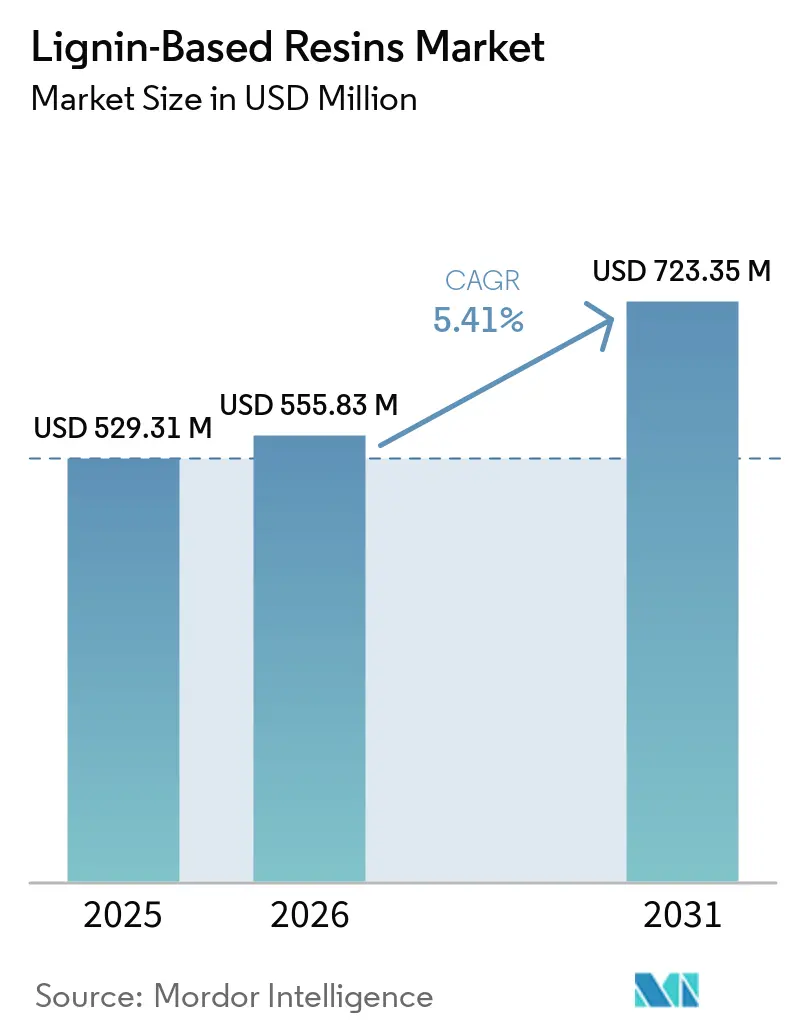
| Market Size (2026) | USD 555.83 Million |
| Market Size (2031) | USD 723.35 Million |
| Growth Rate (2026 - 2031) | 5.41 % |
| Fastest Growing Market | Asia-Pacific |
| Largest Market | Asia-Pacific |
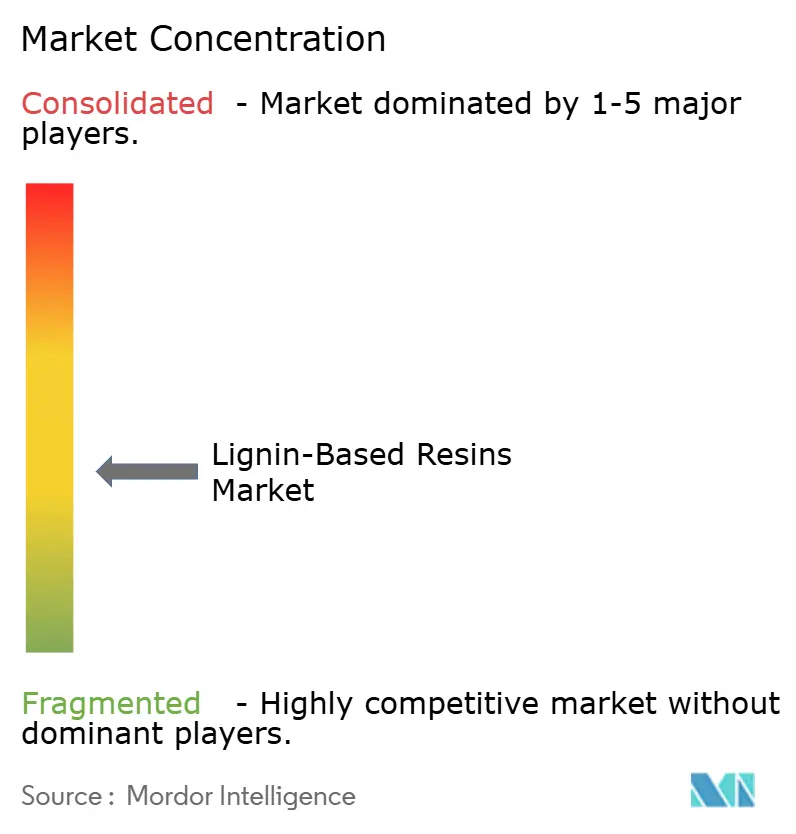
| Market Concentration | Medium |
Major Players *Disclaimer: Major Players sorted in no particular order Image © Mordor Intelligence. Reuse requires attribution under CC BY 4.0. | |
Lignin-Based Resins Market Analysis by Mordor Intelligence
The Lignin-Based Resins Market size was valued at USD 529.31 million in 2025 and is estimated to grow from USD 555.83 million in 2026 to USD 723.35 million by 2031, at a CAGR of 5.41% during the forecast period (2026-2031). Regulatory pressure on formaldehyde emissions is increasing demand for low-emission binders, particularly in composite wood manufacturing. In December 2024, the US Environmental Protection Agency concluded that formaldehyde poses an unreasonable risk to human health under the Toxic Substances Control Act, reinforcing the need for lower-formaldehyde materials in the lignin-based resins market. Corporate sourcing commitments for renewable materials are also shifting resin procurement toward formulations with measurable bio-based content. Lignin availability from pulp production provides a feedstock base that can support this shift, although material quality remains uneven across sources. Producers with integrated pulp operations, stable lignin grades, and application-specific formulations are positioned to benefit as panel, automotive, and construction buyers tighten their material requirements.
Key Report Takeaways
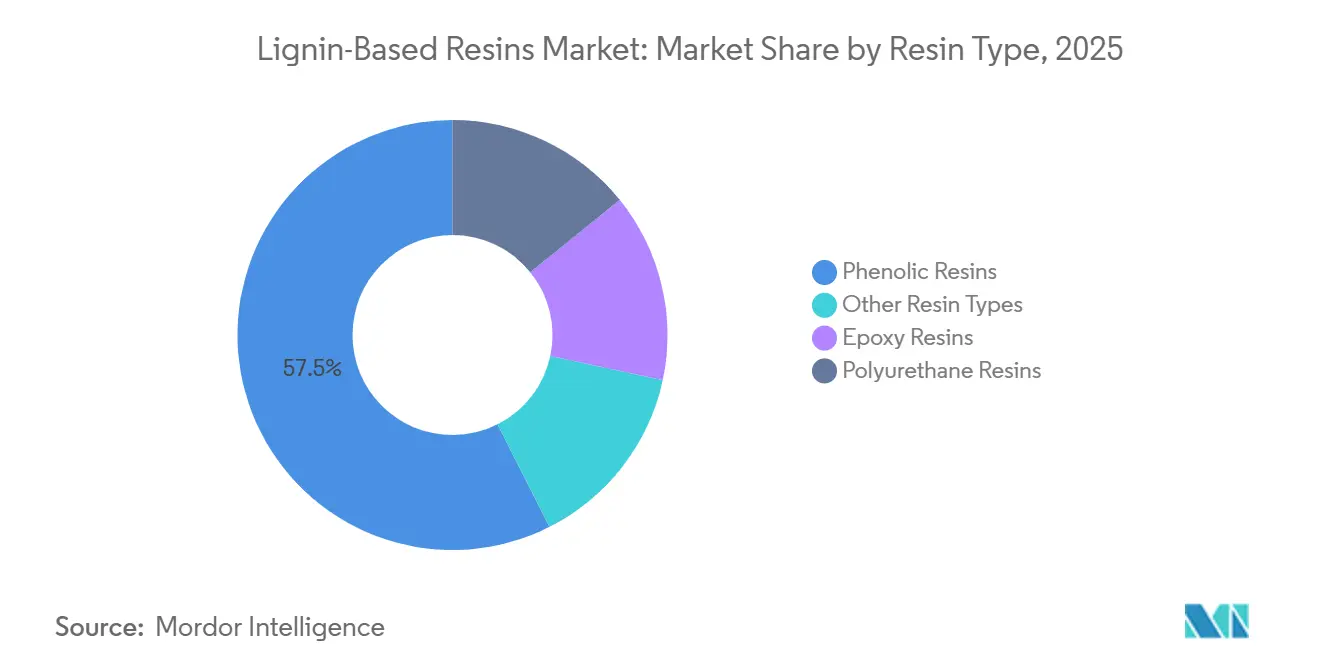
- By resin type, phenolic resins held 57.45% revenue share in 2025, while epoxy resins are forecast to grow at a 5.84% CAGR through 2031.
- By lignin source, lignosulfonates accounted for 76.11% revenue share in 2025, while organosolv lignin is projected to expand at a 5.92% CAGR through 2031.
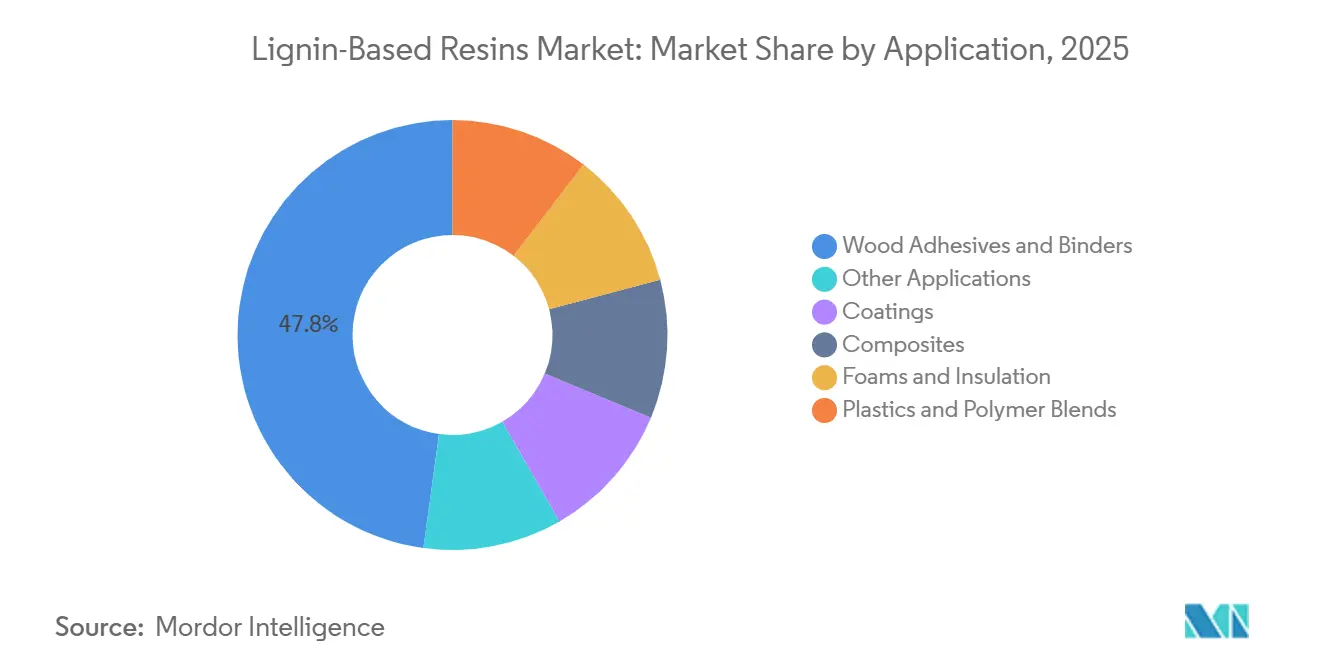
- By application, wood adhesives and binders captured 47.84% of the Lignin-Based Resins Market size in 2025, while composites are forecast to advance at a 6.26% CAGR through 2031.
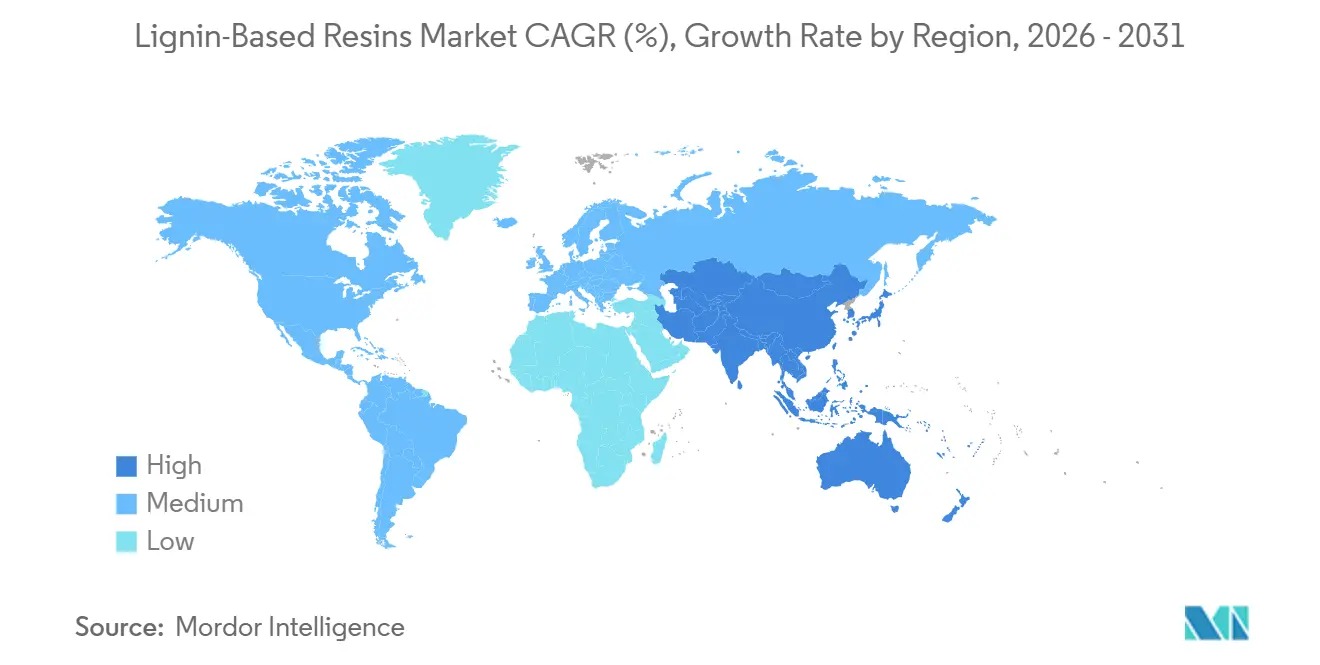
- By geography, Asia-Pacific held 39.76% of the Lignin-Based Resins Market share in 2025 and is projected to expand at a CAGR of 6.04% through 2031.
Note: Market size and forecast figures in this report are generated using Mordor Intelligence’s proprietary estimation framework, updated with the latest available data and insights as of January 2026.
Global Lignin-Based Resins Market Trends and Insights
Drivers Impact Analysis*
| Drivers | (~) % Impact on CAGR Forecast | Geographic Relevance | Impact Timeline |
|---|---|---|---|
| Formaldehyde and VOC Compliance Pull | +1.3% | Global, led by North America, Europe, China, and Japan | Short term (≤ 2 years) |
| Corporate Demand for Renewable and Low-Carbon Resins | +0.9% | North America and Europe, with spillover to the Asia-Pacific original equipment manufacturer (OEM) supply chains | Medium term (2-4 years) |
| Abundant Pulp-Industry Lignin Feedstock | +0.7% | Global, concentrated in Scandinavia, North America, and Brazil | Long term (≥ 4 years) |
| Expansion of Bio-Based Adhesives and Composites | +0.8% | Asia-Pacific core, with spillover to North America and Europe composite clusters | Medium term (2-4 years) |
| Consistent, Application-Ready Kraft Lignin Grades | +0.5% | Nordic markets, with early gains in Germany and North America | Long term (≥ 4 years) |
| Source: Mordor Intelligence | |||
Formaldehyde and Volatile Organic Compound (VOC) Compliance Pull
Tighter formaldehyde emission standards are the most immediate driver of demand in the lignin-based resins market. The U.S. EPA's December 2024 risk determination increased the compliance exposure associated with conventional formaldehyde systems, encouraging composite wood manufacturers to consider lower-emission alternatives before further measures take effect. Registration, Evaluation, Authorization and Restriction of Chemicals (REACH) Annex XVII requirements and the Construction Products Regulation are supporting specification changes among European medium-density fiberboard (MDF), plywood, and oriented strand board producers. China's VOC discharge permitting and its dual-carbon agenda are also affecting procurement decisions at urea-formaldehyde resin plants serving the lignin-based resins market. Furniture exporters in Vietnam and Thailand must meet requirements set by North American and European retailers, thereby extending demand beyond the jurisdictions that originally set the rules. In June 2026, Ahlstrom expanded its European production of filtration media, replacing 30% of fossil-based phenolic resin with lignin and reducing formaldehyde-curing emissions by 40-70%[1]Ahlstrom Oyj, “Ahlstrom Expands Lignin-Containing Filtration Media Production to Europe,” Ahlstrom Oyj, ahlstrom.com..
Corporate Demand for Renewable and Low-Carbon Resins
Scope 3 accountability is influencing sourcing decisions by construction, automotive, and consumer goods companies in the lignin-based resins market. Brand owners increasingly request Environmental Product Declarations that show resin bio-content, creating an advantage for formulations that use renewable inputs. Resin formulators supplying these buyers also require lignin suppliers to demonstrate stable bio-carbon content through verifiable testing. This requirement favors suppliers with controlled fractionation processes and consistent production practices. UPM Biochemicals has positioned its BioPiva kraft lignin as a renewable input for adhesives and resin systems, reflecting demand for higher-purity lignin grades. Over the medium term, the European Commission's Chemicals Strategy for Sustainability could translate these preferences into green public procurement criteria for infrastructure projects.
Abundant Pulp-Industry Lignin Feedstock
Pulp production generates a substantial lignin stream that supports long-term feedstock availability for the lignin-based resins market. The German Bioeconomy Deep Dive identified lignin as an underused industrial resource and highlighted the potential for broader material use across value chains. Södra is developing a kraft lignin facility in Mönsterås, Sweden, with a planned capacity of 250,000 tons per year and a scheduled Q2 2027 startup. The project received support through Sweden's Industriklivet program and demonstrates that pulp producers are treating lignin as a commercial material rather than solely an internal energy source. Eucalyptus-derived kraft lignin adds another supply route for the lignin-based resins market in Asia-Pacific. In September 2024, Suzano introduced Ecolig eucalyptus kraft lignin in China for wood-panel and rubber applications.
Expansion of Bio-Based Adhesives and Composites
The growing use of lignin in structural composites and performance adhesives is opening higher-value applications in the lignin-based resins market. Research published in 2025 found that amine-functionalized lignin epoxy resins achieved mechanical performance suitable for advanced adhesives and wind turbine composites. The European Union-funded LIGNOFUN project is developing foams, adhesives, coatings, and composite materials from depolymerized lignin, with 18 partners, including 7 small and medium-sized enterprises. In June 2025, VITO opened the LignoValue Pilot Plant to supply depolymerized lignin for epoxy resin development. This facility connects bulk lignin supply with the application-grade intermediates required by resin formulators. Chemistry development on the supply side is supporting the adoption of composites in the lignin-based resins market, alongside demand from automotive and wind-energy manufacturers.
Restraints Impact Analysis*
| Restraints | (~) % Impact on CAGR Forecast | Geographic Relevance | Impact Timeline |
|---|---|---|---|
| Feedstock and Chemical-Structure Variability | -0.7% | Global, most acute in the Asia-Pacific due to diverse feedstock sources | Short term (≤ 2 years) |
| Limited Commercial-Scale Valorization Infrastructure | -0.6% | Global, most severe in South America, the Middle East, and Africa, and emerging Asia-Pacific markets | Medium term (2-4 years) |
| Batch Qualification Friction in Existing Resin Lines | -0.3% | North America and Europe, where established phenol-formaldehyde resin specifications dominate | Short term (≤ 2 years) |
| Source: Mordor Intelligence | |||
Feedstock and Chemical-Structure Variability
Lignin structure varies by feedstock species, pulping method, extraction process, and season, creating a restraint on the lignin-based resins market. Lignin grades from the same facility can differ in phenolic hydroxyl content, molecular-weight distribution, and sulfur levels. These differences affect cure behavior and the mechanical properties of finished resins. The German Bioeconomy Deep Dive identified the lack of standard lignin quality parameters and grading systems as a major barrier to wider industrial use. This issue is especially significant in the Asia-Pacific region, where panel producers may source lignin from eucalyptus, bamboo, and mixed hardwood feedstocks. No published ISO standard specifically covers resin-grade lignin, so supplier qualification remains a time-consuming bilateral process.
Limited Commercial-Scale Valorization Infrastructure
The gap between laboratory performance and commercial-scale production remains a constraint for the lignin-based resins market. Many existing facilities were built to produce lignosulfonates for concrete, animal feed, and dispersant applications rather than refined fractions for resin synthesis. Additional refining and fractionation equipment is often required before a facility can economically produce resin-grade lignin. The German Bioeconomy Deep Dive linked slow commercialization to insufficient scalable pilot infrastructure and a fragmented value chain. Metsä Group started its Metsä LigO demo plant in Äänekoski in May 2026, using a 2-ton-per-day process to develop modified lignin products[2]Metsä Group, “Metsä Group’s Demo Plant for a New Lignin Product Starts Up in Äänekoski,” Metsä Group, metsagroup.com.. Assets of this scale remain uncommon, and U.S. regulatory notifications for novel lignin derivatives can add to development lead times.
*Our forecasts treat driver/restraint impacts as directional, not additive. The impact forecasts reflect baseline growth, mix effects, and variable interactions.
Segment Analysis
By Resin Type: Phenolic Incumbency Meets Epoxy Innovation
Phenolic resins accounted for 57.45% of the lignin-based resins market share in 2025, supported by their compatibility with industrial hot-press systems for plywood, oriented strand board, and laminated veneer lumber. Lignin-phenol-formaldehyde systems enable direct partial replacement of fossil phenol in existing production infrastructure, reducing the capital requirements of converting to bio-based formulations. Polyurethane resins remain a smaller segment, but kraft lignin polyols are being evaluated as replacements for petroleum-derived polyols in rigid insulation and flexible seating foams. A 2026 study reported that lignin polyols, used at 20-30% substitution, achieved compressive strength profiles comparable to those of polyurethane formulations.
Epoxy resins are the fastest-growing resin type, with the lignin-based resins market size for this segment forecast to grow at a 5.84% CAGR from 2026 to 2031. This growth reflects interest in bio-based and bisphenol A (BPA)-free alternatives as regulatory attention on BPA increases. Research on lignin-derived epoxy systems has shown that engineered lignin oligomers can approach the thermomechanical performance benchmarks of commercial diglycidyl ether of bisphenol A (DGEBA). In June 2025, Sumitomo Bakelite commercially launched a solid Novolac-type lignin-modified phenolic resin for automotive foundry and friction-material applications. Other resin types, including acrylic-modified and thermoset blends, remain concentrated in specialty coating and electronics applications.



By Lignin Source: Lignosulfonates Lead, Organosolv Disrupts
Lignosulfonates accounted for 76.11% of the lignin-based resins market share in 2025, reflecting long-standing use in concrete admixtures, animal feed pelletizers, and dispersants. Their water solubility and surface-active properties make them suitable for aqueous resin systems. Sulfite pulp mills in Europe and North America provide large-scale commercial availability. Kraft lignin is the second-largest source segment and is gaining traction through deployments of LignoBoost and LignoForce technologies. UPM's BioPiva line illustrates the move toward kraft lignin grades designed for adhesive and resin applications.
Organosolv lignin is the fastest-growing source category, at a 5.92% CAGR through 2031. Its lower sulfur content and more uniform aromatic structure support higher phenol substitution while maintaining resin cure performance. The absence of sulfur-containing groups also reduces odor and catalyst-poisoning concerns in advanced chemical applications. A 2026 analysis of odor-free kraft-lignin thermosets reported favorable economics when lignin outtake was used in bio-based composites replacing diglycidyl ether of bisphenol A (DGEBA) or acrylonitrile butadiene styrene (ABS). VITO's LignoValue Pilot Plant, launched in June 2025, demonstrates that cleaner lignin streams are receiving dedicated investment for epoxy resin development.
By Application: Wood Adhesives and Binders Lead While Composites Record Fastest Growth
Wood adhesives and binders accounted for 47.84% of the lignin-based resins market in 2025, driven by production of medium-density fiberboard (MDF), plywood, and particleboard in Asia-Pacific. Lignin-phenolic adhesives offer a route to lower-emission bonding that meets China's GB 18580 Emission Non-Formaldehyde (ENF) thresholds and California Air Resources Board (CARB) Phase 2 requirements, which are increasingly reflected in export procurement contracts. Coatings represent a smaller but growing application, as lignin's UV-absorption properties and aromatic structure make it suitable for waterborne and powder systems. A 2026 study reported improved compressive strength and thermal insulation performance in lignin-reinforced rigid polyurethane foams.
Composites are projected to grow at a 6.26% CAGR from 2026 to 2031, the highest rate among application segments. Automotive and wind-energy manufacturers are the primary sources of demand, as lignin epoxy formulations are being tested for structural applications. A 2025 study confirmed that amine-functionalized lignin epoxy systems can meet mechanical requirements for advanced adhesives and wind turbine composites. Sumitomo Bakelite's resin-coated sand binders entered automotive casting production in 2024, supporting the commercial case for lignin-modified phenolic systems. The LIGNOFUN project is validating composite prototypes from depolymerized lignin, while other applications in rubber compounding, carbon fiber precursors, and functional fillers remain at different stages of commercialization.
Geography Analysis
Asia-Pacific accounted for 39.76% of revenue in 2025 and is projected to record the highest regional CAGR of 6.04% through 2031. China is the central demand market due to its large wood-based panel industry and GB 18580 ENF emission thresholds, while India's plywood and MDF producers are qualifying lignin-phenolic adhesives as a compliant and cost-competitive alternative to conventional urea-formaldehyde systems. South Korea's automotive sector is evaluating lignin-derived composite precursors for lightweight structural components. Vietnam and Thailand are adopting lignin adhesive systems as furniture and panel exporters respond to retailer compliance requirements. In September 2024, Suzano introduced Ecolig eucalyptus kraft lignin to the Chinese market, adding a regional alternative to Scandinavian kraft lignin supply.
North America and Europe form the innovation-intensive tier of the lignin-based resins market. US composite wood regulations set formaldehyde emission limits and create a compliance-driven opportunity for lignin-phenolic systems. Canada's Kraft pulping base provides feedstock security for regional resin producers, while Borregaard, Stora Enso, and Södra have invested in Scandinavian supply to support access to higher-purity lignin in Europe. REACH, the Construction Products Regulation, and the Chemicals Strategy for Sustainability support demand for bio-based alternatives. According to the German Bioeconomy Deep Dive, Germany has more than 15 large pulp and paper mills and more than 40 specialty chemical manufacturers exploring lignin-based adhesives and coatings.
South America, the Middle East, and Africa hold emerging positions in the lignin-based resins market. Brazil's eucalyptus kraft pulp sector provides low-sulfur lignin suited to resin applications, while domestic construction and panel production provide demand outlets. Argentina's medium-density fiberboard (MDF) producers increasingly serve export markets that require compliance documentation, while Saudi Arabia's Vision 2030 program and South Africa's forestry sector represent longer-term opportunities. Limited extraction and refining infrastructure, restricted pulp capacity, import dependence, and fewer direct regulatory mandates continue to constrain adoption across the Middle East and Africa.

Competitive Landscape
The lignin-based resins market is moderately fragmented at the supply tier. Borregaard, Stora Enso, UPM, Metsä Group, and Sappi hold integrated access to pulp-derived feedstock, which supports cost control and closer management of material quality. Borregaard's Norwegian biorefinery uses wood feedstock to produce specialty lignin products, vanillin, and cellulose. Stora Enso has developed lignin-based resin technologies for engineered wood adhesives through its Lineo product line. These companies compete through feedstock integration, application-specific grades, and customer relationships rather than through commodity lignin supply alone.
In September 2024, UPM Biochemicals and Södra announced a commercial supply partnership designating UPM as an early customer for kraft lignin from Södra's planned Mönsterås facility. The facility is planned for Q2 2027, with a capacity of 250,000 tons per year, to support the partners' long-term supply strategy. Metsä Group started the Metsä LigO demo plant in May 2026 to produce modified lignin for fossil-chemical replacement applications. Sumitomo Bakelite launched a solid novolac-type lignin-modified phenolic resin in June 2025, reflecting a focus on application-specific commercialization. These developments indicate that major suppliers are building supply security and demonstrating lignin performance in defined end uses.
Opportunities remain in high-purity grades for electronics and pharmaceutical intermediate applications that require very low metal content. Non-European developing markets also have room for new supply and refining infrastructure. Lignin Industries AB, Lignolix, and MetGen focus on advanced applications, including carbon fiber precursors, engineering plastics, and enzymatic lignin processing. MetGen's METNIN process is being validated within the LIGNOFUN project as a lower-temperature route for lignin depolymerization. Producers are investing in process analytics to improve molecular consistency for high-performance composite supply chains. Regional suppliers of commodity lignosulfonates remain fragmented and compete mainly on price, keeping margins under pressure for undifferentiated grades.
Lignin-Based Resins Industry Leaders
Borregaard AS
Stora Enso
UPM
Domtar Corporation
Ingevity Corporation
- *Disclaimer: Major Players sorted in no particular order

Recent Industry Developments
- June 2026: Ahlstrom expanded its ECO lignin-containing filtration media production to its Turin, Italy manufacturing plant, extending commercial availability of a lignin-based resin filtration product that replaces 30% of fossil phenolic resin with renewable lignin and reduces formaldehyde curing emissions by 40-70%.
- February 2026: Metsä Group and ANDRITZ started up the Metsä LigO demo plant at Äänekoski, Finland, using ANDRITZ LigniOx technology at a nameplate capacity of 2 tons per day. Developed in partnership with Dow, the plant produces modified lignin-based resins to replace fossil-based chemicals in bio-based plasticizers for concrete and gypsum-board applications. The decision to invest at production scale is contingent on demo results.


Global Lignin-Based Resins Market Report Scope
Lignin-based resins are polymer materials made by replacing traditional petroleum-based components with lignin, a natural organic polymer found in plant cell walls.
The lignin-based resins market is segmented by resin type, lignin source, application, and geography. By resin type, the market is segmented into phenolic resins, epoxy resins, polyurethane resins, and other resin types. By lignin source, the market is segmented into kraft lignin, lignosulfonates, organosolv lignin, and other lignin sources. By application, the market is segmented into wood adhesives and binders, coatings, composites, foams and insulation, plastics and polymer blends, and other applications. The report also covers market size and forecasts for lignin-based resins across 15 countries in major regions. The market sizes and forecasts are provided in terms of value (USD).
| Phenolic Resins |
| Epoxy Resins |
| Polyurethane Resins |
| Other Resin Types |
| Kraft Lignin |
| Lignosulfonates |
| Organosolv Lignin |
| Other Lignin Sources |
| Wood Adhesives and Binders |
| Coatings |
| Composites |
| Foams and Insulation |
| Plastics and Polymer Blends |
| Other Applications |
| Asia-Pacific | China |
| India | |
| Japan | |
| South Korea | |
| Rest of Asia-Pacific | |
| North America | United States |
| Canada | |
| Mexico | |
| Europe | Germany |
| United Kingdom | |
| France | |
| Italy | |
| Rest of Europe | |
| South America | Brazil |
| Argentina | |
| Rest of South America | |
| Middle East and Africa | Saudi Arabia |
| South Africa | |
| Rest of Middle East and Africa |
| By Resin Type | Phenolic Resins | |
| Epoxy Resins | ||
| Polyurethane Resins | ||
| Other Resin Types | ||
| By Lignin Source | Kraft Lignin | |
| Lignosulfonates | ||
| Organosolv Lignin | ||
| Other Lignin Sources | ||
| By Application | Wood Adhesives and Binders | |
| Coatings | ||
| Composites | ||
| Foams and Insulation | ||
| Plastics and Polymer Blends | ||
| Other Applications | ||
| By Geography | Asia-Pacific | China |
| India | ||
| Japan | ||
| South Korea | ||
| Rest of Asia-Pacific | ||
| North America | United States | |
| Canada | ||
| Mexico | ||
| Europe | Germany | |
| United Kingdom | ||
| France | ||
| Italy | ||
| Rest of Europe | ||
| South America | Brazil | |
| Argentina | ||
| Rest of South America | ||
| Middle East and Africa | Saudi Arabia | |
| South Africa | ||
| Rest of Middle East and Africa | ||


Key Questions Answered in the Report
What is current market size of Lignin-Based Resins Market?
The Lignin-Based Resins Market size was valued at USD 529.31 million in 2025 and is estimated to grow from USD 555.83 million in 2026 to USD 723.35 million by 2031, at a CAGR of 5.41% during the forecast period (2026-2031).
Which resin type has the largest revenue position?
Phenolic resins led with a 57.45% revenue share in 2025, supported by their compatibility with existing hot-press production systems.
Which lignin source is growing fastest?
Organosolv lignin is forecast to grow at a 5.92% CAGR through 2031 because its lower sulfur content supports advanced chemical applications.
Why are wood adhesives important for lignin resin suppliers?
Wood adhesives and binders accounted for 47.84% of revenue in 2025 and benefited from tighter formaldehyde requirements in panel production.
Page last updated on:





