
Light Beer Market Size and Share
Market Overview
| Study Period | 2022 - 2032 |
|---|---|
| Market Size (2027) | USD 20.55 Billion |
| Market Size (2032) | USD 26.79 Billion |
| Growth Rate (2027 - 2032) | 5.47 % |
| Fastest Growing Market | Asia-Pacific |
| Largest Market | North America |
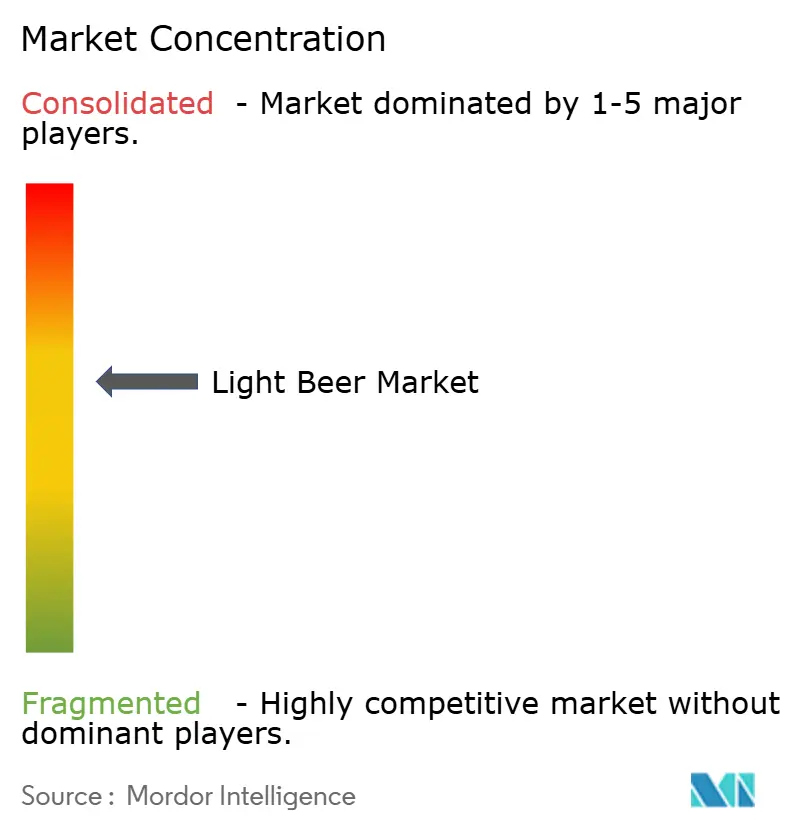
| Market Concentration | Medium |
Major Players *Disclaimer: Major Players sorted in no particular order Image © Mordor Intelligence. Reuse requires attribution under CC BY 4.0. | |
Light Beer Market Analysis by Mordor Intelligence
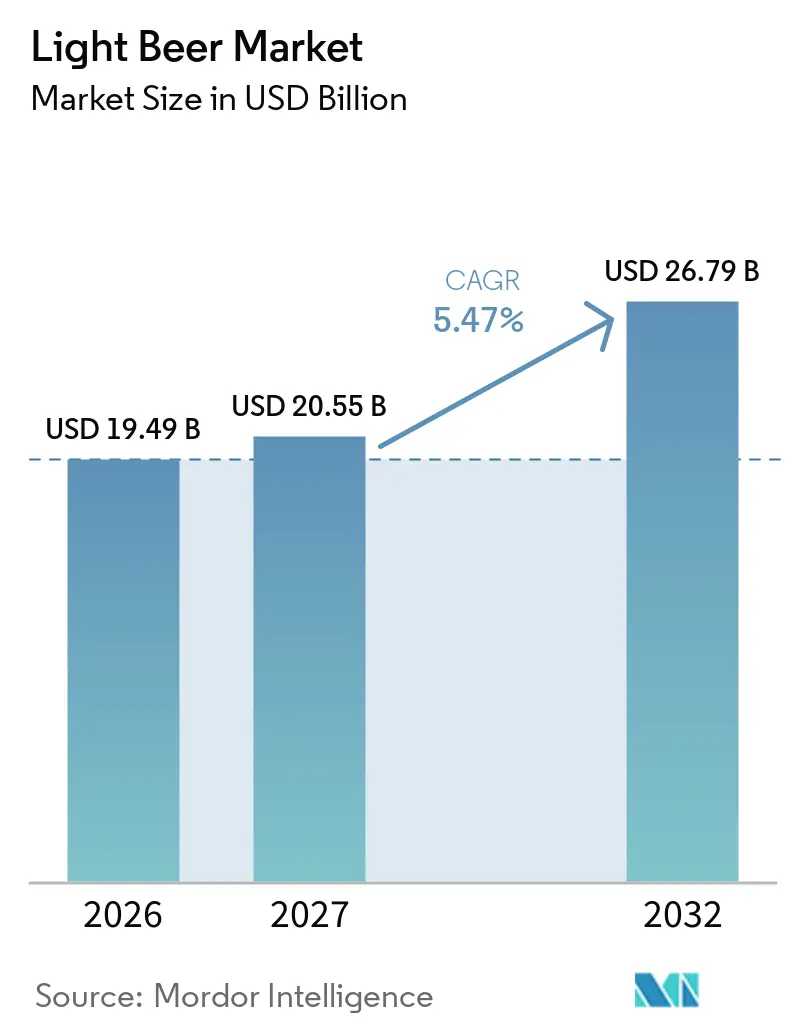
The light beer market size is expected to increase from USD 19.49 billion in 2026 to USD 20.55 billion in 2027 and reach USD 26.79 billion by 2032, growing at a CAGR of 5.47% over 2027-2032. Demand is moving toward drinking occasions where lower calorie and carbohydrate content matters alongside familiar beer taste. This change reaches beyond consumers who identify strongly with fitness, because moderation and nutritional awareness affect wider household purchasing decisions. Established brewers can use portfolio breadth, retail access, and product development to protect their positions as consumption patterns change. Challenger brands can find openings through citrus flavors, clearer carbohydrate communication, and direct digital access, although their resources remain more limited. The light beer market is also shaped by competition from alcohol-free products, increasing regulation, and raw-material costs, which can place more pressure on smaller producers.
Key Report Takeaways
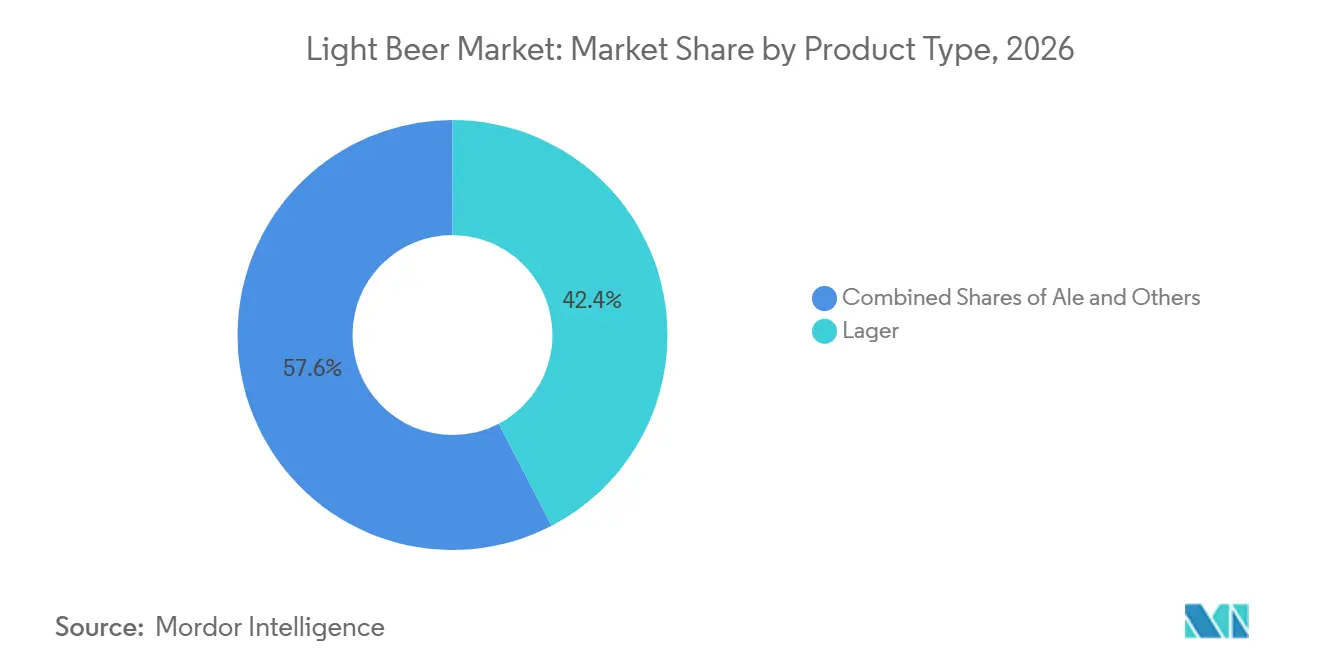
- By product type, Lager held 42.36% of category value in 2026, while Ale is forecast to grow at a CAGR of 6.53% through 2032.
- By flavor, Regular held 38.52% of category value in 2026, while Citrus-Flavored is forecast to grow at a CAGR of 6.78% through 2032.
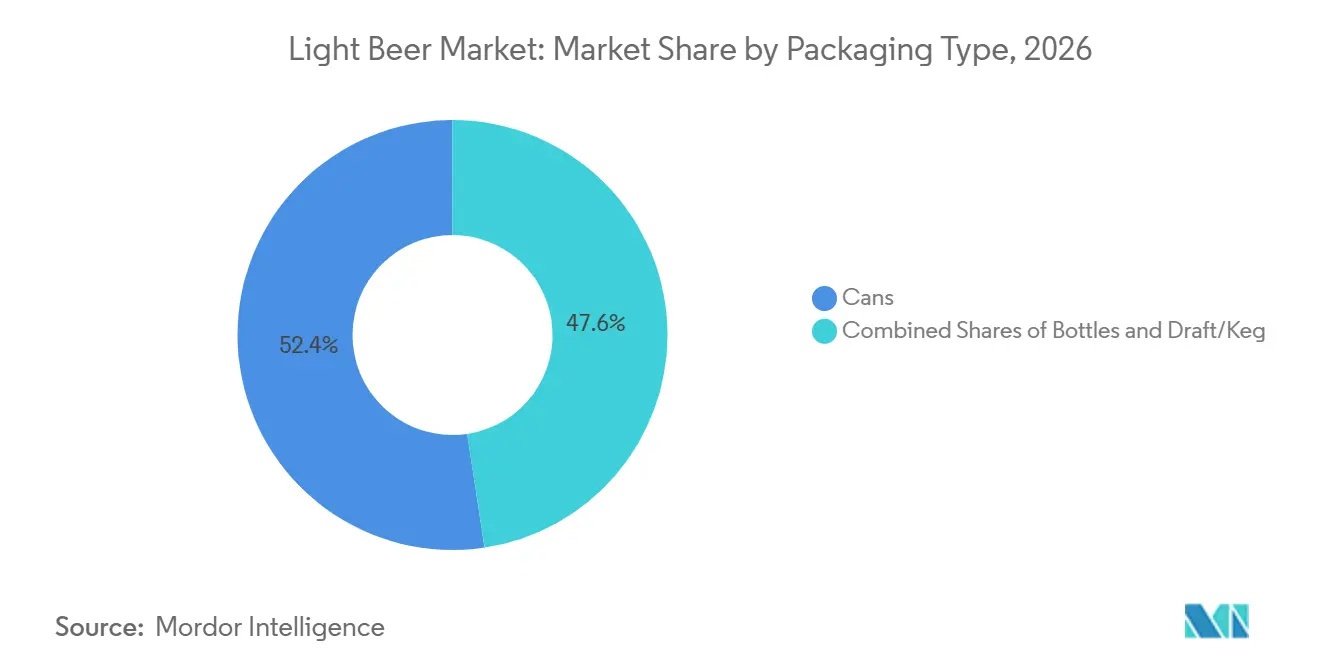
- By packaging, Cans held 52.37% of category value in 2026, while Bottles are forecast to grow at a CAGR of 7.01% through 2032.
- By distribution channel, Specialty Stores held 42.41% of category value in 2026, while Online Retail is forecast to grow at a CAGR of 6.42% through 2032.
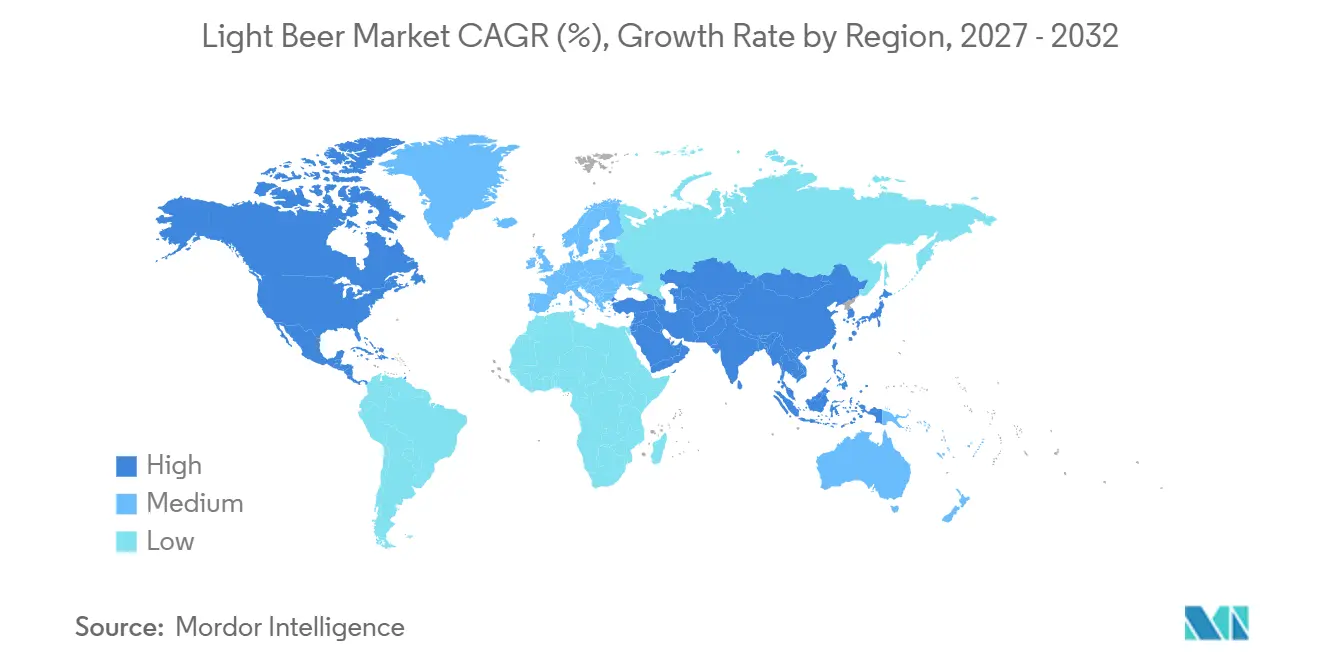
- By geography, North America held 42.41% of global value in 2026, while Asia-Pacific is forecast to grow at a CAGR of 6.57% through 2032.
Note: Market numbers in this report are based on Mordor Intelligence's proprietary estimation framework, which combines nine months of actuals with Q4 projections for base year 2026.
Market Trends and Insights
Drivers Impact Analysis of Light Beer Market*
| Driver | (~) % Impact on CAGR Forecasts | Geographic Relevance | Impact Timeline |
|---|---|---|---|
| Rising consumer interest in lower-calorie alcoholic beverages | +1.8% | Global; highest in North America, Western Europe, and urban APAC | Short term (≤ 2 years) |
| Increasing expansion of flavored beer products | +1.0% | Global; strongest in North America, Western Europe, South Korea | Medium term (2–4 years) |
| Ongoing product development by leading brewing companies | +0.8% | Global, with spill-over to Middle East and Africa and South America | Medium term (2–4 years) |
| Growing consumer interest in premium and specialty beer varieties | +0.7% | North America, Western Europe, Japan, Australia | Long term (≥ 4 years) |
| Wider product accessibility through modern retail and online channels | +0.6% | Global; accelerating in China, India, and the United States | Short term (≤ 2 years) |
| Consumer preference for beer with reduced carbohydrate content | +0.5% | Global; strongest in the United States, Australia, and South Korea | Medium term (2–4 years) |
| Source: Mordor Intelligence | |||
Rising Consumer Interest in Lower-Calorie Alcoholic Beverages
Health and wellness spending supports light beer because consumers increasingly consider alcohol choices within their wider routines. A 2025 Italian consumer study found that 55% of 527 respondents showed greater purchase motivation after learning about health-functional beer properties[1]. This finding indicates that nutritional information can influence purchase intent when it is clear and relevant. Lower-calorie positioning gives brewers a way to address moderation without requiring consumers to leave beer entirely. The light beer market benefits when familiar brands make this choice feel straightforward rather than restrictive. Clear calorie and allergen disclosure requirements in the United States and European Union can further strengthen that communication when companies provide accurate packaging information.
Increasing Expansion of Flavored Beer Products
Flavor innovation gives light beer a route to attract consumers seeking variety without moving away from lower-calorie formats. Stone & Wood introduced Citrus Radler in Australia during August 2025, showing continued interest in lighter citrus-led formats. Corona also introduced Sunbrew Citrus Cerveza with orange and lime peel during 2025, while Shiner launched Ruby Sunburst Tangerine Lager with 85 calories for the U.S. summer season. These releases show that major and regional brewers use citrus to refresh familiar lager occasions. Flavor additions can increase trial while allowing brands to retain a beer-led identity.
Wider Product Accessibility Through Modern Retail and Online Channels
Digital access changes how producers and retailers reach consumers, especially where shoppers want a specific flavor or package. AB InBev reported USD 13.30 billion in BEES B2B gross merchandise value during the third quarter of 2025, an 11% year-over-year increase. Its Zé Delivery and PerfectDraft platforms processed more than 18 million online orders in the same quarter and generated USD 134 million in direct-to-consumer revenue. These systems give large brewers better visibility into assortment, promotion, and local demand. The light beer market can use online availability to extend access beyond the limited shelf space of physical stores. Specialty retailers will remain important because curated assortments support premium, imported, and craft-oriented products. However, online ordering can reduce their exclusive access to niche brands and selected package formats.
Consumer Preference for Beer With Reduced Carbohydrate Content
Reduced-carbohydrate positioning appeals to consumers who closely monitor nutritional content and seek more detailed information than a general light label provides. This consumer group increasingly evaluates beverage choices based on transparent nutritional claims, particularly carbohydrate content, rather than relying solely on broad descriptors such as “light.” While price remains an important consideration, these consumers may be willing to pay more when products provide clear, credible, and easy-to-understand nutritional information. Displaying explicit carbohydrate counts can help products differentiate themselves from beer formats that use only the broader light descriptor without providing specific nutritional details. This approach enables brands in the light beer market to strengthen their value proposition, appeal to health-conscious consumers, and potentially support premium pricing.
Restraints Impact Analysis of Light Beer Market*
| Restraint | (~) % Impact on CAGR Forecasts | Geographic Relevance | Impact Timeline |
|---|---|---|---|
| Strong competition from conventional beer and alternative alcoholic beverages | -1.5% | Global; highest in North America and Western Europe | Short term (≤ 2 years) |
| Stringent regulations governing alcohol production, distribution, and promotion | -0.9% | Global; highest in Northern Europe, APAC, MEA | Medium term (2–4 years) |
| Health-related concerns and negative attitudes toward alcohol consumption | -0.7% | Global; accelerating in high-income markets | Long term (≥ 4 years) |
| Fluctuating prices of barley, hops, and other brewing ingredients | -0.5% | Global; pronounced exposure in North America and Europe | Short term (≤ 2 years) |
| Source: Mordor Intelligence | |||
Strong Competition From Conventional Beer and Alternative Alcoholic Beverages
Light beer competes with conventional beer, flavored malt beverages, hard seltzers, and alcohol-free beer for overlapping occasions. Each category can appeal to consumers seeking refreshment, flavor, social participation, or a lower-calorie choice. Competition is not limited to one substitute because consumers can change formats by occasion and location. Alcohol-free beer has become particularly relevant for health-oriented occasions that may otherwise have supported lower-calorie beer. This makes the light beer market dependent on retaining the consumer who wants moderation but still prefers an alcoholic product. Brands that offer several related formats can preserve more consumer spending across those changing occasions.
Stringent Regulations Governing Alcohol Production, Distribution, and Promotion
Regulatory differences can create uneven costs for producers that sell across multiple markets. Latvia’s amended Alcoholic Beverages Circulation Law took effect on August 1, 2025, restricting price and discount advertising and requiring a 6-hour minimum delay for online alcohol deliveries. These rules can limit the digital and promotional methods used by emerging brands. Thailand’s 2025 Alcohol Beverage Control Act amendment also strengthened marketing and advertising restrictions in an important ASEAN beer market[2]. Nigeria’s 2025 Beer Regulations prohibit health claims in advertising, limiting how brewers can communicate product credentials. These measures can make it more difficult to rely on calorie-led and digital-first marketing strategies.
*Our forecasts treat driver/restraint impacts as directional, not additive. The impact forecasts reflect baseline growth, mix effects, and variable interactions.
Light Beer Market Segment Analysis
By Product Type:
Lager Stability Masks Rising Craft Ale DemandLager held 42.36% of the light beer market share in 2026, supported by consumer familiarity and longstanding brand infrastructure. Its leading position provides a stable base for producers serving routine retail and on-premise occasions. The segment remains important because it gives consumers a recognizable taste profile within a moderation-oriented choice. Producers can use established lager brands to introduce clearer calorie, carbohydrate, and package-format propositions. The category’s scale also supports broad distribution across grocery, specialty, hospitality, and digital channels.
Ale is forecast to grow at a CAGR of 6.53% through 2032, making it the fastest-growing product type. Session ale and pale ale formats can offer more flavor complexity while retaining the lower-calorie proposition that supports the category. The Brewers Association reported 1.60% growth for Golden Ale in U.S. craft volumes during 2025[3]. This performance indicates ongoing interest in sessionable beer styles among craft consumers. Ale can create room for a more premium product experience than mainstream light lager. It can also give smaller brewers a clearer way to differentiate without matching the distribution scale of the largest companies. The opportunity depends on keeping the taste proposition understandable for consumers who usually select lager. The light beer market may see ale gain through selective premium occasions rather than by replacing lager’s large everyday role. Product development should therefore keep a close connection between flavor, calorie positioning, and expected drinking occasion.

By Flavor:
Health Positioning Reshapes the Mix Beyond RegularRegular flavor held 38.52% of category value in 2026, reflecting legacy brand loyalty and frequent replenishment purchasing. This segment remains central because many consumers continue to seek familiar beer flavor from a lighter product. Regular products also benefit from established shelf placement and a clear relationship with mainstream beer brands. Their position is likely to remain resilient in everyday retail purchases where consumers value ease and consistency. At the same time, regular flavor faces gradual pressure as consumers test alternatives that promise fruit-led refreshment. The response does not need to abandon traditional profiles because core buyers still support the segment. Brewers can use clear differentiation between familiar taste and added flavor rather than presenting one as a replacement for the other.
Citrus-Flavored light beer is forecast to grow at a CAGR of 6.78% through 2032, the fastest pace among flavor segments. Tröegs moved Sunshine Salt + Lime Lager from a limited summer release into its rotating Once-a-Year series in April 2025. This action shows how a brewery can retain a citrus product beyond a single seasonal launch. Citrus flavor can support trial because it is familiar and can fit warm-weather, outdoor, and social occasions. Fruit-Flavored products, including mango, berry, and tropical profiles, also serve occasions that were previously associated with hard seltzers. The key issue is whether flavor supports the beer proposition rather than making the product indistinguishable from other flavored alcoholic drinks. Producers can use limited releases to test demand before committing to wider distribution.
By Packaging:
Cans Lead but Bottles Gain Premium GroundCans held 52.37% of the light beer market size in 2026, making them the largest packaging format. Their lead reflects portability, supply-chain efficiency, and a clear fit with informal and outdoor occasions. Cans can also be useful for brands that want to offer multipacks and serve convenience-led shopping occasions. Their light weight can improve handling through retail and delivery channels. Molson Coors completed a USD 85.00 million program by the end of 2025 to replace plastic six-pack rings with recyclable alternatives across its North American brands. This investment reinforces the role of packaging choices in brand and environmental positioning.
Bottles are forecast to grow at a CAGR of 7.01% through 2032, making them the fastest-growing package type. Premium import-style and craft light beers support this growth because bottles can reinforce a more distinctive product presentation. Verallia France introduced its Long Neck Ecova 185g bottle in January 2025. The company stated that the bottle is 16% lighter than its predecessor and saves 12 tonnes of CO₂ per million units. This development shows that glass suppliers are seeking to narrow the environmental gap with cans. Bottles can give brewers a visible way to signal premium quality without changing the underlying liquid. Draft and keg formats remain tied to on-premise consumption, but their scale is constrained by a wider shift toward in-home purchases.
By Distribution Channel:
Specialty Retail Anchors Premium Light Beer AccessSpecialty Stores held 42.41% of category value in 2026, an unusually large share for a beverage category. Their importance reflects the role of curated environments for premium, craft, and imported products. These stores can provide advice, product discovery, and assortments that help new light beer varieties stand apart. Specialty retailers can also support higher shelf prices when consumers recognize a distinct flavor or import proposition. The channel is particularly relevant where premium positioning is a key source of value. It gives smaller brands a path to visibility without requiring immediate large-scale grocery distribution. At the same time, specialty stores need to keep their assortments distinctive as online selection improves.
Online Retail is forecast to grow at a CAGR of 6.42% through 2032, the fastest rate among distribution channels. Digital ordering supports targeted assortments and can help consumers find specific flavors, package formats, and brands. AB InBev reported that more than 70% of its global sales volume moved through digital ordering on its BEES platform during 2025. This scale gives the company substantial capability in order management and retailer engagement. Supermarkets and hypermarkets will continue to capture frequent replenishment purchases, although their promotional approach can pressure brand pricing. Convenience stores and hospitality accounts will retain an important role for impulse and occasion-driven demand. Outlaw Light Beer announced placements across Kroger, Walmart, Costco, Whole Foods, Total Wine, Circle K, and Buc-ee’s during 2025, showing that challenger brands can pursue several channels at the same time.
Geography Analysis
North America Light Beer Market
North America held 42.41% of the light beer market share in 2026, supported by mature beer consumption and a well-developed premium light beer offering. The region has strong brand awareness, broad retail access, and an established on-premise channel. Premium Plus Lights secured a 41.60% on-premise dollar share during the first half of 2025, gaining 0.50 percentage points from the prior year. This position supports the role of premium light formats within a stable overall beer environment. Consumer health concerns can still limit demand because many buyers are reassessing routine alcohol consumption. The region therefore combines a large installed base with the need for credible moderation-focused innovation.
Europe Light Beer Market
Europe has more constrained near-term volume conditions, yet premium and session-oriented formats retain room to develop. Brewers of Europe reported that EU beer production declined from 367 million hectoliters in 2019 to 345 million hectoliters in 2024. This background increases the importance of value, product mix, and higher-quality occasions for brewers. Germany remains important because it accounts for more than 22% of EU beer production. Carlsberg and Heineken are investing behind premium and session formats in Central and Eastern Europe, where growth is expected to exceed the wider region’s pace. The market opportunity depends on maintaining quality and relevance while overall consumption remains under pressure.
APAC, South America and MEA Light Beer Market
Asia-Pacific is forecast to grow at a CAGR of 6.57% through 2032, making it the fastest-growing region in the light beer market. Urban income growth, an expanding middle class, and rising wellness awareness support demand for premium light products. Heineken reported double-digit revenue growth for its premium light beer portfolio in India during the first half of 2025, led by Kingfisher Ultra and Heineken Silver. Carlsberg reported a 23% Indian market share during the first quarter of 2025. South America also offers growth, with its light and zero-alcohol beer segment expanding 10.40% in 2025, supported by Brazilian production scale and Mexican export momentum. The Middle East and Africa remains smaller, though South Africa’s Castle Lite has an established position in the premium light beer segment.
Competitive Landscape
The light beer market is moderately concentrated, which indicates moderate consolidation around AB InBev, Molson Coors, Heineken, and Carlsberg. These brewers have established brands, production resources, distributor relationships, and broad retail access. Their scale can help them manage category shifts while maintaining investment in packaging, digital operations, and product development. Regional producers and independent challengers still compete through distinctive flavors and focused local distribution. The market is not defined by a single company because consumer preference remains fragmented across countries, channels, and drinking occasions. This structure creates room for smaller brands where they can offer clear differentiation. It also means that leading companies must continue to protect relevance, rather than relying only on traditional brand recognition.
AB InBev uses its digital infrastructure as a strategic advantage in channel management. The company reported USD 13.30 billion in BEES B2B gross merchandise value during the third quarter of 2025, while third-party product gross merchandise value on BEES Marketplace reached USD 935 million. This approach can improve visibility over orders, promotions, and local assortment needs. The strategy also identifies Low and No-Alcohol beer as a growth area and expects USD 447.34-559.17 million in annual gross savings. These actions show how large companies connect portfolio priorities with operational efficiency and digital capability. Such investment can create advantages that smaller companies may find difficult to match consistently.
Molson Coors invested USD 85 million to replace plastic six-pack rings with recyclable alternatives across North American brands by the end of 2025. The move demonstrates how packaging investment can support the positioning of major light beer brands. Carlsberg’s presence in India also shows the value of concentrated regional execution in a growing beer environment. Smaller companies can compete by concentrating on citrus flavors, local preferences, specialty retailers, and direct consumer communication where permitted. White space remains most visible in Asia-Pacific premium light beer and in flavored light beer across Latin America. The opportunity is strongest where demand is expanding more quickly than current branded supply.
Light Beer Industry Leaders
-
Anheuser-Busch InBev SA/NV
-
Molson Coors Beverage Company
-
Heineken N.V.
-
Carlsberg A/S
-
Constellation Brands, Inc.
- *Disclaimer: Major Players sorted in no particular order
Light Beer Market Companies Covered in this Report
- Anheuser-Busch InBev SA/NV
- Heineken N.V.
- Molson Coors Beverage Company
- Carlsberg A/S
- Asahi Group Holdings, Ltd.
- Constellation Brands, Inc.
- China Resources Beer (Holdings) Company Limited
- Kirin Holdings Company, Limited
- Diageo plc
- Tsingtao Brewery Co., Ltd.
- Beijing Yanjing Beer Group Corporation
- United Breweries Limited
- Grupo Modelo
- The Boston Beer Company, Inc.
- Pabst Brewing Company, LLC
- New Belgium Brewing Company, LLC
- Sierra Nevada Brewing Co.
- Royal Unibrew A/S
- San Miguel Brewery Inc.
- BrewDog plc
Recent Industry Developments in Light Beer Market
- March 2026: Tilray Brands, Inc. announced the launch of Pub Light under its Pub Beer brand. The new American-style light lager contains 99 calories and 4% alcohol by volume (ABV). Brewed with 100% malt, it is made without sugar, corn, rice, or filler ingredients.
- April 2025: Pabst Brewing Company introduced Pabst Light, a new light lager distributed nationwide across the United States. The product contains 96 calories, 3.5 grams of carbohydrates, and 4.2% ABV per 12-ounce serving. Brewed using premium hops and grains, including El Dorado hops, the beer delivers a crisp and refreshing taste.
- March 2025: Outlaw Light Beer announced an investment partnership with country music artist Koe Wetzel. The collaboration aims to support the brand's growth across the United States by connecting its marketing activities with country music culture and fan engagement.
Global Light Beer Market Report Scope
The light beer market report is segmented by product type, flavor, packaging, distribution channel, and geography. By product type, the market is segmented into lager, ale, and other beer. By flavor, the market is categorized into regular, citrus-flavored, fruit-flavored, and other flavors. By packaging, the market is divided into bottles, cans, and draft/keg. By distribution channel, the market is segmented into supermarkets/hypermarkets, specialty stores, online retail channels, and other distribution channels. By geography, the market is segmented into North America, Europe, Asia-Pacific, South America, and the Middle East and Africa. The market sizing has been done in value terms in USD for all the above-mentioned segments.
Segmentation Overview
| Lager |
| Ale |
| Other Beer |
| Regular |
| Citrus-Flavor |
| Fruit-Flavor |
| Other Flavors |
| Bottles |
| Cans |
| Draft/Keg |
| Supermarkets/Hypermarkets |
| Specialty Stores |
| Online Retail Channels |
| Other Distribution Channels |
| North America | United States |
| Canada | |
| Mexico | |
| Rest of North America | |
| Europe | Germany |
| United Kingdom | |
| France | |
| Italy | |
| Spain | |
| Netherlands | |
| Sweden | |
| Poland | |
| Belgium | |
| Rest of Europe | |
| Asia-Pacific | China |
| India | |
| Japan | |
| Australia | |
| South Korea | |
| Vietnam | |
| Indonesia | |
| Rest of Asia-Pacific | |
| South America | Brazil |
| Argentina | |
| Chile | |
| Peru | |
| Colombia | |
| Rest of South America | |
| Middle East and Africa | United Arab Emirates |
| Saudi Arabia | |
| South Africa | |
| Nigeria | |
| Rest of Middle East and Africa |
| Product Type | Lager | |
| Ale | ||
| Other Beer | ||
| Flavor | Regular | |
| Citrus-Flavor | ||
| Fruit-Flavor | ||
| Other Flavors | ||
| Packaging | Bottles | |
| Cans | ||
| Draft/Keg | ||
| Distribution Channels | Supermarkets/Hypermarkets | |
| Specialty Stores | ||
| Online Retail Channels | ||
| Other Distribution Channels | ||
| Geography | North America | United States |
| Canada | ||
| Mexico | ||
| Rest of North America | ||
| Europe | Germany | |
| United Kingdom | ||
| France | ||
| Italy | ||
| Spain | ||
| Netherlands | ||
| Sweden | ||
| Poland | ||
| Belgium | ||
| Rest of Europe | ||
| Asia-Pacific | China | |
| India | ||
| Japan | ||
| Australia | ||
| South Korea | ||
| Vietnam | ||
| Indonesia | ||
| Rest of Asia-Pacific | ||
| South America | Brazil | |
| Argentina | ||
| Chile | ||
| Peru | ||
| Colombia | ||
| Rest of South America | ||
| Middle East and Africa | United Arab Emirates | |
| Saudi Arabia | ||
| South Africa | ||
| Nigeria | ||
| Rest of Middle East and Africa | ||
Key Questions Answered in the Report
What is the projected value of the light beer category by 2032?
The light beer category is projected to reach USD 26.79 billion by 2032, growing at a CAGR of 5.47% from 2027.
Which product type is growing fastest in light beer?
Ale is the fastest-growing product type, with a projected CAGR of 6.53% through 2032.
Which flavor has the strongest projected growth?
Citrus-Flavored light beer has the highest projected growth rate, with a CAGR of 6.78% through 2032.
Why do cans remain important for light beer brands?
Cans held 52.37% of value in 2026 and suit portability, multipacks, retail efficiency, and informal drinking occasions.