
Kuwait Real Estate Market Size and Share
Market Overview
| Study Period | 2020 - 2031 |
|---|---|
| Forecast Data Period | 2026 - 2031 |
| Base Year Market Size (2025) | USD 11.64 Billion |
| Market Size (2026) | USD 12.23 Billion |
| Market Size (2031) | USD 15.65 Billion |
| Growth Rate (2026 - 2031) | 5.05 % |
| Market Concentration | Low |
Major Players *Disclaimer: Major Players sorted in no particular order Image © Mordor Intelligence. Reuse requires attribution under CC BY 4.0. | |
Kuwait Real Estate Market Analysis by Mordor Intelligence
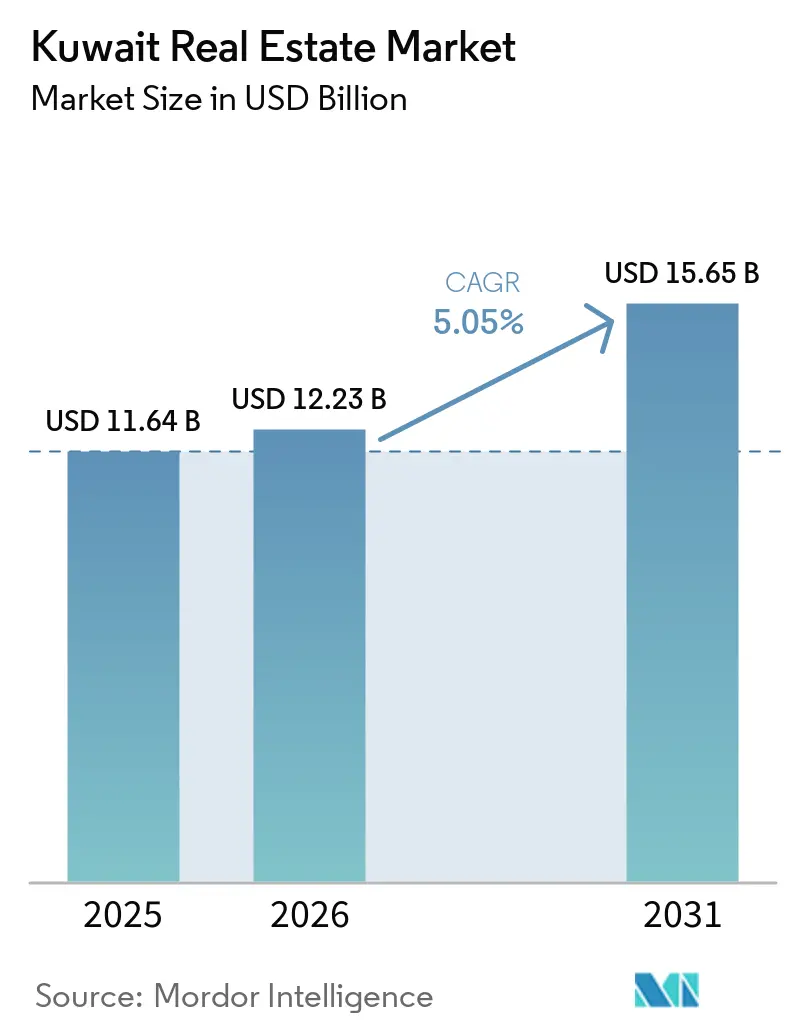
The Kuwait Real Estate Market size is projected to be USD 11.64 billion in 2025, USD 12.23 billion in 2026, and reach USD 15.65 billion by 2031, growing at a CAGR of 5.05% from 2026 to 2031.
The Kuwait real estate market entered 2026 after record sales in 2025, supported by investment-property activity and residential plot transactions. New rules on developer participation, land use, and foreign investment are changing the types of capital that can enter the Kuwait real estate market. Planned mortgage reform could increase access to housing finance, although the effect will depend on whether new homes reach the market at the same time. Infrastructure spending and private participation in new cities may shift more development toward southern and outer areas. Limited land in central districts, restricted individual foreign ownership, and uneven demand for office space continue to shape risk across the Kuwait real estate market.
Key Report Takeaways
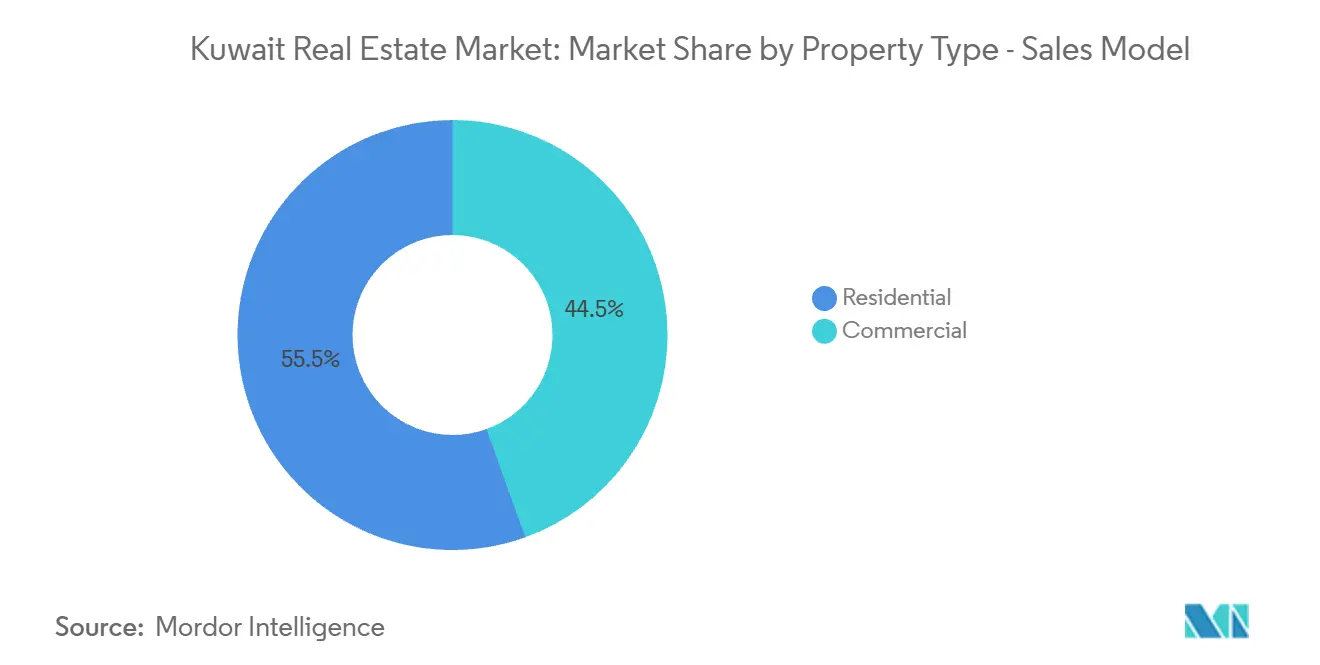
- By property type in the sales model, residential held 55.5% of the Kuwait real estate market share in 2025, while commercial is forecast to grow at a 5.73% CAGR through 2031.
- By governorate in the sales model, Kuwait City held 46.7% of the Kuwait real estate market share in 2025, while Al Ahmadi is forecast to grow at a 5.89% CAGR through 2031.
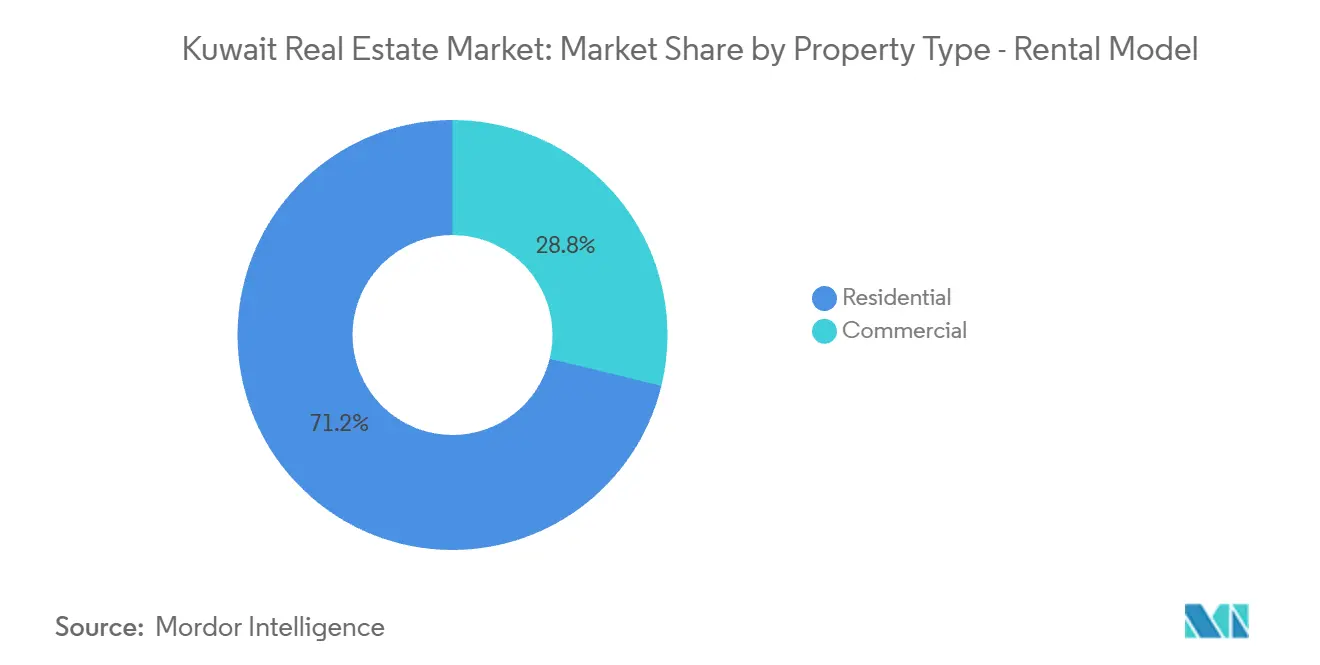
- By property type in the rental model, residential held 71.2% of the Kuwait real estate market size in 2025, while commercial is forecast to grow at a 6.03% CAGR through 2031.
- By governorate in the rental model, Kuwait City held 35.6% of the Kuwait real estate market size in 2025, while Mubarak Al-Kabeer is forecast to grow at a 6.09% CAGR through 2031.
Note: Market size and forecast figures in this report are generated using Mordor Intelligence’s proprietary estimation framework, updated with the latest available data and insights as of January 2026.
Kuwait Real Estate Market Trends and Insights
Drivers Impact Analysis*
| Drivers | (~) % Impact on CAGR Forecast | Geographic Relevance | Impact Timeline |
|---|---|---|---|
| Government-Led Housing and Infrastructure Investment | +1.3% | National, with emphasis on Al Ahmadi, new cities, and northern corridors | Medium term (2-4 years) |
| Population Growth and Expatriate Household Formation | +1.0% | National, with rental demand centered in Hawalli, Farwaniya, and Kuwait City | Short term (≤ 2 years) |
| Recovery in Investment Property and Commercial Transactions | +0.9% | Kuwait City and Hawalli | Short term (≤ 2 years) |
| Mortgage and Housing Finance Reform | +0.8% | National, with early activity in Kuwait City, Al Ahmadi, and Farwaniya | Medium term (2-4 years) |
| Integrated Mixed-Use and Destination Development | +0.5% | Al Ahmadi, Jaber Al-Ahmad City, and Mubarak Al-Kabeer | Long term (≥ 4 years) |
| Digitization of Property Discovery, Brokerage, and Management | +0.4% | National, led by urban areas | Medium term (2-4 years) |
| Source: Mordor Intelligence | |||
Government-Led Housing and Infrastructure Investment
Government-backed projects remain a central source of construction demand in the Kuwait real estate market. Law No. 60 of 2025 set a public debt ceiling of USD 97.6 billion, creating a basis for financing multiyear infrastructure programs. Kuwait opened international bidding in September 2025 for 30-year public-private partnership contracts for Al Khiran, Nawaf Al-Ahmad, and Al-Sabriyah. The 3 projects cover more than 300 hectares and target 170,000 homes, which could expand the development pipeline beyond state-led delivery alone[1]. The scale of these projects gives developers opportunities in housing, retail, services, and supporting infrastructure. Their delivery schedule will determine how quickly the additional supply affects the Kuwait real estate market.
Population Growth and Expatriate Household Formation
Household formation continues to support rental demand in the Kuwait real estate market. Kuwait’s population exceeded 5 million in mid-2025, and expatriates accounted for 70% of residents. Many expatriate households rent apartments in Hawalli, Farwaniya, and Kuwait City investment districts. Family visa resumptions and changes to work visa access since 2024 have widened the potential renter base. A London School of Economics study linked an increase of 6,134 applicants on the Public Authority for Housing Welfare waiting list to a 2.7% rise in residential prices[2]. Housing delivery will therefore remain important to keep rental and ownership demand from putting further pressure on affordability.
Recovery in Investment Property and Commercial Transactions
Investment-property activity strengthened the Kuwait real estate market during 2025. The investment segment reached an 11-year sales high in the second quarter of 2025, and transaction value increased 82% in the first half[3]. Demand was strongest in income-producing apartment buildings and established urban locations. Kuwait Finance House reported that commercial property demand nearly doubled year over year in the fourth quarter of 2025. Prime administrative and commercial areas in Kuwait City still attract tenants because supply is limited. Higher activity can broaden investor interest in logistics and mixed-use assets outside the core city, but the quality of tenant demand remains uneven across locations.
Mortgage and Housing Finance Reform
Mortgage reform could alter how citizens participate in the Kuwait real estate market. The draft law submitted to the Cabinet in September 2025 proposed bank loans of up to USD 649,000 with a 25-year repayment term, replacing the current reliance on the state housing lender. The proposal could give qualified households access to longer-term financing. It may also increase construction activity if demand is matched by new residential supply. The framework would need clear lending limits, collateral rules, and eligibility standards to manage borrower risk. If credit expands before supply, the same reform could raise home prices in the near term.
Restraints Impact Analysis*
| Restraints | (~) % Impact on CAGR Forecast | Geographic Relevance | Impact Timeline |
|---|---|---|---|
| Affordability Pressure and Residential Supply Shortages | -0.9% | National, especially in Kuwait City, Hawalli, and Farwaniya | Short term (≤ 2 years) |
| Restricted Foreign Ownership and Private Housing Access | -0.6% | National, with the greatest effect in private housing areas | Medium term (2-4 years) |
| Interest Rate, Deposit Yield, and Liquidity Competition | -0.5% | National, with greater exposure in Kuwait City and Hawalli | Short term (≤ 2 years) |
| Concentration of Prime Office and Retail Demand in Core Districts | -0.4% | Kuwait City and secondary governorates | Long term (≥ 4 years) |
| Source: Mordor Intelligence | |||
Affordability Pressure and Residential Supply Shortages
Affordability remains a material constraint on the Kuwait real estate market. Residential prices exceeded 22 times the average annual household income in the London School of Economics assessment. Public housing delivery has not fully absorbed the waiting list, and Reuters reported in 2025 that it could reach 197,000 applicants by 2035 if the issue remains unresolved. Higher construction costs also make private housing harder to deliver at accessible prices. The vacant residential land law, effective in January 2026, may encourage the development of idle plots. Its effectiveness will depend on whether released land results in homes that match household purchasing capacity.
Restricted Foreign Ownership and Private Housing Access
Restrictions on individual foreign ownership limit the buyer base for private housing. Decree Law No. 7 of 2025 widened ownership rights for listed companies with non-Kuwaiti shareholders, licensed real estate funds, investment portfolios, and authorized investment entities. It did not permit non-Kuwaiti individuals to acquire private residential land. This distinction allows indirect foreign participation through eligible vehicles while maintaining a limit on direct demand for private homes. The rule can constrain developers seeking a broader market for premium housing. It also keeps the Kuwait real estate market more dependent on citizen demand and local investment structures, while further legislative change would be required to widen direct foreign residential ownership.
*Our forecasts treat driver/restraint impacts as directional, not additive. The impact forecasts reflect baseline growth, mix effects, and variable interactions.
Segment Analysis
By Property Type in the Sales Model: Residential Holds the Largest Position
Residential accounted for 55.5% of sales value in 2025, making it the largest part of the Kuwait real estate industry under the sales model. Citizen demand for villas and landed homes supported this position. Apartments and condominiums also remained important in investment districts with active rental demand. Commercial property is forecast to record the fastest sales growth at a 5.73% CAGR from 2026 to 2031. Logistics, retail, office, and hospitality assets are the main components of this category. Commercial sales growth is supported by projects linked to new cities and logistics development.
Commercial growth will not be uniform across property types or locations. Prime office and retail assets in Kuwait City have stronger demand than secondary stock. The development of new urban areas could create demand for neighborhood retail, services, and warehouses. The Shuwaikh Port logistics city is expected to add logistics-related activity as it advances toward its planned 2028 completion. The proposed mortgage framework could support residential transactions when banks begin offering qualifying loans. Sales performance in the Kuwait real estate industry will therefore reflect both housing finance and the pace of commercial tenant absorption.
By Governorate in the Sales Model: Kuwait City Leads While Al Ahmadi Grows Fastest
Kuwait City held 46.7% of sales value in 2025, reflecting its concentration of financial, administrative, and commercial activity. It's established investment districts and access to major services that support property values. Al Ahmadi is forecast to be the fastest-growing sales geography at a 5.89% CAGR through 2031. Residential-city development, energy-related activity, and logistics investment support this outlook. Hawalli and Farwaniya continue to generate transactions because of their dense communities and large renter populations. Sales activity remains centered on Kuwait City, even as development shifts to outer governorates.
Al Ahmadi’s growth is tied to both housing and commercial uses. South Saad Al Abdullah had exceeded 39% completion on its road contract by June 2025. Farwaniya has a role in logistics and trade-related property because of its location and transport links. Hawalli continues to attract investment in apartment buildings that serve expatriate renters. The Rest of Kuwait, including Jahra and northern areas, has lower transaction activity but remains relevant to long-term public planning. The Kuwait real estate market is therefore becoming less dependent on one urban center, while Kuwait City retains the largest sales base.
By Property Type in the Rental Model: Residential Generates Most Rental Value
Residential represented 71.2% of the rental value in 2025, the largest share across the Kuwait real estate market rental model. Apartments and condominiums account for much of this demand in Hawalli and Farwaniya. Kuwait’s large expatriate population supports recurring demand for rented housing. Commercial property is forecast to grow fastest at a 6.03% CAGR from 2026 to 2031. This rate suggests that owners may retain income-producing commercial assets rather than sell them. Residential rental property remains dominant because household leasing has a larger base.
Commercial rental growth is linked to logistics, hospitality, and quality office space. Prime offices can maintain demand while secondary offices face vacancy risk. Kuwait Real Estate Company stated that its Sabhan Labor Housing project reached 95% completion in early 2026. The project adds institutional workforce accommodation, which could support contractors working on large development programs. Digital rental documentation may also improve consistency in lease administration. Rental performance in the Kuwait real estate market will depend on job creation, expatriate household demand, and delivery of commercial destinations.
Geography Analysis
Kuwait City held 46.7% of sales value and 35.6% of rental value in 2025, giving it the largest position in both transaction models. The city’s banking, government, diplomatic, and Grade-A commercial functions support this role. Investment property sales reached an 11-year high in the second quarter of 2025, with activity in Hawalli and Sharq contributing to momentum. United Real Estate Company won a tender in March 2026 for the upgrade, development, management, and operation of Souq Sharq Phase 3. This reinforces private interest in central commercial assets. Scarce plots and high land costs remain limits on new projects in the capital.
Al Ahmadi is expected to grow at a 5.89% CAGR in sales from 2026 to 2031, the highest sales rate among governorates. Its outlook combines residential-city construction with industrial, logistics, and energy-linked demand. Mubarak Al-Kabeer is forecast to grow at a 6.09% CAGR in rentals, the fastest rate across the 2 models. Large coastal destinations and lower-cost locations can attract households and commercial tenants moving beyond central districts. Activity in these governorates will depend on project delivery, road links, utilities, and local services. New-city public-private partnerships are intended to expand capacity in areas that have not historically had Kuwait City’s development base.
Hawalli and Farwaniya remain core locations for apartment rentals and investment-property transactions. Their proximity to the capital and established retail infrastructure support demand from expatriate households. Farwaniya also benefits from transport and trade-related activity. The Rest of Kuwait includes Jahra and northern areas that have lower current activity but receive attention in longer-term development planning. Mortgage reform could affect demand across all governorates when eligibility and collateral rules are defined. The Kuwait real estate market will continue to show different growth patterns because each area has a distinct mix of household demand, commercial activity, and available land.
Competitive Landscape
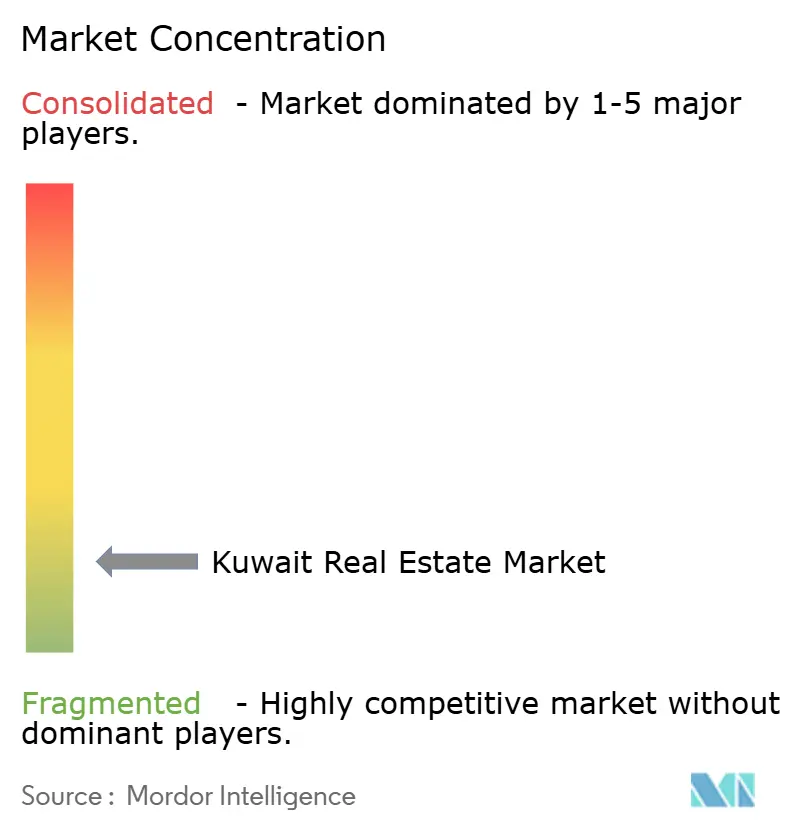
The Kuwait real estate market is moderately fragmented, with listed developers holding major project pipelines and smaller family-owned operators active in secondary investment properties. Larger companies focus on mixed-use destinations, public-private partnerships, and assets with recurring lease income. Mabanee reported a USD 7.8 billion project pipeline across Kuwait and Saudi Arabia in its second-quarter 2026 investor presentation. The Aventura project in Jaber Al-Ahmad City and the Souk Sabah project in Sabah Al-Ahmad City show the importance of long-term master-planned developments. The company also signed a preliminary purchase agreement in May 2026 for a portfolio of Kuwaiti real estate assets, indicating continuing interest in consolidation.
United Real Estate Company is expanding its position in premium and destination assets. Its March 2026 Souq Sharq Phase 3 award supports its presence in Kuwait City’s waterfront commercial area. The company’s collaboration with Nobu Hospitality also adds a branded residential and hospitality element to Hessah Plaza. Kuwait Real Estate Company reported FY 2025 revenue of USD 128.3 million, up 13.1% from the prior year, and identified international diversification as an important part of its strategy. These moves show that established developers are balancing domestic projects with regional exposure. Their scale gives them stronger access to financing and partnership opportunities than smaller operators.
Digital capability is becoming another point of competition in the Kuwait real estate market. Tamdeen Real Estate Company acquired a majority stake in the parent company of 4Sale International in June 2026 to expand its digital commerce presence. Zain Kuwait and United Real Estate Company also entered a June 2026 partnership to integrate 5G, fiber, and smart-city infrastructure in urban projects. Smaller brokers can compete through local knowledge and transaction networks, but they have fewer resources for large projects. No combined share for leading developers was supplied, so the company share cannot be used to rank concentration precisely. The Kuwait real estate market remains open to niche operators in rental housing, property services, and localized commercial projects.
Kuwait Real Estate Industry Leaders
-
Mabanee Company K.P.S.C.
-
United Real Estate Company K.S.C.P.
-
Kuwait Real Estate Company K.P.S.C. (AQARAT)
-
Salhia Real Estate Company K.S.C.P.
-
Tamdeen Real Estate Company K.P.S.C.
- *Disclaimer: Major Players sorted in no particular order
Recent Industry Developments
- September 2026: A Saudi Arabian subsidiary of Mabanee Company signed an agreement to acquire a 17,477-sqm plot in Riyadh for USD 30.1 million, to be developed as an investment property, extending Mabanee's regional pipeline beyond Kuwait as part of a USD 7.8 billion project portfolio.
- June 2026: Tamdeen Real Estate Company, through a subsidiary, acquired a majority stake in the parent company of 4Sale International to expand its digital commerce presence alongside its physical property portfolio, reinforcing the convergence of PropTech and traditional real estate.
- March 2026: URC won the KAPP tender for the upgrade, development, major maintenance, management, and operation of Souq Sharq Phase 3 in Kuwait City, a landmark waterfront commercial destination, signaling continued institutional commitment to prime commercial assets in the capital.
Kuwait Real Estate Market Report Scope
| Residential | Apartments and Condominiums |
| Villas and Landed Houses | |
| Commercial | Office |
| Retail | |
| Logistics | |
| Other Commercial Property, Including Industrial and Hospitality |
| Kuwait City |
| Al Ahmadi |
| Hawalli |
| Farwaniya |
| Rest of Kuwait |
| By Property Type | Residential | Apartments and Condominiums |
| Villas and Landed Houses | ||
| Commercial | Office | |
| Retail | ||
| Logistics | ||
| Other Commercial Property, Including Industrial and Hospitality | ||
| By Governorate | Kuwait City | |
| Al Ahmadi | ||
| Hawalli | ||
| Farwaniya | ||
| Rest of Kuwait | ||
Key Questions Answered in the Report
What is the Kuwait real estate market outlook through 2031?
The sector is forecast to grow from USD 12.23 billion in 2026 to USD 15.65 billion by 2031 at a 5.05% CAGR.
Which property type leads sales in Kuwait?
Residential-led sales with a 55.5% share in 2025, while commercial sales are expected to grow fastest at a 5.73% CAGR.
Which rental property category is growing fastest in Kuwait?
Commercial rental is forecast to grow at a 6.03% CAGR through 2031, while residential held 71.2% of rental value in 2025.
Which governorate has the fastest rental growth?
Mubarak Al-Kabeer is forecast to record a 6.09% CAGR in rental value from 2026 to 2031.
How could mortgage reform affect property demand in Kuwait?
The draft proposal would allow longer-term bank financing for qualifying buyers, but supply delivery will shape its effect on affordability.
Is the Kuwait real estate market concentrated?
The sector is moderately fragmented, with listed developers and many smaller family-owned participants active in different property categories.