
Kuwait Islamic Finance Market Size and Share
Market Overview
| Study Period | 2021 - 2032 |
|---|---|
| Forecast Data Period | 2027 - 2032 |
| Base Year Market Size (2026) | USD 198.60 Billion |
| Market Size (2027) | USD 211.5 Billion |
| Market Size (2032) | USD 295.30 Billion |
| Growth Rate (2027 - 2032) | 6.90 % |
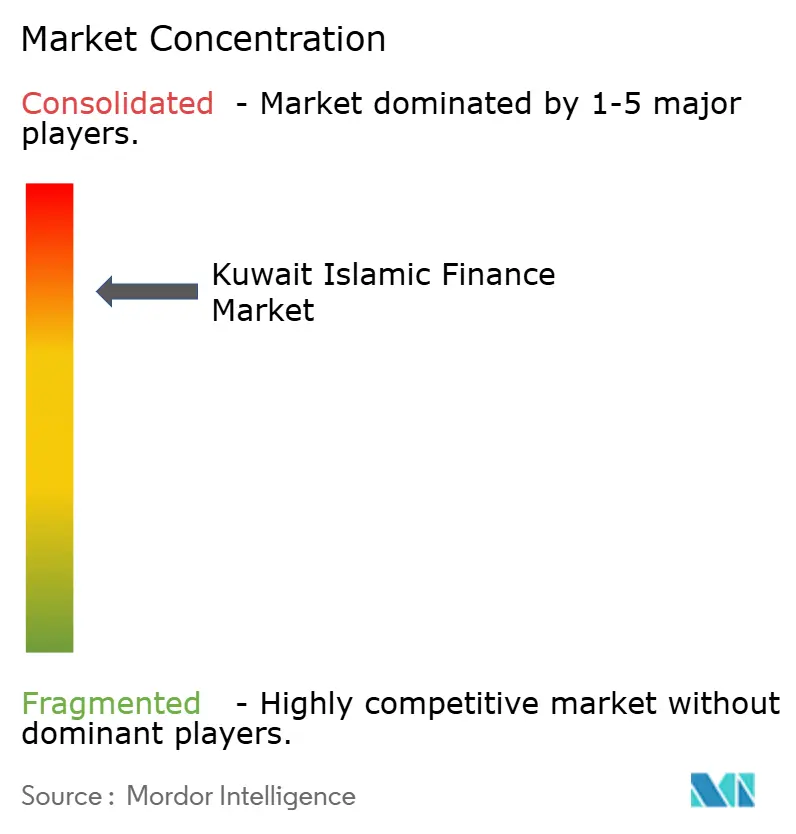
| Market Concentration | High |
Major Players *Disclaimer: Major Players sorted in no particular order Image © Mordor Intelligence. Reuse requires attribution under CC BY 4.0. | |
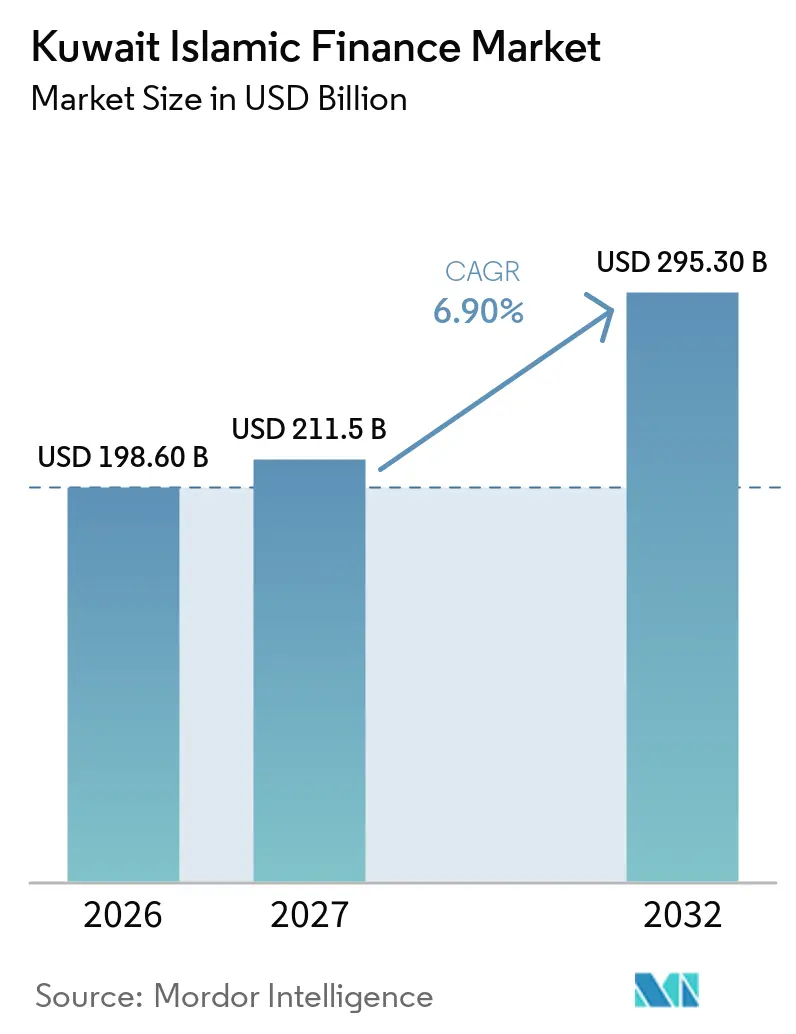
Kuwait Islamic Finance Market Analysis by Mordor Intelligence
The Kuwait Islamic Finance Market size is expected to increase from USD 198.60 billion in 2026 to USD 211.5 billion in 2027 and reach USD 295.30 billion by 2032, growing at a CAGR of 6.90% over 2027-2032.
Islamic banks held 51% of domestic banking assets in May 2026, confirming that Sharia-compliant banking is central to Kuwait’s financial system rather than a specialist activity. Decree-Law No. 60/2025 and Decree-Law No. 90/2026 created a legal basis for sovereign borrowing and government sukuk issuance, which can support a more active debt market. Mandatory health insurance for foreign residents is expanding the potential customer base for takaful providers. The Kuwait Islamic Finance market is also being shaped by digital banking, open banking rules, and a proposed bank merger that may alter the position of major lenders. Limited secondary trading in sukuk and a shortage of specialists with both Sharia and technology expertise remain constraints on market development.
Key Report Takeaways
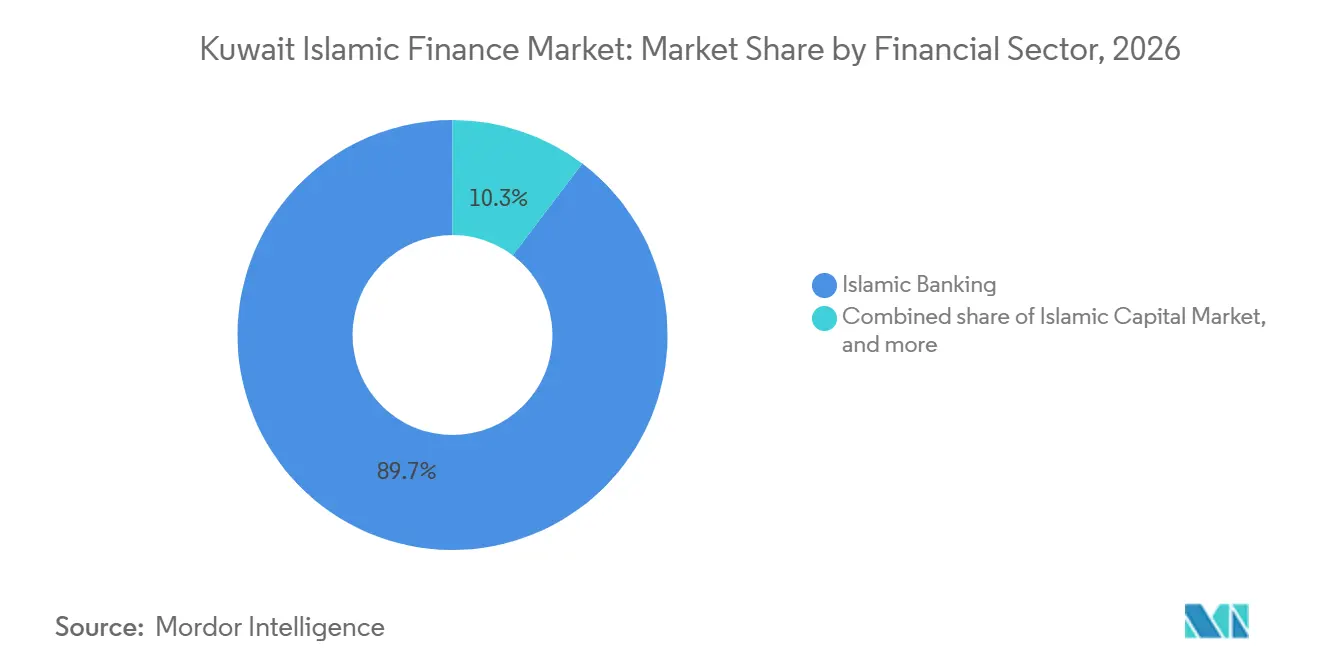
- By financial sector, Islamic banking captured 89.7% of the Kuwait Islamic Finance market share in 2026, while the Islamic capital market is projected to grow at a 9.6% CAGR through 2032.
- By customer type, large corporates captured 31.6% of the Kuwait Islamic Finance market share in 2026, while MSMEs are projected to grow at an 8.2% CAGR through 2032.
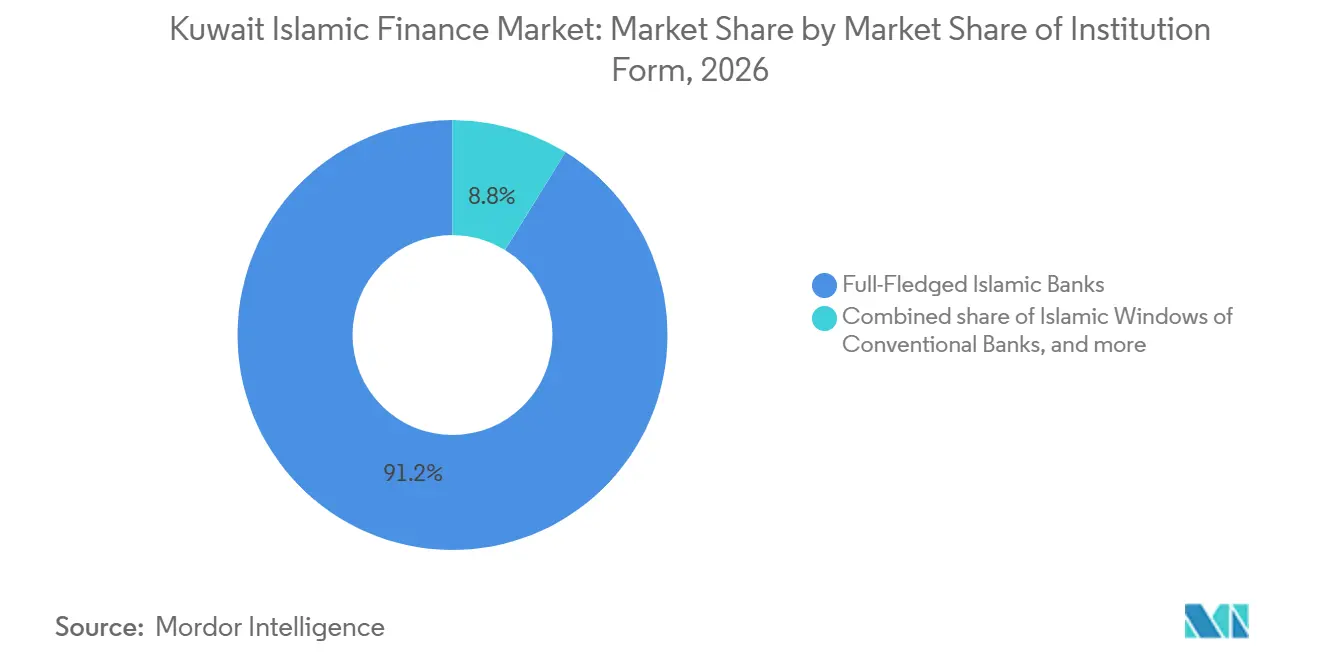
- By institution form, full-fledged Islamic banks captured 91.2% of the Kuwait Islamic Finance market in 2026, while licensed Islamic non-banks are projected to grow at a 9.2% CAGR through 2032.
- By geography, Al Asimah (Capital) captured 66.1% of the Kuwait Islamic Finance market in 2026, while Al Farwaniya is projected to grow at a 7.9% CAGR through 2032.
Note: Market numbers in this report are based on Mordor Intelligence's proprietary estimation framework, which combines nine months of actuals with Q4 projections for base year 2026.
Market Trends and Insights
Drivers Impact Analysis of Kuwait Islamic Finance Market*
| Driver | (~) % Impact on CAGR Forecast | Geographic Relevance | Impact Timeline |
|---|---|---|---|
| Sovereign Sukuk Pipeline After Public Debt Law | +2.0% | National, with strongest gains in Al Asimah capital markets hub | Medium term (2–4 years) |
| Islamic Banking Asset Share Approaching Half of Domestic Banking | +1.5% | National, particularly across Al Asimah and Hawalli | Medium term (2–4 years) |
| Digital Islamic Banking and Open Banking Modernization | +1.2% | National, with access across all 6 governorates through mobile platforms | Short term (≤2 years) |
| Mandatory Health Coverage Expanding Takaful Pools | +0.8% | National, with highest relevance in Al Farwaniya and Hawalli | Short term (≤2 years) |
| Green and Sustainable Sukuk Demand | +0.7% | Global, with domestic relevance through Al Asimah institutions | Long term (≥4 years) |
| Rising Islamic Investment and Wealth Management Demand | +0.6% | National, with strongest relevance in Al Asimah and affluent urban centers | Medium term (2–4 years) |
| Source: Mordor Intelligence | |||
Sovereign Sukuk Pipeline After Public Debt Law
Decree-Law No. 60/2025 authorized KWD 30 billion (USD 100 billion) in borrowing over 50 years after its promulgation on March 26, 2025. Decree-Law No. 90/2026 established a 35-article framework for government sukuk in Kuwaiti dinars and foreign currencies, using a state-owned special purpose vehicle to manage underlying assets. Kuwait’s debt capital market reached USD 52 billion by the end of the first half of 2026, with USD 9.2 billion in outstanding sukuk, equal to 18% of the debt market[1]. The government pipeline can establish a reference yield curve for corporate and government-related issuers. This can provide the Kuwait Islamic finance market with a more reliable pricing base and reduce the need for issuers to rely on separate transaction benchmarks. Green and sustainable sukuk demand can add to this opportunity as institutions develop eligible projects and products.
Islamic Banking Asset Share Approaching Half of Domestic Banking
Kuwait Finance House, Boubyan Bank, Kuwait International Bank, and Warba Bank held KWD 53 billion (USD 172 billion) in combined assets in May 2026, equal to 51% of domestic banking assets. Kuwait Finance House reported KWD 42.8 billion (USD 139.1 billion) in total assets for 2025, following 16.5% annual growth[2]. Its net profit reached KWD 632.1 million (USD 2.1 billion) in 2025, up 5.0% from the prior year. The Central Bank of Kuwait applies capital, liquidity, governance, and Sharia supervisory requirements to Islamic banks within its regulatory framework. This framework supports competition based on products and customer service rather than only branch expansion. As the Kuwait Islamic Finance market matures, banks are placing greater weight on digital delivery and differentiated financing offers.
Digital Islamic Banking and Open Banking Modernization
The Central Bank of Kuwait issued a proposed open banking regulatory framework in June 2025. The framework is intended to allow banks and fintech firms to introduce open banking services in stages aligned with Kuwait Vision 2035. Boubyan Bank upgraded its iMAL core platform in July 2025 and reported a 42% improvement in processing response time. More than 95% of Boubyan Bank customer transactions were digital in 2025[3]. Consent-based information sharing can help lenders assess customers who have limited conventional credit records. This may improve financing access for small businesses and independent workers in the Kuwait Islamic Finance market.
Mandatory Health Coverage Expanding Takaful Pools
Ministerial Decision No. 306/2025 took effect on December 23, 2025, and set the annual health insurance fee for most foreign residents at KWD 100 (USD 325)[4]. The requirement also extended mandatory coverage to visit visas. The Ministry of Health projected annual revenue above KWD 200 million (USD 650 million) from the new framework. Takaful providers can gain from a larger compulsory insurance pool, especially in governorates with substantial expatriate populations. Bank-affiliated takaful businesses have a distribution advantage because they can offer cover through existing customer relationships. The Kuwait Islamic Finance industry may therefore see more interest in insurance businesses that can add fee income to banking groups.
Restraints Impact Analysis of Kuwait Islamic Finance Market*
| Restraint | (~) % Impact on CAGR Forecast | Geographic Relevance | Impact Timeline |
|---|---|---|---|
| Thin Domestic Sukuk Secondary Market Liquidity | -0.8% | National, concentrated in Al Asimah capital markets ecosystem | Medium term (2–4 years) |
| Dual Regulatory Compliance Cost for Islamic Investment Firms | -0.6% | National, most acute for non-bank Islamic financial institutions | Medium term (2–4 years) |
| Shortage of Sharia and Technology Hybrid Talent | -0.4% | National, affecting all governorates | Long term (≥4 years) |
| Limited Product Diversification Across Islamic Financial Services | -0.5% | National, with stronger relevance in Al Asimah and major financial centers | Medium term (2–4 years) |
| Source: Mordor Intelligence | |||
Thin Domestic Sukuk Secondary Market Liquidity
Outstanding sukuk totaled USD 9.2 billion at the end of the first half of 2026, representing 18% of Kuwait’s USD 52 billion debt capital market. Limited secondary-market trading reduces the ability of investors to exit positions and restricts price formation. Islamic banks may consequently hold sukuk mainly for liquidity management instead of trading. Resolution No. 101/2025 enabled the listing and trading of bonds, sukuk, exchange-traded funds, and derivatives on Boursa Kuwait from July 13, 2025. This action can improve market access, but the depth of trading will depend on the development of a sovereign benchmark curve. The Kuwait Islamic Finance market will remain exposed to this liquidity constraint until more issuers and investors participate consistently.
Dual Regulatory Compliance Cost for Islamic Investment Firms
Islamic investment firms and fund managers must meet the Central Bank of Kuwait's prudential requirements and the Capital Markets Authority's obligations. Islamic fund managers also require an opinion from the Capital Markets Authority Sharia Council for fund compliance. This raises the operating cost for smaller non-bank institutions relative to Islamic banks. The pressure is important because sukuk and sustainable instruments require capable intermediaries for distribution and investment management. A shortage of professionals with Sharia credentials and technology skills adds to the operational burden. These requirements can slow expansion in the non-bank part of the Kuwait Islamic Finance market, even as new issuance opportunities emerge.
*Our forecasts treat driver/restraint impacts as directional, not additive. The impact forecasts reflect baseline growth, mix effects, and variable interactions.
Kuwait Islamic Finance Market Segment Analysis
By Financial Sector:
Islamic Banking Anchors the Market as Capital Market Growth AcceleratesIslamic banking holds 89.7% of the Kuwait Islamic Finance market size in 2026, which makes it the leading financial sector. Kuwait Finance House accounted for 60% of domestic Islamic banking assets in 2026. Boubyan Bank reported a KWD 7.7 billion (USD 25.0 billion) financing portfolio at the end of 2025 and a 12.3% share of local financing. The Islamic capital market is projected to grow at a 9.6% CAGR through 2032. Sovereign sukuk issuance can support corporate sukuk pricing and create new mandates for capital-market firms. Takaful, pension, and financing companies remain smaller but can provide banking groups with additional fee-income opportunities.
The Islamic capital-market segment includes sukuk and Islamic funds. Its growth depends on the legal framework for government sukuk and wider access to listed instruments. Kuwait Finance House Capital led and arranged USD 17.8 billion in sukuk issuances across the Gulf Cooperation Council in 2024. The firm also participated in 6 sustainable transactions worth USD 3.8 billion across Kuwait, Qatar, and the United Arab Emirates during 2024 and 2025. Kuwait’s bond and sukuk issuances grew 515% in 2025 as the public-debt framework supported the pipeline. The Kuwait Islamic Finance market can retain more issuance activity domestically if listed sukuk trading develops as intended.
By Customer Type:
MSME Finance Is the Fastest-Growing but Most Structurally Underpenetrated SegmentLarge corporates hold 31.6% of the Kuwait Islamic Finance market in 2026. Their role reflects demand for structured funding from government-linked organizations, real estate companies, and service businesses. MSMEs are projected to expand at 8.2% CAGR through 2032. Open banking tools can give lenders more information for credit decisions involving small businesses. Murabaha supply-chain finance and ijara arrangements can also match the operating needs of firms that rely on equipment or working capital.
Boubyan Bank’s digital transaction banking platform can support cash management and trade finance services for smaller enterprises. Retail customers, government and government-related entities, and financial institutions form the other customer groups. National Bank of Kuwait led a KWD 1.5 billion (USD 4.9 billion) Sharia-compliant syndicated facility for Kuwait Petroleum Corporation in 2025. Government-related entities can be both borrowers and sukuk issuers. Retail demand remains linked to consumer and housing finance, where lower financing rates can support customer activity.
By Institution Form:
Full-Fledged Islamic Banks Dominate, While Non-Banks Grow from a Low BaseFull-fledged Islamic banks hold 91.2% of the Kuwait Islamic finance market in 2026. The segment includes 4 domestic Islamic banks and Al Rajhi Bank’s Kuwait branch. Kuwait Finance House has a first-mover position because it was established in 1977. The Central Bank of Kuwait sets standards for capital adequacy, risk management, governance, and liquidity in Sharia-compliant operations. Warba Bank and Gulf Bank proposed a merger that could create the second-largest Islamic banking group in Kuwait.
Licensed Islamic non-banks are projected to grow at a 9.2% CAGR through 2032. The group includes takaful companies, Sharia-compliant fund managers, and financing companies. Mandatory health coverage increases the demand base for takaful products. A larger sovereign sukuk program can also create work for Islamic capital-market intermediaries. Islamic windows of conventional banks occupy a position between the two main institution forms. Gulf Bank’s planned conversion to Sharia compliance may strengthen the role of full-fledged Islamic lenders in the Kuwait Islamic finance market.
Geography Analysis
Al Asimah (Capital) holds 66.1% of the Kuwait Islamic Finance market in 2026. It is the center for Islamic bank headquarters, sukuk origination, fund management, and takaful operations. Kuwait Finance House reported KWD 42.8 billion (USD 139.1 billion) in assets for 2025. Boubyan Bank reported KWD 10.2 billion (USD 33.2 billion) in total assets for 2025. The Ministry of Finance and the Central Bank of Kuwait are located in this governorate. Their location supports Al Asimah’s role in coordinating future sovereign sukuk issuance.
Al Farwaniya is projected to grow at a 7.9% CAGR through 2032. It has a large expatriate population, which increases the importance of retail banking and compulsory takaful coverage. The health insurance requirement can create a broader base of insured private-sector employees and domestic workers. Hawalli also has a substantial professional and middle-income resident population. Its commercial districts support retail Islamic banking and takaful demand. Digital channels can help both governorates reach customers without expanding physical branch networks.
Al Ahmadi supports Islamic corporate finance demand through oil and energy infrastructure and related government-linked entities. Infrastructure development under Kuwait Vision 2035 can create additional demand for Sharia-compliant project financing. Al Jahra and Mubarak Al-Kabeer represent smaller but expanding areas of the Kuwait Islamic Finance market. Boubyan Bank and Warba Bank have pursued domestic retail expansion through their branch networks. Mobile banking may further reduce access gaps between these governorates and Al Asimah. The United Kingdom, the United States, and the Asia-Pacific region are not geographic segments of this Kuwait-focused assessment.
Competitive Landscape
The Kuwait Islamic finance market has a concentrated banking structure with 4 domestic full-fledged Islamic banks, 1 foreign Islamic branch, and more than 16 licensed takaful operators. Kuwait Finance House held 60% of Islamic banking assets in 2026. Banks compete for corporate and MSME financing mandates, as well as for deposits and retail customers. Kuwait Finance House uses its regional network and sukuk capabilities to support its position. Boubyan Bank emphasizes digital services and small-business banking. Warba Bank and Kuwait International Bank have participated in sukuk and sustainable financing activities.
Boubyan Bank completed a USD 300 million Sharia-compliant syndicated facility in July 2025 with HSBC, Bank of China, and ICBC. The transaction expanded its access to cross-border Islamic liquidity. Kuwait International Bank issued USD 300 million in Tier 2 sustainable trust certificates in October 2025 under its USD 1.5 billion trust certificate program. Gulf Bank is preparing to operate in line with Sharia principles following initial Central Bank approval. Its proposed merger with Warba Bank could make it the second-largest Islamic bank in the country. The transaction would increase concentration among the largest competitors.
The Capital Markets Authority Sharia Council has an important gatekeeping role for Islamic fund launches. This requirement can protect compliance standards, but can also raise entry requirements for new firms. Takaful opportunities are expanding through mandatory health coverage. Small-business supply-chain finance can also offer room for differentiation among banks. Wealth services for mass-affluent Kuwaiti nationals remain an opportunity for Islamic fund managers. The competitive position of the Kuwait Islamic finance industry will depend on whether banks and non-banks can convert regulatory changes into products that customers use.
Kuwait Islamic Finance Industry Leaders
-
Kuwait Finance House K.S.C.P.
-
Boubyan Bank K.S.C.P.
-
Warba Bank K.S.C.P.
-
Kuwait International Bank K.S.C.P.
-
Al Rajhi Banking and Investment Corporation Kuwait
- *Disclaimer: Major Players sorted in no particular order
Kuwait Islamic Finance Market Companies Covered in this Report
- Kuwait Finance House K.S.C.P.
- Boubyan Bank K.S.C.P.
- Warba Bank K.S.C.P.
- Kuwait International Bank K.S.C.P.
- Al-Rajhi Bank
- Gulf Bank K.S.C.P.
- A'ayan Leasing & Investment Company K.S.C.P.
- Al-Manar Financing & Leasing Company K.S.C.C.
- Amar Finance and Leasing Company K.S.C.C.
- Al-Masar Leasing & Investment Company K.S.C.C.
- National Leasing & Financing Company K.S.C.P.
- Al-Riyada Financing & Investment Company K.S.C.C.
- Hayat Invest Company K.S.C. (Closed)
- Noor Financial Investment Company K.S.C.P.
- First Takaful Insurance Company K.P.S.C.
- Wethaq Takaful Insurance Company K.P.S.C.
- Kuwait International Takaful Insurance Company K.S.C.C. (KITI)
- Tazur Takaful Insurance Company K.S.C.C.
- Zamzam Takaful Insurance Company K.S.C.C.
- Gulf Insurance Group K.S.C.P. (GIG Kuwait)
Recent Industry Developments in Kuwait Islamic Finance Market
- August 2026: Gulf Bank completed the regulatory and operational requirements for its planned conversion into a Sharia-compliant bank and moved forward with the process of obtaining CBK approval. The bank also continued progressing with the proposed merger with Warba Bank, although the merger remained subject to completion of due diligence, agreement on key terms, and required regulatory and shareholder approvals.
- February 2026: Kuwait International Bank received IFN's “Regulatory Deal of the Year 2025” award for its USD 300 million Tier 2 sustainable Sukuk, which was issued in October 2025. KIB states that the transaction was the first sustainable Sukuk issued by a Kuwaiti institution.
- January 2026: KFH reported KWD 632.1 million (USD 2.05 billion) in net profit attributable to shareholders for FY2025, up 5.0% year over year.
- January 2026: Boubyan Bank reported KWD 100.5 million (USD 326.6 million) in net profit for FY2025, up 4% year over year, and the financing portfolio increased 11% to KWD 7.7 billion (USD 25.0 billion).
Kuwait Islamic Finance Market Report Scope
Segmentation Overview
| Islamic Banking | |
| Islamic Capital Market | Sukuk |
| Islamic Funds | |
| Islamic Non-Bank Financial Institutions | Takaful / Islamic Insurance |
| Others (Pension, Financing Companies, etc.) |
| Retail / Individual Customers |
| MSMEs |
| Large Corporates |
| Government & Government-Related Entities |
| Financial Institutions |
| Other Customer Types |
| Full-Fledged Islamic Banks |
| Islamic Windows of Conventional Banks |
| Licensed Islamic Non-Bank Institutions (Takaful, Fund Managers, and Other Licensed Non-Banks) |
| Al Asimah (Capital) Governorate |
| Hawalli Governorate |
| Al Farwaniya Governorate |
| Al Ahmadi Governorate |
| Al Jahra Governorate |
| Mubarak Al-Kabeer Governorate |
| By Financial Sector | Islamic Banking | |
| Islamic Capital Market | Sukuk | |
| Islamic Funds | ||
| Islamic Non-Bank Financial Institutions | Takaful / Islamic Insurance | |
| Others (Pension, Financing Companies, etc.) | ||
| By Customer Type | Retail / Individual Customers | |
| MSMEs | ||
| Large Corporates | ||
| Government & Government-Related Entities | ||
| Financial Institutions | ||
| Other Customer Types | ||
| By Institution Form | Full-Fledged Islamic Banks | |
| Islamic Windows of Conventional Banks | ||
| Licensed Islamic Non-Bank Institutions (Takaful, Fund Managers, and Other Licensed Non-Banks) | ||
| By Geography | Al Asimah (Capital) Governorate | |
| Hawalli Governorate | ||
| Al Farwaniya Governorate | ||
| Al Ahmadi Governorate | ||
| Al Jahra Governorate | ||
| Mubarak Al-Kabeer Governorate | ||
Key Questions Answered in the Report
What is the Kuwait Islamic Finance market size?
The Kuwait Islamic Finance market is expected to be USD 198.6 billion in 2026 and USD 211.5 billion in 2027.
What is the forecast growth rate through 2032?
The market is forecast to reach USD 295.3 billion by 2032, growing at a 6.9% CAGR from 2027 to 2032.
Which financial sector leads Sharia-compliant finance in Kuwait?
Islamic Banking holds 89.7% share in 2026, while Islamic Capital Market is projected to expand at a 9.6% CAGR through 2032.
Why is government sukuk important to Kuwait?
The 2025 and 2026 laws support sovereign sukuk issuance, which can provide a benchmark for corporate and government-related issuers.
Which customer group is growing fastest?
MSMEs are projected to grow at an 8.2% CAGR through 2032, supported by digital credit assessment and supply-chain finance structures.
Which governorate is growing fastest?
Al Farwaniya is projected to grow at a 7.9% CAGR through 2032, supported by its large expatriate population and demand for takaful coverage.