
Knotless Tissue Control Devices Market Size and Share
Market Overview
| Study Period | 2020 - 2031 |
|---|---|
| Market Size (2026) | USD 1 Billion |
| Market Size (2031) | USD 1.33 Billion |
| Growth Rate (2026 - 2031) | 5.78 % |
| Fastest Growing Market | Asia-Pacific |
| Largest Market | North America |
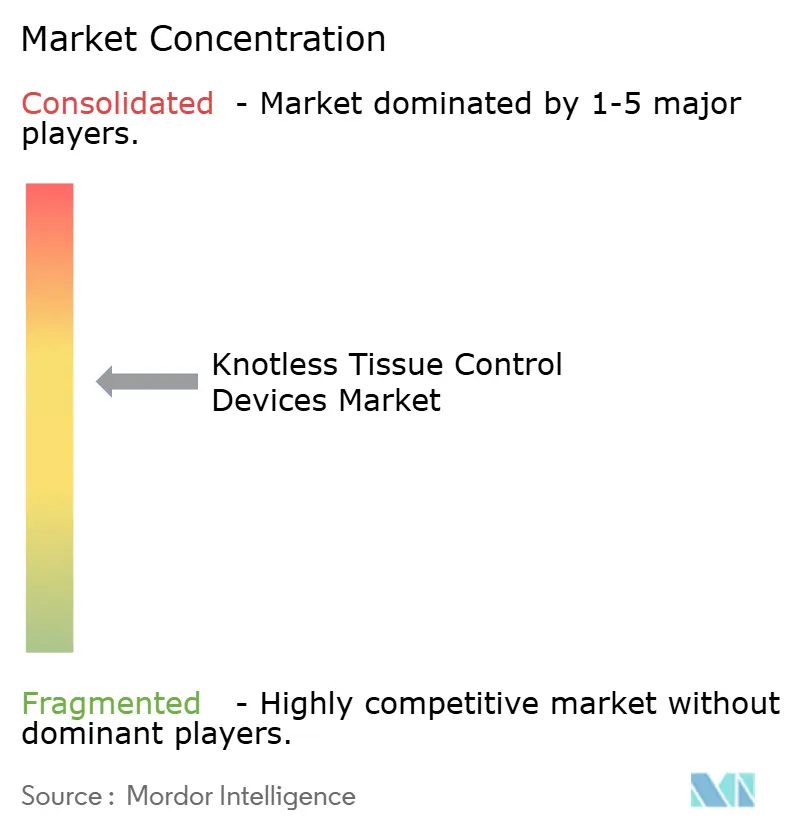
| Market Concentration | Medium |
Major Players *Disclaimer: Major Players sorted in no particular order Image © Mordor Intelligence. Reuse requires attribution under CC BY 4.0. | |
Knotless Tissue Control Devices Market Analysis by Mordor Intelligence
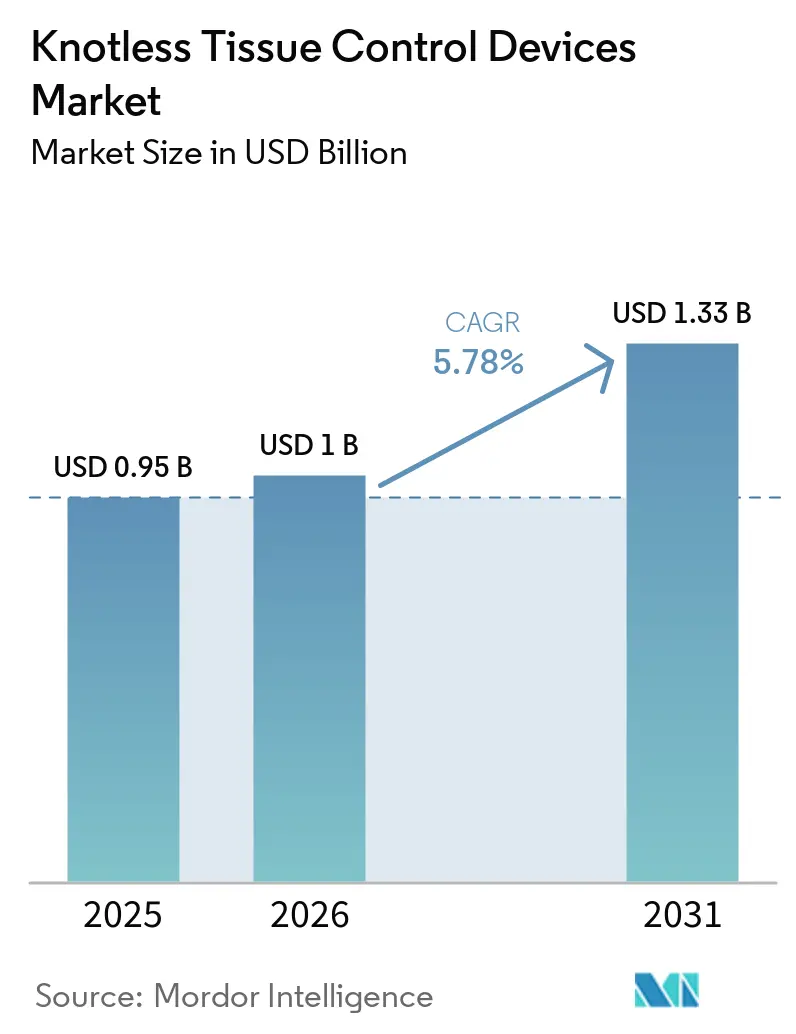
The Knotless Tissue Control Devices Market size is expected to grow from USD 0.95 billion in 2025 to USD 1 billion in 2026 and is forecast to reach USD 1.33 billion by 2031 at 5.78% CAGR over 2026-2031.
Growth reflects wider use of robotic surgery, a shift toward knotless soft-tissue closure, and rising outpatient procedure volumes. The Knotless Tissue Control Devices Market serves a focused clinical need because barbed devices remove the need for conventional knot tying and support more consistent closure workflows. The move of elective procedures into ambulatory surgical centers creates a distinct buying environment in which facilities assess operating-room efficiency directly rather than relying only on hospital purchasing structures. Robotic platforms are extending into additional specialties, so the Knotless Tissue Control Devices Market can expand with installed surgical infrastructure without requiring a separate clinical-evidence campaign for every procedure.
Key Report Takeaways
- By product type, non-absorbable polymer devices held 42.31% revenue share in 2025, while long-term absorbable devices are forecast to grow at a 6.65% CAGR through 2031.
- By barb architecture, unidirectional devices held 58.24% revenue share in 2025 and are expected to grow at a 6.22% CAGR through 2031.
- By anchor design, loop-end devices held 55.14% revenue share in 2025, while fixation-tab devices are forecast to grow at a 6.42% CAGR through 2031.
- By application, general surgery held 27.54% revenue share in 2025, while gynecological and obstetric surgery is forecast to grow at a 6.12% CAGR through 2031.
- By end user, hospitals held 63.61% revenue share in 2025, while ambulatory surgical centers are forecast to grow at a 7.65% CAGR through 2031.
- By geography, North America held 41.61% revenue share in 2025, while Asia-Pacific is forecast to grow at a 7.65% CAGR through 2031.
Note: Market size and forecast figures in this report are generated using Mordor Intelligence’s proprietary estimation framework, updated with the latest available data and insights as of January 2026.
Global Knotless Tissue Control Devices Market Trends and Insights
Drivers Impact Analysis*
| Driver | (~) % Impact on CAGR Forecast | Geographic Relevance | Impact Timeline |
|---|---|---|---|
| Expansion Of Minimally Invasive And Robotic Soft-Tissue Closure | +1.3% | Global, led by North America and Europe | Medium term (2-4 years) |
| Operating-Room Time And Throughput Economics | +0.9% | North America and APAC core | Short term (≤ 2 years) |
| Growth In Surgical Volumes And Outpatient Procedures | +1.1% | Global, strongest in Asia-Pacific | Medium term (2-4 years) |
| Antibacterial And Extended-Support Polymer Innovation | +0.7% | North America and EU | Medium term (2-4 years) |
| Knotless Closure In Deep And High-Tension Anatomy | +0.6% | North America and EU, with spillover to APAC | Long term (≥ 4 years) |
| Procedure-Specific Standardization In Robotic Surgery | +0.5% | Global, led by North America | Long term (≥ 4 years) |
| Source: Mordor Intelligence | |||
Expansion Of Minimally Invasive And Robotic Soft-Tissue Closure
Robotic surgery is reshaping demand for knotless closure beyond a simple increase in procedure volumes. A retrospective study of more than 220,000 U.S. patients found that use of knotless devices in robotic total hysterectomy rose from 2.9% to 10.4% over 7 years. Use in ventral hernia repair rose from 12.2% to 25.3% during the same observation period. In robotic cardiac surgery, V-Loc barbed sutures reduced left atrial closure time by 31.3%, or 11 minutes compared with 16 minutes for conventional sutures, without a rise in reoperation or major complications. Robotic suites often standardize device protocols during team training, which can make conventional sutures less favored within established workflows. This effect supports the Knotless Tissue Control Devices Market as robotic programs broaden across orthopedics, urology, general surgery, and oncology.
Operating-Room Time And Throughput Economics
The operating-room case for knotless devices rests on time savings that can improve daily capacity. In robotic total hysterectomy, knotless devices reduced adjusted operating-room time by 19.1 minutes. Ventral hernia repair recorded a 17.3-minute reduction in adjusted operating-room time. The reported savings equated to USD 700 to USD 2,158 per hysterectomy case and USD 640 to USD 1,955 per hernia repair case, depending on the operating-room cost applied. A single operating room in an ambulatory surgical center commonly manages 4 to 6 cases each day. Recovering 17 to 19 minutes can allow capacity for an additional case, making the revenue case more direct for these facilities. This operational setting strengthens the Knotless Tissue Control Devices Market, where procurement decisions are closely tied to patient throughput.
Growth In Surgical Volumes And Outpatient Procedures
Rising surgical volumes and same-day care are supporting demand for predictable soft-tissue closure. The OECD reported that ambulatory surgery increased substantially across member countries over recent decades. Cataract surgery exceeded a 90% ambulatory rate in most OECD countries by 2023, illustrating the direction of elective care delivery[1]Organisation for Economic Co-operation and Development, “Ambulatory Surgery,” Health at a Glance 2025, oecd.org.. In centers with short postoperative monitoring periods, closure that maintains tension without reliance on knot integrity can be preferred. Same-day laparoscopic hernia repair, minimally invasive spine surgery, and selected joint replacements are expanding the surgical settings relevant to these devices. Hospital expansion in China and India also creates demand for advanced closure in settings where conventional sutures historically dominated. These changes enlarge the Knotless Tissue Control Devices Market across established outpatient networks and newer hospital capacity.
Antibacterial Innovation And High-Tension Closure
Polymer innovation is broadening the role of knotless closure from mechanical approximation toward infection prevention and extended tissue support. In November 2025, the FDA cleared Ethicon’s PDS Plus Antibacterial suture with Triclosan content of 42 to 2,360 µg/m and wound support of up to 6 weeks. The product demonstrated antibacterial activity against MRSA, MRSE, E. coli, and K. pneumoniae. Ethicon received clearance for MONOCRYL Plus Antibacterial in February 2026, extending the combination to a faster-absorbing poliglecaprone-25 material. In May 2026, clearance for STRATAFIX Symmetric PDS Plus expanded knotless use into high-tension fascia applications, including abdominal wall fascia, knee extensor mechanism fascia, deep hip fascia, and ventral hernia closure. These developments give the Knotless Tissue Control Devices Market a pathway into applications where tissue support, antibacterial performance, and closure efficiency are considered together.
Restraints Impact Analysis*
| Restraint | (~) % Impact on CAGR Forecast | Geographic Relevance | Impact Timeline |
|---|---|---|---|
| Clinical Heterogeneity Versus Conventional Sutures | -0.8% | Global | Medium term (2-4 years) |
| Barbed-End Entanglement And Dehiscence Risk | -0.6% | Global | Short term (≤ 2 years) |
| Premium Pricing And Hospital Value-Analysis Scrutiny | -0.9% | North America and Europe | Short term (≤ 2 years) |
| Training, Labeling, And Regulatory Complexity Across Indications | -0.5% | EU and Asia-Pacific | Medium term (2-4 years) |
| Source: Mordor Intelligence | |||
Premium Pricing And Access Requirements
Premium pricing remains an access issue for manufacturers pursuing hospital adoption. Barbed knotless devices were indicated at USD 150 to USD 350 per box of 12 to 24 units in U.S. list pricing, although group-purchasing contracts can reduce realized prices. Hospital value-analysis committees review device additions against the clinical and financial return they can demonstrate. A peer-reviewed evaluation reported average savings of USD 48.8 per total knee arthroplasty case for barbed versus traditional sutures. That saving may not always be sufficient for premium-tier procurement in the hospital channel. New FDA-cleared products from India and South Korea entered the U.S. market in 2025, adding price competition against established suppliers.
Clinical Consistency, Safety, And Adoption Complexity
Published evidence shows consistent operating-time benefits but mixed clinical advantages over conventional sutures. In a study of more than 220,000 U.S. robotic cases, wound complications and index hospital costs were statistically similar for knotless and conventional sutures in colorectal, hysterectomy, and ventral hernia cohorts. A 2026 robotic bariatric study reported lower 90-day composite complications of 2.1% versus 8.3% and a shorter length of stay of 1.34 versus 1.62 days with knotless devices, while index costs did not differ significantly. Benefits are most apparent in robotic settings, where confined workspaces and the absence of an assistant make knot-free closure mechanically useful. In open and laparoscopic procedures, surgeon technique variability can narrow the measured advantage. Barbed-end entanglement, dehiscence concerns, training demands, labeling obligations, and differing regulatory requirements can therefore slow use outside well-defined indications.
*Our forecasts treat driver/restraint impacts as directional, not additive. The impact forecasts reflect baseline growth, mix effects, and variable interactions.
Segment Analysis
By Product Type: Non-Absorbable Polymer Devices Lead While Absorbable Portfolios Advance
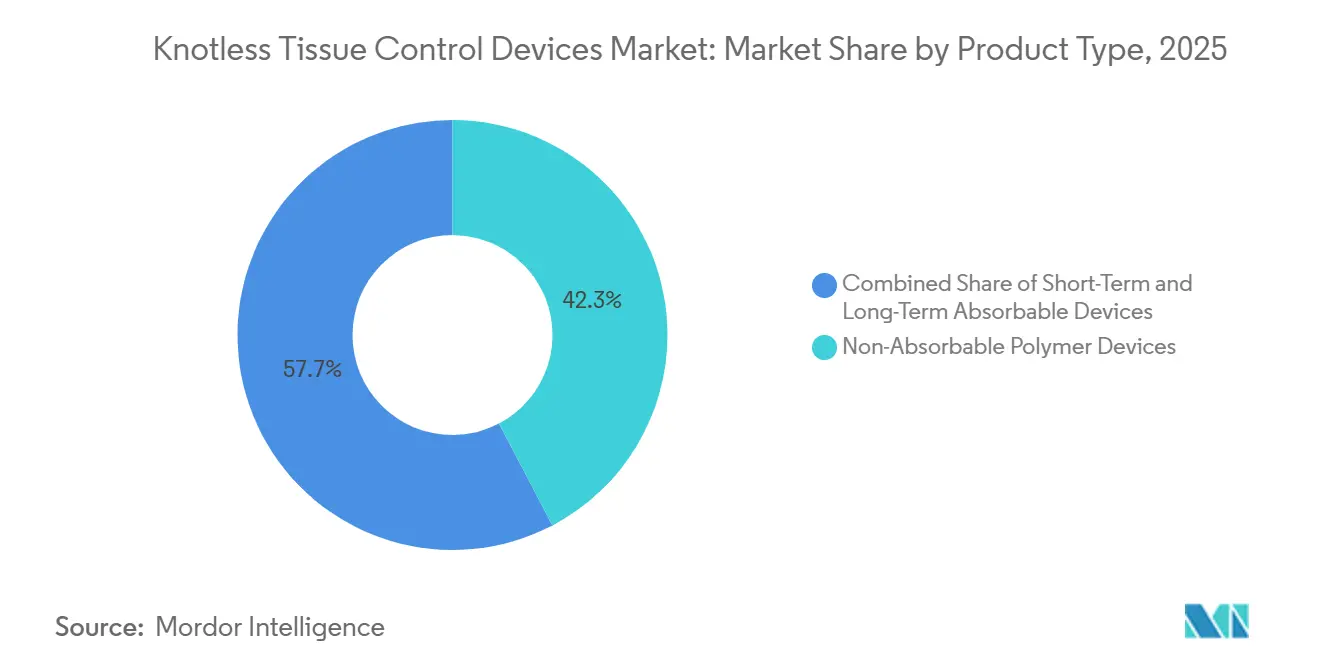
Non-absorbable polymer devices captured 42.31% of the Knotless Tissue Control Devices Market share in 2025. Their position reflects use in permanent and semi-permanent tissue fixation, especially in orthopedic and cardiovascular procedures where mechanical integrity must remain over time. The material is suited to clinical settings in which degradation would conflict with the functional need for continuing support. Short-term absorbable products form a middle tier for gynecological and general soft-tissue approximation. Their absorption pattern aligns with wound-healing periods of 2 to 6 weeks. Product selection is therefore tied to the anticipated healing profile and the level of mechanical support required after the procedure.
Long-term absorbable devices are forecast to grow at a 6.65% CAGR from 2026 to 2031, the fastest rate in this product classification. The FDA cleared STRATAFIX Symmetric PDS Plus in May 2026 for high-tension applications, including abdominal wall fascia, knee extensor mechanism fascia, deep hip fascia, and ventral hernia closure[2]U.S. Food and Drug Administration, “STRATAFIX Symmetric PDS Plus Knotless Tissue Control Devices,” 510(k) Premarket Notification K252047, 510kdatabase.net.. The device extension makes long-term absorbable options more relevant for fascia closure. Continued adoption in high-tension anatomy could reduce the long-term weight of non-absorbable products in the mix. The Knotless Tissue Control Devices Market size for long-term absorbable devices is consequently linked to whether surgeons adopt these products in the newly cleared applications.



By Barb Architecture: Unidirectional Devices Reinforce Their Position
Unidirectional barbed devices held 58.24% of the Knotless Tissue Control Devices Market share in 2025. Their leading position follows the directional workflow used in robotic surgery. Robotic surgeons commonly close tissue from a defined reference point in one direction. Unidirectional barbs permit forward passage and resist backward movement. This design matches the closure performed through a confined robotic workspace. The architecture also reduces dependence on repeated knot tying during the closure run.
Bidirectional devices allow closure from the center of a wound toward both ends. They remain relevant for longer wounds and laparotomy cases in open-surgery settings, where symmetrical tension distribution can be valuable. Robotic growth reinforces unidirectional designs even though bidirectional products can offer theoretical benefits for symmetric wound management. The robotic workflow reduces the practical value of two-direction closure in the settings growing most quickly. B. Braun’s Aesculap division is conducting the BARHYSTER randomized trial, which compares Symmcora with Medtronic’s V-Loc in laparoscopic total hysterectomy. The study focuses competitive attention on the dominant unidirectional architecture in the Knotless Tissue Control Devices Market.
By Anchor Design: Loop-End Devices Define Volume, Fixation-Tab Accelerates
Loop-end devices held 55.14% of anchor-design revenue in 2025. Their self-anchoring structure allows suturing to begin without assistant support. This feature is particularly useful in robotic and laparoscopic procedures. The design supports wound initiation when access is limited or a surgical assistant is unavailable. End-stopper devices serve cases in which fixed-point security at the distal end of a closure run is required. Together, these designs show that anchor selection depends on the starting point and load conditions of the closure.
Fixation-tab devices are forecast to grow at a 6.42% CAGR through 2031. Growth is linked to high-tension fascia closure, where a fixation-tab anchor can distribute load across the wound edge without a knot stack that might irritate underlying tissue. STRATAFIX Symmetric PDS Plus uses a fixation-tab anchor at one end and a surgical needle at the other. It's May 2026, clearance extended this configuration into the abdominal wall fascia and the knee extensor mechanism. Loop-end products are designed for wound initiation rather than high-tension load distribution. Fixation-tab products, therefore, have a distinct clinical role in the Knotless Tissue Control Devices Market.
By Application: General Surgery Anchors Volume, Gynecological Procedures Drive Expansion
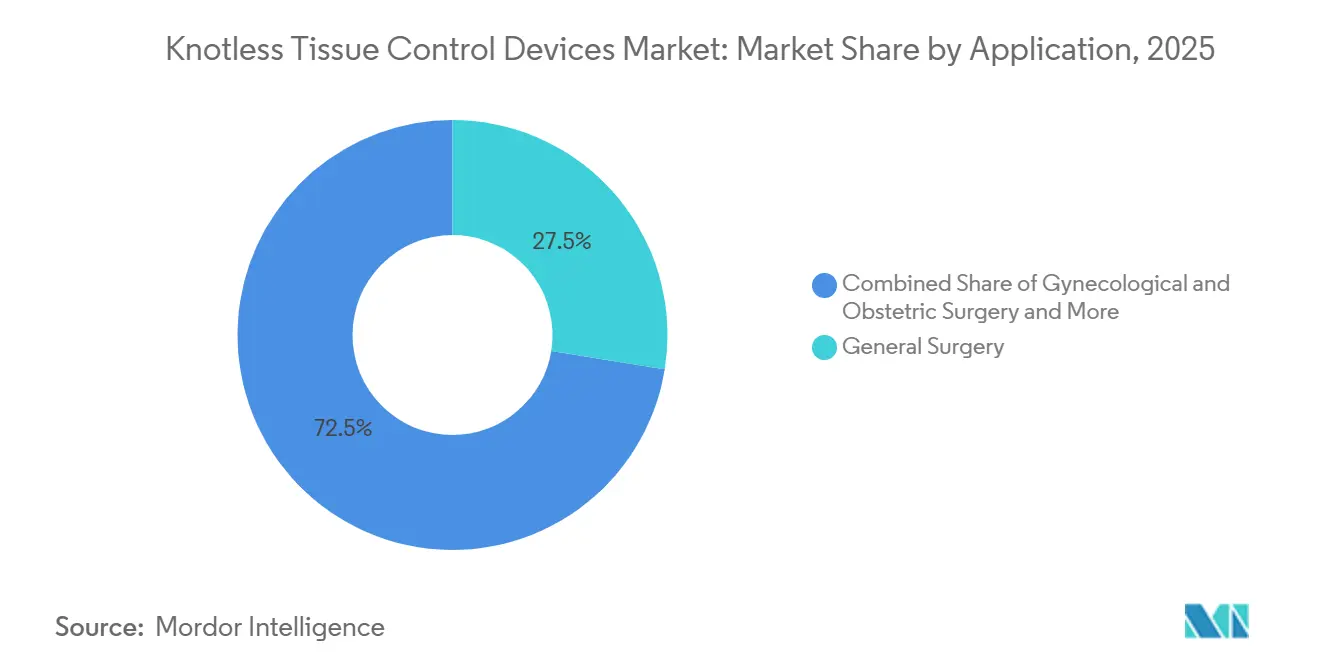
General surgery accounted for 27.54% of the Knotless Tissue Control Devices Market share in 2025. The segment includes laparotomy, hernia repair, colorectal surgery, and bariatric procedures. This broad procedure base provides regular device demand across multiple care settings. General surgeons also work across open, laparoscopic, and robotic approaches. That range makes the category an anchor for overall volume. Its size reflects procedural breadth rather than reliance on a single operation type.
Gynecological and obstetric surgery is forecast to grow at a 6.12% CAGR through 2031. A meta-analysis of 25 studies involving 4,452 women found that V-Loc barbed sutures reduced total operation time by 17.08 minutes and surgical-site infections by 74%, with a relative risk of 0.26 and a 95% confidence interval of 0.09 to 0.78. Robotic hysterectomy adoption supports this demand profile. Robotic mitral valve repair using V-Loc reduced left atrial closure time by 31.3% without an increase in operative mortality. A 2026 robotic gastric-bypass study also reported 90-day composite complications of 2.1% versus 8.3% and a length of stay of 1.34 versus 1.62 days for hand-sewn gastrojejunostomy with knotless devices. Orthopedic and soft-tissue, urological, and cosmetic procedures contribute stable volumes as robotic platforms become more common in their specialties.
By End User: Hospitals Hold Volume Dominance, Ambulatory Centers Reshape Growth
Hospitals accounted for 63.61% of end-user revenue in 2025. They remain the main location for robotic surgery platforms in most markets. Hospital procurement often operates through formularies negotiated by group-purchasing organizations. Value-analysis committee approval can determine the adoption pace for a new device. This pathway creates a deliberate process for suppliers entering established hospital accounts. Hospitals, therefore, provide the largest volume base, even when adoption timing is slower.
Ambulatory surgical centers are forecast to expand at a 7.65% CAGR through 2031, the highest rate among end-user categories. The OECD documented a marked increase in ambulatory surgery as less-invasive technology and improved anesthetics enabled same-day treatment. In these centers, there may be no dedicated assistant surgeon to hold knots during closure. Self-anchoring devices can therefore address a practical workflow requirement. Trauma centers and specialty surgical clinics remain smaller but early-adopter user groups. Their activity is concentrated in high-tension anatomy and sports-medicine applications where device performance aligns with the procedure.
Geography Analysis
North America held 41.61% of the global Knotless Tissue Control Devices Market share in 2025. The United States supports this position through high robotic-surgery penetration and a mature ambulatory surgical center sector. The FDA pathway for Class II suture devices supported 6 related clearances between September 2025 and May 2026. This activity sustained product-cycle momentum and included established U.S. suppliers as well as entrants from India and South Korea. Canada has a more deliberate adoption path shaped by health technology assessment timelines. Mexico’s expanding private-hospital base supports wider use of minimally invasive techniques, although device penetration remains at an earlier stage.
Europe has a distinct demand environment because compliance requirements shape the pace of product entry. EU MDR 2017/745 requires updated clinical evidence for soft-tissue fixation products at recertification. This requirement adds time and cost that favor well-resourced suppliers and can restrict smaller entrants. The United Kingdom’s National Health Service targets 500,000 robotic surgeries each year by 2035, creating a long-term demand base for robotic-compatible closure. Serag-Wiessner, B. Braun, Resorba Medical, and Advanced Medical Solutions are established regional participants. Rest of Europe also follows the wider OECD shift toward ambulatory surgery, which extends demand beyond hospital-centered applications.
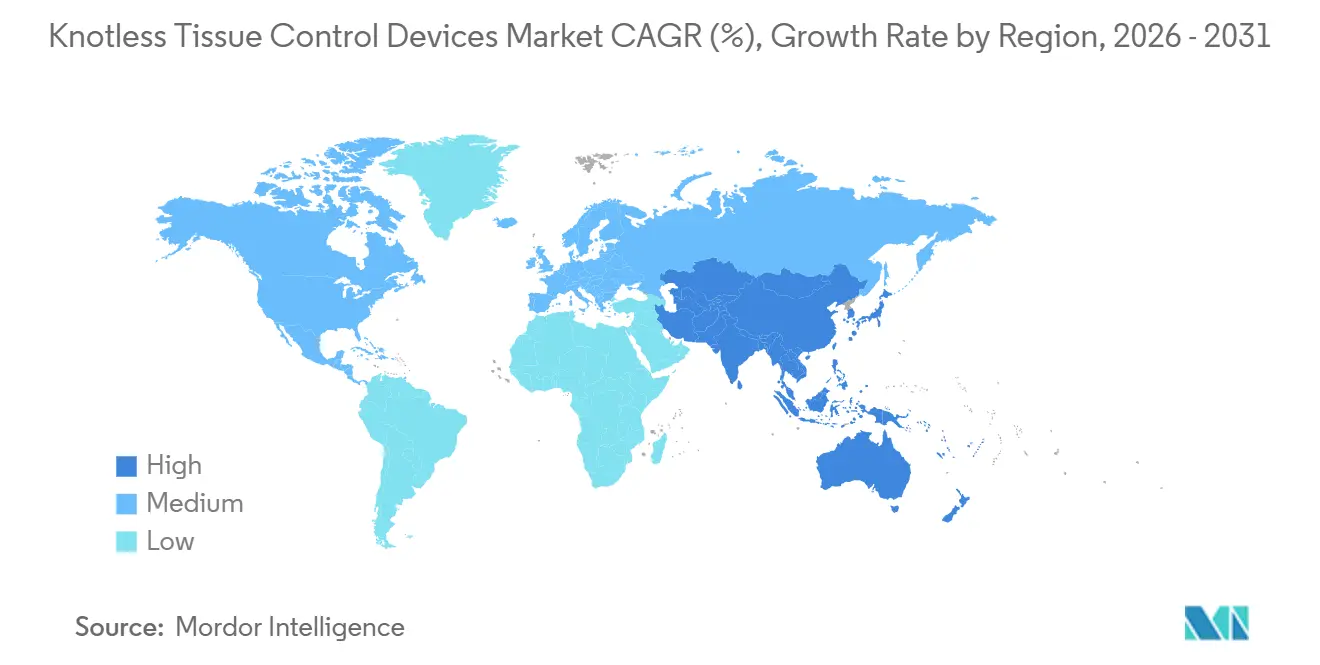
Asia-Pacific is forecast to grow at a 7.65% CAGR through 2031, the highest rate among geographic segments. China, Japan, India, South Korea, and Australia are the key countries supporting this growth. Smith+Nephew began commercial sales of the Q-FIX Knotless Anchor in Japan in March 2026 for shoulder, elbow, hip, knee, and ankle soft-tissue repair[3]Smith+Nephew Japan, “Q-FIX Knotless Anchor Launch in Japan,” Kyodo Press Release, kyodo.co.jp.. Meril Endo Surgery received FDA clearance for the PINION PDO Knotless Suture in September 2025, positioning India as a cost-competitive manufacturing source with access to high-value export markets. Feeltech received U.S. clearance for a barbed surgical suture in October 2025, reflecting South Korea’s medical-device export capability. Hospital expansion in China and India is creating first-time demand for advanced closure across patient groups that historically used conventional sutures. The Middle East and Africa and South America are developing demand centers, with GCC private hospitals and procedure volumes in Brazil and Argentina providing the main regional support.

Competitive Landscape
The Knotless Tissue Control Devices Market is moderately concentrated in its premium tier. Ethicon, a Johnson & Johnson company, markets the STRATAFIX family, while Medtronic markets V-Loc. These companies have the strongest established global clinical identities. B. Braun, Corza Medical, DemeTECH, Healthium Medtech, Shandong Weigao, Advanced Medical Solutions, and newer Asian suppliers form a broader competitive group. Competitors differentiate through price, polymer specifications, and performance in particular indications. The presence of regional suppliers creates pressure on premium pricing while the leading platforms retain established clinical recognition.
Ethicon pursued indication expansion through FDA submissions during 2025 and 2026. Its activity covered high-tension anatomy, non-absorbable polymer variants, and antibacterial combinations. The company’s STRATAFIX Symmetric PDS Plus clearance in May 2026 expanded use in high-tension fascia applications. An Ethicon submission for STRATAFIX Spiral PDS Plus and STRATAFIX Spiral MONOCRYL Plus cited Medtronic’s V-Loc as a predicate device in December 2025. This reflects competition centered on indication-specific positioning rather than a difference in the basic device class. B. Braun is pursuing prospective comparative evidence through BARGASTRO in robotic gastric bypass and BARHYSTER in laparoscopic total hysterectomy.
Corporate activity is also changing the structure around soft-tissue closure. H.B. Fuller announced an offer of USD 942 million for Advanced Medical Solutions in June 2026. The transaction brings a materials-focused acquirer into a space with complementary polymer capabilities. GTCR announced the divestiture of Corza Medical’s Biosurgery Business Unit to EQT in July 2026, separating fibrin-sealant assets from Corza’s surgical suture and needle platform. Strategic opportunities include antibacterial long-term absorbable products for deep and high-tension anatomy, fixation-tab products for ambulatory orthopedic sports medicine, and responsive materials for drug release or infection signaling. The competitive approach remains consistent with a market where established leaders face focused innovation and regional price competition.
Knotless Tissue Control Devices Industry Leaders
Johnson & Johnson
Medtronic plc
Corza Medical
Healthium Medtech Limited
B. Braun Melsungen AG
- *Disclaimer: Major Players sorted in no particular order

Recent Industry Developments
- July 2026: GTCR announced the divestiture of Corza Medical's Biosurgery Business Unit to EQT, separating the company's fibrin-sealant assets from its surgical suture and needle platform and enabling each to pursue independent strategic growth trajectories.
- March 2026: Smith+Nephew Japan began commercial sales of the Q-FIX Knotless Anchor, Japanese approval #30700BZX00265000, targeting shoulder, elbow, hip, knee, and ankle soft-tissue repair in Japan. The all-suture knotless anchor uses a 140 N Chinese-finger-trap deployment mechanism that eliminates knot tying and expands implant-selection options across orthopedic sports-medicine procedures.


Global Knotless Tissue Control Devices Market Report Scope
As per the scope of the report, knotless tissue control devices are medical tools designed to facilitate tissue approximation and secure suturing without the need for traditional tying knots. They typically use innovative mechanisms such as barbs, anchors, or other anchoring systems to hold tissue in place, providing secure closure while reducing operative time and potential complications associated with knots. These devices are commonly used in surgical procedures to improve efficiency and outcomes in tissue management.
The knotless tissue control devices market is segmented by product type into short-term absorbable devices, long-term absorbable devices, and non-absorbable polymer devices; by barb architecture into unidirectional barbed devices and bidirectional barbed devices; by anchor design into loop-end devices, fixation-tab devices, and end-stopper devices; by application into general surgery, gynecological and obstetric surgery, orthopedic and soft tissue surgery, cardiovascular surgery, urological surgery, cosmetic and plastic surgery, colorectal and bariatric surgery, and other applications; by end user into hospitals, ambulatory surgical centers, trauma centers, specialty surgical clinics, and other end users; and by geography into North America, Europe, Asia-Pacific, the Middle East and Africa, and South America. The market report also covers the estimated market sizes and trends for 17 countries across major regions globally. For each segment, the market size and forecast are provided in terms of value (USD).
| Short-Term Absorbable Devices |
| Long-Term Absorbable Devices |
| Non-Absorbable Polymer Devices |
| Unidirectional Barbed Devices |
| Bidirectional Barbed Devices |
| Loop-End Devices |
| Fixation-Tab Devices |
| End-Stopper Devices |
| General Surgery |
| Gynecological and Obstetric Surgery |
| Orthopedic and Soft-Tissue Surgery |
| Cardiovascular Surgery |
| Urological Surgery |
| Cosmetic and Plastic Surgery |
| Colorectal and Bariatric Surgery |
| Other Applications |
| Hospitals |
| Ambulatory Surgical Centers |
| Trauma Centers |
| Specialty Surgical Clinics |
| Other End Users |
| North America | United States |
| Canada | |
| Mexico | |
| Europe | Germany |
| United Kingdom | |
| France | |
| Italy | |
| Spain | |
| Rest of Europe | |
| Asia-Pacific | China |
| Japan | |
| India | |
| Australia | |
| South Korea | |
| Rest of Asia-Pacific | |
| Middle East and Africa | GCC |
| South Africa | |
| Rest of Middle East and Africa | |
| South America | Brazil |
| Argentina | |
| Rest of South America |
| By Product Type | Short-Term Absorbable Devices | |
| Long-Term Absorbable Devices | ||
| Non-Absorbable Polymer Devices | ||
| By Barb Architecture | Unidirectional Barbed Devices | |
| Bidirectional Barbed Devices | ||
| By Anchor Design | Loop-End Devices | |
| Fixation-Tab Devices | ||
| End-Stopper Devices | ||
| By Application | General Surgery | |
| Gynecological and Obstetric Surgery | ||
| Orthopedic and Soft-Tissue Surgery | ||
| Cardiovascular Surgery | ||
| Urological Surgery | ||
| Cosmetic and Plastic Surgery | ||
| Colorectal and Bariatric Surgery | ||
| Other Applications | ||
| By End User | Hospitals | |
| Ambulatory Surgical Centers | ||
| Trauma Centers | ||
| Specialty Surgical Clinics | ||
| Other End Users | ||
| By Geography | North America | United States |
| Canada | ||
| Mexico | ||
| Europe | Germany | |
| United Kingdom | ||
| France | ||
| Italy | ||
| Spain | ||
| Rest of Europe | ||
| Asia-Pacific | China | |
| Japan | ||
| India | ||
| Australia | ||
| South Korea | ||
| Rest of Asia-Pacific | ||
| Middle East and Africa | GCC | |
| South Africa | ||
| Rest of Middle East and Africa | ||
| South America | Brazil | |
| Argentina | ||
| Rest of South America | ||


Key Questions Answered in the Report
How large is the knotless tissue control devices market?
The knotless tissue control devices market is estimated at USD 1.0 billion in 2026 and is forecast to reach USD 1.33 billion by 2031 at a 5.78% CAGR.
Which product category leads knotless tissue control device sales?
Non-absorbable polymer devices led with a 42.31% revenue share in 2025, reflecting their use in orthopedic and cardiovascular fixation.
Which end users are expanding fastest for knotless tissue control devices?
Ambulatory surgical centers are projected to grow at a 7.65% CAGR through 2031, supported by same-day care models and workflow needs.
Why are knotless devices relevant in robotic surgery?
They avoid conventional knot tying in a confined workspace and can reduce operating-room time in procedures such as robotic hysterectomy and ventral hernia repair.
Which region has the highest projected growth through 2031?
Asia-Pacific is forecast to grow at a 7.65% CAGR through 2031, supported by demand in China, Japan, India, South Korea, and Australia.
Page last updated on:





