
Japan Special Interest Tourism Market Size and Share
Market Overview
| Study Period | 2021 - 2031 |
|---|---|
| Forecast Data Period | 2026 - 2031 |
| Base Year Market Size (2025) | USD 54.05 Billion |
| Market Size (2026) | USD 56.94 Billion |
| Market Size (2031) | USD 79.74 Billion |
| Growth Rate (2026 - 2031) | 6.97 % |
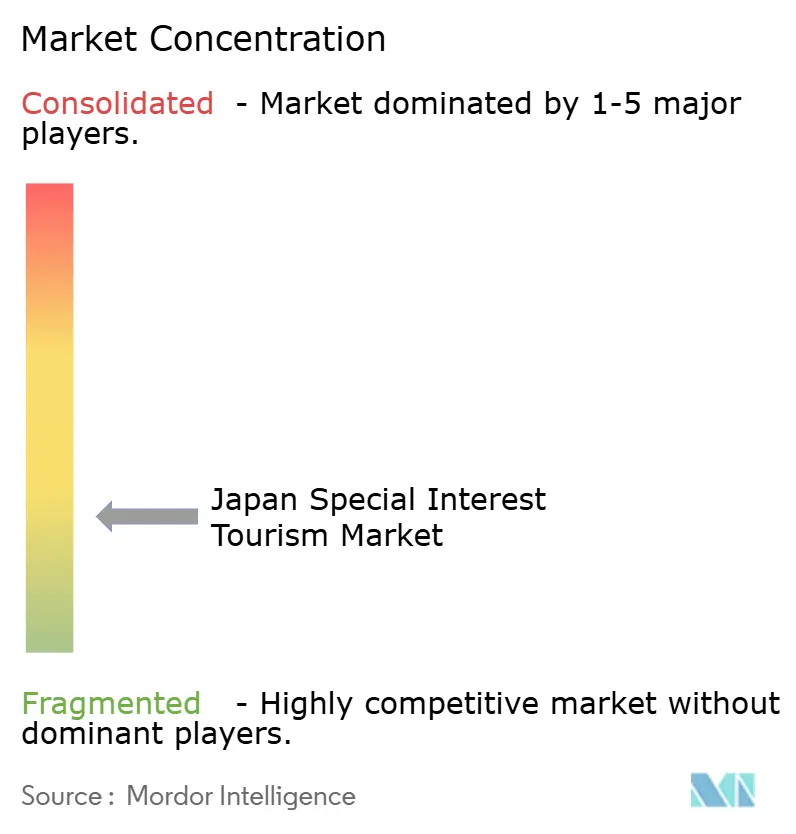
| Market Concentration | Low |
Major Players *Disclaimer: Major Players sorted in no particular order Image © Mordor Intelligence. Reuse requires attribution under CC BY 4.0. | |
Japan Special Interest Tourism Market Analysis by Mordor Intelligence
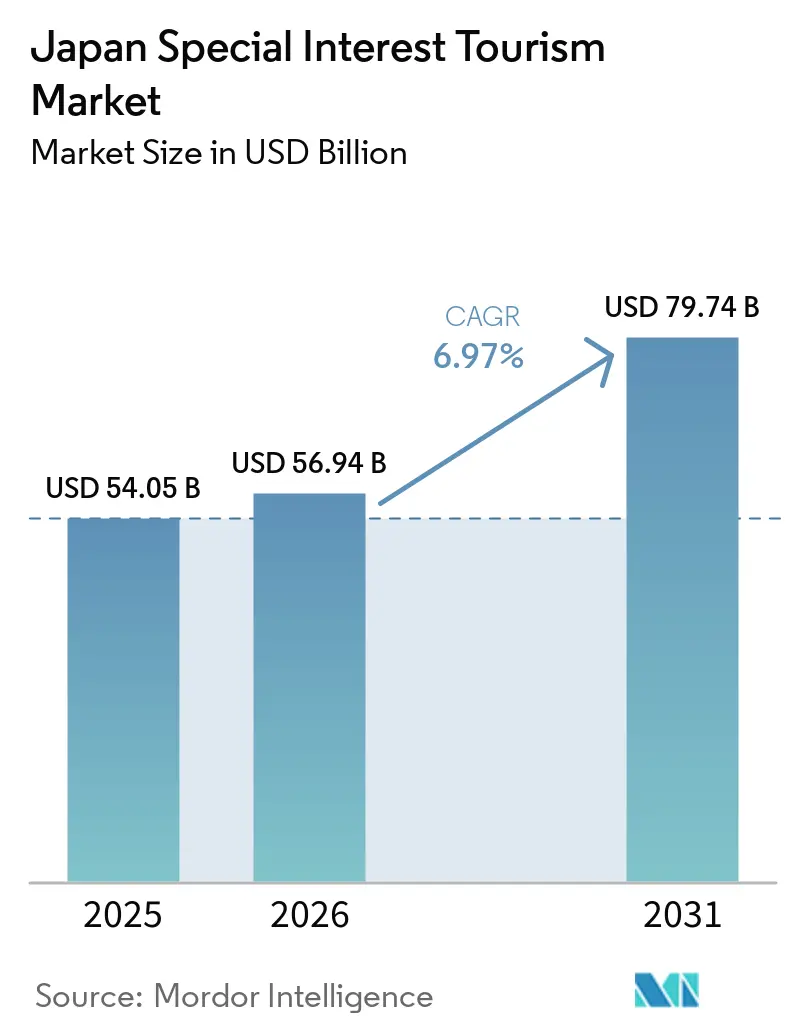
The Japan Special Interest Tourism Market was valued at USD 54.05 billion in 2025 and estimated to grow from USD 56.94 billion in 2026 to reach USD 79.74 billion by 2031, at a CAGR of 6.97% during the forecast period (2026–2031). The country recorded 42.7 million international visitors in 2025, with domestic and inbound travel consumption totaling JPY 37.6 trillion (USD 0.241 trillion), signaling a shift from recovery to growth. The JPY 3.5 trillion (USD 0.022 trillion) accommodation and JPY 2.1 trillion (USD 0.01 trillion) eating and drinking figures align perfectly with the record-shattering JPY 9.5 trillion (USD 0.06 trillion) in total inbound spending tracked for the full year of 2025, mirroring the broader trends of soaring luxury hotel tariffs and inflation in tourist-dense areas[1]Japan Tourism Agency, “International Visitor Survey 2025,” Nippon.com, nippon.com. Policy measures, including the Fifth Tourism Nation Promotion Basic Plan and the FY2026 budget, emphasize regional tourism, overtourism management, and improved transport connectivity to secondary destinations. The market benefits from enhanced digital tools, curated regional itineraries, and increased spending by travelers seeking cultural, wellness, culinary, and nature-based experiences. However, challenges such as congestion at popular destinations, labor shortages, and limited supply in some regions constrain nationwide market expansion.
Key Report Takeaways
- By type of interest, Cultural & Heritage Tourism held 34.80% of the Japan Special Interest Tourism Market in 2025, while Wellness & Medical Tourism is forecast to grow at 7.60% CAGR through 2031.
- By tourist type, Domestic tourists accounted for 71.40% share of the Japan Special Interest Tourism Market in 2025, while international tourists recorded the highest projected CAGR at 8.80% through 2031.
- By booking channel, OTAs held 42.70% share of the Japan Special Interest Tourism Market in 2025, while Direct Booking is expected to expand at 7.90% CAGR through 2031.
- By traveler type, Individual travelers captured 46.30% share of the Japan Special Interest Tourism Market in 2025, while Couple Travelers are projected to grow at 7.20% CAGR through 2031.
- By geography, Kanto accounted for 37.50% of the Japan Special Interest Tourism Market in 2025, while Northern Japan is projected to expand at 9.10% CAGR through 2031.
Note: Market size and forecast figures in this report are generated using Mordor Intelligence’s proprietary estimation framework, updated with the latest available data and insights as of January 2026.
Japan Special Interest Tourism Market Trends and Insights
Drivers Impact Analysis*
| Driver | (~) % Impact on CAGR Forecast | Geographic Relevance | Impact Timeline |
|---|---|---|---|
| Rising Demand for Experiential and Immersive Travel | +1.8% | Concentrated in Kanto and Kansai, with spill-over to secondary regions | Medium term (2-4 years) |
| Government Push for Regional Tourism Dispersion | +1.1% | Nationwide, most material in Tohoku, Hokkaido, and Shikoku | Medium term (2-4 years) |
| Growing Preference for Purpose-Led Domestic Leisure Travel | +0.9% | National, stronger in metropolitan catchments and accessible rail corridors | Short term (≤ 2 years) |
| Digital Booking Platforms Improving Niche Discoverability | +1.0% | Most pronounced for inbound visitors from South Korea, Taiwan, and Southeast Asia | Short term (≤ 2 years) |
| High-Spend Inbound Demand for Heritage and Culture-Led Itineraries | +1.0% | Primarily Kansai and Kanto, with second-order gains in Central Japan and Northern Japan | Long term (≥ 4 years) |
| Aging Traveler Base Seeking Low-Intensity, Interest-Based Trips | +0.7% | Domestic, nationwide, concentrated along accessible rail corridors | Long term (≥ 4 years) |
| Source: Mordor Intelligence | |||
Rising Demand for Experiential and Immersive Travel
International visitors, drawn by a growing interest in cultural and local experiences, have notably upped their spending on food, beverages, and accommodation during extended stays. Surveys, referencing official data, reveal that travelers hailing from Asia, Europe, and Australia have made traditional cultural activities and nature or onsen stays central to their reasons for visiting Japan. This trend holds significant weight for Japan's special-interest tourism market. Offerings like brewery visits, temple rituals, artisan workshops, and guided regional stays not only resonate with these interests but also promote higher spending and longer visits. Operators focusing on experience-based itineraries are better positioned to attract repeat demand and achieve stronger results compared to those offering standard sightseeing options[2]Development Bank of Japan and Japan Tourism Bureau Foundation, “DBJ JTBF Asia Europe Australia Survey of Inbound Traveler Intentions 2025,” Japan Tourism Bureau Foundation, jtb.or.jp.
Government Push for Regional Tourism Dispersion
Japan's Fifth Tourism Nation Promotion Basic Plan identifies tourism as a key growth sector, aiming to increase inbound visitors and spending by 2030 significantly. Supported by the national budget, the plan allocates resources to tourism initiatives, addressing overtourism, and improving regional transport connectivity. The government focuses on developing model tourism destinations and regional strategies to extend tourism beyond urban areas. This approach is essential for niche tourism sectors, as cultural, nature, and spiritual itineraries often depend on smaller destinations requiring better access and promotion. The policy framework enables operators to create specialized travel products in regions such as Tohoku, Hokkaido, and Shikoku, reducing dependence on heavily visited locations.
Growing Preference for Purpose-Led Domestic Leisure Travel
Japanese residents significantly increased their spending on domestic travel, with overall domestic and inbound travel consumption also showing substantial growth. Findings revealed that while trip frequency stabilized, spending per overnight journey reached record levels, indicating a shift toward more intentional and selective trip planning. This trend supports the growth of Japan's special-interest tourism market, as travelers increasingly focus on defined themes such as gastronomy, crafts, spiritual routes, and heritage circuits rather than general leisure trips. Organized domestic tours that cater to mature travelers seeking curated experiences with clear objectives and minimal planning align well with this shift. As a result, interest-driven tourism maintains a strong domestic foundation, even as overall leisure travel volume grows more slowly than spending.
Digital Booking Platforms Improving Niche Discoverability
Rakuten Travel introduced a booking feature for its AI agent, enabling travelers to seamlessly move from natural-language hotel searches to checkout. This addition followed the launch of its AI Hotel Search, highlighting the growing focus of digital intermediaries on creating guided discovery tools for travel planning. Around the same time, Klook and Hoshino Resorts formed a strategic partnership to improve the visibility and booking of lesser-known regional properties. These developments are driving growth in Japan's special-interest tourism market, where niche products often face challenges with discoverability and comparison rather than demand. Enhanced recommendations, better inventory visibility, and smoother booking processes help specialized experiences reach beyond traditional gateway cities[3]Rakuten Group, “Rakuten Travel Adds New Booking Feature to Enhance Hotel Recommendation AI Agent,” Rakuten Group Press Release, global.rakuten.com.
Restraints Impact Analysis*
| Restraint | (~) % Impact on CAGR Forecast | Geographic Relevance | Impact Timeline |
|---|---|---|---|
| Seasonal Concentration and Capacity Strain at Signature Sites | -0.6% | Kansai core, including Kyoto and Nara, with secondary peaks in Kanto cherry blossom and autumn foliage corridors | Medium term (2-4 years) |
| Fragmented Supplier Base Outside Major Gateways | -0.5% | Rural regions across all geographies, most acute in Shikoku and Northern Japan | Long term (≥ 4 years) |
| Skilled Guide and Multilingual Service Shortages | -0.7% | National, most severe in secondary and tertiary destinations | Medium term (2-4 years) |
| Language, Wayfinding, and Payment Frictions for Inbound Niche Travelers | -0.4% | Regional destinations with limited multilingual infrastructure | Short term (≤ 2 years) |
| Source: Mordor Intelligence | |||
Seasonal Concentration and Capacity Strain at Signature Sites
Accommodation statistics indicate that a few prefectures, including Tokyo, Osaka, Kyoto, Hokkaido, and Okinawa, dominate foreign overnight stays. This concentration places significant strain on Japan's special-interest tourism market, as many heritage and seasonal attractions are in these high-demand areas. Peak travel periods, such as cherry blossom and autumn foliage seasons, lead to tighter booking windows, reduced capacity flexibility, and challenges in maintaining the quality of guided experiences. The government has responded by increasing funding for overtourism prevention in the national budget for the upcoming fiscal year. However, reliance on a limited number of destinations continues to create capacity challenges that are unlikely to ease until travel behavior shifts toward greater regional dispersion.
Fragmented Supplier Base Outside Major Gateways
The market is characterized by a fragmented competitive landscape, with a limited share held by the top operators. This fragmentation is more evident outside major cities such as Tokyo, Osaka, and Kyoto, where offerings are distributed among smaller accommodation providers, local guides, transport operators, and community organizations. Government efforts to support local guides, regional content, and model tourism destinations highlight the recognition of supply fragmentation as a challenge to scaling the special interest tourism market in Japan. Operators focusing on secondary-region itineraries face greater challenges in contracting, coordination, and maintaining quality consistency compared to those dealing with established gateway products. Future growth in specialized tourism will depend on both generating demand and effectively packaging regional supply into reliable and repeatable offerings.
*Our forecasts treat driver/restraint impacts as directional, not additive. The impact forecasts reflect baseline growth, mix effects, and variable interactions.
Segment Analysis
By Type of Interest: Cultural Heritage Leads, While Wellness Builds the Fastest Premium Path
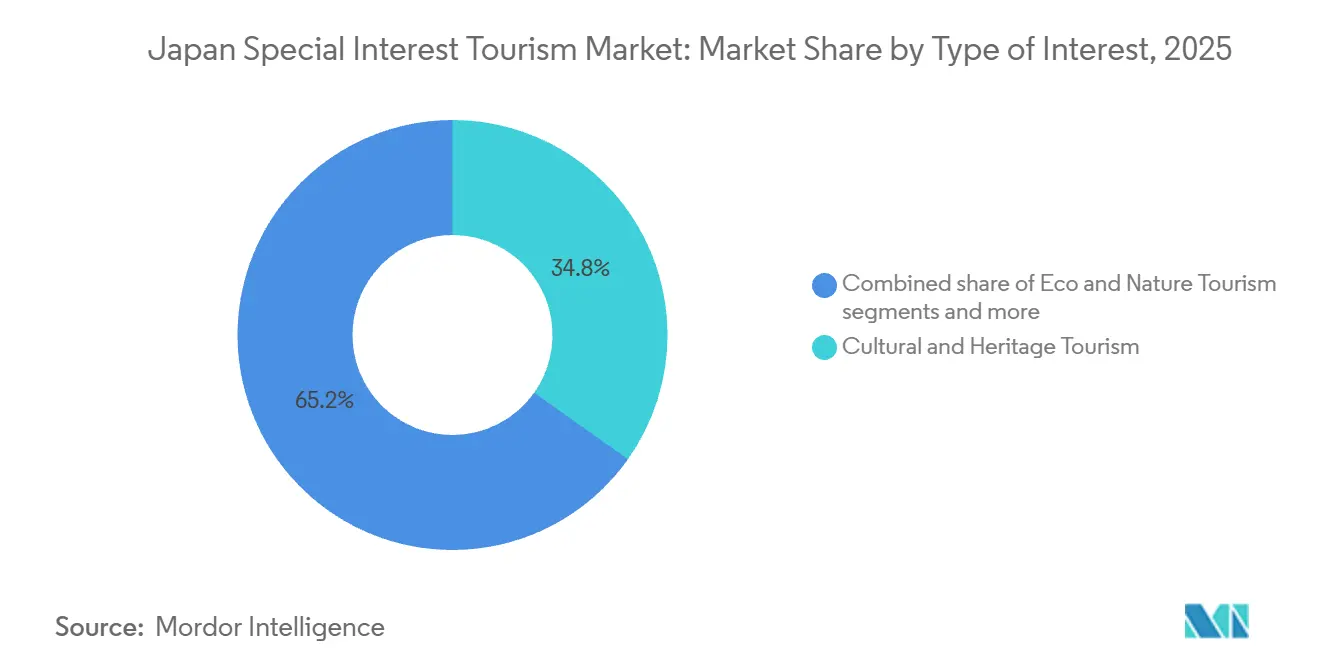
Cultural & Heritage Tourism accounted for 34.80% of the Japan special interest tourism market in 2025. This segment benefits from Japan's wealth of temples, historic districts, traditional arts, and UNESCO World Heritage Sites, which attract domestic and international travelers. Heritage-focused itineraries, which often include guided tours, local dining, and overnight stays, drive higher spending on accommodation and food. Government initiatives promoting regional tourism and content creation further support cultural travel by highlighting secondary destinations through crafts, history, and living heritage. The market remains closely tied to Japan's cultural richness and its ability to offer bookable experiences.
Wellness & Medical Tourism is expected to grow at a 7.60% CAGR through 2031, making it the fastest-growing segment. This growth is supported by Japan's onsen culture, health screening services, and the increasing appeal of restorative travel among regional and long-haul visitors. A DBJ and JTBF survey identified spa, onsen, and wellness experiences as preferred activities, indicating wellness is often integrated into broader itineraries rather than offered as standalone products. Eco & Nature Tourism also benefits from the demand for authentic, place-based experiences. Other segments, such as educational and spiritual travel, remain relevant through pilgrimage routes and specialized regional programs. The industry is expanding by layering wellness, nature, culinary, and spiritual themes onto its strong cultural foundation.



By Tourist Type: Domestic Demand Anchors Scale, While Inbound Growth Lifts Revenue Mix
Domestic tourists accounted for 71.40% of demand in Japan's special interest tourism market in 2025, providing a stable volume base. Domestic travel consumption reached JPY 26.8 trillion (USD 0.172 trillion), highlighting the commercial significance of home-market demand despite growing attention on inbound recovery. Familiarity with local themes, seasons, and regional identities encourages repeat visits focused on food, crafts, pilgrimage, and wellness. This strong domestic presence ensures the market's viability without relying solely on international arrivals and supports operators offering specialized itineraries.
International tourists are projected to grow at a CAGR of 8.80% through 2031, making them the fastest-growing segment. In 2025, inbound visitor spending reached JPY 9.5 trillion (USD 0.06 trillion), with accommodation and food categories exceeding overall spending trends. This indicates a shift in the revenue mix, with overseas visitors contributing to higher-value travel formats. International travelers are key to segments such as heritage, nature, and wellness, which attract longer stays and higher per-trip spending. Future growth depends on converting rising inbound arrivals into repeat and regional special-interest bookings rather than relying on first-time Golden Route visitors.
By Booking Channel: OTAs Lead in Reach, While Direct Booking Gains on Value Retention
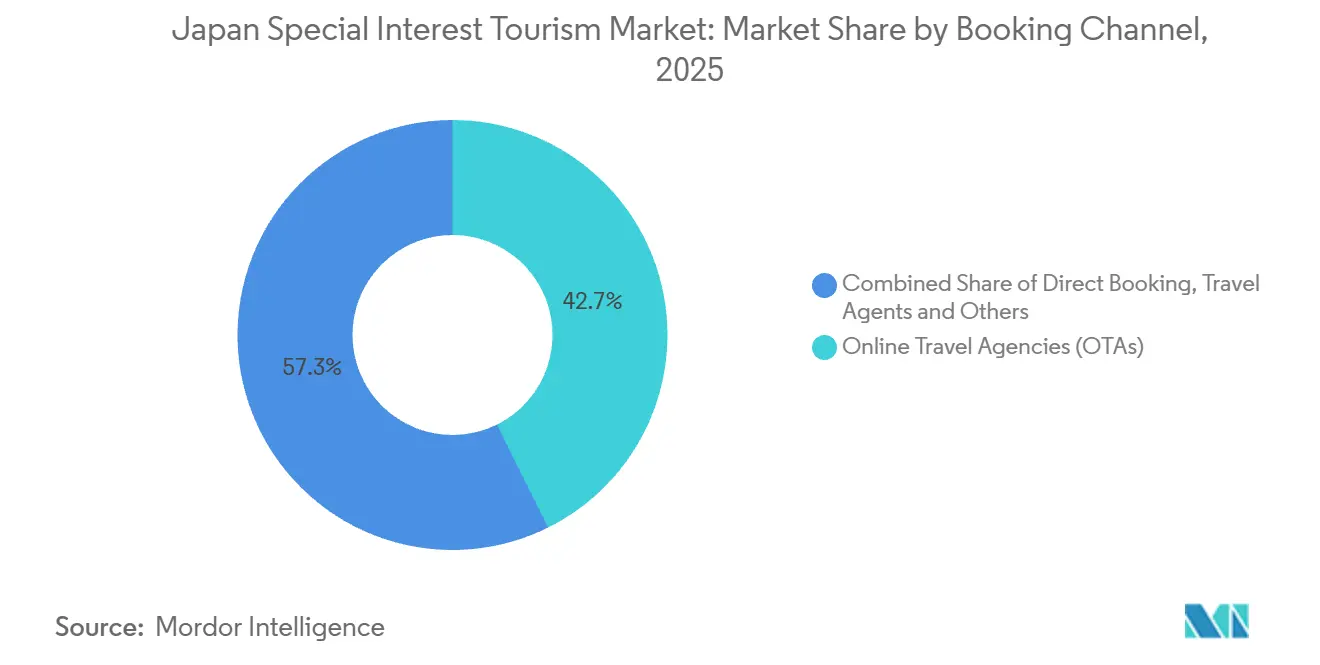
OTAs accounted for 42.70% of the Japan special interest tourism market in 2025, making them the largest booking channel. Their success is attributed to aggregated inventory, comparison tools, and AI-supported recommendations that help travelers identify suitable options early in their planning. This is particularly relevant for niche tourism, where travelers often discover experiences through searches, rankings, and bundled suggestions rather than starting with a specific operator. OTAs influence both transaction flow and demand formation for specialized travel categories. The 42.70% share highlights the role of digital platforms as key entry points for accessing curated offerings.
Direct bookings are projected to grow at a 7.90% CAGR through 2031, emerging as the fastest-growing channel. Hotels, ryokan groups, and specialized tour operators are focusing on direct relationships to gain better control over curation, upselling, and managing limited-capacity inventory. This channel also helps maintain margins on offerings with higher staffing and content costs. The market is becoming more value-sensitive, as fewer direct bookings can generate stronger financial outcomes when tied to regional experiences. While OTAs dominate in reach, direct bookings are expected to capture a larger share of value in the higher-end segment of the market.
By Traveler Type: Individuals Hold the Largest Base, While Couples Support Premium Growth
Individual travelers accounted for 46.30% of the Japan special interest tourism market in 2025, making them the largest traveler type. This reflects the country's strong solo-travel infrastructure, extensive rail connectivity, and availability of self-guided cultural and culinary experiences. These travelers often use digital tools to create customized itineraries that include workshops, local stays, shrines, museums, and specialty dining. Their demand is supported by flexibility, detailed destination information, and ease of independent movement, offering operators opportunities to convert diverse interests into bookable components.
Couple travelers are expected to grow at a 7.20% CAGR through 2031, emerging as the fastest-growing segment. This growth aligns with the increasing demand for wellness, culinary, and cultural experiences tailored for two-person travel. Couples often prefer itineraries combining onsen visits, dining, heritage accommodations, and seasonal events. The shift in spending patterns, favoring accommodation and dining over shopping, further supports this segment. While professional group travel remains relevant for corporate and incentive events, smaller groups are gaining traction, spending more on curated and meaningful travel experiences.
Geography Analysis
Kanto accounted for 37.50% of Japan's special-interest tourism market share in 2025, making it the largest regional market. Tokyo's role as the main arrival gateway provides Kanto with a structural advantage, complemented by its diverse offerings, including traditional neighborhoods, gardens, culinary routes, and cultural experiences. This combination ensures Kanto remains central to the market, even as policymakers aim to more evenly distribute demand. Kansai, with Kyoto, Osaka, and Nara, combines heritage assets, culinary appeal, and established visitor infrastructure, anchoring significant market value despite challenges like crowding and seasonal demand.
Central Japan is gaining importance as a bridge between Kanto and Kansai, offering less-crowded alternatives with strong food, nature, and craft offerings. Its appeal lies in combining scenic beauty, local culture, and slower-paced itineraries while maintaining transport convenience. This makes it valuable for operators to create multi-day products beyond urban routes. Culinary and landscape-based itineraries connecting local identity to overnight stays enhance its relevance. Though smaller than Kanto or Kansai, Central Japan plays a strategic role in dispersing demand.
Northern Japan is projected to grow at a 9.10% CAGR through 2031, driven by public investment in connectivity and air-rail partnerships. It offers opportunities to develop nature, winter, spirituality, and rural culture products with less congestion than Kyoto or Tokyo. The Rest of Japan, including Kyushu, Shikoku, Chugoku, and Okinawa, offers unique offerings such as onsen circuits, pilgrimage routes, and peace-related heritage. Improved regional packaging could elevate these areas as key sources of new supply[4]East Japan Railway Company and Japan Airlines, “Agreement to Strengthen Cooperation for Regional Revitalization in East Japan,” PR Times, prtimes.jp.
Competitive Landscape
The Japan special interest tourism market remained fragmented, with the top players collectively holding a significant share. JTB Corporation stood out due to its extensive domestic distribution, strong packaging capabilities, and focus on data-driven experience models. Other notable players, including H.I.S., KNT-CT Holdings, Nippon Travel Agency, and Rakuten Group, maintained meaningful positions but did not dominate the market. This structure allows room for regional brands, digital intermediaries, and experience-focused operators to compete effectively. Competition in this market is shaped more by access and product curation than by scale.
JTB Corporation expanded its portfolio by acquiring Northstar Travel Group, a global B2B media and travel intelligence firm. It also introduced its long-term OPEN FRONTIER 2035 vision, emphasizing AI-driven intelligence services and international growth. KNT-CT Holdings took a different approach, announcing plans to merge its entities - Club Tourism, Kinki Nippon Tourist, and KNT Blue Planet -into a single entity to enhance efficiency and reduce overlap. These strategies reflect efforts to strengthen data capabilities and operational efficiency as the market shifts toward inbound and specialized products. Success increasingly depends on curation, regional access, and differentiated offerings rather than scale alone.
Partnerships integrating digital platforms and transport services are becoming more prominent in the market. Rakuten Travel enhanced its AI-assisted booking system, while JAL, JTB, and JR East introduced a tourism model combining air and rail services with regional revitalization efforts. Klook and Hoshino Resorts collaborated to promote lesser-known properties through a distribution partnership. These developments highlight a shift in competition, with a focus on discovery, packaging, and regional supply over traditional agency distribution. In this fragmented market, success will likely favor those connecting travelers with unique regional experiences while maintaining product quality.
Japan Special Interest Tourism Industry Leaders
JTB Corporation
H.I.S. Co., Ltd.
KNT-CT Holdings Co., Ltd.
Nippon Travel Agency Co., Ltd.
Rakuten Group, Inc.
- *Disclaimer: Major Players sorted in no particular order

Recent Industry Developments
- April 2026: JTB Corporation, Japan Airlines, and East Japan Railway Company introduced a customizable rail-and-air tour model to boost tourism in East Japan. This initiative, available through Tokyo Metropolitan stores, will continue until September 2026 as part of a broader strategy to attract both domestic and international visitors to the Tohoku region.
- April 2026: Rakuten Travel's AI Hotel Search tool, integrated into its AI agent Rakuten AI, enables seamless transitions from natural-language hotel queries to checkout. Since its launch, user volume and booking conversion rates have consistently increased.
- February 2026: JTB Group has outlined its "OPEN FRONTIER 2035" vision, focusing on significant growth in annual transactions. The strategy emphasizes a shift toward AI-driven intelligence services and expanding its global presence in inbound and third-country travel segments.
- February 2026: Japan Airlines and East Japan Railway Company have entered a strategic partnership titled "East Japan Regional Revitalization." The agreement focuses on developing a wide-area tourism model, encouraging dual residency, and integrating rail and air transportation for travelers in the Tohoku region.


Japan Special Interest Tourism Market Report Scope
| Cultural & Heritage Tourism |
| Eco & Nature Tourism |
| Wellness & Medical Tourism |
| Culinary & Wine Tourism |
| Other Tourism Types (Educational, Spiritual etc.) |
| Domestic Tourists |
| International Tourists |
| Online Travel Agencies |
| Direct Booking |
| Travel Agents and Tour Operators |
| Institutional / Corporate & Group Bookings |
| Individual |
| Couple |
| Professional |
| Group |
| Kanto Region |
| Kansai Region |
| Central Japan |
| Northern Japan |
| Rest of Japan |
| By Type of Interest | Cultural & Heritage Tourism |
| Eco & Nature Tourism | |
| Wellness & Medical Tourism | |
| Culinary & Wine Tourism | |
| Other Tourism Types (Educational, Spiritual etc.) | |
| By Tourist Type | Domestic Tourists |
| International Tourists | |
| By Booking Channel | Online Travel Agencies |
| Direct Booking | |
| Travel Agents and Tour Operators | |
| Institutional / Corporate & Group Bookings | |
| By Traveler Type (Value) | Individual |
| Couple | |
| Professional | |
| Group | |
| By Geography | Kanto Region |
| Kansai Region | |
| Central Japan | |
| Northern Japan | |
| Rest of Japan |


Key Questions Answered in the Report
What is the outlook for Japan's special-interest tourism through 2031?
The Japan special-interest tourism market stood at USD 54.05 billion in 2025, reached USD 56.94 billion in 2026, and is forecast to reach USD 79.74 billion by 2031, at a CAGR of 6.97%.
Which category leads demand by type of interest in Japan?
Cultural & Heritage Tourism led with 34.80% share in 2025, supported by Japan’s strong base of heritage sites, temples, living cultural districts, and guided experience formats.
Which visitor group is growing fastest in Japan’s specialized travel space?
International tourists are projected to grow the fastest at 8.80% CAGR through 2031, even though domestic tourists still held the larger 71.40% share in 2025.
Why are OTAs still important in specialized travel bookings in Japan?
OTAs held 42.70% share in 2025 because they help travelers discover niche products through wider inventory access, search tools, and AI-supported recommendations.
Which region offers the strongest future growth opportunity in Japan?
Northern Japan is the fastest-growing region with a projected 9.10% CAGR through 2031, supported by stronger transport links and lower crowding than major gateway destinations.
Page last updated on:


 Your data is secure and never sold or shared.


