
Japan Semiconductor Demand In Data Center Market Size and Share
Market Overview
| Study Period | 2021 - 2032 |
|---|---|
| Forecast Data Period | 2027 - 2032 |
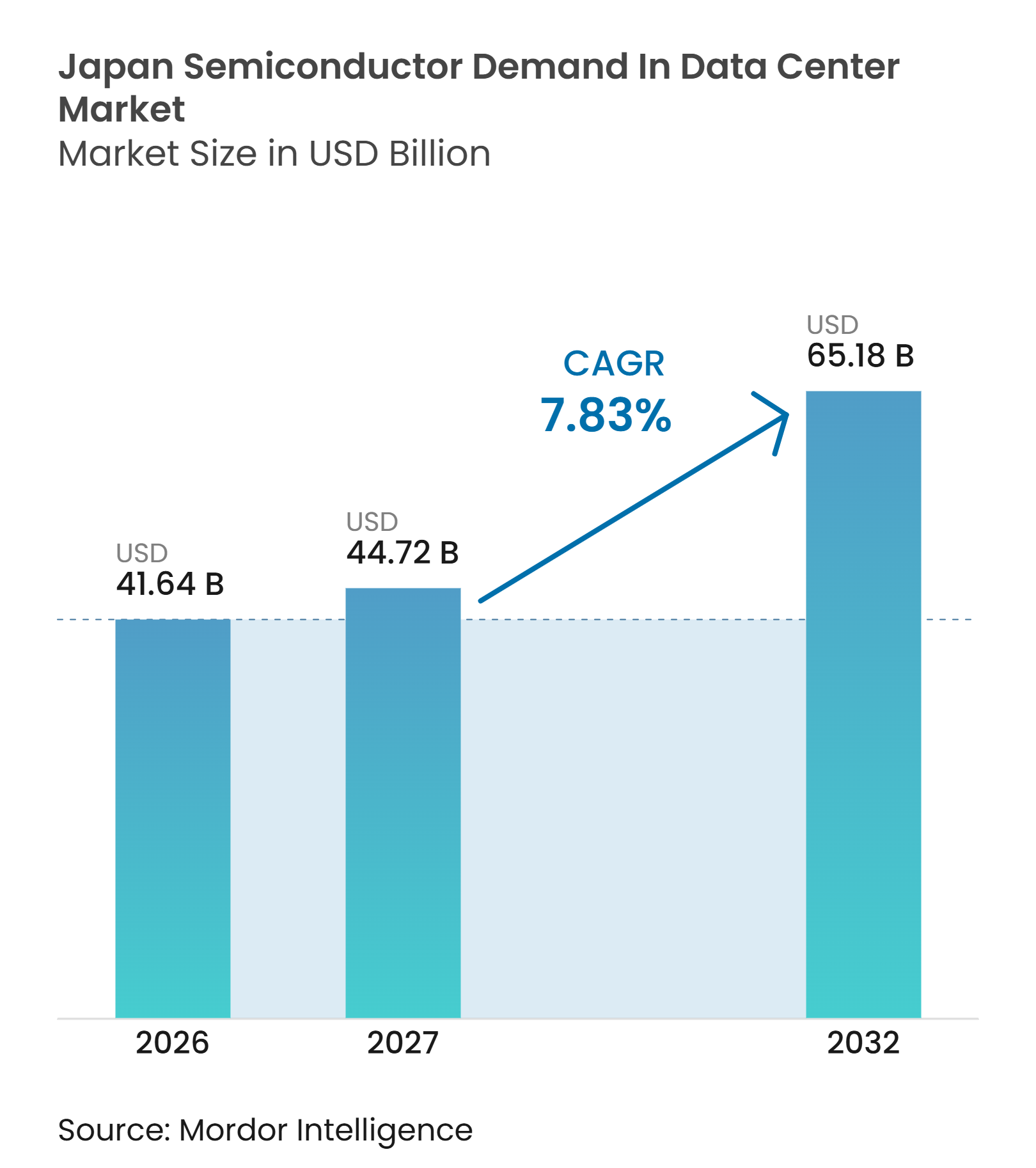
| Base Year Market Size (2026) | USD 41.64 Billion |
| Market Size (2027) | USD 44.72 Billion |
| Market Size (2032) | USD 65.18 Billion |
| Growth Rate (2027 - 2032) | 7.83 % |
| Market Concentration | High |
Major Players *Disclaimer: Major Players sorted in no particular order Image © Mordor Intelligence. Reuse requires attribution under CC BY 4.0. | |
Japan Semiconductor Demand In Data Center Market Analysis by Mordor Intelligence
The Japan semiconductor demand in data center market size is expected to increase from USD 41.64 billion in 2026 to USD 44.72 billion in 2027 and reach USD 65.18 billion by 2032, growing at a CAGR of 7.83% over 2027-2032. AI infrastructure is changing procurement because each high-density deployment requires processors, memory, power devices, networking silicon, and thermal-control components. Public support for domestic semiconductor capacity and secure computing infrastructure is strengthening the local supply chain and supporting longer procurement plans. Cloud migration and domestic AI requirements are also expanding demand beyond large hyperscale campuses into private and hybrid environments. Power availability, imported advanced compute chips, and seismic design requirements may delay some projects or raise their capital needs. The Japan semiconductor demand in data center market therefore depends on execution across data center construction, electricity supply, and advanced chip availability.
Key Report Takeaways
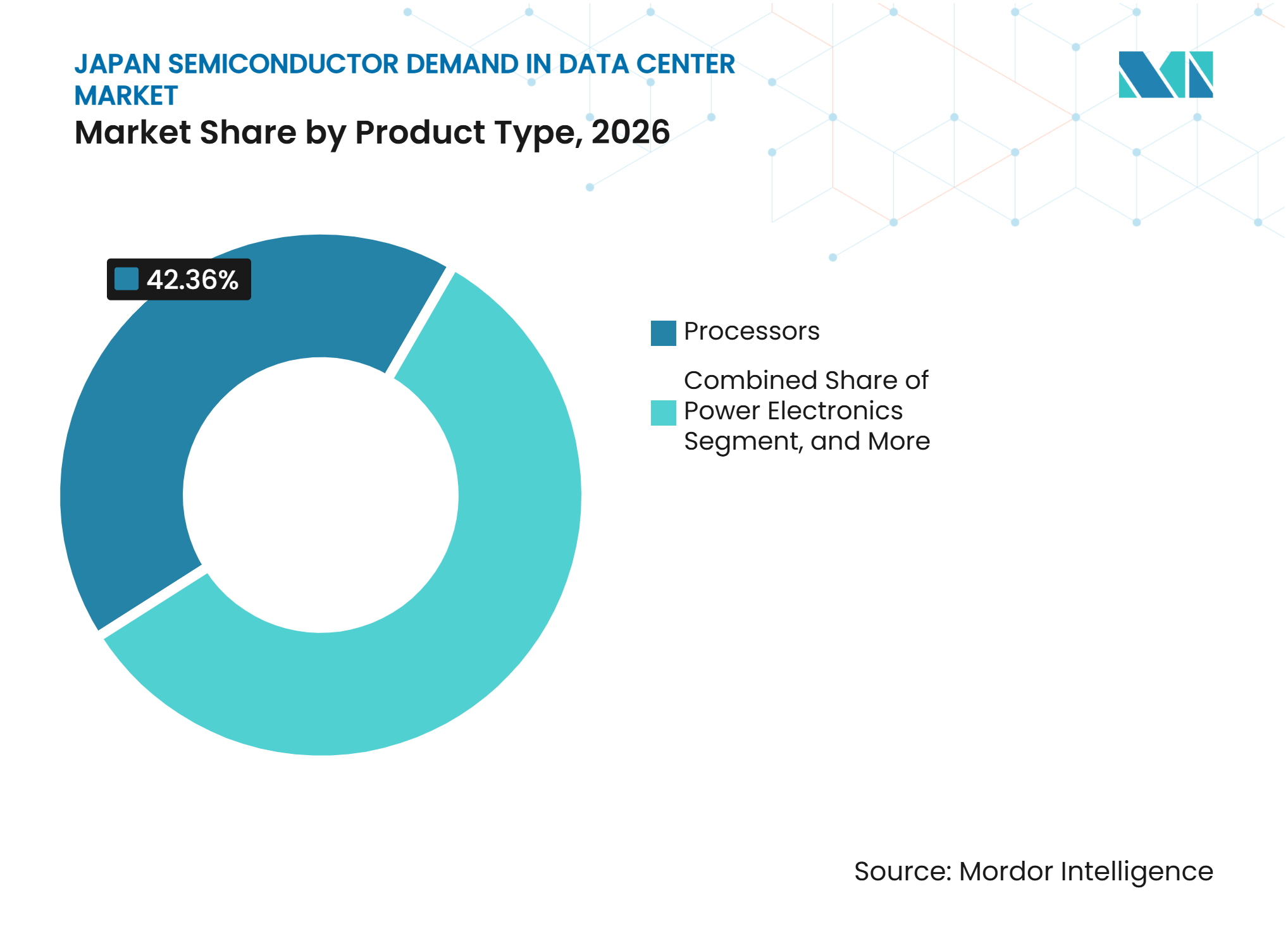
- By product type, processors held 42.36% of the Japan semiconductor demand in data center market share in 2026, while memory type is projected to expand at an 8.57% CAGR through 2032.
- By application, IT equipment accounted for 72.89% of the Japan semiconductor demand in data center market size in 2026, while cooling and thermal management infrastructure is expected to grow at an 8.62% CAGR through 2032.
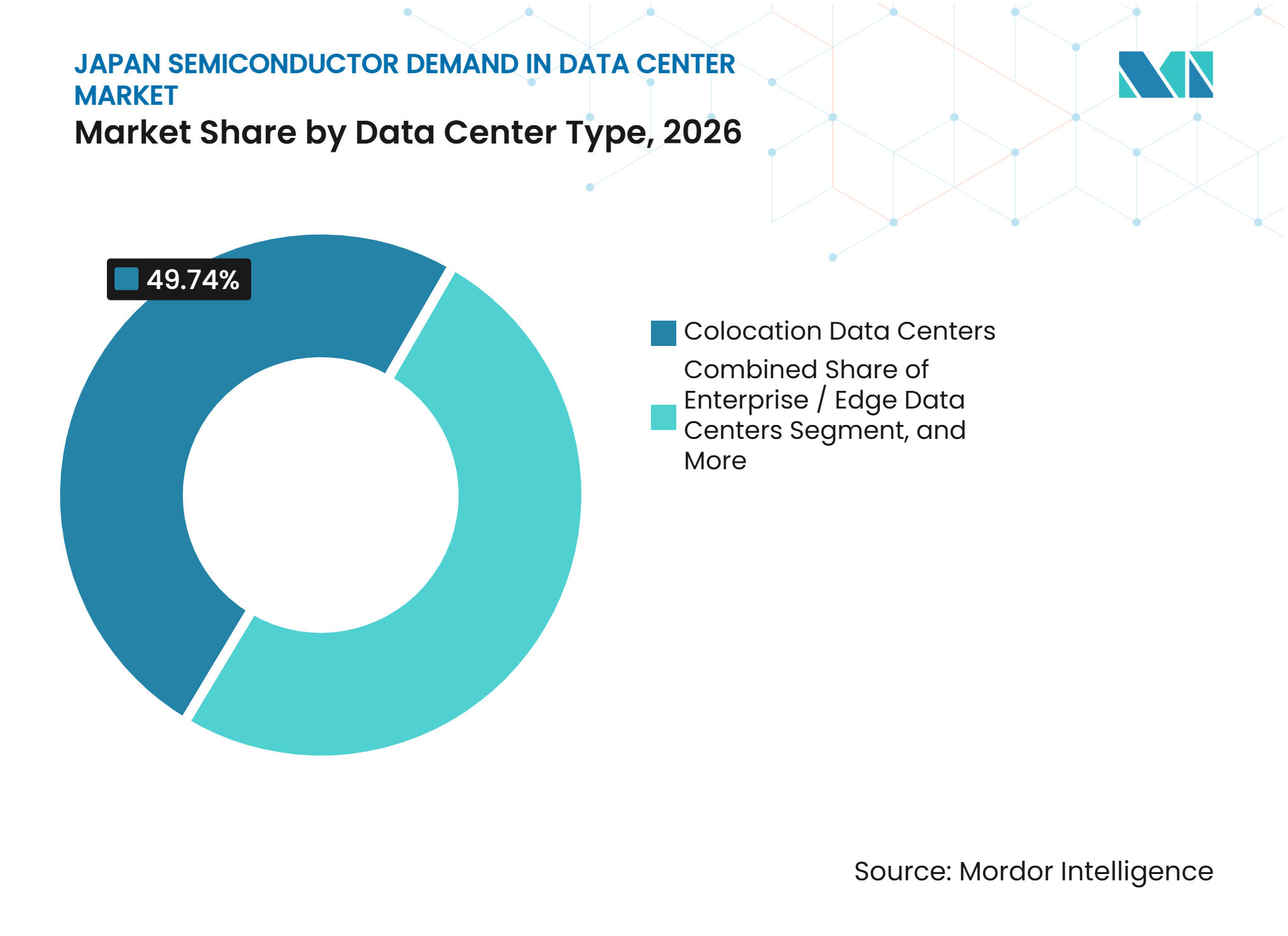
- By data center type, colocation data centers held 49.74% in 2026, while hyperscale data centers are projected to grow at an 8.68% CAGR through 2032.
Note: Market numbers in this report are based on Mordor Intelligence's proprietary estimation framework, which combines nine months of actuals with Q4 projections for base year 2026.
Market Trends and Insights
Drivers Impact Analysis of Japan Semiconductor Demand In Data Center Market*
| Driver | (~) % Impact on CAGR Forecast | Geographic Relevance | Impact Timeline |
|---|---|---|---|
| AI Data Center and GPU Cluster Expansion | +2.1% | Greater Tokyo, Osaka, with spillover to Hokkaido and Kyushu | Short term (≤ 2 years) |
| Government Support for Domestic AI and Semiconductor Capacity | +1.5% | National, with concentrated gains in Kumamoto, Hokkaido, and Hiroshima | Medium term (2-4 years) |
| Enterprise Cloud Migration and Sovereign AI Adoption | +1.1% | National, with early gains in Tokyo and Osaka enterprise clusters | Medium term (2-4 years) |
| High-Bandwidth Memory and Advanced Packaging Intensity | +0.9% | Global supply chain anchored in Japan, with demand concentrated in Tokyo hyperscale nodes | Long term (≥ 4 years) |
| Regional Edge Computing for Low-Latency Industrial AI | +0.5% | Aichi, Kanagawa, Hiroshima, and Kyushu manufacturing corridors | Medium term (2-4 years) |
| Energy-Efficient Compute Procurement and Liquid-Cooling Adoption | +0.4% | National, with early deployment at Tokyo and Osaka data center campuses | Short term (≤ 2 years) |
| Source: Mordor Intelligence | |||
AI Data Center and GPU Cluster Expansion
The Japan semiconductor demand in data center market is moving toward denser computing systems rather than simply adding more data center floor space. GPU clusters increase the number of logic, memory, networking, power-management, and monitoring components required for each deployment. Japan’s semiconductor and digital strategy identifies advanced computing infrastructure as an area for policy support and industrial coordination. This setting favors suppliers that can support full rack-level designs instead of supplying a single component. Higher rack density also makes power delivery and cooling design part of the initial semiconductor selection process. The result is stronger demand for devices that manage voltage, heat, connectivity, and system reliability alongside processors.
Government Support for Domestic AI and Semiconductor Capacity
Japan has established a formal framework to support designated high-speed information-processing semiconductors. The framework allows the Ministry of Economy, Trade and Industry to provide capital contributions, debt guarantees, and human resource measures to designated entities. This policy direction gives domestic and foreign investors a clearer basis for planning local production and related computing capacity. Micron announced an investment of JPY 1.5 trillion (USD 9.6 billion) in a new Hiroshima memory facility, with potential government support of up to JPY 500 billion (USD 3.2 billion). The investment supports Japan’s role in memory supply while data center operators seek greater assurance over component availability. The Japan semiconductor demand in data center market benefits when manufacturing investments strengthen local technical capabilities and supplier relationships.
Enterprise Cloud Migration and Sovereign AI Adoption
Japanese enterprises are adopting dedicated domestic computing environments in which data residency, security, and predictable operational control are important. SoftBank introduced Cloud PF Type A, a sovereign cloud service built on Oracle Alloy for customers requiring domestic data handling. Such deployments create procurement decisions for processors, memory, storage, networking, and power systems across more individual organizations. They also support demand beyond public cloud campuses because regulated customers may use private or hybrid environments. Local service availability can shorten the distance between enterprise requirements and infrastructure design decisions. This broadens the customer base for the Japan semiconductor demand in data center market without changing the importance of hyperscale buyers.
High-Bandwidth Memory and Advanced Packaging Intensity
High-bandwidth memory is becoming more important as AI accelerators handle larger models and greater data movement. JEDEC published the HBM4 standard in April 2025, featuring a 2,048-bit interface that supports the next-generation stacked memory systems.[1] Advanced packaging also links semiconductor design, substrates, bonding equipment, and materials more closely than conventional server chip production. NVIDIA has identified capacity expansion with supply chain partners as part of its wider AI infrastructure buildout. Japanese equipment and materials suppliers can benefit where their products are embedded in these packaging workflows. Japan semiconductor demand in the data center market gains additional value per accelerator as memory stacks and package complexity rise together.
Restraints Impact Analysis of Japan Semiconductor Demand In Data Center Market*
| Restraint | (~) % Impact on CAGR Forecast | Geographic Relevance | Impact Timeline |
|---|---|---|---|
| Grid Connection Delays and Power Availability Constraints | -2.0% | Greater Tokyo, Osaka, and a national overhang | Short term (≤ 2 years) |
| Dependence on Imported Leading-Edge Compute and Finished HBM | -1.4% | National, with greatest exposure in hyperscale and enterprise AI clusters | Medium term (2-4 years) |
| High Capital Intensity and Long Payback Periods | -0.8% | National | Long term (≥ 4 years) |
| Seismic Engineering, Thermal Design, and Skilled-Labor Bottlenecks | -0.5% | National, most acute in Greater Tokyo and Osaka urban zones | Medium term (2-4 years) |
| Source: Mordor Intelligence | |||
Grid Connection Delays and Power Availability Constraints
Electricity access can delay semiconductor demand because operators generally confirm power availability before finalizing major server and cooling purchases. The Organization for Cross-regional Coordination of Transmission Operators is responsible for coordination to support a stable electricity supply across Japan. This makes grid planning a central consideration for Greater Tokyo and other constrained locations. The International Energy Agency reported that global electricity demand from data centers, AI, and cryptocurrency may more than double by 2026, highlighting the wider pressure created by compute-intensive facilities. Operators may respond by selecting locations with clearer power schedules, deploying modular facilities, or changing their cooling approach. These choices can shift the timing and location of the Japan semiconductor demand in data center market even when underlying computing requirements remain firm.
Dependence on Imported Leading-Edge Compute and Finished HBM
Japan continues to rely on overseas suppliers for many leading-edge processors and finished high-bandwidth memory products used in AI systems. Domestic policy support is intended to develop capacity, but local availability of the newest compute chips will take time to expand. This dependence exposes data center projects to global allocation priorities, currency movements, and supply-chain disruptions. The challenge is most significant for AI training installations that need leading accelerators and high-capacity memory configurations. Buyers may need to secure supply commitments earlier and carry longer procurement lead times. These conditions can increase project costs and complicate equipment delivery for the Japan semiconductor demand in data center market.
*Our forecasts treat driver/restraint impacts as directional, not additive. The impact forecasts reflect baseline growth, mix effects, and variable interactions.
Japan Semiconductor Demand In Data Center Market Segment Analysis
By Product Type:
Memory Intensity Challenges Processor DominanceProcessors accounted for 42.36% of the Japan semiconductor demand in data center market size in 2026, reflecting the central role of GPUs and CPUs in AI training and inference. Processor demand includes accelerators, server CPUs, programmable devices, data processing units, and networking silicon. These products form the core of a compute cluster, but they also determine the requirements for surrounding memory and power systems. Higher model complexity increases the importance of low-latency interconnects between compute nodes. This supports demand for switching silicon, network interface devices, and specialized system controllers. Broadcom, Marvell, NVIDIA, and AMD are relevant suppliers for large AI clusters that require high-throughput data movement. Japanese data center developers must also consider the balance between peak performance, power draw, and system availability.
Memory type is projected to expand at an 8.57% CAGR through 2032, the fastest rate among product categories in the Japan semiconductor demand in data center market. HBM is paired with AI accelerators because data-intensive workloads require substantial bandwidth near the compute device. JEDEC’s HBM4 standard establishes the technical direction for wider memory interfaces and more advanced stacked-memory configurations. Kioxia and SanDisk announced planned investments exceeding USD 31 billion through 2032 to expand capacity at Yokkaichi and Kitakami, subject to government support.[2] DRAM remains essential for conventional server configurations, while NOR flash continues to serve firmware and control functions. Memory demand therefore extends across the compute, storage, and monitoring layers of the Japan semiconductor demand in data center market.



By Application:
IT Equipment Anchors Demand as Cooling RisesIT equipment held 72.89% in 2026 because servers, storage systems, and network equipment contain the largest concentration of semiconductor content. This category remains essential regardless of whether capacity is deployed in a colocation facility, a cloud campus, or a private enterprise site. Processors, memory, Ethernet and optical networking components, controllers, and embedded power devices all sit within this application layer. The installed base also creates recurring demand as operators refresh equipment to improve energy efficiency and support newer AI software. Server and rack power systems add demand for power modules, controllers, battery-management devices, and protection components. Battery backup and energy storage equipment require similar devices to protect computing loads during power disruptions. Monitoring and automation systems use sensors and interface components to collect operating data across facilities. Japan’s policy framework for information-processing infrastructure reinforces the importance of reliable, high-performance compute systems.
Cooling and thermal management infrastructure is expected to grow at an 8.62% CAGR through 2032. AI systems increase rack heat loads and make liquid cooling more relevant for deployments that cannot be efficiently handled by conventional air cooling. Thermal systems use sensors, pump controllers, power ICs, monitoring devices, and embedded control electronics. This expands semiconductor demand beyond compute hardware into cooling distribution units and related facility equipment. The direction toward higher-density infrastructure gives thermal design greater influence over site selection and equipment qualification. Suppliers must demonstrate reliability because cooling interruptions can affect system availability and accelerator performance. The International Energy Agency identifies data centers and AI as increasingly important contributors to electricity demand, strengthening the case for energy-efficient cooling design.
By Data Center Type:
Hyperscale Economics Accelerate Beyond ColocationColocation data centers held 49.74% in 2026. This model gives users access to established connectivity, shared physical infrastructure, and data center expertise without having to build a site from the ground up. It can also reduce the burden of securing suitable land, power, and cooling systems in constrained urban locations. Colocation providers purchase equipment directly and influence component selection through facility standards and customer requirements. Their investments span servers and networking equipment as well as electrical and thermal systems. The model is useful for cloud customers who want to enter a market quickly while retaining some infrastructure flexibility.
Hyperscale data centers are projected to grow at an 8.68% CAGR through 2032, the fastest rate among deployment types. Global cloud operators and domestic sovereign AI initiatives are increasing demand for large-scale computing facilities with dense accelerator capacity. These sites prioritize compute output within available power limits, which raises the value of efficient processors, memory, networking, and power-management devices. Hyperscale designs also accelerate the adoption of liquid cooling corridors and higher-voltage power architectures. SoftBank’s domestic sovereign cloud service illustrates the role of locally operated platforms in meeting requirements for secure data handling.

Geography Analysis
Greater Tokyo
Greater Tokyo is the primary demand center for the Japan semiconductor demand in data center market because it concentrates enterprise customers, network interconnection, financial activity, and cloud infrastructure. Inzai, Chiba, Sagamihara, and central Tokyo districts host colocation and hyperscale activity, while proximity to major businesses and carrier networks continues to attract investment. Power and land constraints can slow new development, so operators are considering suburban sites, modular designs, and cooling systems that support greater computing density. Japan’s information-processing policy framework gives a regulatory context for investment in advanced computing resources. Demand remains tied to energized-site availability, which encourages sensors, power-management devices, and thermal-control electronics that deliver more compute within constrained power envelopes.
Osaka and Kansai
Osaka and Kansai are becoming a second major hub as operators seek capacity outside Greater Tokyo and diversify their infrastructure to support resilient domestic operations. Sovereign AI projects and new cloud capacity are supporting demand for advanced processors, memory, high-performance networking equipment, storage, power systems, and cooling equipment. NEC announced that Noetra was starting full-scale research and development for a Japan-developed multimodal foundation model and planned AI computing infrastructure using 27,500 NVIDIA Rubin GPUs, with construction scheduled to begin in April 2027.[3] The region also supports disaster recovery and distributed application architectures, although development depends on power delivery, construction execution, and the availability of technical labor. High-density designs create space for liquid-cooling components and efficient power devices while adding geographic resilience to semiconductor demand in the data center market.
Regional Hubs
Hokkaido, Kyushu, Tohoku, Aichi, Hiroshima, and Kanagawa broaden the geographic base for Japan's semiconductor demand in the data center market. Hokkaido offers cooler conditions, land availability, and renewable energy potential, while Kyushu benefits from semiconductor activity around Kumamoto, and Tohoku is linked to NAND flash supply-chain activity near Kitakami. Kioxia and SanDisk’s proposed capacity investment reinforces the importance of domestic flash manufacturing in the wider data infrastructure chain. Aichi, Hiroshima, and Kanagawa can support low-latency edge computing near manufacturing customers, supported by Hitachi’s industrial edge AI semiconductor development. These sites support specialized workloads, varied cooling needs, and industrial-grade edge equipment while reducing reliance on a small number of urban campuses.
Competitive Landscape
Market Concentration
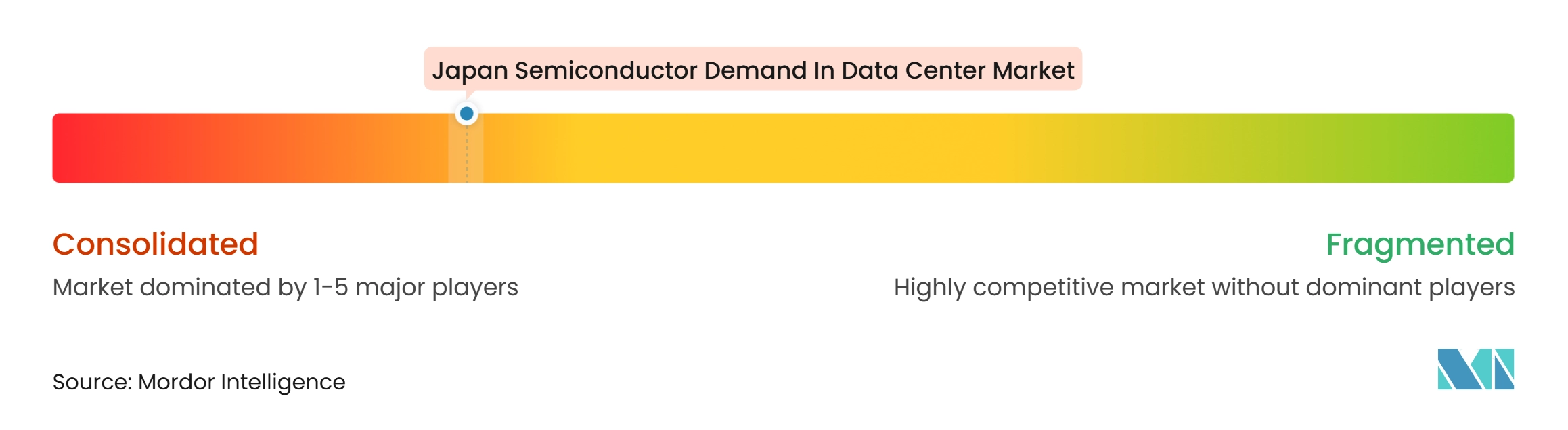
Japan's semiconductor demand in the data center market is concentrated in leading processors and advanced memory, while power electronics, analog devices, sensors, substrates, materials, and production equipment remain more dispersed. NVIDIA, Samsung Electronics, SK hynix, and Micron are influential in supplying processors and advanced memory for AI infrastructure, while Japanese companies play important roles in the surrounding technology layers. Procurement favors vendors that meet performance, qualification, supply assurance, and energy-efficiency requirements for dense AI systems with limited power capacity. Advanced packaging increases collaboration among chip designers, substrate suppliers, equipment makers, and material producers, and NVIDIA has described supply chain capacity expansion as part of its AI infrastructure buildout. This supports established Japanese packaging and manufacturing participants while raising qualification requirements for smaller competitors.
Efficiency is a central competitive factor because data center buyers must manage power draw, cooling needs, and operating cost together. ROHM and Renesas participate in power-device and power-management categories that support high-density server deployments, while suppliers that reduce conversion losses may gain additional design opportunities. Fujitsu began manufacturing sovereign AI servers in Japan and launched the FUJITSU-MONAKA CPU with the Fujitsu MONAKA Server for AI inference and demanding workloads.[4] This introduces a domestic processor option for buyers who value locally developed systems and supply chain control, while leading-edge chips remain essential, even if imported. Kioxia and SanDisk have also positioned planned investment around expanding memory capacity for the AI era.
Supplier relationships are shaped by long planning cycles for advanced packaging, memory, and high-density computing infrastructure. Companies with validated technology and scalable production can secure earlier roles in customer roadmaps, while smaller suppliers can compete by focusing on thermal materials, sensors, power conversion, or industrial edge products. Government support for high-speed information processing semiconductors may strengthen the domestic ecosystem, but it does not eliminate global competition. Buyers assess security of supply alongside performance and total cost, creating an opening for partnerships that combine global compute technology with Japanese manufacturing and infrastructure expertise.
Japan Semiconductor Demand In Data Center Industry Leaders
-
NVIDIA Corporation
-
Advanced Micro Devices, Inc.
-
Intel Corporation
-
Samsung Electronics Co., Ltd.
-
SK hynix Inc.
- *Disclaimer: Major Players sorted in no particular order
Japan Semiconductor Demand In Data Center Market Companies Covered in this Report
- NVIDIA Corporation
- Advanced Micro Devices, Inc.
- Intel Corporation
- Samsung Electronics Co., Ltd.
- SK hynix Inc.
- Micron Technology, Inc.
- Broadcom Inc.
- Marvell Technology, Inc.
- Kioxia Holdings Corporation
- Renesas Electronics Corporation
- Sony Semiconductor Solutions Corporation
- Fujitsu Limited
- NEC Corporation
- Arm Holdings plc
- Monolithic Power Systems, Inc.
- Texas Instruments Incorporated
- Analog Devices, Inc.
- Advantest Corporation
- Tokyo Electron Limited
- Shin-Etsu Chemical Co., Ltd.
- Ibiden Co., Ltd.
- Shinko Electric Industries Co., Ltd.
- Resonac Holdings Corporation
- Kyocera Corporation
- ROHM Co., Ltd.
Recent Industry Developments in Japan Semiconductor Demand In Data Center Market
- November 2026: Fujitsu Limited commercially launched the FUJITSU-MONAKA CPU, designed and developed domestically, alongside the Fujitsu MONAKA Server. The company stated that the system delivers 2x AI inference throughput versus competing CPUs at equivalent power and targets cloud data center operators, defense, and financial customers.
- October 2026: SoftBank officially launched Cloud PF Type A, a sovereign AI cloud built on Oracle Alloy, with operations in its western Japan data center beginning in October 2026.
- September 2026: Samsung Electronics opened an AI chip packaging research center in Yokohama with JPY 22.5 billion (USD 147 million) in support. The facility supports the co-development of HBM4 and advanced package technologies with Japanese back-end materials suppliers.
- July 2026: Noetra Corporation, backed by Sony Group, SoftBank, NEC, Honda, and 44 total investors, launched full-scale research and development for a Japan-developed multimodal foundation model. The company also confirmed plans to build AI computing infrastructure with 27,500 NVIDIA Rubin GPUs starting in April 2027.
Japan Semiconductor Demand In Data Center Market Report Scope
The Japan data center semiconductor demand market encompasses the demand for semiconductors used in data center infrastructure across Japan. These components include processors, memory chips, graphics processing units, networking chips, storage controllers, and power management integrated circuits that support data processing, storage, connectivity, and cloud computing operations.
The Japan Semiconductor Demand in Data Center Market Report is Segmented by Product Type (Processors [Central Processing Units (CPUs), Graphics Processing Units (GPUs), Microcontrollers (MCUs), and Digital Signal Processors (DSPs)], Logic ICs [Field Programmable Gate Arrays (FPGAs), DPUs/IPUs/SmartNICs, Network Switches and Server Rack Connectivity, Controller ICs, and Other Logic ICs], Memory Type [DRAM, High-Bandwidth Memory (HBM), NAND Flash, NOR Flash, and Other Memory Types], Power Electronics [Discrete Components {Rectifiers, Bipolar Transistors, MOSFETs, IGBTs, and Other Discrete Components}, Power Modules {Thyristor Modules, IGBT Modules, MOSFET Modules, and Intelligent Power Modules (IPMs)}, and Power ICs {PMICs (Multichannel), Switching Regulators (AC/DC and DC/DC, Isolated/Non-Isolated), Linear Regulators, Battery Management ICs, Gate Driver ICs, and Other Power ICs}], Analog ICs [Interface and Signal-Conditioning ICs, Signal-Conversion ICs, Application-Specific Analog ICs], Optoelectronics [Laser Transmitters, Photodetectors and Photodiodes, Optocouplers and Optical Isolators, Optical Switches, and Infrared Emitters and Detectors], and Sensors [Temperature Sensors, Pressure Sensors, Magnetic-Field and Hall-Effect Sensors, Current Sensors, Humidity Sensors, and Gas and Smoke Sensors]), Application (IT Equipment, Server and Rack Power Systems, Battery Backup and Energy Storage Systems, Facility Power Infrastructure, Cooling and Thermal Management Infrastructure, Data Center Monitoring and Automation, and Safety and Security Infrastructure), and Data Center Type (Hyperscale Data Centers, Colocation Data Centers, and Enterprise/Edge Data Centers). The Market Forecasts are Provided in Terms of Value (USD).
Segmentation Overview
| Processors | Central Processing Units (CPUs) | |
| Graphics Processing Units (GPUs) | ||
| Microcontrollers (MCUs) | ||
| Digital Signal Processors (DSPs) | ||
| Logic ICs | Field Programmable Gate Arrays (FPGAs) | |
| DPUs / IPUs / SmartNICs | ||
| Network Switches and Server Rack Connectivity | ||
| Controller ICs | ||
| Other Logic ICs | ||
| Memory Type | DRAM | |
| High-Bandwidth Memory (HBM) | ||
| NAND Flash | ||
| NOR Flash | ||
| Other Memory Types | ||
| Power Electronics | Discrete Components | Rectifiers |
| Bipolar Transistors | ||
| MOSFETs | ||
| IGBTs | ||
| Other Discrete Components | ||
| Power Modules | Thyristor Modules | |
| IGBT Modules | ||
| MOSFET Modules | ||
| Intelligent Power Modules (IPMs) | ||
| Power ICs | PMICs (Multichannel) | |
| Switching Regulators (AC/DC, DC/DC, Isolated/Non-Isolated) | ||
| Linear Regulators | ||
| Battery Management ICs | ||
| Gate Driver ICs | ||
| Other Power ICs | ||
| Analog ICs | Interface and Signal-Conditioning ICs | |
| Signal-Conversion ICs | ||
| Application-Specific Analog ICs | ||
| Optoelectronics | Laser Transmitters | |
| Photodetectors and Photodiodes | ||
| Optocouplers and Optical Isolators | ||
| Optical Switches | ||
| Infrared Emitters and Detectors | ||
| Sensors | Temperature Sensors | |
| Pressure Sensors | ||
| Magnetic-Field and Hall-Effect Sensors | ||
| Current Sensors | ||
| Humidity Sensors | ||
| Gas and Smoke Sensors | ||
| IT Equipment |
| Server and Rack Power Systems |
| Battery Backup and Energy Storage Systems |
| Facility Power Infrastructure |
| Cooling and Thermal Management Infrastructure |
| Data Center Monitoring and Automation |
| Safety and Security Infrastructure |
| Hyperscale Data Centers |
| Colocation Data Centers |
| Enterprise / Edge Data Centers |
| By Product Type | Processors | Central Processing Units (CPUs) | |
| Graphics Processing Units (GPUs) | |||
| Microcontrollers (MCUs) | |||
| Digital Signal Processors (DSPs) | |||
| Logic ICs | Field Programmable Gate Arrays (FPGAs) | ||
| DPUs / IPUs / SmartNICs | |||
| Network Switches and Server Rack Connectivity | |||
| Controller ICs | |||
| Other Logic ICs | |||
| Memory Type | DRAM | ||
| High-Bandwidth Memory (HBM) | |||
| NAND Flash | |||
| NOR Flash | |||
| Other Memory Types | |||
| Power Electronics | Discrete Components | Rectifiers | |
| Bipolar Transistors | |||
| MOSFETs | |||
| IGBTs | |||
| Other Discrete Components | |||
| Power Modules | Thyristor Modules | ||
| IGBT Modules | |||
| MOSFET Modules | |||
| Intelligent Power Modules (IPMs) | |||
| Power ICs | PMICs (Multichannel) | ||
| Switching Regulators (AC/DC, DC/DC, Isolated/Non-Isolated) | |||
| Linear Regulators | |||
| Battery Management ICs | |||
| Gate Driver ICs | |||
| Other Power ICs | |||
| Analog ICs | Interface and Signal-Conditioning ICs | ||
| Signal-Conversion ICs | |||
| Application-Specific Analog ICs | |||
| Optoelectronics | Laser Transmitters | ||
| Photodetectors and Photodiodes | |||
| Optocouplers and Optical Isolators | |||
| Optical Switches | |||
| Infrared Emitters and Detectors | |||
| Sensors | Temperature Sensors | ||
| Pressure Sensors | |||
| Magnetic-Field and Hall-Effect Sensors | |||
| Current Sensors | |||
| Humidity Sensors | |||
| Gas and Smoke Sensors | |||
| By Application | IT Equipment | ||
| Server and Rack Power Systems | |||
| Battery Backup and Energy Storage Systems | |||
| Facility Power Infrastructure | |||
| Cooling and Thermal Management Infrastructure | |||
| Data Center Monitoring and Automation | |||
| Safety and Security Infrastructure | |||
| By Data Center Type | Hyperscale Data Centers | ||
| Colocation Data Centers | |||
| Enterprise / Edge Data Centers | |||
Key Questions Answered in the Report
What is the Japan semiconductor demand in data center market size?
The Japan semiconductor demand in data center market is expected to increase from USD 41.64 billion in 2026 to USD 65.18 billion by 2032, at a 7.83% CAGR over 2027-2032.
What is driving semiconductor demand in Japanese data centers?
AI clusters, sovereign cloud programs, enterprise cloud migration, and higher compute density are increasing demand for processors, memory, power devices, and cooling controls.
Which product type leads Japan’s data center semiconductor demand?
Processors held 42.36% in 2026, while memory type is projected to record the fastest growth at an 8.57% CAGR through 2032.
Why is liquid cooling relevant to Japan’s data center expansion?
Higher-density AI racks need more sophisticated thermal control, which increases demand for sensors, pump controllers, power ICs, and monitoring devices.
Which data center deployment type is growing fastest in Japan?
Hyperscale data centers are projected to grow at an 8.68% CAGR through 2032 as cloud and sovereign AI projects increase large-scale computing capacity.
What factors may limit expansion in Japanese data centers?
Grid connection delays, reliance on imported leading-edge compute and memory, high capital requirements, seismic design needs, and skilled-labor constraints can affect project timing.