
Market Overview
| Study Period | 2020 - 2031 |
|---|---|
| Forecast Data Period | 2026 - 2031 |
| Base Year Market Size (2025) | USD 76.76 Billion |
| Market Size (2026) | USD 77.85 Billion |
| Market Size (2031) | USD 83.53 Billion |
| Growth Rate (2026 - 2031) | 1.42 % |
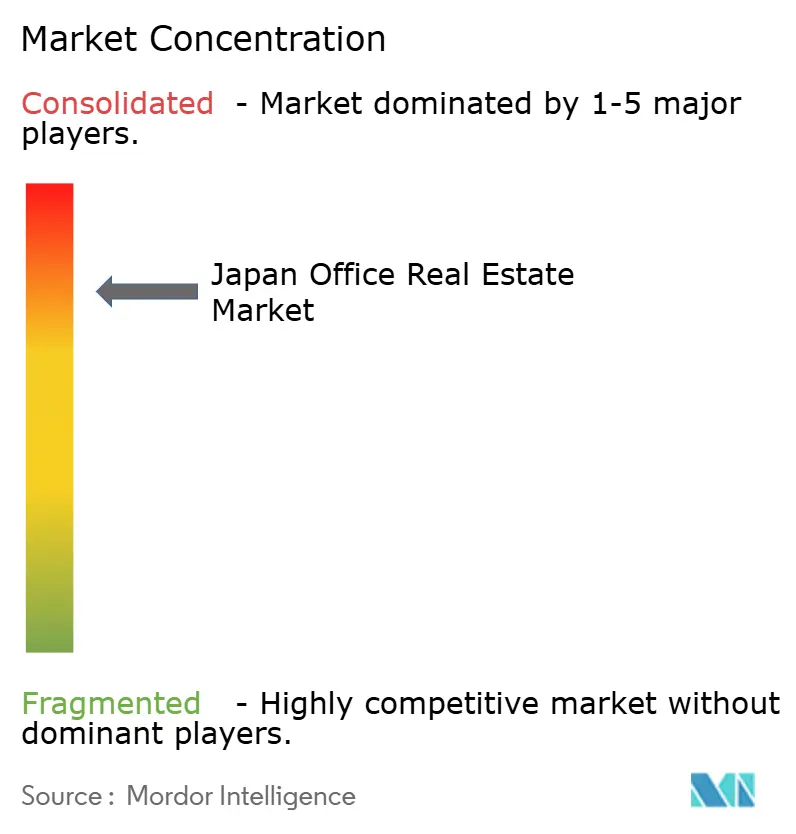
| Market Concentration | High |
Major Players *Disclaimer: Major Players sorted in no particular order Image © Mordor Intelligence. Reuse requires attribution under CC BY 4.0. | |
Japan Office Real Estate Market Analysis by Mordor Intelligence
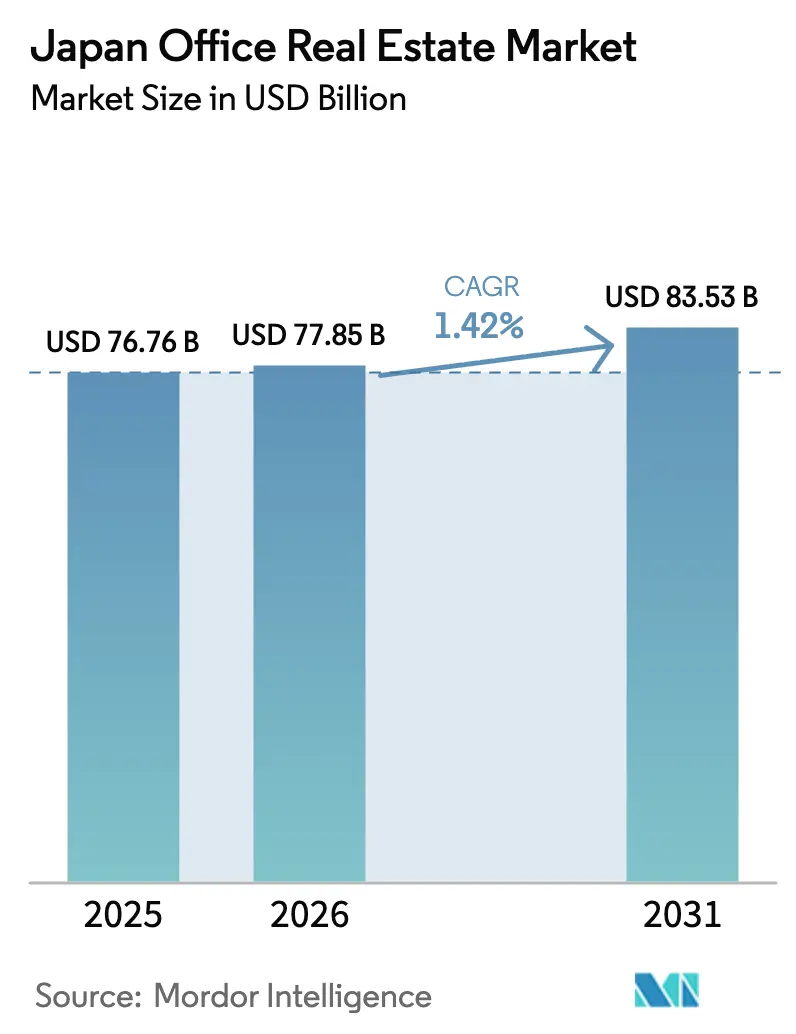
The Japan Office Real Estate Market size was valued at USD 76.76 billion in 2025 and estimated to grow from USD 77.85 billion in 2026 to reach USD 83.53 billion by 2031, at a CAGR of 1.42% during the forecast period (2026-2031). The Bank of Japan lifted its policy rate from negative territory to 0.25% and signaled that the corridor could widen to 1.0% by late-2025, a pivot that improves relative yields for domestic and offshore buyers. Central bank surveys forecast GDP expanding above potential as a modest pickup in global trade combines with a self-reinforcing rise in wages, consumption, and capital spending, particularly in automation and data infrastructure. The IMF’s latest Financial Sector Assessment notes sizeable exposures to equity and bond markets and flags pockets of stretched pricing in select real estate districts, although offices have held up through the pandemic. At the policy level, the administration’s “New Form of Capitalism” blueprint directs incentives toward semiconductors, cloud services, and related supply chains that depend on modern office capacity.
Key Report Takeaways
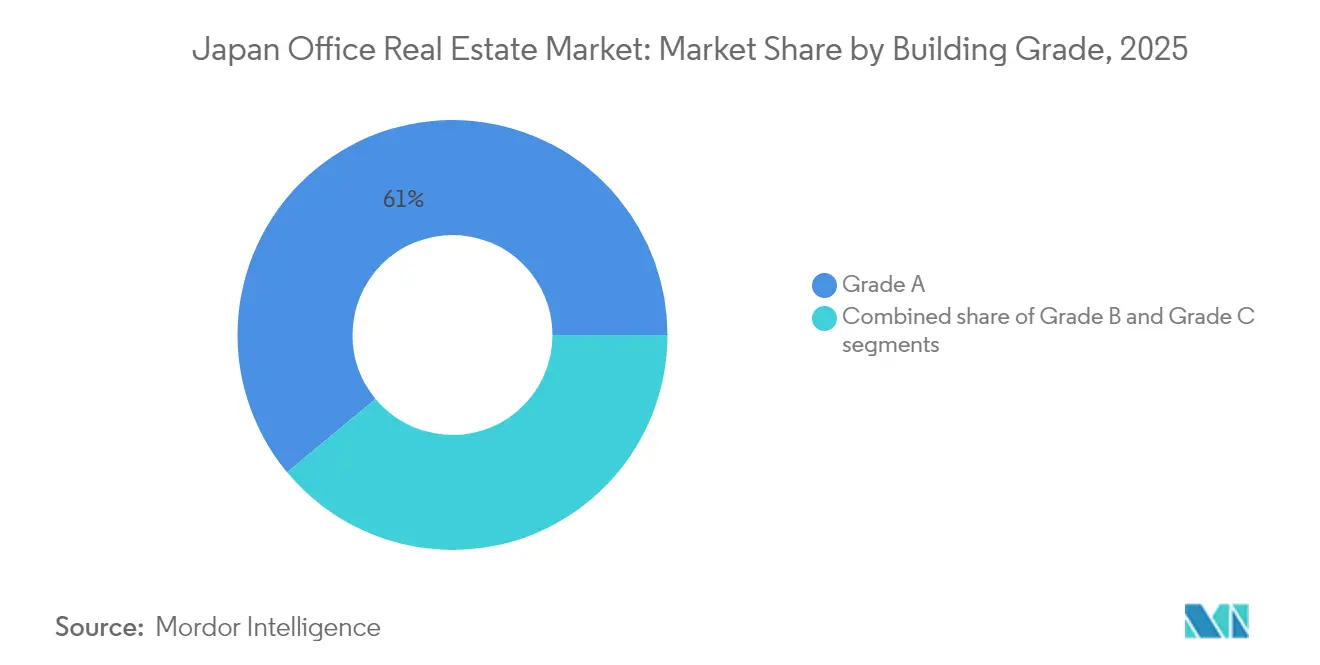
- By building grade, Grade A properties accounted for 61.03% of Japan's office real estate market share in 2025, while this premium cohort is forecast to expand at a 1.58% CAGR through 2031.
- By transaction type, Rental transactions contributed 70.72% to the Japan office real estate market size in 2025; the sales segment is projected to post the fastest growth at a 1.66% CAGR.
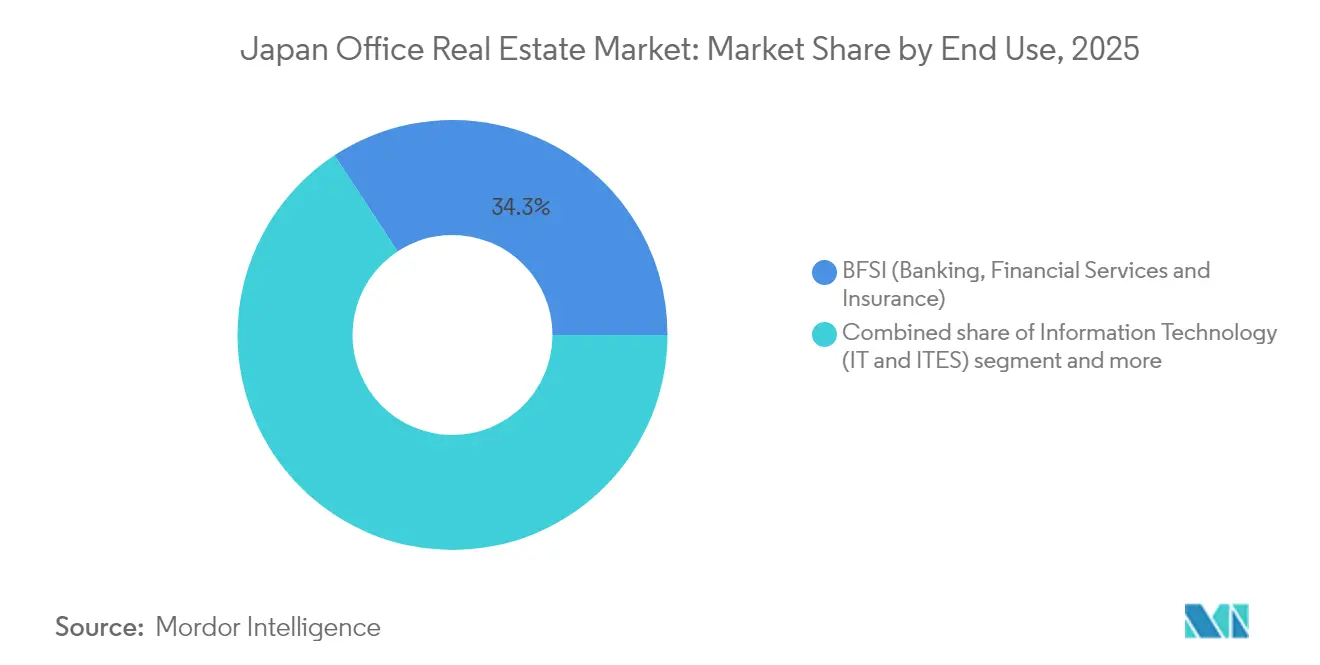
- By end use, the BFSI segment held 34.25% of Japan's office real estate market share in 2025, with Information Technology poised to post the highest growth at a 1.70% CAGR.
- By city, Tokyo captured 57.05% of the Japan office real estate market in 2025, whereas Osaka is expected to register the strongest CAGR at 1.76% to 2031.
Note: Market size and forecast figures in this report are generated using Mordor Intelligence’s proprietary estimation framework, updated with the latest available data and insights as of 2026.
Japan Office Real Estate Market Trends and Insights
Drivers Impact Analysis*
| Driver | (~) % Impact on CAGR Forecast | Geographic Relevance | Impact Timeline |
|---|---|---|---|
| Seismic-resilient & energy-efficient offices | +0.3% | Nationwide; Tokyo, Osaka, Nagoya | Medium term (2-4 years) |
| Government-led urban redevelopment | +0.2% | Tokyo, Osaka; spillover to Nagoya | Long term (≥4 years) |
| Wellness-oriented & tech-integrated space | +0.4% | Tokyo core, spreading to regional cities | Short term (≤2 years) |
| Professional services & IT expansion | +0.3% | Tokyo, Osaka; growing in Nagoya | Medium term (2-4 years) |
| Flexible & co-working network growth | +0.2% | Nationwide; suburban nodes | Short term (≤2 years) |
| Heightened foreign investor interest | +0.1% | Tokyo, Osaka; selective major cities | Short term (≤2 years) |
| Source: Mordor Intelligence | |||
Increasing Demand for Earthquake-Resilient and Energy-Efficient Office Buildings
Tenant and investor priorities in Japan are increasingly shaped by seismic safety and energy performance, elevating the appeal of next-generation office assets. Seismic retrofitting mandates compel owners to upgrade or replace older stock, channeling occupier demand toward recently built projects that already comply with stringent codes. Capital expenditure rises for owners of legacy towers, while developers of new structures gain pricing power through safer, greener designs that align with corporate ESG priorities. The dual necessity of quake resilience and sustainability accelerates tenant migration to Grade A assets, reinforcing the premium commanded by those buildings in the Japan office real estate market. Smart façades, efficient HVAC, and on-site renewables further bolster operating cost advantages that tenants increasingly quantify in lease negotiations. As a result, compliance-driven safety upgrades and ESG imperatives are converging to define the next era of demand in Japan’s office sector.
Government-Led Urban Redevelopment Projects Stimulating New Office Supply
National renewal programs now sit inside a wider digital-society agenda that asks planners to weave data, automation, and low-carbon design into every major district upgrade. Researchers describe Japan’s deregulated “flexible” zoning rules as weak by global standards, yet note that special districts allow planners to adjust height limits and land use to compete for talent and investment. New ministerial guidelines extend the legal service life of timber structures to at least 50 years, a change expected to unlock cheaper finance for low-carbon construction. Advisory panels urge schemes that protect local identity, arguing that copy-paste high-rise blocks erode livability and raise build costs as the population shrinks. Together, these measures keep the redevelopment pipeline active while steering designers toward climate goals and stronger community outcomes.[1]
Rising Tenant Preference for Wellness-Oriented and Tech-Integrated Office Environments
Health, sustainability, and digital infrastructure have become non-negotiables for tenants seeking to enhance employee experience and retention. More than 60% of occupiers have stabilized attendance policies and now refine space to improve experience and retention. Real-time air-quality monitoring, touchless entry, and sensor-driven climate systems increasingly appear on mandatory requirement lists as firms seek to boost productivity while demonstrating duty of care. Surveys reveal 43% of firms hitting peak utilization above 80%, suggesting that right-sized footprints are feasible when paired with data-led space management. Developers respond by embedding programmable lighting, biophilic terraces, and on-site fitness to secure green certifications such as CASBEE and LEED, which in turn support rental premiums. For the Japan office real estate market, the convergence of wellness and technology is no longer a differentiator but a prerequisite for top-tier assets. This evolution reinforces the premium placed on smart, human-centric environments that align with the future of work.
Growth in Professional Services and IT Sectors Driving Demand
Japan’s push to digitize public and private workflows is lifting office demand from technology vendors, consultants, and allied service firms. Cabinet Office analysis positions artificial intelligence as a broad platform that raises productivity and triggers fresh job creation, requiring large-scale reskilling programs that translate into new tenant requirements for training space. Bank of Japan industry studies confirm that machinery, construction, and other investment-heavy sectors carry an outsized share of GDP momentum, reinforcing the need for central locations that support complex supply chains. Meanwhile, the government’s action plan to double inward foreign direct investment to USD 530 billion by 2030 includes tax and visa reforms aimed at building Asia’s largest start-up hub in Tokyo. Against a backdrop of fourteen straight years of national population decline, Tokyo retains 11.5% of residents and posts the fastest growth rate, concentrating talent and workspace demand in the capital.[2]
Restraints Impact Analysis*
| Restraint | (~) % Impact on CAGR Forecast | Geographic Relevance | Impact Timeline |
|---|---|---|---|
| Persistent remote work adoption | -0.2% | Nationwide; strongest in Tokyo CBD | Medium term (2-4 years) |
| Oversupply risk for Grade B/C stock | -0.1% | Secondary areas in Tokyo & Osaka | Short term (≤2 years) |
| High seismic retrofitting costs for aging buildings | -0.2% | Older assets across all major cities | Long term (≥4 years) |
| Source: Mordor Intelligence | |||
Persistent Remote Work Adoption Reducing Large Occupier Space Requirements
Flexible work models are driving long-term shifts in occupier strategy, curbing demand for large, traditional office footprints. Hybrid work has matured into a permanent structure, compelling large corporates to trim excess capacity and pursue distributed footprints that blend headquarters, satellite hubs, and on-demand space. Demand decouples from Gross Leasable Area and shifts toward fit-out quality, pushing rental growth into prime towers while sub-prime vacancy swells. Consequently, Grade A landlords remain insulated but lower-tier owners face asset repositioning costs in the Japan office real estate market. Even so, most occupiers retain a central flagship to safeguard culture and client access, tempering the drag on sector-wide absorption. While the flagship office remains relevant, decentralization continues to challenge the scale and utilization patterns of Japan’s office market.
Oversupply Concerns in Tokyo and Osaka Submarkets
Localized development peaks and aging stock are amplifying vacancy risk in key Japanese submarkets. While headline supply is moderating, completion peaks within five Tokyo wards create local pressure, especially for older mid-rise buildings that cannot match new amenity packages. Osaka’s surge in investment masks pockets of softness where secondary corridors host legacy towers ill-suited to current demand. Owners weigh capital-intensive retrofits against potential demolition in a land-scarce environment, and disposal activities by domestic REITs accelerated in 2024 to preempt value erosion. Vacancy risk therefore concentrates in specific blocks rather than the broader Japan office real estate market. Unless legacy assets are repositioned effectively, these pockets of oversupply may continue to weigh on rent growth and capital values.
*Our forecasts treat driver/restraint impacts as directional, not additive. The impact forecasts reflect baseline growth, mix effects, and variable interactions.
Segment Analysis
By Building Grade: Premium Assets Drive Market Evolution
Grade A space commanded 61.03% of Japan's office real estate market share in 2025, underlining tenant flight to quality that underpins a projected 1.58% CAGR for this cohort through 2031. Record net absorption of 105,000 tsubo in Tokyo in Q1 2025 validates continued appetite for high-spec, ESG-compliant towers despite subdued macro growth. Rising construction outlays and limited CBD land ensure new deliveries arrive in smaller annual tranches, sustaining pricing power for existing Grade A owners within the Japan office real estate market.
Faced with escalating retrofit obligations, Grade B landlords explore shell-and-core upgrades or conversion to alternative uses when economic. Grade C assets often cannot bridge the cost-value gap, encouraging site aggregation by deep-capital developers who can justify demolition and rebuild. Smart-building systems, carbon-neutral materials, and WELL certification now define the minimum standard for maintaining Class A status. Companies such as Japan Real Estate Investment Corporation have already secured green labels on 76.4% of their office portfolio, capturing rent premiums that ripple through the Japan office real estate market.

By Transaction Type: Rental Dominance Reflects Market Maturity
Rental deals represented 70.72% of the Japan office real estate market size in 2025, confirming that corporates still value balance-sheet flexibility over asset ownership. Lease structures remain multi-year with stepped escalation clauses, offering stable cash flows that underpin REIT dividend strategies. Meanwhile, the smaller sales segment is forecast to deliver a 1.66% CAGR to 2031, buoyed by overseas investors hunting yield and domestic institutions rotating assets.
Listed REITs unloaded USD 5.1 billion of office holdings in 2024, monetizing capital gains for share buybacks that enhance total return metrics. High-profile trades such as overseas sovereign wealth funds capturing Marunouchi trophy assets demonstrate that liquidity persists for prime stock. Consequently, rental stability acts as ballast while transaction velocity allows active players to recycle capital, reinforcing depth in the Japan office real estate market.
By End Use: Technology Sector Emergence Reshapes Demand
The BFSI (Banking, Financial Services, and Insurance) community retained 34.25% of the Japan office real estate market share in 2025 through entrenched headquarters and regulatory needs for secure environments. Yet, Information Technology is set to chart a 1.70% CAGR through 2031 as start-ups scale and global platforms grow, in Japanese engineering hubs. This expansion stimulates demand for modular floorplates and advanced connectivity, making IT a structural driver of the Japan office real estate market.
Professional services maintain a steady roster of requirements while leveraging flexible clauses to manage project cycles. Fintech and proptech cross-pollination blurs sector lines; for instance, Mitsubishi Estate’s flex-office arm saw robust revenue of USD 2.3 billion thanks to enterprise subscriptions. The diversification of occupier mix thus reduces over-reliance on any single industry and broadens resilience across the Japan office real estate market.
Geography Analysis
Tokyo retained 57.05% of its national share in 2025 and sustained six consecutive quarters of rent growth as Grade A vacancy fell to 3.6%. Flagship redevelopments such as Tokyo TORCH refresh the skyline while enhancing multimodal connectivity, reinforcing the capital’s magnetism for multinational headquarters and global investors operating within the Japan office real estate market. Rising construction costs temper speculative supply, which in turn maintains upward rent pressure in core districts. Investor activity, topping USD 34 billion in 2024, further amplifies Tokyo’s liquidity and cements its status as the premier gateway city.
Osaka’s share sits below Tokyo’s, but records as World Expo preparations accelerate infrastructure and place-making projects. Office absorption outpaced new completions in 2024, driving Grade A vacancy down to 2.6% and validating capital inflows from cross-border buyers attracted to comparatively wider yields. The USD 4 billion Umekita scheme will add mixed-use inventory that integrates life-science, hospitality, and workspace, anchoring long-term competitiveness in the Japan office real estate market. Local stakeholders leverage the Expo platform to brand Osaka as a global innovation hub, differentiating it from Tokyo’s corporate pedigree.
Nagoya delivers mid-single-digit rental gains as automotive and aerospace majors lock in footprints near supplier ecosystems. Grade A vacancy fell to 2.3% in Q1 2025, the tightest in four years, reflecting deep-seated industrial demand. Beyond the three megacities, regional centers vary: Fukuoka benefits from IT offshoring; Sapporo leverages tourism; and Sendai undertakes downtown renewal. Government incentives support decentralization, yet demographic headwinds require cities to cultivate niche specializations to sustain office absorption across the Japan office real estate market.
Regulatory Landscape
Japan office development and redevelopment is primarily governed by the Building Standards Act and the City Planning Law, implemented through local governments and accredited inspection bodies. More recently, tighter building-energy compliance has raised requirements for new office stock, with the Act on Improvement of Energy Consumption Performance of Buildings requiring a certificate of conformity for all new construction from April 1, 2025. This has reinforced demand for high-performance Grade A supply and increased pressure to upgrade older assets.
On the construction and renovation side, amendments to the Construction Business Act introduced guardrails on contract pricing. Article 19-3(2), effective December 12, 2025, prohibits contractors from agreeing to prices below the cost required to perform work, and MLIT issued revised compliance guidelines in January 2026. Separately, the amended Act on Building Unit Ownership took effect April 1, 2026, lowering the condominium reconstruction resolution threshold to three-fourths, which can broaden urban renewal activity and support mixed-use, office-led district redevelopment.
Value Chain Analysis
Japan's office real estate value chain is led by large integrated developers that cover land assembly, planning, financing, construction procurement, leasing, and asset management. General contractors and specialist trades, architectural and engineering firms, and building systems and material suppliers also shape delivery and build quality. Institutional capital acts as a downstream channel, with developers and listed REITs transacting stabilized office assets, while property management and tenant services (fit-out, building operations, and smart-building platforms) influence retention and effective rents, particularly for Grade A stock.
Execution capacity and the ability to manage costs across the chain remain key linkages. Developers including Mitsui Fudosan and Mitsubishi Estate have incorporated CPI-linked contract approaches to protect earnings in inflationary environments, while labor shortages and rising construction and land costs add schedule and budget risk that can delay completions and intensify pre-leasing. Asset sales also support capital recycling for new development, and Mitsubishi Estate reported that it had secured 70% of its targeted capital gains from overseas assets for FY2026 as of March 2026.
Competitive Landscape
The Japan office real estate market is highly concentrated. Large developers still dominate, yet the central bank’s Financial System Report cautions that elevated pricing in a few districts and rising vacancy in older towers warrant close monitoring. Field studies show that one quarter of central Tokyo’s stock already offers modern amenities and commands rents about 6.5% above market, although vacancy in this cohort inched up by 1.7 points as new deliveries hit the market. Tenant surveys confirm that indoor environmental quality explains half of the variation in user satisfaction, underscoring why owners continue to invest in air, light, and acoustic upgrades. High concentration allows these players to dictate design standards while absorbing compliance costs that deter smaller rivals within the Japan office real estate market.
Strategically, developers favor block redevelopment over single-site builds, allowing integration of office, retail, and hospitality that maximizes land value. Technology adoption—smart air-handling, AI-based energy dashboards, and tenant apps—creates service stickiness, and firms like Mitsubishi Estate dedicate dedicated venture arms to proptech incubation, aligning buildings with digital tenant requirements. REITs add a fluid capital market dimension; for example, record sales of USD 5.1 billion in 2024 freed liquidity for dividend boosts and unit buybacks, intensifying total-return competition.
Foreign finance reshapes bidding dynamics, as North American pension funds and Middle Eastern sovereign vehicles broaden mandate scopes to include Osaka, Nagoya, and even regional cities. Joint ventures give domestic groups access to cheaper capital, while overseas partners leverage local origination acumen. Emerging disruptors, notably flexible-workspace brands, partner with landlords to back-fill partial vacancies and power communal amenity floors, adding diversity to the Japan office real estate market’s competitive tapestry.
Japan Office Real Estate Industry Leaders
-
Mitsui Fudosan Co., Ltd.
-
Mitsubishi Estate Co., Ltd.
-
Sumitomo Realty & Development Co., Ltd.
-
Tokyu Land Corporation
-
Nomura Real Estate Holdings, Inc.
- *Disclaimer: Major Players sorted in no particular order
Market Opportunities and Future Outlook
A core opportunity is the widening performance gap between prime, amenity-rich buildings and older stock, as occupiers prioritize quality, resilience, and measurable building performance. Prime conditions offer a reference point for this shift, with Tokyo vacancy hovering just above 1% in mid-2026, and Mitsubishi Estate reporting a 0.55% vacancy rate in the Marunouchi area as of March 2026.
Landlords are using rent reset strategies to capture the upside from modern specifications, including Mitsui Fudosan's stated FY2026 objective for double-digit average rent increases on existing office properties nationwide. A second opportunity is the repositioning and redevelopment of aging properties under evolving building-energy and construction practices, which include pathways for lower-carbon construction and specialty formats that extend demand beyond traditional offices. With Tokyo new supply averaging 153,000 tsubo annually across 2026-2028, differentiation through ESG credentials, smart-building systems, and tenant experience becomes more relevant, particularly as hybrid and flexible work patterns open space for flexible layouts, satellite locations, and lab-office formats. These formats can support longer tenancies from technology, life science, and professional services users aligned with national digitalization priorities.
Recent Industry Developments
- June 2026: Mitsui Fudosan Co., Ltd. certified the Hakata Shin-Mitsui Building Redevelopment Plan under the Hakata Connected Bonus and Green Bonus programs in Fukuoka City. The Hakata redevelopment boosts office intake and ESG-linked financing. Enhances asset value and financing flexibility for large-scale redevelopment in regional Japan.
- May 2026: Sumitomo Realty and Development Co., Ltd. announced that Rosewood will anchor the Roppongi 5-Chome West District Category 1 Urban Redevelopment Project, approved by Tokyo in March 2024. Anchor tenancy strengthens CBD redevelopment pipeline in Tokyo. Improves project viability and rent-up profile for Tokyo urban redevelopment exposure.
- November 2025: Mitsui Fudosan Co., Ltd. began construction on the Nihonbashi Honcho 1-Chome District 5 Project, a hybrid timber rental office building in Tokyo. Timber and offsite construction projects advance the central Tokyo office supply mix. Demonstrates shift toward sustainable, mass-timber office development in premier districts.
Research Methodology Framework and Report Scope
Market Definition and Coverage
This market covers the value of office real estate activity in Japan, captured through leasing and sales of office space across major cities, and tracked in USD using a consistent set of rent, occupancy, and stock assumptions.
Scope exclusions: We exclude non-office property types such as retail, residential, hospitality, and industrial facilities, even when they sit inside mixed-use developments.
Segmentation Overview
- By Building Grade
- Grade A
- Grade B
- Grade C
- By Transaction Type
- Rental
- Sales
- By End Use
- Information Technology (IT & ITES)
- BFSI (Banking, Financial Services and Insurance)
- Business Consulting & Professional Services
- Other Services (Retail, Lifesciences, Energy, Legal)
- By City
- Tokyo
- Osaka
- Nagoya
- Rest of Japan
Data Sources, Market Sizing, and Validation
Desk Research
Desk research is used to build the base structure for the model and to keep inputs grounded in measurable indicators. For Japan office real estate, we typically start with public releases that describe office stock, new completions, and market conditions, and then align them with macro signals that move corporate space demand.
Common references include official statistics and publications such as the Statistics Bureau of Japan, the Ministry of Land, Infrastructure, Transport and Tourism (including land price and building-related releases), the Bank of Japan for rates and business sentiment, Cabinet Office macro data, and city-level planning or redevelopment disclosures where available. We also review listed company filings, investor decks, and reputable press for transaction context, and we use paid subscriptions for company financials and intelligence, news and financials, and relevant patent screening when workplace and building-tech themes matter. This list is illustrative and not exhaustive, since many other sources are also checked for data collection, validation, and clarification.
Primary Interviews and Surveys
Primary work is used to stress-test the rent and occupancy path, and to confirm how quickly new supply is being absorbed in key business districts. We speak with a mix of property owners, asset managers, brokers, developers, and corporate occupiers so assumptions like effective rent (net of incentives), vacancy, and typical lease terms are not left as desk-only inputs.
Since Japan is a single-country market, interviews are still balanced across the major office hubs and tenant profiles so local conditions in central Tokyo do not over-shape the nationwide view.
Distribution of primary research fieldwork respondents
| Company type | Respondent position |
|---|---|
| Top tier: 30% | CXOs: 13% |
| Mid tier: 56% | Functional/Unit leaders: 28% |
| Smaller Players: 14% | Managers: 59% |
Market-Sizing & Forecasting
Sizing starts with a top-down reconstruction where office stock and expected completions are combined with occupancy and rent levels to build an implied revenue pool for leased space, which is then complemented with sales-side value where applicable. To keep the totals realistic, results are subsequently checked using selective bottom-up approximations such as sampled building-level rent quotes by grade, broker channel checks on incentive packages, and a small set of transaction benchmarks.
Inputs that usually matter most include Grade A and non-Grade A rent trends, vacancy movement in the core wards and secondary locations, the pipeline of new supply by city, and rate expectations that shift cap rates and buyer appetite. Where a data gap exists for smaller cities, we apply conservative interpolation based on nearby market behavior, followed by a sanity check against observed leasing momentum.
For forecasting, scenario analysis is used around two or three demand paths, and then a base case is selected using interview consensus on return-to-office stability, tenant flight-to-quality pace, and redevelopment timing. Final values are expressed in USD with a consistent currency conversion approach so year-to-year changes are not overstated by FX noise.
Data Validation & Update Cycle
Outputs are validated through cross-checks against independent signals like leasing volume commentary, supply completion schedules, and vacancy direction, and then variances are reviewed before sign-off. When an assumption creates an unexpected jump, the driver is isolated, inputs are rechecked, and respondents are re-contacted if the change looks structural rather than seasonal.
Each report is refreshed annually, and interim updates are completed when material events occur, such as large rate shifts, major redevelopment delays, or a step-change in vacancy. Before delivery, a final analyst pass is completed so clients receive the most current view aligned to the latest available inputs.
Mordor Intelligence's Japan Office Real Estate Market Estimate Compared With Other Published Estimates
Published market sizes for Japan office real estate often differ, even when they look like they are describing the same space, because the counted activities and the value math are not always the same. Differences usually come from what is treated as office real estate versus adjacent formats, how rents are converted into a value pool, and how quickly assumptions are refreshed after market conditions move.
The main gap comes from whether flexible offices and serviced workspace revenues are added on top of traditional office leasing and investment values, where Mordor Intelligence keeps the scope anchored to office real estate activity tracked by grade, transaction type, end use, and city, and then converts it using consistent rent, vacancy, and stock assumptions rather than a broader workplace services basket.
Benchmark comparison
| Source | Market Size | Gaps in Research Methodology |
|---|---|---|
| Mordor Intelligence | USD 76.76 B (2025) | |
| Industry Publisher A | USD 21.50 B (2025) | Uses a narrower value construct that appears closer to selected revenue streams tied to office usage, which can undercount the full leased stock value pool and omit parts of sales-side value in major cities. |
| Regional Consultancy B | USD 77.00 B (2024) | Reported around a different base year and may blend co-working and serviced offices into the office figure, which changes comparability when the model is meant to track office real estate value rather than broader workspace services. |
Across the three figures, the spread is mainly explained by what gets counted as office and which year is used as the anchor. By tying the value build to stock, occupancy, and rent inputs that can be rechecked, and by keeping the same scope rules across cities, the estimate stays traceable and easier to reproduce when assumptions are updated.
Key Questions Answered in the Report
How big is Japan’s office property sector in 2026?
The Japan office real estate market stands at USD 77.85 billion in 2026 and is forecast to reach USD 83.53 billion by 2031.
Which city leads national office demand today?
Tokyo holds 57.05% of Japan office real estate market share, supported by deep corporate clusters and repeated record inflows of foreign capital.
What segment commands the largest occupier share?
Financial services accounts for 34.25% of occupied space, though Information Technology is the fastest-growing end user with a 1.70% CAGR outlook.
Why are Grade A towers outperforming other buildings?
Stricter seismic codes, ESG targets, and wellness requirements channel occupier demand and investment into new or recently refurbished Grade A assets.
How is hybrid work changing investment strategy?
Corporations reduce total floor area but pay premiums for tech-enabled, flexible layouts, while investors place larger bets on core assets offering resiliency in the Japan office real estate market.
What role does foreign capital play in current pricing?
Overseas investors—lured by stable yields and a comparatively weak yen—drove a 68% YoY jump in Q4 2024 transactions, especially in Tokyo and Osaka.