
Japan Metal Forming Equipment Market Size and Share
Market Overview
| Study Period | 2020 - 2031 |
|---|---|
| Forecast Data Period | 2026 - 2031 |
| Base Year Market Size (2025) | USD 1.43 Billion |
| Market Size (2026) | USD 1.48 Billion |
| Market Size (2031) | USD 1.71 Billion |
| Growth Rate (2026 - 2031) | 2.93 % |
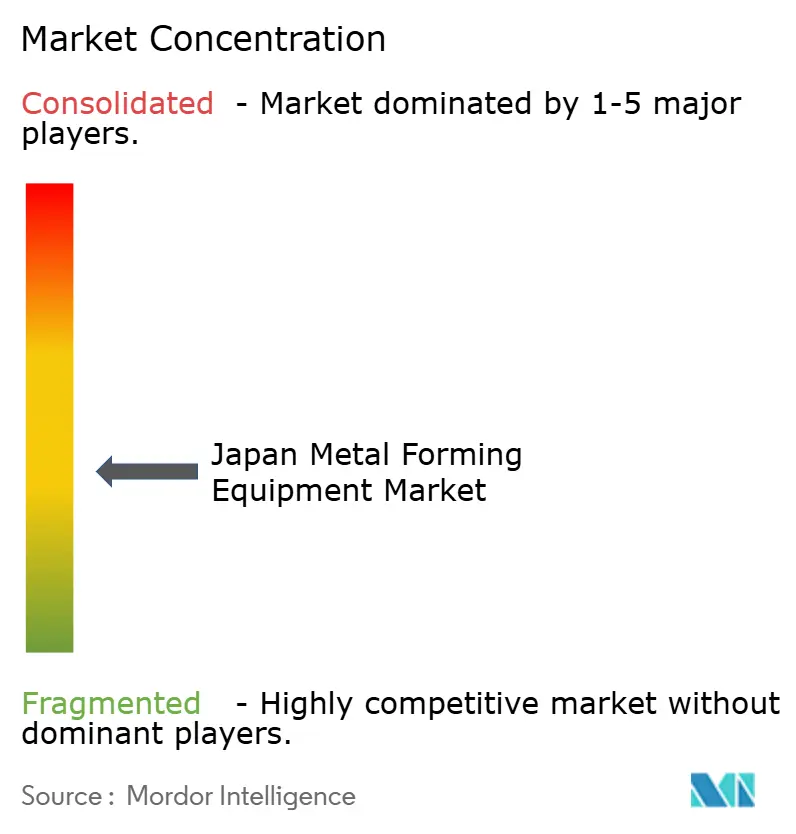
| Market Concentration | Medium |
Major Players *Disclaimer: Major Players sorted in no particular order Image © Mordor Intelligence. Reuse requires attribution under CC BY 4.0. | |
Japan Metal Forming Equipment Market Analysis by Mordor Intelligence
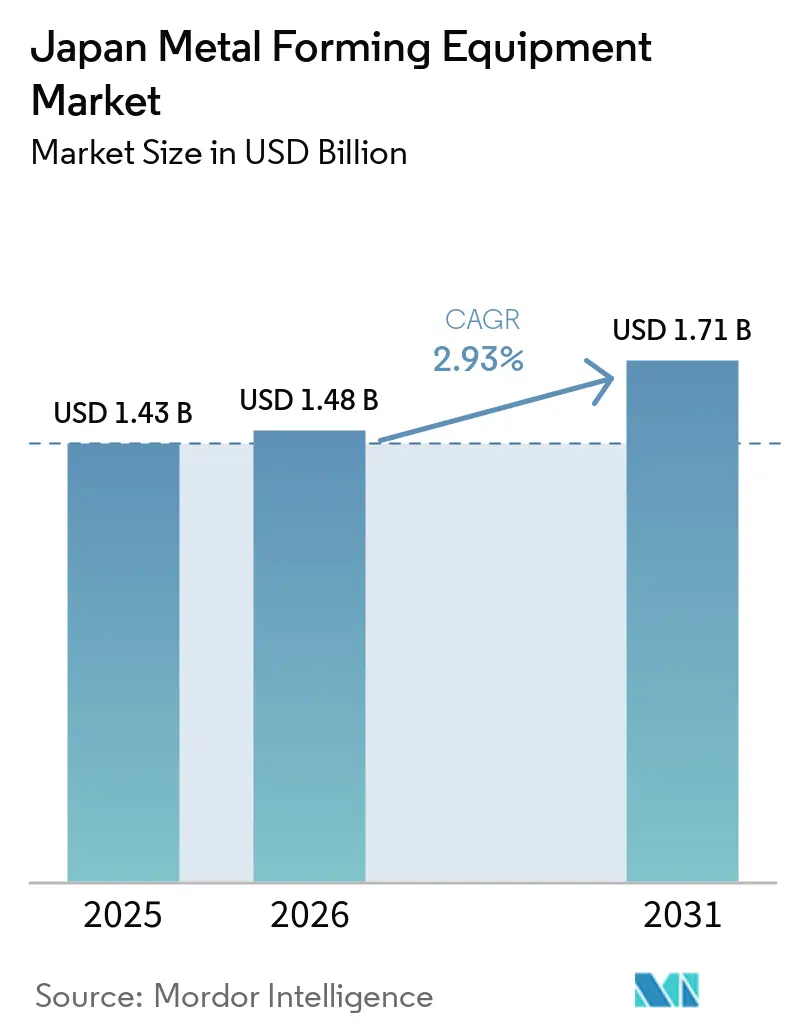
The Japan metal forming equipment market size was valued at USD 1.43 billion in 2025, and is estimated to grow from USD 1.48 billion in 2026 to reach USD 1.71 billion by 2031, at a CAGR of 2.9% during the forecast period (2026-2031).
Replacement investment is supporting demand because manufacturers are renewing aging production assets while managing tighter operating requirements. Electrification is changing the equipment mix as automotive suppliers need more precise forming of aluminum, battery components, and complex structures. Semiconductor and electronics investment is widening demand for high-accuracy equipment beyond traditional automotive production. Energy performance has become a procurement consideration, which favors servo-electric and hybrid platforms that can meet customer sustainability requirements. Export orders also provide support for Japanese producers, although cautious domestic capital spending and trade policy uncertainty can delay large projects.[1]Japan Forming Machinery Association, “FY2025 Annual Orders Survey,” Japan Forming Machinery Association, j-fma.or.jp
Key Report Takeaways
- By equipment type, press machines held 41.5% of Japan metal forming equipment market share in 2025, while servo presses are forecast to expand at a 5.2% CAGR through 2031.
- By forming process, stamping and punching accounted for 30.5% of Japan metal forming equipment market size in 2025, while hydroforming is forecast to expand at a 5.8% CAGR through 2031.
- By material formed, carbon and low-alloy steel accounted for 42% of Japan metal forming equipment market size in 2025, while aluminum and aluminum alloys are forecast to expand at a 4.8% CAGR through 2031.
- By end-use industry, automotive and transportation held 38% of Japan metal forming equipment market share in 2025, while electrical and electronics are forecast to expand at a 5.4% CAGR through 2031.
Note: Market size and forecast figures in this report are generated using Mordor Intelligence’s proprietary estimation framework, updated with the latest available data and insights as of January 2026.
Japan Metal Forming Equipment Market Trends and Insights
Drivers Impact Analysis*
| Driver | (~) % Impact on CAGR Forecast | Geographic Relevance | Impact Timeline |
|---|---|---|---|
| Replacement of Aging Press and Forming Equipment | +1.0% | National, with early gains in Aichi, Kanagawa, and Osaka manufacturing corridors | Short term (≤ 2 years) |
| EV Lightweighting and Battery-Component Forming | +0.8% | National, concentrated in the Chubu and Kansai automotive supply networks | Medium term (2-4 years) |
| Servo-Electric and Hybrid Press Adoption for Energy Productivity | +0.6% | National, with spillover to ASEAN export markets | Short term (≤ 2 years) |
| Semiconductor, Electronics, and Precision-Component Capacity Expansion | +0.5% | National, including Hokkaido, Kumamoto, Kyoto, and Osaka | Medium term (2-4 years) |
| Skilled-Die-Maker Scarcity and Autonomous Process Windows | +0.4% | National, especially Kyoto, Nagoya, and Greater Tokyo | Long term (≥ 4 years) |
| Precision Tooling Exports | +0.3% | Global, including North America and China | Medium term (2-4 years) |
| Source: Mordor Intelligence | |||
Replacement of Japan's Aging Press and Forming Equipment Base
The Japan metal forming equipment market is supported by a large installed base that requires renewal, maintenance, and repair. Renewal, maintenance, and repair represented 30.8% of planned manufacturing capital expenditure among major firms in FY2025, the highest share among investment motives.[2]Development Bank of Japan, “Survey on Planned Capital Spending for Fiscal Year 2025,” Development Bank of Japan, dbj.jp The same purpose accounted for 37.8% of FY2025 planned capital expenditure among small and medium-sized manufacturers, making it the largest purpose category in that survey. These figures point to a backlog of time-expired assets moving into replacement cycles. Older mechanical presses also carry higher maintenance needs and lower productivity than newer servo platforms. METI’s 2025 vision called for the modernization of the machine parts and tooling base as manufacturers move toward higher-value applications.
EV Lightweighting and Battery-Component Forming
The Japan metal forming equipment market is being reshaped by battery electric vehicle production requirements. Honda’s 0 Series production plan uses a 6,000-ton megacasting machine to reduce 60 battery-case parts to 5 parts. This change reduces some multi-stage stamping work while increasing the need for high-precision, high-force production systems. Automotive equipment investment in Japan reached JPY 1.6 trillion in 2024 (USD 10.24 billion), and transport equipment capital expenditure was planned to rise 28.2% in FY2025. UACJ’s work on one-piece 6000-series aluminum door inners for Lexus shows how material choices are changing forming requirements.[3]UACJ Corporation, “Forging the Evolution and Future of Automotive Panel Forming,” UACJ Corporation, uacj.co.jp The shift favors equipment that can manage aluminum deep drawing and controlled motion profiles. It also narrows the role of conventional mechanical presses in selected applications.
Servo-Electric and Hybrid Press Adoption for Energy Productivity
Energy productivity is increasing the appeal of servo-electric and hybrid press platforms in the Japan metal forming equipment market. The JFMA reported 1,596 MF Eco Machine-certified units in 2025, with a 33% penetration ratio across the relevant installed base. The certified base recorded an average energy reduction ratio of 69% and cumulative carbon dioxide reductions of 6,485 tons. The MF Eco Machine 2.0 standard applies to machines manufactured from 2013 onward and requires 40% energy savings against a reference machine. These requirements favor technology refreshes among operating lines that do not meet newer efficiency expectations. Large Tier-1 buyers also use sustainability criteria in supplier assessments, making certification relevant to equipment procurement. This can shorten replacement decisions for suppliers that need to retain preferred status.
Semiconductor, Electronics, and Precision-Component Capacity Expansion
Japan’s semiconductor program is adding a new source of demand for precision forming equipment. METI selected Rapidus as a supported next-generation semiconductor manufacturer in November 2025 and committed JPY 100 billion (USD 640.2 million) from the FY2025 budget. NEDO approved the company’s FY2026 plan and JPY 631.5 billion (USD 4.04 billion) in additional funding in April 2026. The program requires formed housing, flanges, and connector components that must meet close tolerances. This work has longer procurement cycles and different requirements from automotive press work. Japan also faces a shortage of qualified full-time employees, which supports the case for closed-loop process control in high-tolerance production.[4]International Monetary Fund, “The Impact of Aging and AI on Japan’s Labor Market,” International Monetary Fund, elibrary.imf.org
Restraints Impact Analysis*
| Restraint | (~) % Impact on CAGR Forecast | Geographic Relevance | Impact Timeline |
|---|---|---|---|
| High Upfront Cost and Long Payback for Smart Press Lines | -0.5% | National, especially SME fabricators in Osaka, Hiroshima, and Niigata | Short term (≤ 2 years) |
| Cyclical Domestic Automotive Capital Expenditure | -0.4% | National, concentrated in Aichi, Chubu, Kanagawa, and Oppama | Medium term (2-4 years) |
| Retrofit And Data-Integration Friction in Legacy Factories | -0.3% | National, including metalworking SMEs in Kanto and Kansai | Long term (≥ 4 years) |
| Specialized Tooling and Service Expertise in Aging Suppliers | -0.2% | National, especially Kyoto, Niigata, and Nagano | Long term (≥ 4 years) |
| Source: Mordor Intelligence | |||
High Upfront Cost and Long Payback for Smart Press Lines
Domestic automotive investment introduces a cyclical element to the Japan metal forming equipment market. Automotive and transportation held 38% of demand in 2025, which makes changes in OEM capital plans important to equipment suppliers. Major manufacturers planned a 28.2% increase in transport equipment capital expenditure in FY2025. The increase reflected electrification spending and may not represent a lasting annual spending level. Nissan announced in July 2025 that it would transfer and consolidate vehicle production from Oppama to Nissan Motor Kyushu. JFMA data showed domestic transport-equipment orders for forming machinery rose 5.2% in FY2025, while electrical machinery orders fell 18.7%.
Cyclical Domestic Automotive Capital Expenditure
Domestic automotive investment introduces a cyclical element to the Japan metal forming equipment market. Automotive and transportation held 38% of demand in 2025, which makes changes in OEM capital plans important to equipment suppliers. Major manufacturers planned a 28.2% increase in transport equipment capital expenditure in FY2025. The increase reflected electrification spending and may not represent a lasting annual spending level. Nissan announced in July 2025 that it would transfer and consolidate vehicle production from Oppama to Nissan Motor Kyushu. JFMA data showed domestic transport-equipment orders for forming machinery rose 5.2% in FY2025, while electrical machinery orders fell 18.7%. These different cycles can produce uneven order patterns across suppliers and regions.
*Our forecasts treat driver/restraint impacts as directional, not additive. The impact forecasts reflect baseline growth, mix effects, and variable interactions.
Segment Analysis
By Equipment Type: Servo Presses Pull Market Value Up-Tier
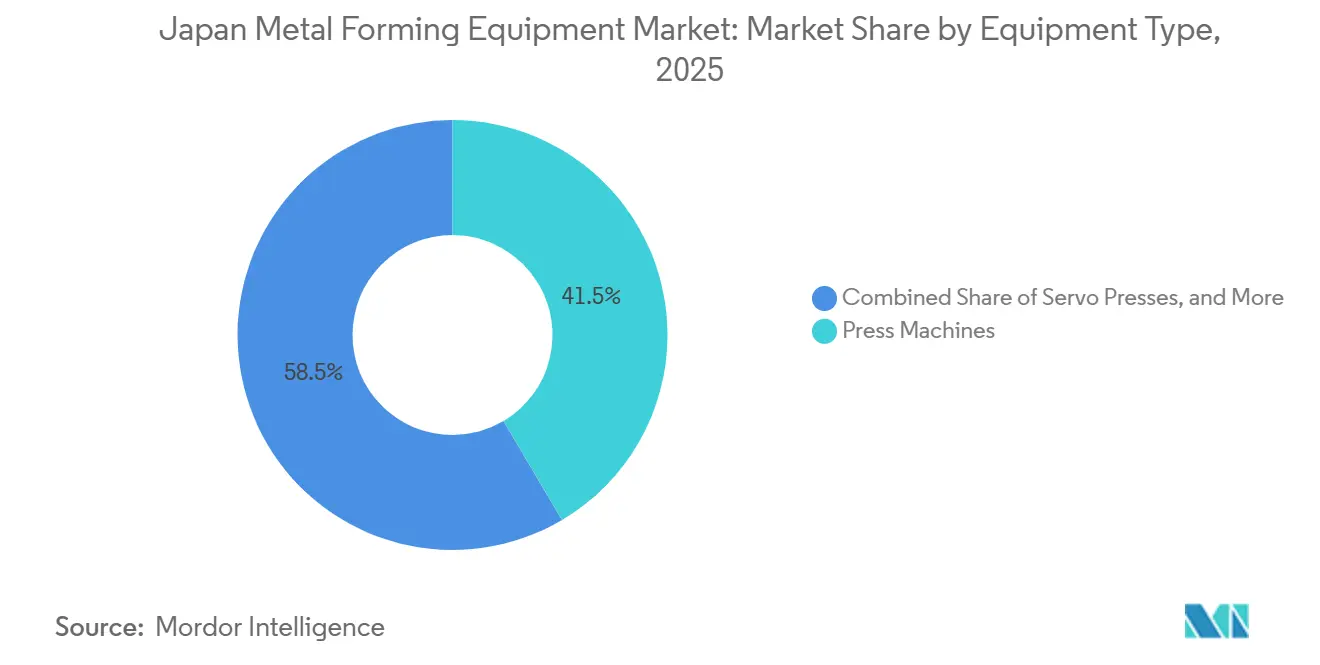
Press machines held 41.5% of the Japan metal forming equipment market share in 2025, making them the largest equipment category. Mechanical and hydraulic presses continue to support established automotive bodies and powertrain operations. Press brakes and bending machines are used across hydraulic, servo-electric, and mechanical configurations. JFMA reported that press brake orders increased 14.6% year over year in FY2025, the strongest result among sheet metal sub-categories.
Servo presses are expected to post the highest 5.2% CAGR through 2031 as users seek programmable motion, die protection, and compatibility with advanced steels and aluminum. Komatsu Industries began taking orders for an upgraded H1F200-2 servo press in June 2026, with faster operation, higher-precision control, and expanded ICT connectivity. The Japan metal forming equipment industry is moving toward product refreshes that retain machine-family value while meeting newer performance expectations. JFMA had 158 certified models across 44 product lines registered as of January 1, 2026, a signal that favors servo and hybrid-electric equipment. Forging, roll forming, wire and tube forming, extrusion, and hydroforming equipment serve automotive, aerospace, and industrial machinery users. Hydroforming and extrusion equipment have a smaller installed base but align with growing aluminum and titanium use.



By Forming Process: Hydroforming Outpaces on BEV and Lightweighting Tailwinds
Stamping and punching accounted for 30.5% of the Japan metal forming equipment market size in 2025, supported by high-volume sheet processing. Deep drawing, bending, forging, rolling, roll forming, and extrusion serve separate production requirements across the manufacturing base. This capability suits battery electric vehicle chassis and battery enclosure designs. The Japan metal forming equipment market retains a broad process base because manufacturers require both high-volume and precision work.
Hydroforming has the highest projected CAGR at 5.8% through 2031 because it forms complex aluminum and steel tubular structures with fewer operations. Gigacasting and megacasting can replace multi-stage stamping for selected body panels. They can also increase demand for hydroforming and deep drawing of structural parts that are not economical to cast. Domestic forming equipment orders from the metal products manufacturing sector rose 8.2% year over year in FY2025. Forging equipment benefits from aerospace fasteners and precision drivetrain components. Extrusion serves aluminum profile requirements in battery trays and heat management systems.
By Material Formed: Aluminum Alloys Accelerate as Steel Holds Ground
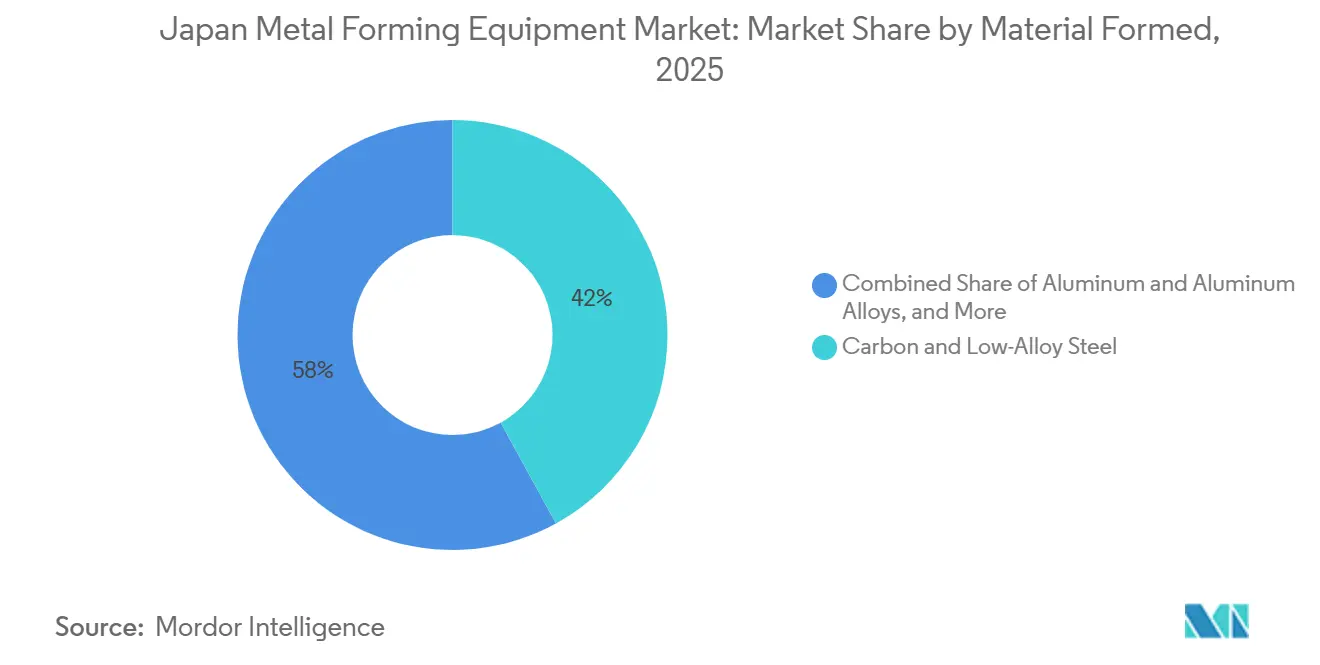
Carbon and low-alloy steel held 42% of the Japan metal forming equipment market share in 2025. Steel remains central to high-volume body panels, structural components, and industrial machinery because of its cost-to-strength characteristics. Stainless steel, copper alloys, titanium, and nickel-based materials support electronics, energy, medical, and aerospace applications. Their growth reflects wider use in battery casings, door panels, and floor structures.
Aluminum and aluminum alloys are forecast to expand at a 4.8% CAGR through 2031. Aluminum requires controlled stroke profiles and blank-holder force during commercial-scale forming. The Japan metal forming equipment industry benefits when this requirement raises demand for higher-value servo press lines. UACJ described one-piece 6000-series aluminum door inners for Lexus that replaced multiple 5000-series stampings. Titanium, nickel, and other non-ferrous materials also serve medical and precision manufacturing applications. Multi-material designs create demand for flexible platforms that can run different materials without extensive retooling.
By End-Use Industry: Electrical and Electronics Gains Share on Semiconductor Capacity Wave
Automotive and transportation commanded 38% of the Japan metal forming equipment market size in 2025. Industrial machinery, metal fabrication, electrical and electronics, aerospace and defense, and other sectors make up the remaining demand base. Demand comes from manufacturing semiconductors, precision connectors, leadframes, industrial automation, and power electronics. This gives the Japan metal forming equipment market a growth path that is not solely tied to vehicle production.
Electrical and electronics are forecast to expand at a 5.4% CAGR through 2031, the highest rate among end-use sectors. Rapidus received JPY 100 billion (USD 640.2 million) in FY2025 budget support and JPY 631.5 billion (USD 4.04 billion) in FY2026 plan funding. These commitments support multi-year procurement activity in semiconductor supply chains. Aerospace and defense demand is linked to titanium airframe components and precision forged structures. Medical manufacturing offers a stable demand for implantable and surgical-grade metal components. JFMA recorded a 36.2% increase in domestic forming equipment orders from steel and non-ferrous metals in FY2025.
Geography Analysis
The Chubu region is the largest demand cluster in the Japan metal forming equipment market because Aichi Prefecture is home to Toyota, Aisin, Denso, and their supply networks. Capital expenditure decisions by large OEMs and Tier-1 suppliers can therefore affect national equipment orders within a fiscal quarter. The national manufacturing total was planned to rise 21.4% in FY2025. Chubu’s automotive weight means that a slowdown in vehicle investment has an outsized effect on national demand.
Kansai is the second major cluster and includes Osaka, Kyoto, and Hyogo. The region has strength in precision sheet metal work for electronics, instruments, and industrial machinery. The Japan metal forming equipment market size in Kansai is supported by fabricators that serve the electronics and medical device supply chains. Domestic forming equipment orders from metal products manufacturers increased 8.2% year over year in FY2025.
Kanto, centered on Greater Tokyo and Kanagawa, has major equipment OEMs and a large base of tool-and-die SMEs. Nissan’s July 2025 decision to move Oppama production to Nissan Motor Kyushu shifts future automotive equipment investment toward Fukuoka. Kanto demand is therefore exposed to changes in the local automotive production footprint. Hokkaido is becoming a smaller precision-forming cluster through Rapidus’s Chitose semiconductor project. Rapidus is targeting full-scale 2nm production in fiscal year 2027. The project is expected to create equipment demand for semiconductor manufacturing tools as the facility scales.
Competitive Landscape
The Japan metal forming equipment market is moderately consolidated among domestic OEMs led by AMADA, AIDA ENGINEERING, and Komatsu Industries. These companies cover press brakes, punching systems, servo presses, and transfer presses through established aftermarket networks. ANDRITZ’s Schuler division, Bystronic, TRUMPF, and Fagor Arrasate compete in selected areas, including heavy stamping lines and laser-integrated sheet metal systems. Specialized firms such as Yamada Dobby, Toyokoki, Nidec Minster, and Kojima Iron Works address precision press, fastening, and fine-blanking niches. The Japan metal forming equipment market remains shaped by specialization rather than broad price competition.
AMADA launched a full-scale machinery resource recovery and restoration initiative in June 2026. The program established a closed-loop recycling partnership with an electric furnace steelmaker and supports its shift toward circular, data-driven business models. AIDA introduced the SAT-M High-Speed Transfer Robot and ARB High-Speed Articulated Robot in 2026. The systems reach a line takt time of 30 min⁻¹ for direct press-to-press conveyance. This expands AIDA’s role into automation equipment that had often been supplied by third-party integrators.
AIDA and AMADA received JFMA MF Technology Grand Prize recognition for 2024-2025 process innovations. AIDA was recognized for sheet-forged joint technology, while AMADA was recognized for dual-acting machining with a 4-axis hybrid press. The Japan metal forming equipment market has room for flexible SME automation, energy-efficient retrofits for older mechanical presses, and service support for imported systems outside major industrial cities. Competition is distributed across broadline OEMs and specialized suppliers.
Japan Metal Forming Equipment Industry Leaders
AMADA Co., Ltd.
AIDA ENGINEERING, LTD.
Komatsu Ltd.
Sumitomo Heavy Industries, Ltd.
ANDRITZ Schuler Group
- *Disclaimer: Major Players sorted in no particular order

Recent Industry Developments
- June 2026: AMADA CO., LTD. launched a full-scale sheet metal machinery resource recovery and restoration initiative, establishing Japan's first metal processing machinery circular recycling loop with a resource recycling partner and an electric furnace steelmaker, targeting approximately 1,000 units of machinery procurement in its first year under the AMADA Mid-term Management Plan 2030.
- June 2026: Komatsu Industries began accepting orders for the upgraded H1F200-2 servo press under the H1F-2 Series, featuring higher press speed, advanced precision control, and expanded ICT connectivity.
- May 2026: AIDA ENGINEERING announced commercial availability of the SAT-M High-Speed Transfer Robot and ARB High-Speed Articulated Robot, achieving a 30 min⁻¹ line takt time for direct press-to-press conveyance at a 1,800 mm transfer pitch.
- April 2026: NEDO approved Rapidus Corporation's FY2026 plan and budget for 2nm semiconductor integration technology projects, with total committed government support reaching JPY 2.4 trillion (USD 15.36 billion).


Japan Metal Forming Equipment Market Report Scope
| Press Machines | Mechanical Presses |
| Hydraulic Presses | |
| Servo Presses | |
| Other General-Purpose Presses | |
| Press Brakes and Bending Machines | Hydraulic Press Brakes |
| Servo / Electric Press Brakes | |
| Mechanical Press Brakes | |
| Other Bending Machines | |
| Forging Equipment | Forging Presses |
| Forging Hammers | |
| Upsetting and Heading Machines | |
| Other Forging Equipment | |
| Roll Forming and Plate/Profile Rolling Equipment | Roll Forming Machines |
| Plate Rolling Machines | |
| Section and Profile Rolling Machines | |
| Other Secondary Rolling/Forming Equipment | |
| Wire, Tube and Profile Forming Equipment | Wire and Bar Drawing/Forming Equipment |
| Tube Forming and Bending Equipment | |
| Profile Forming Equipment | |
| Extrusion Presses | |
| Hydroforming Equipment | |
| Other Metal Forming Equipment |
| Stamping and Punching |
| Deep Drawing |
| Bending |
| Forging |
| Rolling and Roll Forming |
| Extrusion |
| Hydroforming |
| Other Forming Processes |
| Carbon and Low-Alloy Steel |
| Stainless Steel |
| Aluminum and Aluminum Alloys |
| Copper and Copper Alloys |
| Titanium, Nickel and Other Non-Ferrous Metals |
| Other Materials |
| Automotive and Transportation |
| Aerospace and Defense |
| Industrial Machinery and Capital Equipment |
| Metal Products and Fabrication |
| Electrical and Electronics |
| Construction and Infrastructure |
| Energy and Power |
| Consumer Appliances and Durable Goods |
| Medical and Precision Manufacturing |
| Other End-Use Industries |
| By Equipment Type | Press Machines | Mechanical Presses |
| Hydraulic Presses | ||
| Servo Presses | ||
| Other General-Purpose Presses | ||
| Press Brakes and Bending Machines | Hydraulic Press Brakes | |
| Servo / Electric Press Brakes | ||
| Mechanical Press Brakes | ||
| Other Bending Machines | ||
| Forging Equipment | Forging Presses | |
| Forging Hammers | ||
| Upsetting and Heading Machines | ||
| Other Forging Equipment | ||
| Roll Forming and Plate/Profile Rolling Equipment | Roll Forming Machines | |
| Plate Rolling Machines | ||
| Section and Profile Rolling Machines | ||
| Other Secondary Rolling/Forming Equipment | ||
| Wire, Tube and Profile Forming Equipment | Wire and Bar Drawing/Forming Equipment | |
| Tube Forming and Bending Equipment | ||
| Profile Forming Equipment | ||
| Extrusion Presses | ||
| Hydroforming Equipment | ||
| Other Metal Forming Equipment | ||
| By Forming Process | Stamping and Punching | |
| Deep Drawing | ||
| Bending | ||
| Forging | ||
| Rolling and Roll Forming | ||
| Extrusion | ||
| Hydroforming | ||
| Other Forming Processes | ||
| By Material Formed | Carbon and Low-Alloy Steel | |
| Stainless Steel | ||
| Aluminum and Aluminum Alloys | ||
| Copper and Copper Alloys | ||
| Titanium, Nickel and Other Non-Ferrous Metals | ||
| Other Materials | ||
| By End-Use Industry | Automotive and Transportation | |
| Aerospace and Defense | ||
| Industrial Machinery and Capital Equipment | ||
| Metal Products and Fabrication | ||
| Electrical and Electronics | ||
| Construction and Infrastructure | ||
| Energy and Power | ||
| Consumer Appliances and Durable Goods | ||
| Medical and Precision Manufacturing | ||
| Other End-Use Industries | ||


Key Questions Answered in the Report
What is the Japan metal forming equipment market size?
The Japan metal forming equipment market is estimated at USD 1.48 billion in 2026 and is forecast to reach USD 1.71 billion by 2031.
What is driving demand for metal forming equipment in Japan?
Equipment replacement, vehicle electrification, energy-efficient servo systems, and semiconductor capacity investment are supporting demand.
Which equipment category leads demand in Japan?
Press machines led with a 41.5% share in 2025, while servo presses have the fastest projected growth at a 5.2% CAGR through 2031.
Which forming process is growing fastest in Japan?
Hydroforming is expected to grow at a 5.8% CAGR through 2031 because it supports complex lightweight vehicle structures.
Which end-use sector has the strongest outlook?
Electrical and electronics are expected to grow at a 5.4% CAGR through 2031, supported by semiconductor and precision-component demand.
Who are the leading suppliers of forming equipment in Japan?
AMADA, AIDA ENGINEERING, and Komatsu Industries are major domestic suppliers, alongside specialized and international competitors.
Page last updated on:





